All You Ever Do Is Put Me Down

Tuesday morning and I didn’t spring out of bed joyously this morning, but I feel pretty okay this morning. I slept well, just wanted to sleep longer. It rained heavily last night, which was nice–you know I love me some rain when I am safely inside and warm and comfortable. The rain was supposed to bring cold weather with it, but it’s only 51 this morning, which isn’t that terrible. My whole attitude towards cold weather is changing, isn’t it? I didn’t mind the cold in Kentucky–it was bitterly cold on Thanksgiving; my windshield froze over while I was at my sister’s–so what on earth is happening to me? #madness, indeed. Granted, it wasn’t at zero or even close to it; that, methinks, would be an entirely different story.

I did find my copy of The Postman Always Rings Twice last night, and that opening line–“They threw me off the hay truck about noon”–is such a great opening. I think the other noirs I am going to read this month will include The Falling Sparrow by Dorothy B. Hughes1, another Jim Thompson novel (I have several on-hand), a Silvia Moreno-Garcia modern neo-noir, and maybe some short stories, and/or a Cornell Woolrich novel. The well (or TBR pile, you choose) is very deep in the Lost Apartment. I also have to write my reviews of O Jerusalem and Fever Beach for the newsletter, too. Sigh. So much to write, so little time in which to do it all, y’know? But that just means I need to go back to my OCD organization and to-do lists so I can get things done.

I also managed to go over the edits and copy edits of Hurricane Season Hustle, so it is finished for me other than the page proofs. I also got a short story I sent to an anthology a few months ago back with its edits, which is also kind of cool. I always love to sell a short story, you know? I am more confident with my novels than I ever can be with my short stories, and I was thinking last night as I sat in my chair watching The Real Housewives of Salt Lake City that I may try something different when it comes to writing short stories, but I’ll inevitably always fall back on my usual way of doing things. I think we’re going to be busy in the clinic this morning, which will keep me hopping all day. I have to stop again at the store to make some groceries on my way home tonight, and the kitchen is a mess, and I have another load of dishes to unload so I can wash the ones in the sink and run the dishwasher again and the household chores never end, do they? I have measured my life by washing dishes, or something like that.

I was able to leave work early yesterday (Friday was a paid holiday for eight hours; I usually put in about four on a normal work-at-home Friday, so had to shave some time off yesterday. No, I never over-explain, do I?), and so ran by the Fresh Market on the way home and also ordered groceries for delivery. I got home and finished the laundry, put the dishes away and ran another load through the dishwasher. I got caught up on the news and have reached the point where I just shake my head in bewilderment, sadness, and disgust. Heavy heaving sigh. Is there now a light at the the end of the tunnel of horrors? One can only hope, but this dismantling of our institutions and eroding of trust in them has been –and continues to be–nothing more than a disgrace.

Our new LSU football coach, Lane Kiffin, arrived in Baton Rouge yesterday to a cheering crowd at the airport and people lined up along the drive from there to the campus. Controversy about the move continues to swirl, driven by the so-called “talking heads” who know absolutely nothing but somehow think they’re relevant? Dad and I talked about how useless and stupid so many of them are nowadays–“professional bull-shitters,” is what Dad calls them, and accurately–but they have to talk and weave and bullshit in order to earn their ridiculous salaries. I don’t care what you think about this, just as I don’t really care about anything you think, really. And all the unctuous moralizing by trash like Stephen A. Smith and Colin Cowshit and all the rest of the idiots? Spare me. All you are doing is enhancing the victim complex LSU fans and Louisiana residents already have, and they’ll just circle the wagons and it just endears Kiffin to the fans and residents here all the more. It also doesn’t hurt that he’s buddies with Coach O, either. They are billboards and signs all over the state welcoming him.

I do not remember any of that happening for Brian Kelly, mind you.

So, we’ll see how this new era of LSU football will work out for us. Everyone here is excited, as I said, and I am optimistically hopeful but cautious.

And on that note, I am heading into the spice mines for this fine Tuesday morning. Have a lovely day, Constant Reader, and I’ll be back on Pay-the-Bills Wednesday tomorrow morning.

  1. Also a book with a fantastic first line. ↩︎

Long Long Time

Thursday and my last day in the office before the weekend. I slept really well last night–I even forgot to set the alarm but woke up on time on my own, without an assist from Sparky. My legs feel a bit fatigued, but that’s not a big deal. I was also very productive last night when I got home from work. I did the dishes and finished the laundry, and then made mac ‘n’ cheese for our potluck today at work. (I now have more dishes to do, but that’s okay.) Paul has a gala event for the TWF to attend tonight, so he’ll be home late, probably after I fall asleep. I watched The Real Housewives of Salt Lake City, by far and away my favorite of these marvelously trashy shows, and went to bed relatively early. Tonight when I get home (after an errand) I will unload the dishwasher and reload it, and try to get the kitchen straightened up as much as I can so I don’t have to do it over the weekend. I also need to make a list for the trip–things to take, and things to get done before I leave–and after I do all that tonight, I’ll probably read for a bit.

Being oblivious, it never dawned on me that this month is Noirvember (despite seeing lots of posts about it, and even commenting on some…my grasp of the obvious is slippery at best) which would have made it perfect for another reading project. Sigh. I should have spent this month reading (and watching) noir! Especially since I am getting ready to really immerse myself in writing one. Making I can make the project Noir for the Holidays, and move it back to December? Heavy heaving sigh. I have a ton of noirs in my ebook library–there was a big sale on the marvelous Dorothy B. Hughes recently and I snapped up quite few of them, and two–Ride the Pink Horse and The Fallen Sparrow– look especially interesting, as do some of the Jim Thompsons I’ve also gotten on sale. I also want to revisit some of James M. Cain’s classics, and maybe even some I’ve not read. I also would like to rewatch In a Lonely Place and The Strange Love of Martha Ivers…so much awesome noir out there!!

I’ve also been revisiting Fleetwood Mac lately, mostly inspired by Buckingham Nicks finally being released on DVD and to streaming services. It’s a great album, yes, but as I listened and enjoyed it, I kept thinking it was missing something. Yesterday on my way to work I played Rumours in the car (and on the way home; today I am listening to Mirage) and it hit me: that is what’s missing from Buckingham Nicks–the keyboards and harmonies of Christine McVie, and that incomparable rhythm section of Mick and John. Some of these songs got repurposed later as Fleetwood Mac recordings, but really–they should have just rerecorded it as a Fleetwood Mac record. The interesting thing about their music collectively is it holds up still, all these years later, and most of the albums are masterpieces.

Oh, if you’re interested in trying my mac ‘n’;’ cheese, the recipe is here, if you’d like to give it a try. HIGHLY RECOMMEND. It is a LOT of cheese, and if you’re dieting, don’t bother, as it also calls for heavy cream, half-and-half, and sour cream on top of about 32 ounces of cheese.

And ICE is here, staying at the Riverside Hilton and apparently using the Riverwalk parking as a staging area for evil. I bet those ICE agents were also really excited about being reassigned to New Orleans…mwah ha ha ha ha. New Orleans is a city known for its, well, everything, but its hospitality is always top notch, unless you aren’t wanted here. Sure, Louisiana is a red state (look at the pitiful fools we sent to Washington and our state government of fools–a true confederacy of dunces), but New Orleans gave 83% of its vote to Harris/Walz. The orangutan never even drew twenty percent of the vote here once in three tries, and immigrants rebuilt this city after Katrina. This isn’t going to go the way ICE thinks it will…and there’s so much interference on a basic level here. It’s not like our streets make sense to begin with, and they are riddled with deceptively deep potholes. We have second-lines all the time, and it’s also marching band practice season with Carnival just around the corner. High speed chases here end in fatalities all the time because the streets make no sense, are often insanely narrow, and change one-way directions all over the city. Compass directions make no sense here; the sun rises over the West Bank every morning and you drive east to get to the north shore. I hope we have several flooding rains here during their stay.

And on that note, I am going to head into the spice mines. Have a great Thursday, everyone, and I’ll check in with you again tomorrow morning.

I Know a Place

Saturday morning in the Lost Apartment and all is well. I slept incredibly last night. I woke up at seven and stayed in bed relaxing in a half-sleep for another hour or so, and finally got up when Sparky woke up and decided he was hungry. He was delayed this morning–and was very calm and cuddly and sleepy yesterday–because of the vaccines he got yesterday, as well as the shock to his system of leaving the apartment. He likes his carrier–he’ll go in there on his own, and Paul often tells him to go get in the crate when he’s having Big Kitten Energy, which he does–but he finally started meowing yesterday when we took him outside in the crate. He’s never meowed before, only chirped, which worried me a bit…but now he’s done it so I guess he only meows when he’s unhappy. His nails were trimmed (which he also didn’t like this time), but we brought him home to be a sleepy, cuddly sweet kitty for the rest of the night. We also went to Costco yesterday, which was nice and a little tiring. We watched Skate America last night (ladies and pairs short programs) and of course, today is a football all day kind of day. LSU plays at Arkansas tonight, and of course Alabama-Tennessee is this afternoon’s game. I am going to take books to the library sale this morning and go to the grocery store today before I come home to watch games for the rest of the day. There’s also some cleaning I can do around here this morning, too. Yippee!

I’m also going to read some more of Gabino’s book this morning; I read some while Sparky and Paul were with the vet yesterday and I just love the way he writes, in this interesting combination of Jim Thompson crossed with some John D. MacDonald but heavily flavored and filtered through his own remarkable talent in a unique voice that is entirely his own. It’s very rare to come across a writer with a voice and style so strikingly original, and the pacing is ethereal but also fast at the same time. I loved his last book, and I am absolutely loving this own. Next weekend I’ll be heading up to Kentucky to see Dad for about a week, so I can listen to another horror novel in the car (maybe Shadowland by Peter Straub, which I’ve not read before. I can take the paperback with me if the audio book is too long for a twelve hour drive; I actually just went to Audible and got Nick Cutter’s The Troop, and saw that I had a Riley Sager already downloaded, so that’s the trip up and back sorted. I also got the Straub), and I can take some horror with me to read. I’ll make shrimp tempura for dinner tonight, and am kind of torn about making chili or not tomorrow, but will probably go ahead and do so; I may even make it over night so tomorrow morning I can just get up and put it in the refrigerator. That’ll sort my lunches for the week, methinks.

I also managed to get the majority of the dishes done yesterday, no small feat I might add. That’ll teach me to be lazy when I get home from work every day, won’t it? It seemed endless, and I was also doing the bed linens at the same time as well as unpacking Costco and putting everything away; the living room is, even now, filled with empty boxes that need to go out this morning. I need to revise that short story and start working on another one for the Bouchercon anthology open call; I picked out the story just have to finish it now, which is also no easy chore. But today is an official day off from everything other than relaxation, reading and some cleaning around the house. I’ll try to reread the story I’ve selected; I just need to remember to channel my rage at developments in the neighborhood and on my street–this is one of the reasons I love being a writer, petty revenge on people who’ll never even know they inspired me to kill them in fiction–and retrieve that voice from deep inside my head. I think one of the problems I’ve had with some of the stories I’ve been writing lately is I’ve been too lazy to write about people the way they really are, instead of an idealized character who is logical and rational and then simply snaps. It’s that breakdown of going from law-abiding to murderous that I live to explore–it worked really well in “Neighborhood Alert”–but in some of the noirish stories I’ve been trying to write and sell since the pandemic they come across as too cheerful; bitterness and rage is what drives my stories, and the tone and voice need to reflect that.

Tone and voice are key to whether your story works or not.

And on that note, I am heading into the spice mines. Have a lovely day, Constant Reader, and I’ll check in with you again later. GEAUX TIGERS!

Screenshot

Let’s Kill Tonight

I had never read Jim Thompson before this past week.

I knew of him, of course; it’s very difficult to be a crime writer/reader and not to have. He probably isn’t as revered as authors like James M. Cain or Patricia Highsmith, but he also wrote dark stories about outsiders from society living on the fringes who tend to do whatever they need to in order to go on surviving, and that’s the kind of fiction I’ve always enjoyed reading for the most part. I kind of avoided him because…well, because straight white male writers of his era tend to be misogynistic, racist, and homophobic; those things tend to make me recoil as well as take me out of the story. I bought my copy of The Killer Inside Me a number of years ago, primarily out of curiosity and feeling like I should at least give him a go, and for some reason it jumped out of me when I was selecting books to take on the trip this past week…although thinking about it more, I think I bought it (and took it on this trip) because I was thinking about Chlorine, and wanted to read some noir. This was the one everyone seemed to think I should read, and so…into my backpack it went. I read it at night in the motel in Alabama last weekend, and it did not disappoint.

I’d finished my pie and was having a second cup of coffee when I saw him. The midnight freight had come in a few minutes before; and he was peering in one end of the restaurant window, the end nearest the depot, shading his eyes with his hand and blinking against the light. He saw me watching him, and his face faded back into the shadows. But I knew he was still there. I knew he was waiting. The bums always size me up for an easy mark.

I lit a cigar and slid off my stool. The waitress, a new girl from Dallas, watched as I buttoned my coat. “Why, you don’t even carry a gun!” she said, as though she was giving me a piece of news.

“No,” I smiled. “No gun, no blackjack, nothing like that. Why should I?”

“But you’re a cop–a deputy sheriff, I mean. What if some crook should try to shoot you?”

“We don’t have many crooks here in Central City, ma’am,” I said. “Anyway, people are people, even when they’re a little misguided. You don’t hurt them, they won’t hurt you. They’ll listen to reason.”

As simply written as this book is in terms of language–you’re not going to find complicated sentences in Thompson’s work–it’s actually a very smart and clever novel that kind of sneaks up on you, and also pulls the trick Patricia Highsmith/Daphne du Maurier were so good at: making you root for a horrible person to get away with committing crimes. Thompson has captured Lou Ford’s point-of-view and voice so brilliantly that you can’t help admiring him as he goes on his spree of torture, illegality and murder, fooling almost everyone in “Central City” (I loved the comic-book simplicity of the city name) into thinking he’s not only a good guy, but a decent one and a friend to everyone who is just going around doing his job. He also is very quick on his feet, often confounding people asking him questions about the strange crimes on his periphery by the intelligence and honest-to-God-seeming confusion by the questions in the first place. It’s a great act, and he pulls it off time and again over the course of the book, and Thompson/Lou do such a great job with said act that you start to root for him to get away with things. All the interior happenings and crimes also tend to distract the reader from what is actually going on in the book–which is that all of Lou’s crimes circle a local businessman/power broker whom he blames for murdering his half-brother…who took the blame for a crime involving a little girl when they were young that Lou committed. Lou also is a very unreliable narrator, who doesn’t give us anything beyond his own point of view and train of thought, which disguises from the reader brilliantly his own pathology.

I can imagine this book alarmed and disturbed people with its stark and realistic view of what can go wrong when a sociopath is given a gun and a badge, and how an exceptionally smart killer, which Lou is, can use the system to cover up his own crimes and pin blame on others. And it does seem, all the through the book, like Lou is going to be able to explain it all away and get away with all of his crimes…

I really enjoyed this book, and it made me realize I’ve been a little unfair to the straight white male writers of the past by avoiding their work. I’m definitely going to read more Thompson; this was exceptional and I do recommend you read it.

Carousel

As Constant Reader should know by now, while my entire identity and ego is wrapped up (probably too much) in being a writer, the truth is I have always been, currently am, and will always be, a reader first. I love to read, always have since I first learning what the little squiggles on the pages actually meant and learned how to decipher the little squiggles first into words, then into sentences, paragraphs and eventually entire stories. Reading was always my escape from a world too harsh for a little creative gay boy surrounded by people who didn’t read much nor cared much about books and so forth; sometimes the fantasy worlds I created in my head–always influenced by my reading–were safer and better places that I preferred to what, to me, was the horror of reality. I also learned a lot from my reading. I learned about other countries and cultures and groups; history and geography and other little odds and ends of information that remain lodged in my head and make me good at both Jeopardy! and Trivial Pursuit (case in point: I learned from Nancy Drew’s 44th adventure The Clue in the Crossword Cipher that the Incas’ language was quechua; I’ve never forgotten that, or that the Nasca Lines play a part in the book, and she and her friends also went to Machu Picchu).

Over the last few years I realized that my reading was primarily white and straight and decided to correct that; since then I have discovered the eye-opening marvel that is the talent of non-white authors and their remarkable story-telling ability. S. A. Cosby, Kellye Garrett, Silvia Moreno-Garcia, Mia P. Manansala, Alex Segura Jr, Raquel V. Reyes and many others have opened my eyes to other American experiences, and reading their work has also given me a broader and deeper understanding and appreciation of a different kind of American experience.

And then I read Gabino Iglesias’ 2022 release, The Devil Takes You Home.

Leukemia. That’s what the doctor said. She was young, white, and pretty. Her brown hair hung like a curtain over her left eye. She talked to us softly, using the tone most people use to explain things to a child, especially when they think the child is an idiot. Her mouth opened just enough to let the words flow out. She said our four-year-old daughter had cancer in her blood cells. Our Anita, who waited in the other room, playing with Legos and still wrapped in innocence. Acute lymphoblastic leukemia. Those strange words were said in a voice that was both impossibly sharp and velvety. Her soft delivery didn’t help. You can wrap a shotgun in flowers, but that doesn’t make the blast less lethal.

The young, white, pretty doctor told us it was too early to tell for sure, but there was a good chance that Anita was going to be okay. Okay, that’s the word she used. Sometimes four letters mean the world. She immediately added that she couldn’t make any promises. People fear being someone else’s hope. I understood her, but I wanted her to be our hope.

Jesus.

The opening of the book rips your heart out and rends your soul.

I am not a parent, never have been, never wanted to be, and never will be. I admire and respect parents (for the most part) because when I try to imagine what it’s like to be one, I can’t–it literally wears my brain down. I am a chronic worrier as it is; I get nervous when Paul doesn’t come home from work when he’s supposed to, or dawdles and delays and doesn’t text me. But for the most part, I know he’s an adult and functional and I believe he can, for the most part, navigate the world safely so I don’t spend a lot of time worrying about him.

I don’t think parents ever have a moment’s rest from the time the child is born until the child or the parents die–and I can imagine no greater grief than losing a beloved child.

Losing their child is how this book opens. And you just know in your heart of hearts–things aren’t going to get better any time soon for the father narrating this story. It isn’t a spoiler to let you know, Constant Reader, that by Chapter Three Anita is dead and her parents are swimming in debt and grief and drowning in it all. Before long, the marriage is over and Mario is alone with his grief and his debt and misery.

I don’t think I’ve ever read such a literate and powerful description of rock bottom in my life.

Mario turns back to crime in an attempt to make things right with the world and to somehow fill his horrible emptiness with something, anything. He starts off as a hitman, killing bad people and making money to pay down his debt and maybe, just maybe, somehow get his wife back and they can start over. Mario is desperate–and aren’t desperate characters the essense of noir at its purest distillation? He is then recruited to help liberate some cash from a cartel on its way to Mexico. Success means a cool two hundred grand and the potential to start over. Failure means a bullet in the head.

Both are better options than the life Mario is living at the time.

The pacing is breakneck and the story itself is a trainwreck you can’t look away from; you can’t help rooting for Mario, flaws and all, because the suffering is so intense you want him to find, somehow, both redemption and peace. (The book also serves as a stinging indictment of poverty in this country, and the near-impossibility of bettering yourself while drowning in the debt incurred for the possibility of bettering yourself, as well as our fraudulent health care system. Parents shouldn’t be saddled with insurmountable debt for trying to keep their child alive and especially not when the child passes.)

There are also some fascinating elements of the paranormal/supernatural mixed into the story, too–but while this might throw a typical noir off-track, it works here to heighten the sense of madness and unreality the entire book invokes. The true horror of the book is the system, designed to keep people of color down and to keep the cycle of poverty going.

Here are just a few of the gems in the prose:

The middle of nowhere is remarkably consistent in terms of being unmemorable.

The décor was a mix of a failed attempt at hill-country chic circa 1970 and neon signs for the kinds of beers folks buy at gas station convenience stores on their way to somewhere they wish they could escape.

The Devil Takes You Home is raw, fresh and original, with the kind of crisp smart literate writing that speaks of Lisa Lutz, Megan Abbott, and Jim Thompson.

I marked any number of pages for these writing gems that both awed and inspired me (to do better with my own work).

I highly recommend the book–but be warned: there is violence and gore aplenty, but it all works because it’s not there for shock value.

Ecstasy

It’s gray again this morning in New Orleans, and I have about six boxes of books to take to the library sale today. I also have five or six boxes of condom packs that will have to go back to the office on Monday; which, I suppose, is the easiest way to say that my living room currently looks incredibly cluttered and desperately in need of organizing and cleaning and so forth. I also have a lot of errands to do–the mail, groceries, etc. and need together to the gym today as well. I would also like to get some writing done today–at least a revision of a short story or something–so tomorrow I can primarily focus on the edits of Bury Me in Shadows….and maybe do a bit on Chlorine as well.

I was ridiculously productive yesterday–as mentioned before, I really did a great job of paring down the books last night while laundering the bed linens; Paul was out having dinner with a roommate for college (who was indirectly responsible for our meeting, actually) and so while I watched Smithsonian documentaries on World War II (The Battle of Midway, The Battle of Okinawa, The Fall of Japan, Normandy: 85 Days After D-Day) Started going through the boxes of books I have cleverly concealed beneath blankets so they sort of look like tables, in way, with more books and decor on top of them (we have far too much bric-a-brac in this house, seriously), and when Paul got home we watched the second part of the Aaron Hernandez documentary. (I think perhaps the saddest thing–other than the victims, of course–was how exploited he was for his ability; he was clearly trouble at the University of Florida, so they covered for him for three years and once they’d gotten their use out of him, told him he wasn’t welcome back on the team for his senior year and to enter the draft early; as soon as he was arrested and charged the Patriots–and their fans–turned their backs on him immediately as did their fans…which tells me everything I needed to know about how his coaching staff and teammates felt about him–that was an almost lightning like 180, and considering how many other players have committed crimes and not been abandoned….and while murder is pretty extreme, of course, they clearly knew there were issues there and yet no one did anything.)

I also watched two movies yesterday while making condom packs, and both were kind of terrible. The first, The Getaway, starring Steve McQueen and Ali McGraw, was so unbelievably bad I came very close to turning it off numerous times, but figured you finished Carnal Knowledge, you can finish this. Directed by Sam Peckinpah, known for his violent and bloody films, and based on the novel by Jim Thompson (whom I’ve never read, and I need to correct that at some point), it basically is a dark story about a criminal whose wife gets him paroled by appealing to a corrupt businessman (with her body), so that they can commit a bank robbery and share the money with the businessman. Of course, there are all kinds of double crosses, and the bad guys are after them, as are the cops as well as one of their other accomplices they assumed was dead; there’s a weird subplot with him taking a veterinarian and his wife along with him on the chase for no reason (other than he’s banging the wife); interestingly enough, the vet is played by Howard fro The Andy Griffith Show and the wife/girlfriend (never clear) by Sally Struthers. It’s a mess, really; its only saving grace the chemistry between McQueen and MacGraw (who became involved) and that they are both ridiculously good looking; neither can act their way out of a paper bag (if they can. there’s no evidence of it here), and the score is also terrible and jarring. I know it was remade in the 90’s, I think; but as a noir film, or Neo-noir, it fails. I didn’t care about any of the characters and breathed a sigh of relief when the credits rolled. It’s a definite Cynical 70’s Film Festival entry; that was the time of the anti-hero and anti-establishment thinking…but I couldn’t help but think how much better the film would have been had it starred, say, Paul Newman and Ellen Burstyn, or Clint Eastwood and Natalie Wood, or even Robert Redford and Jane Fonda.

In fairness, they were done no favors by the script.

The second part of my double feature was John Huston’s Reflections in a Golden Eye, based on the Carson McCullers novel and boasting a cast including Elizabeth Taylor, Marlon Brando, Julie Harris and Brian Keith. I read the book several years ago and didn’t much care for it, to be honest–again, maybe I simply missed the point, but I didn’t care about any of the characters and that also translated into the film. There’s never any sense of why they do the things they do, and it’s kind of just a story about sexual hang-ups and frustrations, set around a military base somewhere in the South. Both Taylor and Brando sport really bad Southern accents, and Julie Harris is the only one who really pulls off her role–that of a sad woman who never got over the death of a child and has formed an unnatural attachment to her (incredibly racist and homophobic depiction of a) Filipino houseboy. She also apparently cut off her nipples with garden shears; she’s clearly not well, and yet all around her no one, especially her husband (Brian Keith), who’s sleeping with Elizabeth Taylor. Taylor is married to Brando, who chews the scenery at every opportunity (as I watched I couldn’t stop thinking considered the greatest actor of his generation, wow) who is an extremely repressed gay man who becomes obsessed with a young enlisted man who likes to ride horseback in the nude as well as lay out in the sun in the nude. The enlisted man is obsessed, in his turn, with Taylor, breaking into their house at night and watching her sleep while he paws through her underwear and nightgowns, sniffing them but never touching her. Brando becomes convinced the young man feels the same attraction to him, and at the end, sees the young man sneaking up to the house in the dark out a window. Thinking the young man is coming to him, he becomes enraged when he sees the young man–Elgee–sneak into his wife’s room, so he gets a gun and shoots him dead. The credits roll as Elizabeth Taylor screams. The movie is pretty true to the book, which kind of goes to show how not every book needs to be made into a movie. Most of the book is internal, which doesn’t translate to film very well–and I didn’t much care for the book. The movie could have been good–great cast after all–but overall, it fall flat for much the same reasons The Getaway did; I couldn’t muster up even a little bit of investment in any of the characters, other than Julie Harris, who is the only one who comes across well in the film. It did make me want to revisit the novel again, though, so that’s something. And while this is from 1968 or 1969, I do include it in the Cynical 70’s Film Festival–as there were many films in the late 1960’s that actually began what I consider the cynical period in American film, where the heroes were now who would have been the villains under the old Hays Code–neither Bonnie and Clyde nor The Graduate (both from 1967) could have been made under the code; certainly Who’s Afraid of Virginia Woolf? (1966) couldn’t have been.

I may have to take a break from the Cynical 70’s Film Festival for a bit. The last three films were terrible, and while I am kind of glad I saw them–always wanted to–I don’t know if I can stand watching another dated bad movie.

Maybe it’s time to go back to the Halloween Horror Film Festival.

And since I finished The Man with the Candy, now it’s time to pick something new to read. I came across a copy of Dan Jenkins’ Semi-Tough, of all things, while pruning the books. I read it when I was a teenager, along with Peter Gent’s North Dallas Forty, which are two completely different books about the same subject: pro football. Semi-Tough is comic; North Dallas Forty (which I preferred) is dark and almost noirish; the two books came up in conversation on Twitter recently; someone tweeted asking for people’s favorite sports film. I responded with Brian’s Song, and Laura Lippman professed her love for North Dallas Forty. I would really like to revisit the Gent novel and was also thinking I should reread the Jenkins; so having it turn up while pruning the books seemed to me like a sign. I’ll probably hate it–just looking at the first page there are some racial slurs already, and there’s nothing I hate more than the contract sumbitch, which was prevalent in the 1970’s; in theory, it’s how Southern people say “son of a bitch” with their accent. It annoyed me because everyone in my family, excepting my sister (and her children and grandchildren) and I, has a very thick accent…and not one of them ever says sumbitch. It became extremely popular in the 1970’s because Jackie Gleason, playing a corrupt Southern sheriff, says it all the time in Smoky and the Bandit…and I’ve always hated it, and never minded that it went gently into that dark night and no one bothers with it anymore. Being reminded of it sets my teeth on edge, frankly.

I may not, in fact, be able to get through the book. I know it’s meant to be funny and satirical, but….I just opened it at random and the narrator was talking about how it’s very important that we understand that he’s white because most running backs aren’t and….

Yeah.

I can only imagine the misogyny. Sigh.

All right, I need to get this mess under control so I can get everything done. Have a lovely Saturday, Constant Reader.

On the Road Again

Yesterday was another awful, low energy day. I got something lovely in the mail–thank you again, Penni Jones, that was so incredibly kind and thoughtful of you–and I got caught out running errands in a wonderful thunderstorm; I eventually had to make a mad dash through the pouring rain to the apartment with bags of groceries and the mail. After getting into the house I was very tired and cranky and out of sorts, and looking at Bury Me in Shadows just made my stomach clench and my nerves fray. I wasted some time writing an entry about writing about vampires, which I will post at some point this morning (if I haven’t already) and looked through some of that writing. I was also enormously pleased, despite the frayed nerves and the stomach clenched in knots, to see that the writing of said vampire fiction was actually quite good, which was nice; I have such a tendency to avoid looking at my old work (for any number of reasons, none of which speak well to my self-confidence) that it was kind of a pleasant surprise to read it and think, hey, this was from really early in my career and this isn’t bad at all, well done, earlier-in-his-career Greg!

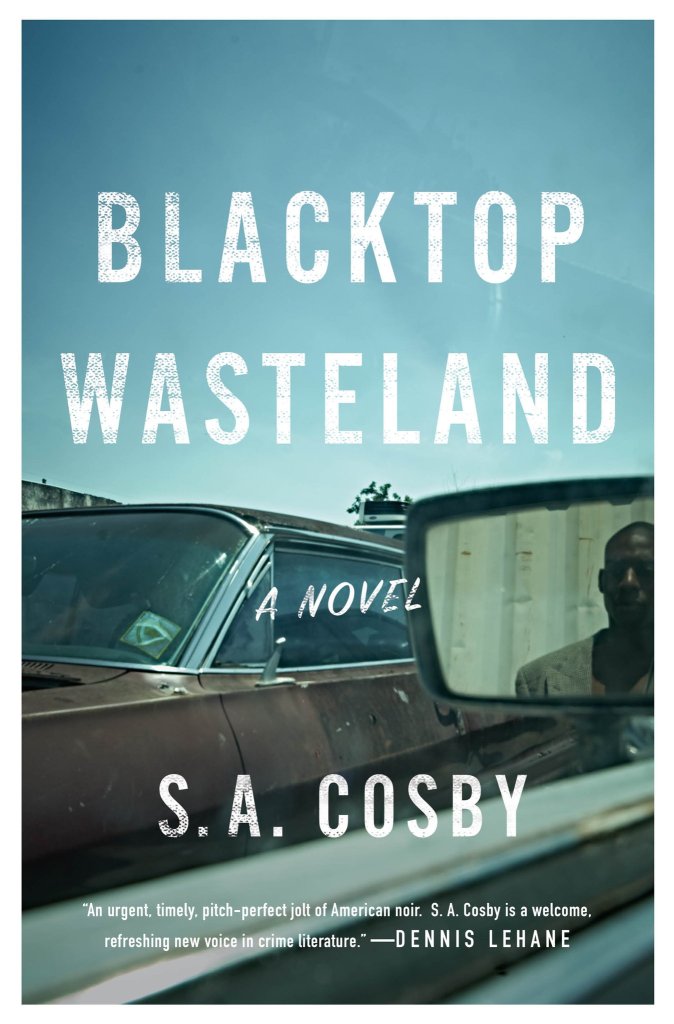
So, tired and with low energy, I decided to retire to my recliner with Blacktop Wasteland, figuring that finishing that book was one of my goals for the weekend, and that was probably the easiest goal to reach.

Nor do I regret one second of the time I spent with the book.

Beauregard thought the night sky looked like a painting

Laughter filled the air only to be drowned out by a cacophony of revving engines as the moon slid from behind the clouds. The bass from the sound system in a nearby Chevelle was hitting him in his chest so hard, it felt like someone was performing CPR on him. There were about a dozen other late-model cars parked haphazardly in front of the old convenience store. In addition to the Chevelle, there was a Maverick, two Impalas, a few Camaros and five or six more examples of the heyday of American muscle. Yhe air was cool and filled with the scent of gas and oil. The rich, acrid smell of exhaust fumes and burnt rubber. A choir of crickets and whippoorwills tried in vain to be heard. Beauregard closed his eyes and strained his ears. He could hear them but just barely. They were screaming for love. He thought a lot of people spent a large part of their life doing the same thing.

The wind caught the sign hanging above his head from the arm of a pole that extended twenty feet into the air. It creaked as the breeze moved it back and forth.

Laura Lippman describes noir as “dreamers become schemers,” and that’s always the closest description of what noir actually is that I’ve ever heard. Like all definitions of noir, it’s not quite everything, but nothing else anyone has written or said about noir comes as close to it, in my mind, as that. For me, noir is like pornography; I maybe can’t tell you what it is, but I know it when I see it. I personally love noir; it’s probably one of my favorite things to read (or styles of film to watch). I try to bring a noir sensibility to almost everything I write, no matter what label it’s given as an important keyword on Amazon. (I still believe that Timothy is the most noir thing I’ve written to date; but I am looking forward to delving more deeply into it with future work.)

Blacktop Wasteland is called a ‘heist’ novel by people who know the genre probably better than I do; and they are not incorrect; it is a heist novel. But it’s also so much more that I feel calling it that is, in some ways, a disservice to it–and I don’t mean to imply by that statement that there is anything wrong with heist novels. I haven’t read many of them, and I haven’t seen many heist films. Rob Byrnes writes truly clever, intricately plotted ones with a wide variety of distinct and well-developed characters that are also witty and funny as well as smart. But Blacktop Wasteland is also noir of the purest sort, the kind that Cain and Thompson and the other greats wrote; about working class people who can’t quite catch the break they need to be upwardly mobile, who believe that in a society and culture where everything is stacked against them, the only answer is criminality–and knowing when to walk away from that life. It’s about wanting more for your kids and your family than you had; it’s about grabbing for the American Dream and the brass ring. It’s also about family, and the damage done by wrong decisions and believing mythology you’ve invented rather than facing harsh and painful truths.

The main character of Cosby’s novel, Beauregard Montage (more commonly known as Bug) has tried, throughout his adult life, to build a better life for his wife and kids, and the child he rarely sees he fathered when he was a young teenager with a white girl whose family keeps her away from him. He’s opened his own business–a garage doing car repair and oil changes, etc–but the opening of a franchise oil change place has eaten into his business and has put him in danger of losing it all. A complication with his mother’s Medicare has resulted in a vast amount of money due to the retirement home where she makes everyone’s life miserable. That oldest daughter needs money for college and is dating a guy who might not be good for her. The bills are all overdue and the mortgage on the garage is so overdue it could lead to foreclosure.

Is there anything more American or relatable in these troubled times than financial distress?

But what Bug is best at is driving; he was in the Life before he decided to walk away from it for the sake of a straight life for his wife and kids. His own father walked away from his family when Bug was a teenager–for their sake, since he couldn’t escape his own criminal past. And the carefully constructed life Bug has put together for his family is slowly coming apart at the seams; and he needs money, and fast. So when a driving job in the life comes available, he grits his teeth and agrees to it. But nothing is ever as easy as it seems, and this job leads to other bills that have to be paid–with blood and bone.

The story alone is riveting, but what makes this novel so strong and powerful is the voice and the development of Bug as a character. The struggle within him between the desire for a normal family life and to do right by his children versus the thrill he gets from being in the life; from getting to flex and use his driving skills to skirt the law and get away with it is what takes this book to another level–and then the realization, the coming to terms with his feelings for his own father and that abandonment, as well as coming to terms with his complicated relationship with his mother, as he tries to do the right thing by his own family was breathtaking in its complexity and how agonizingly real it all seemed.

And those actions scenes are masterfully crafted, and keep you on the edge of your seat the entire time. Even had I wanted to put the book down, to take my time with it and read it more slowly, to draw the pleasure out, I couldn’t have once the kicked into high gear.

The writing is also deceptively simple yet honed to a sharpness and beauty worthy of compare to the grand masters of crime writing.

And while it was an accident of my TBR pile, I am very glad I read Kelly J. Ford’s Cottonmouths and S. A Cosby’s Blacktop Wasteland back to back, as both are surely writing some of the best contemporary rural noir of our time; they should be paired, really, and read back to back, much the same as how Megan Abbott’s Dare Me and Michael Koryta’s The Prophet should be paired together.

What a terrific time to be living in for a fan of crime fiction this is!