If Not For You

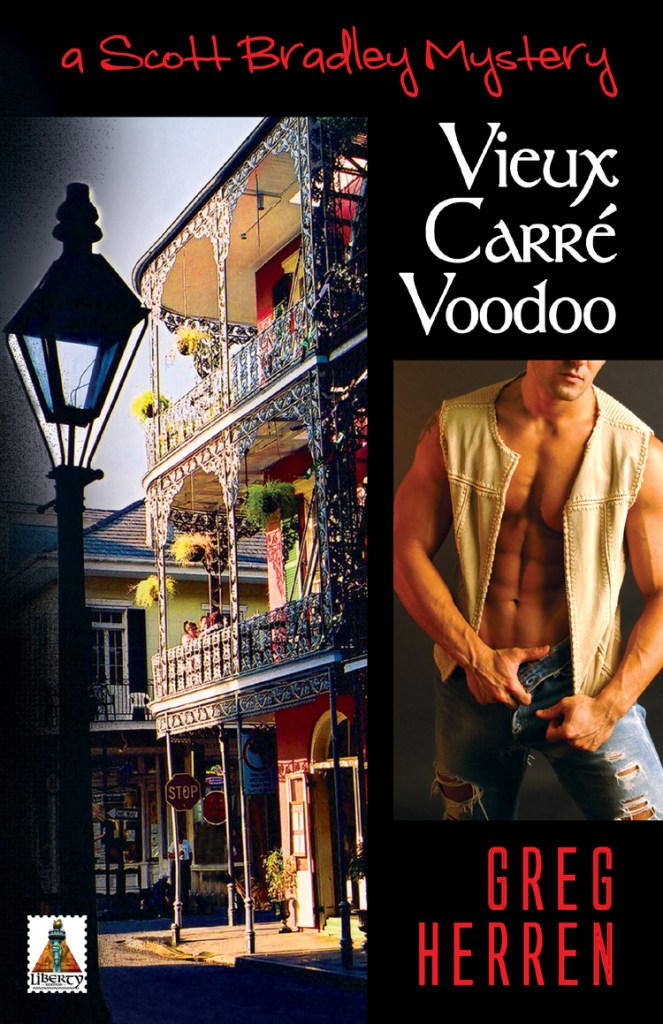
One of the most fun, for me, things about being a writer is being able to pay homage to books and writers I’ve enjoyed or felt a connection to in some way. I do this in at least every book I write–sometimes it’s as little a thing as having one of my characters reading a book I greatly enjoyed–and sometimes it’s a little more sly and tongue in cheek. For one example, I wondered occasionally while writing Bury Me in Shadows if anyone would notice that the name of the plantation house that burned during the Civil Was was Blackwood Hall–I only called it that once or twice; I usually referred to it as “the ruins”–and that it was a ghost story…hence The Ghost of Blackwood Hall, which had always been one of my favorite Nancy Drew mysteries when I was a kid (my favorite books in any series were ones that dealt with ghosts, hauntings, or the supernatural–it never was anything supernatural–in them; even as a kid I had, apparently, this morbid fascination with death and the afterlife that has continued into my adulthood). Vieux Carré Voodoo was also inspired, in some ways, by The Mystery of the Fiery Eye, one of my favorite Three Investigators mysteries–a jewel stolen from an idol that cultists will kill to get back is at the heart of both stories, and I also took inspiration somewhat from Wilkie Collins’ The Moonstone, which I had also read and loved as a child.

I’ve not picked up a Nancy Drew mystery in years to read through, until recently. I remember the series fondly–it wasn’t my favorite, nor was the Hardy Boys; but those books were more easily accessible and easier to find in stores and libraries than the other kids’ series, and with the kind of obsessive behavior I’ve always had–which hasn’t tempered much with the passage of time–once I started reading a series I wanted to read (and own) the complete set. This odd childhood obsession has never abated, even as I am now past sixty; I don’t have room to have all my series books out displayed on bookshelves (they are some of the boxes in the attic and the storage unit) and I think I am missing a few volumes from each series I do collect–but without being able to put them out, it’s hard for me to know which ones I am missing, so I’ve kind of held back on collecting them over the last decade or so. Discovering eBay in the wake of Hurricane Katrina was a big impetus in getting me to start collecting (trying to finish collecting) again, but the lack of space for storage–let alone putting them out on display in bookcases–inhibited me and I began to wonder about the advisability and the point of collecting children’s book series if I was simply going to put them in boxes and store them. It seemed kind of dumb, in all honesty, and so I stopped.

But the kids’ series had an enormous impact on me growing up and as a developing writer. I honestly think that The Haunted Showboat, number 35 in the Nancy Drew series, was my first actual encounter with New Orleans and Mardi Gras; it was either the fourth or fifth Nancy Drew mystery I had actually read (I started with The Secret of Red Gate Farm, The Mystery at Lilac Inn, and The Hidden Staircase; I think the next I read was The Haunted Showboat or Password to Larkspur Lane) and I do believe it was Nancy Drew who introduced me to New Orleans (outside of US History; I knew the Battle of New Orleans and the Louisiana Purchase and all of that, but this was my first non-historical introduction to the city).

I used to be able to list the books in order as well as give some background on the story; my memory isn’t quite as reliable on that score as it used to be. I joined some fan groups on Facebook, primarily to see if there were other alternatives than eBay and scouring second hand stores for the copies of the series books I am missing (and that’s a whole other story; there’s definitely a murder mystery novel that can be built around adult fans of kids’ series, seriously), and have been taken aback by the toxicity that can show up in these groups: hatred of anything new or daring or different to do with the characters (they have gone to TOWN on the new television series for both Nancy Drew and The Hardy Boys–hating changes and updates with the fiery white hot passion of a dozen burning suns–and it inevitably comes down to ‘political correctness’ and ‘being woke’–despite knowing that all the earlier series books were revised in the 1950s thru the early 1970s to get rid of dated stereotypes and racism), but that is a subject for a different time (I’ve not watched Nancy Drew–literally forgot about it–but I’ve liked The Hardy Boys).

Anyway, as I am writing a new Scotty book, I decided to do some research into Nancy Drew and New Orleans–mainly deciding to reread both books that were set, at least in part, here.

So, I went on line (much easier than going through the boxes in storage–which is yet another example of how stupid it is for me to keep storing books) and ordered copies of both The Haunted Showboat and The Ghost of Blackwood Hall, which, according to a synopsis I read on a Nancy Drew website, had Nancy, Bess and George come to New Orleans–which I didn’t remember. I remembered that the book was about Mrs. Putney being swindled out of her jewelry, and it had something to do with spiritualism, which eventually led Nancy and her friends to the abandoned, haunted Blackwood Hall–but I did not remember them coming to New Orleans. This struck me as strange–I certainly vividly remembered other parts of the story, particularly a scene when Ned and Nancy stumbled into quicksand (which, according to everything I read and saw on television and/or movies as a child, I thought would be more of a danger to me at every point of my life).

Both books arrived on the same day, but since I do remember The Haunted Showboat more than I remembered anything New Orleans with The Ghost of Blackwood Hall, I decided to look through the latter and read the New Orleans section again.

Yeesh.
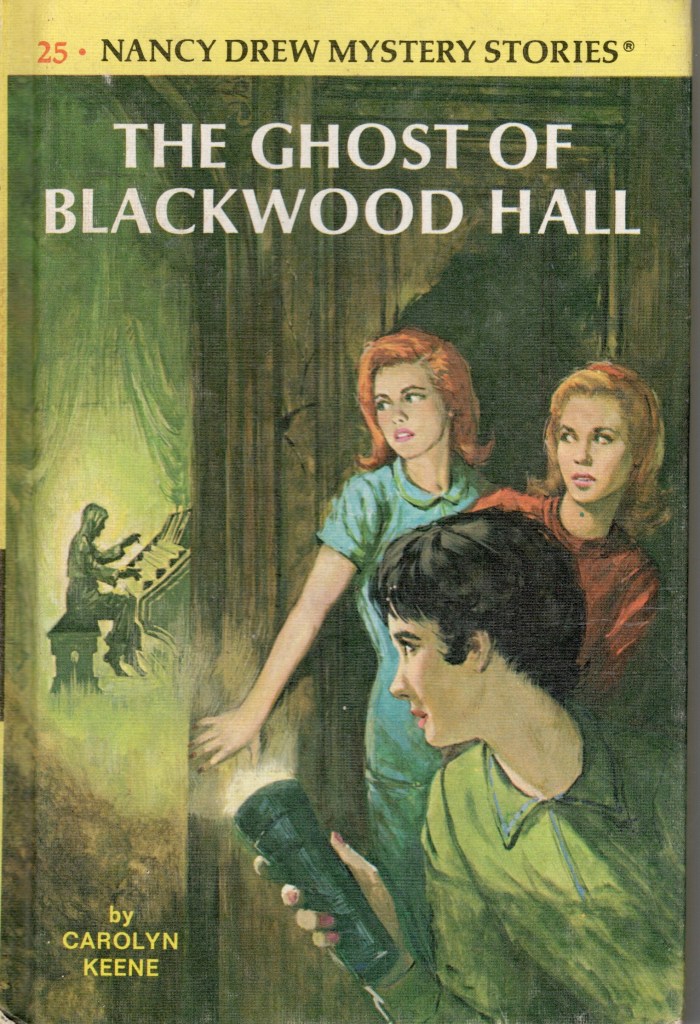
Despite my obsession with collecting and reading the entire series, as I mentioned earlier, Nancy Drew was never my favorite of the kids’ series; I liked The Three Investigators and Ken Holt most of all, and I always thought both Trixie Belden (the original six) and Judy Bolton were better written and more interesting than Nancy (Judy was also a goody two-shoes, but she was more rounded and developed, as were her friends), and looking through The Ghost of Blackwood Hall made me remember why she was never a favorite; the books aren’t very well written. (The original texts were much better than the revised ones, but it was a very low bar to hurdle, seriously.) And yet I had to have all the books and read them all; I watched the 70s television series with pre-Dynasty Pamela Sue Martin; and I still sort of have a soft spot for good ole Nancy; but man, these revised texts are simply terrible–and the later, newer books steadily declined in quality–I remember one where Nancy and her friends, being chased by a bad guy, duck into a room and–this is so stupid, it was even shown as an illustration–hide by sitting in chairs and holding up picture frames because of course the bad guy would look at them sitting still and believe they were a photograph or a painting.

Even as a kid, I knew that was fucking stupid.

Anyway, so Nancy is hired by a jeweler to help out his client Mrs. Putney–who clearly isn’t the sharpest tool in the shed–who is a widow and received a message from “beyond the grave” from her husband that she needed to bury her most valuable jewelry in the woods for safekeeping. (She’s also told to tell “no man or woman” about this; which is why the jeweler brings her to Nancy because she’s a “girl”–but the jeweler is a man…I guess in her mind he doesn’t count because he’s the one who spots that her jewelry is all fake, once she’s reconsidered her stupidity and dug the jewels back up.) There’s a lot of gullibility and superstition in this book, for the record, that doesn’t really make any logical sense. In a weird sequence of events, Nancy winds up with the name of a man from New Orleans who was an accomplished jewelry designer and “capable of making fakes that look real”–so she decides to follow the clue to New Orleans to look for information on the man. Because of course. Anyway, despite the fact that Mrs. Putney isn’t paying for this trip and in fact warns her not to go–Carson Drew, Nancy’s father, decides to foot the bill for her, Bess and George to fly down to New Orleans and follow this laughable clue that could only be a valuable one in a Nancy Drew mystery. (As I was reading this part again, I started thinking about how expensive this would be back then–the revised text was written in 1967, the original in the late 1940’s–and how amazing it was that all three eighteen year old girls had nothing else to do and could hop on a flight to New Orleans just like that; I am sure even back then it was more expensive to buy a ticket at the last minute.)

None of this mattered, of course, to young Greg when he was reading it the first time…and yes, I am being harsh about a kids’ series book which I am clearly too old for, but c’mon. And I knew when I was a kid that the books weren’t well written. (One thing that always annoyed me about this series and the Hardy Boys was they never really deduced anything or solved an actual mystery; really, the books were usually about catching a criminal whose identity was known almost from the start through a series of contrivances.)

But…

Once they are in New Orleans–after Bess tells a strange woman on their flight where they are staying in city: Nancy, seated in front of them, was sorry their hotel had been named. She had wanted to keep their visit to New Orleans as secret as possible. Um, you’re on a flight to New Orleans. So, since it’s too late to call on the suspect’s former boss, they go sight-seeing–but Nancy ducks into every jewelry and/or pawn shop they come upon.

The trip proved to be pleasurable, if not profitable. Their inquiries led them into many sections of New Orleans. The French Quarter, where the buildings were charming in their elegance of a bygone day, interested them most. Beautiful ironwork, delicately tinted plaster walls, old courtyards, once the center of fashionable Creole family life, fascinated the girls.

On a balcony, a brightly-colored parrot chattered at them in friendly fashion. A smiling woman, bearing a basket of flowers, stopped to sell a flower to each girl. On all sides, the visitors saw interesting characters, and heard the soft-spoken dialect which was a blend of French, Cajun, and Gumbo.

GUMBO IS NOT A LANGUAGE.

And since Cajun is a derivative of French…sigh. And by 1967 New Orleans wasn’t really bilingual anymore. It had begun to die out around the turn of the twentieth century, and it’s definitely a rarity here now to find anyone native who speaks both English and French, or speaks French as their first language.

The next day they visit their suspect’s former employer, who knows nothing, and then do some site-seeing before lunch “in a quaint restaurant.”

“New Orleans is wonderful!” Bess exclaimed. Counting on her fingers, she added, “We’ve seen the banana wharf, the market, the garden district, and that old cemetery where all the dead are buried in tombs above the ground.”

“That’s because this place is below sea level,” said George. “Say, do you suppose that guide that we believed the story about the tomb which is supposed to glow at night with an unearthly light?”

“He said spirits come out and weave back and forth like wisps of fog,” said Bess.

“That’s just what they are–fog,” George declared practically.

“Oh, I don’t for a minute believe in ghosts,” Bess replied quickly.

“I wish we had time to go to Grand Isle, the haunt of Lafitte and his men,” said Nancy.

“Who is he?” Bess asked.

“He was a famous pirate,” Nancy replied. “According to tradition, when burying treasure, he always murdered one of his band and left his ghost to guard the hidden loot!”

I guess Bess never studied about the Battle of New Orleans–and no one at either the Stratemeyer Syndicate or Grosset & Dunlap knew that you capitalize “Garden District.” Then comes a really weird section where the girls visit a spiritualist photographer on whose works sometimes “spirit writing” appears. Naturally, Nancy’s image has a warning to stop sleuthing, and then the lights go out and when they come back on, the photographer is unconscious, along with Nancy, are gone! This for me is a particularly weird section. Nancy is the point of view character, even if at a distance. Why would you then switch to Bess and George frantically searching for Nancy rather than showing her capture and abduction and eventual escape? WHY HAVE THE ACTION TAKE PLACE OFF THE PAGE?

Oh, and when Nancy regained consciousness, she was tied up and trapped in a basement near the Quarter.

A basement. Near the French Quarter. In New Orleans, which we’ve already learned is below sea level and therefore bodies can’t be buried in the ground. So of course we have basements.

But Nancy leads the cops back to the house, where all evidence of her being tied up and so forth have disappeared:

To their surprise the policeman remarked soberly, “This isn’t the first time queer things have happened in this section of the city.”

Ah, so it must be the Faubourg Marigny. Lots of queers lived there and in the lower Quarter back then. But I guess the girls should consider themselves lucky that they found an English-speaking cop–who would never say “this section of the city.” He’d name the neighborhood–“this isn’t the first time queer things have happened in the Marigny.” So anyway, the girls decide to go home, and fortunately, there’s a flight from New Orleans to River Heights within an hour. They pack and head for the airport just in time to catch their flight home–when Bess mentions something else mysterious that is going on that she knows about and just hasn’t mentioned before for some reason, and of course, as always, this side story subplot is connected to the main one.

And that’s where I stopped, since that was the end of Nancy’s adventures in New Orleans.

Sigh.
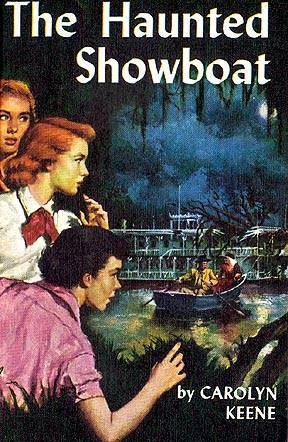
The Haunted Showboat, on the other hand, opens with an immediate eye-roller for New Orleanians:

“Would a trip to the Mardi Gras interest you, Nancy, and also a mystery to solve?” Bess Marvin asked.

Mardi Gras is French for Fat Tuesday, so basically Bess just asked her if she would interested in a trip to “the Fat Tuesday.” Yes, I am well aware that outside of New Orleans it’s all lazily considered Mardi Gras, but it’s really Carnival. Mardi Gras is quite literally Fat Tuesday, the final day of Carnival, and while I’ve grudgingly come to accept that there’s no way that people will ever not refer to the entire event as “Mardi Gras”–even I have a tendency to get lazy and say”Mardi Gras” when I mean Carnival–it will never not bother me. Of course, Bess isn’t from Louisiana and she can be forgiven for getting this wrong, and even using “the” as unnecessary definitive article can be forgiven. But–and this is something that always annoyed me about both Nancy Drew and the Hardy Boys–never is it mentioned in this book that Nancy and her friends have been to New Orleans before, and never was it mentioned on that previous trip in The Ghost of Blackwood Hall that Bess and George have New Orleans relatives.

Wouldn’t you think that would have come up in The Ghost of Blackwood Hall? Of course it didn’t, because when book 25 was written they had no idea that Book 35 would return Nancy and friends to New Orleans and Louisiana. (This kind of continuity thing used to drive me nuts; Nancy and the Hardys were ‘well known’ as amateur detectives, and every book opens with a reference to their first series book as well as the most recent, and closed with a teaser for the next, despite the fact that really, every mystery they solved was a stand alone with no connections to the past or the future. A couple of other continuity errors that always bugged me with Nancy is that Ned is mentioned as her boyfriend in the revised text of Number 5, The Secret at Shadow Ranch even though she meets him for the first time in Number 7, The Clue in the Diary; she finds her dog Togo as a stray at the opening of The Whispering Statue’s original text; but she already has Togo in the revised text of earlier volumes and yes, I am aware that I have spent way too much time in my life obsessing about Nancy Drew and continuity errors in the series–and there are a lot.)

Anyway.

If anything, The Haunted Showboat is actually worse than The Ghost of Blackwood Hall in so many ways, and not just in the aforementioned minor ways. First of all, the cousin of Bess and George’s, who invited them down, is named Donna Mae, because back in the day you could always make your audience know “hey this is set in the South” by giving a female character two first names–and always something Mae. (Ellie Mae Clampett is another example; for the record, out of dozen and dozens of southern women relatives there is exactly one whose name was “Something Mae”.) It takes a while for them to get to Louisiana–Nancy’s car is stolen once, and the replacement is sabotaged–because of course the criminals down in Louisiana will stop at nothing to keep this teenager from the midwest to interfere with their plans!–but there’s one part of their trip that is absolutely hilarious: they drive through Mobile on their way to New Orleans, but somehow get to the Mississippi River before they get to New Orleans or the plantation outside of town they are visiting:

Soon the girls reached the broad Mississippi and gazed at the peaceful, somewhat muddy river.

SOMEWHAT MUDDY?

Nancy then follows the River Road and turns inland. This geography makes literally no sense at all. But..it’s Nancy Drew, and the worst is yet to come.

You see, the Havers–who live at Sunnymead–have two black servants: Mammy Matilda and Pappy Cole. And oh yes, it’s just as racist and horrible as you can imagine–especially when you add in the “voodoo drums” they hear when canoeing through the swamp to get to the wrecked and haunted showboat, the River Princess. Anyway, yes, you can just imagine how dated and awful these depictions are. And everyone calls it “the Mardi Gras,” which no one does in the real world, either. The Quarter is referred to (correctly) as the “Vieux Carré”, but an aside says “or the old city”–it means “old square”, not old city–and of course they have lunch at Antoine’s.

There’s also an Uncle Rufus, who lives in the swamp in a tiny cabin and does voodoo spells.

There’s also a swamp episode and a wrecked, haunted showboat in an episode of Scooby Doo Where Are You?, which I’ve always wondered whether it was inspired (or stolen) from this edition.

So, neither book has aged particularly well–I’m still trying to wrap my mind around Gumbo as a language–and I suppose I shouldn’t be surprised by the racist depictions of Black characters in The Haunted Showboat, but the book is still in print and kids are still reading it. Everyone knows that the original texts of the Hardy Boys and Nancy Drew series were updated in the 1950’s and through the 1960’s to get rid of problematic depictions of non-white characters; it might not be a bad idea for them to do it again now. No one should be reading The Haunted Showboat as it stands today, really.

But it was an interesting time travel to revisit the books again. At some point I’d love to talk about all the kids’ series I read when I was a child, but…time.

I Know I’m Not Wrong

I posted a list of things–a thread, if you will–on Twitter yesterday of helpful hints to get prepared for a hurricane-related power loss; simple things I’ve picked up from other people over the years, and was more than a little surprised by the response that received from other users in the Twitter-world. But it’s all common-sense things you might not think about when you’re panicking and battening down the hatches, as it were. The refrigerator and food spoiling without electricity is one I will always wish I knew before Hurricane Katrina, frankly. It also looks as though Tampa is going to get a direct hit, and I don’t think it’s gotten one of those in a very long time–since the 1960’s, at least, if I am not incorrect, and that area is particularly vulnerable to storm surges and so forth. I’ve not lived there since 1995, but there are still people I care about who live there, and obviously, I’m sending them good thoughts and positive energy and hope everything will turn out okay for them and the power will be back soon and the storm will do little damage. (UPDATE: Tampa has not had a direct hit of this strength since 1921! Over a hundred years ago!)

It’s also kind of interesting because one of my in-progress projects (one of too many) involves my Tampa stand-in city while under hurricane threat. YIKES. (In that self-absorbed reflex I suspect all of us have but manage to successfully filter before those thoughts come out of our mouths, there’s a part of me that thinks maybe if your idea for Scotty IV hadn’t been about a hurricane…and so of course in the back of my head I can’t help but wonder if writing about such a thing didn’t wish it into being…because of course that’s how things work and my mind has that kind of power mwa-ha ha ha ha! I mean, come on.)

I feel rested this morning but felt like a burnt out husk for most of the weekend. I got all of my day job duties completed yesterday and yes, my eyes were crossing from the data entry by the time it was finished right around quitting time for the day, which was helpful; I don’t think I could have faced another form yesterday but now I am all caught up, which is great and puts me in great shape ahead for the coming weekend. Last night we got caught up on Bad Sisters and watched two stand-up comedy shows, the new one from Patton Oswalt and one from a non-binary comedian from Australia, Rhys Nicholson, and both were highly entertaining and quite funny. After that I repaired to the bed for my night’s rest, which seems to have gone well. Today I need to start working my way through my to-do list, and need to add some things to it. I need to work on the book this evening after work, so here’s hoping today won’t be a emotionally and physically taxing one at the office. I am trying not to get worked up or stressed out about how far behind on this damned thing I actually am–if I get back to work, albeit slowly, I’ll be able to get the damned thing finished on time and one great stressor will be lifted out off my shoulders.

One fun thing I got to do this past weekend was listen to voices–not the ones inside my head, of course–but rather voice actors auditioning to do the audiobook for A Streetcar Named Murder, which also triggered me to do the pronunciation key for whoever the final voice actor is. All four were fine, but there was something about the way this one of them spoke that just seemed right to me, and so I picked her (I think the fact that she was also the only one to say New Orleans correctly played a part in it as well as the fact that she didn’t try to do an accent of some sort; people never really get that the natives here don’t have Southern accents–one of the biggest mistakes made in movies and television shows set here; the actual New Orleans accent, if the area could be said to have one, is very similar to the Brooklyn one–“dese” and “dose” and “the kitchen zink” and so forth; it’s a working class accent known as yat, and it gets its name from saying “where yat?”), and I am actually looking forward to listening to my book at some point. How exciting is that?

It’s also kind of hard to fathom that September is ending and October is nigh; 2022 has gone by very quickly–although January also at this point seems like it was a million years ago in the past. It’s been quite a year and I’ve traveled more this year than I have in many years prior to the pandemic, frankly. I started off the year with the Birmingham/Wetumpka weekend, moved on to Left Coast Crime, the Edgars, Sleuthfest, and Bouchercon, with a trip to Boston for Crime Bake coming up too, and I also went to Kentucky for a long weekend, and will be heading back up for Thanksgiving this year (which means listening to Ruth Ware on the way up and Carol Goodman on the way home, woo-hoo!) but next year my traveling will be severely curtailed; probably Bouchercon in San Diego will be my only travel in 2023 other than Kentucky. I am getting too old to travel well, alas–Bouchercon knocked me out for an entire week, but that was also partly due to the back injury I sustained while I was there–and it also put me into a hole of being behind that I don’t really want to think about too much, you know? I despair of ever clearing out my email inbox, and as for all the writing I need to get done…well, somehow it will happen or it won’t. Heavy heaving sigh.

And on that note, I am heading into the spice mines. May your Tuesday be all you hope it can be, Constant Reader, and I’ll be back tomorrow.

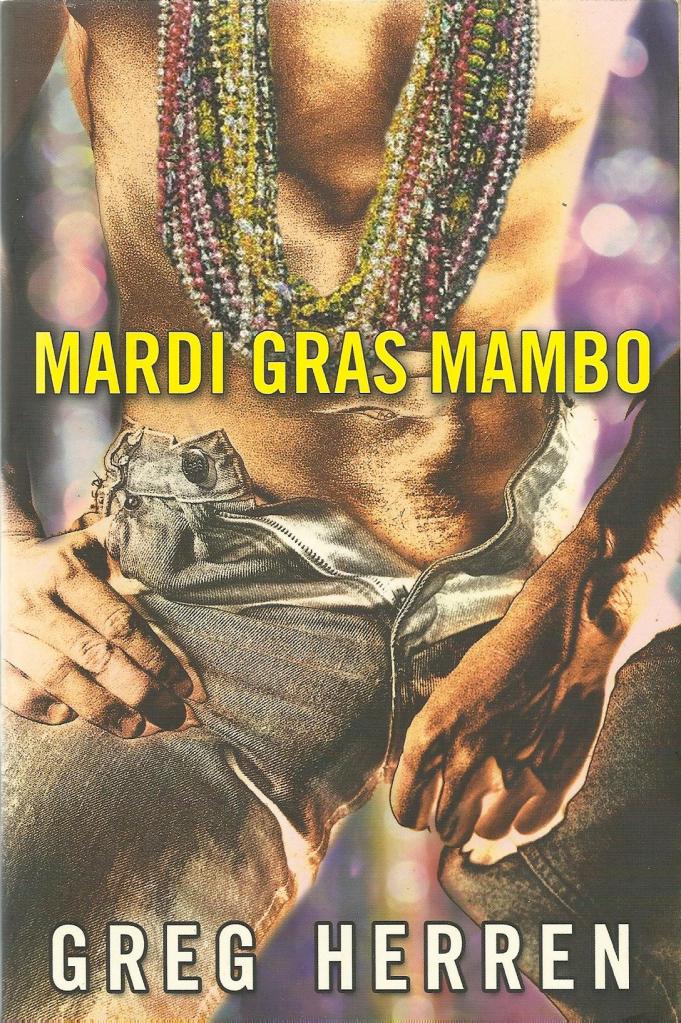
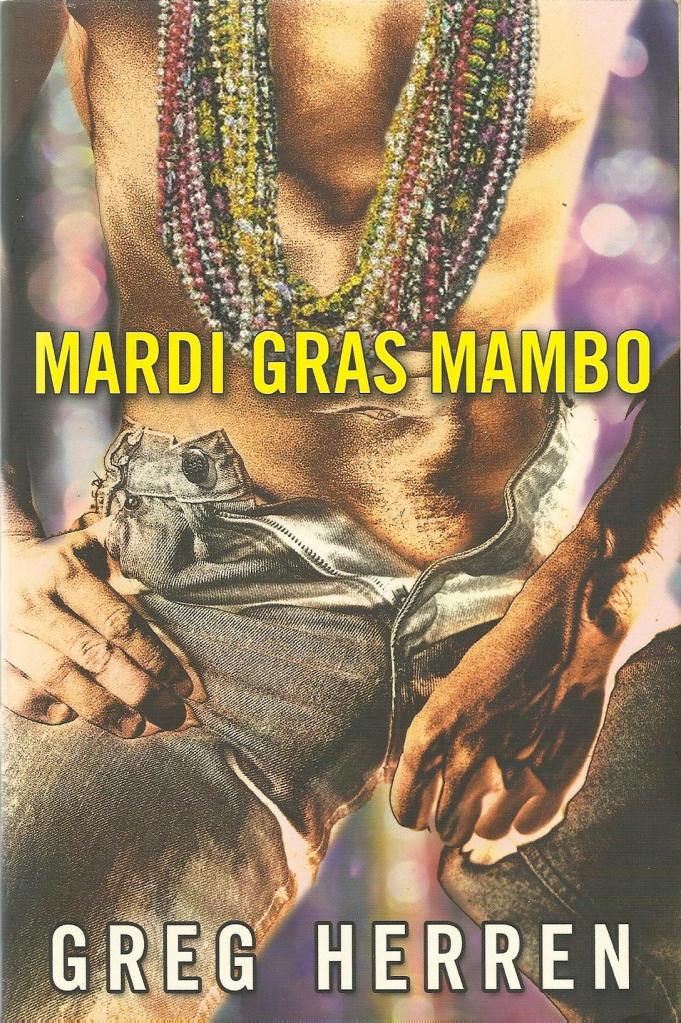
Mardi Gras Mambo

Or, my own personal Vietnam.

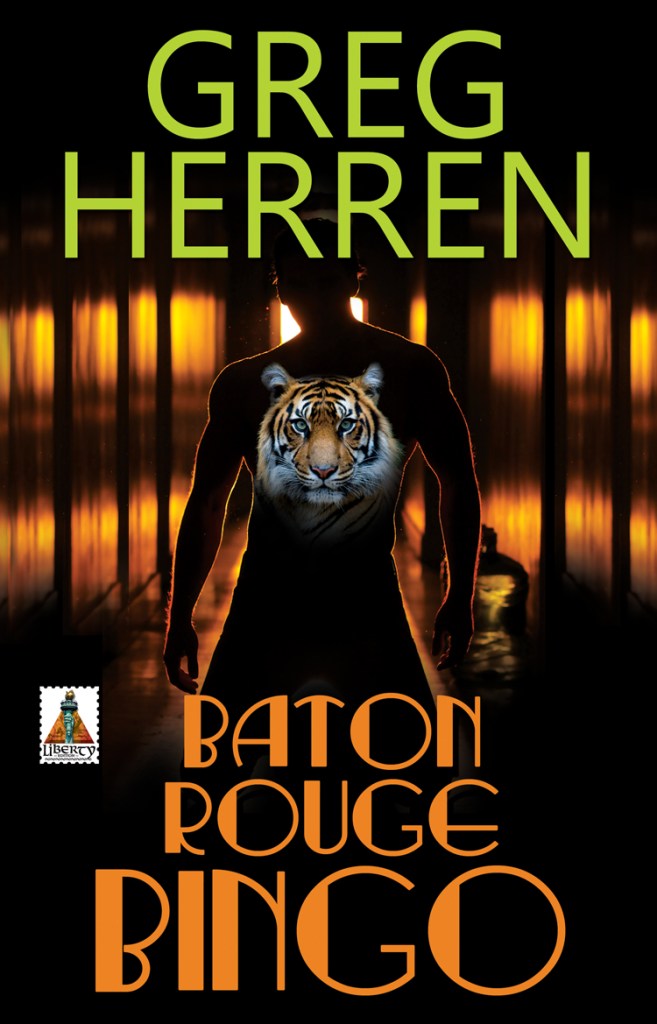
I’ve told this story any number of times; how the writing of the book was derailed by two awful things that happened in my life, and how I finally got back to writing again in the spring of 2005, managing to finish this and turn it into literally two or three weeks before Hurricane Katrina came barreling ashore and changed everything in my life, and the long recovery time from that paradigm shift, trying to adjust to the new reality I was facing every day. It felt weird going over the copy edits, weirder still doing the page proofs (I actually had the incredibly sharp-eyed Becky Cochrane and Timothy J. Lambert do it for me while I was visiting the Compound, thanks again, guys!), and even stranger having to tour and promote a book about New Orleans set before Katrina while still dealing with the recovery.

I’ve told those stories before, and that isn’t really what these entries are about; these entries are about the books themselves and how I came up with the stories and so forth, and the writing of the books. The primary problem, of course, is that I wrote this book between and around tragedies; the two year period I call the Time of Troubles that began on Memorial Day weekend in 2004 and ran through about 2008, really; because that’s about how long it took after all those issues for me to feel like my feet were beneath me again and I once again had a grasp on my life. I don’t remember what the original story was about, other than it centered on the Krewe of Iris, Scotty’s Diderot grandmother’s best friend who’d married a much younger muscle-stud Russian, and that’s really about it. The Russian would have something to do with a Colin case–and it would turn out actually be the case that brought him undercover to New Orleans in the first place during Southern Decadence; in Jackson Square Jazz we find out what Colin’s real job is, and that he was in town originally about the Napoleon death mask–but he was also in town to keep an eye on the young muscle-stud Russian who’d married Scotty’s grandmother’s best friend. It wasn’t really working, and I didn’t much care for the story, to be honest; I’d already asked for an extension before Memorial Day weekend in 2004 when all the shit started happening; after Paul was attacked they took it off the schedule and told me not to worry about it. (I appreciated the courtesy greatly at the time, but at the same time had this sinking feeling in the back of my head uh oh, they may not want another one after this–which turned out to be correct. But I dismissed the fear as part of my on-going struggle with Imposter Syndrome. It took me about six months, more or less, to get back to writing. I started my blog right after Christmas that year, and there I was writing every day again, and by January of 2005 I was ready to get going on this book again. I remember rereading everything I’d already done, not liking it, and deciding to scrap it and start over with the same essential premise: rich older society woman in New Orleans has married a much younger Russian boy-toy; Colin is investigating the boy-toy; and it’s Carnival season. Shortly after getting about halfway into a new first draft, the Virginia thing happened and I was derailed again. After that was over and I went back to the book…once again I didn’t like what was happening in the story and I threw it all out and started over again.

But this time, I hit my stride and four months later I turned the book in at long last, along with a proposal for a fourth, Hurricane Party Hustle, which was going to be set during an evacuation and would wrap up the loose ends left at the end of Mardi Gras Mambo.

And of course, three weeks later Katrina changed everything, and Hurricane Party Hustle went into the drawer.

Last night I dreamed it was Mardi Gras again. It seemed to me I was standing inside an iron gate, watching one of the night parades go by. The sidewalks in front of the gate were crowded with people, all shouting, with their grasping eager hands up in the air. Out beyond the edge of the curb, I could see people sitting in lawn chairs. Still others were up on ladders, with coolers and plastic bags of booty piled around them on the ground. Fathers and mothers were holding up babies, while black kids with the crotches of their pants down around their knees walked behind the crowd, weighted down by the ropes of beads around their necks. Beads were flying through the air, some getting caught and tangled in the branches of the towering gnarled oaks lining the avenue.  The heavy upper branches of those oaks also blocked out the glow of the ancient street lamps so the night seemed even darker than it should. I could hear a marching band, playing a recent hip-hop hit, and the strange clicking sound of the baton girls’ tap shoes on the pavement. The air was heavy with the heavy fragrance of hot grease, corn dogs and the strange melted yellowish-orangey substance the vendors put on nachos that purports to be cheese—but no one is really sure what it is. A group of flambeaux carriers were passing by, dancing that odd little circular dance they do, their propane tanks popping and hissing, throwing long and twisted shadows that also danced inside the iron fence I was behind. Right behind them a huge float pulled by a tractor was coming and the crowd’s shouts became louder, more desperate, more pleading. On the float’s front was a huge white clown face, its bright red lips parted in what passed for a smile but seemed to me to be a frightening leer. The masks on the float riders glowed supernaturally at the hordes begging them for generosity in the strange light cast by the moon when it cleared the thick clouds in the cold night sky.   I stood inside the black iron fence, my arms wrapped around me against the cold as an increased sense of menace and dread built inside me. Something bad was going to happen—

Oh, get real, Scotty!

If I do have bad dreams, I don’t remember them when I wake up. I’ve certainly never been troubled in my sleep, even though crazy things always seem to happen to me. I’m just one of those people, I guess. For whatever reason, the Goddess has decided to throw some wild stuff at me—she always has, even when I was a kid—and what can you do? I just don’t think I am one of those people who were destined to have a nice, normal, quiet life. Maybe it’s because I was named Milton Bradley at birth. Yes, that’s right. Milton Bradley. My older brother started calling me by my middle name, Scotty, before I started school and thank the Goddess, it stuck. Can you imagine how cruel the kids would have been to someone named Milton, let alone Milton Bradley? And then of course there’s the gay thing. I was lucky—my parents are pretty liberal and were delighted to have a gay son—like it somehow proved how truly cool they really are or something. They are pretty cool, actually.

By now, I’d taken to starting all of my New Orleans novels with a Tennessee Williams quote; for this one I chose a line from Vieux Carré: “You’ve got a lot to learn about life in the Quarter.”

I had opened Bourbon Street Blues with a parody of “The name’s Bond, James Bond” and I’d done something similar with Jackson Square Jazz–“Danger is my middle name”, riffing on Trouble is My Business. I decided to open this book with a parody of the opening line of Rebecca: “Last night I dreamed I went to Mardi Gras again.” But that entire opening paragraph of du Maurier’s is so fucking brilliant, I couldn’t help myself and made my entire first paragraph a parody of that opening. I then decided that from then forward, every Scotty book would have a Williams quote and each prologue–where Scotty introduces himself and his cast of characters and gives backstory so I don’t have to do it in the text of the story itself–would parody the opening paragraph of a famous novel, rather than just the first line (I am actually struggling to find the proper opening to parody to start the prologue for this one. I’ve used Rebecca, Peyton Place, The Haunting of Hill House, and Lolita, among others so far already; I’ve tried with this one to use An American Tragedy, Atlas Shrugged and The Great Gatsby thus far, with no luck. I’ve tried Valley of the Dolls several times for other books in the series already, but I can’t ever get it to work for me).

I do remember that the one thing that didn’t come across in those earlier drafts that I had abandoned was the sense of insanity that Carnival always brings with it; that feeling of “controlled anarchy” we experience those two weeks of parades, of knowing you have to schedule your entire life around a parade schedule–true even for those who do not live inside the box, as we say here; the box being the Uptown parade route–I always have to schedule my job, my trips to run errands uptown, everything, predicated around having to get home at least two hours before the parades start, and am incredibly lucky if I can get a parking spot within three blocks of the Lost Apartment. The thing I kept forgetting in those earlier versions was the books are meant to be fun. Granted, I was hardly in a mental space to write something fun…and of course the decision to really take it completely over the top the way I did was something I still think about to this day and wonder, where on earth did you get the idea for identical triplets?

Which, while crazy, made more sense than the cloning story I tried to write the second time.

Maybe those bad things happened for a reason? Because I couldn’t be more pleased with how the story and the book turned out. I also ran out of room to finish the personal story…but I also was operating on the assumption I’d get a contract for a fourth book. If not for Katrina, Kensington might have made another offer and Hurricane Party Hustle might have been the fourth Scotty than something just sitting in the files.

The book was released on Fat Tuesday, 2006. Paul and I had been out of town–the truncated Carnival/parade season seemed almost too sad to handle, so we’d accepted a gig to speak at the South Carolina Book Festival. We flew back to New Orleans the Sunday morning before Fat Tuesday. I’d checked my email that morning before boarding the flight to Atlanta (we changed planes) and then our cab driver couldn’t get closer to St. Charles than Baronne Street. A parade was going as we got out of the car, and we had to cross the parade (it was in the high seventies and sunny) with our luggage–I’ll never forget looking up as we got ready to cross and catching a bag of beads with my hand just before it connected with my face–and got home. I checked my emails and my word! SO MANY EMAILS.

You see, that day’s edition of the Times-Picayune carried Susan Larson’s review of the book, and it was a rave! Everyone emailed me as soon as they saw it–I still bask in the glory of that review–and I was about to embark on probably the most ambitious book tour of my career.

I just didn’t see, though, how I could write another funny, light book about a city still in ruins whose recovery was still questionable.

The series was, for the moment, over–with the personal story not resolved the way I would have wanted, but it could stand as it was, should there never be another Scotty story.

Rereading it, I couldn’t but laugh at some of the outrageous twists and turns the plot took.

I guess you could say I’m proud of it.

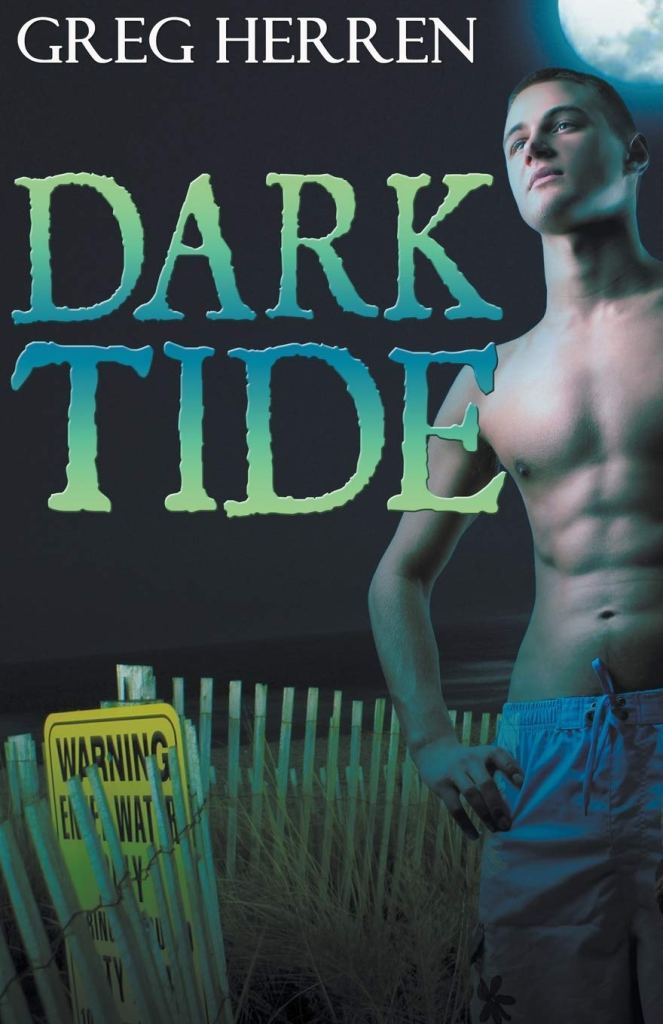
Dark Tide

I hadn’t been sure that I would keep writing young adult novels after I revised, rewrote and published the first three (Sorceress, Sleeping Angel, and Sara) I didn’t know if it was a direction I wanted to keep going in. I knew I wanted to do stand-alones–always have wanted to do stand-alones–and I also like writing about teenagers and young adults.

If you remember, a few entries back I talked about a horror novel I started writing in the 1980’s called The Enchantress that only got about three or four chapters into before abandoning (because I didn’t know where to go next with it; and the first chapter I specifically remember rereading at some point in the decades since and shuddering in horror at how badly it was written), but one of the places in the book really stuck in my head–an old family owned hotel called Mermaid Inn, which sat on the shores of Tuscadega Bay (which was my stand-in for Choctawhatchee Bay–my grandparents retired to a house on that bay and I’ve always wanted to write about that area). After shelving The Enchantress (which I do think about from time to time, and wonder if I should revisit the idea) I kept thinking, you should write a book and call it Mermaid Inn.

I made a folder for it, wrote a few sketchy notes, and it sat in my files for a very long time.

If you will remember, I had originally planned to write an entire series of interconnected young adult novels, a la the Fear Street series by R. L. Stine, and one of the varied locations they would be spread out over would be Tuscadega, Florida, in the panhandle on a fictional bay. That was part of the note I scribbled for the folder–set this in the panhandle of Florida, and connect it to the fictional Alabama county you’re going to write about somehow.

I decided to write Mermaid Inn sometime after Hurricane Katrina, when I discovered yet again my own ignorance of geography. I’d just never really given it much thought, to be honest; I knew Mobile was on a bay, I knew when you drove on I-10 through Mobile you have to take a tunnel below the Mobile River. I just had always assumed there was nothing south of Mobile in Alabama–I mean, it’s ON water–and figured that those lower prongs of Alabama that reach down along the sides of the bay were uninhabitable wetlands. I discovered this to not be the case when visiting friends for the first time who lived in Alabama south of Mobile. They told me to take an exit off I-10 and drive south, which I didn’t think was possible.

It is.

I don’t remember precisely when or how or why I decided to write Mermaid Inn and set in a small town on the prongs, south of Mobile; I just know now that at some point I decided to do this–and my friend Carolyn Haines might have been involved; I know she told me some stories about closeted society men in Mobile and their hijinks and I thought, I could use this for the book and I think that may have been the impetus? And then I created my character, Ricky Hackworth, from Corinth, Alabama–po’ white trash who needs a swimming scholarship to attend the University of Alabama. (Sidebar: alert readers will recognize that Beau’s last name in Bury Me in Shadows–and at one point in the story he mentions he’s only the second Hackworth to go to college; “besides my cousin who got a swimming scholarship.”)

The engine of my pickup truck made a weird coughing noise just as I came around a curve in the highway on the Alabama Gulf Coast and I saw Mermaid Inn for the first time.

My heart sank.

That’s not good, I thought, gritting my teeth. I looked down at the control panel. None of the dummy lights had come on. I still had about a half tank of gas. I switched off the air conditioning and the stereo. I turned into the long sloping parking lot of the Inn, pulling into the first parking spot. I listened to the engine. Nothing odd. It was now running smooth like it had the entire drive down. I shut the car off and kept listening. There was nothing but the tick of the engine as it started cooling.

Maybe I just imagined it.

Hope springs eternal.

The last thing I needed was to spend money on getting the stupid old truck fixed. Maybe it just needed a tune-up. I couldn’t remember the last time it had one.

Dad gave me the truck when I turned sixteen. It had been his work truck since before i was born–it was two years older than I was. He’d finally broken down and bought himself a new one. This old one was dependable and had almost two hundred thousand miles on it. Dad had taken good care of it. He’d babied it, gotten an oil change every three thousand miles without fail, and I could count on one hand the number of times it had been in the shop to be repaired.

It still had the original transmission.

It might not have been the nicest or prettiest car in my high school parking lot, but it got me where I needed to go and got good gas mileage. Since I was saving every cent I could for college, that was a lot more important than horsepower and cosmetics and a loud stereo that rattled your back teeth. The swimming scholarship I’d accepted from the University of Alabama wasn’t going to remotely cover anything close to the lowest estimate of what my expenses might be, but it was the best offer I’d gotten.

And I was grateful to have it. If they hadn’t offered, I wouldn’t be going at all.

Swimming was my ticket out of Corinth, Alabama.

That opening scene!

Mabel Normand

Saturday in the Lost Apartment and all is well–at least so far.

I ran errands last night on my way home from work so I don’t have to go anywhere or do anything today involving leaving the house, and I think I’ll go ahead and make groceries on-line today to pick up tomorrow; we don’t really need a lot of stuff but it must be done. There’s a part of me that feels incredibly lazy doing this for some reason–perhaps the more I do it, the less guilt I’ll feel about having someone else make my groceries for me. I guess that’s really what it is; getting used to a new service. I mean, even the Fresh Market will do this, too–but one of the things I like about the Fresh Market is, well, everything seems fresher than at the other groceries, and picking out fruit and vegetables isn’t something I am willing to trust to another person just yet. I like to see the fresh stuff I am buying and pick it (although I am still regretting not stopping at that roadside stand when I was on the North Shore last weekend and picking up some Creole tomatoes fresh from the field, especially since I’ve not seen any in stores since then).

It rained again most of the day, and of course we’re still under a flood warning through sometime tonight. There are two systems out there I’ve yet to check but probably will momentarily. It’s that time of year when we seem to be getting hit with a higher degree of frequency since Katrina–just before Labor Day–and I know there have been at least three more storms around this time that I can think of right off the top of my head (2008, 2012, and last year for sure). Well, I took a look and yes, there is still a system in the Caribbean near the Yucatan, and there’s another one developing in the eastern Atlantic (meaning there are now two out there) but at least we’re okay for now. Labor Day weekend, on the other hand, could be something else entirely. Last year’s Ida was more of a Labor Day thing, if I am remembering correctly, or at least its impact and aftermath lasted through Labor Day. (2021 is still kind of blurry for me.)

The sun is shining right now, and I rested really well last night. A good night’s sleep is always a pleasure on the weekends, of course, and I even allowed myself the indulgence of sleeping in a little later. I have some laundry to finish and a sink to clear in the kitchen, and some other casual cleaning up and household maintenance to take care of this morning before I dive back into the wonderful world of work. I did get Chapter One rewritten Thursday–still leaves something to be desired, but isn’t completely the shitty mess it was before–and I did get started revising Chapter Two, which is going to be trickier–and then I have to springboard into Chapter Three, which I still have to figure out. I also want to do some work on some other things I am working on (as always) and I want to dedicate some time to reading Gabino’s marvelous novel The Devil Takes You Home today and tomorrow. I’ve actually been better these last couple of weeks at not being completely exhausted when I get home, which has also enabled me to try, at some level, to keep up with the housework so I don’t have to spend the entire day today cleaning and organizing and filing–there will be some of that, of course, and I also have to spend some time revisiting older Scotty books; maybe one of the things I could do today is start working on the Scotty Bible? That would help me remember everything that’s going on in the family and refresh my brain about some other things (did I ever give Rain’s doctor husband a name, for one really strong example of bad memory) and of course it would never hurt to have all of that assembled in one place that is easily accessible. Heavy sigh.

We also are watching Bad Sisters on Apple TV, and am really enjoying it. It’s rather dark; it’s about five extremely close Irish sisters who lost their parents young and were all raised by the oldest sister, who now lives in the family home, is single and apparently unable to have children. One of the sisters is married to an emotionally abusive asshole named John Paul who apparently takes delight in torturing and being cruel not only to his wife but to her sisters. One decides he needs to die, and recruits the oldest to help her kill him…and then each episode details how another sister got involved in the plan. The show opens with his funeral, so we know they succeed at some point, but the story alternates between the past (the sisters slowly coming together to decide to kill The Prick, which is what they all call him) and the team of brothers who work for the insurance company who have to pay out the death claim. The brothers (half-brothers, actually; one is played by the same hot actor who played the escort Emma Thompson hires for sex in her most recent film, which we enjoyed and I can’t recall the name of now) don’t really get along either. The oldest is convinced John Paul was murdered, but the younger brother is really attracted to the youngest sister and they are starting to develop a romantic relationship. It’s quite cleverly written and plotted–and even before I was completely sold on the show, I realized I wanted to keep watching because I hated John Paul so much I wanted to see how they decided to kill him and how. But well into the second episode I had to confess to being hooked. I loved the dueling timelines (I have always been a sucker for stories that are told this way, both the past and the present, flashing back and forth; I’ve always wanted to do one that way, but it seems really hard. A good example of a crime novel using this technique is Alison Gaylin’s What Remains of Me), the writing is sharp, and the acting top notch. It also takes place in Ireland, with gorgeous cinematography. I’ll keep you posted as we continue to watch.

We also watched the latest episode of Five Days at Memorial, which was truly painful to watch. The first episodes didn’t really get to me, but episode five–the fifth day, when the decision was made that everyone had to be out of the hospital and whoever couldn’t get out would be left behind regardless of the consequences, was absolutely wrenching in a way the previous episodes had not been. My Katrina scars are as nothing compared to what a lot of other people experienced: I survived, I was able to get out before the storm arrived, and my scars, while still from loss, are from bearing witness by watching television and witnessing what I saw when I finally came home in October, as well as living in a nearly-empty, 90% destroyed city after my return. (Last year, when we trapped here as Ida came in, was bad enough; I cannot imagine how horrible it would have been to have been stuck here praying for someone to come rescue us. At least we were able, and had the means, to finally get out when we ran out of food and water.)

I’ve also found myself thinking a lot about my Katrina writing these last couple of days–my essay “I Haven’t Stopped Dancing Yet”; my short stories “Disaster Relief” and “Annunciation Shotgun” and “Survivor’s Guilt”; and of course, Murder in the Rue Chartres. I was thinking about this book last night–partly because of watching Five Days at Memorial, because it reminded me that Rue Chartres wasn’t supposed to be the third Chanse book at all. The third Chanse book was supposed to be something else altogether, but obviously in the wake of Hurricane Katrina my plans for both the Chanse and Scotty series had to dramatically shift and change. Seventeen years ago was a Saturday, the Saturday we nervously watched the storm, having now crossed south Florida and entered the Gulf, intensifying and growing and taking aim directly at New Orleans. We decided to not leave just yet; every other time a hurricane had threatened the city after we moved here we watched and waited patiently, and were rewarded with the storm turning east before coming ashore and the city avoiding a direct hit. We never lost phone, cable or power during those other instances–we were nervous, still reassuring ourselves of the turn to the east before landfall but the reality that we would have to leave was becoming more and more real. It’s odd that this year the dates all on the same day they fell back in 2005, so it’s a reflective anniversary that mirrors the actual weekend it happened. I’m debating whether I want to watch the new documentary on HBO MAX, Katrina Babies–that might be definitely too much for me to handle. (I’m still surprised that we’re able to–and were willing to–watch Five Days at Memorial, to be honest.)

At least I know Paul won’t be shaking me awake tomorrow morning at eight saying, Honey, we need to go.

OH! I didn’t tell you. Yesterday my other glasses I ordered from Zenni arrived–the red frames and the purple frames, and I absolutely love them. I don’t think I need to order any more pairs, to be honest, but it’s so cool to have them! And to have options now. I never ever thought of glasses as anything other than utilitarian, to be honest; I needed them to work and that was all I cared about, and I also thought they were too expensive to treat as part of a “look” or to be more style conscious…but Zenni is so inexpensive; the three pairs I got are all cheaper than the pair I got with my eye exam, and using my insurance. Had I saved my insurance for use on Zenni, they would have been even cheaper.

Life. CHANGED.

And on that note, I am going to make some more coffee and dive back into the spice mines. Have a lovely Saturday, Constant Reader.

Watching Scotty Grow

As I get ready to write another Scotty book, I am busy making his acquaintance all over again. It might seem strange, but yes, although I’ve written eight books about my ex-go-go boy/personal trainer/private eye, it remains true in this as in all other aspects of my life that my memory is not what it once was; in fact, I don’t think I’ve ever written a Scotty book since the first three without having to go back and revisit the series again. I have made continuity errors over the years (Scotty’s mother’s name changed over the course of the series, from Cecile to Marguerite and back to Cecile again), and I may forget things about his past and things I’ve written in previous books, but the one thing I never ever forget is his voice.

No matter what else is going on in my life, Scotty’s voice is very easy for me to slip back into, like a house shoe, and it somehow always feels like coming home to me in some ways. This is odd–because I would have always thought Chanse was the series character I was more connected to rather than Chanse, but that’s not the case at all. Scotty just won’t go away; but I ended the Chanse series and only every once in a while do I regret it (although I am beginning to suspect that I am going to probably end up writing another Chanse novel at some point in my life; I have two ideas that he’d be perfect for, but it also might be better and more challenging for me to simply come up with a whole new character for those stories rather than resurrecting Chanse); Scotty just won’t ever go away.

The idea for the Scotty series famously came to me during Southern Decadence, 1998.

(Well, I don’t know about famously, but I know I’ve told this story before many, many times. Feel free to skip ahead if you don’t want to see how I remember the birth of the character and the series now)

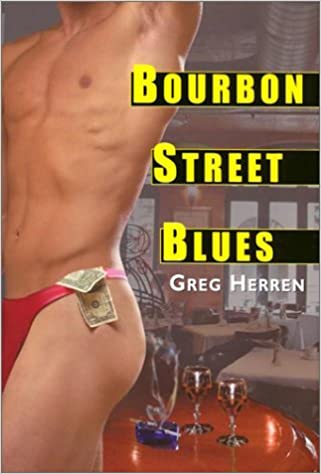
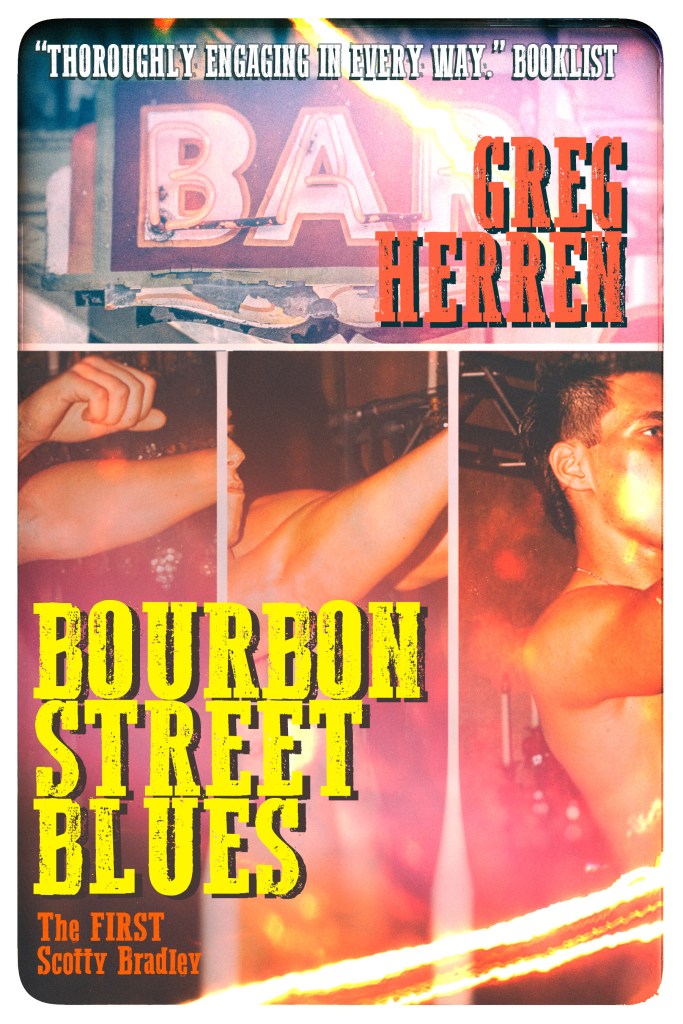
It was a Sunday afternoon, and Paul and I had somehow managed to get prime balcony standing spots–at the Bourbon Pub/Parade, right at the corner of St. Ann and Bourbon where the railing curves at the corner to head alongside the upper floor down the St. Ann side; so we could look down directly into the roiling mass of sweaty, almost completely naked bodies of hundreds of gay men from all over the country. That was my favorite spot for Decadence sight-seeing (Halloween, too, for that matter), and as I looked down into the crowd, I saw a guy in booty shorts and a very very loose fitting tank top, carrying a bag and trying to get through. I recognized him as one of the out-of-town dancers working at the Pub/Parade that weekend (I may have tipped him the night before) and as I watched in sympathy as he tried to get through that tightly-packed crowd of gays in various stages of being wasted, I closed my eyes and an image of him–or someone like him–fighting his way through the Decadence crowd while being chased by bad guys with shaved heads popped into my head just as Paul said, next to me, “You should really write a story set during Decadence” and then it popped into my head: someone escaping the bad guys has slipped a computer disc into one of the dancers’ boots on Friday night as he danced on the downstairs bar, and the bad guys want the disc back.

I didn’t have any way to write it down, obviously–I was wearing booty shorts, socks, and half-boots that came to my ankles, with nothing underneath the shorts and I had my tank top tucked through a belt loop like a tail in the back–yet even the title popped into my head: Bourbon Street Blues. The idea clearly stuck, because when I got home the next morning at about six or seven, dehydrated, drenched in sweat and having lost the tank top at some point during the night, I remembered it and wrote it down.

At some point over the next two years, I wrote a short story called “Bourbon Street Blues” about my stripper–only instead of being from out of town, I made him a local, filling in for someone booked from out of town for the weekend who had to cancel–and wrote about seven thousand words. It felt very rushed to me–the story–and I kept thinking it’s too long for a short story, it would have to be a novel but I also wasn’t sure there was enough story there for a novel. But I liked the idea, no one (at least, to the best of my knowledge) had written anything like it, and I thought, someday I’ll get a chance to write this story and develop this character.

Flash forward to 2001. This was during the time Paul and I had moved to DC to work for the Lambda Literary Foundation, we were miserable there and wanted to move back to New Orleans but didn’t have the money to do so, and the release of Murder in the Rue Dauphine was still at least a year away. I was talking to an editor on the phone about one of his new gay releases, and out of the blue I just pitched Bourbon Street Blues to him. He loved the idea, and asked me to write a proposal and email it to him. I had never written a proposal before, but I thought what the hell, how hard can it be? and so I wrote a two page proposal for the book. Two months later they made me a two-book offer–and the money was good enough to pay for Paul and I to move back to New Orleans as well as to live on for a while. I had only seen the book as a one-off, but they wanted a series. I needed and wanted the money, so I thought I can figure this out later and signed it.

Three months later, we moved back to New Orleans and I started writing the book.

The one thing I wanted to do with Scotty was make him unabashedly, unashamedly, gay. I didn’t want him to have any hang-ups, a sad backstory, or parental issues. I wanted him to be a free spirit who embraces life with both hands, lived in the Quarter, and loved having sex, loved being found desirable, and never really said anything or thought anything mean about anyone else. I made him a personal trainer, and his poverty–he agrees to do the dancing gig for Decadence because he’s behind on his rent and other bills; he teaches aerobics and was a personal trainer–comes from his grandparents freezing his trust funds when he dropped out of college to go to work for a booking agency for male dancers. He has since stopped doing that, but fills in when needed (and when he needs the money) at the Pub/Parade. I also based the shitty politician running for governor–and trying to mount a Christofascist takeover of the state, beginning with an attack on Southern Decadence–on an actual politician who ran for the US Senate shortly after we moved here; we saw him being interviewed on the news and couldn’t believe it wasn’t a joke, some kind of performance art–but forget it Greg, it’s Louisiana.

I also want to let you know that while I was working on this manuscript my first book, Murder in the Rue Dauphine, was released–and I got a “damned with faint praise” review from the Bay Area Reporter, which complained that “it would have been nice to see inside the heads of the other characters”, which took me aback as the book was a first person narrative, which made that impossible. What the reviewer I think was trying to say was that she wished the book had been told in the third person; that to her that would have made the book more interesting to her. But in my baby-author naïveté, all I could think was how can you see inside the heads of other characters in a third person narrative unless the main character was psychic?And the proverbial lightbulb came on over my head. Make Scotty a psychic. This was also an integral key to the puzzle of who Scotty was; the reviewer also yawned over my “gay stereotypes” in Rue Dauphine, so I decided to make Scotty the embodiment of all the worst stereotypes of muscular gay men who worked out and had a lot of sex. Just writing that down now, I realize how incredibly insane it was for me to use my new series book and character to respond to criticism o my debut novel; and when the book came out I braced myself for the inevitable backlash to come.

No one was more surprised than I was at how readers embraced him. The book got great reviews, even from Publishers Weekly and Library Journal (Kirkus, of course, has always pretended I don’t exist). Bourbon Street Blues was even nominated for a Lambda Literary Award for Best Gay Mystery of 2003 (I lost, I think to John Morgan Wilson?) shortly after the sequel, Jackson Square Jazz, was released.

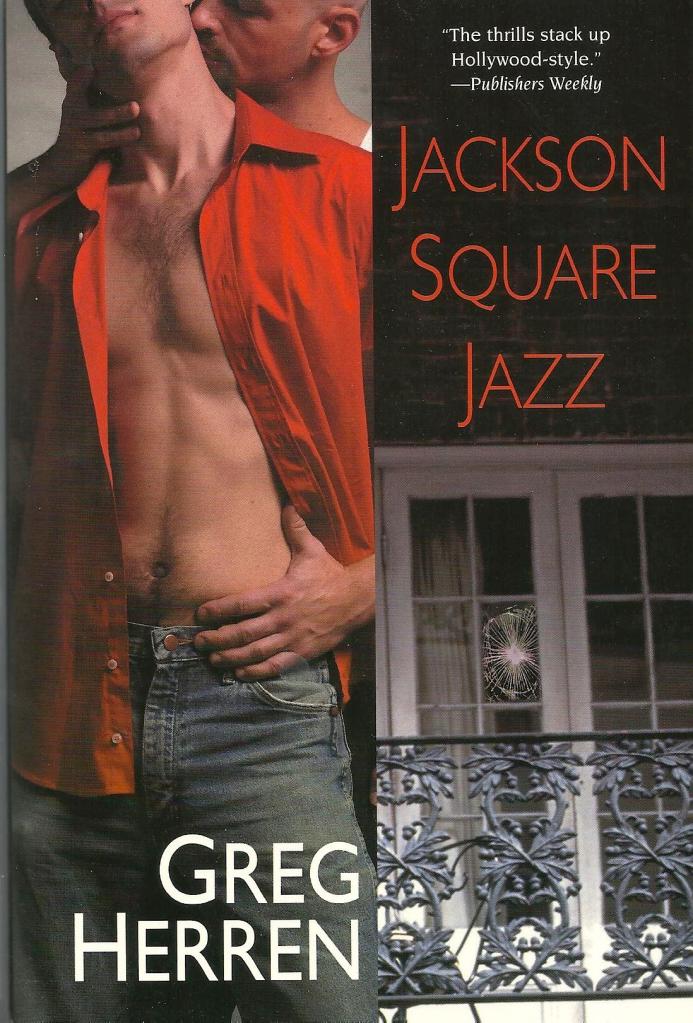
Jackson Square Jazz’s story was actually a recycled idea I had for a spin-off book for Chanse’s best friend Paige. The original concept was that someone would steal the Louisiana Purchase from the Cabildo–and somehow Paige stumbled onto the theft, and knew that the one on display currently there was a copy. (I was calling it, originally enough, Louisiana Purchase.) I decided to make that the basis of the second Scotty book. (This was inspired by a documentary I’d seen about the Cabildo fire of 1989–that may be the wrong date–and how the fire department tried saving everything in the museum before fighting the fire. I remembered how in the documentary they literally were placing historical objects and paintings against the fence at Jackson Square and thinking, anyone could have walked off with something during the fire…and my imagination immediately was off to the races.) Unfortunately, when I met with the museum director–whose actual first day on the job was the day of the fire–I found out that 1) the copy of the Louisiana Purchase at the Cabildo was actually only a replica and the original was stored in the weather-protected underground archive at the Library of Congress and 2) it was more than one page long–I’d imagined it was one large document like the Declaration of Independence; it is not. However–he also suggested I make the MacGuffin the Napoleon death mask–one of the three originals made when Napoleon died–and gave me some great backstory on it as well that I don’t remember if I used in the book or not; but it was a lot of fun talking to him (his name escapes me at the moment, alas) and was a great example of why it is important to actually do research and talk to people.

I also wanted to include figure skating–the working title for the book was Death Spiral, which the publisher made me change, asking for something alliterative, like Bourbon Street Blues–and so I decided to open the book with Scotty having a horrific hangover and then realizing someone was in the bed with him (it’s to this day one of my favorite book openings; what slutty gay man hasn’t been there?)…and then I remembered I’d introduced two love interests for Scotty in book one, and here he was in bed with someone else entirely. (The young man he woke up with was a figure skater in town to compete at Skate America, being held in the Smoothie King Arena.) I loved both of his love interests, and knew I was going to have to bring both of them back somehow, and then I was going to have to figure out which one he’d end up with. (Spoiler: I couldn’t decide, so he wound up with both of them.) I also threw in a ghost, a billionaire artifact collector, and pretty much everything but the kitchen sink. I turned in the book, along with a proposal for Book Three, in which I finally decided I was going to resolve the threeway relationship personal story, and that would be the end of the Scotty trilogy.

Man plans and God laughs. (Jackson Square Jazz was also nominated for a Lambda; I think this was the time I lost to Anthony Bidulka.)

Mardi Gras Mambo turned out to be an entire other kettle of fish.

I’m not entirely sure I remember exactly what the original plot of Mardi Gras Mambo was going to be, but I know it had to do with the Krewe of Iris (Scotty’s sister Rain belongs) and the book opened at the Iris parade on the Saturday morning before Fat Tuesday. It was due in June of 2004, and of course, I wasn’t nearly finished by the time Memorial Day rolled around, and was planning on asking for another month on the manuscript on the Tuesday after. Of course, that was the Memorial Day weekend when Paul was attacked and everything went to hell in my personal life. My publisher was incredibly kind; they took the book off schedule, told me to take care of Paul, and get the book done whenever I got the book done.

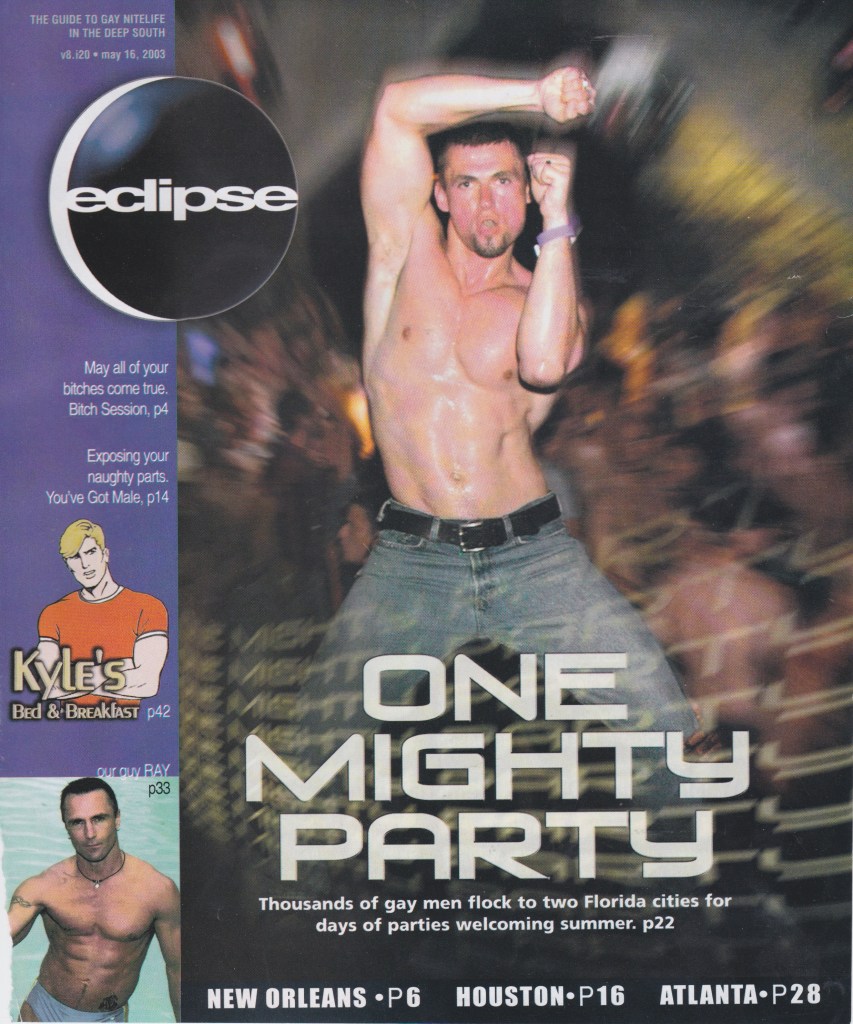
I started writing it again in January of 2005, shortly after I began keeping a blog in order to get me writing again. That was when the Christian/Virginia nonsense happened, and everything got derailed again. When I started writing the book again, I threw out everything except that first chapter at the Iris parade–which did wind up in the final book–and I do not recall what the second plot I chose to write was at this time, other than I knew I was bringing in a Russian character, inspired by someone I’d seen around in the bars for years and had always been just awestruck by his body–and yes, that Russian turned out to eventually be Wacky Russian, my personal trainer. I actually kept this as an inspiration–Eclipse used to be the nightlife insert for IMPACT News, a queer newspaper that died out in the early aughts:

Finally, it was April 2005, and I started writing Mardi Gras Mambo again. I had the plot all figured out–it was completely insane–but I also realized I couldn’t end the personal story with Scotty the way I had hoped and wrap it all up with Book Three. There had to be a Book 4, and so when I finished the book at last and turned it in, I included a proposal for a fourth Scotty, Hurricane Party Hustle–which was going to be set during an evacuation for a hurricane that missed New Orleans…I always thought it would be interesting to write a mystery story set during such an evacuation.

Of course, I turned the book into Kensington on August 14th, 2005. Fourteen days later, Paul, Skittle and I fled from New Orleans in the face of Hurricane Katrina.

I wouldn’t come back for good until October 11. Paul didn’t come home until after Thanksgiving.

Of course, I wrote to my editor a day or so after the levee failure to say, well, I don’t think I can write that book I proposed now.

I didn’t see, for a very long time afterwards, how I could write another Scotty book–light, funny, zany–in the aftermath of Hurricane Katrina. Then one day I was walking to work from where I’d parked my car and some people on bicycles came riding toward me. They smiled and waved and I smiled and waved back…and realized oh my God, that was Brad and Anjelina. Their house wasn’t far from my office–in fact, it was quite literally around the block from where Scotty lived–and I thought, you know, Brad kind of looks the way I describe Scotty–wouldn’t it be funny if someone tried to kill Scotty because he looked like a movie star who lived in his neighborhood? The more I thought about it, the funnier it became, and I started writing the proposal for Hollywood South Hustle when I got home from work that night. I was so certain they would take it that I started developing the characters and writing out a detailed synopsis…and they turned it down.

I wasn’t expecting that, but it was a marketing decision. Even if they signed the book immediately, it would still be another year before it would come out, and they felt by then Scotty’s audience was long gone, if it wasn’t already. It was disappointing, but right around the same time Alyson came back to me for a fourth Chanse book but they needed it right away–like within ten weeks–so I turned the Scotty story into Murder in the Rue Ursulines. I finished the book, turned it in, and figured the Scotty series was dead, alas.

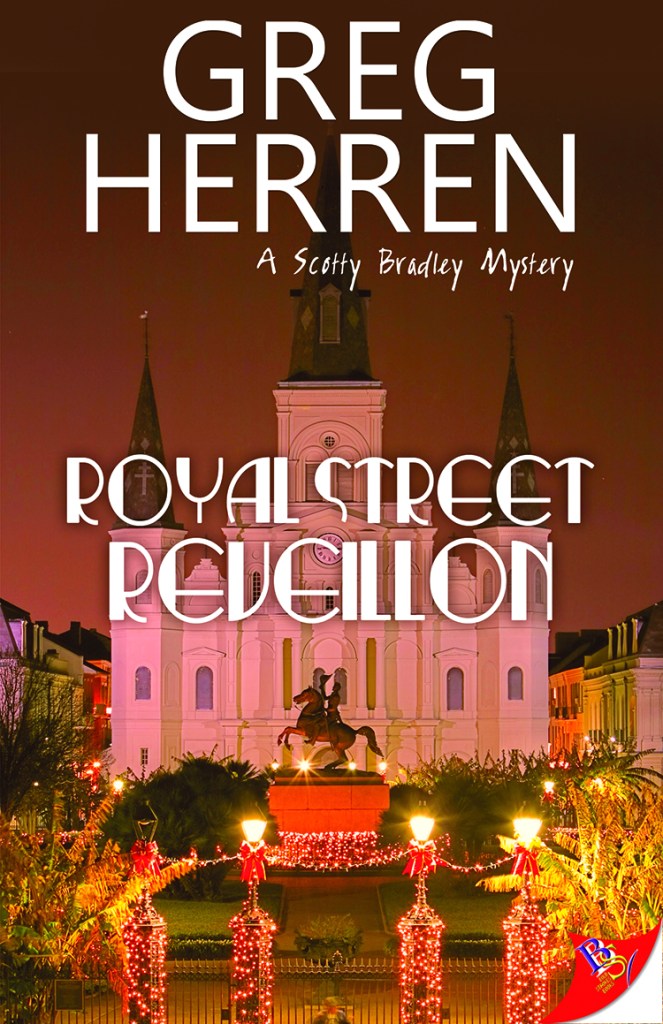
Shortly thereafter, during the Gay Easter Parade an idea for a different Scotty book occurred to me . The parade was over and I was walking back to my car to drive home when I walked underneath a balcony…just as they started watering their plants. I got soaked–you can’t get mad, it happens in the Quarter periodically and it’s just one of those New Orleans things–and I thought, you really need to write about this. As I walked to the car, dripping, I pictured Scotty hurrying to catch a ride on his parents’ business’ float for the Easter Parade–and of course, he’d wear a white bikini, rabbit ears, and have a rabbit tail–when the exact same thing happened to him, only his bikini would become see-through when wet. By the time I’d driven home, I’d figured that the person on the balcony would be an old friend of his parents’, he’d invited Scotty in to dry off, and when Scotty was on his way home from the parade, the cops would be there because the friend had been murdered. Using The Moonstone as my inspiration, I came up with another MacGuffin story, a way for Colin to come back and explain everything that happened during Mardi Gras Mambo, and I had the perfect ending to Scotty’s story. I just didn’t have a publisher.

But Bold Strokes Books, a primarily lesbian publisher, had started doing books by and about gay men. I’d taken an erotica anthology to them when it was orphaned by the death of its original publisher, and so I wrote and asked if they wanted a Scotty story. They did, and thus Scotty came back to life one more time…and I figured that was the end of it. I wrapped up the personal story about the three-way relationship in a way that was organic and made sense; and I also added a new wrinkle to Scotty’s personal life: Frank’s late-in-life decision to become a professional wrestler. (One of the things we locals learned from Hurricane Katrina was to not put off following or chasing dreams or goals; my attitude thus became go for it and I started chasing down dreams I’d pushed to the side for years.) Mardi Gras Mambo and Vieux Carré Voodoo were both nominated for Lambdas, but at this point I can’t remember who I lost to in both of those cases–for the record, Lambda has never rewarded a Scotty book with an award–probably because they are inevitably funny and over-the-top, which never wins awards because funny is seen as “not serious,” despite the fact that humor/comedy is much harder than drama/tragedy.

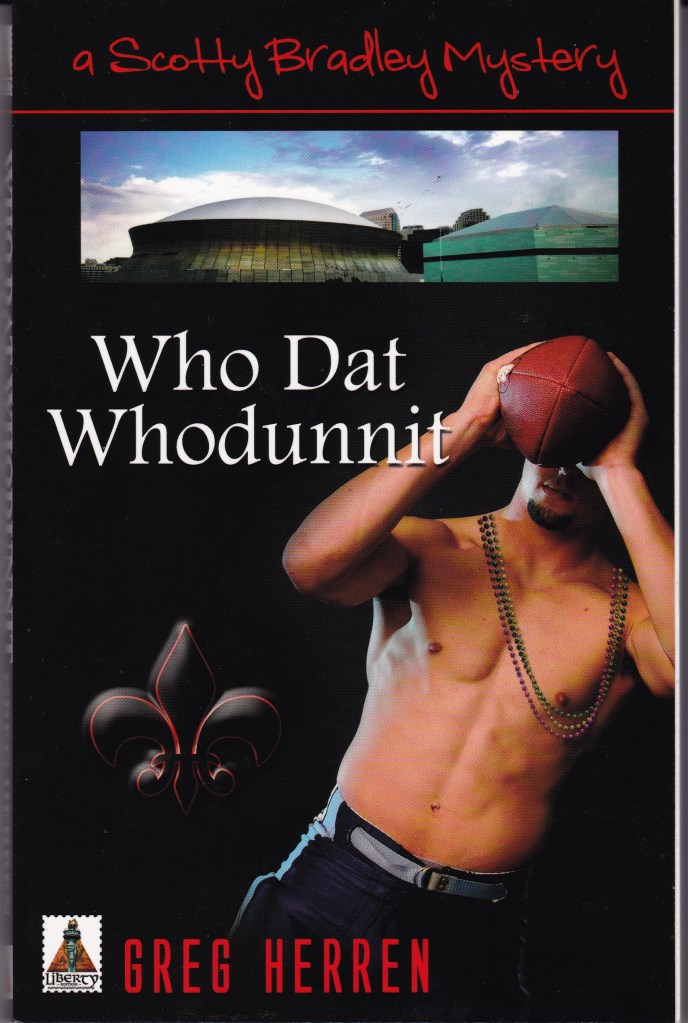
I didn’t think I was going to write another Scotty book then, either. But then something miraculous happened: the New Orleans Saints won the Super Bowl, and I wanted to write about what it was like to live here during that incredible time. It didn’t seem like the right story for another Chanse book, so I thought, well, I can pull Scotty back out and write it from his point of view.

And of course, Who Dat Whodunnit was just sitting there for the title. How could I not write that book?

I had already established over the course of the series that the two sides of his family–the Diderots (maternal) and the Bradleys (paternal) didn’t really get along. The Diderots go back to Iberville and the 1718 settling of New Orleans; the Bradleys were Americans who came after 1803, and thus are not only parvenus to the aristocratic Diderots, but also l’Américains. Perish the thought! We’d also established that the Diderots were not nearly as conservative as their State Street living in-laws, but we’d never actually seen much of the Bradley side of the family, so I thought why not do the Bradleys and let us get to know the other side of Scotty’s family? It was around the same time I started reading about a megachurch out in Kenner (or Metairie? I don’t recall) that was rising to prominence in local politics and was, as you can imagine, homophobic. The same-sex marriage wars were also being fought at this time; and during one of those pageants (Miss America? Miss USA?) the reigning Miss California was asked about same-sex marriage during the question portion by judge Perez Hilton (why was he judging a beauty pageant for women is a mystery for the ages) and she responded that her faith had taught her that marriage was between a man and a woman (the audience started jeering) and she apologized by saying “I’m sorry, but that’s how I was raised!” She wound up as First Runner-Up, and some felt, rightly or wrongly, that her “politically incorrect” answer cost her the title. In some ways, I felt bad for her (although it’s not my fault it’s how I was raised I have always thought was an incredibly stupid thing to say; you have free will, and you should be capable of making up your own mind rather than simply parroting things without question you were raised to believe. So if your parents were racist white supremacists…) but then of course, the Right tried to turn her into a martyr and heroine, and she dove right into that headfirst, erasing any sympathy I might have felt for her (I still think the question was inappropriate for a pageant, as would be anything polarizing–and yes, well aware that same-sex marriage shouldn’t be polarizing, but here we are), and of course, Miss Upright Moral Christian had a bit of a shady past that eventually came out and that was that. I decided to base the murder victim in the book on this girl, and tried to explore the influence of this megachurch on her. I also gave Scotty a first cousin who was the darling of the Bradley grandparents because he was a jock and was on the Saints team as a player–but also a homophobic asshole. The Bradleys were like something out of Tennessee Williams–I think I even named Scotty’s uncle (the football player’s dad) Uncle Skipper as an homage to Cat on a Hot Tin Roof.

There’s a lot of story there left in the Bradley side of the family, now that I think about it–and I’ll be digging into that in the new one, rest assured!

Funny story: After I wrote Who Dat Whodunnit, I decided I was not going to write another Scotty book. This had been Book 5 of what started as a stand-alone and then became a trilogy and yet somehow, I’d kept going on top of that. I kind of felt played out a bit with Scotty, and the longer the series went on, the more problems I was having with things like character ages–Scotty was getting older, which meant his parents were getting older, which meant his grandparents were getting older, too. I didn’t want to deal with the deaths of his grandparents (or Aunt Sylvia, who was his grandmother’s age and had married Uncle Misha), and so I had two options: pretend they weren’t getting older and not talk about their ages, or let the series go. I was still writing Chanse at the time, and I kind of figured that would be the series that went on longer. But I was on a panel at Saints and Sinners and someone from the audience asked me if there would be another Scotty.

GREG: Probably not, but if I can figure out a way to include Mike the Tiger (the live tiger mascot at LSU), Huey Long, and a treasure hunt for Huey’s deduct box, I will.

(I had read T. Harry Williams’ award winning biography Huey Long and had become fascinated completely with him. All I had known about Long going into reading that biography was that he’d been a demagogue (thanks, US History textbook from high school) and Robert Penn Warren’s All the King’s Men had been loosely based on his life and career. Mention Long’s name to anyone and they immediately reply with “oh, he was so corrupt”–which amused me, since every Louisiana politician is corrupt to a degree–and I knew Roosevelt and others had worried about him as a populist politician who reminded them of Hitler (and the way he crushed his opposition in Louisiana and essentially became the state’s dictator, who could blame them?), but what was the real story? And Huey Long made me start to have what was at first a grudging admiration for him which grew into a kind of fandom the more I learned. (There are some similarities–more than one would think–between Long and LBJ in the Caro biographies, as well as with Robert Moses, another Caro biography; which would make for a very interesting comparison/contract essay at some point.) But the more I read about Long, the more I wanted to write about him. He fascinated me, and the fact that his trove of cash–the deduct box–was never recovered after his murder was even more fascinating to me.)

And don’t you know, later that night, it came to me. A few months earlier there had been a bomb threat at the LSU campus, and there had been some controversy about how the administration had handled the situation–they’d evacuated Mike the Tiger off the campus before the mass evacuation call for the students. It made sense to me (but I didn’t blame the students for being upset because it absolutely looked like the administration cared more about the tiger’s safety than the students’)–in the chaos of evacuating the campus, getting the tiger out safely would have been a nightmare, and God forbid something happen and Mike got loose. Then it hit me: what if some animal rights’ activists had staged the bomb threat in order to steal the tiger in order to set him free somewhere? (Mike is a frequent target of PETA, who often calls for him to be released into the wild–not in the US, of course–, or sent to a big cat sanctuary.) So, I had the tiger kidnapped, and since Huey Long was responsible for LSU being what it is today, it only made sense for the treasure hunt to have to do with his missing “deduct box”–Huey always used cash, after his assassination the deduct box containing thousands and thousands of dollars in cash disappeared–and there we had it: a plot involving Mike the Tiger, Huey Long, and the deduct box.

This was also the book where I decided to extend Scotty’s family a bit further by adding a new, younger gay character to the mix: Taylor, Frank’s nephew, disowned by Frank’s sister and her homophobic husband after he comes out to them after a semester in Paris, and so he comes to live with Scotty and the boys in the house on Decatur Street. I wanted to bring in someone younger, and gay, with literally hardly any gay experience in the world to reflect the change between generations of gay men and how they view being gay and the rest of the world.

I also figured this would be the last one, but like I said, Scotty just won’t go away.

SIDENOTE: I had to write to the administrators of the Huey Long website for permission to use some quotes from the site in the book. Needless to say, they were very wary of me when they responded, so I emailed them the chapter where I would use the quotes–Scotty was doing some research on Long, and came across the website. Like me, Scotty had always been told Long was corrupt and a demagogue…but demagogues also don’t get things done, which Long did. Some of Long’s programs–like the Homestead Exemption–still exist as public policy in Louisiana. They wrote me back, granting permission…and that was when I found out the person I was talking to was Long’s great-granddaughter, who was rightfully suspicious of anyone writing about her great-grandfather. I sent her a copy of the book when it was finished, and she sent me a lovely thank you card, which is probably one of my favorite writing souvenirs.

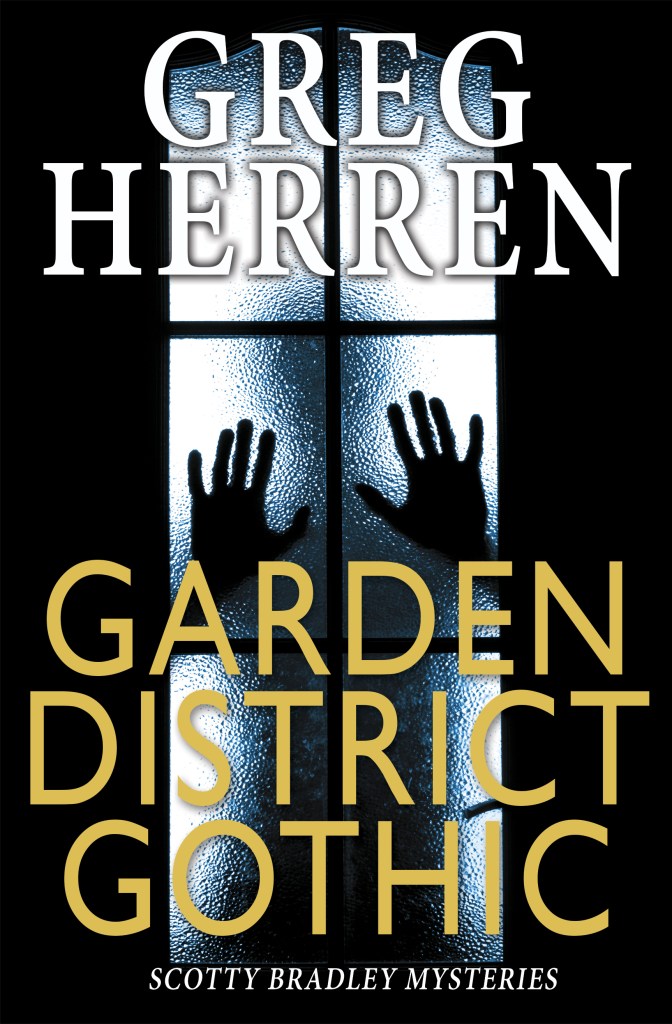
The genesis of Garden District Gothic was weird, but yet serves as yet another example of my adage never throw anything you’ve written away.

I had always wanted to spin Chanse’s best friend, journalist Paige Tourneur, off into her own series. I had always intended to do so; from the first time I thought her up for Murder in the Rue Dauphine I thought, “she’s fun and witty and interesting and that weird name–there’s so much more story there than we can get to as a supporting player in a series about someone else.” I have so much written down about Paige and her origin story; how she came up with that name and why; how she wound up at LSU; and so on and so forth. A friend started an ebook publishing company, and wanted me to write Paige novellas for her; I did two–Fashion Victim and Dead Housewives of New Orleans–but the sales, frankly, weren’t there and I didn’t have the necessary time to put in marketing them to help drive the sales, so even though I’d started a third, The Mad Catter, we agreed to kill the series and pull the first two from availability; ultimately, I was working too hard for too little pay-off. I was disappointed, obviously; Paige was kind of a passion project for me–I’d made any number of false starts writing a series book for her, and it was sad to see that there wasn’t an audience for her after all. But I had about four chapters of The Mad Catter in place, and I didn’t want to waste the time spent on them…so I decided to turn them into a Scotty book, which became Garden District Gothic.

I also brought in a new character–a true crime writer with a shady past of his own–who actually wrote a book, a la Midnight in the Garden of Good and Evil, about the case. The name of his book? Garden District Gothic. I brought him in, thinking I would spin him off into his own book/series–I thought it might be fun to write about a writer…(I thought about using him as the main character in another book based on an actual unsolved string of murders in a rural Louisiana parish, but very quickly realized he was simply an amalgamation of Scotty and Chanse, so that book–The Bodies in the Bayou–went onto the backburner. I think I may have created the character before, in the Chanse series, but I could be remembering that wrong. I also used this book to sort of set up the next; I will explain that further when I am talking about Royal Street Reveillon. I also crossed the character of Paige Tourneur over from the Chanse series into the Scotty series (I loved the character, hated to sideline her after I ended the Chanse series and the novella series didn’t pan out); not that she will be a big part of the Scotty series, but hey, every so often I need a journalist, and why not use a character I am very fond of already and wasn’t ready to stop writing about?

The book was loosely based, obviously, on the Jon-Benet Ramsey case–a decades old notorious murder of a child in the Garden District that was never solved. I wanted to examine and explore issues of class in New Orleans, but I am not entirely sure I pulled off what I intended with the book.

Then again, I think that with every book, don’t I?

And we now come to the (so far) most recent book of the Scotty series, Royal Street Reveillon.

Originally I’d envisioned the Scotty trilogy (when it morphed from a stand-alone) as encompassing the three big gay holidays in New Orleans: Southern Decadence, Halloween, and Mardi Gras. Jackson Square Jazz wound up taking place just before Halloween, alas; Scotty talks about their costumes in the epilogue, but I hit the other two holidays out of the park. When I added a fourth book, I tied it to the Gay Easter Parade–Scotty is on his way to ride on the Devil’s Weed’s float when the book opened–and then of course the next book was sort of Christmas/sort of Mardi Gras/sort of the Super Bowl. Baton Rouge Bingo was the first book that wasn’t tied to a holiday of some sort; neither was Garden District Gothic. But for the next Scotty book, I wanted to do a Christmas book. I’ve never really written much about Christmas, and I do love the season, especially in New Orleans. I wasn’t sure what kind of plot I was going to use, but I knew it was going to be set during Christmas season and I knew I wanted to use reveillon, the Christmas season meal you use to break your fast for Mass, in the title. I had introduced one of the characters from Dead Housewives of New Orleans in Garden District Gothic, so it only made sense to me (or so it seemed at the time) for me to take the framework of Dead Housewives–the entire Real Housewives spoof I wanted to write–and build this new story around it. I changed a lot–made the overarching story much more complicated, and especially complicating the “whodunnit” aspects of the three murders that all occurred within twenty-four hours of the premiere party for Grande Dames of New Orleans.

I also did a couple of horrible things to Scotty and his loved ones over the course of this book…which will have to be dealt with in the new one, alas. I hate when I do this to myself! But with Royal Street Reveillon and its darker themes, I wanted to show how much Scotty has grown and changed over the course of the series; he’s evolved as a person, partly because of the changes to his life and partly because of what he experiences through the murders he finds himself involved in. Do I wish, as I start writing Mississippi River Mischief, that maybe I hadn’t given so many growth opportunities over the years to Scotty and his gang of family and friends? Absolutely. But that’s part of the challenge of writing a series, and what makes it so much fun.

*Funny story about the original cover of Bourbon Street Blues. Back in the day, publishers used to meet with reps from Barnes & Noble and Borders to show them covers and get their input; covers were changed based on those meetings. The Bourbon Street Blues cover was so in-your-face it took me aback when I first saw it; and they had toned the original image down dramatically, mainly smoothing down the bulge so it wasn’t so in-your-face. The Barnes & Noble buyer told them, “he needs a bigger bulge” so they made it bigger–but were still cautious; the image’s original bulge was still bigger. I do think that story is hilarious.

Sleeping Angel

I originally started writing Sleeping Angel in 1994.

That seems like such a long time ago, too. I hadn’t met Paul yet, was still working for that wretched airline at the airport, was broke broke broke and often ran out of money long before payday, and any kind of decent life for me seemed impossible. It was the next year I decided to snap out of the constant feeling sorry for myself, and instead of waiting for the world to come knocking on my door to make my dreams come true, that the only person who could make my dreams a reality was me, and that I needed to make the changes necessary to my life if I were going to become a writer for real–like stop dreaming about it and writing now and then, and start taking it seriously and writing all the fucking time, and trying to make it happen–which meant sending things out to try to get them published.

It’s weird how you forget things about books you’ve written until something out of left field reminds you of something. Julie Hennrikus, during our Sisters in Crime podcast interview, asked me about writing young adult fiction, and how I came to do that. The story is very simple, really; after discovering Christopher Pike and R. L. Stine and other young adult authors who wrote young adult novels that were either crime or horror or a cross of the two, I decided to take the book I was writing at the time–Sara–and write it as a young adult novel instead of as one for adults. It really didn’t take a lot, to be honest–I removed the framing device that firmly set the book back in the 1970’s–and turned it into a modern day story about teenagers (which it always was). After I finished Sara, I wrote another called Sorceress–and when I finished it, I began writing Sleeping Angel. I still didn’t have a strong grasp of how writing actually worked (which is kind of embarrassing when I remember how naive and stupid I actually was back then, but what did I know. seriously? Very little.) and so I never rewrote anything; I just printed them (I had bought a very inexpensive word processor that I loved, and wrote on) out and saved the originals. I was about half-way through Sleeping Angel when I discovered there was such a thing as queer crime novels…so I abandoned writing young adult fiction and started thinking more in terms of writing a gay private eye series…which eventually became the Chanse MacLeod series and Murder in the Rue Dauphine.

Flash forward another decade or so, and in the spring of 2005 I attended BEA and the Lambda Awards in New York. I lost twice that year (Best Gay Mystery for Jackson Square Jazz and Best Scifi/Fantasy/Horror for Shadows of the Night) and then on Saturday night I attended a cocktail party for the Publishing Triangle. (It was at this party that I met both Tab Hunter and Joyce Dewitt.) I also met a very nice man who was familiar with my work, and asked me if I had ever considered writing young adult fiction with gay characters and themes? I laughed and replied that I had two completed first drafts and a partial for another in a drawer back home; he then gave me a business card and told me he would love to take a look at them with an eye to publishing. I lost the card years ago, probably in the Katrina aftermath, but he was an editor for Simon and Schuster Teen, which was very exciting. I told him I would revise one and send it to him as soon as I finished Mardi Gras Mambo, which was at that point over a year overdue (I didn’t mention that part). This was exciting for me, as one can imagine; another opportunity gained by simply being in the right place at the right time, which has been the story of my career pretty much every step of its way. Once I finished Mardi Gras Mambo that August, I started revising Sara.

And then came Hurricane Katrina, and everything went insane for a few years, and I abandoned the attempt to rewrite Sara. There was just too much going on, I was displaced and finding it hard to get back into writing, and I just wasn’t in the right place emotionally to revise or rewrite a book. I’ve always regretted that last opportunity.

Flash forward another year or so and I casually mentioned to a friend this missed opportunity. What I didn’t know when I mentioned it (bemoaned it, really; I still regret this lost chance) was that she had been working for another publisher as an acquiring editor for young adult/children’s work. “Would you rewrite one of these for me? I’d love to pitch this to the company.” So….rather than Sara, I went with a rewrite of Sorceress, which had a teenaged girl lead character and I didn’t see any place to add queer content (I’d been adding that to the revision of Sara ) and sent it to her. Alas, before she had the opportunity to pitch it the line she acquired for was closed down and that was the end of that….until a few years later when she decided to start her own small press for juvenile/young adult fiction, and wanted Sorceress. I sent it to her, we signed a contract…and then I realized I needed to let Bold Strokes Books know I was doing this. I emailed them, and they replied, “You know we do young adult?”

Well.

I wrote back and mentioned I had two others collecting dust, and so I contracted both Sara and Sleeping Angel with them. I decided to do Sleeping Angel first–which is odd, as I didn’t even have a completed first draft; I don’t remember why I decided to do this, frankly–and so I started writing and revising.

The really funny thing–just looking at the cover for the book–is that the character name “Eric Matthews” was one I came up with when I was in college; I had an idea for a book set in my fraternity, and came up with three names for characters that were pledge brothers and friends: Eric Matthews, Chris Moore, and Blair Blanchard. I used Eric and Chris for Sleeping Angel (completely forgetting that I had already used those names in Every Frat Boy Wants It a few years earlier), so yes, even though the fraternity books I used were by “Todd Gregory”, I accidentally re-used the character names.

Whoops.

The original intent with my young adult fiction was to connect it all together, the way R. L. Stine did with Fear Street, and sort of how all of Stephen King’s work is as well. The three books I started with–Sara, Sorceress, and Sleeping Angel–were connected, and were the springboard from which the others would come–or were supposed to come, from. Sara was set in rural Kansas. The main character of Sorceress moved from rural Kansas to a small town in the mountains in California, Woodbridge, which was also where Sleeping Angel was set. The main character of Sara moved to Kansas from the Chicago suburb where the main character of Lake Thirteen was from, and so on. (Likewise, the main character from Dark Tide was also from the same county in Alabama where Bury Me in Shadows took place, and #shedeservedit was set in the town that was the county seat for that rural Kansas area where Sara was set.) I’d consciously forgotten that, but fortunately my subconscious still holds on to things the forefront of my brain doesn’t.

When I originally envisioned Sleeping Angel back in 1993 (or 1994, I don’t remember which), the concept I wanted to explore was something, a concept, that Dean Koontz had used in his book Hideaway–that someone was in a car accident and died, only to be resuscitated by the EMT’s. But when he came back to life, he brought back something with him from the other side that gave him a psychic connection with a serial killer. It was an interesting idea–I wasn’t using the serial killer thing–but I loved the entire concept of someone being brought back with something extra (which, now that I think about it, is also the entire conceit Stephen King built The Dead Zone around). I decided to keep the car accident to open the book in the new version, but the opening I originally wrote had to be tossed. I also came up with an entirely new concept for the book: what if you were in a bad car accident, but there was a dead body in the car who was NOT killed in the accident but had been shot and was already dead when the car crashed? And if the main character has amnesia….who killed the kid in the back seat?

And away we went.

He was driving too fast, and knew he should ease his foot off the gas pedal, bringing the car down to a safer, more manageable speed.

But he couldn’t bring himself to do it.

“Hang in there, buddy,” he muttered grimly under his breath, taking his eyes off the road for just a moment to glance in the rearview mirror into the backseat. What he saw wasn’t encouraging. Sean’s eyes were closed, and he couldn’t tell if Sean was still breathing.

The blood–there was so much of it, and it was everywhere.

He swallowed and took a deep breath, trying to hold down the panic. He had to stay calm. He couldn’t let the fear take over, he just couldn’t. He had to hold himself together. He had to get to town, to get Sean to the hospital before it was too late–if it wasn’t already too late.

Not a bad beginning, right? Pulls you right into the story.

I don’t remember what–if anything–I was expecting when Sleeping Angel was finally released (it actually wound up coming out before Sorceress, ironically); it had not even been six years since the right-wing homophobes had come for me for daring to accept an invitation to speak to high school students in a Gay-Straight Alliance. And now I’d actually dared to write a book about teenagers, for teenagers. The horror! But the book come out and there wasn’t even the slightest whisper of controversy about the “gay pornographer” writing a y/a book. It got really good reviews for the most part, people really seemed to enjoy it, and it eventually won a gold medal for Outstanding Young Adult Mystery/Horror from the Moonbeam Children’s Book Awards, which I’d never heard of but was kind of a big deal, or so I’m told. The gold medal was nice, too–very pretty (but it’s not the rock from the Shirley Jackson Awards–the smooth polished stone I got for being a finalist may be my favorite thing I ever received as recognition for my writing).

I’m still pretty proud of Sleeping Angel.

One More Big Time Rock and Roll Star

And now it’s Friday, Three Day Weekend Eve.

It rained again yesterday, so it wasn’t terribly awful while running my errands after work last night. I came home, put away dishes and did some laundry, provided a lap for Scooter–who stayed there all night, and even when I would get up he would just jump back into my chair and go back to sleep (Paul didn’t get home from work until after I’d gone to bed, so he was feeling abandoned the way he always does when there’s only one of us at home), and did some more brainstorming and plotting for the stuff I am working on. I feel good and rested again this morning (I did get a bit tired yesterday afternoon), and hope springs eternal for another productive long weekend at home. The theme for the weekend is clearly editing, since i have copy edits for two manuscripts to start working through, and two short stories to edit–I also need to go through my “call for submissions” folder and see what is possible and what is not ( as well as tossing the ones that have already passed).

It seems weird to be celebrating Independence Day this year, since the radical, highly politicized “supreme” court continues to demolish every right and protection anyone non-white and not male have fought for and earned since the second World War–even going back as far as JOHN FUCKING MARSHALL to overturn decisions–as they work to establish a Fascist state once and for all. I was thinking about this last night while watching Real Housewives Ultimate Girls’ Trip 2 and remembering why I didn’t miss seeing Jill Zarin on my television, and I was also thinking about memoirs and memories and writing about my life. One of the primary reasons I’ve always backed away from it (and yes, I am aware that I am talking about being reluctant to write personal essays about my past and life in MY FUCKING BLOG) is not only because I know my memory to be faulty, but also because I know that–like most other people–I also have a tendency to rewrite my memories to make me look better or to justify bad behavior on my own part, and that isn’t fair to the other people in said memories who don’t have a platform (no matter how small) to tell their side of the story (which has also been undoubtedly rewritten in their own minds to make themselves look better). No two people ever see the same situation exactly the same; our interpretations and reactions to things are often predicated and formed by our life experience, our education, our opinions, and our beliefs and values that have also developed over a lifetime. An event that may have seemed completely throwaway and inconsequential to one person can be life-changing to another.

I’ve also begun recognizing and finding holes in my memory. For some reason I had always believed we’d moved, for example, from the south side of Chicago to the suburbs in the winter of 1969. That was firmly cemented in my brain as fact…until a year or so ago when I realized I was ten when we moved to the suburbs, which means we didn’t move out there until the winter of 1971. That’s a significant difference, which has skewed the order of memories in my head.

Some friends have been encouraging me to write personal essays, but I’m not really sure I should or not. For a long time I shut the door on my past as much as I could; it was painful to remember and it was simply easier for me to shove everything into a corner of my brain and lock the door behind them. When I started rebooting my life at age thirty-three, I still looked back a lot with sadness and heartbreak and bitterness–but I also began trying to put it all behind me at the same time because it was sad and heartbreaking and I didn’t want to be trapped into that quagmire of negativity. After Paul and I had met and we’d moved to New Orleans and my new life was beginning to take shape–the life I’d always wanted and had dreamed of for years; those dreams sustaining me through even the darkest of times–I decided to put it all behind me once and for all, deciding that I loved my life and was very happy with it, which meant that everything that had happened–no matter how terrible–was necessary to put my feet firmly on the path that led to my happiness and so therefore I should have no regrets about anything. It was helpful to distance myself from my past and never look back, so I tried never to do so. But now that I’ve reached sixty–I’ve started reflecting about the past a lot more over these past few years, plus writing my last two books (Bury Me in Shadows and #shedeservedit, respectively) required me to start digging around in those inner rings of the giant redwood of my life, as did watching It’s a Sin, which, despite being set in London, took me back to the 1980’s and brought a lot of painful memories back. It made me realize that while that coping mechanism of “no regret, not looking back” was necessary for my growth into who I am now, and for me to build a writing career, it wasn’t long-term healthy because a lot of unprocessed pain, anger and grief (and joy and laugher, as well) had never been recognized, processed, dealt with, and moved on from. I think part of the reason I decided to finish those two in-progress-for-years books was precisely so i could start processing and dealing with my past…and sometimes that means revisiting painful memories. It’s also part of the reason I moved “Never Kiss a Stranger” up on the lengthy list of things I want to write and finish and get out there; I want to remember the mentality of what it was like to be a gay man in New Orleans in 1994, just really coming to terms with your sexuality after being closeted at least most of the time for most of your life, and beginning to explore what it means to be gay while the specter of AIDS hung over your head like a death sentence just waiting to be pronounced. As prevention and treatment options continue to lower the risk of infection as well as the threat of death over the last decade or so, people are slowly beginning to forget what it was like back then–and the literature of the period is going out of print and disappearing. I now have clients who don’t remember what it was like because they weren’t alive then, and while it is so wonderful and lovely that they didn’t come out and experience life with that shadow hanging over their heads, periodically I feel a bit of pang remembering all those wonderful bright lights that were extinguished so cruelly, and the old embers of white-hot anger at the societal and governmental neglect, often deliberate and intentionally cruel, that allowed them all to die returns.

Which is why unveiling a commemorative stamp honoring Grendel’s mother, aka Nancy Reagan, during Pride Month was tone-deaf as well as a slap in the face to those of us who survived in spite of that miserable bitch and the raw sewage she married.

I also think this most recent pandemic and the memories it stirred up, timed with watching It’s a Sin and some other things, is why I am so exhausted all the time (well, that plus being sixty); it’s a sign of depression from all of the unprocessed emotions and feelings from locking away my past and turning away from it. It may have been necessary in 1995 to move forward, but it wasn’t healthy, and the longer I kept those memories locked away without dealing with them the worse it became. So I am going to set a goal of trying to write an essay every two weeks about something from my past, unlocking a memory and trying to find the meaning in it, how it impacted and affected my life–and not with regret, but with the cold, unflinching eye of the non-fiction writer. I also feel like something snapped inside my head this past week–I know how weird that sounds–but Wednesday I was really down. Memories flashing through my head, triggered by the reversal of Roe (I remember a pre-Roe United States, and also remember when the decision came down) and what that meant for other decisions revolving around personal privacy/freedom and government overreach. The four or five days following the Dobbs decision were dark ones for me (I cannot imagine what they were like for women), and yet, somehow, in writing something Wednesday afternoon something snapped in my head and I got past it all–and I realized I’d been dealing with a lot more anxiety and depression than I thought I was (and I thought I was dealing with a lot as it was). I have felt much better since getting over that hump on Wednesday, but I am also not foolish enough to think I am past it all, either–it will come back.

If I learned anything from Hurricane Katrina, it’s that trauma and depression come in waves. There will be good days, and there will be bad days. I usually deal with darkness by writing–not writing makes the darkness even darker–which is something I also need to remember: writing always makes things better for me.

And on that introspective note, I am heading into the spice mines.

Boogie Fever

In March of 2020, something I had only been vaguely aware of became something I was acutely aware of, seemingly overnight: the world, in fact, shut down in the face of a virulent and potentially deadly disease that was communicable. I went to work one morning and all of our appointments had been cancelled; they’d put up shields everywhere in the testing rooms and at the front desk; and after we were there for about a couple of hours the word came down from the chief medical officer: we were shutting down. It happened so fast my head spun. Within days the Tennessee Williams Festival was cancelled, the Edgar banquet was in jeopardy, and false information was spreading even more quickly than the virus. I also remember thinking that the measures we were taking as a country were so drastic that “surely it would be over in a few weeks.”

Ah, naivete.

Stressed out and concerned about everything and everyone, I did what I always do in stressful times: I turned to books. And, as is my wont, I decided to read about plagues. I got down my copy of Barbara Tuchman’s A Distant Mirror to read the bubonic plague chapter again; I have a copy of a book called The Black Death (whose author I cannot recall) that I also read; I revisited The Stand by Stephen King (an all-time favorite of mine); Thomas Mann’s Death in Venice; Camus’ The Plague; and even got down Katherine Anne Porter’s short story collection to reread “Pale Horse Pale Rider.” I was, as you can obviously tell, interested in seeing how previous plagues had been dealt with, survived, and the changes they wrought on civilization and society. I also wondered how to write about the pandemic (it not being my first pandemic, either; I always felts queers of a certain age were a little better prepared for the coronavirus outbreak than the rest of the world because we’d already been through HIV/AIDS), and if I would eventually; I wrote a short story called “The Flagellants” which I hope to publish someday somewhere, probably in a short story collection of my own, and even came up with an idea for a Scotty: Quarter Quarantine Quadrille.

But I was also seeing people saying they wouldn’t read fiction set during pandemic times; and other authors shying away from it. I kind of shook my head but understood; I remember how New Orleans writers didn’t want to deal with Hurricane Katrina afterwards–I certainly didn’t when I was living through the aftermath–but we all eventually came around to writing about it. Even if it’s fiction, I feel like we need to have documentation of what it’s like to go through things like hurricanes and pandemics and other paradigm shifts that change the world as we used to know it before the shift.

This past week I started reading an advance copy of the new Chris Helm book, Child Zero, and finished it yesterday–and yes, it’s a pandemic story, and no, it’s not about COVID-19…but what it is, is one hell of a read.

Pike and his men reached the encampment’s southwest gate at precisely 3:15 a.m.

Twelve minutes earlier, their sleek black SUV’s–three in total, armored, tinted, and stripped of emblems, license plates, and VINs–entered the Lincoln Tunnel in Weehawken, New Jersey, having passed the darkened tollbooths without slowing. Two minutes after that, they emerged beneath the murky waters of the Hudson River in Midtown Manhattan and zigzagged until they reached Eighth Avenue.

The stoplights blinked yellow in all directions. They encountered neither traffic nor pedestrians. Three years ago, Pike thought, these streets would’ve been bustling–even at this time of night. Now, thanks to the citywide curfew, they were empty save for police cruisers and sanitation crews.

The forer rolled lazily through intersections, or idled nose-to-tail beside one another so their drivers could converse. The latter clung to the side of tanker trucks in hazmat suits, or wandered two-by-two with smaller canisters strapped to their backs spraying bus stops, subway stations, and other public spaces with disinfectant foam. Fresh from the nozzle, it was enough to make your eyes water, but within minutes it dissipated to a lacy film that turned to fine white dust when touched, and smelled like some fragrance chemist’s idea of clean.

My assumption is that smell was either lemon or pine, or a combination of both?

Child Zero is, more than anything else, a rapid-paced thriller about a future world in which antibiotics have become useless; a virus has spread throughout the world rendering them (I won’t go into the technical details here; it’s explained much better within the pages of the novel and I am no scientist) ineffective in stopping infections or bacteriological diseases of any kind. A cut or a scratch can literally lead to death, and the world has clamped down into an authoritarian society that is even more frightening to contemplate than the pandemic itself. Would this be considered a science thriller? I’m not sure how you would classify this book within the world of crime fiction; it’s definitely a page turning thriller (once I got going yesterday there was no way I was putting it down until I reached the end), and kind of reminded me of Michael Crichton’s The Andromeda Strain, only better (The Andromeda Strain scared the shit out of me when I read it as a teenager a gazillion years ago); Chris Helm is a better writer than Michael Crichton at his best, and it’s amazing what a difference sentence structure, word choices, and intense character development can make in a thriller. Focusing on a pair of cops, one white male and one Muslim woman, who get drawn into an investigation into a mass shooting event at a quarantine camp in Central Park (“Park City”), their investigation soon runs afoul of powerful people, within the government and without; Jacob Gibson is soon put on leave but soon they are witness to another mass death event; and find themselves helping a young illegal immigrant, twelve-year-old Mateo–who is the target everyone is looking for.

You see, all the murder victims in Park City were, surprisingly enough in a time of pandemic, completely healthy–which makes no sense. Somehow, Mateo is the key to everything…and time is running out because Jacob’s four year old daughter is sick.

This is a non-stop thrill ride from start to finish, but what makes it better than your average thriller is not just the timeliness of the story but the fact that the characters aren’t two-dimensional Hero, Sidekick, and Target, the way they so often are in thrillers. They have interior lives, are sharply drawn, and you care about what happens to them–which, to me, is perhaps the most important part of a thriller (and why so many thrillers, in my opinion, miss the mark).

Get it pre-ordered if you haven’t already. It’s truly terrific.

In and Out of Love

Monday morning and it’s a weird new work thing for me; I now work at home on Mondays and go into the office on Thursdays instead; it’s going to take me a little while to get used to this. I woke up at six this morning, and just kind of drifted in and out of sleep until around eight, when i finally rose. I feel very rested this morning, but have a daunting day ahead of me. I have my work at home duties, of course, and then when I am finished with those I have some things to get done for me personally. I have one more chapter to write in the book, and then some final revising, before it’s finished. (I am at the point where I keep thinking but does this make sense? How do I make this part make sense? Does changing this make this confusing? which means I am in the final stretch of finishing it.) I have some writing to do for a friend’s website, and I have some MWA things to get done. But if I keep my head down I should be able to get everything done–and then once the book is out of my hair, things should open up for me.

Pressure. I should have named this blog entry “Under Pressure.” Maybe that’s what i can call my memoir.

I did get work on the book done over the weekend and it is very close to being finished–so close it’s almost kind of scary, really. It’s been a lovely challenge–it’s completely out of my wheelhouse, but as always, anything that forces me to write in a different way or pushes me out of my comfort zone is precisely the sort of thing I should be writing. I do worry about getting stale; I know I’ve mentioned finding patterns in my work, whether it is character arcs or story structure or themes I return to again and again. When I took the contract break in 2015–and then made the decision to never sign a contract without a complete first draft at least on hand (a rule for myself that I broke with this one I am finishing; which is also reminding me of why I went this way in the first place, as the stress and pressure of finishing on an <extended> deadline has really had me on the verge of a nervous breakdown for the last month or so) in order to try to better manage my stress AND my writing habits–I decided to keep writing and doing things that push and challenge me. Royal Street Reveillon was an attempt to get back to Scotty and how I originally wrote him; the last few books had much more simplistic A to B to C plots, and I wanted to get back to those insanely complicated, twisty plots I dreamed up for him in the first three books in the series. The end result was that RSR was one of my favorite Scottys in a very long time to write; it felt like a return to form that had been lost or forgotten in those amorphous, nebulous years that followed Hurricane Katrina; and I felt like I was challenging myself with the writing again. RSR was the make-or-break Scotty title–how it went and how it turned out would determine whether the series would continue.

Reader, it will continue, probably later this year. I do want to get a Scotty done this year, but I also want to get a strong first draft of Chlorine done first. If all goes according to plan, Chlorine will be finished no later than the end of April and I can start working on Mississippi River Mischief over the summer. Fingers crossed, Constant Reader. I also plan on getting the novellas finished as well as get another short story collection pulled together this summer. The essay collection will have to be punted until next year, undoubtedly; I don’t see how I would have the time to start pulling it together this year, especially when I don’t know what all I have on hand that is ready to go and what I need to write new and what I need to finish writing that is already started. Heavy heaving sigh.

It kind of feels like I’ve been in the weeds with this book since the beginning. I remember getting the contract offer right around Hurricane Ida–I remember desperately communicating with the publisher via email with my spotty cell service those horrible hot days without power–so all told, from contract offer to finished book to turn in was about five months, give or take. Pretty quick, really, especially for a book that only had fifty pages written on spec and had an entirely different setting for the key to the series. But there will be plenty of time to bore you to tears with A Streetcar Named Murder, Constant Reader; I probably should still be shilling #shedeservedit but it’s hard to focus on that while stuck finishing another book.

And on that note, I am going to have some more coffee and head into the spices mines. Have a lovely Monday, Constant Reader.