Maybe It Was Memphis

Maybe it wasn’t?

Sunday here in the Lost Apartment, and all is well. LSU won, 13-10, not a particularly impressive showing. (Tulane also won, GO WAVE!) The games yesterday weren’t exciting or interesting, so after Paul got up we alternated between games and other things (more on that later). It was a very nice relaxing day, over all. I did run some errands in the morning, but after I got home that was it; no more outside for me this weekend. It was actually in the 80s yesterday, too. I didn’t do much cleaning around here yesterday, either, and the kitchen is a total mess (because I made Shrimp Creole last night for dinner) which I will need to clean up at some point this morning. I also didn’t read much yesterday, either; something I need to rectify this morning. I mean, it is a real messy mess. Yikes.

I dropped off four boxes of books to the library sale yesterday morning, and yes, this pruning of the books had helped de-clutter the living room, and I also came across some books I’d forgotten that I had–juvenile mysteries, amongst other things–which was also kind of cool. I’m planning to do another round of pruning once I get back from the trip (but probably not next weekend; I’m going to spend Sunday recovering from the drive); progress! I also want to start working on the storage attic. I know, the non-stop rollercoaster thrill ride of my life is almost too much to read about, isn’t it?

But I came across copies from a juvenile series, Ken Holt, that I really loved when I was a kid (still one of my favorites; it’s a toss-up between this series and The Three Investigators) and while paging through one of the copies (The Secret of Hangman’s Inn) I remembered how incredibly homoerotic the series was, particularly the relationship between Ken and his best friend, Sandy Allen–they are often around each other in varying stages of undress, including nude, for one example–and often share rooms and beds. There’s definitely an essay for the newsletter about this series, its homoeroticism, and how well the books are actually written. They all have a hard-boiled, noir-ish aesthetic that I loved. They were shot at with real ammunition, had to outwit and out think criminals, and since they were journalists (despite being so young) Ken’s write-ups of their cases and Sandy’s photos often went into syndication. Not bad for a pair of eighteen-year-olds! I also think this series is why I kind of wanted to be a journalist when I first went to college–but that is also a story for another time.

I didn’t write anything on the computer yesterday, but I did spend a lot of time writing in my journal. I also went back and reread my current one from the start, picking up on notes and ideas and thoughts about several things I am working on. I came across some excellent notes for Chlorine, for example, and as I reread my notes (just from this journal) I recognized something–part of the problem I am having with writing further into the book is base premise that starts the book doesn’t really work or make sense; the stakes aren’t high enough for my main character to get involved to begin with, and so I have to amp them up, kill my darlings, and maybe start over. I get very stubborn about throwing stuff out that I’ve already written, but those chapters are salvageable, kind of; I may be able to use the bits and pieces, but I am going to dive into it, headfirst, in December with the goal of getting a first draft finished by the end of the year. Stubbornness about your work is not a good quality for an author to have.

I also got my contributor copy of Celluloid Crimes, which ironically has the short story I adapted from Chlorine’s first chapter, “The Last To See Him Alive,” which is still a good story and I do love that title an awful lot. It’s always nice to see your work in actual print in a book, you know?

Around the games we watched some of the skating from Cup of Finland, this week’s season finale of The Morning Show, and a lot of the news shows. I am still processing the Friday news; the bromance in the Oval with FOTUS basically rolling over on his back and showing Zohran Mamdani his belly, and it may take me a while longer to wrap my head around the devolution of the MAGA movement into fascism and Nazism with the embrace of Nick Fuentes, the gay Latino Nazi, which makes no sense to me but I’ve never understood people who lick the boots on their own throats.

I am also really enjoying Ken Burns’ The American Revolution, which at least is honest and doesn’t really get into any of the weird national mythology we’ve built up around our history–basically to erase any wrong-doing and eradicate any questioning of the endless justifications for stealing an entire continent from its inhabitants. The Americas weren’t discovered and colonized; they were actually conquered, in a mass genocide that lasted centuries. US History and the American Revolution were actually my gateways into my lifelong obsession and interest in history; watching this series is reminding me of how I went from US History to English history to European history, with some dabbling in the ancients (Egypt, Greece, Rome); I really should have majored in History, the primary problem being picking a particular period to specialize in. As I said the other day, I should have majored in History with a minor in creative writing, and I could have become a historian like Barbara Tuchman; her A Distant Mirror remains one of my favorite histories and served as an inspiration for my idea to write a popular history of the sixteenth by focusing on women holding power…that century remains an outlier in Europe when it comes to powerful women and queens. I am probably going to write an essay about my interest in US History, and one about my interest in ancient Egypt.

And on that note, I am going to take my coffee into the living room to see if any more news has broken since I went to bed last night, after which I am heading into the spice mines. Have a marvelous Sunday, Constant Reader, and I’ll be back tomorrow morning.

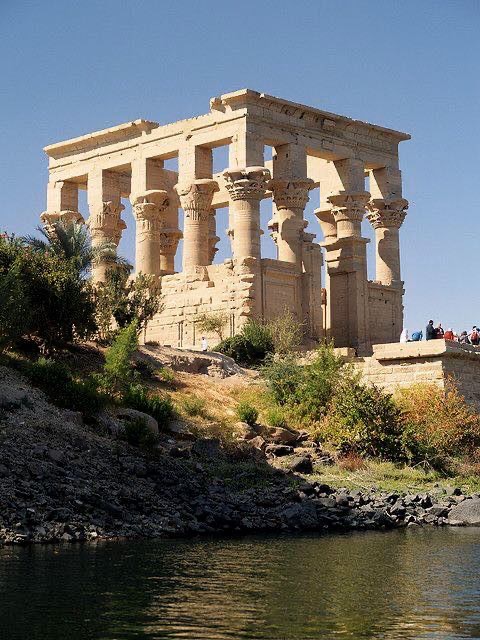
The temple at Edfu, Egypt

Muscles

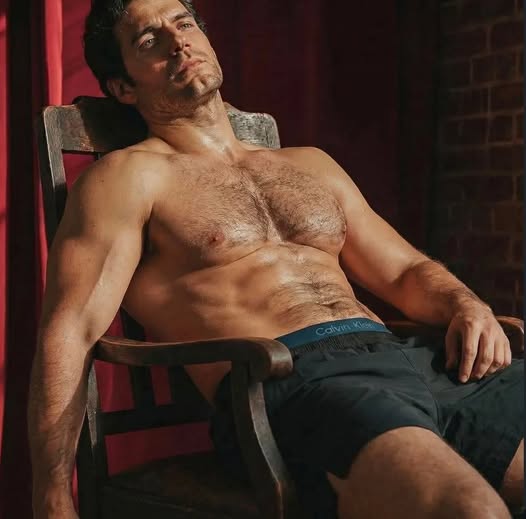
Ah, the gay obsession with muscular bodies. It goes way back into the past; the Greeks always showed men in their art to illustrate perfection—gods and heroes—as muscular and lean and physically proportioned. The emergence of gay artists during the Renaissance sparked a revival of an ideal male form since they took most of their inspiration from the classical art of ancient Greece and Rome (which essentially plagiarized almost everything of Greek culture). Leonardo and Michelangelo and other great artists, regardless of sexual orientation, always somehow got away with depicting nudes etc in art by using Biblical or other mythological sources; the influence of queer artists can be seen in every cathedral in Europe—look for the nudes. (I’ve always loved that Michelangelo painted the ceiling of the Sistine Chapel with hot male nudes depicting Bible scenes.)

And of course, Michelangelo’s David set a standard for male physical beauty for centuries.

I often wonder how much cultural and societal influences impact our own tastes. I’ve often mentioned how I don’t have a type; people always assumed I did, but I never have. I appreciate men I find beautiful, of course, but just because I find aesthetic beauty in someone has never meant I wanted to fuck them. I’ve always been attracted to all different types. My attraction to bears, for example, I know comes from a childhood obsession with professional wrestlers (which will be addressed in another entry, about the evolution of professional wrestlers’ bodies). Anyway, if we are perpetually bombarded images and told this is what is attractive, do we change our tastes?

I’m not going to lie: I have always liked muscles—but they aren’t necessary; no one has to have a perfectly sculpted body with high vascularity for me to find that person attractive. Perfect male physiques have become so ubiquitous now, with OnlyFans and reels and videos and TikToks and so forth; I think it’s great these young men have find a way to make money from their looks, and more power to them…but the more I see those perfect bodies the more humdrum and alike they all start to look, like The Stepford Hunks (which would also make a good title for a satirical story or novel sometime).

And muscles serve mainly as visuals for fucking, anyway.

The year I turned thirty-three was really the pivotal time, a turning point, in my life.

I was thirty-three and still single, and the only gay relationships I’d had at that point weren’t really relationships; they were, actually, borderline abusive and only served to convince me all the more that I was destined to be alone and miserable–that maybe I was actually better off alone. It was time to make changes…the only thing I had control over was myself–I couldn’t make my job better, I couldn’t improve my finances, and if I was weird-looking in the face, I couldn’t do anything about that either. I was losing my hair and I basically thought you’re too old to find a partner now, so you’re just going to be alone for the rest of your life, so make the most of it.

The first thing I looked at was my physical self. I wasn’t in shape and hadn’t been since I stop cheerleading in college. That was something I could change (I also identified several other areas in which I could change–including my attitude, and started working on those), and so I decided I was going to live healthier. I was getting older (laughable now) and I knew the longer I waited, the harder it would be to change my physical self (as I am finding out now for sure). I had joined gyms before but had never stuck with it more than a week or so, paying them for a membership I didn’t use for at least a year before I could quit–which was also a bad financial decision.

So, rather than joining a gym, I decided to be smarter. I got out the Abs of Steel tape I’d bought and never used (it was still shrink-wrapped) and told myself, okay, if you do this workout three times a week and do push-ups with it, and can do that every week until New Year’s, then I will go ahead and invest in joining a gym again. Any exercise was better than none, three times a week was better than two, twice better than once, and once better than none at all. I wrote that in sharpie on a note card and taped it to my bathroom mirror so I had to see it every time I went in there. I changed the way I ate (simplifying my diet to “nothing with three or more grams of fat per serving”, started drinking skim milk, using fat-free everything and eating more salads and vegetables and turkey sandwiches. I had dropped from 210 pounds in August to 170–and the change was not only dramatic (forty pounds is a lot to lose in slightly less than four months) physically but also emotionally.

And so, I joined a gym.

It was a new, gay gym in Tampa at the time, Metroflex, and it was convenient because it was on my way to work. I could take the work uniform with me, workout, shower, change and head to work. It was very convenient, and I worked out three days a week: Mondays, Wednesdays, and Fridays. My trainer, whose name I forget now, was really good and thorough–he explained things, which was something I’d never ever, not even when I was an athlete back in high school, really understood about working out. And…I started getting into the weeds by reading diet and exercise books.

One thing I did notice, though, as I was losing weight was how differently people treated me. I’d never really paid much attention to it before, other than the way guys in bars would avert their eyes when ours met–which I just took to mean as blech gross why are you even here–and it was hard to get a bartender’s attention. I stayed out of bars when I was doing that first diet-and-exercise change that fall, and when I went back I stopped drinking alcohol, sticking to water but eventually going back to Bud Lite, but once I started going again after the weight loss…I never had to wait for a drink because as soon as I walked up to the bar, the bartender was right there. People smiled at me a lot more. I got treated treated better in restaurants and stores by the staff–even passengers at the airport were friendlier and nicer than they used to be.

I found that to be very interesting from a sociological point of view; a little experiment in human behavior, if you will. Other things started happening, too, all of which was very much a boost to my fragile ego.

And thought about writing an essay called Looks Don’t Matter and Other Lies.

I also liked the attention. I liked being flirted with and bought drinks in gay bars. I loved being treated better, but at the same time I had to be careful. I have some obsessive tendencies–part of the faulty brain wiring–and my tendency to judge myself very harshly was a dangerous combination that led to some really unhealthy habits with food and eating–I often will skip eating without a second thought, and often when I travel I forget to eat, and get sick. I also don’t see myself in the mirror the way I actually look; body dysmorphia. I always worried I was overweight, and I also wanted to get bigger–you see how those two positions are diametrically opposed to each other–but it was all a part of the whole parcel of self-examination and evaluation with the intent to make positive change.

But as my life began to change and improve with my new approach to life (I was also writing again), I attributed a lot of it to the changes wrought by my exercise devotion. I was so much happier, had so much more energy, and felt better overall. I also met and fell in love with my life partner…and realized several things: I did not want to work in the heterosexual world anymore nor did I want to spend a lot of time in it; and the best thing for me to do, the thing that made the most sense, was to become a personal trainer to help other people reset their lives and take a holistic approach to working out—mind, body, spirit—that would be more effective, and also I could charge enough per hour being a trainer that I could do it part time and spend the rest of the day writing.

I was a good trainer, too.

So, that’s what I did. I also started writing a fitness column for the local gay paper, and for other national glossies. It wasn’t the kind of writing I wanted to be doing, but getting a clip file was important for writers starting out back then, and I stayed committed to my own workouts, even after I stopped working as a trainer.

I can also happily say that since I left the travel agency here in New Orleans in 1997, I’ve never worked in a hetero business ever again.

Injuries and getting older have messed up my working out since about 2011, but I am hoping that once I get past this rehab of my arm I will be able to do regular, harder workouts again and get back into better shape.


The Lion Sleeps Tonight

Weeheeheehee dee heeheeheehee weeoh aweem away

You’re welcome for that hellish ear worm.

Well, here it is Tuesday morning and I feel a lot better, more rested, than yesterday. I was extremely tired when I got home after work last night. I didn’t really do much of anything once I was home, other than cuddling with Sparky and watching this week’s Last Week Tonight with John Oliver, which I always enjoy, as well as two more episodes of Alexander on Netflix, which I am enjoying. I was always interested in Alexander when I was growing up–I liked Egyptian, Greek, and Roman history and culture before moving to United States history, then British, and ultimately European. I also watched some documentaries on forgotten kings and queens of Europe. Sparky mostly slept in my lap for much of the evening, and I retired early. PT was rough yesterday morning, but this Friday I get to go to the gym on my own for the first time in well over a year. YIKES. I only have a few exercises to. do there, and I am a little bit excited about going for the first time and getting back into the swing of working out regularly again.

I am starting to feel acclimated back to my life again, and I am also thinking I am feeling more like myself. I’ve been flooded with story ideas over the last few days (Alabama always does that for me, for some reason), solutions to issues in works in progress that I’ve been struggling with, and book ideas. This is, of course, a relief, as I’ve felt kind of stagnant creatively since the surgery. It’s like my brain is finally waking up again, something I was concerned about, obviously–when your identity and most of your life is wrapped around being a writer, the loss of creative energy in my mind is even scarier than falling from a great height or cutting myself (two of my biggest fears). I suppose it would be okay, but I also can’t imagine never writing again.

I actually have thought about it seriously during this time of forced solitude and recovery. Writing and publishing is like a roller coaster ride–filled with ups and downs and frightening hazards to get past. 2023 was obviously a bad year for me, but I did produce two books I am proud of, Death Drop and Mississippi River Mischief. Is it any wonder that I wasn’t able to get much work done after they were finished and proofed and approved? Bouchercon was at the end of August, and when I got back was when I had my teeth done and went on the soft diet–no surprise I was low energy and not able to write very much–and then came the surgery and the recovery. And of course Scooter died last summer…yeesh, what a shitty year, underscored by the grieving for Mom. So, having not really written much after the books went into production, and not really being able to create while I recovered, made me take some stock and wonder if I wanted to keep doing it–the publishing side, anyway. But now that my overactive imagination has been reignited, all those doubts and self-questioning seem like self-pity. Waaah, I’m not Stephen King. So what? Sure, more money would be nice, but it’s not really the be-all end-all of why I do this, anyway. I love writing, I love telling stories, and I love creating characters I genuinely am interested in and want to get to know better.

I feel good this morning. I woke up and didn’t feel fatigued, either. I got a lot of work done at the office yesterday, which was awesome, and tonight when I head home I am making groceries and have some chores to do around the house, too. And…hopefully will get some writing done, too.

And on that note, I am heading into the spice mines. Have a lovely Tuesday, and I’ll check back in with you later.

Material Girl

Saturday and all is well within the Lost Apartment. I slept really well last night, and woke up early this morning. I guess I slept in yesterday till eight so today my body was all “what the hell, dude? GET UP”so I did. My coffee is brewing, and I have a lot to do today. I have errands to run later, cleaning to do, and writing to do as well. Paul has his trainer later this morning and will probably go to the gym after; he’s been really good about that since the Festivals are now over. As soon as my toe is fine again, I plan on starting up again. It’s been over a year, and I think I can hang with returning to the gym again, testing out my left biceps, and seeing how long it takes me to get back into the groove. I need to lose some weight–I’ve not weighed in months–but my shorts are getting to the point where they don’t really fit comfortably anymore and same with my jeans; getting back into shape and starting to eat a more healthy diet can’t hurt, either.

I got some good work done on the revision yesterday; my goal is to get it finished this weekend and turned back in so I can get back to work on another revision I have to get done quickly. This one will require a lot more work than the other, so here’s hoping I can get it all done in April. I really do want to get these out of the way so I can go back to the ones I really want to be working on. I went down a Michelangelo wormhole this week, thanks to the stupidity of the David statue controversy, and I really want to write that book at some point–not quite yet, I don’t think; it’s also going to require another trip to Italy. Paul and I are thinking about doing an Amsterdam-Berlin jaunt at some point; I’ve always wanted to see both cities. I’d also like to do Greece and Spain before I die, too; Egypt is probably never going to happen (Mom always wanted to see the pyramids), but that’s also fine. Who knows? I could die in my sleep tonight, too. And of course, I have always wanted to go to France, too. Heavy heaving sigh. Ah, well. As little as I enjoy traveling domestically, not so sure how I will do on another international flight.

We finished watching season three of Outer Banks last night and it was terribly disappointing. I’m not entirely sure what went wrong with this season, but it was nowhere near as fun as the first two. Without giving spoilers, the treasure hunt that has been the basis of the first three seasons ends with the third; with a potential set up for a fourth season that’s a whole new treasure hunt coming at the very end. I’m not sure if the magic will return, but I suspect the writers ran into the problem that so many do; you have to keep going bigger, and eventually it becomes farcical. The writing was particularly bad in this third season; so much that didn’t make sense, and of course they wasted the first half of the season setting up the second half, which then felt incredibly rushed and nonsensical and stupid. It was disappointing, of course–we’d been looking forward to its return, too. Ah, well. Now that A Knock at the Cabin is streaming, we’ll probably just watch movies tonight; The Pale Blue Eye is also something I’d like to watch.

And what a night for LSU yesterday, as the women’s basketball team won to make it to the National Championship game for the first time in school history, where they will be facing Iowa. That game is tomorrow–I also think it’s Iowa’s first time playing for the national title–but I am not sure that I’ll watch. I used to love basketball, but stopped watching when they kept changing the rules to try to make it more exciting. LSU’s Gymnastics team is competing for a shot in the final four in that sport as well; not sure if they’ll make it out of the group of eight, but you never know. GEAUX TIGERS! And the baseball team is kicking ass this year, too. Looks like that athletic director that replaced the idiot one who went along with all the program abuses (I also like to remind people he was the same guy who blew the Duke lacrosse case) knows what he’s doing.

I also want to spend some time with Margot Douaihy’s Scorched Grace this morning (her last name is pronounced like Hawaii–only with a d. Doo-wa-eee), which looks fantastic. I am taking books to the library sale this morning, and want to do some more purging over the weekend, too. I’m starting to feel. like i have my life back again–the gym is the last piece of the puzzle to snap back into place–and I’m kind of enjoying myself again. It’s been quite a ride since Mom’s initial stroke–the grief still sneaks up on me every once in a while–but I also hadn’t realized what a subconscious weight her health had put on my shoulders. I don’t clench up and my stomach doesn’t knot when I get a text message anymore. I guess with all the other weight I was carrying around from other things I didn’t really notice? I think my compartmentalization is probably not as healthy as I would have liked to believe. But you know, you live and you learn. I’m realizing a lot of things now about life (mine in particular) and seeing things I couldn’t see before. I think the past few months, with everything going on with Mom and all the writing I had to do and the readjustments at my day job, was just so much that I just was kind of coasting along, doing what I needed to get by and trying not to get overwhelmed by focusing on one thing at a time. I also think, hard as it was to be a Festival widow this year, that it was probably good for me to have all that time in the evenings to myself. I could have been a lot more productive, but I think that was also part of the grieving process?

I just feel sort of like I’ve been asleep for a long time and have finally woken up.

And on that note, I am heading into the spice mines. Have a lovely Saturday, Constant Reader; I certainly intend to!

Between Two Islands

One of the best parts of the Reread Project is reminding myself how much I truly love and appreciate certain writers.

Mary Stewart is certainly at the top of that list.

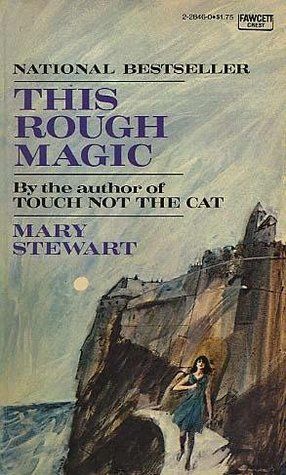
As I’ve mentioned before, I read most of Mary Stewart’s so-called “romantic suspense” novels when I was a teenager or in my early twenties, my favorites being The Ivy Tree and Airs Above the Ground.  Unfortunately, the mists of time and my faulty memory have robbed me of just how good the other books she wrote were; I recently reread The Moon-spinners and loved it more than I remembered loving it the first time; likewise, I started rereading This Rough Magic this week (finishing yesterday) and it, like The Moon-spinners, is fucking brilliant; far better than I remembered it being–and frankly, far better than it had any right being (says the incredibly jealous author).

Like most of Stewart’s novels, the book is set somewhere other than England–this one is Corfu, just off the coasts of Greece and Albania. (The Moon-spinners was set on Crete, and My Brother Michael was also set in Greece.) I’ve always wanted to visit Greece; it’s on my bucket list with Egypt, France, Germany and England. I loved Greek mythology and history when I was a kid, and of course I absolutely loved Mary Renault’s novels about ancient Greece. Lately I’ve become more and more interested in the history of the Eastern Roman Empire; aka the Byzantine empire, as well. Paul also would love to return to Greece–he spent a summer there as a teenager as an exchange student.

Stewart is often described, and counted amongst, romantic suspense novelists of the mid to late twentieth century, primarily because she was a female writing suspense novels about women in a time period where publishing didn’t know how to market women-driven suspense novels written by women. While there are slight elements of romance included in her novels, it’s often an afterthought, and rarely actually drives the plot–it’s more like a little lagniappe; something extra tossed in to appease editors and readers that she really had no interest in exploring. At first, you think, wow, her characters kind of fall in love awfully quickly with total strangers–and then you realize, oh, of course they did–women weren’t really allowed to be sexual beings in those days so it had to be masked as falling in love plus the “romance” elements were easily explained by the “trench warfare mentality”–in which soldiers become bonded to the guys they are serving with because they are responsible for each other’s lives; it’s not a stretch to see a romantic attachment grow between two people who are in a tough, difficult situation in which they could easily both wind up dead.

35bf4dd563c369f8ea00531721b47a74

“And if it’s a boy,” said Phyllida cheerfully, “we’ll call him Prospero.”

I laughed. “Poor little chap, why on earth? Oh, of course…Has someone been telling you that Corfu was Shakespeare’s magic island for The Tempest?

“As a matter of face, yes, the other day, but for goodness’ sake don’t ask me about it now. Whatever you may be used to, I draw the line at Shakespeare for breakfast.” My sister yawned, stretched out a foot into the sunshine at the edge of the terrace, and admired the expensive beach sandal on it. “I didn’t mean that, anyway, I only meant that we’ve already got a Miranda here, and a Spiro, which may not be short for Prospero, but sounds very much like it.”

“Oh? It sounds highly romantic. Who are they?”

“A local boy and girl: they’re twins.”

Lucy Waring, a twenty-five year old British aspiring actress, finds herself on the island of Corfu visiting her very pregnant sister who married very well–to a wealthy Italian banker whose family owns an enormous property on Corfu, which includes an enormous castle-style main structure and two guest villas some distance away, all gathered together on the shoreline of a small, private bay. Lucy’s big break has just come and went in a play that closed after only two months, so she has gratefully accepted her sister Phyllida’s invitation to come stay for a while with her on Corfu. There’s a photographer staying in the other villa; the main castle is being rented to a retired British actor, Sir Julian Gale, best known for his performances in Shakespeare (The Tempest in particular) and his son Max, a composer–and trespassers are forbidden and frowned upon. That very first day Lucy decides to go down to the beach and sunbathe, and while she is down there she makes the acquaintance of a friendly dolphin, much to her delight–and the suspense begins when someone starts shooting, with a silenced gun, at the dolphin. She assumes the shots are coming from the castle, so she goes storming up there, and soon becomes entangled in the affairs of Sir Julian and his son Max.

Stewart’s mastery as a story-teller is so complete that she doesn’t waste a word or a scene; her economy of writing is astonishingly complex and clever. For example, that opening sequence, quoted above, seems like simply a lovely back-and-forth introduction to Lucy and her sister while establishing their affectionate closeness; but Stewart uses that dialogue to tell the readers things that are going to be important to the novel: they are on Corfu, references to The Tempest are scattered throughout the book and are incredibly important, not just to the story but for the atmosphere (Stewart was an incredibly literate writer; references to classic literature are scattered throughout her works, be it Shakespeare or Greek mythology or Tennyson, etc.), and even the throwaway line about the twins, Spiro and Miranda, isn’t a throwaway–the two are very important to the story.

And Lucy Waring is no shrinking violet, either–none of Stewart’s heroines are. Lucy courageously thinks nothing of putting herself in danger in order to help catch a monstrous, sociopathic killer:

He must have felt me watching him, for he flicked me a glance, and smiled, and I found myself smiling back quite spontaneously, and quite without guile. In spite of myself, in spire of Max, and Spiro’s story, I could not believe it. The thing was, as I had said to Max, impossible in daylight.

Which was just as well. If I was to spend the next few hours with him, I would have to shut my mind to all that I had learned, to blot out the scene in the cellar, drop Spiro out of existence as if he were indeed dead. And, harder than all, drop Max. There was a curiously strong and secret pleasure, I had found, of speaking of him as “Mr. Gale” in the off-hand tones that Godfrey and Phyllida commonly used, as one might of a stranger to whom one is under an obligation, but whom one hardly considers enough to like or dislike.

There’s also a few amazing chapters in which Lucy, having found the definitive evidence to convict the killer, is trapped with nowhere to go on his sailboat when he returns–she hides, but is spotted, and then reveals herself and in an astonishing display of bravado tries to play the entire thing off, but winds up going overboard herself and trying to make it to shore–only to be helped by the very dolphin she herself had helped rescue earlier in the book.

As I said, nothing happens or is done in a Stewart book that doesn’t have significance or come into play later.

I cannot tell you how much I loved rereading this book, and while I’d love to dive into another Stewart reread, I’m probably going to do another Phyllis Whitney–oh, and I buried the lede! I read the entire thing as an ebook on my iPad–so I have finally broken through that final barrier to reading books electronically, and may never pack a book to take with me when I travel again as long as I live!

Who says you can’t teach an old queen new tricks?

Walking the Floor Over You

I have always loved to read, and have always encouraged other people to read. It’s one of the great pleasures of my life, for as long as I can remember. Once I learned how to read, I never stopped reading. I will probably never stop reading. There are fewer non-sexual pleasures in life as satisfying as reading a good book.

As I’ve mentioned before, my grandmother got me really started into watching old movies–both horror and crime–and also encouraged me to read. She was the one who got me started reading Mary Stewart, by giving me her copy of The Ivy Tree; my friend Felicia in high school reminded me of Stewart and so I started reading more of her work. (I still have not read all of Mary Stewart’s work–that “I don’t ever want to run out of something new to read by Mary Stewart” thing I do) And while I enjoyed all of them, I enjoyed some more than others. For example, i remember reading The Moon-spinners, but not really enjoying it very much, frankly. I never revisited the book…but now that I am doing the Reread Project, I decided to give it another read.

0449027953

It was the egret, flying out of the lemon grove, that started it. I won’t pretend I saw it straight away as the conventional herald of adventure, the white stag of the fairytale, which, bounding from the enchanted thicket, entices the prince away from his followers and loses him in the forest where danger threatens with the dusk. But, when the big white bird flew suddenly up among the glossy leaves and the lemon flowers, and wheeled into the mountain, I followed it. What else is there to do, when such a thing happens on a brilliant April noonday at the foot of the White Mountains of Crete; when the road is hot and dusty, but the gorge is green, and full of the sound of water, and the white wings, flying ahead, flicker in and out of the deep shadow, and the air is full of the scent of lemon blossom?

The car from Heraklion had set me down where the track for Agios Georgios leaves the road. I got out, adjusted on my shoulder the big bag of embroidered canvas that did duty as a haversack, then turned to thank the American couple for the lift.

“It was a pleasure, honey.” Mrs. Studebaker peered, rather anxiously, out of the car window. “But are you sure you’re all right? I don’t like putting you down on the hill like this, in the middle of nowhere. You’re sure you’re in the right place? What does that sign post say?”

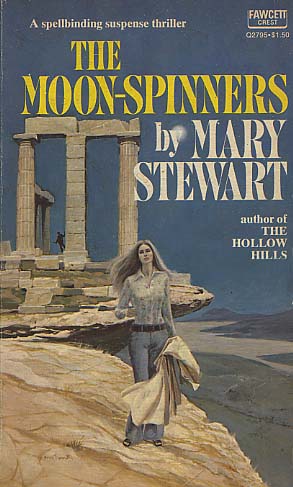
The above pictured cover was the one I originally read; the reread was of a more recent edition. When I was younger, I was fascinated by ancient history: Egypt, Greece, and Rome, to be exact; Greek or Roman or Egyptian ruins on the cover of a book, especially if it was a suspense novel, drew me to the book like moth to flame. (That was what originally drew me to read Phyllis A. Whitney’s Mystery of the Hidden Hand, which I now believe–my memory lies, remember–was the first Whitney I read, because it was set in Greece) I had also remembered seeing a film version of The Moon-spinners, broken up over two weeks’ episodes of The Wonderful World of Disney, which starred Hayley Mills. I don’t remember much of the film now, but I do remember thinking it was vastly different from the book when I read it the first time. It’s not on Disney Plus (neither is Johnny Tremain or Now You See Him Now You Don’t, which has annoyed me regularly since I signed up for the service), and I’m not about to spend even three dollars on renting it on Amazon Prime–although I was tempted enough to look it up to see if it can actually be viewed anywhere.

Anyway.

I enjoyed the book much more greatly this time. I’m not certain why, precisely, I didn’t like it as much as Stewart’s other books at the time, but sometimes that’s just the way it is. The Moon-spinners focuses on Nicola Ferris, an adventurous young Englishwoman in her early twenties. She works at the British Embassy in Athens; her parents died when she was a teenager and she went to live with her aunt Frances, who is a leading botanist. Frances is also single and terribly independent, like most women in Stewart novels; Nicola admires and loves her aunt greatly and emulates her. Her aunt is taking a yacht voyage with friends around Greece and the islands; Nicola decides to take a vacation, meet up with Frances on Crete–a friend, a travel writer, has recommended a very remote village with a small hotel to them–and Nicola has the great good fortune, while on Crete, to meet an American couple (the above mentioned Studebakers) who are driving around Crete and offer her a lift to Agios Georgios, putting her there a day earlier than expected. (This sentence, describing the Studebakers,  They were both lavish with that warm, extroverted, and slightly overwhelming kindliness which seems a specifically American virtue–is a terrific example of Stewart’s exceptional skill as a writer; in that one sentence she tells you exactly who the Studebakers are.) The Studebakers aren’t terribly keen on letting her off in the middle of nowhere, to lug her suitcases and such over a dusty mountain trail to a village where she isn’t expected until tomorrow and where she will know no one; fortunately her work at the embassy has given her a passable knowledge of speaking Greek.  Nicola insists she’s fine and thanks them for their kindness, and starts trudging along the dusty path.

All of Stewart’s heroines are strong, capable, intelligent young woman who can take care of themselves; and courageous. It is while walking on the path that Nicola’s Greek adventure takes off–she stops at a pond to get a drink of water, and in the reflection of the water she sees a man’s face, watching her. Your average run-of-the-mill heroine would scream and run off or be terrified; Nicola is merely startled and curious. This is how she comes across Lambis, the Greek boatman, and young Mark Langley, who has been shot and needs medical attention. Nicola immediately makes Mark’s problems her own. Lambis, as it turns out, had put in his boat in a nearby bay so that Mark and his younger brother Colin could go exploring and look at the ruins of an old church, originally a shrine to a Greek god but converted during the days of the old Eastern Empire into a Byzantine church. As they are walking back to the boat they come across of small group of people arguing over a recently dead body. Mark is shot and left for dead; Colin is taken. And so, now of course, Nicola wants to help rescue Colin and help Mark–she isn’t, after all, expected for another day, and of course, the killers/kidnappers must be from the small town of Agios Georgios.

Stewart is, as always, an exceptionally talented writer. Her descriptions are simple yet poetic; she vividly brings the town, the mountains, the sea, everything to life so well you can easily imagine yourself there. And courageous Nicola, now possessed of dangerous knowledge that could get her killed, has to navigate the village while trying to help Mark find Colin, with no idea of who she can trust and where she can turn to help.

Nicola is a terrific heroine, and I can see why Stewart was so popular with women and teenaged girls; she wrote smart, no-nonsense, capable young women who were courageous and fearless and could pretty much handle anything. The suspense is, at times, unbearable.

There is an element of romance to the story as well; Nicola begins to have feelings for Mark, but it’s practically an afterthought, and it feels almost like it was inserted into the story. There’s absolutely no need for the two of them to develop feelings for each other; other than the psychological closeness that comes from a shared danger (one of the things I loved the most about the sequel to Romancing the Stone, The Jewel of the Nile, is that it showed that happy couples who bond over adventures don’t necessarily wind up living happily ever after; I’ve often wondered about the couples from these types of novels), and this is one of the reasons I no longer really consider Stewart a romantic suspense writer; the romances in her books often feel that way–something inserted into the story later to appease either her agent or editor–and they are completely unnecessary to the story; if anything, the romance develop organically because of what else is going on in the story; the suspense/mystery aspect is the most important part.

And Stewart consistently wrote some of the best openings in crime fiction.

Highly recommended; I will probably reread it again someday.