It’s the eve of July 4th, and all through the house–not a creature is stirring (besides me and Sparky), not even a mouse! (Thank God. The lack of mice means Sparky is earning his keep. I’ve not even seen a flying roach in the house this year.)
Sigh.
I woke up feeling sinus-y this morning, with a bit of a sore throat and a runny nose. I took a Claritin a little while ago, which hopefully will clear this all up. One can hope, at any rate. I was tired last night when I got home, so was kind of useless for the evening. We finished watching Olympo, which picked up the pace significantly in its final episodes, and I’m not sure there’s going to be another season, although they did leave most everything hanging in the meantime, and there was a cliffhanger. I am also feeling a bit worn down this morning as I sip my coffee and Sparky climbs all over me and my desk. It’s going to rain this afternoon (and most of the day tomorrow, it looks like), and I have some errands to run after I get off work–so I don’t have to run any this weekend. We’re thinking about going to see Jurassic World Rebirth tomorrow (Jonathan Bailey and his slutty glasses are a big draw); and I must confess I’ve never seen anything Jurassic on the big screen. (We are also going to see Superman next weekend.)
I am hoping to get some rest this holiday weekend. I think my lethargy this week was a kind of hangover from the trip last weekend, despite having Sunday as a recovery day. I keep forgetting that I am older than I was and my body has already been through a massive trauma this year already that I am still recovering from as well. It was probably too close to the illness for me to do all that driving and exertion; but I’ve also never been that ill before so am not sure how long the recovery will take–or if this is the new normal. That’s the lovely thing about getting old without a user manual; you always wonder if something is a result of getting older and this is how it’s going to be for the rest of your life. I am hoping, at any rate, to do some writing tonight and over the weekend, finish reading the three books I am currently in process of enjoying, and pick out three new ones. I got the new Megan Abbott, El Dorado Drive, this week and it may hop to the top of the pile. My reading goal for the year is to reread a bunch of Gothics, read/reread some young adult novels, and get through the books in the stack on the end table in the living room before moving on to the top shelf of the left bookcase (who am I kidding, once I clear off the end table I’ll make a new stack on the end table). I also have a lot of other books from the past year or so that I’d like to get caught up on, but I don’t seem to read as fast as I used to, and I am not going on another road trip until October when I can listen to another book.
I hate not having the energy that I used to have.
And I have another infusion a week from Monday. Hopefully I am getting used to them, and the second won’t make me as tired and lethargic as the first one did. We shall see. I still need to go get lab work done before my next appointment with my primary care physician in August, and I need to figure out which of these bills I need to pay and which ones I don’t–I hit my deductible but am getting bills still, which is kind of confusing? One of the things on my to-do list is to get this all figured out. I just don’t want to pay anything I don’t have to, you know? It’s so fucking exhausting, you know? Heavy heaving sigh. But at least work today is going to be fairly easy; we have a light schedule so I can get a lot of my Admin work done and get things caught up for the end of the fiscal year. I do have to run some errands on the way home tonight–mail and a relatively minor grocery run–but after that, I am hoping to get the chores done and the house in some better semblance of order.
And on that note, I am heading into the spice mines. Have a lovely July 4th Eve, and I will most likely be back in the morning.
Nuno Gallego, formerly of Elite and now starring in OLYMPO
Wednesday Pay-the-Bills Day has rolled around yet again, and the week is half-over, huzzah! It’s all a downhill slide into the weekend now–wishing my life away again, as Mom always used to say–but can I help it if I enjoy my days off and look forward to them? Surely I am not alone in this, and I say this as someone who actually enjoys his job and what he does for a living (and health insurance).
Speaking of insurance, my nurse from Louisiana Blue (Blue Cross/Blue Shield) called me yesterday morning to see how I was doing and to check in about my treatment and care, which is really nice and again emphasized to me how serious this condition I have actually is. I was pleased to report that I feel better, am hungry all the time, and have gained back some weight, which is great. I am also glad she didn’t call Monday, when I was so tired and low energy…I suspect my answers and my enthusiasm wouldn’t have come across over the phone Monday.
I also finally got a first draft of a guest blog written that I should have finished back right after Saints and Sinners–but got sick. I’ve been writing my Pride posts for the newsletter, and one of them triggered an idea for how to write the guest blog, so I free-formed it and sent it to the blog host for input and feedback. (It also gave me an idea for another book, because of course it did–NoWay Out, only the sex worker is gay which will be a big Washington scandal, would it not, with his Capital Hill clientele–because I need more ideas, don’t I?) I also spent some time with fiction last night after I got home from work, but my mind was a bit foggy so am not entirely sure if the work I did was any good or not, but…I wrote some fiction at long last!!!!
Huzzah!!!
After that, though, I was very mentally drained and felt tired. I made dinner for us, and then just settled in to relax for the few hours of the evening allotted to being awake before retiring early in preparation for today. I do feel better, every day–even tired and listless the other day wasn’t as bad as it used to be, so even that is getting better than it was. I’m trying not to overdo it, but at the same time I am rather chomping at the bit trying to get back into doing things and acting like I’ve completely recovered. I am not, and I need to remember that going forward when I am itching to do something which is pushing it–like pushing myself to write and do chores when I am already tired from everything I’ve always done; and I think Monday was actually a result of me doing too much over the weekend, honestly. So, I need to take that lesson and remember it the next time I am feeling ambitious. Just read something. I did spend some time with The Dark on the Other Side last evening, which has me in a Gothic mood, and I think Summerhouse might also be Gothic in tone; I do know The Mystery of the Haunted Mine is actually a Western treasure hunt set in Arizona. (And it was one of my favorite books as a kid.)
I also realized I don’t have to do a Pride newsletter every day for the month. That’s a lot of pressure on me to produce while at the same time writing this every day, and I kind of need to save some of my writing mojo for my fiction–even if it’s just thinking and taking notes. The newsletter was supposed to be different from the blog in that it wasn’t daily; I was even limiting it to once a week for a while there–as I said, even I get tired of my voice sometimes, let alone dropping into people’s inboxes who have other things to do. This meant another difference between it and the blog; the blog is stream of consciousness whatever I’m thinking about while I wake up over coffee and breakfast every morning (I am having Honey-nut Cheerios, a piece of toast with peanut butter and a second with strawberry belly–I prefer preserves and will remember that the next time I get some–and a slice of marble coffee cake); the newsletter had no pub dates, so to speak, so I could spend more time with those essays and go far more in depth than I can here, so why am I killing myself trying to send one every day? Am I no different from corporations, marginalizing queer culture and life and only examining it during Pride Month and then ignoring it? No, I don’t think so. I read queer books all year, absorb queer art, and think about my queer future in a country double-downing on its vicious homophobia. Everything I write, no matter what it is, is framed through my gay gaze; I am intrinsically queer and that impacts my art, no matter what I am creating.
And I also think, since oppression is so intersectional, I can talk about anything that falls under that umbrella, because I had to unlearn so much over the course of my adult life, and I am incredibly lucky to have so many kind friends who didn’t mind teaching me how to think in a more macro kind of way–every lesson unlearned was a revelation and gave me a new perspective on how to see the world, and how wrong the way I used to see it was. I’m not perfect, by any means, and I learn every day while acknowledging the possibility I still have bad things I was taught yet have not unpacked.
But I went to bed early–I was falling asleep in my chair after watching one episode of Department Q, which we are loving–and slept super well. I feel good this morning, awake and rested, which is very odd for a Wednesday, but it is very pleasing in our eyes.
And on that note, I am heading into the spice mines. Have a lovely day, everyone, and I’ll check in with you again tomorrow.
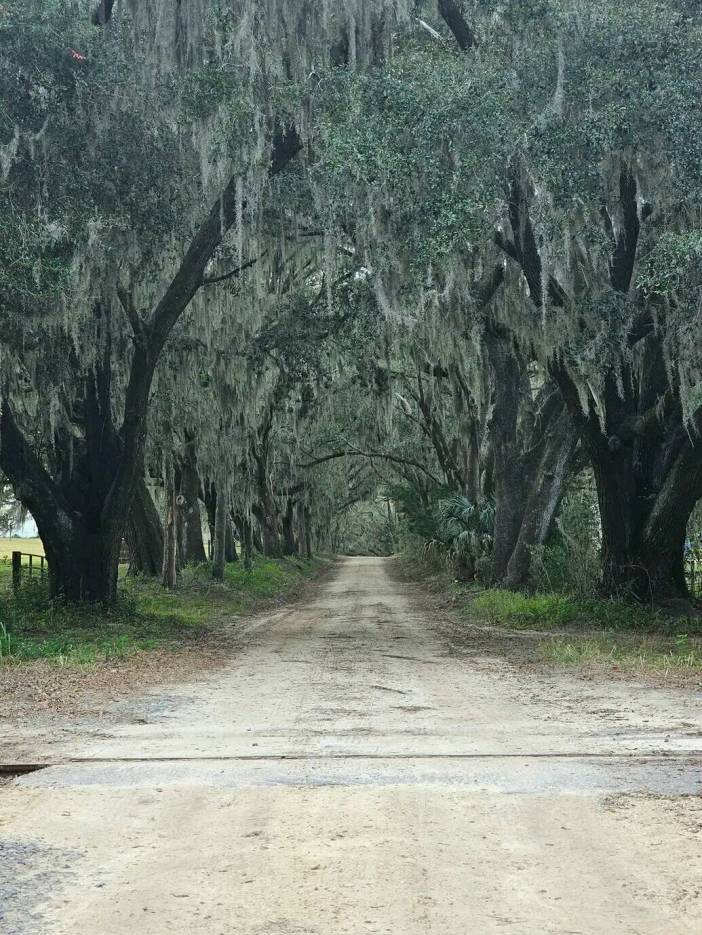
I love these old dirt country roads, and the Spanish moss just makes it look even cooler.The image is very evocative, and I am already thinking of a story inspired by the picture.
Sunday of the holiday weekend and I am feeling pretty good. I am up earlier than I would prefe, but it seems sleeping in later than six is something rare for me now and it’s okay; it gives me more awake time to get things done. I’m getting some reading done every morning when I get up, and yesterday I did do some chores, but tried to mostly relax while processing Victoria’s death. I also read a little bit, and mostly just tried to relax and gather my strength back. I have to run an errand today–a library book is ready for me, and I can swing by Fresh Market on the way home; oh, never mind, the library is closed for the holiday so that will have to wait until Tuesday after work, but I do need to go to Fresh Market anyway, maybe even wash the car while I’m on Louisiana Avenue. But I did get the bathroom and part of the kitchen under control and finished; so the downstairs looks a lot nice than it has since I fell ill, which is a lovely thing. I can finish it today and then work on the living room next, and maybe, just maybe, my house will finally be under control again and presentable and won’t make me groan with despair every time I walk in.
I also watched one of the few Hitchcock films I’ve never seen–mainly because it’s never been available before when I thought about watching: Suspicion, which stars Joan Fontaine (the only performer to win an Oscar for a Hitchcock movie, although she should have won for Rebecca and Anthony Perkins’ failure to be even be nominated for Psycho remains a hate crime) and Cary Grant. It’s based on the Francis Iles novel Before the Fact (of which I have a copy and have been assured it’s better than the film). It did make me think about a theory I have about domestic suspense and Gothics–that they are about women’s fears and therefore women’s noir of a type–and Suspicion is definitely one of those–does her husband–whom she catches in lies all the time and is kind of a bounder–love her or did her marry her for her money? (This is a very common theme in Victoria Holt novels, by the way, which I loved.) Something to write about for another time, methinks. The film itself was okay, and I am now more convinced than ever that Fontaine’s Oscar was a make-up for Rebecca, a far superior film in every way. (It may be time for my annual reread of Rebecca, in fact.)
I also read a bit more into Moonraker, which is fascinating in its casual misogyny, and it’s really hard-boiled attitude; as I said, Fleming’s Bond is so far removed from the Roger Moore/Timothy Dalton/Pierce Brosnan Bond that they may as well be different characters; Connery and Daniel Craig more captured the Fleming feel of the sociopathic killer/spy. The parallels between the villain in the book, Hugo Drax, and Elon Musk are so prescient as to make me wonder whether Fleming could see the future. More on that later, of course.
We finished watching Overcompensating last night, and it’s such a good show. It does an excellent job of depicting how terrifying it is to come out–to anyone and everyone–and how you wind up being a liar for self-preservation; I think all those lies is why I am so triggered by people calling me a liar these days, and I’ve never really seen this depicted in anything queer before–about how you can’t really be a good friend with people you can’t be honest with and have to lie to all the time. It really can’t be explained, but I still have a lot of shame from that time in my life, from when I was overcompensating and making an absolute fool of myself because no one was actually fooled and my true friends were delighted when I came out. The depression and faulty wiring in my brain certainly didn’t help.
And yes, I will always be grateful to those friends who were delighted.
I’m looking forward to relaxing some more today, to be honest. Paul has his trainer this afternoon, and when he gets home I am going to barbecue burgers and cheese dogs. Yes, I know you’re supposed to actually cook out on Memorial Day itself, but I’d rather do it today. I’ve been experiencing hunger a lot more lately than I can recall, and I am snacking on top of it all. I’ve been spending a lot of time looking at Door Dash to have something delivered, and I’ll probably pop that cherry next weekend. I’ve also been missing my mom’s cooking–her chicken and dumplings were sublime, and she made everything from scratch and from memory; her biscuits and gravy were to die for, and somehow she made the best pancakes I’ve ever had anywhere. I am going to make an easy chicken-and-dumplings recipe tomorrow; will definitely report back.
I am getting stronger every day, but I also still tire far too easily and am not even close to being back to 100% yet, which is fine. I just need to be patient–never my strongest suit–and let my body heal itself from the trauma.
And on that note, I am heading into the spice mines. Have a lovely Sunday, Constant Reader, and I may be back later; I hope to get my newsletter done today as well.
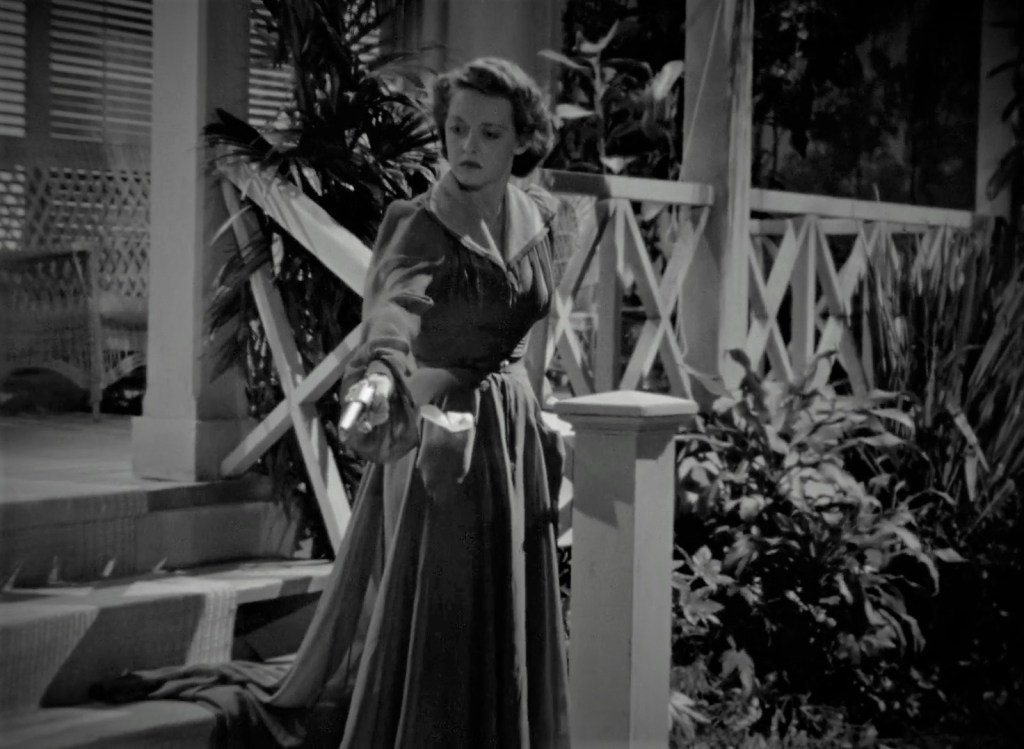
Bette Davis in the opening scene of her Oscar nominated performance in The Letter.
Monday morning and back to the office with me today. Huzzah? Why not? Yesterday was a low energy day, alas. I didn’t sleep as well Saturday night as I did on Friday, and I think all the shopping and running around depleted all of my batteries and I needed to have a down day to recharge. I also think I overdid it. I don’t feel so great this morning, but it’s my Admin day so I think I can push through and make it. At least there’s a three-day weekend looming on the horizon; and yes, I am going to spend most of it resting, reading, and relaxing. I always get impatient with recovery and try to speed it up, which isn’t very smart. And I’ll have everything delivered; no grocery shopping for me for a while. I am also seeing my doctor Wednesday morning, so I can get some tips on eating and rest and so forth.
I spent most of yesterday in my easy chair, getting caught up on Hacks and The Studio (we also started MurderBot, which is interesting), and I don’t really remember much of last evening–an indication of how tired I was–and I didn’t sleep that great last night, either. Ah, well, these are the challenges that make life interesting.
I had a great ZOOM meeting with my editor yesterday–the book has now been pushed back and will be out in January, sorry, Scotty fans, just a little longer to wait–but I feel a lot more confident that once I am through with this recovery thing I’ll be able to whip it into something I can be proud of and Scotty fans can enjoy. I think my next read–as I try to get my brain unclouded and able to read again–will be a Vicki Barr Stewardess1 kids’ mystery that I’ve not read yet–The Silver Ring Mystery. At least I can use this foggy brain situation to my advantage and get those newsletters about kids’ mysteries done. I may even reread some old Gothics, too–my Kindle is filled with Phyllis A. Whitney and Mary Stewart classics–not to mention all kinds of other things I could reread. There’s also some great history books in there that I can dig into as well. I just never really think about reading on my iPad.
The house is also a mess; I was too tired to do the dishes last night after I made dinner and so left them, hoping I might get to them this morning. But alas and alack, I was much too tired to do so once I was up and so left them for tonight. It doesn’t take much to fill up both sinks, you know, which inevitably makes the kitchen look terrible. I also need to do the floors and the windows, get the filing done, and clean up my workspace. Slowly, slowly, slowly, of course, while taking breaks and resting so I do not wear myself out completely again. I have to swing Uptown to get the mail on the way home tonight–my box grater should be delivered today–and at some point, yes, I need to reorganize the pantry and the cabinets. I’m just going to make a to-do list without a date on it and see how that all goes.
And on that note, I am heading into the spice mines. Have a great Monday, and I’ll check in with you again later or tomorrow.
Work at home Friday, and I have two on-line meetings today and some simple quality assurance and trainings to do. Woo-hoo! Yesterday wasn’t too bad, despite me being so damned tired. I was exhausted by the end of the day, as I suspected I would be, but I wasn’t crabby from being tired, either. I took I-10 home (I’ve been doing that lately and despite the traffic back up on the ramp to 90 and the bridge, it’s been fine) and dragged myself inside where i promptly let Sparky climb me and ride on my shoulders while purring and rubbing his head against my face (which does get awkward as I change out of my work drag), which is lovely. I did come home to a NEW garbage disposal; did I mention yesterday that we cleaned Wednesday night because, well, the house was a disaster area to the point we didn’t want our plumber–who’s been our plumber for over twenty years now–to see it? It was nice to come home to a clean apartment, just as it was nice to get up to one yesterday (and this) morning. I’ve really let the house get out of control, and I feel like now that we’ve got this deep start on it, it’ll be easier to finish what’s left and then maintain it. High hopes, y’all, I got high hopes again on a micro personal level. I even made a to-do list for the weekend. I know, right? Who am I and what have I done with Gregalicious?
And there are few things I love more than cleaning and writing at the same time. It’s a sickness, I know. But it is my happy place. I actually daydreamed last night as I caught up on the End Times (which is what I call the news now) about how much better my life will be with a working garbage disposal again and realized, with not even a pang, that I actually like being able to find so much happiness is getting a household appliance operating again. That will dramatically help keep the kitchen clean (see? I really went deep down that rabbit hole), because it means I can also use the dishwasher again (I don’t understand this, but I don’t need to–it just is) which means…washing dirty dishes off and loading them into the dishwasher to run once it becomes full. It’s weird how things like that please me, make me feel contented, and settled. Paul and I did talk about that a bit (before I finished watching the reunions of The Real Housewives of Salt Lake City); that since the world is being such a dumpster fire and every day brings a new barrage on our intellects and senses, what need to do is go back to thinking about the apartment the way we did when we were able to move back in after Katrina–our safe space, a comfortable and quiet place where we can get away from the insanity and shut the outside world off and withdraw into a bubble. Our haven, as it were. And even now, with things still needing to be worked on and put away or taken to the dumpster, it looks so nice and clean and different, so better, than it has in a long time and I’m so pleased.
And with the Super Bowl this weekend, who wants to leave the house? No thank you. I’ll go uptown to run some errands, but downtown? No fucking thank you. I don’t want to be around crowds unless catching beads is involved. I think there’s a Super Bowl parade today for the visitors, but…I don’t know. I’m glad they get a taste of what our parades are like, but it’s still not quite the same as standing on the sidewalks of St. Charles Avenue on a crisply warm evening with the sky so dark blue it’s black, the glow of streetlights casting flickering shadows as people dance to the music of a marching band and wave their hands in the air while masked riders toss some beads to the waiting gleeful celebrating hordes of the unwashed1.
I also want to get my email inbox cleared out. I also think I need to send some emails to people I’ve not touched base with in a while. Not to worry, I still intend to spend most of my time in isolation like an anchorite (which would be a good title, wouldn’t it? Anchorite, by Greg Herren. I actually like the sound of that), but it doesn’t hurt to have contact with people that I do actually like and care about. Make sure they’re still alive, you know? I still need to get some things worked out within my life and my schedule and the barely contained or controlled chaos of my existence. I’ve got to get this exercise thing back into swing, and I need to start working on trying to eat a bit more healthier. I hope to finish reading She Who Was No More this weekend, and then I am going to get to pick out another new read. I also get to pick out something to listen to in the car on the way to and from Alabama next weekend (not sure how much I’ll be posting from up there, but it’s only a quick trip and back. I am very grateful I live that close to where we’re from; I could not make trips to Kentucky with great regularity), but I always like something Gothic and fun in the car. I know I’ve got a lot of titles built up on Audible; I’ll have to look through and see what sounds fun.
Look at me, making plans and shit, looking forward to a future. I guess there’s no point in letting myself burn down with the rest of the world. I got up earlier than usual this morning (before seven; Sparky was hungry and would not be denied) and I feel pretty good, to be honest. My coffee is going down well, I feel rested and alert, and here’s hoping I’m going to have a great day.
And on that optimistic note, I am going to head into the spice mines. Have a lovely Friday, Constant Reader, and I may be back later; if not, tomorrow morning.
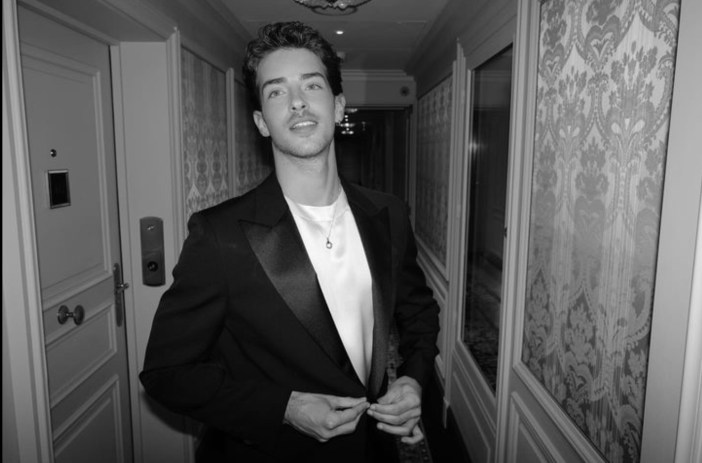
Gorgeous young Spanish actor/singer Manu Rios. I’ve had a crush on him since he played chaos gay Patrick on Elite.
I count myself as one of the unwashed; I’ve never ridden and I don’t think I would ever want to. I’m not sure why that is, but I’ve never really wanted to belong to a krewe and go to a ball and ride in a parade. ↩︎
A month or so ago, Ira Levin’s A Kiss Before Dying was one of those “special deals for ebooks,” and I can never pass up a classic for a mere $1.99 (I generally replace my hard copy books with ebooks when they are on sale, so I can donate the real book; but Ira Levin novels will never be donated), which put me in mind of him again (the book is a crime fiction classic), and I started thinking about what is the best part of two of my favorites by him, Rosemary’s Baby and The Stepford Wives, which is the slow build of paranoia until the heroines are completely convinced that everyone is in on it and there’s no one she can trust. This is what I consider “women’s noir,” which is books that depict and explore women’s fears (which is why Gothics were so popular, I think; the wife can never trust the husband and always thinks he is trying to kill her–before the real culprit is exposed and they have their happily ever after. This, to me, mimics what it’s like for a woman when she gets married in real life; she wants to believe in her marriage and love, but how many times has that turned to ashes and dust in reality? Husbands kill wives or cheat on them or leave them; all these marriage fears were tentpoles of Gothics). I was going to revisit both novels–I had some other things I wanted to talk about with The Stepford Wives, and its similarities to Rosemary’s Baby, but I couldn’t find my copy of the latter so went with the former.
Since 2015, the term “gaslighting” has come back into vogue, with small wonder. Gaslighting can make you question your own judgment and your grasp on reality1; something many of us have experienced over the past nearly ten years and it isn’t an enjoyable experience.
Paranoia, combined with not being believed, makes for a fantastic novel that is very difficult to pull off; I can think of any number of films and books that use paranoia as a driving theme for their plots, and I always enjoy them. There really is nothing more frustrating than being being not believed about something that’s happened–or is happening–to you. It can make you crazy, make you question yourself and your own grasp of reality. It’s horrible and cruel in reality, and it’s something everyone can relate to because we have all not been believed at some point in our lives. It’s happened to me enough times (including losing jobs) that it certainly resonates with me. (I have an idea for a gaslighting/paranoia short story that I’ve been wanting to write for some time now.)
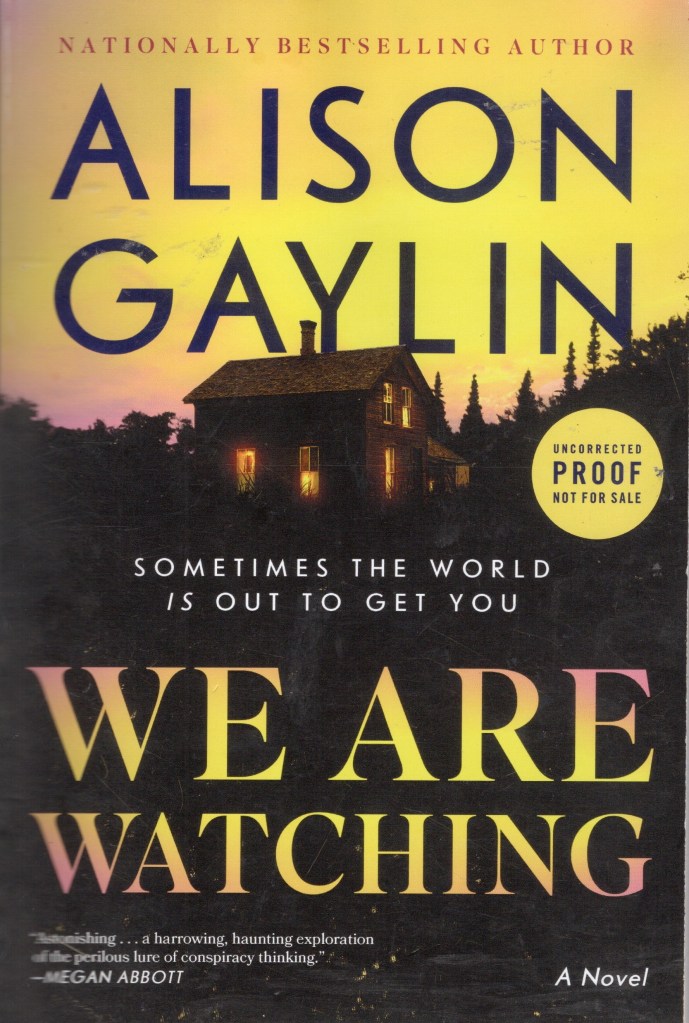
So, needless to say, I greatly enjoyed reading my advance copy of Alison Gaylin’s upcoming January release, We Are Watching.
It’s been the longest day of Meg Russo’s life, and it isn’t even half over. Her stomach gnaws at her, her hands heavy on the steering wheel. But when she glances at the clock on the dashboard, she sees that it’s a little shy of 11:30 a.m., which means that Meg, her husband, Justin, and their daugheter, Lily, have only been on the road for an hour. They’ve got at least three more hours on the thruway, and then they’ll have to contend with the series of veinlike country roads Meg and Justin haven’t traversed since their own college days. If they don’t hit too much traffic, they should be in Ithaca by five, which now feels like some point in a future so distant, Meg is incapable of envisioning it.
Time is strange that, the past eighteen years zooming by in an instant, all of it leading up to a single day that’s already lasted eons. Meg blames the stress of last night, wanting everything to be perfect for their daughter’s send-off, which led to thoughts of Lily’s first visit home for Thanksgiving break, which in turn made Meg think for the millionth time about how cold their house gets in the fall, and how Lily always complains about it. New windows, Meg had thought, lying in bed with her eyes open, envisioning insulated windows to replace those paper-thin sheets of glass, the same windows that were here when she and Justin bought the place twenty years ago–and it was a fixer-upper then. What if Lily came home to new windows? Meg mused, still awake in the wee hours of the morning. Will she have changed by then? Will she have grown too sophisticated to get excited over a warmer house? And so on, until the sky was pink and it was time to wake up and Meg had barely slept at all.
I’ve enjoyed Alison Gaylin’s work since I first read And She Was back in 2012, and have been a fan ever since, gobbling up each new book as she releases them. She has always been a terrific novelist, but what has been amazing to watch is how she pushes herself to do better with each book, tackling bigger themes and creating believable, relatable characters you can’t help but want to root for. We Are Watching may be her best yet, starting as a slow burn but building into an adrenaline boosting rollercoaster of a thriller.
The book opens with Meg and Justin taking their daughter Lily off to college, with all the emotions and fears and sense of loss that comes with a child leaving home and starting to move into their adulthood. Meg is likable, and so is her family. But as they drive a carload of skinheads pulls up alongside of them and start taking pictures. Meg reacts very strongly–so strongly that even I was like take a chill pill, girl!–which eventually leads to a crash that kills Justin, leaving the two women shattered shells of their previous selves. Lily decides to take time off from college and even Meg becomes housebound, despite needing to run her book store in the small Hudson Valley town they live in.
But things slowly begin closing in on both Meg and Lily; who were those skinheads in the other car? Why are truly strange, cult-like people showing up in the store or in town, chanting weird things at them? As Meg’s paranoia and fear grows, it soon becomes apparent that a religious cult is targeting her and her family, but why? But to find the truth, Meg has to not only survive the cult, which seems determined to kill her and her child, but when she has the time, to dig back into her own past to discover the truth–because the truth is the only thing that can set them free.
This book is fantastic, and I couldn’t put it down. It has all the hallmarks of a great Gaylin novel–a compelling and relatable main character doing the best she can in a terrible situation; a twisty plot full of surprises; and the kind of strong writing that makes her sentences and paragraphs sing.
Preorder it now and thank me in January when you finish reading it.
The film this term comes from, Gaslight, is a great movie and Ingrid Bergman is terrific as the wife who isn’t sure if she is losing her mind; she deserved her Oscar and the film still holds up–and a very young Angela Lansbury makes her screen debut in it. ↩︎
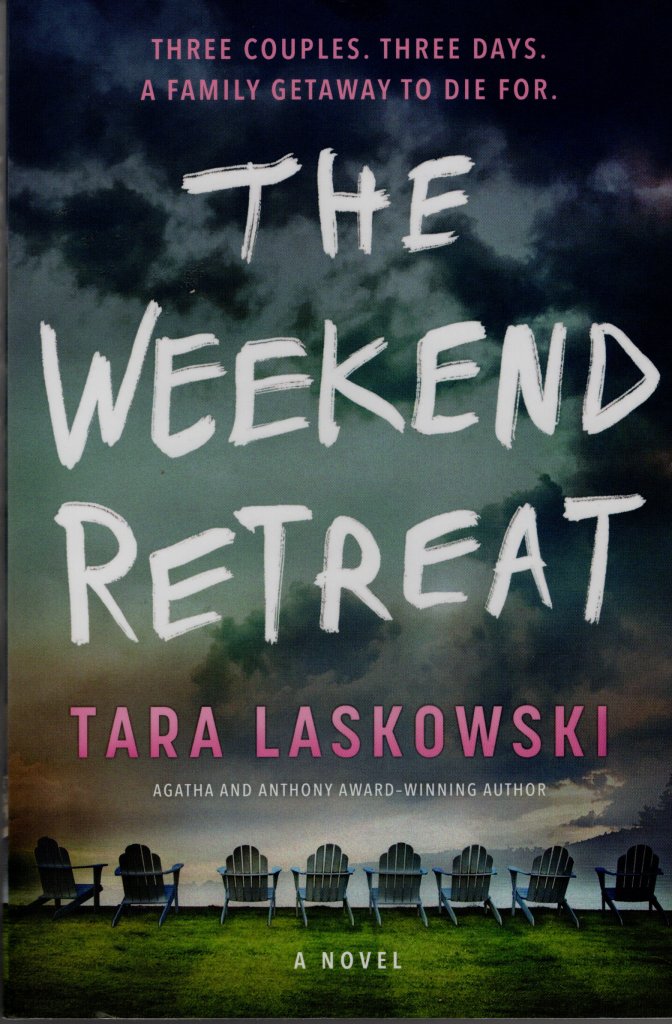
I don’t remember when and where I first met Tara Laskowski; my memory has become a sieve over the years and the bout of long COVID in the summer of 2022 didn’t help much, nor did any of the things that have gone on for the last three or four years. But I’ve liked her from the very first–I love that she loves Halloween and centered one of her books arounnd it–and when I read her debut novel, I became a big fan. She, along with Carol Goodman, are killing the Gothic suspense novel genre, which has always been one of my favorites ever since I was a kid and discovered Mary Stewart and Victoria Holt and that Phyllis A. Whitney also wrote books for adults. She followed up her sensational debut One Night Gone with the Halloween book, The Mother Next Door, and it was also magnificent.
So I really was looking forward to her third novel, and Constant Reader, it did not disappoint.
Ever since Zack told me about The Weekend, it’s all I’ve been able to focus on. Most people would naturally be at least a little nervous to meet their significant other’s family for the first time.
But most people aren’t dating a Van Ness.
“Earth to Lauren.” Zach snaps his fingers, grinning over at me. He left work early to get on the road sooner and didn’t have time to change, so he’s still wearing his suit, purple tie slightly askew but knotted even after hours of driving.
“Sorry,” I say, tugging the ends of my hair. “Zoning out.”
“You look like I’m driving you to your death,” he says, then grabs my hand and squeezes. “Don’t worry. I promises it’ll be fun. Even if my family’s there.”
This is a great opening, and it sets up the story perfectly. Our sympathies are immediately with Lauren. Laskoswki has put her into a situation we can all relate to: the terror of meeting your partner’s family and the discomfort that comes with it, the self-doubt, the need to be liked and accepted. Zach is a Van Ness, too, and while we aren’t really certain what that means yet, it’s important and stressful enough so that Lauren, in communicating her thoughts and feelings, thinks it bears mentioning and we should understand how she feels. It works, and that outsider feeling (and haven’t we all felt like an outsider at some time? See Saltburn) keeps the reader’s sympathies with Lauren completely.
But there are three more point of view characters–two other women, one a Van Ness by blood and the other by marriage–which is always a difficult feat for an author to pull off, but making those voices distinct and clearly different from each other is what makes the book work. Harper, Zack’s sister, is harsh, tough, cold and vindictive. She runs her own beauty company and blog, VNity, which is struggling. Elle is married to Harper’s twin brother Richard, who oversees the vast Van Ness holdings, and like Lauren, has some serious “pick me” energy too; she joined the Van Ness family and has wiggled her way into the family by asserting herself as well as trying to take over the role of family matriarch, as their mother is dead. Their mother, Katrina, was a tough woman who was hard on her children, but babied the youngest, Zack–which the twins have always resented. The retreat, this Weekend, is a celebration of the twins’ birthdays, with a huge party being thrown the Saturday night of that weekend, spent up at the Van Ness Winery, in the Finger Lakes section of New York.
So yes, that Gothic feeling is there almost from the start. The wide-eyed young innocent, coming to the big family estate in a remote part of the country (see also, Beware the Woman by Megan Abbott) into a situation where she’s not sure she can entirely trust her boyfriend. The house is filled with secrets, too–hidden rooms, secret staircases and passage ways–and a lot of sibling resentment, bitterness, and anger begins bubbling up to the surface almost immediately.
There’s also a fourth POV character, known only as the Weekend Guest, who hates the Van Ness siblings and is trying to bring the entire family down as a brutal winter storm bears down on Van Ness Winery…
What a terrific read! Get a copy–you can thank me later.
Several weekends ago, I did an on-line panel for Outwrite DC. The moderator was John Copenhaver (whom you should already be reading), and my co-panelists were the always delightful and intelligent Kelly J. Ford, Margot Douaihy, Renee James, and Robyn Gigl. The video is actually up on Youtube, if you would like to watch it. John’s questions were insightful and intelligent (as always), and the conversation was marvelous, inspiring, and fun; there’s nothing I love more than communing with other queer crime writers (or any writers, to be certain), and I always try very hard to not monopolize panels because I do have a tendency to talk too much–especially if and when I get going on a topic I am passionate about. So, I thought it might be fun to take John’s questions and turn them into a long form interview, for thoroughly selfish and totally self-promotional reasons.
The panel blurb claims that “queer characters are riveting and necessary material for crime fiction and how those stories can shape (and perhaps reshape) the landscape of contemporary crime fiction.” Do you agree with this statement—and why do the stories of queer characters have the potential to shape crime fiction?
I completely agree with this statement. Queer crime fiction has a very proud history that was never really recognized or appreciated by the mainstream crime writers, readers, organizations, and conferences. That is changing for the better.
New blood is always necessary for any genre–horror, romance, crime, literary fiction–because genres tend to stagnate after a certain period of time. The cultural shifts of the late 1960’s and 1970’s echoed in crime fiction, for example; you couldn’t write crime in those periods without addressing all the cultural and social shifts; Ross Macdonald’s later novels are a good example of this. The 1970’s saw a lot of anti-hero books being written. The private eye sub-genre had grown quite stale by this time, which was when the women really moved in and gave it a shot of adrenaline–Marcia Muller, Sara Paretsky, and Sue Grafton blazed that trail, and revitalized a sub-genre that had kind of lost its way. Queer writers and crime writers of color are currently doing the same to the entire genre. Voices and perspectives we aren’t used to seeing are now getting into print and changing how we see, not only our genre, but each other. Crime fiction has always given voice to societal outsiders and outliers; queer people and people of color are the ultimate outsiders and outliers in this country. Who better to tell stories of societal alienation?
Why did you choose your sub-genre? How do you think the sub-genre has influenced the types of characters you write?
Well, I write in several different ones. Chanse MacLeod was a straight private-eye series; Scotty Bradley was more of an amateur sleuth/humorous series, but he does have a private eye license in Louisiana. A Streetcar Named Murder was a cozy, with an amateur sleuth heroine who gets caught up in a family mystery. I’ve also done young adult and “new adult,” whatever that is (it’s been described as ages 16-25), and Gothics with a touch of the supernatural. I tend to write things that I like to read, and I have a varied reading taste. I started writing the Chanse series because I wanted to do a harder-edged private eye series with a queer twist and set it in New Orleans. I didn’t know about J. M. Redmann’s Micky Knight series when I started writing Chanse; would I have done something different had I known she’d already covered the hardboiled lesbian private eye in New Orleans? We’ll never know, I suppose. Scotty was meant to be a lark; a funny caper novel and a one-off. And here we are nine books later…
As for Streetcar, I had been wanting to try a traditional mystery with a straight woman main character for a long time. When the opportunity presented itself, I jumped in with both feet. I like trying new things and pushing myself. Having to follow the “rules” of a traditional cozy was a challenge–especially because I have such a foul mouth in real life. I love noir so am working on two different gay ones at the moment.
Why do you think amateur detectives are appealing? Do you think there’s a reason queer characters often find themselves in the role of amateur detective?
I think it’s because we all think we’re smarter than the police? We enjoy seeing a character we can identify with figuring things out faster than the cops, especially without access to all the evidence, interviews, and forensics the cops do. Murder She Wrote has been off the air for about thirty years and yet the books based on the show continue coming out every year. If we start out in mysteries reading the juvenile series–Nancy Drew and the Hardy Boys and Judy Bolton and all the rest were amateurs, so we always cut our teeth in the genre with them to begin with. Scotty is basically an amateur, even though he has a private eye license he rarely uses; he and the boys never get hired (although they kind of do in the new one, coming this November.)
Let’s talk about place. Greg, your books take place in the South. Why is place important to the crime novel—why is it especially important to the queer crime novel?
Place shapes who we are–not just as queer people, but as people in general. There are similarities between growing up in a small town in the Midwest and growing up in one in the South, but the differences are very marked. I’ve lived all over the country–pretty much everywhere but New England or the Northwest–and always felt, as a Southerner (despite no accent and not growing up there) like an outsider. Couple that with being gay in a time when it was still considered a mental illness, and you have someone always on the outside looking in. But I have that Southern pull to write about the South–although many would say that writing about New Orleans and writing about the South are not the same; like me, New Orleans both is and isn’t of the South, and I feel that very strongly. I’ve written books set in California and Kansas, even one in upstate New York, but I very much consider myself a Southern writer.
Place is even more important in a queer crime novel because place shapes the queer people so much. As a writer, I think one of my strengths is setting and place, and I think that comes from being very much a fan of Gothics growing up. Gothics are known for place and mood, and I think those are two things I do well.
All of you write wonderfully flawed characters. Sometimes, as LGBTQ+ writers, we feel the burden of representation and the urge to write only positive LGBTQ+ characters as an attempt to undo history’s (the dominant culture’s) demonization of us. Unfortunately, that can be limiting—even flattening. Clearly, you’ve all struck a beautiful balance with your characters. Talk a bit about how you approached this issue.
The flaws, to me, are what make the characters seem real. Nancy Drew and the Hardy Boys always annoyed me because they were so perfect; no one is that perfect, and anyone that close to perfect in real life would be irritating and insufferable. I am am quite aware that I am flawed (one of my biggest flaws is believing I am self-aware because I most definitely am not), but I am not trying to be perfect; I just want to be the best version of myself that I can be. By showing queer people with all their facets and flaws and failures and blind spots, we’re showing the reader that we are human; despite what those who hate us say or claim, we are human beings just like everyone else, just trying to get through life and do the best that we can. The villain in my first book was a gay man–and the entire book was a commentary on how we, as queer people, tend to overlook flaws and red flags from members of our own community. Just because someone is queer doesn’t mean they are a good person–and queers with a criminal bent do exist, and often take advantage of that sense of camaraderie we feel with each other, especially when we don’t know the person well. I tend to trust a queer person more readily than I will a straight person, and that’s wrong–which is why I think we feel so much more hurt when queer people betray us.
Speaking of the demonization of LGBTQ+ folks … Ray Bradbury of Fahrenheit 451 fame said, “There is more than one way to burn a book. And the world is full of people running around with lit matches.” What do you think about the current tactics to ban queer books from schools, libraries, and even bookstores in places like Florida, Arkansas, and Texas? Why are they targeting queer books?
This is, I hope, the last gasp of the homophobes who’ve never updated their hate speech in over fifty years. What the hate group “Moms for Liberty” are doing and saying is no different than what Anita Bryant said and did in the 1970’s, what Maggie Gallagher and her evil co-horts at the National Organization for Marriage repeated, then came the One Million Moms…all too often it’s the cisgender straight white women who are the real foes of progressive politics who fight to uphold a bigoted status quo. They always claim they’re concerned moms worried about their children–but are perfectly fine with them being shot up at school; working in a meat factory on the night shift at thirteen (have fun in hell, Sarah Huckabee Sanders, when you get there and French-kiss your Lord and Master Lucifer); or shouldn’t have the right to vote…they know better than a child’s actual parents, you see, about what the child needs or wants. Maybe they should spend more time with their own children than worrying about everyone else’s? Phyllis Schlafly, queen skank of the conservative right, ignored her own family while she embarked on her crusade to strip women of their rights and autonomy–all the while shrieking like a hyena into any microphone nearby that she was fighting progress to save the American family while selling some Leave it to Beaver-like nonsense as reality. I always felt sorry for her gay son. Imagine that as your mother.
As for why, it’s about control and power. I actually respected Anita Bryant more, because she truly believed all the vile, horrible, unChristian things she said and espoused. Most of the others, including the unspeakably vile and disgusting Moms for Liberty, are working a grift for money, attention and power. Hilariously, they’ve sold their souls in the worst possible way in the guise of family, religion and God; if they’ve ever actually read their Bibles, they need to work on their reading comprehension skills as they are both apostates and blasphemers who will spend eternity doing the breast stroke in the lake of eternal fire. Hope they enjoy it.
Sorry your husbands and children don’t love you, but who can really blame them?
What are you working on next? What’s coming up?
I have a short story in an anthology called School of Hard Knox from Crippen and Landru (and somehow got a co-editor credit for the book with Donna Andrews and Art Taylor); Death Drop, the first in a new series from Golden Notebook press, drops in October; and the ninth Scotty comes out in November, Mississippi River Mischief. I am writing a gay noir, and may be writing second books for the new series I started with Crooked Lane last year as well as a sequel to Death Drop, and have a couple of short stories I want to finish to submit to anthologies I’d love to be in.
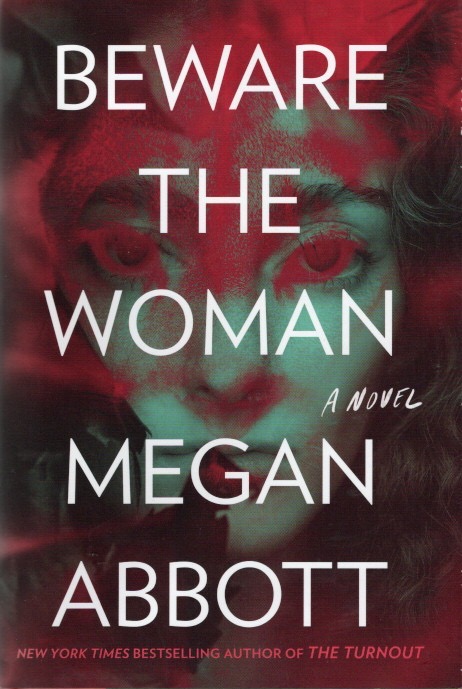
I finished reading the new Megan Abbott novel, Beware the Woman, this morning during a marvelous, raging thunderstorm that filled the gutters and streets of New Orleans with dirty swirling water, cutting the temperature to something bearable for once this summer and cooling the interior of my apartment to the point I needed to put on a sweatshirt and a knit cap on my head. Curled under a blanket with a good book while a thunderstorm rages with a warm cup of coffee on the side table, tendrils of steam rising in curly-cues of white from the creamer-lightened pool of soft brown, is perhaps my happiest of places.
Hell, reading anything new by Megan Abbott is my happiest of places.
My first Megan Abbott novel was Bury Me Deep, which stunned me with its craftsmanship, its voice, its literate choices of words and sentences structures that are short yet lyrical, minimalist strokes painting a broad canvas of human frailty and contradiction, crime and desire that comes from a primal place within, almost inexplicable and unexplainable yet so easily understandable and recognizable. I went on from there to Dare Me and the rest of her all-too-short canon; admiring, loving, respecting and enjoying each book with its magical spell woven by a true master of the literary form, astonishing in its humanity and an exploration of what lengths her characters will go to in order to get the thing (or things) they want, need, desire and hunger for.
Some of the earlier reviews I saw for Beware the Woman painted some parallels between the book and what is perhaps my favorite novel of all time, Rebecca by Daphne du Maurier…which had me intrigued and interested even more than usual.
But more on that later.
“We should go back,” he said suddenly, shaking me out of sleep.
“What?” I whispered, huddled under the thin bedspread at the motor inn, the air conditioner stuck on HI. “What did you say?”
“We should turn around and go back.”
“Go back?” I was trying to see his face in the narrow band of light through the stiff crackling curtains, the gap between every motel curtain ever. “We’re only a few hours away.”
“We should go back and just explain it wasn’t a good time. Not with the baby coming.”
His voice was funny, strained from the AC, the detergent haze of the room.
I propped myself up on my elbows, shaking off the bleary weirdness.
We’d driven all day. In my head, in my chest, we were still driving, the road buzzing beneath us, my feet shaking, cramped, over the gas.
Our main character here is Jacy Ashe, a pregnant wife in her early thirties, married to a neon sign artist, Jed, and working as an elementary school teacher. They are en route when the story opens to the remote upper peninsula of Michigan (primarily known to me from Steve Hamilton’s novels) to visit Jed’s retired doctor father, who lives up there in what used to be the family summer place, with his housekeeper, Mrs. Brandt. This is one of the classic set-ups of one of my favorite subgenres of crime fiction–the Gothic–as well as placing it strongly into another category I love, domestic suspense. This novel has echoes of du Maurier, Phyllis A. Whitney, Dorothy B. Hughes, and Margaret Millar…blended seamlessly together into a classic yet modern novel that updates and reinvigorates both subgenres, bringing them into the modern era and proving they are still just as relevant and important as they have ever been.
(Aside: I do not know where Abbott came up with the name “Jacy,” but it’s one I’ve always liked and wanted to use in my own work since first reading Larry McMurtry’s The Last Picture Show and seeing the Bogdonovich film based on it; I smiled and wondered if that was where Abbott got the unusual name from.)
The Gothic set-up is there, and I can also see the slight echoes from Rebecca: the brooding remote house in the country where tragedy has occurred in the past; the mysterious housekeeper who doesn’t seem to like our heroine very much; the slow-burn of slow revelations of secrets from the past; and the creeping paranoia and potential gaslighting of Jacy…often explained away as her pregnancy hormones or a reaction to the medications after she has a pregnancy complication. One of the strengths of Gothics, for me, is that question of paranoia vs. reality; the gaslighting that is always a hallmark of a Gothic novel. After all, what reason could either Jacy’s father-in-law or husband have for wanting to drive her mad and risking her baby’s health and well-being? She feels her husband slipping away from her and no one seems to believe her…this is probably one of the best depictions of a paranoid pregnant woman in literature since at least Rosemary’s Baby.
Someone once said the Gothic and domestic suspense novels were “women’s noir,” because the danger to them always arose from them being women and doing women’s things; a reaction to the terror of getting married and placing (until very recently) all of your agency into the hands of your husband–and what if you chose poorly?
Abbott takes the best elements of noir and combines them with the foundations of domestic suspense and Gothic to explore what it is like to be a woman, how it is to be a woman, and the trap of societal and cultural expectations for women.
And there’s a reason why the cops always look at the husband first when a woman is killed.
This is a brilliant novel, with many layers to unpack and unravel through its deceptively simple voice and brevity of language. Megan Abbott is a sorceress, a Scheherazade of crime fiction to whom you simply cannot stop listening. Read it, cherish it, love it.
On my way home from Kentucky over the weekend, I started listening to Carol Goodman’s marvelous The Seduction of Water. The book was too long, however, for me to finish before I pulled up in front of the Lost Apartment Saturday night; I have been known to stay in the car for another fifteen to twenty minutes to finish an audiobook, but when I checked with this one, I still have over an hour left to go. There was no way I was going to sit in the car for another hour with the apartment merely a dozen or so yards away from me, so I unplugged the phone and started unloading the car, figuring I could listen to it on Sunday while doing things. I was exhausted and had too many other things to do that day, so I put it off until the morning of the 4th, when I finished listening while doing laundry and cleaning the kitchen.
And what a marvelous tale it is, indeed.
My favorite story when I was small, the one I begged for night after night, was “The Selkie.”
“That old story,: my mother would say. She’d say it in the exact tone of voice as when my father complimented her dress, Oh, this old thing, she’d say, her pale green eyes giving away her pleasure. “Wouldn’t you rather something new?” And she’d hold up a shiny book my aunt Sophie, my father’s sister, had bought for me. The Bobbsey Twins or, when I was older, Nancy Drew. American stories with an improving message and plucky, intrepid heroines.
“No, I want your story,” I would say. It was her story because she knew it by heart, had heard it from her mother, who had heard it from hers…a line of mothers and daughters that I imagined like the images I had seen when I stood by her side in front of the mirrors in the lobby.
“Well, if it will help you sleep…”
And I would nod, burrowing deeper into the blankets. It was one of the few requests I stuck to, perhaps because my mother’s initial hesitation came to be part of the ritual–part of the telling. A game we played because I knew she liked that I wanted her story, not some store-bought one. Even when she was dressed to go out and she had only come up to say a quick good night she would sit down on the edge of my bed and shrug her coat off her shoulders so that its black fur collar settled down around her waist and I would nestle into its dark, perfumed plush, and she, getting reading to tell her story, would touch the long strands of pearls at her neck, the beads making a soft clicking sound, and close her eyes. I imagined that she closed her eyes because the story was somewhere inside her, on an invisible scroll unfurling behind her eyelids from which she read night after night, every word the same as the night before.
“In a time before the rivers were drowned by the sea, in a land between the sun and the moon…”
I’ve always loved the selkie story, myself, and what a marvelous opening this was for the novel!
Our main heroine, Iris Greenfeder, is an ABD (all but dissertation) trying to patch together a living from being an adjunct writing teacher at several different schools. This particular semester, as the book opens, she is also teaching a writing class at Rip Van Winkle Prison. Iris’ mother was a sort of successful fantasy writer who was killed in a fire before she could either write or complete writing the final volume of her trilogy. Iris’ father manages the Hotel Equinox in the Catskills, a luxury resort hotel with stunning views of the Hudson River Valley. Her mother was killed when she was about eleven, and was checked into the dive hotel as “Mr. and Mrs. John McGlynn”–but only her body was found. Was it an affair? Was it something else? This mystery hangs over Iris’ life when the book opens, and her own writing career gets a boost when she sells a story to Caffeine magazine, whose editor kind of pulls Iris back into the orbit of the Equinox Hotel. She lands a top agent who also has more than a passing interest in Iris’ history, and her mother.
She isn’t there long when she realizes that many mysteries shroud not only her own past, but the hotel as well. As she starts trying to figure out her mother–no one believes she was having an affair, despite the police conclusion–and what happened all those years ago, she finds that her mother was also involved in a crime involving some of her friend–the McGlynn, one of whom went to prison and her friend, his sister, threw herself in front of a train after visiting her brother. He was in jail for robbing a hotel, but did he actually do it, or was he framed? Did Iris’ mother know the truth? Slowly but surely Iris starts following the clues and trying to figure out what the truth about her mother was–and there are also people who are looking for that final manuscript of her trilogy. Why? Who cares about an old unpublished manuscript? Iris also is in a long term relationship with an artist that isn’t really giving her what she needs, either–but can she trust the younger, sexy ex-con from her class at the jail that she hires at the Equinox?
This book is classic Goodman; erudite and literary, with ties to writers and the publishing world and legends and fairy tales, all woven together in an enthralling mystery that is very hard to put down.




 Queer and Loathing in America