I Will Follow You Into the Dark

I’ve always thought that my favorite two literary genres–crime and horror–were flip sides of the same coin. I sometimes reduce my theory to the barest of bones–both are about death but in crime the monsters are human. Horror novels always have elements of mystery and suspense woven into the story–there are always characters trying to figure out what is actually going on, and usually suspecting humans, only to find out it is not–and there’s also a lot of death. You have to figure out what is causing those deaths, and the best horror novels seem like straight-up mysteries until you find out otherwise. I didn’t really start reading horror until Stephen King and Peter Straub, and much as I love the genre, my first love will always be mysteries…but reading the kids’ series, with all their phony ghosts and hauntings and phantoms and spirits, got me really interested in the concept of ghosts–something that stays with me to this very day. (I mostly write about ghosts when I try horror; because Gothic is my absolute favorite and that runs across both genres.)

This is one of the reasons I fell in love with Michael Koryta’s novels. The first I read was So Cold the River, which was more of a ghost story/mystery about a haunted and cursed resort hotel in Indiana, which was a wild ride and great fun to read. He’s also written some other crime novels that crossed over into the supernatural; The Ridge was another favorite. I also wondered how he was writing both straight up crime fiction and sometimes supernatural styled mysteries; I was always told you couldn’t write in two genres like that under the same name.

And then he started releasing those types of novels under the name Scott Carson, so maybe there is something to that old publishing truism? I don’t know why he rebranded those books under a different name and it’s none of my business other than to satisfy idle curiosity. But I did recently finish one of his Scott Carson novels, and Where They Wait is an excellent illustration of the blurred line between horror and crime.

I was never a dreamer.

I mean that in the most literal sense. Figuratively speaking, I absolutely consider myself a dreamer. Aspirational, at least. Optimistic? To a point, although my profession–journalism–mandates a certain cynicism. When I say I was never a dreamer, I mean at night, in the depths of sleep.

No dreams. Just didn’t have ’em. Not good, bad, happy, or sad.

Slept well, though. I slept well. That’s hard to believe these days, but I know that it was true once.

People talk about their dreams all the time. I dated a woman for a few years who would wake up and recite the bizarre and vivid stories that had accompanied her through the night. Sometimes, I’d be tempted to pretend that I could share the experience. Dreaming sounds normal, right? Seems like something that should happen to all of us. And yet we don’t know much about the mechanisms of dreams, for all of our scientific research and psychological theorizing. We believe dreaming is tied to memory, that REM sleep is an archival process. We believe dreams are indicative of repressed emotions, or perhaps harbingers of maladies that haven’t yet offered physical symptoms. Warnings. Messages from the dead. From God. We believe all of these things and more, but what we know is this: dreams are still not fully understood after all these years. They come and they go.

For most people, at least.

I have always been interested in dreams, and what they say about our psyches and consciences. I’ve never studied the psychology of dreams–what little I did read was all supposition and theory, as there is no real answer to what dreams mean–is it just our brains doing freestyle, like a jazz singer bopping up and down the scales using their voice as an instrument, or are they the key to who we are, our hopes and dreams and traumas? I like to play around with dreams a lot in my work, since there is no real consensus on why some people do and some people don’t, why some remember their dreams and why others don’t; do people not remember their dreams because there’s nothing to remember, and on and on from there.

But dreams are at the heart of this chilling and masterful suspense novel, which is really more about tech horror than anything else. Our main character is a journalist who reported on the Afghanistan war, has recently been laid off from his job, and gets a call from an old buddy from the area where he grew up to write a puff piece on a local tech company and it’s newest development; a wellness relaxation app which sounds like every other relaxation app–other than it’s not. Given the latest version of the app to experiment with and write about, it starts affecting him in dreams–scary nightmares about an a shipwreck, and ghosts coming to visit him ,and the dreams are so incredibly vivid that he’s not entirely sure whether they were dreams or not. And as he discovers more, he finds that everything to do with the app is connected to him in some way, as his dreams become more vivid and sometimes waking; to the point he’s not sure if things are actually happening or he’s losing his mind.

This book was fantastic: the story is great, the pacing fantastic, the characters absolutely real–and the horror is terrifying, absolutely terrifying. Carson knows how to build suspense and suck the reader in along for the ride.

Highly recommended.

Down by the River

My appreciation of all things Gothic is at least partly due to the old soap opera Dark Shadows, which I watched as a child and has crept its way into my work, my reading, and the majority of my entertainment consumption ever since. I have always loved anything with a touch of the Gothic in it, and spent my teen years (and a lot of my twenties and thirties) loving and consuming Gothic fiction. The post-war style of Gothic literature, marketed primarily towards women, was being done by authors whom I loved like Phyllis A. Whitney and Victoria Holt and others (while Mary Stewart’s work was also considered Gothic and featured many of the tropes of Gothic fiction, I consider her books to be Gothic-adjacent, and I will probably explain that better and in more depth at another time) and I couldn’t get enough of them. Holt and Whitney, to me, were the two best at this subgenre, and when Gothics stopped being published in such great numbers, I was disappointed and mournful.

Which is why I love Carol Goodman’s books so much. Her books have that Gothic feel to them, are beautifully literate in their prose and structure, and they are also incredibly smart. The books also cover art, education, and the classics; every book is filled with classical references that inevitably make me feel smarter for reading them.

The Drowning Tree is no exception.

The river feels wider from the shallow boat, the humpbacked hills of the Hudson Highlands looming like the giants Dutch sailors believed dwelled there.

“Just put the water behind you,” he says.

I can’t see the man in the boat behind me, and I don’t want to risk my precarious balance turning to see him.

“You’re been through the drill,” he goes on.

And I have. Six weeks practicing in the indoor pool under the watchful eye of the kayaking instructior, tipping myself into blue chlorinated water and rolling up again, gasping, into the humid air, all in one long in-drawn breath. I’ve practiced it until it’s become second nature, but it’s one thing to turn over in the clear, warm pool water and another to imagine myself hanging upside down in the cold gray water of the Hudson, trapped in the currents…

“This is where the current is most dangerous,” the voice says. “The Dutch called it World’s End.”

Like many of Goodman’s novels, this book is set in the Hudson Valley and there’s also an institute of higher learning–Penrose College–involved. Our main character here, Juno McKay, runs a stained glass restoration business in the same town where she went to college and grew up; she also lives in the building that houses her glass works. Her best friend from college, Christine, is coming back to the college to give a lecture into her research into a stained glass window at the college that Juno’s company is in the process of being restored. But before the lecture, Juno sees Christine arguing with the school president, the most recent Penrose, and afterwards when they have drinks together before Christine catches her train back into the city, Juno gets the impression that somethings’s going on with Christine–and then she is found, drowned in a creek along the shoreline of the original Penrose estate, near a sunken sculpture garden, in a scene very reminiscent of the scene in the stained glass window Juno is restoring. IS there a connection? Was it an accident, or was it murder or suicide?

Like any intrepid heroine in a Gothic novel, Juno is soon drawn into the mystery Christine was looking into–what happened years ago, between the first Penrose, his wife and her half-sister? How many secrets does the abandoned estate (very Nancy Drew, too–it reminded me of The Clue in the Crumbling Wall a bit) conceal? What secrets did the original Mr. Penrose, an artist and painter, conceal in his paintings and art and stained glass windows? Briarwood, a local mental institution, also comes into play as well; years ago, Juno’s ex-husband tried to kill her and their infant daughter by drowning them in the river. They survived, but his mental health did not and he’s been in Briarwood ever since. The pattern of three from the past with Penroses and the half-sister also seemed to play itself out with Juno, Christine, and Juno’s ex-husband, pulling the reader into all these complicated skeins and twists and turns, until the book comes to an extremely satisfying end with all secrets revealed and life back to normal at the end.

What a great read, and a great example of why I love Goodman’s work so much.

Down by the Lazy River

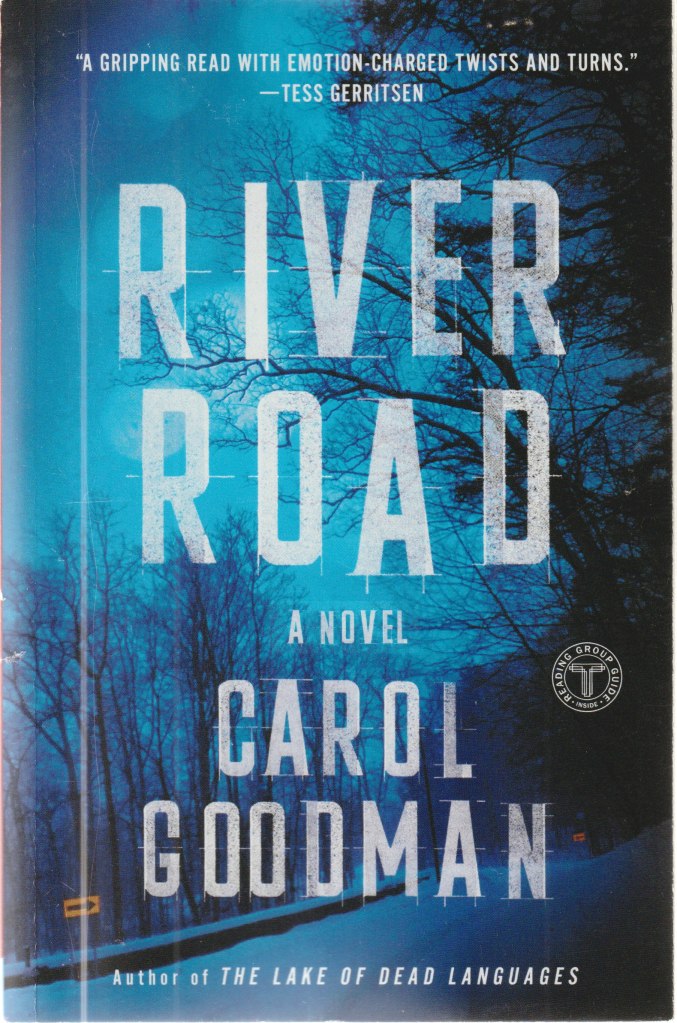
There are few things I love more than digging my teeth into a good, solid Gothic story, and there are few modern authors who do it as superbly as Carol Goodman.

I love the modern-style Gothics, which evolved naturally as the role of women in our society and culture has; whereas in the Victoria Holt novels I loved so much, they were rarely professional, working women unless they were a paid companion or a governess (governess of an unruly, undisciplined child was a particular favorite of hers), while the heroines of Phyllis A. Whitney often had some kind of job or professional background. Goodman’s women are often teachers or writers, with a classics background and education, and Goodman is a very literate, smart writer as well.

River Road is no exception to that rule, either.

She came out of nowhere.

I was driving back from the faculty Christmas party. I’d had a couple of glasses of wine but I wasn’t drunk. Distracted, sure, what with Cressida dropping that bombshell and the scene with Ross, but not drunk.

I didn’t see her. It ws dusk, that dangerous hour when day slides into night and deer sneak out of the woods. I’ve lived here long enough to know that. I’ve braked a hundred times to watch a doe lead her fawns safely across the road. A lot of people hate the deer. They eat gardens and carry ticks. But I have always thought they were more beautiful than any garden I could grow and loved them for Emmy’s sake, who thought there were as magical as unicorns.

It was on that blind curve just before Orchard Drive. Everyone takes it too fast. I, of all people, should have known that too, but I was distracted nd my vision had gone blurry for a moment. I’d lifted my hand off the wheel to wipe my eyes and something hit the bumper. A horrible thump I felt in my chest. Then something white scrolling upward like a long scarf unraveling, its body weirdly elongated like one of those cave paintings from the South of France, a hunter’s dream of a spirit deer flying across the cosmos.

That throwaway, almost easy to miss because it just sounds poetic line about “scrolling upward like a long scarf unraveling” is actually incredibly important to the story, and serves as yet another example of Goodman’s powerful skill at her art.

Everything matters in her books–nothing is just by chance.

This book–with the terrific opening, where it becomes soon clear we’re dealing with a narrator who might not be entirely reliable–is set in the upper Hudson valley small town of Acheron which also is home to a campus of SUNY, which is where our unreliable (maybe) narrator is a creative writing teacher. Nan Lewis published a book some years ago, got the job and moved up to Acheron with her husband and daughter, Emmy–who is killed by a hit-and-run driver on the River Road–there’s a terrible blind curve on the road, and this is also where Nan hits the deer. Worried about the wounded deer, she looks for it to see if it needs help, walks into the woods looking and in the falling snow, ends up falling asleep under a tree. She eventually makes it back to her car and drives home, only to find out in the morning that a student of hers, Leia Dawson, was killed by a hit-and-run driver the night before on the River Road…and with the damage to her car, she is the number one suspect.

Had she had too much to drink? She was upset–she was denied tenure and found out at the party, screaming at her ex and department chair, Ross, before storming out to her car in the cold and falling snow. Was it deer she hit, or was it the student?

As Nan tries to get to the bottom of what happened that night–having horrific flashbacks to her daughter’s death, drinking too much, her life a complete mess–she slowly learns that while she was wallowing in misery and alcohol in her house, a lot was going on right under her nose at the campus, with students and teachers involved in strange schemes and secrets, all leading to a thrilling and suspenseful climax during the height of a blizzard, as a horrified Nan has to save herself while still processing all the secrets and lies she’s unraveled.

Layered, complex, with a strong cast of fully developed characters with interior lives, this is Carol Goodman at her finest.

The Long Run

Not only do I write two private eye series, erotica, and the occasional stand alone,  I also, sometimes, write what’s classified as young adult fiction. I have not published anything that could remotely be considered y/a in quite a while, and therein lies a tale (I think the last book I published that could be considered “young adult” was Dark Tide; I could be wrong. I no longer remember when and in what order my non-series books came out).

To be clear, the fact that I even call those books “y/a” even though I don’t really think of them as young adult fiction is a marketing thing, really; in my mind, they’re simply novels I wrote about teenagers. I started writing about teenagers when I actually was one; the stories I wrote in high school weren’t bad, for a teenager, and were the first indication–from my fellow classmates, and my English teacher–that I could seriously become a published writer if I chose to try to do so; the utter lack of seriousness my writing aspirations received from my family was kind of soul-crushing. But I always wanted to write about teenagers, from the very beginnings; I wanted to do my own Nancy Drew/Hardy Boys style series, and then progressed to other stories.

I progressed as a reader pretty quickly when I was growing up; I went from the series books, like the Hardy Boys and Nancy Drew, and the Scholastic Book Club mysteries, to Agatha Christie, Charlotte Armstrong, and Ellery Queen when I was around eleven or twelve, if not younger; I know I read both Gone with the Wind and Antonia Fraser’s Mary Queen of Scots when I was ten. The few books I read that were considered “children’s books” (there was no such thing as young adult fiction then) were books like The Outsiders and The Cat Ate My Gymsuit and I did enjoy them; I just didn’t think of them as either being particularly authentic or realistic. Nor did they have any bearing on my life, or the lives of my friends–I viewed them like youth-oriented television shows like The Brady Bunch, existing in some bizarre alternate universe that has no basis in actual reality or what those of us who were that age were actually experiencing. I always thought there was something missing–complicated and authentic books about the lives of real teenagers and the real issues they faced everyday, without getting into the insanity of the preachy-teachy “issue” books that usually wound up as ABC After-school Specials, which I loathed. 

Not all “issue books” were bad, in all fairness; some, like Lisa Bright and Dark, about a girl struggling with mental illness whose parents refused to face their daughter’s reality, so her friends tried to help her by serving as amateur psychologists, and  I Never Promised You a Rose Garden, about a teenaged girl in a mental hospital dealing with her illness were actually quite good. But I loved books like The Cheerleader, about a poor girl in a small New England town with ambitions and dreams that far exceeded those of most of her friends…dealing with issues of popularity, sex, and first love.  David Marlow’s Yearbook was also a favorite, and while not marketed to kids, was about high school, but had some themes and plot-lines considered far too heavy for teens to digest in the 1970’s. You can also see it in the pap that was considered movies for teenagers; G-rated bubble-gum like The Computer Wore Tennis Shoes, and inevitably came from Disney and starred Kurt Russell. (These movies are an interesting time capsule; I did try to watch one of them recently on Disney Plus and didn’t last three minutes in that squeaky clean, sex-free college environment.)

(Also, I would like to point out at this time there were terrific books being published in the 1970’s for teens that dealt with major issues and were groundbreaking; Sandra Scoppetone was writing about queer teens back then, and there were some others doing terrific work at the time–I just wasn’t aware of those books until much later.)

My first three young adult novels–Sorceress, Sleeping Angel, Sara–were written as first drafts in the early 1990’s, put in a drawer, and forgotten about for nearly twenty years. Sorceress  had no queer content in it at all; it was my version of the truly popular trope of romantic/domestic suspense where an orphaned girl goes to live in a spooky mansion far away from her old life (Jane Eyre, Rebecca, almost everything written by Victoria Holt), and slowly becomes aware that everything in the house isn’t as it seems. It was a lot of fun to write–I loved those books and I loved putting a modern spin on them. Sleeping Angel’s first draft was never completed, and the published version is vastly different than what the original first draft contained; there are still some vestiges of the original plot there in the book that are never truly explained, and by the time I realized, after many drafts, that I hadn’t removed those vestiges from the book it was too late to do anything about it other than hope no one noticed. The book did well, won an award or two, and is still a favorite of my readers, according to what I see on social media. One of the things I added to the story was a queer subplot about bullying, which is what I think readers truly responded to, and I also feel like adding that to the story in addition to the other changes I made to it made it a stronger book. Sara was always intended to have gay characters and a gay plot; I originally started writing it as a novel for adults and realized, over the course of writing it, that actually the teenage story was the most interesting part and I could deal with some issues there if I switched the focus of the book to the teenagers. One thing that changed from the 1991 first draft to the draft that was published is that the character I originally had being bullied for being gay, even though he wasn’t (another character, one of the biggest bullies, actually was), was actually not only gay but had come out, and so the book also talked about the reverberations of a popular football coming out, and what impact that had on the school social structure and hierarchy.

Sara, incidentally, is one of my lowest selling titles–which also kind of breaks my heart a little bit.

Since those three, there have been others I’ve written–Lake Thirteen, Dark Tide–and I’ve also dabbled in what is called “new adult fiction”–books about college-age or just out of college-age characters–this is where The Orion Mask and Timothy and the current one I’m working on, Bury Me in Shadows, fall on the marketing spectrum.

One of the questions I had to deal with in writing young adult novels with queer content was the question of sex. I had already been through being banned in Virginia because I had written gay erotica (a really long story that I revisited recently with Brad Shreve on his podcast; I really do need to write in depth about the entire experience); what would happen if ‘notorious gay porn writer’ Greg Herren began writing fiction specifically aimed at teenagers? But the truly interesting thing about being used as a political pawn by the right-wing fanatics in the power games they play is that once they’ve made use of you, they forget about you and move on. My young adult fiction was released without a single complaint, protest, or any of the sturm und drang that my speaking at a high school to a group of queer and queer-supportive youth created scant years earlier.

Interesting, isn’t it?

And yet…there is no sex in any of those books. None. I don’t  remember my gay teens even getting a chaste kiss, let alone a sex life, or fantasies, or a boyfriend.

And what about desire?

A couple of years ago someone tagged me on Facebook on an article about just that very subject; that was when I started writing this post (three yeara ago, looks like) but I never finished writing this until this morning.

Go ahead and read it. I’ll wait.

Okay, welcome back. Some interesting points, no?

Now, check out this one. 

I know, it’s a lot of information to process, but it’s something we should all be thinking about, particularly as the calls for diversity in publishing and popular culture continue. Sex is, quite obviously, a touchy subject when it comes to young adult fiction, but when it comes to questions of sexuality and being a sexual minority, what is too much and what is not enough? Even depictions of straight sexuality is frowned on and controversial when it comes to young adult fiction. (For the record, that is also considered the case for crime fiction–no explicit sex scenes–or at least so I was told when I was first getting started; doubly ironic that my mystery series were what the right-wing Virginian fanatics considered porn–I really do need to write about that.)

I also have noticed the elitism evident in hashtags like #ownvoices and #weneeddiversevoices that have come and gone and return periodically on Twitter; those actively involved in promoting those tags, when it comes to queer books, make it abundantly clear they only care about those published by the Big Five in New York–which is a good target, I agree, and they do need to be doing better when it comes to diversity and “own voices” work–but this focus also ignores the small presses, particularly the queer ones, who have been doing this work all along and making sure queer books were still being published for all ages and getting out there and made available to those who want and need them. I am absolutely delighted to see queer books by queers being published by the Big 5, and young adult work in particular…and yet…there are some serious issues still with the Big 5–and with what is called ” young adult Twitter”.

I do find it interesting to see who they decide are the “cool kids” and who they banish to the outer tables with the freaks and geeks.

It’s part of the reason I don’t engage with young adult twitter, to be honest. I really have no desire to return to the high school cafeteria at this point in my life.

And I’ll write about teenagers whenever there’s a story I want to tell involving teenagers–which currently is the Kansas book; I turned my protagonist in Bury Me in Shadows into a college student because it actually works better.

And on that note, tis back to the spice mines with me. (And huzzah for finally finishing this post!)