You Are Everything

Tuesday morning and trying to get awake fully; my mind is awake and my body is, but I still feel a bit groggy. I slept well, which was absolutely lovely, and am sitting here swilling coffee and getting mentally prepared to face the day. I have to run errands tonight after work (prescriptions, mail, gym), and then I am going to come home and just chill for the evening, maybe do a little writing. I didn’t do any last night, because I wanted to watch the regional final (LSU lost in extra innings to the fourth ranked team in the country and could have won), after which I didn’t do much of anything just puttered around the kitchen doing chores until it was time for bed.

The LSU loss was disappointing, of course, but the Tigers made a helluva run in the post season. Just three weeks ago, no one thought they’d even make the post season, let alone get to a regional final. But then they had their amazing run in the SEC tournament, eliminating top ten teams left and right before giving Tennessee a run for their money in the final. So, well done, guys! Sure, another world series run would have been fun this year, but not having one does in no way diminish or undermine how magical last season was, or make it any less wonderful to remember. GEAUX TIGERS, and we’ll see you again next spring….and now it’s time to start gearing up for football season, which isn’t that far off. Woo-hoo!

I’ve been posting my Gay Moments in Greg’s Life entries, which has been kind of fun doing. Right now, I have several drafts in progress about dancing in gay bars, circuit parties, and body culture–which all will be interesting to write–and of course at some point I will probably write about HIV/AIDS. I enjoyed writing my Pride entry and the ones about The Other and Starsky and Hutch; probably will do Robby Benson, Playgirl, and Gordon Merrick at some point, too. I also will probably do some others, but right now I can’t think of what they might be. I’ve also started posting these longer form posts to Substack, too–if you’re reading them here, I don’t imagine there’s any need to read them there–but I think I need to start building up things; I don’t know if social media numbers or Substack followers or anything like that will matter in the long run in publishing. No one ever really knows what publishers are looking for or want; their criteria is ever changing but what isn’t is that the accountants also have their thumb on the scale. It is to my everlasting disappointment that my career started right when the industry began to substantially change from what it had been since the Depression to the disheveled mess it is now. At any rate, I think Substack is the place for me to post my personal essays, which is much easier than trying to find a place to publish any of them. Set a goal of perhaps one per week after the Great Moments in Greg’s Gay Life, or my pride celebratory posts are completed.

Something to consider, any way.

I know Substack is evil, but isn’t everything nowadays? The glory days of social media are, I think, finally past us; Twitter (fuck you, Musk) and Facebook aren’t nearly as much fun as they were over a decade ago, and kind of feel like some pointless obligation and reflex activity that really isn’t what’s cracked up to be anymore. It never really was, to be honest, and it was a horrible waste of time more than anything else, really. It also creates a bizarre illusory reality that bares no resemblance to real life. How many times have I been excited to meet someone because we’ve had a lot of fun interactions on-line, only for them to be like “who are you?” I noticed this early on, back in the days of Livejournal’s heyday when everyone blogged (and here I am, twenty years later–this blog will turn 20 on 12/26/24); you don’t really know someone from on-line social media interactions, and you’re certainly not friends. Needless to say, it was a learning experience (I never have really understood friendship, in all honesty; what I think it is clearly is not what other people think it is, and maybe that’s a me problem–which is why I always have so many walls I can withdraw behind, so many masks I can slip on; when you grow up queer in a homophobic society, you develop lots of coping mechanisms), and I always now just say “we know each other on-line” instead of “oh I love her! We’re friends”.

Now that social media has turned into what it is, I am not on it as much and…I don’t really miss it? And it’s very noticeable how much time I used to waste on it.

And on that note, I am heading into the spice mines. Hope you have a lovely Tuesday and who knows? I may be back later.

Play with Fire

Well, I met quota again last night which was marvelous. It’s still a bit chilly this morning. By the weekend it should be back into the seventies (it was yesterday as I ran my errands after work; it’s sixty-one this morning but it does feel colder outside of my bed and blankets), as the Alabama and Kansas State fans start arriving for the Sugar Bowl. LSU is also playing on New Years’ Day in the Citrus Bowl against Purdue, which will probably be the only game I actually watch that day.

There’s been a conversation going on over at Book Twitter lately that doesn’t really impact me in any way, but it’s been kind of interesting to follow. The conversation has to do with concerns about what is and isn’t considered y/a fiction as well as what is, or should be, considered age-appropriate reading material for teenagers and pre-teens. It doesn’t impact me because no one considers me a young adult writer, for one thing; despite having written numerous books with younger and/or teenaged characters (Sorceress, Sleeping Angel, Sara, Lake Thirteen, Dark Tide, Bury Me in Shadows, #shedeservedit), most people think of me as a gay mystery writer. Everything published under my own name is a mystery novel of some sort, whether it’s one of the series books or one of the stand-alones. I’ve never really marketed myself as a writer of young adult fiction, really; I shy away from that, I think, because of The Virginia Incident and the subconscious fear that one day that controversy might resurrect itself (which is ludicrous, and I know that; it certainly would have by now and it hasn’t, which further proves my belief that The Incident had nothing to do with me or my writing or my career and everything to do with systemic homophobia and othering used for political gain). It just seems weird to me that in less than five years after that happened–when I was deemed a menace to America’s youth–I could publish books for teenagers without a single whiff of complaint or scandal or even the raise of a single eyebrow.

Interesting, isn’t it? Almost like the whole thing was just more smoke and mirrors whose sole intent was to rile the homophobic base.

I just love that my existence is considered by some as a constant and continued threat to children.

One of the things that has always mystified me over the years is what is and isn’t considered age-appropriate. Intellectually I was far more advanced that most of my classmates (my emotional and personal maturity being an entire other subject–I’d say I am still behind on that score) and I started reading early. The library and the Scholastic Book Fairs were my best friends as a child, and I read everything I could get my hands on. I loved history, from which grew an appreciation and love for historical fiction (which I really don’t read much of anymore, which is odd. I really want to read Hilary Mantel’s Cromwell books…) and of course, my grandmother got me interested in “scary” movies and mysteries.

You’d think I’d be a huge fan of historical mysteries, but I actually don’t read many of them. I did love Elizabeth Peters’ Amelia Peabody series, and I’ve become a huge fan of Laurie R. King’s Mary Russell series…I think exploring historical mysteries might be a project for 2023.

But the point was I was reading books far too advanced for most people my age when I was young. I freely will admit that in my first read of Gone with the Wind at age ten I didn’t know Rhett raped Scarlett the night of Ashley’s surprise birthday party–it wasn’t until a reread in my late teens where I thought oh, this isn’t right–let alone that she enjoyed being overpowered and forced. I also read The Godfather when I was ten, and there was no mistaking anything about Sonny Corleone and Lucy Mancini. He had a cock the size of a horse’s and her vagina was apparently the Lincoln Tunnel. (Although the she felt something burning pass between her thighs still mystifies me to this day.) I also read The Exorcist when I was ten and I was also very well aware of what was going on in the crucifix masturbation scene. As a kid, I was fascinated by these sex scenes (aka “the dirty parts”), and it wasn’t until I was older than I began to question the entire Sonny-Lucy thing (and why it was even in the book in the first place); and while the crucifix scene was gross, shocking and basically icky to me at ten–when I reread the book sometime in the past decade it seemed prurient, to be honest–used primarily for shock value and to get people to talk about it.

So, yes, I started reading books for adults when I was around ten. I also read Antonia Fraser’s Mary Queen of Scots and Robert K. Massie’s Nicholas and Alexandra that same year–I remember doing a book report on Mary Queen of Scots and my teacher not believing that I had read the thick volume; he started opening the book at random and asking me questions–which I was able to answer, so he grudgingly accepted the book report and gave me an A. (Teachers have doubted me all of my life; can’t imagine why I am insecure about my intelligence…)

Over the course of my teens I also read books by Harold Robbins, Sidney Sheldon, Jackie Collins, Jacqueline Susann and Gordon Merrick-every last one of them crammed to the gills with racy sex scenes. I was also reading Stephen King, Irving Wallace, Herman Wouk, Agatha Christie, Ellery Queen, Jean Plaidy, Victoria Holt, Phyllis A. Whitney and any number of authors who wrote for adult audiences not teens. Were there things in the books I didn’t understand? Sure there were. Were there things in those books that were probably inappropriate for teenagers? Undoubtedly. (I’ve also never forgotten the scene in Joyce Haber’s The Users where a Liza Minnelli-based character fucked herself with her own Oscar; some images are simply too vivid to forget methinks.)

This is one reason I shy away from calling some of my books with teenagers “young adult” novels. Megan Abbott’s Dare Me centered teenagers, but I would never consider Dare Me a young adult novel. I was thinking about this the other night while watching Sex Lives of College Girls (it’s hilarious, you really should be watching); can I authentically write about teenagers anymore? Have I ever been able to? I don’t speak their language anymore, and I haven’t been one in over forty years (!!!!); I don’t know the technology they use or their slang or what they watch or listen to. I don’t know what today’s teens think about virginity and sexuality these days; do the tired old tropes still exist? Does that whole “good girl/bad girl” dynamic still exist, or are today’s teenaged girls a bit more sophisticated than they were when I was in high school when it comes to sex and sexuality? (Contrasting two high school shows with queer content makes you wonder–there’s the jaded cynicism of the rich kids in Elite vs the wholesome purity and innocence and sweetness of Heartstopper, which also had me wondering–although I feel certain Heartstopper might be closer to reality than Elite…or that’s just my hope?) Of course I have other ideas for more books about young people–I have another in-progress one that’s been sitting around for a very long time that I need to repurpose–and I’d kind of like to write more at some point, but I don’t know. My suburban 70’s serial killer preying on teenaged boys book would be told from the perspective of a twelve year old, but it would definitely not be a young adult novel–but will probably be marketed and sold as one.

And on that note I am heading into the spice mines on my last day in the office for 2022. Check back in with you later, Constant Reader.

I’m Gonna Make You Love Me

I’ve always considered myself to be a child of the seventies.

Sure, I was a child for during the sixties, but I turned nine in 1970. While I am sure that turbulent decade provided some (a lot of) influences on me, my personality, my likes/dislikes, and my future, I am equally confident that my values and thoughts and beliefs probably weren’t as shaped from that turbulent decade as they were by the 1970’s. The seventies are really the first decade for which I have a lot of recall (recently, a friend was amazed that I remembered those horrible Rag City Blues jeans for women that were, for some reason beyond my thought processes, popular in the latter part of the decade; what can I say–I do remember the decade fairly well for the most part–or at least as far as my memory can be trusted). I’ve always wanted to write books either set in the seventies completely or even partly; Where the Boys Die, my 70’s suburban Chicago novel, keeps pushing its way to the forefront of my increasingly crowded (and clouded) mind. (NO I AM WRITING CHLORINE NEXT WAIT YOUR TURN)

I remember Watergate and how the scandal grew. I remember the 1972 landslide reelection of Nixon, and the country’s negative reaction to the Ford pardon of the man who brought him to power; I also remember Jimmy Carter running for president out of seemingly nowhere and getting elected. There was The Brady Bunch and The Partridge Family and Archie Bunker and Mary Richards; Sonny and Cher and Carol Burnett and Donny and Marie and the Jackson 5 and Grand Funk Railroad. Top Forty radio ruled the AM airwaves; not every car came equipped with FM capabilities, and the only way you could play your own music in your car was with an eight-track player. I started the decade reading the Hardy Boys and Nancy Drew and The Three Investigators; by the end of the decade I was reading John D. MacDonald and Sidney Sheldon and Harold Robbins. It was a very weird decade…of odd color and fashion choices; avocado greens and browns and American cheese orange were ridiculously popular, as was shag carpeting, velour, clingy polyester shirts, corduroys, bell bottoms and slogan T-shirts. Baseball shirts and rugby sweaters also became popular later in the decade. People had feathered hair parted in the center, and there was this weird sense of, I don’t know, missing out? Movies were grittier, harsher, more realistic; actors went from the polished shine of the old Hollywood system glamour to warts-and-all realism. Television was also beginning to change but was still heavily censored. Boogie and truckin’ and shake your booty became part of the vernacular; the decade began with the break-up of the Beatles and ended with disco’s last gasps while new wave and punk and rap started their rise.

It was the decade I went through puberty and realized that I was attracted to other boys instead of girls; I wasn’t quite sure what that meant but definitely found out in the seventh grade it meant I was a faggot, fairy, queer, cocksucker, and all those other lovely words that were burned into my brain that year. It was the decade where I read Harold Robbins’ Dreams Die First (a truly execrable novel) over and over again because the main character had sex with both men and women, and if I am not mistaken, contained the first male-on-male sex scene I’d ever read (oral); it was also the decade where we moved from Chicago to the suburbs to the cornfields of Kansas and I graduated from high school. (Ironically, it was in Kansas that I discovered gay books with explicit gay sex scenes in them–the News Depot on Commercial Street not only carried The Front Runner by Patricia Nell Warren and her other novels, but also Gordon Merrick; and their magazine racks also had gay porn magazines–which, now that I think about it, meant there were others there in Lyon County and environs; I didn’t realize it at the time, of course.) It was when Norah Lofts’ The Lute Player made me aware that Richard the Lion-Hearted was like me, too; and Susan Howatch’s Cashelmara and Penmarric also had gay characters and plots involving them…

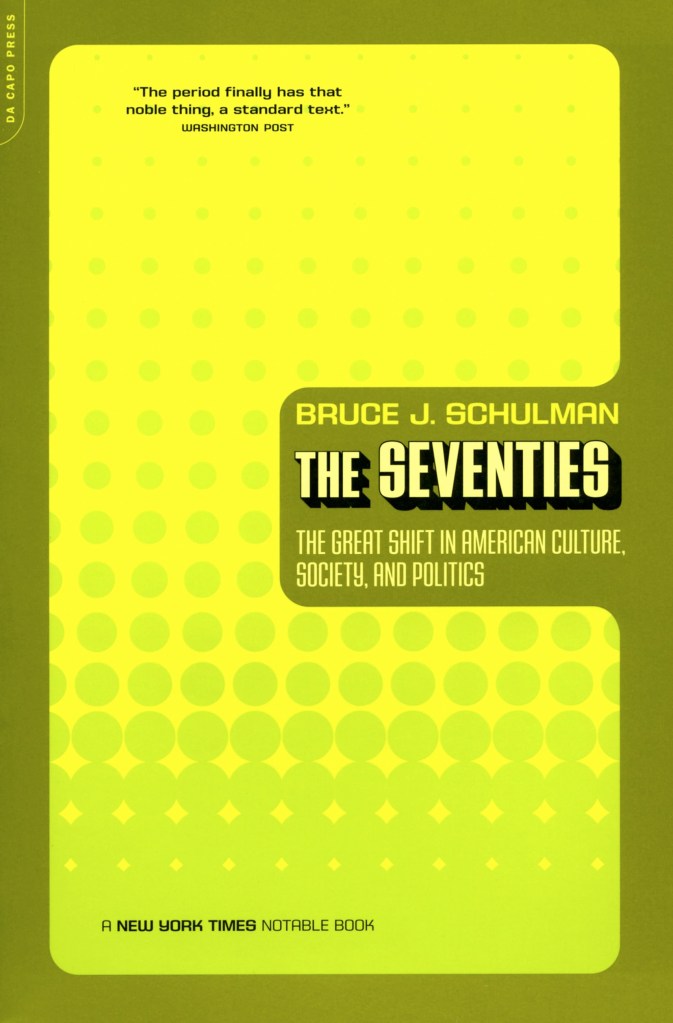
I’ve always thought the seventies was a much more important decade than ever given credit for; usually it is merely considered a connecting time from the 60’s to the 80’s…but almost everything that came after–socially, politically, culturally–got started in the seventies. So I was glad to see this book about that frequently dismissed time.

As I mentioned previously, the Seventies were turbulent; they were the decade that also saw the beginning of the end of the post-war economic/prosperity bubble. Gas shortages, skyrocketing inflation, and the insidious use of racism to break the Democratic coalition began–everything we find ourselves dealing with today had its roots in the Seventies–and it did seem, to those of us growing up in the shadow of the mushroom cloud, that the world had lost its mind and our country (or rather, its mythology) had lost its way. Schulman’s study of the decade, breaking down how the shifts in culture, politics, and our society began, were exploited for divisive purposes, and permanently changed attitudes moving forward was a fascinating, if chilling, read. I remember the terrorist attacks. I remember watching the Munich Olympics that ended in bloodshed on an airport runway and murdered Israeli athletes. The book brought back a lot of memories; I am not so sure I agree with all of Schulman’s assertions about the decade–there certainly wasn’t very much about the burgeoning gay rights movement, other than how it chased lesbians off into the Women’s Movement–but it was interesting to read the book and relive the decade a bit, as well as the memories it triggered.

I do highly recommend this book for people who weren’t around for the Seventies and might be wondering how the fuck did we end up in this current mess?

Don’t Say Your Love Is Killing Me

Ah, Kansas.

Moving between your sophomore and junior years in high school isn’t easy on any teenager. I wasn’t quite as nervous about this move as I had been when we moved from Chicago out to the suburbs–which was a major shift in everything I was used to, moved me away from friends I’d been going to school with since first grade, and made me that thing no one wants to be: the new kid–primarily because I’d already experienced being the new kid once already, and had never really gotten over it. Suburban life wasn’t good for me, really–I got picked on and bullied alot, called gay slurs pretty regularly, kids didn’t want to be my friend because they’d open themselves up to the same bullying I was experiencing. So, while I was going to miss the people I did consider to be my friends–which was yet another eye-opening experience in and of itself, but more on that later–but I wasn’t going to miss the bullying, the being targeted, the snickers after I walked past people in the halls, and worrying about having a place to sit in the cafeteria every day (my sophomore year I joined Choir to get out of the lunch break–we were always dismissed fifteen minutes early so we could eat, so I would grab something quickly and eat it as fast as I could; I still eat fast to this day).

I even thought it could be a fresh start for me, and all of that could stay in the past.

While I sometimes will joke about how glad I was to get out of Kansas five years later, I appreciated my time there. My high school was actually–given its size–a much better school than the enormous one I attended in the suburbs; I actually learned there and participated in class. I was, of course, horribly lonely; it’s never been easy for me to talk to people I don’t know (painful shyness, to the point of anxiety), and as always, when nervous and uncomfortable I resort to humor and jokes and being a clown. I never felt like I fit in there, but it was so much better than my old school experience–and the slurs didn’t start there until the second semester of my senior year. That was fine; I just had to make it through a few more weeks by then and at that point I was ready to get out of there and move on with my life.

Kansas wasn’t a particularly welcoming place for a gay teenager in the mid-1970’s, but then most places weren’t at the time. I remember thinking I was the only gay kid in Kansas, the only one at either school I attended, and there was absolutely no one I could trust to talk to about it. I missed having real friends, ones like I read about in books or saw in movies and television shows; it wasn’t until much later in life that I realized I never had real friends because I never trusted anyone enough to actually be honest with them, tell them the truth about me–and the real basis of friendship is mutual trust. I obviously have always had serious trust issues–the whole no one can find out hell of my first few decades of life–but I never felt close to people because I didn’t trust them enough to not turn on me, walk out of my life, and/or mock me if I told them the truth.

So, for a long time I rather held it against Kansas and the area where we lived for not being more open and welcoming, and it was unfair. Would rural Alabama have been better? New Orleans? Nebraska or Texas or California? Even in the cities with a big queer population at the time–New York, Chicago, San Francisco–I wouldn’t say the life of queer kids going through the hell of being closeted in public school was better there. Maybe it was, maybe it wasn’t; I don’t know. But when you live in Kansas and are a queer kid in the 1970’s…I felt like I was marooned on a distant planet.

Oddly enough, the little book store in the county seat, the News Depot–they had a massive newspaper/magazine section, and also carried comic books; it was there I started reading them again–that I found the books that were my foundational queer reading: Gordon Merrick’s The Quirk, Patricia Nell Warren’s The Front Runner, and Marion Zimmer Bradley’s The Catch Trap (and yes, I am aware of the allegations against her as well as her husband–and his, I believe, actual crimes; but I cannot deny the book was foundational reading for me, either). The clerk didn’t even give me a second glance whenever I bought one of these books; I also had to bury them in my room in stacks of other books so my mom wouldn’t find them (my biggest fear was always one day my mom would get bored, wander into my room to find something to read, and wonder, ‘The Quirk? What’s that about?”). There were sex scenes in them, too–sex scenes I read over and over again, memorizing the page numbers so I wouldn’t have to use a bookmark or turn down a page, which was far too risky. I already had a vague idea of what gay sex was like, gathered from insults and comments in other books; but these were pretty graphic and left no doubt in my mind whatsoever about what was involved.

And boy, I wanted to find out how it actually felt.

(I never actually found a gay bookstore until I moved to Tampa in 1990. But I would spend hours in bookstores in the years prior looking for anything that might even be remotely gay or gay-friendly; and occasionally I would find something like Dancer from the Dance or The Swimming-Pool Library but what I really wanted was something fun to read with positive gay characters. characters who weren’t stereotypes or to be pitied or felt sorry for; gays who lived their lives openly and proudly, and maybe solved crimes, fell in and out of love, experienced life that wasn’t all solemn and dreary and sad. Don’t get me wrong–I am not dogging either of those books; they are wonderful novels and beautifully written, but…I am a genre guy, not a litfic guy, and I wanted to read some gay crime or horror or romance or something entertaining. Once I discovered the wealth of books and authors that actually existed in the genres? There was no turning back.)

I had always felt like I didn’t belong anywhere–my earliest childhood memories are of me being aware I wasn’t like the other kids, in many ways, and how odd and different I felt. That feeling never changed growing up–hell, there are still times when I feel like I am from another planet–and the moving around didn’t help, either…I do remember thinking, every time I moved to a new city and state as an adult, ah, here we go again–no friends, no life, and no idea how to find anyone who is like me–if there are any people like me.

It was often discouraging. I felt like I was going to always be alone.

By the time I was twenty it was time to go, to leave Kansas and never go back. I felt so stunted, and so unhappy, like my potential hadn’t been tapped and never would if I remained there. I knew if I stayed in Kansas I would wind up probably very unhappily married, with kids and a whole life I didn’t want, had never wanted, but was expected of me. I knew I would never be happy there, completely happy–and so when the chance presented itself to move to California (California! You can imagine how exciting that sounded to me), I took it and never looked back.

With the passing of time and more perspective, a lot of the bitterness I used to feel about my experience there has changed. I don’t know that the experience there now would be any different than it was in the 1970’s, but I suspect that even had we stayed in the suburbs of Chicago those last few years of high school and first years of college would have been equally scarring and stifling; that’s pretty much how it was for queer kids everywhere back then. Some of the kids I was friends with, or knew, from my old high school in Kansas have friended me on Facebook, and me being a big ole queer must not bother them too much; it’s not like I hide it anymore (those days are forever gone) and they don’t unfriend or block me (although my feed could be hidden from their walls; I’ve certainly done that). I’ve revisited Kansas some in my work already–some short stories, a novel here and there–but this latest visit there in the world I created for #shedeservedit might be a bit unfair; but in a town where toxic masculinity has been allowed to run unchecked, I can’t imagine it would be a comfortable place for a gay teen.

And that’s enough for today. Hope you have a lovely Monday, Constant Reader, and I will check in with you again tomorrow.

Left to My Own Devices

Thursday morning and here we are, with a mere two more days before we can call it the weekend again. I’m not really sure why I am looking so forward to it; I just have to write and clean and do shit all weekend. Yay? But I guess it’s lovely because I am on my own schedule, I suppose?

I didn’t sleep for shit last night, which was highly annoying. Also, convenient because I forgot to set my alarm. Fortunately, my eyes opened at promptly six this morning. Huzzah?

So, overnight my HBO app on my Apple TV magically converted to an HBO MAX app, and I got lost in there for hours last night, just exploring all the options. I doubt I’ll ever watch the eight or nine Harry Potter movies ever again, but they are there, along with all kinds of over things. Scooby Doo Where Are You in its original two series is there–I watched one last night, delighted, before making dinner–and of course TCM is there, and there are so many classic films I’ve either not seen, or haven’t seen in a very long time. One of my all time favorites, Body Heat, is also there; I can’t wait to rewatch, as I’ve been wanting to rewatch it for quite some time. Also a lot of classic Hitchcock films, many of which I’ve never seen, including North by Northwest and several others. Essentially, with HBO MAX, combined with Hulu and Netflix and Prime and Disney Plus, I really don’t think I ever will have an excuse to be bored ever again, as there’s always something I can watch on one of those streaming services. There’s also some very good classic Hollywood, thank to TCM (Mildred Pierce, Laura, Bringing Up Baby, etc.). In other words, I am quite pleased.

Alas, that will undoubtedly cut into my reading and writing time–but better that than Youtube black holes, right?

Larry Kramer died yesterday, and I thought, “you know, I’ve been meaning to reread Faggots for a really long time and perhaps this is the time to do so, as a tribute to Larry and everything he did for us all.” As I took the book from the stack, I also realized this meant pushing Night Has a Thousand Eyes back into the pile, and this was probably the kind of thing that has happened with far too great a frequency and why I’ve never gotten back to reading the Woolrich, so I decided to go ahead and read the Woolrich and then I’ll get back to the Kramer. Faggots was one of the first “gay” books I read after coming out officially (I had read Gordon Merrick and The Front Runner and The Swimming-Pool Library while in the closet. Faggots was recommended to me when I walked into my first gay bookstore, Tomes and Treasures, in Tampa in the early nineties; the incredibly sexy bookseller–on whom I had a major crush–told me I should read it and Dancer from the Dance, so I bought both and read them) and I sometimes joke that “it almost pushed me back into the closet.” The gay sexuality was so in in-your-face, and all the kinks and other variations depicted within the covers of that book–plus the clear misery and unhappiness of the main character, Fred Lemish–kind of was shocking to someone as naïve as I was when I first came out.

This also made me think about my life in those years prior to my thirty-third, which was when I stopped passively floating through my life and tried to take control of it–to start actively living instead of passively letting my life happen to me. I rarely talk about, or even think much about, my life between moving to the suburbs when I was ten and my thirty-third birthday; primarily because my existence was so completely miserable and tragic and pitiful. There was the duality of living as both a closet case in my more regular day-to-day life (and fooling no one, as I was quick to find out later), plus my hidden, furtive life on the edges of gay world. It’s difficult for me to look back at that twenty-three years and not wince or recoil in embarrassment at what a miserable life I was leading, and how desperately unhappy I was all the time. But that time was necessary, because it was also that same period where I was starting to recognize, and learn, that almost everything I was raised to believe was not just a lie but a horrible one. Unlearning those decidedly terrible values and lessons is an ongoing process to this very day, but it’s also terribly important and necessary to shed all that conditioning in American exceptionalism, evangelical Christianity with its bizarre morality and cognitive dissonance, and the true American legacy of white supremacy. As I thought about this last night–we watched the first episode of CNN’s docuseries The Movies on HBO MAX last night, and I was remembering, not only the unhappy first more-than-half of my life, but started unpacking the rest as well.

And it will inevitably show up in my writing at some point.

ANd now back to the spice mines. Have a lovely Thursday, Constant Reader.

Last Song

Sunday morning, and so much on my plate this morning. That’s okay, Constant Reader, I slept really well and once I have enough caffeine in my system, I will be up for the challenge. I still need to do some chores around the apartment today as well, but I am going to be keeping my head down and focussing on the things that need to be finished today–or at least, that’s the plan this morning. Being distracted is, of course, always a possibility; I may even close my web browsers to avoid that once I get started on my work.

Yesterday I spent some time with S. A. Cosby’s My Darkest Prayer, which is absolutely fantastic. That voice, and the influence of writers of color–Walter Mosley and Gary Phillips–are apparent, as are the biggies of crime–Chandler and both MacDonalds (Ross and John  D.) are also there. The result is staggeringly original, a little raw, and completely absorbing. One reason I want to get all my writing and chores done this morning is so I can curl up in my chair with the book later today.

I also started streaming a CNN documentary series last night on Hulu–The Movies, which is very similar in set-up to their decades documentary series; a history of film by decade, which is quite frankly the smartest way to go; you certainly can see the difference in film by decade. It was fun to see films I’ve either not seen nor heard of (or had but forgotten) talked about, along with the blockbusters, the big movies, the award-winners, and how stars built their careers from their big break movie. I highly recommend The Movies, even if you aren’t a film fan; it’s also an interesting look at how films reflected the times they were made, which is always, for me, the best way to examine popular culture. (I really wish someone would write a non-fiction book about the gay publishing boom of the 1970’s, a decade that saw a gay novel, The  Front Runner, hit the New York Times bestseller list; saw the birth of a queer literary sensibility, and also saw the enormous success of the Gordon Merrick novels–and no, please don’t say why don’t you write it, Gregalicious? There’s no time for me to write anything like that, and as it is, I have to start reading VOLUMES of research about gay life in post-war Hollywood, as well as what was going on in Hollywood in that time as well, and again, so very little time.) I think literature also holds up a mirror to society much in the same way as film and television does; it would be interesting to see a series of essays on how books published not only reflected, but influenced the society which produced them.

As I was reading My Darkest Prayer yesterday, I was thinking about how some of our larger cities, with their more cosmopolitan and international feel, should be reflected more in crime novels by, about, and for minorities. I’d love to read some crime fiction about New Orleans about people of color by people of color–whether it’s African-American, or Latino, or Vietnamese, for that matter. I’d love to see the same for cities like New York, Boston, Chicago, Houston and Los Angeles, to name a few. I loved Steph Cha’s Juniper Song novels, as well as her soon-to-be-released Your House Will Pay, which is, simply stated, genius. I’ve always wanted, for example, to give Venus Casanova, the African-American police detective who is both my Scotty and Chanse series (as is her partner, Blaine Tujague) her own story–but at the same time I have never thought myself capable of telling her story, or having the right to do so, at any rate. I have a great idea for such a story–a way of writing the end to her story, as it were, which would of course mean removing her from the two series I already write afterwards, which would probably rank up there with shooting myself in the foot as it would mean introducing a new cop to both series…although that in and of itself might not be such a bad idea, either. Could be just the thing to shake both series up a little bit.

I’ve also thought about writing a stand-alone Colin book. I’d once thought about spinning him off into his own series–wouldn’t a gay undercover operative make for a great series? I had thought, originally, that after the initial Scotty trilogy I would write Colin out of the series (SPOILER) and possibly give him his own series. I thought it would be fun to do a gay kind of Indiana Jones/James Bond hybrid with our boy Colin as the lead of the story. (It’s always fun to revisit ideas I had in the past.) Katrina of course ended that possibility, but I am still thinking it might be an interesting idea to write a Colin stand alone before tackling the next Scotty, which is going to be Hollywood South Hustle. There are–I will tell you this now–some unresolved Colin issues left over at the end of Royal Street Reveillon, and it might be interesting to tell Colin’s story before we get around to getting back to another Scotty book. I’m also probably going to do at least one more Chanse novel as well, but I don’t know when I’m going to get to either of these stories–Chanse, Scotty, or Colin’s.

But the Venus story is reverberating in my brain, and I might just have to write it to get it out of my system. It’s working title is Another Random Shooting and I’m jotting ideas down in my journal as they come to me.

And on that note, tis time to get back to the spice mines. I want to get the Major Project done today, and some work on the book, too.

We’ll see how it goes.

5abercrombe-fitch-ad-03282012-05