Weird Science

I loved kids’ series when I was, well, a kid. I still have fond memories of reading and collecting as many of the books as I could–I still have all my copies–and while of course times have changed, I feel bad for kids today who don’t have the plethora of series to choose from that I did when I was a kid.

Of course, I chose all of them, pretty much.

And while the most popular kids’ series were Nancy Drew and the Hardy Boys, my favorites were the ones that weren’t as well known, didn’t last as long, and vanished from print during the late 1960’s and through the 1970’s. I always preferred Judy Bolton, Trixie Belden, and Vicki Barr to Nancy Drew; I enjoyed The Three Investigators, Ken Holt, and Rick Brant far more than I liked the Hardy Boys, but you could get Nancy Drew or Hardy Boys books almost anywhere, whereas the others were incredibly hard to find. Our babysitter used to take us to the Goldblatt’s Department Store on 26th Street in Chicago when she went, pulling her buggy behind her (Dad says Mom used to pull me and my sister in hers to the grocery store, but I don’t remember that). Mom would always give my sister and I two dollars each to spend, and I loved going there because in the basement was the kids’ section, and while my sister was looking at dolls or single records (remember 45’s?) I discovered the remainder table, where Goldblatt’s marked down some of the lesser known Grosset & Dunlap/Stratemeyer Syndicate books on a big table, for like thirty-nine cents, which was a big deal because I could get a lot of books at that price. They were all series books I’d never heard of, but they sounded interesting. It was off that table that I got my first Ken Holt. Rick Brant, and Biff Brewster mysteries. The Biff Brewster books weren’t as good as the other two series, but today I want to talk about Rick Brant, and why I loved the series so much.
Rick Brant, being tall for his age, had no trouble making the final connections on his latest invention. He screwed the bell on solidly, then stepped back to view his handiwork.

The doorbell was now in an unusual position. Instead of being at waist level, it had been moved to the inside of the doorframe and placed up high.

It looked fine. A stranger might have to hunt a little before he saw the push button, but he’d find it all right. Rick went inside and threw the switch that would send electricity into the gadget and went to collect the family.

Mrs. Brant was in the kitchen, supervising the supper preparations for the family and the scientists who made their home on Spindrift Island.

Rick sampled the cake frosting in a nearby bowl and invited, “Can you come out on the porch for a minute, Mom? There’s something I want to show you.”

Mrs. Brant looked up from the roast she was seasoning, a twinkle in her eyes. “What is it now, Rick? Another invention?

“Wait and see,” he said mysteriously. “I’ll go get Dad and Barby.”

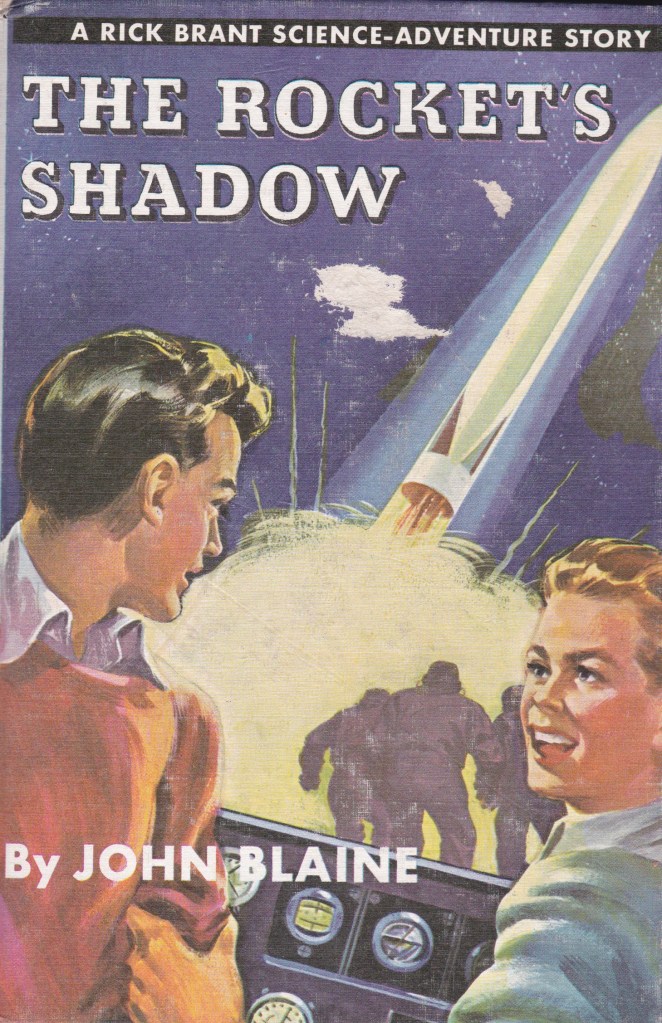
And so opens the first Rick Brant Science Adventure. I bought four Rick Brant books that day (The Rocket’s Shadow, The Egyptian Cat Mystery, The Flying Stingaree, and The Flaming Mountain), all of which had some appeal to me. I wasn’t really that much into science or rocket ships, but I did buy the first because it was, well, the first in the series, and OCD Child Greg had to read the first book. I didn’t have to read the series in order–I did try that with the Hardy Boys, but gave up when it was time for Book 4 and the title, The Missing Chums, didn’t excite me so I got one of the later volumes, The Mystery of the Aztec Warrior instead. There was a pyramid on the cover. I’ve always been a sucker for pyramids–but I always felt obligated to eventually get to the first volume of every series. It wasn’t always necessary, but in some cases–The Three Investigators, Trixie Belden, Judy Bolton–they really did set the stage for the rest of the series and it helped to have read the first one.

I’ll be completely honest here, too: I was never good at science. I don’t know why that was, but I just was never good at any of it–biology, chemistry, physics; math and science were my two Achilles heels. I only read a couple of the Tom Swift books, and even those were because one was reissued in paperback and renamed In the Jungle of the Mayas (the Mayans built pyramids!) but I got the impression the Swift books were more about science than a case or a mystery or anything. The Rick Brant series, on the other hand, while having some insane titles (The Electronic Mind Reader, The Wailing Octopus) like all series did, there were also some that were called “mysteries.” So, yes, science, but also mystery.

I also had no idea it was going to become one of my favorite series.

When I first read The Rocket’s Shadow in the late 1960s/early 1970s, it was already significantly dated. Originally published in either 1946 or 1947, the background to the story was that the scientists on Spindrift Island, off the coast of New Jersey, were trying to build a rocket to send to the moon. Several different groups were trying to accomplish this, and whoever succeeds first was going to get a very lucrative government contract…and their efforts are being sabotaged. Rick’s father, Dr. Hartson Brant, is world-renowned, and of course Rick is very interested in science and is always inventing things to either save time or effort, and they aren’t usually very practical, even though they do work. Rick and his younger sister Barby go to school on the mainland–Spindrift is separated from the coast by tidal flats that are underwater during high tide–but everyone on the island is determined that their rocket will succeed and they’ll catch the saboteurs.

Rick soon figures out a clue and gives chase to some of the saboteurs, who turn on him and attack him–only he is rescued by a blond hitchhiker carrying a military duffle. He and Rick run the attackers off, and then Rick brings his new friend, Don Scott–“Scotty”–home with him because he has no place to go. He’s out of the military and has no family, was just wandering the roads to see where he wound up. The close bond between Rick and Scotty1 resonated with me, especially their sense of camaraderie and affection for each other. They had no girlfriends or even any girls who might be potential dates at first (some were introduced in the series later, Barby growing up for Scotty and a new scientist comes to the island and has a teenaged daughter Jan who is sort of an interest for Rick–but the girls are never more important to them than they are to each other.2

Obviously, by the time I got and read the book we were already into the Apollo space programs from NASA, and we landed on the moon in 1969–so all the science in The Rocket’s Shadow was off and wrong–also the rocket got there in like twenty minutes, not possible even now–and as such, the series could never really be updated and revised like the Hardys and Nancy Drew. The Rocket’s Shadow would have had to have been completely rewritten, and I’m not sure how you could introduce Scotty as a hitchhiker/war vet (he lied about his age) today.

I enjoyed all the books in the series. I did eventually get them all over the years and read them, and many of them are dated. High tech walkie-talkies don’t seem so impressive in a cell phone world, and of course, there are some trips to foreign lands (Asia and Pacific Islands) that are probably more than a little racist and dated now. But I loved The Lost City, where they are off to Tibet to set up a radio receiver on the opposite side of the world from Spindrift to triangulate with the rocket on the moon, and they discover a lost city of Mongols and the tomb of Genghis Khan. They also meet, in that book, an Indian youth named Chahda who helps them out and becomes basically a member of the family, and they take him off the streets of Delhi and pay for him to go to school. Chahda was incredible smart and adventurous too–but not sure how he’d hold up under modern scrutiny in these more evolved times.

And maybe when I’m retired I’ll reread the series critically. The books can be found on ebay and second-hand sites; some are available as ebooks, either on Amazon or Project Gutenberg.

  1. I am even now wondering if this character is why I’ve always liked the name Scotty, and have used it repeatedly for characters of my own creation. ↩︎
  2. I do find in also amusing that my parents–so worried about me reading books about girls instead of boys; did they not understand just how homoerotic the relationships between boys in these books were. This amuses me greatly now. ↩︎

Only the Wind

While the official first day of the summer season isn’t here quite yet, it’s already summertime in New Orleans–with everything that means. The thick heavy wet air that clings to you like a warm wet wool blanket; the beautifully bright and yellow sunlight that burns your skin red as it pierces through the windows of your car; and the climbing electric bills as your air conditioning unit desperately tries–and only occasionally succeeds–to keep the temperature livable and breathable inside your home. Tourists who come to New Orleans often complain about the extreme difference in temperature from going inside to out and back inside again; how cold it is everywhere in doors; that the shorts and tank tops, soggy and wet from sweat, aren’t enough covering as the they dry in the cold frigid inside air. It is really impossible to know how to dress in New Orleans when it’s hot; but those of us who live here are used to it, but you never get used to how just existing and moving around outside sucks the energy right out of you, and sometimes–like when you’re lugging all the shit you bought at Costco in from the car–you have to just sit for a spell, chug some cold water or Gatorade (or a daiquiri if you planned ahead), and collect yourself.

That was my yesterday. As you may have noticed had you paid close attention, I had been unwell for a while; primarily from forgetting that I have to be more cautious dealing with heat and more careful and mindful of the maintenance required for my older body. This whole thing started with me being unable to sleep for several nights in a row, and the moved on to severe dehydration and exhaustion and stomach issues. This led to another COVID-19 test, being sent home from work, and a slow recovery. But after days of drinking lots of water, avoiding caffeine (much to my own detriment when it comes to productivity), and good sleep–as well as staying inside as much as possible–I am finally, this morning, feeling like myself once again; energetic and creative and ready to go. I took two more vacation days this week–Wednesday and Thursday–to continue my rest and recovery, and it seems to have done the trick (I was really worried about the Costco trip being a setback; but I am stubborn and I wanted to get it out of the way; but I downed lots of water before I went, took a Gatorade with me, and had another after I got home).

And this morning, yes, I feel like me again for the first time in what seems like an incredibly long time.

I’m working from home today, which means data entry and making condom packs while streaming things on the television; I should finish the first season of Jonny Quest today, since the episodes are only about twenty-four minutes long; which makes me wonder if that’s why it had such a short run on Saturday mornings when I was a child–not enough time left for commercials. Scooby Doo Where Are You? episodes are 21-22 minutes. Money is key, and despite some problematic issues with the show (it was produced in the 1960’s, after all) it still holds up pretty well. It did put me in mind of another kids’ book series I read when I was younger–the Rick Brant Science Adventures by John Blaine, which was yet another one of the many Grosset & Dunlap series. Like the Ken Holt series I talked about recently, the Rick Brant series was never as popular as the Hardy Boys (nothing ever achieved the popularity of Nancy Drew), but were much more interesting, more action-packed, involved actual detective work, and were far better written. The similarities between Jonny Quest and Rick Brant are staggering; the Quests live on an island; Rick and his family also lived on Spindrift Island, separated by tidal flats from the coast on New Jersey. The Quests sort of adopted Hadji, who became Jonny’s best friend; Rick’s best friend is Don Scott (Scotty), and the Brants unofficially adopt him into their family. Jonny and his family go all over the world having adventures and solving mysteries having to do with science, for the most part; Rick and Scotty do the same. Jonny’s father is world-famous scientific genius Benton Quest; Rick’s father is world-famous scientific genius Hartson Brant.

The first few Rick Brants I read, like Ken Holt, I obtained off the sales table in the bargain basement at Goldblatt’s in Chicago: The Rocket’s Shadow, The Egyptian Cat Mystery, The Flying Stingaree, and The Flaming Mountain. Over the years, I found more of them at swap meets and flea markets and used bookstores; I think I met have an almost complete set of them now (I did acquire some via eBay after Katrina). Some of the books are now available for download on Project Gutenberg; several volumes from a variety of those old kids’ series–including Ken Holt, Judy Bolton, and Biff Brewster–are there (and yes, I downloaded all of them). I want to start revisiting some of these series, since they influenced me into becoming a mystery writer, and while scientific knowledge has proceeded incredibly rapidly since the Brant series were published and went out of print, it’s kind of fun to go back and revisit the world of cutting-edge science (or what was seen as futuristic science) at the time; The Rocket’s Shadow was basically about how the Spindrift Island scientists (other scientists and their families also lived on the island) were racing to build and launch a moon rocket–the case involved Rick trying to solve the mystery of who on the island was a traitor and leaking secret information about the rocket project to a competitor; Scotty rescues him from the bad guys in the first chapter. Scotty was a military veteran who lied about his age to enlist and fight in the war (World War II; the book was originally published in 1947)–which was glossed over and ignored as time passed and the series continued, which would have aged him. This was twenty-two years before the actual moon landing, so to kids reading this in 1947 and the years after, it was kind of science fiction.

We will finish the final two episodes of Elite that are available tonight, and then will have to wait for season four. They had started filming before the world shut down, alas, so there’s no telling how long it will be before we get another season to binge and love. I also am not sure how the show is going to continue; this season has them all graduating and the crime this season is focusing on occurs at the graduation party. I can’t praise this show enough; it’s completely addicting, and there are never any slow parts. The way they have developed the characters and their relationships with each other make total sense and are completely believable, despite the sometimes completely over-the-top situations they find themselves in. Once we finish watching, I will devote an entire entry to discussing the show. But seriously–you won’t be sorry if you watch.

And now back to the spice mines. Have a lovely day, everyone.

It’s Alright

Monday morning, and we have thus far made it through another weekend, and have another week to stare down. I’ve not heard or seen any reports about how the gradual reopening of New Orleans went this weekend–I stayed my ass at home; I didn’t go outside at all other than to take out the trash–and today’s a work-at-home day. The gym has reopened, and I am debating whether I should go workout after work tonight. I’ve been itching to get back to the gym since everything closed–if you will recall, I’d started working out again before the shutdown, even managing to make it through Carnival, and had developed a really good routine before the world closed down on me.

I got some writing done on the Secret Project yesterday, almost two thousand words, which was pretty thrilling for me. I’d hoped to get more done–as I always do–but I really had to force those words out, and I was pretty glad to have been that productive when the words weren’t coming, so I called it a day when the well went dry and retired to my easy chair. I watched a great documentary on Galaxy Quest (one of my favorite movies) on Prime called Never Surrender–if you’re a fan of the movie, I highly recommend the documentary. Last evening Paul and I continued watching The Great, which is becoming more and more fun as I no longer think of them as actual historical figures, since the show bears so little resemblance to the actual history.

I also tried reading  a classic novel by a master of our genre, but couldn’t get very far into it. I admire what the author was doing with his style, voice and use of language–I’ve heard him speak and he’s all about the rhythm of the words, which is very important, and something I tell beginning writers all the time to watch for, and why it’s always important to read your work out loud to make sure the rhythm you’re using is consistent–but he also was guilty of one of my pet peeves: the use of colons and semi-colons in fiction prose. Anyway, between that and the toxic masculinity and racism–I don’t care if it was accurate for the period, it’s hard for me to see toxic racist men as heroic–and when I got to the extensive use of the n*word–again, probably accurate and correct for the period–I was done. I put it in the donation pile and was done with it. I’ve read his work before and I don’t remember it being quite as bad as this particular book; but I intend to reread that book again at some point (it was also homophobic, which jumped off the page at me, and that’s why I want to reread it–to see if it still rings that way) and then I can gladly call it quits on that author.

I’m also still rereading Phyllis A. Whitney’s The Red Carnelian, which is more of a straight-up mystery than any of her other novels for adults. As I mentioned before, it was originally titled Red is for Murder; most of her novels for adults had a color in the title somehow–The Turquoise Mask, Silverhill, Hunter’s Green, Black Amber, Sea Jade–but when her work became more romantic suspense, it was reissued and retitled as The Red Carnelian, to fit her other titles more. Set in a sprawling department store on State Street in Chicago (like Marshall Field’s or Carson Pirie Scott, back in the day–I wonder which store she used as a research; Mrs. Whitney was a librarian, and always exhaustively researched her novels) named Cunningham’s, the book also offers an interesting, behind-the-scenes look at how department stores are run, and the various jobs (window dresser, poster and sign copy, marketing and sales, backdrop painting, mannequin arranging) that are necessary for the day-to-day operation of a large department store. Thinking about which store she used to research her novel sent me into an Internet wormhole, where I looked up Marshall Field’s, Carson Pirie Scott, Goldblatt’s, and Zayre’s, among the many department stores I remember visiting as a child in Chicago. (The bargain basement at Zayre’s was where I first discovered the children’s mystery series featuring Rick Brant, Ken Holt, and Biff Brewster.)

I kind of miss department stores.

I am hoping to get a lot accomplished this week–and I am really looking forward to our three day weekend that’s coming up. Huzzah!

Have a lovely day, Constant Reader.

IMG_1316