This Used To Be My Playground

Monday morning of Malice week. Ugh, all the little things one has to do to get ready for traveling. Make a list of what to pack, take inventory of the kitchen to make sure Paul has what he needs while I’m gone, and so on and so forth. Heavy heaving sigh. But my flight Thursday isn’t super early; eleven-ish, if I recall correctly, which means I don’t have to be at the airport until around nine, which isn’t bad. I’m going to take some books with me to read for pleasure at the airports and while in flight; I will be editing when I can in my room periodically trying to get this revision finished by the end of the month. The weekend wasn’t nearly as productive as it could have been–there was another wave of depression and grief to be gotten through this weekend, unfortunately–but I did make some progress, which I am taking as a win. I did also make a to-do list for the week; that should help in some ways.

We watched A Knock at the Cabin last night, which I enjoyed; a lot more than I usually enjoy an M. Night Shyamalan movie. I had also enjoyed the book on which it was based, The Cabin at the End of the World by Paul Tremblay, who is one of our best horror writers today; I’ve enjoyed everything of his I’ve read thus far. The film follows the book very closely; it’s one of those claustrophobic horror stories where some city folk take a vacation in the country at a remote cabin–but remote and country are very much staples of horror; someone really should do a look at the trope of “city folk in the country” horror–and things of course go very south. The film is very well cast; Jonathan Groff and Ben Aldridge play Eric and Andrew, a gay couple who’ve adopted a young Asian girl they’ve named Wen and they make an adorable little family group. The location of the cabin is idyllic and tranquil and beautiful; the perfect spot for some city folk who want to get away from the every day and rest and relax. Wen collects grasshoppers in a jar because she wants to study them; the movie opens with her catching grasshoppers and then catching a glimpse of a very big man coming through the woods to talk to her. This is Leonard, played very well by Dave Bautista, who is the leader of a group of four people who have seen visions and have concluded that in order to stop the apocalyptic end of the world, they must come to this cabin and present the family with a horrible choice: they have to sacrifice one of their own in order to stop the end of the world. Are they crazy? They sound like it, as they try to reason with the family…but what if they aren’t? The movie’s ending is different than the book’s–there was no way they could film the book’s ending, really–but I do prefer the book’s ending than the film’s; it seemed like the inevitable outcome, and made the most sense. It’s a good movie, I do recommend it, but one thing I’ve always been curious about since reading the book and was only heightened by viewing the film: why a gay family? I gave Tremblay props when I read the book, because they were very real and didn’t seem forced or stereotypical at all; I thought it should stand as an excellent example of someone who is not gay writing gay characters. The politics of the representation–gays in peril–is one I am not going to give any time to; sure, the gay family was in danger almost from the minute the credits rolled, and it was nice having a gay couple to root for in a horror film. Horror by its very nature is disturbing and tragic; you cannot have gay representation in horror and then not expect the gay people to go through some things, you know? And having gay characters also adds another dimension to the home invasion situation–are they crazy, are they telling the truth, or did they target a gay family purposely? There’s an essay to be written about the book and the movie from a sociopolitical and sociocultural perspective, but I don’t know that I am the right person to write such a thing; I’m not an academic, after all, and have very little desire to ever be an academic.,.although that sometimes can explain my insecurities about thinking deep and heavy thoughts and wanting to write deep and heavy essays picking apart and deconstructing gay representation in modern fiction, with an emphasis on horror and crime.

I also read some academic treatises this weekend, one about being gay and the gay rights movement’s intersectionality and how it got away from that in the beginning only to circle back around to it in the present day, and the other about the television show Dark Shadows, which probably had more influence on me, my writing, and my preferences when it comes to reading, film, and television than anything else I’ve watched or read in my life. I know I used to watch classic black and white films with my grandmother (she was a big fan of the gay icons, ironically: Bette Davis, Joan Crawford, Barbara Stanwyck, and Katharine Hepburn; she also liked horror and noir, and she was a fan of Dark Shadows, as was our babysitter down the street, Mrs. Harris), so pretty much my course was set when I was a little boy–gay writer was my future. I should write more about Dark Shadows–I was actually thinking last night that I should write a memoir of being a writer; my influences and how they shaped my creativity and what I actually write–not that anyone would be interested in reading such a thing, of course; which is partly why I don’t write more personal essays. Just as I’ve never really been interested in writing a writing manual, or one of those Greg Herren teaches you how to write a novel things. I always feel like a fraud when I talk about writing; never does my Imposter Syndrome strike as hard as it does when I am talking about writing or teaching a workshop. I don’t know.

It’s back into the office with me today. It’s a light day for me; mostly busy work, like data entry, filing, resupplying testing rooms, that sort of thing. It’s always nice to ease back into the week with an easy day in the office. It’s also weird to know that I am leaving on Thursday morning; the trip doesn’t seem real to me yet even though I’ve already made plans to meet up with people while I am there. Looks like I’m going to have to take a Lyft or an Uber from the airport once there, which is fine. And then of course when I get home I have to make up for lost time with the manuscript. Heavy heaving sigh. It wasn’t a good weekend for working, really; I kept spiraling and had to finally, on both days, remind myself that my mental health was more important than a deadline and so focused on positivity and and worked when I was able to get things done. The house isn’t nearly in the kind of shape I would like for it to be in when I am leaving for a weekend (two in a row; the next weekend I am off to Alabama) but seriously–when is it ever? I just need to make sure everything is in order before I go away on Thursday morning. Heavy heaving sigh.

And my books that I’ll be taking to read with me are going to be That Summer Night on Frenchmen Street, Wined and Died in La,, Let Me Die in His Footsteps, and Monday’s Lie. I am not going to get through all of these, of course; I may even cut it down to two–like I won’t be buying books in the book room, please–and I will also be working on the revision while I am there, too. (I so wanted to be finished before I leave…)

And on that note, I am going to get cleaned up and head into the office. Have a lovely Monday, Constant Reader, and I will check in with you again tomorrow.

Dark Shadows (Josette’s Theme)

I always forget this when I am asked about major influences on my life, writing, and career–but probably the biggest influence on me was the television soap Dark Shadows.

“My name is Victoria Winters…”

So began the first episode, with young heroine Victoria speaking over some rather spooky music, usually with a background scene of a light in the window at the great house of Collinwood in the fog, or waves crashing against the beach, or the family cemetery, or even the Old House.

Dark Shadows is probably the root or seed from which Bury Me in Shadows was grown from, now that I think about it more. A haunted old house, an even older house in ruins nearby in the woods that was the original family home, ghosts and secrets from the past–oh yes, the framework is absolutely there, and it never even occurred to me.

When my sister and I were kids, we moved to Chicago from Alabama. I was about two years old, give or take; I don’t remember moving up there nor do I remember ever living in Alabama; my sister was two years older. My parents both got jobs–the point of the move was for climbing the economic ladder; they both got really good jobs in factories while my dad finished his degree. But because they both worked (our friends and neighbors all felt sorry for us because our mom had to work; their moms all were housewives), we needed to be watched while they weren’t home. Our landlady recommended a woman down the street–a mother of six whose two youngest were in their last years of high school–and so we started spending our days with Mrs. Harris, who fed us breakfast and lunch, and Mom would pick us up on her way home from the bus stop. When we started school, we went there for breakfast and lunch but came home after school; school let out at 3:15 and Mom was usually home by 3:30. But it was Mrs. Harris–and my grandmother, who worked a night shift–who got me started watching soaps in the first place. One Life to Life and General Hospital sort of held my attention, but it was Dark Shadows I couldn’t wait for. I used to run home from school to try to catch the last five or ten minutes during school; it wasn’t a problem during the summer.

I loved Dark Shadows.

I was crushed when it was canceled.

I mean, look at that house!!!!

The show wasn’t canceled, although the ratings were starting to slide a bit in the later years. The truism that Dark Shadows‘ producers and writers discovered is one that practically every other continuing series having to deal with the supernatural and supernatural creatures has had to deal with: how do you keep topping yourself and raising the stakes? True Blood, Supernatural, The Chilling Adventures of Sabrina, and countless others have all run headfirst into that wall. Once you’ve done time travel and vampires and witches and werewolves and Frankenstein and other dimensions, what is left to do? I admire them for pulling the plug rather than getting more and more desperate to get the ratings up and eventually damaging the legacy of the show.

The show was a phenomenon the likes of which had never really been seen before in daytime–and the lesson learned from its success (go for the young audience!) would soon lead to the creation of youth-oriented shows like All My Children and The Young and the Restless–and of course in the mid-1970’s soaps would be forever changed when General Hospital introduced the character of teenager Laura Webber, played by an actual teenager, Genie Francis–and daytime was never the same. But Dark Shadows managed something that other soaps hadn’t–they created teen idols. Jonathan Frid as Barnabas, David Selby as Quentin, and even David Hennessey as David Collins were often on the covers of teen magazines like Tiger Beat and 16. The show even licensed FAN FICTION–a series of books based on the characters from the show, but thanks to all the fun stuff with time travel and parallel dimensions, Dark Shadows was perfect for spin-off books that took place in other Dark Shadows universe; one could even say Dark Shadows was one of the first shows to make use of a multi-verse.

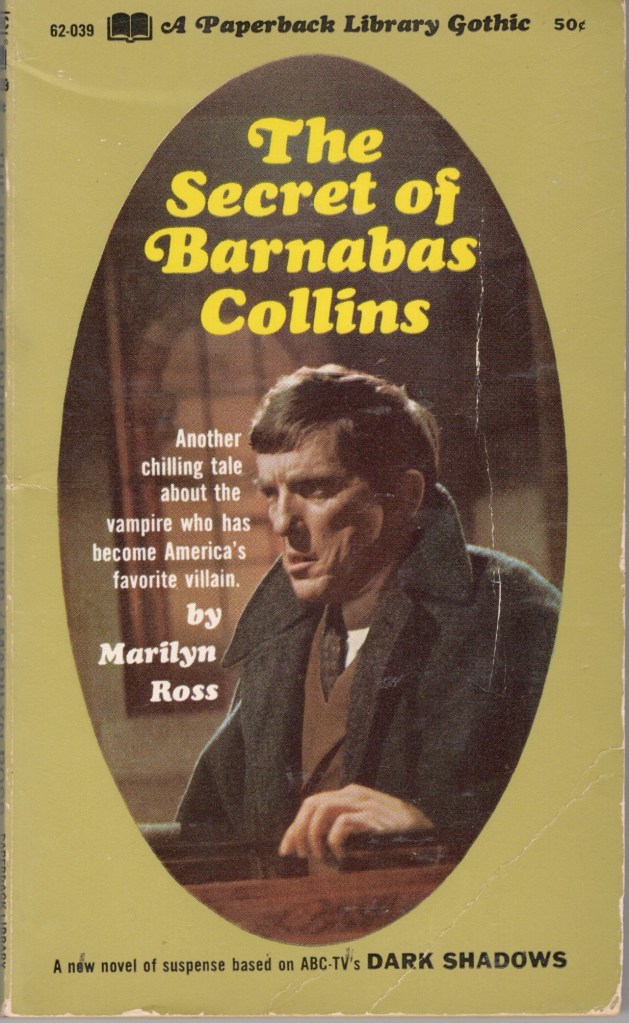
The books were cheap–as you can see in the picture above (a copy sent to me by a friend with whom I bonded over our mutual love of the show) they ran between fifty cents and seventy-five cents a copy; they all had that same gold bordered cover with an oval image of characters from the show, and they were all written by “Marilyn Ross”, which was a pen name for a very prolific Canadian author named  William Edward Daniel Ross; he wrote over three hundred novels during his career, and Marilyn Ross was the name he used for Gothics–and the Dark Shadows books. (He also wrote as Clarissa Ross, and I read some of those novels as well, including The Spectral Mist.) They also weren’t particularly well written, and while they did take place outside the show’s continuity, there were also moments in some of them that didn’t make sense; in one of them, in which Barnabas shows up at Collinwood in the 1910’s, the only son of the family dies in a tragic accident…but if he was the only son, where did the present day Collinses come from? (The earlier books were told from the perspective of Victoria Winters, and in some cases the gimmick was some member of the family was telling Victoria a story about the family history.)

That’s the kind of shit that drives me insane.

But I remember when one of the off-brand television channels in Chicago (not affiliated with a major network) started running repeats of Dark Shadows from the very beginning when we lived in the suburbs in the evenings while the networks ran the evening news–guess what I was watching instead? Yup, Dark Shadows. (I always found it interesting, too, that the young actress who played Victoria Winters originally–Alexandra von Moltke–eventually became infamous as Klaus von Bulow’s mistress Alexandra Isles, who was, in the prosecutor’s theory, the reason Klaus injected Sunny with enough insulin to induce the coma from which she never woke up. But I digress.

I always wanted to write a vampire story similar to that of Barnabas Collins; I have an entire idea for a rural Louisiana version called Bayou Shadows that I’ve tinkered with off and on since the early 1990’s…but then Charlaine Harris started the Sookie Stackhouse series, which was essentially the same thing. I still might write about Bayou Shadows–the town called that has popped up from time to time in my books about New Orleans and Louisiana; most recently in A Streetcar Named Murder, actually–and if people think I’m ripping off Charlaine, so be it.

I’ll know that I’m really ripping off Dark Shadows.

The show also spawned two feature films, Night of Dark Shadows and House of Dark Shadows, each featuring one of the show’s leading men, Jonathan Frid and David Selby, respectively; the first did far better than the second. The show was revived in prime time for a single season in the late 1980’s; I watched it and loved it, of course–even got Paul to watch when it became available on DVD and I rewatched. I wish that show had been given more of a chance, because it was really quite good, and I was curious to see where the story went from that first season. It also had an excellent cast, including Hammer Film star Barbara Steele as Dr. Julia Hoffman. I did watch the Tim Burton film from this century, which had some clever moments but wasn’t quite as good; it went for the silly parody thing The Brady Bunch movies of the 1990’s did, but it didn’t land. The actress who played villainess Angelique in the original series, Lara Parker, has also written some Dark Shadows novels (I have copies but haven’t read them; I really should). Kathryn Leigh Scott, who played the original Maggie Evans on the soap (and in the first film) also has written novels; she was at Long Beach Bouchercon, where I met her and got a signed copy of her book Down and Out in Beverly Heels. She was lovely and couldn’t have been nicer; I really should read that book someday.

I’ve had Dark Shadows on my mind lately because I bonded with Carol Goodman at Bouchercon over our mutual love of Dark Shadows, and the Scotty book still in draft form takes place mostly in a rural parish outside of New Orleans; not the same parish where Bayou Shadows is located, but the next one over.

Sometimes I think it would be fun to reboot the show again, retelling the original story, or picking up from where the television series ended, or even doing a new generation, some forty years later, with David Collins as an adult with children and so forth…Carol and I have joked about coming up with a concept and trying to sell it and be the showrunners…which would be a dream.

Dandelion

I am soon to depart for the airport, where I am catching a flight to LaGuardia for a weekend in New York; I am flying back home on Sunday. It’s going to be a short but busy trip, where I will get to see all kinds of people i really like and run all over the island and do all sorts of things. I also need to carve out time to write while there as well–I have gotten really bad about writing when on trips over the years, but I really can’t go without writing the entire time. I made quota again yesterday–it was a little harder to get motivated and not quite as easy to get into a proper rhythm, but it was also a transitional chapter and my first goes at those are always stilted and awkward and people don’t really talk like that, do they? But I got through it, the transition was made, and the stage has been set. Now we move on to act 2, which is why it really cannot wait. Hopefully, if I am not too tired when I get to the hotel, I can spend a few hours working.

My flight is already delayed, I see–so I don’t have to leave quite as early for the airport as I had originally thought, which is fine. Our Internet was spotty last night, going in and out, so we ended up not finishing watching the Golden Globes and I went to bed early. It seems to be working fine this morning, so I am not going to worry about it–I’m the one who always has to deal with it, the Cox bill is in my name, etc. etc. etc. It would suck for Paul to have no Internet for the weekend, but I am going to assume that last night was an aberration. Our cable box is also so old they can’t even service it anymore, so I need to go get a new one at some point; the Cox office is near my office, so I can run by there during lunch someday when I get back. Sigh, it’s always something.

I am taking A Walk on the Wild Side with me to read on the plane and at the airport, along with a rather short book by Harry M. Benshoff, Dark Shadows, which is a kind of academic breakdown of the original show that I am kind of looking forward to reading. Dark Shadows probably had a much bigger impact on me than almost anything else–my preference for Gothics, supernatural stories, murders–and I should probably do an entire entry about Dark Shadows and its influences and impact on me creatively. I am also trying to decide what other books to take on the trip with me–I need at least one more for the flight home–and am kind of torn as to what to read next. I’ve got some great cozies stacked up in the TBR pile, but I also have some books by other favorite authors and some other books that have gotten some high praise from either reviewers or friends on social media. Maybe someday I can get the TBR pile under control but it won’t be anytime soon, I can promise you that. I am really looking forward to reading more this year than I have in past ones.

I’m also looking forward to writing a lot more this year, too. I can’t believe what a roll I’ve been on since Christmas (or just before); I’ve written at least three thousand words a day on average ever since (some days I skipped, others I did from four to six thousand words), which is quite a bit, really–somewhere between forty-five and fifty thousand words, which is kind of impressive, I must say. It’s also not been wearing me out, or making me very tired. I think some of that has to do with the lessening of outside pressures and stressors–I’ve been sleeping very well (well, last night was kind of spotty) for the most part, feeling rested, and not letting things get to me the way they always seem to have been doing for the last three or four years. I really hate stress and anxiety, and I really need to make sure I continue to focus on reducing those thing. Staying off social media more has done a good job of that, too–nothing can quite raise the blood pressure the way reading something racist or homophobic or misogynist or transphobic from people who should know better, and I’ve started unfollowing and/or blocking people who are, for wont of a better word, assholes. And it actually feels good to hit unfollow or block, knowing you never have to interact with that person or read their shitty screeds ever again.

And it’s not required that I follow every crime writer on social media, either.

I went to a lot of events last year, and will be scaling back dramatically on that this year. Probably Bouchercon in San Diego is all I am going to do involving air travel, and yes, I’ve been offering my short stories and books up for Lefty and Agatha consideration, but I won’t be attending either event so even were I to score a nod, not being present doesn’t help your odds of winning. (For me, being present isn’t enough, either.) It’s weird to think that after this weekend’s trip I probably won’t be flying anywhere again until Labor Day weekend for Bouchercon, and I’m actually feeling kind of iffy about that, to be honest. I hate the thought of traveling over Labor Day weekend, but at least if I fly home on Sunday I’ll have Monday off to recalibrate and recenter and recover from the conference.

I just hope I can sleep this weekend. Let’s focus on getting through that first, shall we? LOL.

And on that note, I am going to bring this to a close and start packing. I made a list of everything I need for the trip, and I got the big black suitcase out last night so everything is in place and ready to go. I may check in with you tonight from the hotel–stranger things have happened–but one never knows. I was actually thinking the other day that I’ve gotten into a bit of a rut with this; I always write it in the morning with coffee and maybe, just maybe, sometime during the day I may write another entry, usually about a book I’ve just finished reading or something–and there’s really no reason for that other than habit. Maybe the blog entries that require a more awake brain, for logic and reasoning and making a rational argument either for or against something, can be worked on during the day or in the early evening or around my writing for the day. I have any number of entries I’ve started over the years–dealing with things like racism and homophobia and all the other, irrational bigotries and prejudices that run rampant in our modern world, and it would be nice to finish them all, get them out there into the world to be read by the two or three people who actually check in with me every day and read these meanderings of my mind.

Stand on the Rock

Thursday morning and I slept really well last night. About time, right? But it’s amazing what a good night’s sleep makes, especially coming after two consecutive nights of insomnia. It’s lovely not to feel tired, you know? I was so tired when I got home from work yesterday that my eyes were almost crossing. I was too tired to think, too tired to write, too tired to do much of anything, so I just collapsed into my easy chair–Scooter actually slept in my lap all evening, and when I got up, he’d curl up in the chair again waiting for me to come back, which was very sweet–and then I watched the documentary God Forbid, which focuses on the Jerry Falwell Jr. pool boy scandal that ended Falwell’s career, from the pool boy’s point of view, which made it a lot more interesting.

It also explored how Falwell’s father led the evangelicals into politics and set us on the downward path that put our entire democracy into the peril it still faces today. The original Falwell was a monster–racist, homophobic, misogynist–and perverted Christianity for money and power. He isn’t the first to do this–look up “Father Coughlin” sometime–and maybe not event the worst (anything is possible), but the damage done to the fabric of the culture and society, predicated on the evangelical desire to make this a Christofascist nation (definitely not what the Founders wanted), by this man and his son may even prove irreparable in the long run. Who knows? Falwell Jr. was important to the election of Trump and the evangelical embrace of this thrice-married ungodly and unChristian wannabe dictator, too. And it got the evangelicals what they’ve wanted since Falwell Senior realized that open racism wasn’t a winning ticket–but abortion could be: the overturn of Roe v. Wade. Would Falwell have backed Trump if Michael Cohen hadn’t known about the sick sexual games the Falwells were playing with a young, naïve young man named Giancarlo Granda? It would make an epic crime novel, truly–I loved John D. Macdonald’s examination of a Midwestern megachurch, One More Sunday, which I really enjoyed.

I have had this idea for a crime novel built around a cult-like church for quite some time. When I was living in Kansas, there was a college in Emporia that was owned and operated by just such a cult-like church. The College of Emporia, a Presbyterian school, had gone bankrupt and closed in 1973. A few years later it was purchased by The Way International and transformed into The Way College of Emporia. The Way College was strange. Their campus was closed to outsiders and patrolled at night by armed guards. There was all kinds of gossip around the county about what went on there and the kinds of things they believed and did; the students always wore name-tags and travelled in pairs–and would often try to corner other young people and proselytize. When I was working at McDonalds, for example, I observed them do this to a girl who was cleaning tables in the lobby. They essentially waited until she was in a part of the place that had only one way out, and once she was back there cleaning tables, they blocked the way out to talk to her. They always had this weird look on their faces, too–their eyes always seemed either glazed or vacant or both, and they always had a zombie-like smile that didn’t reach their eyes. One of the many iterations of the Kansas book took place over two time-lines, one in the 1970’s and the other the present day; where the quarterback’s murder in a sex scandal in the 1970’s gave rise to a megachurch in the town. I have done some research in the Way International (they sold the Way College and its campus to Emporia State University sometime after we left Kansas) and even have a book written by someone who belonged and got out.,,so I would never say never.

Oh, and thank you, Brazil, for ousting your Fascist. Well done!

Unfortunately, my exhaustion last night means that I have fallen another day behind on the book, which isn’t good. But it was really out of my hands, to be honest. I was so tired I don’t even really remember driving home from work last night–which is NOT a good thing at all. But I am hoping that feeling rested and not being exhausted will make a difference tonight. I am halfway done–it’s planned to be twenty chapters, and I finished Chapter Ten on Tuesday–so tonight I am going to go back and reread and edit the first half of the book. It’ll take some serious work–the kind where I have to close the Internet browsers to avoid distraction–because some of the earlier chapters need to be moved around and rearranged; the order in which the story unfolds needs to be switched up a bit–and I need to outline the first half as well as make a character list and due a timeline. I also realized that my usual Scotty thing to do–parody the opening of a famous novel–doesn’t have to be a parody of a famous novel opening–and I’ve always wanted to write something that opened the way Dark Shadows did (“My name is Victoria Winters”), so why not do that? “My name is Scotty Bradley” or something along those lines. I wonder if Victoria’s opening monologue from episode one is on-line anywhere? Better add that to the list.

And on that note, Constant Reader, I am going to head into the spice mines. Have a great Thursday, and I will talk to you again tomorrow.

The Nightwatchers

I never really thought much about writing vampire fiction.

I’ve been a Stephen King fan since I read a battered paperback copy of Carrie when I was fourteen, and ‘salem’s Lot continues to be a top 5 King novel for me, if not my favorite (it’s always a toss-up between this and The Stand, frankly) and despite my attempts to turn myself into a King clone in the 1980’s, I’ve never been very good at writing horror. I love to read it–there are some truly terrific horror writers publishing now (if you’ve not read Paul Tremblay, you really need to start), and they are, if you’ll pardon the incredibly cheap pun, killing it. I can do creepy. I can do Gothic. I can do atmosphere and all those marvelous things I love in horror fiction. But I cannot, for the life of me, scare people. I don’t know why I can’t write anything that gets under your skin and into your nervous system; the kind of thing that makes you leave a light burning after you go to bed. I wish I could write like that. I’ve certainly tried a few times…I still have an idea for a horror novel sitting in the back of my brain that I am really going to have to try to get around to writing at some point, because I really should give it a real try sometime.

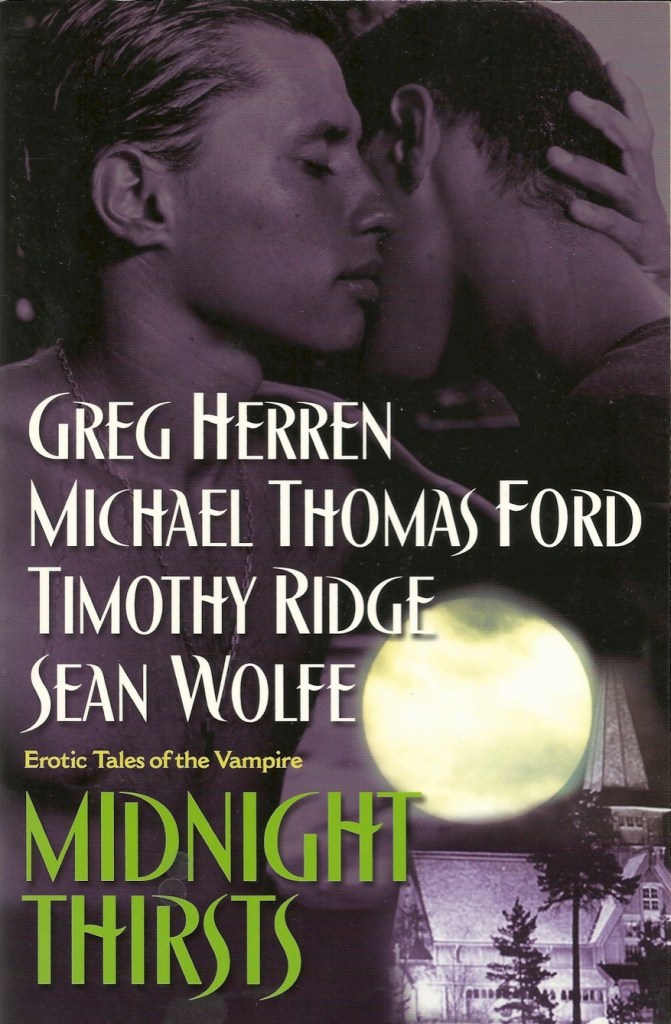
I have always enjoyed reading vampire stories. “salem’s Lot has always been one of my top five Stephen King novels; I loved Dracula (oh to write an epistolary novel!) and numerous other such tales. It took me awhile to come around on Anne Rice’s The Vampire Chronicles (a tale for another time), but I did eventually. Twilight never struck any chords with me. But the one thing I never thought I would do was write about vampires, despite loving them the way I do–going all the way back to my childhood and Dark Shadows. I don’t think I ever would have written about vampires, but my editor at Kensington thought I could; thought I would do a good job at it, and encouraged it, beginning with an offer to write an erotic vampire novella for a collection to be called Midnight Thirsts.

Go home, old man, Rachel thought, tapping her black fingernails on the counter.

It was a quarter till nine, fifteen minutes before she could lock the doors. Everything was clean and the cash register was already counted down. All she had really left to do was dump the remains of the day’s coffee down the sink, lock the cash drawer in the safe, and turn everything o. She’d be gone by ten minutes after at the latest.

She glanced out the big windows fronting the coffee shop. The streetlight just outside cast a yellowish glow in the thick mist pressing against the glass. She shivered and looked back at the old man. He was sitting at one of the tables in the far corner, with the same cup of coffee he’d ordered when he came in around seven thirty. He hadn’t touched it. It was still as full as when she’d filled the cup, only no steam was coming off the black surface now. He didn’t seem to be watching for anyone, or waiting. He never glanced at this watch, which she’d spotted as a platinum Tag Heuer, nor did he ever look out the window. Every once in a while. he would look up from his newspaper and catch her staring. He’d smile and nod, then go back to his reading.

Apparently, he was determined to read every word.

She stood up, bending backward so her back cracked. The night had been really slow. The Jazz Café, even on weeknights, usually was good for at least thirty to forty dollars in tips. Tonight, when she counted out the tip jar, it yielded less than seven dollars. Just enough to get her a pack a cigarettes and a twenty-ounce Diet Coke at Quartermaster Deli on her way back to her apartment. It wasn’t, she thought, wiping down the counter yet again, even worth coming in for.

Usually, on this kind of night, cold and damp and wet, Rachel was kept busy with orders for triple lattés. The tables would be full of people who would coming in shivering, bundled against the cold wetness in the air, which seemed to penetrate even the thickest coat. They’d hold their steaming cups of coffee with both reddened hands, talking and laughing. SOme would be doing their homework on laptops.

She liked busy nights, when the orders kept coming and the tip jar filled. Then, the time seemed to fly by, her closing shift passing in the blink of an eye. She hated the slow nights, when every passing minute seemed to take an eternity. She glanced back at the clock on the wall, then back at the old man. If you would just leave, she thought, I could go ahead and close early.

He’s kind of good-looking, she thought as she sipped her tepid cup of green tea, for an older guy.

At that moment he look up, and their eyes met. His were blue, a deep blue with some green in it. Once again, he nodded his head to her and smiled, but this time he didn’t go back to his newspaper. He held her eyes.

Not to worry, my child, I’ll be gone soon enough.

She turned away, shaking her head, the hair on the back of her neck standing up…

As is frequently the case with my work, The Nightwatchers began as a short story. Within a year of moving here, Paul had struck up a friendship with the director of the Tennessee Williams/New Orleans Literary Festival (which is where he now works), and as such he volunteered us both to help out with the 1997 Festival. I worked at the sign-in desk, where people picked up their badges and so forth, and it was in the lobby of Le Petite Theatre de Vieux Carre, a marvelous old theater on the corner of Chartres and St. Peter, right across the street from the Cabildo, and kitty-corner to Jackson Square. It was very old, and the main stage was named for Helen Hayes, who’d actually played there before. It was haunted, too–every building in New Orleans is–and I heard some of the stories. Being a volunteer, I had access to back stage, upstairs to the balcony, the prop attic; everywhere. (I eventually used some of this knowledge in Jackson Square Jazz.) At some point during the weekend I had an idea for a story–a horror story–about a theater company rehearsing in an old haunted theater in the French Quarter, where the person always cast in the lead female roles is also sleeping with the director. The young actress who deserved the part doesn’t listen to company gossip, but she does eventually find out that the rumors are true, and at some point made a deal with a devil who appeared to her in her dressing room, on and on and on. I called the story The Nightwatchers, because to me, that was what the devils/demons were called–they watch at night for souls to prey on. When I was asked to write this novella, I dug out the story and reread it, deciding it was perfect to adapt into something new.

I played with it a while, and couldn’t quite get it right in my head until I decided to abandon the theater idea; I’d tried turning the girl into a gay guy but it didn’t really work. I also couldn’t seem to get the atmosphere right, either, and I was convinced–still am, in fact–that the atmosphere had to be just right or the story wouldn’t work. Then one night I was walking through the lower Quarter in December–meeting Paul somewhere, I think–and it was one of those evenings when the fog is so insanely thick that you literally can’t see more than a foot or so in front of you at any time. As I walked along the sidewalk, with the old buildings pushing up against the sidewalk, when I heard the sound of hooves on the street–and realized, bemusedly, that in the fog and the only light from a gaslight–that I could have traveled back in time. Only in New Orleans can you feel like you’ve traveled back in time when it’s foggy, I thought, and wrote an entire scene around that feeling when I got back home. It was the perfect mood/atmosphere for the story, and it worked very well.

And as I wrote the novella, I got more and more into the characters and started imagining my own supernatural world, with vampires and witches and werewolves and everything else, including a ruling council over the paranormal world, the Council of Thirteen, and the old man Rachel sees in the coffee shop is a representative of the Council, in New Orleans to hunt a rogue vampire…a vampire who believes her young friend Philip Rutledge (now the center of the story) is the reincarnation of someone he loved hundreds of years earlier when he was human (shades of Dark Shadows!) and so wants to turn Philip into his eternal companion, and it’s up to Nigel and Rachel to rescue Philip.

It was a lot of fun to write, and I left the ending a bit open so I could write more about the characters if I ever chose to do so; I actually slotted a continuation novel into my writing schedule; it was supposed to be what I wrote next after finishing Mardi Gras Mambo…needless to say, life conspired to keep me from ever getting around to this book. I am still a bit disappointed I never carried on with the story; I used this same mythology when I returned to writing about vampires again several years later with Blood on the Moon.

So, that’s how The Nightwatchers came to be a story. Writing this now I see the parallels between what I wrote and some things I read and enjoyed (or watched, a la Dark Shadows); and is my “Nightwatcher” group that different from Anne Rice’s Talamasca? Probably not.

I did read and enjoy the other novellas back in the day; I’ve been meaning to revisit Michael Thomas Ford’s because it was particularly memorable.

Tusk

Monday and a work-at-home day, for data entry and other things. I also have a meeting at one (yay) and I am hoping to get some things delivered today so I don’t have to leave the house. Yesterday started out well; I wrote my entry and did some writing planning and then repaired to my easy chair to read; but then Paul got up and came downstairs and I decided that as long as I kept my notebook/journal handy, I could make notes while thinking and watching television. We missed the Saints game; I’d forgotten it was in London and by the time I checked what time it was starting it was already over so I can’t even blame the Saints for my complete (well, pointed, at any rate) failure to get as much done yesterday as I had wanted to–which means it’s entirely my fault.

I did watch the first two episodes of the new Interview with the Vampire series, and it put a lot of thoughts into my head. I thought it was remarkably well done and well-cast–I would have gone for a Skargaard for Lestat, but that could be True Blood’s fault as well–and it was beautifully filmed. The changes made to the original book (I liked that it’s structured as a follow-up interview to the original interview) and story were barely noticeable. It’s also amazing how different Jacob Anderson looks as Louis as opposed to Greyworm from Game of Thrones. It also made me start thinking about vampires and how/why they are so popular with queers–this show has no gay subtext, it’s right there in your face–and also remembered how incredibly disappointed I’d been when I first read the book, as a teenager. At that point in time, I’d forgotten that Dark Shadows had turned a vampire into a romantic leading man–my thoughts about vampires were entirely shaped at that time by Dracula and ‘salem’s Lot, and that was what I was expecting from Interview…and that is most definitely not what the book was. I read it again about ten years or so later, and still didn’t care for it much; I didn’t come into an appreciation of Anne Rice’s work until the 1990’s–a friend told me to read The Mummy so I did and enjoyed it, and then I read and loved The Witching Hour, so I took the first three volumes of The Vampire Chronicles with me to Hawaii on a vacation and that time…well, that time I got into the books and enjoyed them. Mrs. Rice soon became a “buy in hardcover on release” author for me, and remained that way for a very long time. I do think there’s a line from Barnabas Collins in Dark Shadows to Lestat/Louis to True Blood/the Sookie Stackhouse books; I once described True Blood as “Dark Shadows with sex, violence, nudity and blood.”

We then watched the first episode of Queer for Fear, a documentary series on Shudder about queer themes and subtexts in horror films, which was fun and certainly fit the theme of the day, but then we moved on to Your Honor starring Bryan Cranston, filmed and set in New Orleans (again, we marveled a lot about the geography–“oh, look, they’re transporting him from the courthouse to OPP but for some reason are coming in from I-10 which means they somehow detoured through Metairie”–and we can’t quite figure out where Cranston and his son live; they are always taking the bridge across the river, but Cranston can go jogging from his front door down St. Charles Avenue down to the lower 9th ward (clearly, training for a marathon of some sort) and back, so I am not sure why they have the need to go back and forth to the West Bank (Paul: this would only make sense if they lived in Algiers, but why would he cross the river to go jogging?). I know, I know, it’s fiction and make-believe and has everything to do with shots and visuals that remind the viewer it’s New Orleans; both the Crescent City Connection and the Huey P. Long bridges will do that, as will the drawbridge over the Industrial Canal, and nothing says New Orleans quite like the streetcar. I also know it’s being nit-picky and “more New Orleanian than thou”, but I can’t help it when I watch something filmed here (I was also identifying where scenes were shot in Interview with the Vampire as well). I’m sure New Yorkers do this a lot, too. We also watched this week’s House of the Dragon, which I am enjoying–there’s really no good characters to root for in this one; they are essentially all terrible people; at least in Game of Thrones we could root for the Starks as the only decent people in Westeros. We also watched the new episode of The Serpent Queen, as Catherine is now slowly coming into her own. I really am enjoying this series; I hope it doesn’t go off the rails at some point.

But now it’s October already–yikes; it seems as though this year has sped past but on the other hand January also seems like it was a million years ago already–and I’ve really got to start getting things done.

As I’ve been doing my entries about writing my books, it’s been a fun journey down memory lane, as I remember things I wanted to do and plans I had that somehow were either forgotten or pushed aside as other things crowded them out of my brain. Watching Interview and Queer for Fear reminded me of my own world of the supernatural I was trying to create with some of my horror writing (I don’t really consider my vampire writing as horror; yes, vampires, but the primary focus of them was the eroticism), and somehow I’ve managed to stick to the rules of that weird world of the supernatural I was creating through short fiction that spilled over into the erotica; so far I’ve done vampires and witches, rougaroux and le feu follet, all tied around parishes on the other side of the river and west/south of New Orleans. I have a couple of short stories to write still, and a book to get done–and I want to read more. I want to finish reading my current book and I think the first book for Horror Month will be a reread of Interview with the Vampire, perhaps followed by a reread of ‘salem’s Lot; why not explore the vampires?

And on that note, I am heading into the spice mines. Have a lovely first Monday in October, Constant Reader, and I will be checking in with you again tomorrow morning before the sun comes up. Yay.

We Gotta Get Out of This Place

Saturday morning in New Orleans and all is right–for now–in the world. I slept in this morning, which felt great, and while I have some errands to run–mail, drop off a return, make groceries, take books to the library sale–overall I pretty much have the day free. The LSU-Kentucky game isn’t until six thirty, and I don’t have any need to actually watch any of the other games today–although I will undoubtedly have the television on and tuned into said games–but I want to work on cleaning today, getting organized, and potentially doing some writing. I started writing another Blatant Self Promotion (BSP) post for Bury Me in Shadows the other night, and I really would like to get that finished and posted (I had hoped to write a post a day to try to sway you, Constant Reader, into opening your wallet and buying the book, but there’s only so much time in a day and I do need to rest and refresh both body and brain) at some point either today or tomorrow. But the book–and therefore the self-promotion–walk a line that I have to be very careful with, which always makes me nervous. It’s never my intent to ever offend or upset anyone, but my books are my books and my personal politics, values, and beliefs do affect what I choose to write about–and if you’re looking for a conservative point of view (or a white supremacist one) you are definitely buying the wrong books should you buy one of mine.

Yesterday was actually kind of lovely. I did some work, I made some condom packs, and I rewatched a film from the 1970’s that fits both into the Cynical 70’s Film Festival as well as the Halloween Horror Film Festival: Brian de Palma’s The Fury, based on a book by John Farris, which I read at the time (I eventually originally saw the film on HBO; I never rented it nor saw it in the theater). Horror fiction and films made an enormous comeback in the 1970’s; one could see the genre actually achieved never before see heights in that decade. Part of this, naturally, was the publication of Stephen King’s first novel, Carrie, and the enormously successful, Oscar-nominated film adaptation of it a few years later (still one of the best King adaptations of all time). Both publishing and film responded accordingly, and also in the late 1970’s the one-two punch of Halloween and Friday the 13th took the slasher film to new heights, taking the horror genre along with them. The 1970’s also saw the debut of Anne Rice’s Interview with the Vampire, which wound up spawning an enormously successful series of books that completely changed the vampire dynamic in fiction–following the lead of Dark Shadows and making vampires into deeply flawed, romantic heroes. But horror was everywhere in the latter part of the decade (you should really check out Grady Hendrix’ marvelous Paperbacks from Hell, which examines the proliferation of horror titles in the 1970’s and 1980’s, through the window of their cover art), and so, naturally, The Fury–with the same director as Carrie, Brian de Palma–was primarily viewed as a rip-off trying to cash in on the success of Carrie.

But if The Fury is similar to Carrie in some ways, it is much more like Firestarter than any other King work; as I rewatched I kept being reminded of Firestarter and thinking about it (and thinking it, too, was due for a reread). The premise of the film/book is that there is a secret government agency (1970’s paranoia again) tasked with exploring and examining the potential of young people with some psychic gifts, whether it’s ESP, telekinesis, etc., with an eye to weaponizing them as well as advancing science (the government will turn anything into a weapon of war; this moral debate is mentioned very briefly during the film but to no great degree). Kirk Douglas plays the father of an extremely gifted young man, played by Andrew Stevens (which may or may not have been my first exposure to the handsome son of Stella Stevens; he also appeared in a two-part television adaptation of John Jakes’ The Bastard, and I don’t remember which came first. Nevertheless, he was quite handsome and had a terrific, sexy body). The very first scene of the film shows them on the beach somewhere in the Middle East; there’s a terrorist attack and Douglas is the target, but Stevens is kidnapped by the bad guys and Douglas manages to escape, embarking on a lifelong quest to find and rescue his son from these bad guys operating under the aegis of the government (I cannot emphasize how deeply distrust of the government ran in this time, in the wake of Watergate and Vietnam, there was a definite shift in public perception). The movie then switches over to Amy Irving, daughter of wealthy parents attending an extremely exclusive girls’ school in Chicago. Amy (another tie to Carrie) also has powers she doesn’t understand and can’t control; a bully starts harassing her in the cafeteria, and Amy blurts out the girl is pregnant–and the girl starts bleeding from her nose profusely, causing a panic, etc. Amy is then recruited to a school to test her talents–the same people who kidnapped Andrew Stevens, but their end game is never really explained; they’re all just bad guys who work amorphously for the government. Amy and Andrew are somehow connected; being able to see each other’s thoughts and so forth, so Douglas helps her escape from the school and they go looking for Stevens. SPOILERS: Stevens and Douglas finally end up dead, basically killed by the government people–not really, but they are definitely the reason they do–and in the final scene Amy uses her powers to punish the bad guys (again, very similar to Firestarter, which The Fury predates by several years). It’s not a bad movie, per se, but it’s also not a great one; it’s certainly not as engaging as Carrie–and I remember thinking that about the book as well; that it was just a quickly written attempt to cash in on King’s success.

What was interesting–what is always interesting–about watching these old movies is seeing actors who have not yet made it big in bit roles. There were three I picked out in this one: Melody Thomas, yet to become Nikki Newman on The Young and the Restless for decades; Daryl Hannah as one of the bitchy mean girls at the private school Irving attends; and Dennis Franz, playing a cop years before NYPD Blue.

We watched the season finale of Ted Lasso (oh, Nate, you poor broken man) which made us both laugh and cry, as it always does; the show really is a joy and I am rather distraught we have to wait now for the next season, and then a new show on Apple TV called Acapulco. This show is interesting; a wealthy older Latino man is explaining to his nephew his life story; how he came up from nothing to become wealthy, and how it all began with him getting his first job at a ritzy resort hotel in Acapulco called Las Casinas when he was a teenager. The parts with the older man talking to his young nephew are not engaging at all; there’s a mimicry of The Princess Bride with just a hint of the story-telling structure of How I Met Your Mother as well; it didn’t work for me in this instance. But the teenagers working at Las Casinas back in the 1980’s? Very charming, engaging, and likable. We’ll keep watching, but I want to see less of the present and more of the past, which is the show’s true strength.

That’s about it here from the spice mines. I think I’ll have some more coffee and try to get that BSP post finished. Have a great Saturday, Constant Reader!

Mean

When I was a child and lived on the south side of Chicago, elementary school was dismissed every day at 3:15 pm. It took about ten minutes for my sister and I to walk the block home, meaning we usually could just catch the last minutes and closing credits of Dark Shadows every day. This was disappointing, of course, because we loved the show and tried to keep up with it; the older woman down the street with whom our mother left us every morning on her way to catch the bus for her shift spooling wire at an electronics factory in Cicero and fed us both breakfast and lunch also watched, and would tell us the following morning what was going on in Collinwood (she also got us to watch One Life to Live and General Hospital with her; but we weren’t as veste in Llanview and Port Charles as we were with the haunted Collins family).

But at three thirty every day one of the affiliate networks in Chicago showed reruns of old movies, and we generally watched the movie–we weren’t allowed outside unless our mother was home–and she usually got home around four. My grandmother had already given me a taste for old movies and mysteries, so watching the afternoon movie wasn’t a hardship for me, and it kept my sister and I quiet while Mom made dinner and did whatever housewifely and motherly chores she had to take care of before Dad came home.

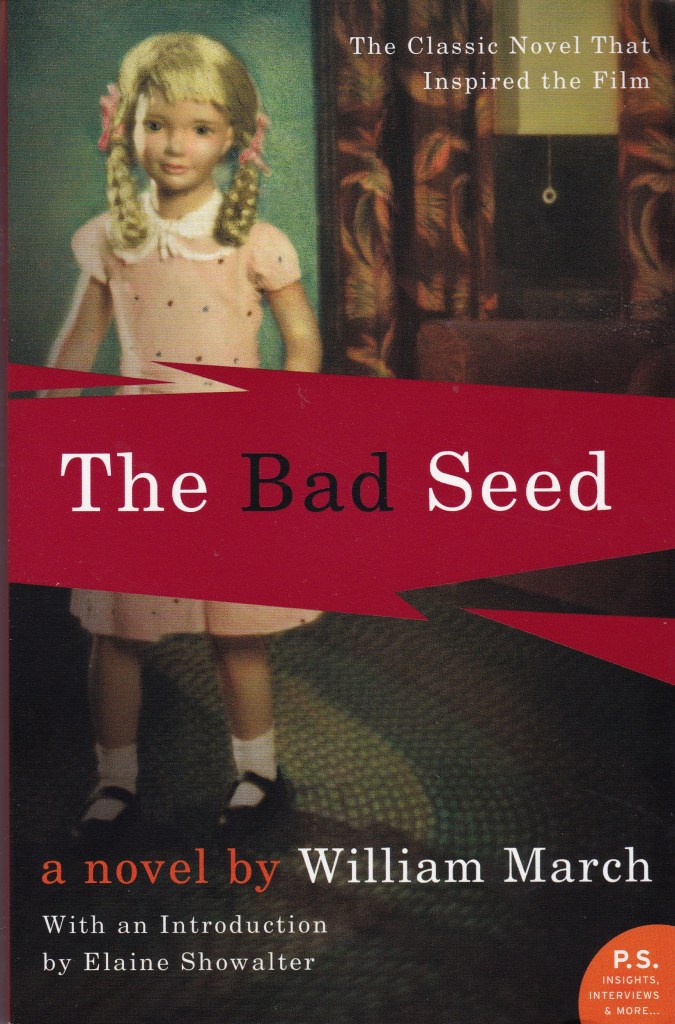
It was watching those afternoon movies where I first encountered The Bad Seed.

Later that summer, when Mrs Penmark looked back and remembered, when she was caught up in despair so deep that she knew there was no way out, no solution whatever for the circumstances that encompassed her, it seemed to her that June seventh, the day of the Fern Grammar School picnic, was the day of her last happiness, for never since then had she known contentment or felt peace.

The picnic was an annual, traditional affair held on the beach, an among the oaks, of Benedict, the old Fern summer place at Pelican Bay. It was here that the impeccable Fern sisters had been born and had lived through their languid, eventless summers. They had refused to sell the old place, and had kept it up faithfully as a gesture of love even when necessity made them turn their town house into a school for the children of their friends. The picnic was always held on the first Saturday of June since the eldest of the three sisters, Miss Octavia, was convinced, despite the occasions on which it had rained that particular day, and the picnic had to be held inside, after all, that the first Saturday of June was invariably a fine one.

If The Bad Seed has lost its ability to shock and horrify, it’s because in the decades since it was published (and adapted into both a play and film) the notion of a child being a killer has gone from being shocking to the general public to one that is kind of accepted; children do kill, and despite all the societal push towards sentimentality toward children. Rhoda is a sociopath, if not a psychopath; her inability to feel remorse or empathy or any other kind of human emotion is chilling to read about–she’s a stone cold killer, and clearly, she thinks nothing of killing to get something she wants: whether it’s the penmanship medal from her school, or a nice trinket promised to her, and then to shut up the janitor who sees through her and threatens to expose her; there’s a progression there. First she kills on impulse to get something she wants, then she coldly and calculatedly kills to protect herself. Rhoda is maturing as a killer, which is very chilling for the reader. The book is told entirely from the point of view of Rhoda’s mother, Christine–who is very slowly coming to realize, time after time, that her child is a monster, despite the innocence of childhood and everything we are taught to think, sentimentally, about children.

Psychology was starting to come into its own in the United States during the 1950’s, and you can see how crime writers took to psychology in that decade: The Bad Seed asks the question of nature v. nurture (although its answer is that it’s nature, genetic, and cannot be helped–and there’s some truth to that. I’m not entirely sure that sociopathy or psychopathy is learned behavior; are these cold-blooded killers born that way or are they creations of their environment? The solution Mrs. Penmark comes up with and executes in the novel is dramatically different from the film–the film had to abide by the Production Code, whereas novels had no such restrictions on them–and I believe the book’s ending actually works better than the film’s.

One thing that the book does brilliantly is depict the emotional turmoil and distress of the mother, slowly beginning to suspect and find proof that her child, that she loves so dearly, is actually a monster.

I first read this book when I was a teenager; I’d already seen the movie when I discovered the book on the shelves at the library, and so I checked it out and read it. I enjoyed it tremendously at the time–and it also had me watching other teens and young children for signs of sociopathy for a few years–and so thought it might be worth a revisit. It was, most definitely; it’s a bit dated, and of course the notion of a killer child isn’t quite so shocking as it was back during the Eisenhower administration–we’ve seen too many real life examples of this, and of course the trope of the killer child has been used, over and over again, in crime fiction and in films, so it’s not the brace of cold water in the face that it once was (kind of like how Beast in View by Margaret Millar was groundbreaking in its time–its still a great read–but what Millar did in that novel has been copied and imitated so much that it’s almost a cliche; one has to read these books with those sort of things in mind). Agatha Christie also used the trope of the sociopathic child (although in a quick google search it turns out Christie’s sociopathic child killer predated The Bad Seed; honestly, Christie did everything first).

It was a very pleasant reread, and as always, it’s interesting to visit (or revisit) books that were considered shocking in their time, only to have them turn out to be fairly tame–I’m looking at you, both Peyton Place and Valley of the Dolls–as well as to see how far the crime fiction genre has progressed. (I still consider Peyton Place to have a place in crime fiction, even though most people don’t. And while the crimes in the book may not be the driving point of the story, those crimes do impact everyone in the town in some way….there’s another essay to be written, probably after I reread the book at some point. It’s been awhile since I’ve revisited both Peyton Place and Valley of the Dolls….perhaps that can be my Christmas present to myself.

Starlight

And so now it’s Sunday.

I won’t lie; I’ve lost my sense of time and date and day already this weekend and I’m perfectly fine with it. I hope everyone who has the good fortune to have the weekend off–I know there are many who do not–are in the same state of what day is this that I found myself in most of yesterday and when i woke up this morning–I overslept again, which was amazingly lovely, but i really need to stop indulging myself this way–and am now awake, on my first cup of coffee, and ready to get shit done today. I did get shit done yesterday–I cleaned and organized quite a bit (not enough, it’s never enough) and while I do have some little bit of cleaning and a lot of organizing left to get done, at least I made a start on it yesterday. My desk, for example, this morning is clean and clear; which will make writing later much easier.

I finished Little Fires Everywhere yesterday–I blogged about it already, so I won’t repeat anything other than that it’s a fantastic book I encourage you all to read–and started reading The Coyotes of Carthage, which was originally recommended to me by my friend Laura, who was lucky enough to receive an advance copy. It, too, is fantastic and unlike anything I’ve ever read before, and I am really looking forward to getting more into it–I will undoubtedly take a reading break or two at some point today. It seems to be a political thriller about dark money and political consultants in a very rural county in South Carolina, with a Black male protagonist, so I am sure it’s going to be quite interesting to read.

But I really also need to write today; I’ve not looked at the manuscript since last weekend, and this “only writing on the weekends for one day” simply cannot continue to stand, really. I have too much to write, and I need to stop giving into the laziness or the tiredness or self-destructive patterns or whatever the hell it is that keeps me from finishing this damned book. Heavy sigh. I also have any number of short stories I need to wade through to pick out some to work on for submission calls.

Again, I think there’s something to that I am so overwhelmed believing I’ll never get everything done so why bother doing any of it thing.

Repeat after me: SELF-DEFEATING.

While I waited for Paul to finish working on a grant last night I watched, or rather, rewatched (although I didn’t really remember watching it before, and I figured, meh, if I’ve already seen it I can do stuff on my iPad while it’s on in the background) a documentary called Master of Dark Shadows, about Dan Curtis and how the show came about, and its legacy (I’m sure most people don’t remember Curtis also produced and directed the mini-series based on Herman Wouk’s novels The Winds of War and War and Remembrance). I was one of those kids who watched Dark Shadows only in the summertime, because my elementary school didn’t get out until 3:15; even though we lived only a block away from the school I couldn’t ever get home fast enough to watch even the end. I did love Dark Shadows–our sitter/caregiver, Mrs. Harris, also watched One Life to Live and General Hospital, which were my first exposures to soaps–and it always stuck in my mind; I always give it credit for my interest in horror and the supernatural. I enjoyed watching the documentary (and for the record, I loved the NBC reboot of the series in prime time in the early 1990’s, and was crushed when it was canceled; I rewatched it with Paul and he too was disappointed it ended on its cliff-hanger) and then we started watching a documentary about a double murder in India called Behind Closed Doors, in which the investigation was so incredibly fucked up–I mean, if the primary take-away from all the other true crime documentaries we’ve been watching has been man is our system seriously fucked up, the takeaway from this one is yeah, but ours is clearly better than others.

Which is kind of scary, really.

While I was also bored yesterday waiting for Paul–and only really sort of watching Master of Dark Shadows–I was right, I’d seen it before–I started looking things up on-line; which was an absolutely lovely example of how one can fall into a wormhole on the Internet. As you know, I’ve been having this Cynical 70’s Film Festival, and thinking about the rise, and proliferation of, conspiracy theories in that suspicious, paranoid decade, and one that I hadn’t remembered until yesterday sprang up into my min, completely unbidden, while I was reading about the Bermuda Triangle: Chariots of the Gods? by Erich von Daniken. Does anyone else remember von Daniken and his theories, which were based in nothing scientific or archaeological? Von Daniken believed that ancient texts–the Bible, the Code of Hammurabi, etc.–all contained evidence that in Ancient Times the Earth was visited by space aliens–Alien Astronauts, as he called them–who brought knowledge and information with them to the primitive creatures of our planet at the time, and also assisted them in the massive building projects that modern man cannot conceive of them building back then–the pyramids, for one thing, and the lines on the plains of Nazca (which I first read about in the Nancy Drew volume The Clue in the Crossword Cipher)–and those aliens with their vastly superior technology, were seen as gods by the primitives and those visits have come down to us in the form of mythology. It’s an interesting idea for sure–but it was all conjecture, with no proof. I read all of von Daniken’s books back in the day; others included The Gold of the Gods, and were simply further conjectures, but he developed quite a following, and set the stage for what is called the pseudo-science of Graham Hancock, his modern day successor. (I’ve also read some of Hancock’s work; his theory that the Sphinx is far older than we suspect based on water wear on its base is interesting, as is his other theory that the Ark of the Covenant’s final resting place is in Ethiopia; before reading that book I had no idea that Christianity was so firmly entrenched there) So, I spent some time looking up von Daniken’s theories yesterday, as well as some other conspiracy theories of the time–I also did a deep dive into the entire Holy Grail Holy Blood thing which provided the basis for The Da Vinci Code and Dan Brown’s entire career; and of course we certainly cannot forget the apocryphal writings of Hal Lindsay and The Late Great Planet Earth–which, really, is where The Omen came from; we forget how “end times” theory truly began flourishing in the 1970’s.

I’ve always been interested in stories about lost books of the Bible, or lost Biblical theory, along with the end-times prophecies Lindsay wrote about; Irving Wallace’s The Word, which was built around the rediscovery of a lost testament of Jesus which would revolutionize and make-over the Christian theology was one of the first novels of this type I read; it was also made into a mini-series, which made me aware of it in the first place (Irving Wallace isn’t really remembered much today, but he was a huge bestseller back in the day, and he wrote incredibly thick novels, mostly about international conspiracies or legal issues–The Seven Minutes, for example, was about censorship and “blue laws”; The Second Lady was about a Soviet conspiracy to replace the First Lady with a lookalike imposter who was a Soviet spy; The Prize was about the machinations around how the Nobel Prize was given out; etc etc etc). The Da Vinci Code fits clearly into this category, as does The Gemini Contenders by Robert Ludlum and The Fourth Secret by Steve Berry (which is about the fourth secret Our Lady of Lourdes–or was it Fatima?–revealed to either Bernadette or the peasant children; Irving Wallace also covered this in The Miracle); Raiders of the Lost Ark and Indiana Jones and the Last Crusade also kind of fit here, as both films are about the search for Biblical relics. I’ve always, always, wanted to write one of these. Years ago I had the idea for one, in which there was a secret document or testament hidden in the Hagia Sophia in Constantinople for years, and that part of the reason the 4th Crusade sacked the city was the Pope’s desire to get his hands on those documents, which were thus smuggled out of the city by the Patriarch and lost forever…this is the idea I always come around to for a Colin stand-alone (I also realize I could do Colin stand-alones set at various times throughout the last twenty years or so of Scotty books, as he is gone a lot of the time on missions), and the working title for it always is Star of Irene, because the Byzantine Empress Irene–contemporary of Charlemagne–has always fascinated me.

But I will never write a Colin stand-alone, or series, unless I get this fucking book finished, so I suppose it’s time for me to head back into the spice mines.

Have a lovely Sunday, Constant Reader.

Vampires

And now we found ourselves at the dawn of a Saturday, the first day of a new weekend, which are always, inevitably, far too short.

I have requested a book from the library which is the beginning of my research into Chlorine; and I will be picking that up today as I run a couple of errands in the heat of the day. My goals for the weekend are to finish reading Blacktop Wasteland and get Chapters 1-10 of Bury Me in Shadows completed; which of course is preparatory to getting the next ten chapters revised and redone and rewritten over the next week. It is a rather ambitious program, to be sure–and I am also certain at some point I’ll get tired and stop, then berate myself all week that I’m not further along with it than I am. You know, second verse, same as the first.

Yesterday–hell, this entire past week–was not a particularly pleasant one, and my usual go-to when I am not having a good week–being kind to people and trying to help them–also blew up in my face, which, while incredibly unpleasant, is actually fine. Usually, when there’s not a pandemic, I get to be kind and caring and helpful to my clients pretty much every day of the week, and that, inevitably, always makes me feel better about the world (and people) in general. I miss having that daily release of kindness and caring, of being sympathetic to people and listening to their concerns and helping them to feel better about things, but…I also need to recognize that outside of my job, in the real world other people don’t necessarily give a shit about my help, or need it, or particularly want it, and that the people I help at work are actually my clients, and they want help, they’re worried and need someone to be empathetic and kind and ease their fears. I also need to remember that people in my every-day-not-coming-in-for-an-appointment life might actually see my offers of help and caring as something else entirely, and not receive it well. I also need to remember that people I only know through pleasant enough internet interactions actually aren’t people I know, and I should save my empathy, caring, and kindness for people who actually are my friends–of whom there are, in fact, a lot.

It was, all in all, a stressful week, an up and down rollercoaster of emotions and triggers and psychological distress. As I tell my clients at the office, it’s normal to feel stress and worry and fear about getting any kind of diagnostic medical test, even when you’re absolutely mostly certain there’s nothing to worry about–there’s always that gnawing fear that this will be the time the news is bad, and being who I am, I inevitably try to prepare myself for the news to be bad. This is no doubt the psychological residue of years of getting HIV tests and nervously waiting the two or more weeks to get the results back while people I knew were going into the hospital and not coming back out; of going in and having the blood drawn and going through the entire session of data gathering and demographics and behavioral risks that always –while not the intent of the counseling, of course–left me feeling like an irresponsible drunken whore who deserved to die. One of the reasons I went into this line of work was to make sure that everyone who comes in to get tested knows that the person testing them cares about them, doesn’t judge them, and is doing everything in their power to make them more comfortable and relaxed. I treat all my clients with dignity and respect and empathy, and I have found that actually works, for the most part, in the world outside of my testing office as well.

I really miss doing my job every day.

And yesterday, of course, I had to take Paul out to Metairie to get his eye cleaned, and while it’s been sixteen years, being reminded by something as innocuous as an eye cleaning appointment inevitably still weighs heavily on me emotionally. Some years I make it through the anniversary without thinking about it; most days it doesn’t cross my mind, and sometimes can go for great stretches of time without thinking about or being reminded of it; it’s now mostly a part of the distant past. Yet it still lives on in my memories, even if they are pushed to the back most of the time, they are still there, and when something like yesterday’s appointment rolls around those memories will crowd their way up to the front of my mind, and even though I try not to allow them to affect (for fuck’s sake, it’s been sixteen years) me emotionally, they still somehow weigh heavily on me and drag me down. All the way to Metairie yesterday I was snapping and cursing out other drivers–okay, I do that every time I drive because New Orleans seriously has the worst and stupidest and most careless drivers of anywhere I’ve ever lived–but yesterday I felt particularly angry with them all for putting our lives at risk with their carelessness and stupidity.

Which is why I never understand how people are amazed about the anti-vaxxers and the anti-maskers; all you ever have to do to see how little most people care about anyone else’s lives or safety is go for a drive. I saw a meme months ago about the “shopping cart test” being an excellent way of determining what kind of person someone is; do you leave the cart abandoned in the middle of the parking lot, blocking a parking space, or do you return it to the front of the store or to a cart corral which is a short walk, at most, from wherever you are parked? (It should come as no surprise to anyone that most people just abandon the carts where they are once they’ve finished using them–which means a low wage employee has to walk around the entire parking lot retrieving the carts, sometimes in the broiling sun. I always either put the cart in the corral or walk it back to the front of the store–but with the caveat being that in college I worked at Toys R Us and sometimes, in the broiling heat of 115 degree summer days, had to go on cart duty. I know firsthand how shitty of a job that is, and so I try to do my little part to make it easier for the unfortunate soul whose job it is. On the rare occasions when I eat fast food I always throw my trash away and leave the tray on the space provided in every fast food place for them, usually on top of the actual trash bin. I honestly don’t think it’s mean-spirited; I think it’s thoughtlessness for the most part–someone else will take care of this for me. And sure, it is someone’s job–but there’s no rule that says we can’t make things easier for someone doing their job by doing something as simple and easy as dumping your trash or returning a shopping cart to a corral–just like I don’t understand why people don’t drive with a concern for the safety of themselves, let alone others.

We finished the second season of Babylon Berlin last night with a massive binge of almost the entire season in one sitting, beginning at seven pm and finishing just after eleven–I hesitate to think we actually watched as many as seven episodes, but I really think we must have, because I seem to recall finishing Season One and watching the first episode of Season 2 on Thursday night. I cannot praise the show nearly enough–Paul and I are getting to the point where we have very little interest in watching American television programs anymore, because the foreign ones are so much better. There are about, on a quick check, three or four books in the series; I do have the first one on hand, and I may move on to it when I finished Blacktop Wasteland, hopefully this weekend.

So, my plan is to shake off yet another shitty week and get my head cleared and back on straight and dive back into my work. I am treating myself to making cappuccinos this morning rather than having my usual coffee; grinding beans and frothing milk and making espresso–it’s really not a lot of trouble, honestly; it’s more about the mess it makes more than the process–a lot of moving parts that need to be cleaned afterwards more than anything else. (I love the smell of beans being ground!) The kitchen/office is, as always on a Saturday morning, messy and in need of being put in order; the ongoing battle to get organized rages on.

Yesterday, after making my phone calls and while making my daily quota of condom packs, I discovered that the old ABC Movie of the Week The Night Stalker was available on Youtube –a lot of those old made for television movies from the early 1970’s/late 1960’s are on Youtube–. but not particularly good copies; whenever I try to watch one I am inevitably disappointed by the poor quality of the film. It seems like someone used their VCR to record them as a general rule, and then uploaded them–with all the usual glitches and scratchiness and poor reproduction one would expect from an old VCR tape (this was the case with some I have watched, like Go Ask Alice and The House That Would Not Die, which was based on Barbara Michaels’ brilliant novel Ammie Come Home); I was delighted to see that this was not the case with The Night Stalker–it was almost like the film had been digitized before uploading. The picture was very clear, the colors bright, and absolutely no fuzziness. The sound quality was also very high. The Night Stalker, and its sequel, The Night Slasher, were two of the more popular ABC Movies of the Week, and wound being the basis for a series, Kolchak: The Night Stalker, which was kind of a mid-to-late 1970’s version of The X Files. The series didn’t do very well, was pretty roundly mocked for cheesiness and poor quality, and didn’t last more than a season, but surprisingly enough, The Night Stalker holds up pretty well, despite being obviously dated and produced on a shoestring budget (the producer was Dan Curtis, of Dark Shadows fame); but the heart of the movie is Darren McGavin’s brilliant portrayal of Carl Kolchak, a world-weary, down on his luck investigative journalist who has been fired from many major newspapers in his career and had wound up working at a paper in Las Vegas, which at the time was kind of a backwater casino town (its still a casino town, but a much bigger city now; I don’t know if one would consider it a backwater or a comedown from Boston or Chicago or Washington anymore; maybe). The premise of the film is young women are being murdered, and their bodies drained of most of their blood; the second body is found in a dried out gulley with no footprints around it; which means it must have been thrown quite a distance to get where it was. Kolchak begins to slowly believe that there’s a vampire in Vegas (Vampire in Vegas is actually a great title), despite resistance from both the higher-ups at the paper and the police, and he begins to gather the evidence. He tracks down the vampire finally, and kills it by driving a stake through it’s heart just as the police arrive–and of course, his story is spiked and he is threatened with prosecution for murder if he doesn’t leave town. The girl he is seeing, who works in a casino, is played by Carol Lynley; she is also forced to leave town without even getting a chance to say goodbye to him. The story holds up pretty well–and it is interesting seeing Las Vegas as it was in the early 1970’s, which is vastly different than it is now; and watching it made me a little sad–the death of print journalism for the most part over the last twenty years has forced that kind of character, once so integral to the crime genre–the crusading, world-weary journalist–into retirement. Journalists and journalism was also a popular genre of television and film, too–remember Lou Grant? I had always wanted to write a book about a newspaper and how it operates, a kind of Arthur Hailey type thing, with characters at every level, from the publisher down to the copy clerks. Maybe it could still be done today; I don’t know. It’s an interesting idea, but one that has languished in my files for decades and will probably continue to do so.

I also think a study of the evolution of the vampire story would be an interesting read, going back to pre-Dracula writings and then tracing its evolution through modern times; how Dark Shadows and Chelsea Yarbro Quinn changed the face of the vampire tale and made Anne Rice’s novels possible; and all the other vampire stories, like ‘salem’s Lot and Poppy Z. Brite’s Lost Souls. Maybe someone already has? I know Stephen King covered some of this material in Danse Macabre, but that is nearly forty years (!) out of date, and I doubt he will be doing an updated version anytime soon.

And on that note, tis back to the spice mines with me. Have a lovely Saturday, Constant Reader.