Thursday and my last day in the office before Christmas. Our department potluck is today, and so yes, last night I had to make a red velvet cheesecake–one-handed. I stopped to make groceries on my way home from work after swinging by the post office to mail the last of my Christmas cards. The one thing I thought for sure I had? Sugar, and no, I didn’t have any in the cabinets…so I walked to Walgreens to get some and didn’t realize until I was there that I was wearing my house shoes…and since I used sweats as pajamas, I’ve officially become a New Orleans elderly eccentric, going out in public in pajamas and house shoes. I do have to finish the cake this morning–putting it together and making the frosting–but the lion’s share of the work is already done, thankfully.
But the layers are uneven, so it will be a little trickier than usual to pull together.
Of course, the frosting will hide any defects in the layers, so…but I doubt very seriously I’ll be making it again. The sugar was only the first hassle in the entire experience; the one-handed was something easily handled, but the kitchen is not big enough to do complicated baking when you have a kitten with big energy and a lot of curiosity. “Don’t lick that! No, don’t walk there! No, you don’t need to climb inside the refrigerator! No, you can’t climb me while I am whipping frosting!” To say I had a bit of an anxiety backslide while making this cake, giving into frustration and everything else felt like a setback, and that carried over to this morning. Heavy sigh. But now that the cake is finished and in its carrier, I can relax, do some deep breathing exercises, and rid myself of the anxiety again.
We started watching Percy Jackson and the Olympians on Disney last night, and it’s much better than the movies; it works better as a television series, frankly, and this time out they cast age-appropriate actors, for one thing. I read the Percy Jackson books, and some of Rick Riordan’s other mythology series until I judged a book prize one year and fell behind on my reading. I did keep buying them, hoping I’d get back to them at some point but never did. It’s a great concept, and the books themselves are better written and better plotted than anything the Chatelaine of Castle TERF ever wrote. They didn’t become the phenomenon that the TERF Queen ever put on paper, more’s the pity. Riordan also wrote a great crime series before he switched to mythology; I enjoyed those crime novels and was really happy to see his career gain traction when he switched to Percy Jackson. I am really looking forward to the entire series, and there should also be a new Reacher this weekend. Huzzah!
I also wrote some more on the book, and it’s falling together. I’ll soon be at the middle section, so hopefully I will be able to figure out the middle part that I always have trouble with. So huzzah! I hope to get a lot of good work done this weekend…I’m also getting my new microwave this weekend, which is kind of exciting, too. I need to figure out some things, and hopefully I’ll have the time to reorganize the kitchen over the course of this weekend as well as prune some books. I also want to finish reading the Tamara Berry so I can move on to another cozy; I have quite a few backed up in the TBR pile.
And I sent the last of my Christmas cards out yesterday.
And on that note, I am heading into the spice mines. Have a lovely day, Constant Reader, and I will check in with you again tomorrow.
Friday and a work-at-home day, except for the morning department meeting I have to attend in person, which means I didn’t get to just roll out of bed, wash my face, brush my teeth, throw on some sweats, and get a cup of coffee just before nine…no, I have to be there at nine. I’ll run a couple of errands on my way home, which spares me from having to leave the house on Saturday; I may order groceries for pick-up on Sunday, but I don’t need to decide that right now.
This week wore me down and wore me out. I didn’t sleep terrific all week long to begin with, then of course it was one thing after another to have to deal with. But it’s Friday and I am relatively unscathed, methinks; I slept really well last night and think that could again be the case tonight. I was completely worn out when I got home from work last night, so I collapsed into my easy chair and watched a lengthy James Somerton video on Youtube called “What Ever Happened to Good Taste?”, which was about camp classic films, beginning with All About Eve before cycling through Whatever Happened to Baby Jane?, Mommie Dearest, and the drag queen road movies of the early 90s, The Adventures of Priscilla Queen of the Desert and To Wong Foo, Thanks For Everything, Julie Newmar. (I must confess to being enormously disappointed that Showgirls didn’t make the documentary; it is, after all, an all-time classic.) Paul got home shortly after I finished watching (it was two hours long) and we watched another episode of Welcome to Chippendales, which could have been just a movie and not a series I think; there’s a lot of padding out of the story to stretch it out into a mini-series. I have a lot to do this weekend; one of my tasks for today is of course a to-do list for the weekend. I need to get caught up on the book, I need to get caught up on a lot of things, and I want to finish reading Wanda Morris’ marvelous latest work. Perhaps after I get home from the meeting at the office this morning and get through my work-at-home chores today, I can spend some time with Wanda’s book and finish it. I am going to run some errands on my way home from work today, too–hoping that I won’t have to leave the house much this weekend so I can get things done.
My arm continues to get better every day, so I think it is something that didn’t necessarily require the emergency room costs or a forced-onto-the-schedule doctor’s appointment. It means I won’t be able to start back to the gym this weekend as I’d planned–I like to start going again before the new year when everyone’s resolutions crowd the place to within an inch of its life come January–but I cannot lift weights with this arm, which pretty much eliminates every upper body exercise. I could, I suppose, go a couple of times a week and simply focus on legs–but the weight plates would be a problem, too, you see. So, that’s going to have to go back on hold until my arm feels better.
I was very surprised and pleased yesterday to see that a couple of Instagram users did “reels” talking about A Streetcar Named Murder, and I have to confess this week–shitty as it was personally–has been a really terrific week for me professionally. It certainly was a good one for my writer’s ego, for sure. The outpouring of support and appreciation for my book from the cozy reading and writing community has been quite nice, rather unexpected, and I am enormously appreciative and grateful for it all. In some ways, it’s kind of validating; over the past few months I’ve really come to understand that I have an enormous chip on my shoulder when it comes to my own writing, and have tried unpacking that a bit. (I’ve spent quite a bit of time since turning sixty in the wake of a global pandemic unpacking my behaviors and the events that occurred that shaped those behaviors.) How different would my life have been had I gotten support and encouragement when I was younger? Had people taken my ambitions and desire to write seriously rather than dismissively? I honestly don’t know, can never know, will never know–the great pleasure of human life is you can never do anything more than speculate about how differently a shift in something, even a very small minor one, can alter the course of a life and a career.
The other night, before my Murder by the Book event with the marvelous John McDougall and my very dear Ellen Byron, John asked me “Now that I’ve read your book, Greg, I have to ask–why did it take you so long to write a cozy? Why haven’t you been doing this all along?” and my answer was “I really don’t know.” It absolutely gave me pause, and has lived rent-free in my brain ever since Tuesday. Why did it take me so long to write a cozy? I still don’t have an answer that makes any kind of sense. Let me see, I’ve always read them, always appreciated them, and have always done my best to fight the stigma attached to them by some elitists who need to feel better about themselves by looking down on a subset of other writers. I hate that, particularly because I know how it feels to not be taken seriously or be respected by your peers (there’s that enormous chip on my shoulder again).
But despite all the difficulties encountered during the time of its writing, I really enjoyed writing A Streetcar Named Murder. Sure, it was hard, and sure, I had to make myself do it (like always), but when I finally held the finished copies in my hands, I was incredibly proud of it. I have always said that I want to always be challenged by what I am writing, that I don’t ever want to fall into a familiar pattern of writing that feels like painting by the numbers (which is why I ended the Chanse series), which is incredibly easy to do. Writing a cozy presented me with a challenge, and yes, it was hard and yes, it was outside of my comfort zone. But I created likable, believable characters and an interesting story, with new situations and paradigm/life shifts that all played out throughout the course of the story. Now that it’s out in the world, it is an interesting question as to why I never tried to write one before, or even why I believed that I couldn’t write one in the first place.
And in some ways, it’s almost like starting my career over again. I am finding a new audience. I didn’t center queer characters and stories. I just wrote about New Orleans again but from an entirely different perspective, and it was enjoyable.
And I am proud of the book, and of myself. It feels weird to say that, but at the same time it also feels good to say it.
And on that note, tis back to the spice mines with me. Have a lovely Friday, Constant Reader, and I’ll check in with you again tomorrow.
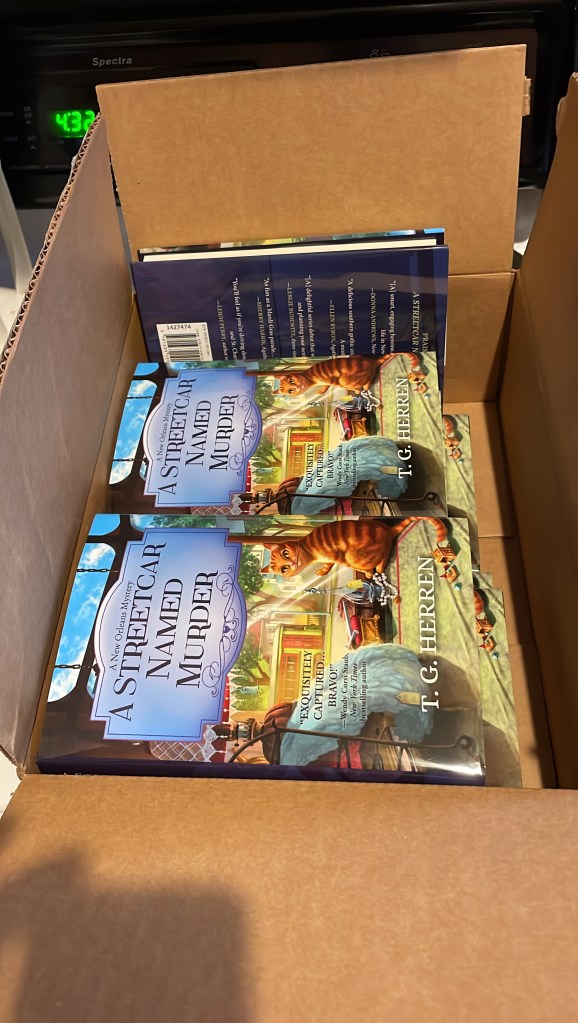
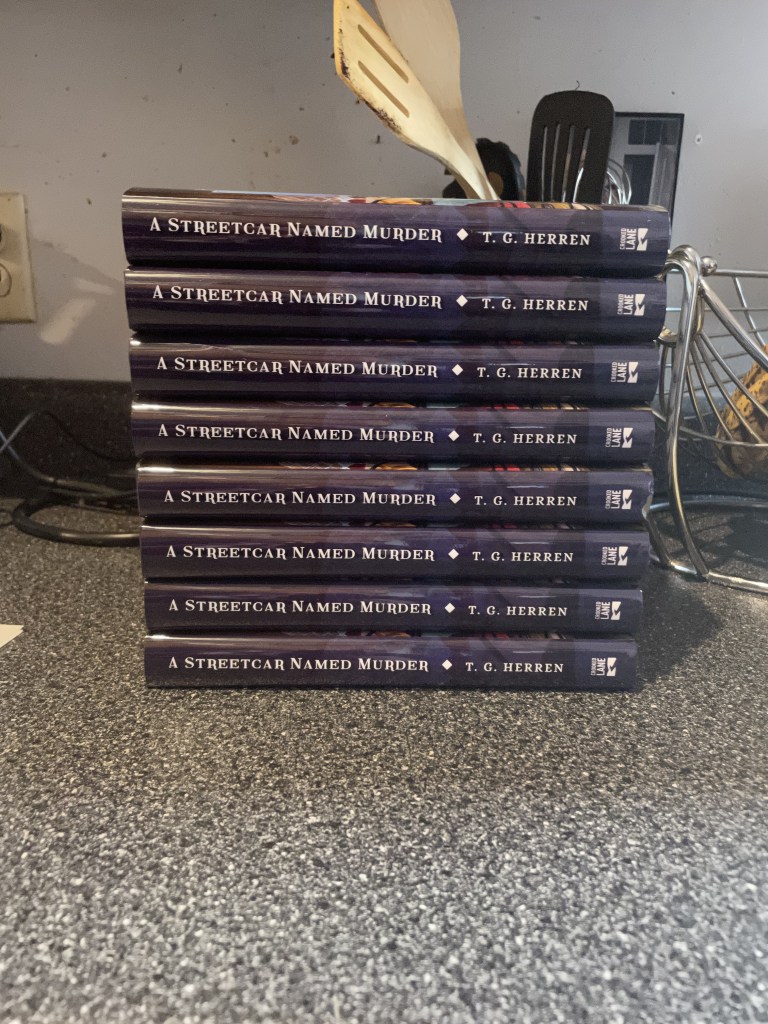
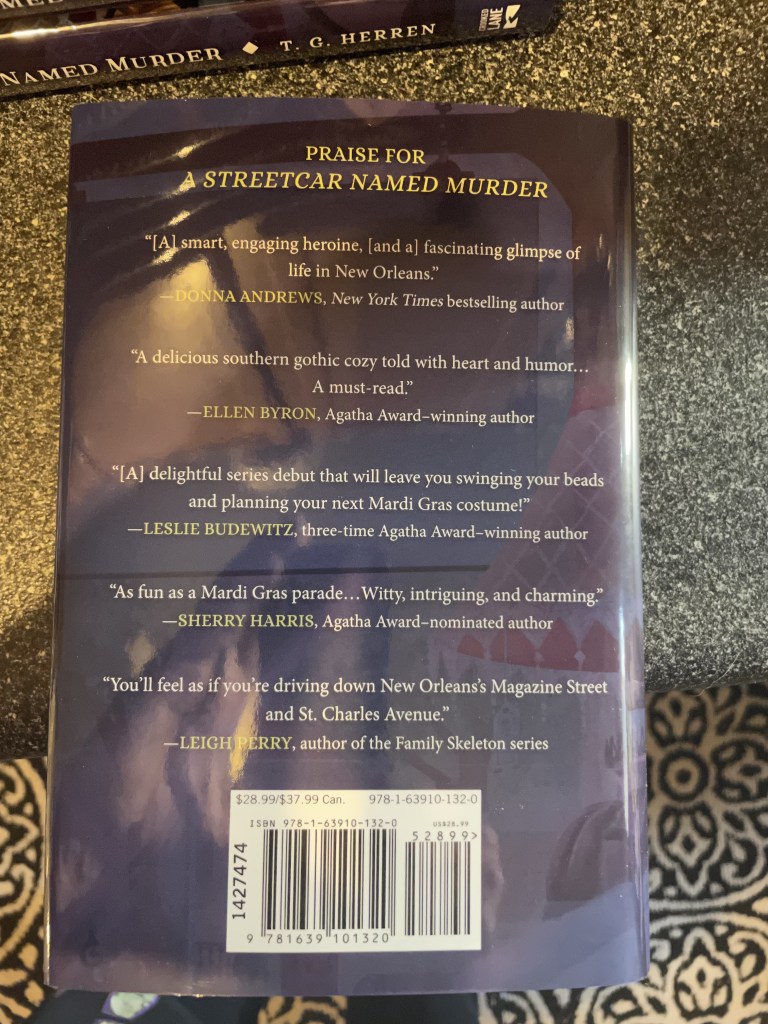
If you follow me on social media you will know already that I got my box o’books of A Streetcar Named Murder this week. The book looks stunningly beautiful, seriously; I couldn’t be more pleased with everything about the book’s packaging. The cover is gorgeous; and stacked up together they look especially gorgeous, as you can see in these delightful images from my kitchen counter.
So, Greg, why did you write a cozy mystery?
The same reason I write anything–primarily because I wanted to, and to see if I could, you know. actually write one. I’ve always liked them–I love traditional mysteries, always have–and have always admired how authors pull off the crime aspect of the story. Sure, there’s a bit of an imaginative stretch required to read a series–how realistic is it that an every day citizen will continually get involved in the solving of a crime, through no fault of their own? But…no one bats an eye about the realism of private eye series, and let’s face it: private eyes involved in murder investigations are just as rare. They spend most of their time on insurance claims or, you know, infidelity. Likewise, police investigations are often very straight-forward, without the usual twists and turns and surprises a writer needs to include to keep the reader turning the pages. The Scotty series–despite him actually becoming a licensed private eye, fits more into the cozy genre than it does the private eye; for one thing, it’s funny, and for another, Scotty is never hired, he always stumbles over a body somehow–to the point that it’s almost a running joke in the series.
I had always wanted to write a mainstream series centered around a straight woman, to be honest. I mean, let’s face it, I’ve done that queer mystery, both series and stand-alones, and I always like to keep my work fresh and interesting for me–I cannot imagine the hell writing something that bores me would be. Early on, before I sold my first book, a major figure in the crime fiction world told me that every so often she wished she could write something else, but “all anyone wants from me is *series character*,” but very quickly added, “But I’m still grateful people want that.” I always remembered that–obviously, I still do–and so while I would be eternally grateful were I ever to achieve that level of great success, I tried to always diversify my writing so I’d never get bored. The Chanse series was very different from the Scotty series; the stand-alone novels are rarely set in New Orleans; and so on.
I’ve tried spinning off my Paige character from the Chanse series into her own series; I always liked the character and thought she was a lot of fun and could carry her own stories quite nicely. I still think so, but audiences didn’t respond to her when I did finally give her those own stories–but there could have been any number of reasons why that didn’t work. The books were marketed and sold as cozies–which I think was a mistake, because I didn’t write them as cozies. Sure, Paige was a single woman, working for Crescent City magazine and a former crime reporter for the Times-Picayune, which gave her some credibility as an investigator, but Paige was sharp-tongued and foul-mouthed. Had I known that the books would be marketed to the cozy audience, I wouldn’t have used Paige–she was too centered in my head as who she was for me to change her significantly in her own series–and would have simply come up with someone new. The books were also electronic only, and oddly enough, my readers tend to prefer to read me in print hard copies.
I had actually tried writing a cozy series before–I had this great idea for one, about an English professor at a university in a fictional Louisiana town on the north shore (based on Hammond); I called it A Study in Starlet and wrote a strong introductory chapter, trying to channel my inner Elizabeth Peters/Vicky Bliss; sarcastic but not bitchy, but it never got anywhere. I actually became rather fixated on my fictional Hammond (which I called Rouen, pronounced “ruin”, and I did want to call one of the books The Road to Rouen), which I may still write about at some point–I never say never to anything–but I am digressing. But I always had it in the back of my head that I should try writing a mainstream cozy at some point in my career. And this came about in a very weird way–it’s a long story–but I wound up pitching the idea I had to Crooked Lane and they offered me a contract, which was quite lovely. (Incidentally, I signed the contract electronically on the Friday before Hurricane Ida; the last email I got from Crooked Lane that Friday afternoon after signing the contract said you’re going to be getting some emails from the team next week so keep an eye out for them and welcome aboard! So, of course the power went out on Sunday morning…)
I originally was going to write about a costume shop. There’s one across the street from Paul’s office that has a showroom and an enormous warehouse; they do a lot of costume work for film, theater, and television, which seemed like a great backdrop for a series with all kinds of potential stories for the future. Crooked Lane didn’t like that, and asked me to come up with something else, so I walked down Magazine Street writing down the kinds of businesses I saw. An antique shop was one of them, and that was what they liked. My working title for the book was Grave Expectations, because it involved an inheritance, but they didn’t like that title either, and I reached back into my archives for a title for the original spin-off idea I had for launching the Paige series–I wrote like 100 pages of the first Paige book in 2004 and it never got used–and grabbed the title from it: A Streetcar Named Murder, and hence, the title was born.
And…I had three months to finish the book, as they wanted it by January 15th. And of course there was the power situation in New Orleans, and…
Heavy sigh. I will leave the rest of the story for another day and time.
I slept really well last night; woke up again at five and since it wasn’t the alarm yanking me out of the clutches of Morpheus this morning, I feel rested. I was very tired last night when I got home; I hit the wall around three yesterday afternoon and when I got home it was the easy chair for me. We watched more Big Mouth, and then I retired to bed around ten. I am working at home tomorrow, so am hopeful this will be a good weekend for writing. I do want to watch both the LSU-Arkansas and Alabama-Mississippi games this weekend–as they could determine who wins the SEC West for the season (and I cannot believe that LSU is in the driver’s seat; I was hoping for an 8-4 season and feared that was unlikely), but I also need to get caught up on my writing and everything. Yikes.
And on that note, I am heading into the spice mines. Have a lovely Thursday, Constant Reader!
The traditional mystery often gets a bum rap by mystery fans. I’m not sure why that is; these books have never gone out of style, have never decreased in popularity, and have always been the backbone of the crime/mystery genre. They are often (wrongly, I think) identified with Agatha Christie–if anything, Christie should be identified with every sub-genre of crime/mystery fiction. She wrote private eye novels (Poirot); dark noir (Endless Night); spy fiction (N or M?, The Man in the Brown Suit, They Came to Baghdad); historicals (Death Comes as the End); and even romantic suspense (as Mary Westmacott). Sure, she often relied on the amateur sleuth–her most famous amateur being probably Miss Marple–but she literally did everything first, really.
Probably why everyone refers to her as the Queen of Crime Fiction.
But the traditional mystery, for some reason, gets short shrift in our modern world, despite being one of the most popular subgenres of crime fiction. Why? I don’t really understand it. Sure, there’s not any blood or sex or violence–the sort of thing generally used to sell everything from television shows to movies to laundry soap and deoderant. Many of us grew up reading books about amateur detectives, from Nancy Drew to the Hardy Boys to Trixie Belden. So why do so many turn their noses up at the traditional mystery, also known as the cozy mystery?
I think it’s much harder to write about crime without using the tough guy male lead (stereotype), blood, violence, swear words, and sex. Is it this lack of the “rougher” aspects of crime that earned these books the nickname “cozy”?
What precisely does the word cozy mean, used as a book descriptor in this way? Ask five mystery fans/writers, and you will get five different answers. It’s often hard to quantify the variety of subgenres within the mystery/crime field. Everything else aside, I think the most important thing, the key, for a mystery novel to get this kind of classification is that the book focuses, on one level, on a sense of community; the reader develops a warm, comfortable feeling, the kind that you usually get from visiting family and friends you don’t get to see all of the time. You open the book and start reading and already feel relaxed and at home; happy to see people you care about, are interested in, and are excited to find out what they have been up to. Donna Andrews’ Meg Langslow series is an excellent example of this; so is Leslie Budewitz’ Spice Shop mystery series (both series, obviously, are favorites of mine). These books welcome you in, invite you to put your feet up, get comfortable, and spend some time with your old friends you’ve not seen in a while.
This, naturally, is very difficult to establish when writing the first book in a new series of this kind; how do you immediately establish this warm environment where the reader feels comfortable enough to kick off their shoes and relax? It’s not the easiest thing to pull off for an accomplished writer; so it’s all the more remarkable when someone nails it in their very first book.
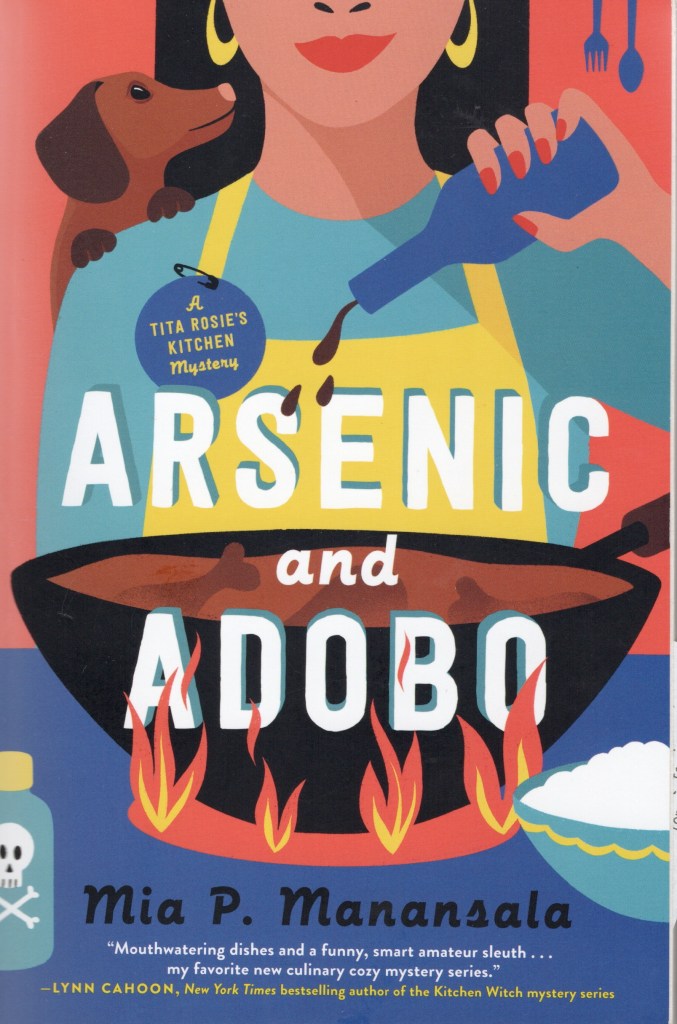
Mia P. Manansala nailed it in her debut.
My name is Lila Macapagal and my life has become a rom-com cliché.
Not many romantic comedies feature an Asian-American (or dead bodies, but more on that later), but all the hallmarks are there.
Girl from an improbably named small town in the Midwest moves to the big city to make a name for herself and find love? Check.
Girl achieves these things only for the world to come crashing down when she walks in on her fiancé getting down and dirty with their next-door neighbors (yes, plural)? Double check.
Girl then moves back home in disgrace and finds work reinvigorating her aunt’s failing business? Well now we’re up to a hat trick of clichés.
And to put the cherry on top, in the trope of all tropes, I even reconnected with my high school sweetheart after moving back to town and discovered the true meaning of Christmas.
Okay, that last part is a joke, but I really did run into my high school sweetheart. Derek Winter, my first love.
First of all, can we talk about the voice?
It is impossible not to fall in love with Lila’s voice from the very first sentence of the book. She is smart and funny and eminently likable, which is important in a traditional mystery (no one wants to read a cozy whose main character is an unlikable bitch) and much harder to do than most people who don’t actually write books think it is. Lila is a remarkable character; very clear-eyed about what she wants and what she doesn’t, as well as who she thinks she is and wants to be. She’s returned from her big escape to the big city to the small town she wasn’t terribly happy in when she was growing up–her past experiences continually are reminding her, and not in pleasant way, of why she left in the first place. She never intended to return home (as Thomas Wolfe said, you can’t go home again), but she is back and rather than focusing on what she is certain everyone she knows or is related to sees as her “failure,” she intends instead to focus on helping save her aunt’s restaurant business.
The immense strength of this story rests upon those family bonds, and Lila’s recognition of just how important those bonds–family, friends, community–actually are to her; and her growing realization, over the course of the books, that those things she once thought were strangling and restraining her are actually where her own power comes from.
The mystery itself is also strong: Lila’s wretched local ex, whose mother has since married a businessman who rents Tita Rosie’s building to her and is a total dick, has taken to writing shitty reviews of local restaurants, apparently targeting one and trying to destroy its business before moving on to another. Lila’s relationship with him is also strained; and she also doesn’t like the dickish stepfather either. It is while she is serving them lunch that her ex keels over face-first into his plate–dead from arsenic poisoning. In the food Lila fed him, and came from her aunt’s kitchen. The financially strapped business is shut down pending an investigation into the murder and a health department inspection, and there is the very real fear that Tita Rosie may lose her restaurant. Lila takes it upon herself to investigate and find the real culprit, to clear herself as well as her aunt and the beloved family business of any wrongdoing and scandal. The journey, which introduces us to her friends and family, and welcomes the reader into their charming world and community, twists and turns and is full of surprises every step along the way–as Lila also learns just how much the restaurant, her family, and her friends really mean to her.
This book is absolutely charming, well-written, and very fun. I cannot wait to revisit Lila and her crew in the second book, Homicide and Halo-Halo. Mia P. Manansala is definitely one to watch, and it’s going to be fun watching her career reaching even more heights than she has already achieved.
I didn’t grow up in a household of spices and flavors.
That’s not me being disrespectful to my family; they were from rural Alabama and beyond the basics–salt, pepper, garlic, and sugar–they never had much access to anything beyond that, other than what was used in specialty/special occasion foods, like stuffing/dressing at the holidays. Once my mother stopped working and became a stay-at-home mom, she began teaching herself how to cook–she always had a Betty Crocker cookbook in the kitchen when I was a kid–and began using other spices; but those basics were all I knew and it wasn’t until I got much older–fifty-ish–that I, too, began teaching myself how to cook and learned to stop being afraid of experimenting in the kitchen (alas, this was also around the time I quit smoking and injured my back, which kept me out of the gym. The end result is the long-bemoaned weight gain I’ve been struggling with in the decade since). My friend Michael is a terrific cook, very knowledgeable, and I’ve spent many an hour sitting in the kitchen watching him cook and learning from him tips and techniques; I have also learned to not stick to measurements in recipes and do it from instinct–and not to be afraid to make mistakes here and there. (I put way too much onion in a mac-and-cheese dish I made for the kids at the office once, which was mortifying.)
I also know how the spice trade changed world history–the silk road was also the spice road between Asia and Europe.
So Leslie Budewitz’ Spice Shop mysteries are definitely right up my alley.
“Parsley poop.” The Indian silver chandeliers hanging from the Spice Shop’s high ceiling swayed, their flame-shaped bulbs flickering. The crystal candelabra they flanked burned on defiantly. As I stared up, unsure whether to curse the Market’s hodgepodge of ancient and modern wiring or the fixtures themselves, all three blinked, then went dark.
“Cash register’s got power,” Sandra called from behind the front counter. “And the red light district’s open.”
I glanced over my shoulder at the miniature lamp perched on the Chinese apothecary that displays our signature teas and accessories. The red silk shade glowed steadily, a beacon in the back corner.
“Better call the electrician,” I said at the exact moment as my customer asked, “where’s your panel?” and Lynette, my newest and most annoying employee, said, “I’ll check the breakers.”
Guilty as Cinnamon is the second book in the series, following Assault and Pepper (which I also greatly enjoyed), and this is a worthy successor to that series debut. Pepper Reece runs Seattle Spices, a spice shop in historic Pike’s Market, and is an engaging character for the reader to identify with and root for. Divorced from Tag, a bike cop who pops up regularly (she divorced him for cheating), she also lost her job in HR at a prestigious law firm when some of the partners turned out to be crooks and the firm closed. She bought the spice shop and a gorgeous loft apartment nearby in an attempt to reboot her life and start over, and is a walking encyclopedia of spices–how to blend and mix, what works best in what recipe, and can identify them by smell. (This olfactory knowledge often comes in useful when she’s involved in a crime.)
This time around, Pepper finds herself mixed up in murder and mayhem in the cutthroat world of the restaurant business of Seattle; a former boyfriend, Alex Howard, an Emeril-type figure in Seattle who is also kind of a dick, fires an assistant who is secretly planning to open a restaurant, partnering with another successful restauranteur in the city, Danielle Bordeaux. He fires her because Tamara, who plans on using Pepper as a supplier, comes into the shop and discusses business in front of an incompetent Seattle Spice employee, Lynette; Lynette tips off Alex. Tamara is fired and Pepper fires Lynette–and then Tamara is murdered. Pepper is the one who finds the body, and the case is off and running. Pepper can’t help but feel a little responsible, having found the body, as well as her employee having tipped off Alex, who is the number one suspect. It turns out as well that Tamara was murdered by ghost pepper–an insanely hot pepper that can, per the book, be fatal if ingested in large enough doses. Pepper had given Tamara samples of the ones she carries in the shop during the fateful visit; adding to her sense of responsibility.
She also lands herself a new potential love interest: reporter Ben Bradley (the investigating detectives are Spencer and Tracy; Budewitz loves punny names–and names actually play a vital role in this case). Or will she reunite with her ex, Tag, who seems to be interested in that very thing happening? Can he be trusted?
And are there ghosts involved?
Guilty as Cinnamon is not only an engaging and fun read–several times I had to stop and wonder, who is the killer here, and why–and was wrong every step of the way; but the author doesn’t cheat; like all the best traditional mystery writers, the clues are provided along the way in a nonchalant way that also makes them incredibly easy to miss–but they are there. Budewitz is also a charming writer, weaving a web that it’s very hard for her readers to extricate themselves from. Seattle and Pike’s Market and the shop are drawn so realistically and vividly that they are a workshop in setting as character.
And the food–the spices, the smells, the tastes, the textures–of everything are described so lovingly and with such vivid detail that I found myself getting hungrier and hungrier with every meal–from appetizers to wine to falafel burgers to salads.
What an incredibly fun series, and it’s definitely one I look forward to visiting again.



 Queer and Loathing in America