Without You

And now its Muses Thursday. How we got here so quickly is a mystery, but here we are. I am slowly waking up, the coffee is helping, and yesterday was actually a very good day, perhaps one of the best I’ve had in a long time. It was the first time in a very long time (several weeks, at least) where I was alert and awake and felt good. I was also in a good mood all day…all of which added up to a very productive day. I ran my errands after work (I left early because parades) and managed to get everything done AND find a place to park close to the house when I got home. I put the laundry away and started working on chores, getting things cleaned up and taken care of. It was nice to wake up on a Thursday and come down the stairs to a tidy kitchen. I watched my reality television shows (Vanderpump Rules, which is actually boring this season, and Real Housewives of Beverly Hills) and then Paul got home. We got to hang and chat for about half an hour before it was time for me to go to bed, and I went out almost immediately. I like this new sleep pattern, and having the right kind of medication that helps me not only sleep deeply but feel very rested when my body and brain finish waking up–it’s much easier than before, that’s for damned sure.

In honor of Muses, I switched to a new pair of every day shoes this morning, and it’s always quite an adjustment. I should probably change every-day shoes more regularly; I have flat feet and my feet (the technical/medical term for it is overpronation; eventually my shoes will reflect that and need to be changed out) roll inward. Shoe inserts have helped dramatically with my ankles, knees, and hips; before using inserts I needed to get new shoes every six weeks. They last longer now, but I still need to change out my shoes more regularly than most…which is why I always buy at least two pairs of shoes every time, so I have the next pair ready to go when I change them out, always buying two pair when I start wearing the second pair and thus no longer have a pair of shoes “on deck”. I also don’t have to walk to the office and home, or stand out on the corner hawking condom packs to partying people all weekend–which of course will help my shoes last longer. (I still miss my old office, though.)

I’m just fascinating this morning, aren’t I?

The Krewe of White Supremacy and the Lost Cause rolled again last night, but once again New Orleans said nix to Nyx and their dying, pathetic parade needs to have its fucking permit pulled once and for all. Let them parade in Metairie or the North Shore where their deeply offensive and archaic values would be more appealing. New Orleans doesn’t forget and holds a grudge forever. You racist skanks and your Confederate flag throws aren’t welcome in New Orleans, and you know it, so why do you bitches keep parading to empty streets and the utter contempt of New Orleans? To prove a point? Think of all the money they waste to prove a point. I can’t wait to write my book about the murder of an all-female all-racist krewe captain. I had no difficulty finding a place to park on my block last night after four, which doesn’t happen on days when the popular parades that everyone goes to–no matter how minor it may be–roll. I could have probably left the office at the usual time yesterday and still been able to find a place to park on my street (note for next year if this year wasn’t their death rattle). Tonight I will drive straight home and probably won’t be able to find a place to park, Sigh.

I am going to Alabama the weekend after Fat Tuesday to meet Dad. I’m really glad to spend the time with him, but I hate the reason for it.

There’s controversy brewing again in the mystery community, and while I generally don’t opine on these kinds of things, I kind of am feeling my oats and I may just have to voice an opinion. I always forget that I had anxiety with my commentary and observations about controversies in publishing because of my volunteer work on the MWA board; I never wanted anyone to ever think I was speaking for the organization when I was not and didn’t want to have to deal with any controversies for the org things I said may have caused. But my anxiety is gone now, I have very few (if any) fucks left to give about anything or anyone, and I have a voice and a platform (no matter how small it may be in the overall scheme of things) so I should make better use of it than introspective navel-gazing about my life and career and so forth. So what if I piss off a few people? No one cares if they piss me off, do they? And I’ve been the target of other people’s bullshit far too many times and for far too long to worry about offending people who find my very existence offensive, so they can fuck right off. I’m not saying I’m going back to channeling my inner Julia Sugarbaker regularly or anything, but I will probably be speaking out more in the future…and I have some definite thoughts about the current one. LOTS of them, in fact.

So, buckle up, buttercup. 2024 is a whole new mentality for me.

Coming Up

I always say my first identity is reader; I was a voracious reader long before I realized that loving to read and loving books predestined me to become an author, a teller of tales. Certainly author is my primary, preferred identity; sometimes I worry that my identity is entirely too wrapped up in being an author. But trying not to worry and be anxious about anything and everything in my life is my new mantra.

Anyway, I had the great pleasure of meeting S. A. (Shawn) Cosby at Bouchercon in St. Petersburg. I don’t really remember much of the weekend–I met a lot of people and I drank way too much–but I know I met and liked him enough to get a copy of his debut novel, My Darkest Prayer. I loved the book, and saw in its pages an incredible talent, for character and place and dialogue and language, and when I reviewed it on here I predicted an incredibly bright future for him as a crime writer.

I was right,

Titus woke up five minutes before his alarm went off at 7:00 A. M. and made himself a cup of coffee in the Keurig Darlene had gotten him last Christmas. At the time she’d given it he’d thought it was an expensive gift for a relationship that was barely four months old. These days, Titus had to admit it was a damn good gift he was grateful to have.

He’d gotten her a bottle of perfume.

He almost winced thinking back on it If knowing your lover was a competition, Darlene was a gold medalist. Titus didn’t even qualify for the bronze. Over the last ten months he’d forced himself to get exponentially better in the gift-giving department.

Titus sipped his coffee.

His last girlfriend before Darlene has said he was a great boyfriend but was awful at relationships. He didn’t dispute that assessment.

Titus took another sip.

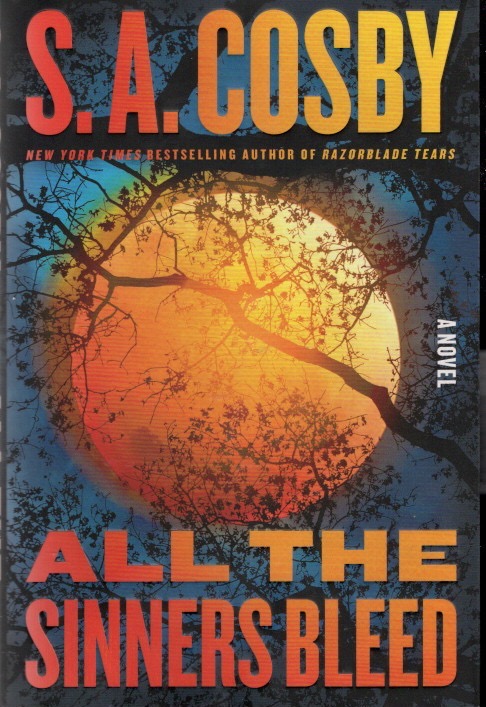
All the Sinners Bleed is Shawn’s fourth novel (as a solo author–he also co-wrote a book with Questlove). In the wake of My Darkest Prayer, he released two novels to extraordinary success and acclaim, Blacktop Wasteland and Razorblade Tears. Both were amazing, and somehow each book is somehow better than the preceding one–which is really saying something; I’d happily retire if I ever reached anything comparable to those two with any two of my own.

But they were just warm-up acts for this incredible new novel.

Something that has always interested me over the years is the integration of American police forces on every level. How do, for example, Black and/or Latinx/Hispanic cops feel when their fellow officers commit racially driven police brutality? How does it feel to be a part of a police force–particularly in the deep South, but also in places like Los Angeles–that has always been historically racist and oppressive to non-whites? For that matter, how does it feel to be a queer police officer?

All the Sinners Bleed takes on that question with our main character, Titus Crown, the recently elected first-ever Black sheriff in a pretty racist little corner of southeastern Virginia. Titus was born and raised there; his father and brother live there, and he returns to his hometown after a stint with the FBI. He ran for sheriff not expecting to win, but to try to break the stranglehold of power always held by money and white supremacy there. (I have another essay or entry to write about small Southern counties/parishes, and how they all too frequently are run like corrupt authoritarian dictatorships with the power being passed down within a few families, sometimes only one. Exhibit A: the Murtaughs in the South Carolina low country.) As the first Black sheriff of Charon County, he has to uphold the law–which he intends to do to the best of his abilities.

The book opens with a shooting at the local high school; this was hard for me to read and part of the reason it took me so long to get into it; I thought this was going to be a school shooting novel and I wasn’t sure if I wanted to read that. But I was wrong; yes, there was a shooting at the school and yes, that shooting was pivotal to the plot, but it wasn’t a mass shooting: a young Black man goes to the school and murders one of the teachers, and on his way out he is shot and killed by the cops when he won’t drop his weapon. Why would Latrell Macdonald shoot Mr. Spearman, a very popular teacher? As Titus starts looking into the strange shooting, he discovers another level of horror going on in Charon County, and once the story gets moving, it’s hard to put the book down.

Over the course of this all-too-short novel, Cosby tackles a lot of issues without either being preachy or over-the-top. Confederate monuments, the Daughters of the Confederacy, racism, white supremacy, the cruelty of poverty, police brutality, and the hard, cruel kind of Christianity practiced in poor, remote rural regions of the South. But the most powerful aspect of the book is how it handles grief; the three Crown men dealing with the loss of wife and mother, a wound that never heals–and the guilt that comes with moving on from such a loss. Cosby had a lot to say in just over three hundred pages; the fact that he said it all, and powerfully, by using character, place and story to get his messages across is testament to his great skil.

And this book is bound to piss off white supremacists. It will make a great Christmas gift for any in your family.

Something’s Wrong

At some point over the past decade, a movement started on-line to promote the voices of minority writers writing about their experience in fiction, called “#ownvoices”. The focus of the tag was primarily for non-white writers, whose work has been so long marginalized and kept out of the mainstream of publishing; forcing those writers to either not see print or go with either a small press or self-publishing. It brought up some interesting conversations about who gets to tell what story, the importance of representation in fiction, and the need for greater diversity in the popular culture.

Recently, the “who gets to tell what story” debate took on an entirely new meaning and went in an entirely different direction with the publication of a piece in the New York Times that became known as, for simplicity’s sake, “Bad Art Friend.” Who owns a story, and who gets to tell that story? Both women on either side of the conversation appeared, to me, to be kind of assholes; but when it comes down to brass tacks, I strongly believe that if you feel your own story—the story of your own life—belongs to you and only you, then you need to write it; not tell the story to other writers (or other people in general, really) and expect them not to use it. Writers are thieves, every single one of us; anything we ever are told, read, see, and hear goes into the computer of our mind and at some point, might come back out in a fictional form. The fact that the “kidney story” was used as a jumping off point for a short story by a writer fascinated by the story of the woman who donated said kidney—and her need for attention predicated on the ownership of that story—shouldn’t surprise any writer; as I read the piece in the Times myself I kept thinking, I don’t know that I could have resisted writing about this woman either—it’s such a fascinating place to start an examination of both altruism and narcissism, how could anyone resist? I also started, in fairness, to think of the story in terms of crime fiction—how would I build a crime story out of this?

I do know, however, how shitty it feels to have my story taken and told in a way I didn’t much care for; yet that doesn’t mean I couldn’t tell my story how I wanted to, if and when I choose to. Everyone’s take on this has been interesting to watch on social media–you can certainly tell how personal experience effects other writers’ opinions on things–but I think the bottom line of it all is, don’t be a shitty person. Everyone involved in that whole mess was kind of a shitty person, at least in how it was reported–and again, those people involved in the group chat/email or text chain or whatever the hell it was and were actually named in the Times piece? Their story is now being told by someone else. Karma? Serendipity? The arc of justice? Who knows? Who gets to decide?

So, who does get to tell whose story?

Most of my work is fiction, and the majority of it is also set in New Orleans. New Orleans is one of the few cities in the United States with a majority minority population (at least it used to be; I’m not as certain post-Katrina of that fact as I was pre-Katrina) and it would be impossible to write about New Orleans without including non-white characters; that would be science fiction. It might be possible to live in New Orleans and never, ever come across a non-white person; I don’t see how, frankly, but, on the other hand, I’ve read any number of lily-white books set here. The casts of my two series contain one person who is non-white; police detective Venus Casanova, a character I love deeply and have always wanted to write more about. I had two ideas for Venus novels over the years—Stations of the Cross is one, and more recently, Another Random Shooting—but I always held back from writing either of them because I am not a Black woman. I don’t know what it’s like to grow up as a Black woman in New Orleans or in the South, let alone the struggles faced with being a Black woman working for the New Orleans Police Department—the racism, the micro-aggressions, the misogyny—and while I still believe both books would be good ones, I still am not entirely comfortable writing from that point of view—nor am I comfortable taking a publishing slot (if it came to that) from an actual Black woman crime writer, of which there aren’t enough as it is.

Bury Me in Shadows didn’t present the same kind of issue that I have with writing from Venus’ perspective (I also started writing a short story once with her as the main character; I revised it to be from the point of view of her white gay partner on the force, Blaine Tujague), the issue here was that I was going to be looking at and examining the racist history of the South and issues of race themselves…from the point of view of a twenty year old white gay kid. Just what the world needs, right, another white take on racial injustice in the southern United States? The possibilities for offending people were endless; do I have blind spots in my white privilege when it comes to racial injustice? Would those blind spots come across in the book? (I don’t care if I offend Confederate apologists, none of whom would be reading anything I write to begin with for fears of gay contagion.)

One thing my main character Jake’s mother always emphasizes to him is “the heritage is hate, Jake—never forget that.”

Jake has no pride in the fact his ancestors enslaved people, or in the family history of what was once a plantation that has now dwindled to a small amount of acreage that is mostly wooded; his mother refused to raise him that way, and I wanted to show how possible and effective—and important– breaking the generational link passing white supremacy along for centuries can be. Like most white people, Jake really hasn’t thought much about the history or his own privilege—there’s a part in the book where he thinks about how many students of color there were in his elite, private Catholic school—and being there, on the ground soaked in blood and perspiration and oppression, he has no choice but to face up to it, think about it, and be appalled by it all. I didn’t want to write something that could be called, or considered, an oh look another white guy explains racism or even worse, oh look another white person discovers racism is actually a thing and is horrified book; but the land is definitely haunted by its past.

Another theme I worked on within the book is the history of this county is written in blood. That’s a recurrent theme within any of my Alabama fictions; I tend to always write about my fictional Corinth County, and its history is actually very heinous. There’s a short story I’ve been working on for years called “Burning Crosses,” about a lynching that happened there many years ago; during the horrors of the Jim Crow era—in which a young white girl, a student at the University of Alabama, comes to Corinth to research the lynching for the Justice Project—a fictional group at the University that researches all racially motivated killings in the South since Appomattox, to name the victims and so the memories never fade with time. Again, not sure if I am the right person to tell this story, and the possibilities for giving offense with it are endless; so, I continue to work on it, tweaking here and there, and maybe someday I will try to get it published. But Corinth County’s bloody history is very real in my mind, and there are countless book and story ideas (and in-progress stories) I have for continuing to write about it.

Whether I will or I won’t remains to be seen, of course, but there are files and files and files…

Because of course there are.


Take Good Care of Her

As the launch date for my book draws nearer and nearer, I find myself not experiencing the kind of stress and anxiety that I usually feel as the clock winds down. Maybe it’s because I am making the effort to promote the book this time around? Finding the time to do so? Paying more attention than I usually do when I have a book coming out? I don’t know why I am feeling so much more relaxed than I ordinarily do in the final days before this release, but it’s nice to have some awareness—other than the usual stopping in the middle of something to think, oh yes, I have a book coming out—is it today or tomorrow? I should probably do something about that, shouldn’t I?

It really is a wonder that I have any career of any kind, seriously.

And maybe it’s just the swing back from the twenty months or so of nightmarish existence, but I do feel like I am doing good work when I am writing these days. I don’t really remember much of the final push to get Bury Me in Shadows finished and out of the way, but I do remember doing the page proofs and thinking, you kind of did what you wanted to with this, well done! One of my big worries whenever I start writing something new is the fear I’ve already written the story, albeit in a different form; I was worried, almost constantly, that I was plagiarizing Lake Thirteen, my other ghost story, in this book. But the stories are very different, and the main character in each are quite different from each other. I think the mood in both books—the atmosphere I was creating—are very similar to each other, but I was trying to do something Gothic and almost dream-like with both.

As I mentioned the other day, I’ve always worried about writing about the South, and Alabama, in particular. How does one write about the South without dealing with the racism, present and past, of the region? How do you write honestly, with realistic Southern characters, without touching on that third rail of enslavement and war? Not all Southerners are racists, of course, just as not all Southerners are homophobes (I do make that point—about them not being all homophobes—in the second or third chapter of the book). But you cannot write about the South without mentioning that whole “Lost Cause/states’ rights” nonsense; that misplaced pride in something that was, at its core, evil. I was not educated in the South; I started school in the Chicago public education system; we moved out to the suburbs for junior high and my first two years of high school, finishing in Kansas. I was never taught in school that the root cause of the Civil War was anything other than slavery; and in all my extensive outside reading of American history, I never came across any of that. (I knew that the Southern politicians were all shouting “states’ rights!” in the lead-up to secession; but this was subterfuge. They couldn’t win the argument about slavery on moral grounds, so they fought against emancipation on Constitutional grounds. And, as I often note whenever someone trots out the tired states’ rights canard, the only right they cared about was the right to own slaves, and they sure as hell wanted the Fugitive Slave Act enforced against the will of the free states, didn’t they?)

I also like to point out that all those lovely, wonderful society ladies in Gone with the Wind—Melanie, Mrs. Meade, Mrs. Elsing, Mrs. Merriweather, etc.—would all be full-on Trump voters today. (I’ve not read the book in years, but while I do remember that in several places, Ashley talks about how he would have freed the enslaved people at Twelve Oaks had the war not come; but Melanie talks about the Lost Cause with all the fervor of a believer at a revival meeting in a tent…which makes Melanie, theoretically the moral center of the book, the biggest racist of the main characters in the story—and yes, I know, Margaret Mitchell did a great job of propagandizing the “Cause” as the Confederacy rather than slavery; but there’s an awful lot of racism and “they were better off enslaved” in that book, which, along with the movie, has done a great job of romanticizing something hideous and ugly )

I could write volumes about Gone with the Wind and how problematic both book and movie are (not the least of which is that Rhett rapes Scarlett but she enjoys it), but that’s an entirely different subject, deserving of its own entry (or two or three) or an essay—but I will say this one last thing on the Gone with the Wind subject: since the movie was released, for decades it imprinted on the minds of white Americans “this is what the antebellum South, and enslavement, was like”—when it was actually nothing of the sort and bore no resemblance to anything true or right.

One of the things I wanted to make clear with Bury Me in Shadows is that the shadow of white supremacy can be overcome and the continuing link, from generation to generation (parents teaching it to their children, who teach it to their children) can be broken by a person not blinded to realities or brainwashed by romantic fantasies; that character in this book for me is Jake’s mother, Glynis Chapman. Glynis rejected the white supremacy/racism she was raised with and did not pass that on to her son. I’ve always felt—and this was best exemplified with that Miss California who all those years ago blamed her homophobia on “It’s how I was raised”; it’s how I was raised is perhaps the laziest, most disgraceful, and embarrassing excuse ever given for perpetuating hatred and discrimination. It essentially states that you are incapable of thinking logically and rationally for yourself; you are incurious, and your parents are God-like, with beliefs and values that are above question. At least own your bigotry and don’t blame it on your parents because at some point, you must become your own person; you either continue to blindly believe everything your parents told you, or you actually become a functional human being capable of making up your own mind rather than simply blindly parroting what you were taught. I began questioning everything quite young, frankly; more so than most, but still to a far lesser degree than I should have. I didn’t question American mythology as young as I should have, but I did start questioning religion quite young–and I am also happy that I never fossilized my beliefs and values but rather kept them fluid and receptive to change based on new information, or more in depth thought.

Racism, and white supremacy, are evil. Period. Race theory has no validity or origin in actual science—the genetic differences between white people and non-white people are so infinitesimal as to be practically non-existent—and were created for no other reason than to justify western European colonialism, exploitation, and looting the resources of the rest of the world for power and money. Originally cloaked in religious fervor (if there was gold and riches for the crown, there were souls to be won for the cross), even American expansionism at the expense of the indigenous people of this continent was called manifest destiny, which gave mass genocide and the theft of land a cloak of holiness: it is the destiny of the white man to rule over others and expand his empire.

And it can’t get more white supremacist than that, can it?

I’ve never understood the notion of racial pride, frankly; likewise, I’ve never really grasped the mentality behind ancestor-worship, as evidenced by Confederate apologists. Regardless of reason, the truth is, and always has been, that the Southern states tried to destroy the union, period. They fired on the flag. The great irony that the Confederate apologists also consider themselves to be more patriotic Americans than those who think the Confederates were traitors–talk about cognitive dissonance–is something that always amuses me. How do you chant USA! USA! during the Olympics or other international sporting events of any kind when you have a Confederate flag decal on your car? Why are you do defensive about the crimes of your ancestors, when you have no more control over what they did during their lifetimes than they have over yours? No one can help who they are descended from and no one pays for the crimes of their ancestors. Confederate monuments never should have been erected (again, the groups that raised the money for them and put them up were run by women like Melanie Wilkes and Mrs. Meade and the other society women from Gone with the Wind) so there should have been no need for discussion, debate, or confrontation over their removal; as I always say, “Where are the statues of Benedict Arnold or the other Tories from the Revolutionary War? Weren’t they just standing behind their values and beliefs? They also saw themselves as patriots–just for the King.” I am incredibly happy not to see the statue of traitor Robert E. Lee every time I drive home from work–I hated having to try to explain the existence of the statue and the circle named for him to visitors…I used to say, “And here’s one of our monuments to treason, Lee Circle” every time I drove around it with a visitor in the car.

So, no, Bury Me in Shadows is definitely not a Lost Cause narrative that romanticizes the antebellum Southern states or the Civil War–and is definitely not the place to look for one.