Cool, Cool Considerate Men

We are taking a break from our regularly scheduled blog to talk about US History and current affairs, which is something I don’t do very often here. But since it’s the 4th of July, how can we not reflect on our most imperfect union and the journey to where we are now?

Today’s title is from the musical 1776, which doesn’t get near enough attention. I was thinking about using something from Hamilton, but…I don’t think Lin-Manuel will mind, do you? I saw the film version of 1776 when I was in junior high school (I think it was; we used to go see movies periodically; which is how I saw both Fiddler on the Roof and Jesus Christ Superstar1). But 1776 seems to have been largely forgotten.
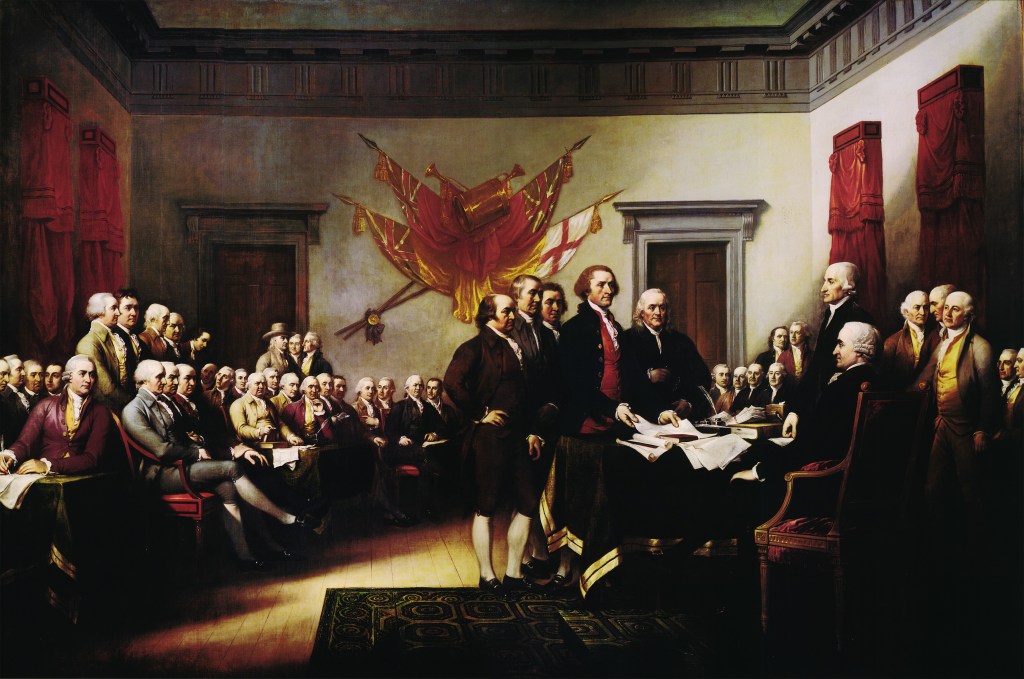
It’s hard to imagine, really, how courageous the American rebels actually were. They were farmers and lawyers and doctors; yet they believed in their cause enough to defy and stand up to, and take on, the mightiest Empire the world has ever seen. 2They were imperfect humans, as we all are; the attempt by the Right to frame them as infallible gods, guided in their work by the Christian god, is offensive and insulting. The greatest of humans are still human, and all humans have frailties and flaws, and enshrining any human as an infallible instrument of God is, at the very least, blasphemy. The Founding Fathers were both racists (more than a few enslaved people) and misogynists (where are the rights for women?), which made them….fallible. They weren’t gods, they were men.

I grew up in the 1960s and 1970s, and my education was tailored to the times. We were in a Cold War with the “evil” Soviet Union, when the possibility of nuclear annihilation was always in the back of our heads. Communists were the enemy, and they were evil; so…we all had to be brainwashed into the mentality of American exceptionalism. The right of white Europeans to the continents of the Americas, despite the fact people already lived there, was never to be questioned…the ends justifying the means, I suppose. The true horrors of enslavement weren’t taught; it was just something that happened, we fought a civil war to end it, and then it was over…we weren’t taught about the racism baked into the country and society from colonial days that continues to the present day.

And a lot of the failures of the Constitution were primarily due to the Founding Fathers being unable conceive of things that are just taken for granted by us today–politics as a profession; primaries and elections as a multi-billion dollar industry, and the levels of corruption in our political class, as well as the failures of the news media to hold the government accountable.

The passage of yesterday’s foul and evil legislation was the final betrayal of the Founders, and I think people are finally waking up to the clear and present danger in Washington. Funny that the people always screaming about their freedom and their liberties are too blind to see how their freedom and liberties are being taken from them–and how happy they are to give them up so long as they think other people will suffer. I see a lot of social media posts since yesterday talking about the new authoritarianism, yet have never noticed how the Right has been building to this point for decades. The police state’s foundational legislation was the PATRIOT Act–which has never been repealed and has been reauthorized by Congress several times.

I don’t see a great future for us over the next ten years, frankly. I do not see a way out of this situation we’re in without it becoming really ugly. MAGA isn’t going to go down in any electoral defeat because, as we have seen, they will not accept the results and are more than willing to use violence to get their way. That will get ugly, don’t you think? And let’s face it, our current situation isn’t much different than the one the country was in during the 1850s–when enslavers controlled the Supreme Court, Congress, and the White House. Losing that control led to the Civil War, because enslavers weren’t willing to give up the power they’d enjoyed for so long because they feared losing their slaves.

How long before the people in the prison camps are contracted to work in the fields and doing the grunt work we’ve pushed off onto immigrants for decades?

I always suspected our system was collapsing, rotting from the inside and spreading the foul disease across the nation. I always hoped I was wrong, but the logical side of me couldn’t deny the evidence of the decay.

My one hope was that if I was correct, I wouldn’t live long enough to see the collapse. Ah, well. That ship has sailed, hasn’t it?

Yeah, not up for celebrating seventeen million people losing their health insurance, or the many millions of children who will go hungry.

But there’s always hope, no matter how bleak it seems. As Winston Churchill once said, “You can always count on Americans to the do the right thing–after they’ve exhausted every other possibility.”

I also believe this will not end well for corporations and billionaires–as it did not for the French and Russian aristocracies.
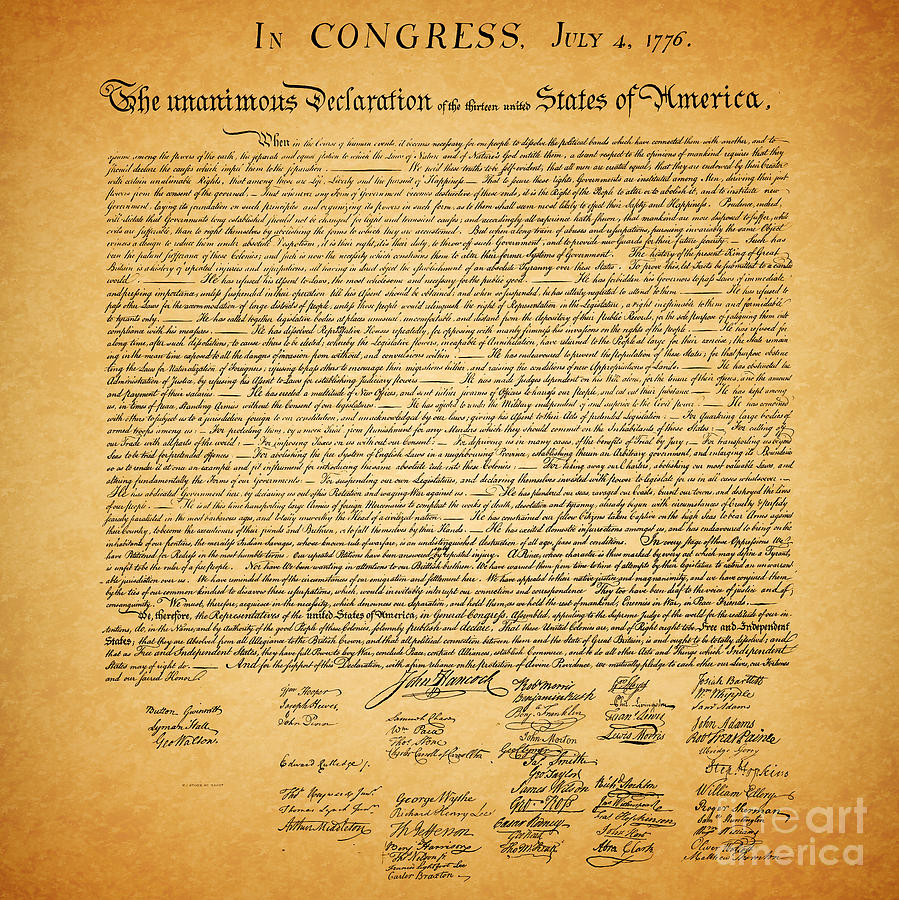
And in case you’ve forgotten (or never knew) the text:

When, in the course of human events, it becomes necessary for one people to dissolve the political bands which have connected them with another, and to assume, among the powers of the earth, the separate and equal station to which the laws of nature and of nature’s God entitle them, a decent respect to the opinions of mankind requires that they should declare the causes which impel them to the separation.

We hold these truths to be self-evident, that all men are created equal, that they are endowed by their Creator with certain unalienable rights, that among these are life, liberty, and the pursuit of happiness. That, to secure these rights, governments are instituted among men, deriving their just powers from the consent of the governed. That, whenever any form of government becomes destructive of these ends, it is the right of the people to alter or to abolish it, and to institute new government, laying its foundation on such principles, and organizing its powers in such form, as to them shall seem most likely to effect their safety and happiness.

Prudence, indeed, will dictate that governments long established should not be changed for light and transient causes; and, accordingly, all experience has shown, that mankind are more disposed to suffer, while evils are sufferable, than to right themselves by abolishing the forms to which they are accustomed.

But, when a long train of abuses and usurpations, pursuing invariably the same object, evinces a design to reduce them under absolute despotism, it is their right, it is their duty, to throw off such government, and to provide new guards for their future security. Such has been the patient sufferance of these colonies; and such is now the necessity which constrains them to alter their former systems of government. The history of the present King of Great Britain is a history of repeated injuries and usurpations, all having in direct object the establishment of an absolute tyranny over these states. To prove this, let facts be submitted to a candid world.

He has refused his assent to laws the most wholesome and necessary for the public good.

He has forbidden his governors to pass laws of immediate and pressing importance, unless suspended in their operation till his assent should be obtained; and when so suspended, he has utterly neglected to attend to them.

He has refused to pass other laws for the accommodation of large districts of people, unless those people would relinquish the right of representation in the legislature; a right inestimable to them and formidable to tyrants only.

He has called together legislative bodies at places unusual, uncomfortable, and distant from the depository of their public records, for the sole purpose of fatiguing them into compliance with his measures.

He has dissolved representative houses repeatedly, for opposing, with manly firmness, his invasions on the rights of the people.

He has refused for a long time, after such dissolutions, to cause others to be elected; whereby the legislative powers, incapable of annihilation, have returned to the people at large for their exercise; the state remaining in the meantime exposed to all the dangers of invasion from without, and convulsions within.

He has endeavored to prevent the population of these states; for that purpose obstructing the laws for naturalization of foreigners; refusing to pass others to encourage their migrations hither, and raising the conditions of new appropriations of lands.

He has obstructed the administration of justice, by refusing his assent to laws for establishing judiciary powers.

He has made judges dependent on his will alone, for the tenure of their offices, and the amount and payment of their salaries.

He has erected a multitude of new offices, and sent hither swarms of officers to harass our people, and eat out their substance.

He has kept among us, in times of peace, standing armies, without the consent of our legislatures.

He has affected to render the military independent of and superior to the civil power.

He has combined with others to subject us to a jurisdiction foreign to our constitution, and unacknowledged by our laws; giving his assent to their acts of pretended legislation:

For quartering large bodies of armed troops among us;

For protecting them, by a mock trial, from punishment for any murders which they should commit on the inhabitants of these states;

For cutting off our trade with all parts of the world;

For imposing taxes on us without our consent;

For depriving us, in many cases, of the benefits of trial by jury;

For transporting us beyond seas to be tried for pretended offenses;

For abolishing the free system of English laws in a neighboring province, establishing therein an arbitrary government, and enlarging its boundaries, so as to render it at once an example and fit instrument for introducing the same absolute rule into these colonies;

For taking away our charters, abolishing our most valuable laws, and altering fundamentally the forms of our governments;

For suspending our own legislatures, and declaring themselves invested with power to legislate for us in all cases whatsoever.

He has abdicated government here, by declaring us out of his protection, and waging war against us.

He has plundered our seas, ravaged our coasts, burnt our towns, and destroyed the lives of our people.

He is at this time transporting large armies of foreign mercenaries to complete the works of death, desolation, and tyranny, already begun with circumstances of cruelty and perfidy scarcely paralleled in the most barbarous ages, and totally unworthy the head of a civilized nation.

He has constrained our fellow citizens, taken captive on the high seas, to bear arms against their country, to become the executioners of their friends and brethren, or to fall themselves by their hands.

He has excited domestic insurrections amongst us, and has endeavored to bring on the inhabitants of our frontiers, the merciless Indian savages, whose known rule of warfare is an undistinguished destruction of all ages, sexes, and conditions.

In every stage of these oppressions, we have petitioned for redress, in the most humble terms. Our repeated petitions have been answered only by repeated injury. A prince, whose character is thus marked by every act which may define a tyrant, is unfit to be the ruler of a free people.

Nor have we been wanting in attentions to our British brethren. We have warned them from time to time of attempts by their legislature to extend an unwarrantable jurisdiction over us. We have reminded them of the circumstances of our emigration and settlement here. We have appealed to their native justice and magnanimity, and we have conjured them by the ties of our common kindred, to disavow these usurpations, which would inevitably interrupt our connections and correspondence. They too have been deaf to the voice of justice and of consanguinity. We must, therefore, acquiesce in the necessity, which denounces our separation, and hold them, as we hold the rest of mankind, enemies in war, in peace friends.

We, therefore, the representatives of the United States of America, in General Congress assembled, appealing to the Supreme Judge of the world for the rectitude of our intentions, do, in the name, and by authority of the good people of these colonies, solemnly publish and declare, that these United Colonies are, and of right ought to be free and independent states; that they are absolved from all allegiance to the British Crown, and that all political connection between them and the state of Great Britain is and ought to be totally dissolved; and that, as free and independent states, they have full power to levy war, conclude peace, contract alliances, establish commerce, and to do all other acts and things which independent states may of right do. And for the support of this declaration, with a firm reliance on the protection of Divine Providence, we mutually pledge to each other our lives, our fortunes, and our sacred honor.

Funny how some of their indictments of George III also apply today…

  1. I still can’t believe we saw Jesus Christ Superstar and no parents complained. That wouldn’t happen today. The show and movie and music were highly offensive to Christians back in the day, but they don’t complain much about it anymore. ↩︎
  2. I’m always amazed at how the people screaming the loudest that they are the REAL American patriots…would never put themselves at risk for their values and beliefs. For the record, conservatives in 1776 were called…Tories. ↩︎


Cathouse Blues

Monday morning and I am off to the office to cover for a co-worker rather than work at home. This works because my work-at-home day this week will be Friday, and then the next week it will be Monday again, so I’ll have four days of not going into the office around my birthday, which is kind of nice. I didn’t have any trouble getting up this morning–I woke up actually at 5:58 and stayed in bed through another two snooze cycles starting at 6, as usual–and now I sit, swilling coffee and feeling awake, as the clock inevitably makes its way to the time when I have to start getting ready to leave for work.

Costco was delivered yesterday, and it really is a remarkable convenience. I still need to run past their actual store one night after work this week–some things can’t be delivered, or they don’t offer them for delivery; it’s also entirely possible they do have the stuff in stock just don’t deliver it and that’s why I want to run by just to make sure. It’ll be an easy in-and-out, and after work one day should do the trick, I would think.

It’s weird going in on Monday morning and getting up so early an extra morning this week–I don’t have to stay the entire shift today, so will most likely leave earlier than I usually do on my day shifts in the office. I suspect we’re going to go back to our old way of doing things in September at last, and I am hoping that means I can swing back around to evening shifts once again–which would be super lovely. An adjustment again, to be sure, but one that should be much easier than adjusting to getting up early every morning, which goes against every grain and fiber of my being.

Heavy sigh.

I didn’t get a lot of writing done this past weekend–not really a surprise, to be honest–but I was pretty worn down by the time the weekend rolled around again, and so I am not terribly surprised I didn’t get a lot of work done this weekend. By the time I got home on Friday I was feeling fatigued already, and of course, I didn’t have much energy the entire weekend, either. Which is fine–I was able to do things that didn’t require much thinking, like cleaning and so forth–and while my mind couldn’t really wrap around reading over the weekend, I did start rereading my Sandman graphic novels, which help make the show even more enjoyable, to be honest; seeing how well the books were adapted into the show–well, I may need to watch the show again because I can’t stop thinking about it and the concepts it explored. It really is an exceptional television experience. We also got caught up on Five Days at Memorial, which I didn’t realize was still airing, so we are caught up on everything available, and we also caught up on American Horror Stories–the last two episodes were vastly superior to the first two, but still, not the greatest–and I also watched The Manchurian Candidate (the original, with Sinatra and Angela Lansbury) for the first time; it was a bit dated, and I also couldn’t help but think how much better it would have been if someone like Montgomery Clift or Paul Newman had played the male lead rather than Sinatra (I’ve never been much of a fan of his acting, really). It was interesting, and of course Paul didn’t see the big twist coming–the Angela Lansbury thing–and she was fantastic. It was also very much of its time–Communist scare, evil Soviet and Chinese Communists, brainwashing–but I’d also like to go back and read the novel on which it was based at some point.

I have an errand to run today after work–picking up a prescription–which is why I am wondering if it would be smart to swing by Costco on my way home; I can catch I-10 right here outside the office and be there in like five minutes, give or take, plus it’s much easier to get uptown from Costco. Decisions, decisions–but why not get it all over with tonight, then go home and shave my head and face for the week? It does make the most sense. Ah, well, no need to decide now.

And on that note, this is my birthday week–I will be sixty-one on Saturday, ee-yikes!–which only bears mentioning (it’s not something I care about excessively, to be honest) because all of my social media will announce it eventually this week at any rate. So I am heading in to the spice mines; y’all have a marvelous Monday!

Up the Ladder to the Roof

It’s a gray Saturday morning, and my body clock has definitely reset. I woke up just before six again, wide awake, but stayed in bed for another hour (just like yesterday). I don’t feel as energetic as I did yesterday, though; but I have things to dig through and work to do and lots of coffee on-hand for fueling. But that’s okay; I don’t have huge plans for the day. I am going to start doing some editing, I am going to work on my short story a bit, and i am going to spend some more time with Kellye Garrett’s Like A Sister, which will be my reward for getting the other stuff done. I need to go make groceries at some point this weekend, just haven’t decided which day to do that. I also need to go to the gym, maybe later today. There’s always organizing and cleaning to do, too.

In other words, another normal weekend around the Lost Apartment.

But that’s cool, I suppose. Trying to do normal things helps me deal with the over-all concern about the world burning to the ground around us, which sometimes makes doing anything feel completely pointless. (I do remember all the hesitation from people in December about trying not to get thrilled or be happy that 2021 was coming to an end; we all felt that way every December for several years only for the new year to be even worse than the one before. Looks, sadly, like those people were right.) It’s a weird place to be in for someone my age, or in my generation, or those of us who remember the world before the collapse of the Soviet Union. I’m sure many of them, like me, had forgotten what it was like to live under the daily threat of nuclear annihilation and the end of civilization as we’ve come to know it. But that’s what we did back then–we went about our daily lives with that worry in the back of our minds at all times. I remember the amazement and joy when the Berlin Wall came down, and Germany reunified; part of their punishment for causing World War II and uncountable war crimes was allowing the Russians to basically split the country, turning East Germany into a communist satellite state while West Germany became a democracy and joined NATO and the west–basically for protection from a Communist takeover. I don’t miss nuclear apocalyptic fiction and films; Neville Shute’s On the Beach was such a bleak read, and the television movie The Day After was also dark and hopeless. There was an abandoned nuclear missile base about two or three miles from my high school in Kansas (which I’ve always wanted to write about); I remember there was a PBS documentary that aired when I was in high school about nuclear war, which was also the first time it ever crossed my mind that Kansas, of all places, would be a strategic military target for the Russians (because of all the missile bases spread across the prairie), they even named the closest town to the abandoned base as a target (Bushong, Kansas, population 37 at the time). And of course, The Day After made that very clear, as it took place in Kansas City and environs. Testament is another bleak film about the aftermath of nuclear war; and I remember reading another book, War Day, by Whitley Strieber and someone else, set about twenty years after a nuclear war between the superpowers. We used to learn about all kinds of things, like the electromagnetic pulse (the detonation of a nuclear weapon in the atmosphere which somehow–I don’t remember how it worked–rendered anything requiring electricity to cease working), often simplified to EMP. We were taught that iodine helped with radiation sickness, along with the grim knowledge that those killed instantly were the lucky ones. Apocalyptic and dystopian fiction used to be about the aftermath of nuclear war.

I didn’t realize how lovely it had been to be able to push those concerns completely out of my mind.

And what unique privilege it is, to be so consumed with worry over what may happen that might affect me and my life, while people are literally being slaughtered by the minute and large cities are being bombed and shelled ruthlessly and refugees are fleeing by the hundreds of thousands.

And there are other atrocities occurring around the world that aren’t being reported on, or covered as widely by the western media–primarily because the people being slaughtered or bombed aren’t white.

The great irony is that we consider our current civilization as the apex of humanity thus far–that civilization continues to evolve and grow less barbaric with the passage of time, while knowing that future generations will look back to our times and wonder what the fuck was wrong with them? How could they not see how fucked up the world was, and do something about it?

What is happening in Ukraine is just another chapter in the never-ending on-going series of books showing how incredibly inhumane humans are.

I don’t know what’s going to happen over there, and I worry that a peaceable resolution is not possible. I don’t see how Putin can possibly survive this, and he is a desperate thug with a massive Napoleon complex. I don’t know how many Ukrainians have to die before the rest of the world says enough. I don’t know how you get a madman with a nuclear arsenal to stop making war on civilians.

So, I just keep going. I get up every morning and have coffee. I check my emails, read some, delete some and reply to others. I check the news to see the latest from the front. I work on day job responsibilities and my writing and MWA business and edit. I do my dishes and clean my house and cook dinner and try to read to take my mind off the nightmares unfolding in the far corners of the world. I donate what I can to relief efforts. Little things, here and there, to cope with a reality that is incredibly worrisome and stressful and so overwhelming that I can’t allow myself to spend too much time going down that road–because I have the privilege to not have to be concerned about surviving today’s bombings. I have food and medicine and access to services. I have power and water and a working car. I have resources to draw upon. I am lucky.

I create. I write novels, fictions which may or may not have any meaning, trifles that can serve as a distraction from the worries and cares of a burning world over which I have little to no control. I have always been hesitant to use the word art when it comes to my writing; I’ve always felt that it isn’t for me to decide whether my work is art or I am an artist. But literature is a form of art, so therefore by extension my work is art and I am an artist; whether good or bad, important or forgettable is for others to discuss, debate and decide. But one of the foundations of civilization is art; art can survive the centuries and epochs and tell future generations stories about the times in which we live, to give them context for our civilization and our country and what we do and how we live. Fiction can educate and distract; it can provide a needed distraction and escape from the horrors of reality and provide comfort and joy in times of stress and terror. I have always escaped into books, and as a writer, I can also now escape into worlds and characters of my own creation. Reading and writing have always been my escapes; and now, more than ever, those kinds of escapes are necessary.

So, writers–we need to keep creating even as the world burns. There is always a need for beauty and truth, especially in times like these. And with electronic books–our words can now last for eternity, forever–or at least as long as civilization as we know it exists. I have no crystal ball; I do not have visions–although there have been times I’ve felt like Cassandra screaming on the walls of Troy, ignored and mocked as she tells them their future and of their folly. I do not know how this will all turn out, I do not know where we will be tomorrow or the next day. But as long as I have the ability to do so, I will keep working. I will keep making to-do lists and crossing off the tasks as I complete them. I will go on, living my life and doing whatever small thing I can do to try to keep the light burning. I will always try to make sense of the senseless, and I will always keep going.

No matter how dark the world might seem, no matter how much suffering we have to witness.

And on that somber note, I am going to dive into the spice mines. Have a lovely Saturday, Constant Reader, and hope you and all your loved ones are safe and secure, and continue to be.

Make Me Smile (Come Up and See Me)

New York!

It really is a wonderful place, and I love it here. The energy, the rapid pace, the mobs of people everywhere–comparatively speaking, of course–it is all quite exhilarating, frankly. It usually wears me out being here–the constant activity of rushing from one meeting to the next; walking around slow walkers, hearing all the different languages and accents and voices; clambering down the steps to the subway and remembering my age as I climb back up at my stop, the towering buildings, the light show that is Times Square…it’s really quite marvelous, all of it. This time, though, I am not worn to a nub the way I usually feel when I am in the city. My sleep–never great when I travel–has actually not been so bad this time around; I wake up periodically during the night but for the most part I am actually getting some decent sleep, so I feel rested. Last night I did kind of hit a wall, though; I was very exhausted when I managed to make it back to my room and collapse onto the bed, too tired to read or think or much of anything, so I turned on the massive television here (which has Netflix) and it suggested that I watch Glee–soon to be leaving the service–and I hesitated for a moment before starting. I remember loving Glee in the beginning, but it became so bad and off the rails in later seasons that it went from “love it” to “what the fuck” to “hate watching” to “life is too short to watch bad television.” And there’s some weird curse on the show, too–several stars have died, Lea Michele turned out to be a bigger monster in real life than Rachel Berry (which is saying something–although to be fair, I already knew she was awful because I knew someone who went to Yale with her), and of course, Glee is the show that truly launched Ryan Murphy as a television production conglomerate. (His previous shows, Nip/Tuck and Popular were cult favorites; Glee’s huge success is what made him golden). It was interesting to watch it again, and see how subversive the show was for its time: a closeted gay teenager slowly making his way out of the closet, although terrified to admit it because he was already being bullied for being different; the absolute mockery of Chastity Clubs for teenagers; and while the show would probably have difficulties were it a new show starting to air today–playing off bullying for laughs, for one thing–it was still groundbreaking for the time.

It’s so interesting how things change so quickly, isn’t it? Over the course of my lengthy lifetime there has been so much change that things that were groundbreaking and transgressive at the time are now problematic; I’ve been thinking about this a lot lately, particularly in the wake of rewatching both Pillow Talk and The Rocky Horror Picture Show (which may be the first time those two films have ever been linked together in this manner–any manner, really; they are actually quite different films but…at their core they both challenged the status quo of their time), and especially now having rewatched the first few episodes of Glee.

And, as always, there’s probably an essay in there. I used to think about how much the world changed over the course of my grandmother’s life–she was born in 1910, during the Taft administration, and died during the Clinton–and all the changes she must have seen over the course of her lifetime, although in remote rural Alabama she might not have been terribly aware of those changes; she wasn’t able to get a telephone line until the early 1980’s–but now that I am past the sixty mark and no matter how much I want to believe otherwise, I cannot deny that I am on the downward side of the mountain of life I also marvel at how different the world is now than it was when I was a child. You never hear anything anymore about nuclear disarmament or the threat or potential of a full-blown nuclear war that could take civilization back into the dark ages again…but I also remember learning very young about atomic weapons and the damage they could do; I remember air raid drills when I was in elementary school and that there was a very large bomb shelter below the basement level of my school–you never forget seeing those triangular symbols on the wall over the staircase down. The right still drags out that cold-war era trope of communists! Communists! that they used to bleat about endlessly; I just saw it from moronic state legislator from Arizona on Twitter just the other day; and to this day they conflate socialism with communism as a scare tactic to drum up the base…who seem to think living as wage serfs from paycheck to paycheck, one medical bill or car accident away from bankruptcy and homelessness is better than any government assistance to ease their lives in any way–because there is nobility in suffering? But then, that also goes hand-in-hand with their embrace of a version of Christianity that tells them the more the suffer in this life the more wealth they will have in Heaven, which is weird. (I’ve never understood why they despise socialism and communism when in fact their ideation of heaven and the afterlife is…socialism.)

I’ve started reading Rachel Howzell Hall’s These Toxic Things, which is also quite marvelous. I am a bit behind on my reading of Hall’s canon; this is her release from last year and I also have her release from this year in the TBR pile as well; and I really want to go back and finish reading her Lou Norton series. The opening chapters of this are quite excellent, and I know what I’ll be reading on the train to Boston tomorrow. (One of the reasons I enjoy traveling as much as I do is because the uninterrupted reading time it gives me…I probably won’t finish all the books I brought with me on this trip–there are two others I’ve been meaning to read for quite some time; I love having time where I have nothing to do but read, although I suppose I could actually try to write on the train….nah. I may write in my journal instead if the mood hits me.)

I guess I should wrap this up so I can start getting ready to head out for my day. Don’t know if I will have time before my train to post in the morning tomorrow, but will definitely check in at some point–it’s weird to not being posting daily this week!

Happy Thursday, Constant Reader, and a shout out to all veterans on this Veterans’ Day as well!

Girl, You Make My Day

One of the things I’ve greatly enjoyed over the last few years has been the sea change in how publishing views works by non-white and non-straight authors; the push for more diverse voices in the publishing community has already borne wonderful fruit. I’ve been saying for years that the world of crime fiction was in danger of getting stale again, much as it did in the late 1970’s and early 1980’s; particularly the private eye novel. The arrival of Sara Paretsky, Sue Grafton, and Marcia Muller on the scene shook things up and shook things out; the private eye novel got a much-needed shot in the arm of adrenaline with these three women and the others their work inspired; I strongly believe the move toward diversity is going to bear fruit in much the same manner–and it already has, frankly; the works of diverse writers like S. A. Cosby, Kellye Garrett, Rachel Howzell Hall, Alex Segura, Tracy Clark, Cheryl Head, and so many others have joined the great pioneers like Walter Mosley and the wonderful Barbara Neely to open up new perspectives on crime and crime fiction; our society and world; and again, this was desperately needed–and is necessary every so often, for our genre to refresh and expand and become more inclusive. We’re also seeing more queer books being sent out into the world from the big houses in New York, which is also incredibly exciting (another shout out to Yes Daddy By Jonathan Parks-Ramage and A Beautiful Crime by Christopher Bollen).

It’s a very exciting time to be a fan of crime fiction.

Noir has always been one of my favorite sub-genres of crime fiction, and I always enjoy reading modern takes on it. I want to write more noir, quite frankly; Chlorine would be the first of at least four I want to write, if not more (for now, I have ideas for four of them, with Chlorine being the most full formed). I always enjoy modern takes on noir–Laura Lippman’s Sunburn was quite marvelous, as was Christa Faust’s Money Shot and Choke Hold)–and of course, S. A. Cosby is a master of rural Southern noir; both Blacktop Wasteland and Razorblade Tears are destined to be considered classics, I think.

So, I was very curious to read Silvia Moreno-Garcia’s take on modern noir, Velvet Was the Night. It took me a very long time to finish–which is not indicative of the quality of the book, I hasten to add–because after I read so much during the post-Ida power outage, I kind of broke my brain and thus haven’t been able to really focus as much on reading as I would like; yesterday after the LSU game I sat down and finished it with Georgia-Kentucky on as background noise.

And what a fun ride it was.

He didn’t like beating people.

El Elvis realized this was ironic considering his line of work. Imagine that: a thug who wanted to hold his punches. Then again, life is full of such ironies. Consider Ritchie Valens, who was afraid of flying and died the first time he set foot on an airplane. Damn shame that, and the other dudes who died, Buddy Holly and “The Big Bopper” Richardson; they weren’t half bad either. Or there was that playwright Aeschylus. He was afraid of being killed inside his house, and then he steps outside and wham, an eagle tosses a tortoise at him, cracking his head open. Murdered, right there in the stupidest possible way.

Often life doesn’t make sense, and if Elvis had a motto it was that: life’s a mess. That’s probably why he loved music and factoids. They helped him construct a more organized world. When he wasn’t listening to his records, he was poring over the dictionary, trying to memorize a new word, or plowing through one of those almanacs full of stats.

No, sir. Elvis wasn’t like some of the perverts he worked with, who got excited smashing a dude’s kidneys. He would have been happy solving crosswords and sipping coffee like their boss, El Mago, and maybe one day he would be an accomplished man of that sort, but for now there was work to be done, and this time Elvis was actually eager to beat a few motherfuckers up.

He hadn’t developed a sudden taste for blood and cracking bones, no, but El Güero had been at him again.

The recent rise of Silvia Moreno-Garcia has been meteoric, although I am sure to her it has seemed anything but. I read her terrific vampire novel, Certain Dark Things, a while back, loved it, and have been following her career ever since as she has turned out novels at a terrific rate–Gods of Jade and Shadow, Untamed Shore, Mexican Gothic–all of which have been critically acclaimed and sold very well; I love that she bounces from genre to genre–horror to fantasy to crime; even bouncing around in the sub-categories of the crime genre. This is only my second read of her work–I have them all, of course–and had been meaning to get around to her take on noir with a Mexican flourish for quite some time. (I am really sorry I broke my brain with all the reading I did after the power went out; I greatly enjoyed this book, but it was so hard for me to focus for some reason…but am glad I sat down yesterday with the book, determined to finish it at last.)

One of the things that strikes me about Moreno-Garcia’s work is that I am seeing Mexico, a place I greatly love, through a fresh new perspective; like all Yanquis, I always view Mexico through the prism of a tourist. I’ve always wanted to write about Mexico, and have several short stories in the files that are set there (I did write one erotica story as Todd Gregory set in Acapulco; from the perspective of a tourist, of course: “Oh, What A Friend I Have in Jesus”)…but reading Moreno-Garcia makes me aware of how scant my knowledge of our Southern neighbor is–all of the counties south of the Rio Grande, frankly–which is a stinging indictment of our education system. (Don’t even get me started on the concept of Latin America vs. “America”) I know very little of Mexican history after the Spanish conquest, other than the Mexican War and the French empire set up under a Hapsburg by Napoleon III during our civil war. I know very little history of any of the countries that make up the rest of the American continents, really–and isn’t that more than a little bit disgraceful? I also know very little about their cultures, their politics, and what goes on there; a quick glance through the news also will show very little information or news being reported about those non-United States/Canada American countries, which is really a shame.

Velvet Was the Night is set un 1971, a particularly politically rife period in Mexico. The US was terribly concerned about communism being spread by the Soviets in what has always been considered the American soft underbelly–I mean, look at our reaction to Cuba–and there’s no question that CIA operatives and money were working to subvert Communism while supporting borderline Fascist governments because that was preferable to Washington than another potential Soviet satellite state in our hemisphere. The vast paranoia of that time–which really lasted from 1945-1990, really–cannot be underestimated or understated. By rooting her story in actual events of 1971–the crackdown of the Mexican government on dissidents–Moreno-Garcia slyly gives us a taste of how American foreign policy of the time affected everyone in Mexico, as well as a history lesson. (One of the great modern deceptions of our society is this idea that we always act benevolently as a nation; we’re doing this for your own good.) The book has two point of view characters; one, depicted in the opening above, is “Elvis”, a very young man who works as a thug, basically, for an oppressive group of anti-Communists that try to infiltrate dissident groups and haunt protests in order to make them turn violent, so the military can intervene on behalf of the “people.” Elvis grew up very poor and sometimes imagines what his life would be like if he were able to pursue his primary interests–educating himself and music. He doesn’t know what his future holds but is vaguely aware the path he is on–violence and more violence–will not end well. Over the course of the book he begins to question the values he’s been taught to believe in his gang, and begins to aspire to get out of it.

The other main character is Maite, a legal secretary barely getting by on her low salary and barely able to afford food. Her car has been in the shop unclaimed because she cannot afford the mechanics’ bill. She leads a lonely and solitary life, has a very vivid imagination and fantasy world she prefers to inhabit, colored strongly by her love of romance comic books and the music she likes to listen to. Maite’s lovely neighbor, Leonora, asks her to feed her cat while she is away, and when she agreed, Maite unknowingly enters the world of political struggle and upheaval. The riot depicted in the first chapter, that Elvis helps engineer? A friend of Leonora’s has taken pictures that prove that the riot was started by government forces, and those two rolls of film are the McGuffin everyone in the book is after–except poor innocent Maite, who, like any main character in a great Hitchcock film, becomes involved in something life threatening by simply agreeing to feed a neighbor’s cat–something she resents agreeing to do. When Leonora doesn’t come back, Maite starts looking for her–primarily motivated by the fact she can’t afford to keep feeding the car, and Leonora promised her money for feeding it–money she needs to get her car back. Motivated by her own poverty, Maite finds herself getting involved more and more in this clandestine world, and her own life is in danger soon.

The true strength of the book lies in the careful characterizations of both Elvis and Maite; two desperate people trapped by poverty in lives they want to escape, and the parallel journeys they both follow that lead their paths to cross; and the richness of the reality of what life in Mexico City was like during the turbulent time when the book is set. Moreno-Garcia shows us, as she did in Certain Dark Things, what the reality of life is like in one of the world’s largest cities, the reality the tourists rarely, if ever, get a chance to see. And while the hopelessness of both their situations seem unresolvable at times, the pacing is strong and the story construction so tight, and you the readers finds yourself rooting for them both to get out safely.

I really loved this book, and am sorry my inability to focus forced me to take so long to finish reading it. It’s extraordinary, and I recommend it highly.

Style

I often talk about how my education in the classics is sorely lacking; this applies across all spectrums and all genres. I was in my thirties when I began to appreciate John D. MacDonald, for example; I didn’t start reading Ross MacDonald until I was in my forties. There are any number of classic works of fiction I’ve not read, and I am sorely under-read in my own genre. I am trying to rectify that as I age; it’s, like almost everything else I do, a project.

I am not nearly as well read in spy thrillers as perhaps I should be; I certainly went through a Robert Ludlum phase (although I am not entirely sure that’s where Ludlum belongs–only rarely are his main characters, at least in the volumes I’ve read–actual spies), and over the last decade I’ve started reading Eric Ambler. I also gave, back in the day, both Helen MacInnes and Alistair MacLean a whirl; and of course, I’ve read some Ian Fleming–but not all. (I really want to reread Live and Let Die to see if it’s as racist as I remember; I also want to rewatch the film again–and not just because a lot of it was filmed in Louisiana; I want to see if the book’s racism carried over into the film, which I strongly suspect it did)

So, John Le Carre. I’ve never read his books nor seen anything adapted from one of them (other than the wonderful The Night Manager starring Tom Hiddleston; highly recommended, and now I need to read the book), but of course I’ve heard of him. His most famous book is probably The Spy Who Came In From the Cold, and I acquired a copy of it from somewhere at some point. I recently decided to give it a read–my attempt to improve my education in crime classics at work–and I finished it this morning.

The American handed Leamas another cup of coffee and said, “Why don’t you go back and sleep? We can ring you if he shows up.”

Leamas said nothing, just stared through the window of the checkpoint, along the empty street.

“You can’t wait forever, sir. Maybe he’ll come some other time. We can have the polizei contact the Agency: you can be back here in twenty minutes.”

“No,” said Leamas, “it’s nearly dark now.”

“But you can’t wait forever; he’s nine hours over schedule.”

This is how the book opens, and it does draw the reader directly into the story; the action is already underway, and LeCarre masterfully choses this method–entering the story in progress, with dialogue–to draw the unwary reader into the story. The use of polizei and the year it was written gives the clue that this is very likely occurring in Germany, and most likely the divided city of Berlin. Alec Leamas, a British agent, is the main character of the story, and one of his spies on the other side–East Berlin/East Germany–has had his cover blown and is trying to make his escape to the west. As Leamas watches, the mission fails spectacularly and his final agent on the other side is shot to death by guards as he tries to make through from east to west. Leamas is tired of spying, tired of betrayal, tired of dealing with the worst aspects of international espionage and how it exposes the smallness of most people on either side of the capitalism/communism divide; he is alsi very tired of deaths that eventually mean nothing in the long run. Agents are merely pawns of their states, expendable and disposable. Brought back to England, he is informed that his counterpart in east German intelligence, who has been killing off his agents left and right, must be brought down, and his final job for British intelligence will involve deep cover and a plan that will inevitably lead to the Communists bringing their master intelligence agent, Mundt, down on their own as a traitor.

The Berlin Wall came down during my lifetime; 1989 to be exact, and its construction began the week before I was born. The division of Germany into two halves–one a democracy, the other a Communist autocracy–occurred after the utter defeat and collapse of Nazi Germany in 1945. The Berlin Wall was itself a symbol of the ideological divide between east and west; the cold war itself a world-wide struggle for hearts and minds that didn’t always go so well for the west–primarily because of the West’s determination to uphold Fascist dictatorships that violated the freedoms of its citizens repeatedly as bulwarks against Communism. It’s been thirty-one years since the Wall came down and Communism collapsed in most of the world, and there are at least two generations of Americans who have grown up without the the constant threat of the mushroom cloud’s shadow–yet the right’s constant portrayal of the left as communist/socialist/enemies of American freedoms and liberty persists to this day, and there are any number of American voters still alive (and voting) who will knee-jerk reflexively react to anything being labeled socialism or communism. The Republican party began their decades-long policy of red-baiting during the Truman administration, initially behind the demagoguery of Joseph McCarthy of Wisconsin. Nixon was an acolyte of McCarthy’s (which should have been enough to disqualify him from public office thereafter); and it was under Nixon that the right began its gradually lurch toward authoritarianism which we see bearing fruit today.

The Spy Who Came in From the Cold is dramatically different from any other “international espionage/intrigue” spy novel I’ve read to date–and while LeCarre despised Ian Fleming’s work and often stated that he wrote his novel in reaction to the popularity of the Bond novels, the same moral ambiguity permeates both. Both Bond and Leamas are merely doing their jobs in both, and neither is particularly vested in ideology or politics or even nationalism. They are simply professionals, doing their jobs. LeCarre’s novel isn’t very action-packed, but it is written stylishly, and the suspense comes from whether or not Leamas will prevail in his task of bringing down an important figure in East German intelligence. Once the book got going-after an admittedly slow start–I simply couldn’t put it down, and now I am definitely interested in reading more of LeCarre’s fiction. It’s extremely well done, deeply cynical, and there are twists and turns that not only come as complete surprises–but really, shouldn’t have.

I highly recommend it.

Long Live

Good morning, Sunday!

I did the windows yesterday, and it is literally amazing how I can forget between window cleanings what a difference it makes. It had been so long since I’d done it I need to do them again–it’s never easy getting all that caked on dirt and dust and debris off the glass, even when you do it weekly, as I used to do–but it’s a start.

I woke up early and feeling rested yesterday, which was absolutely lovely–and it was an absolutely lovely day in New Orleans, if a bit warm for mid-November. Did I get as much done as I needed and/or wanted to? Of course not. I did some other cleaning and straightening around the Lost Apartment; made some notes on some projects I am working on, and reread “The Snow Globe” to get a better idea of what I am dealing with on the revision, which I am going to get done today before I go to the gym. I’m also making the week’s to-do list, doing some other chores around the house, and feeling a lot better about things. Yes, I am behind on everything, but a little bit of focus and a little bit of desperation never hurt me, or anything I’ve worked on.

Rereading the story was, actually, something i’d been dreading doing; I always hate to reread something I’ve written, as I always tend to be highly critical and negative, and this story was no exception. I do love the story a lot–it was written to be submitted to a war on Christmas anthology and wasn’t accepted (the anthology never happened, either; long ugly story)–but it definitely needs some work. I originally came up with the story for a Halloween anthology, to be completely honest; there was a call for submissions, I think maybe from the Horror Writers’ Association, for stories with a Halloween theme. I distinctly remember reading the call and then an image popped into my head–me standing on the balcony at the Pub, looking down on Bourbon Street and the front doors of Oz, as a man in a devil costume came out; and he was hot as fuck; perfect body, body paint to make his skin red, and a skimpy red bikini, and thought Satan has a great six-pack, which I then made the opening line of the story. I believe at the time the story was called “All Hallow’s Eve” or something along those lines; but the story never made it past the opening paragraph. When the chance to write a story for the Christmas anthology came along, I remembered that opening and I remembered the joke I made on the Facebook post and thread about Christmas horror stories–I wanted to write about a Satanic snow globe–and immediately saw how to turn my unfinished Halloween story into a Christmas horror story called “The Snow Globe” merely by changing a single letter in the opening line: Santa had a great six-pack.

Voila! And the story began to flow. As I said, it was rejected from the anthology I wrote it for–and in the notes I got from the editors, which was lovely (one rarely gets notes on a rejected story) they basically told me I should have made it more than it was–which I had also thought about doing, but was afraid to–and so naturally, with that confirmation that the initial instincts I’d ignored from lack of confidence were, in fact, correct, I went back to the drawing board and revised it. And clearly, it needed one more revision. I have editorial notes on this story already, which I completely agree with, and I don’t know why–other than utter and sheer laziness–that I have not gone ahead and worked on this story to get it finished and out of the way. That is my goal for this morning–get the damne thing finished and be done with it–and then I can move back on to the book that has been stalled for weeks now.

Last night we watched a few more episodes of Mr. Mercedes, which finally introduced the character of Holly Gibney, who quickly became one of my favorite King characters–which was why I was so delighted she showed up in The Outsider–and so far the character is being played as she was written in the book, which is quite lovely. I think the show has padded/built up some things that I don’t remember from the book–but since I don’t remember them from the book, I am not entirely sure there were changes made. I just know I am deeply enjoying the show–it’s really a shame it hasn’t gotten as much success as it should have. (Maybe it did, I don’t know; but I rarely, if ever, heard anything about the show and there are three seasons…so there wasn’t a lot of social media buzz about it.)

The Saints play this afternoon–I think the game starts around three-ish, if I am not mistaken–and then of course there will be a new episode of The Undoing tonight. That should give me more than enough time to get this story finished, some chores done, and a trip to the gym for a workout. This is my fourth week since we rejoined the gym, and I am eminently proud that I have gone three days a week ever since. I can’t get over how much better I feel physically–the stretching really helps, too–and that correlates with how much better I’ve been sleeping. Who knew that exhaustion would help one sleep? (Sarcasm, don’t @ me)

I also read a few more chapters of The Hot Rock yesterday, which I am enjoying. Westlake’s style in this book is very reminiscent of Rob Byrnes’ brilliant caper novels (Straight Lies, Holy Rollers, Strange Bedfellows)–although since Westlake is the influence here, I should probably say I can see his influence on that unappreciated trilogy; it still kind of amazing to me that I’ve not read more Westlake (or Lawrence Block, for that matter), which is something I am going to need to rectify. (I’ve also never read Ed McBain, but I read some of his Evan Hunter novels.)

As I have often said, my education in crime fiction is a little lacking when it comes to the classics; I’ve not read all of Ross MacDonald or Raymond Chandler, for example, and I’ve also never read a Dick Francis novel either, for that matter. I think I’ve read a Nero Wolfe or two, but not many–although I have thought about using the trope of that series for a book of my own–the brilliant investigative mind who never leaves his/her house so needs a legman, from whose point of view the story is told–and there are any number of other classic crime fiction writers I’ve not cracked a spine on. But with new books I want to read being released all the time and being unable to even keep up with the canon of current writers whose work I love–not to mention all the new-to-me writers I keep discovering–there’s just simply no way I can ever read everything I want to read.

I’ve been doing some more research on Chlorine, recently reading Confidential Confidential, about the scandal rag of the 1950’s, and Montgomery Clift Queer Star, an academic treatise of multiple essays about reading Clift performances and films as queer, which was very interesting. Reading these two books also reminded me of something else that was going on in the time period which I wish to cover–red-baiting and the House Un-American Committee hearings; another period of America not living up to her ideals. It’s probably hard to explain to people who didn’t grow up, or were old enough, to remember the existential threat of the Soviet Union that had Americans seeing Communist spies and Communist infiltration everywhere; without an understanding of the highly paranoid state created by politicians and news outlets, neither the Korean nor Vietnam Wars would have most likely happened. That fear of Communism was also used by conservatives to gin up racial hatred as well as systemic discrimination against people of color and queer people–the queers were considered a national security threat because if you were queer and worked for the government in any capacity, you were thus opened up to blackmail by Communist agents. This was an actual thing, and I all too often see that key element left out of writings about the time, both fiction and non-fiction.

It would thus be wrong to leave Red-baiting out of Chlorine, which will mean more research. Heavy heaving sigh.

And on that note, the dryer just clicked off, so I should fold the clothes and get ready to get back to to work on the story. Have a lovely Sunday, Constant Reader.

Cross My Broken Heart

I slept well again last night, so here’s hoping that Monday night’s shitty night of sleep was an aberration. I feel very rested and well this morning, which is a lovely change from yesterday morning’s horror.

Paul was home late last evening, so I was able to finish watching Greatest Events of World War II in Colour, which I highly recommend. It’s incredibly well done, and powerfully moving. The final two episodes, “Liberation of Buchenwald” and “Hiroshima”, are the perfect pair to end the series with; in my last post I talked about how the “Dresden Firestorm” episode brought up questions of morality, both national and that of war; how absolutely fitting that “Liberation of Buchenwald” was the very next episode; so that any sympathy one might have felt for the German citizens killed during bombing raids and so forth, evaporates almost immediately. The documentary is also one of the first times I’ve ever seen anything about World War II and the Holocaust that absolutely puts the lie to the German everyday citizen’s claim, afterwards, that they didn’t know anything about the death camps. They knew, and at best, just didn’t care. At worst, cheered the mass slaughter of “undesirables”. Thank God Eisenhower brought in the press to document the horrors of the camps.

Even more horrifying is knowing that the threat of Soviet Communism was deemed so terrible that the Western nations chose not to pursue a lot of war crimes trials against horrible Nazis, and instead helped rehabilitate them into German society, deciding it was simply better to move on–the past was the past, the Nazis were defeated, and Communism was apparently worse–to our everlasting shame.

“Hiroshima” naturally deals with the development of atomic weapons and the lead-up to the decision to use them on the Japanese. The reason given at the time was that Japan would never surrender, and the conquest of the home islands would have cost many American lives; so President Truman–also wanting to finish off Japan as quickly as possible, before the Soviet juggernaut could turn east–made the decision to wipe two cities off the map–and the xenophobic racism that allowed the Americans to be more brutal with the Japanese then they ever were with the Germans; had the Germans won the Battle of the Bulge and taken Belgium back, would the Americans have dropped atomic bombs on say, Frankfurt and Munich? Highly unlikely.

I highly recommend this series. World War II changed the face of the world, and politics, forever; and almost everything that has gone on in the world ever since the war ended has been affected and colored by the war. It was the war that made minorities in the United States–who fought, bled and died for this country in a brutal and bloody war–no longer willing to accept second class status. For many closeted queers, it gave them the opportunity to meet others like themselves, and planted the seeds for the gay neighborhoods in places like San Francisco and New Orleans and New York–gay men and lesbians no longer felt isolated and alone, knew there were others like them, and tried to make community, eventually leading to the queer rights movement. Women participated in the war and stepped up to replace the fighting men in their jobs, and soon realized they could be more than wives and mothers, chafing against their once-again restricted roles after the end of the war–which of course led to the Women’s Movement…and that’s not even taking into consideration the changes wrought in the world in geopolitical terms.

Even if you aren’t interested in watching all ten episodes, I strongly encourage everyone to watch “The Liberation of Buchenwald.” The Holocaust was real, it happened, the Western nations allowed it to happen, and it must never happen again. And if you have the capacity to even consider, for one moment, the notion that it was a hoax–fuck all the way off, and I hope your death is slow, painful, and horrific.

I kind of want to revisit Herman Wouk’s The Winds of War/War and Remembrance series; such a well done fictionalization of the war, as seen through the eyes of the Henrys, a naval family. Of course the two volumes total something like three thousand pages–I’ll never in a million years ever have the time for a deep reread–but they were amazing, and I read them as a teenager.

Yesterday I taped Susan Larson’s “My Reading Life” with Jean (J. M.) Redmann, which is always a delight. Susan is smart and fun, as is Jean, and it’s all I can do to keep up with them and not come across as a drooling idiot. But it’s always lovely to talk to Susan and Jean about books and writing, and even more delightful, Susan told me she’d enjoyed Survivor’s Guilt and Other Stories, which was of course the crowning jewel of my month. As you know, Constant Reader, I have constant doubts about my short story writing ability, and so getting Susan’s stamp of approval meant a lot. I’ll post a link for the show when it airs.

Today is a half-day, and after tomorrow my vacation for Thanksgiving begins. I’m hoping to get a lot done–like always–and maybe I won’t; but at least I feel confident I can get a lot of reading done. I also have my blog entries about The Hunter by Richard Stark and The Ferguson Affair by Ross MacDonald to write. I also would like to catch up on all the things–little things, nothing major–that I always seem to let slide since I don’t have much time.

LSU has also managed to maintain its number one ranking, despite the abysmal showing of the defense last Saturday against Mississippi. I saw an interview with Joe Burrow after the game in which he simply shrugged and said, “You know things have changed at LSU when we score 58 points and get over 700 yards of total offense and the locker room mood is disappointment at how badly we played.” YIKES. But I tend to agree–I was enormously disappointed by the defense in both the Vanderbilt and Mississippi games; but the offense was spectacular in both games and ordinarily I’d be aglow by those high-scoring offensive performances. Maybe it’s true; maybe we do get spoiled quickly–God knows I get annoyed when the Saints don’t play well and they’ve consistently been one of the best teams in the NFL since 2006. Sigh.

But the last two games of LSU’s season are at home, against Arkansas and Texas A&M, and if they win either of those games they clinch the West division and are going to Atlanta to play Georgia for a shot at LSU’s first SEC title since 2011. Woo-hoo!

I hope to start reading Colson Whitehead’s The Nickel Boys today; today is my half-day and so I can get home earlier, possibly do some writing, and then curl up in my easy chair while I wait for Paul to get home. I still haven’t written a damned thing recently, and I really need to get back on that.

And on that note, tis back to the spice mines with me.

71391062_997135077299524_6289661932030918656_o