I’m Gonna Love You Just a Little More Baby

I wrote twenty-three hundred and sixty-six words yesterday; a rather precise amount, I admit, but I am rather proud of them, as I’ve not written anything new in nearly two weeks, I think.

It was also new, nothing do with any of the many works in progress I am in the midst of; it was one of those things where the idea came to me, and I knew how to write the chapter, so I sat down and I did lest I forget it. I also wanted to see if I could get the voice right, the tone, and all of that. I think it kind of works, but I am going to let it sit for a moment or two (or weeks) and see what I think of it then.

It’s the first chapter of Chlorine, which is a start. Probably not what I needed to be writing or working on, but

I do want to get back to the WIP–and I’m not really sure why I keep calling it that. Why am I superstitious about sharing the title of this book? I like the title, and I believe I have even mentioned it before. I originally had the idea a million years ago, when I was a little boy. My grandmother–the not sane one–used to love to tell me stories about the past; she always swore on the Bible the stories were true, but I’ve long suspected that most of them were invented or stories she read somewhere–she did like to read, and encouraged both my sister and I to also read. I never wrote the stories she told me down, but I do remember bits and pieces of them, and one of those bits and pieces became a short story I wrote in college called “Ruins.” I wrote it as a ghost story, weaving what I remembered from my grandmother’s story into a modern-day story in a fictional county based on the one my family is from (I also planned to do a lot of writing about this fictional county when I was in college…I have published some work about the county; it’s where Scotty’s sorta-nephew Taylor is from and where Frank’s sister lives. It’s where my main character from Dark Tide  was from, and also where “Smalltown Boy” was set, along with various other short stories, like “Son of a Preacher Man”…so I’m using some of those old ideas today. There are also any number of short stories in some form of completion set there, and the current WIP is, of course, set there). I always thought “Ruins” (still unpublished) could be expanded into a pretty decent novel, and that’s what I am currently working on, have been for the last few months. I no longer call it “Ruins”–that title has already been used multiple times for a novel, and why invite comparison–but when I needed a new title, I wanted something more poetic. I started looking through poems (can you imagine? I know so little about poetry it’s staggering) and wanted something Barbara Michaels-ish. I decided to riff on her title Be Buried in the Rain, which is from a poem, and then a lyric from The Band Perry’s song “If I Die Young” stuck in my head, and I started using that as the title, Bury Me in Satin. But that didn’t really work or fit, and it evolved into Bury Me in Shadows, which had the right creepy, spooky, Gothic feel to it that I wanted, that I am trying to get in the book. It’s a ghost story of sorts, it’s set in the woods of rural central-western Alabama, and there’s a ruin of a plantation back in the woods, which an archaeological team from the University of Alabama has started excavating. There’s a legend about the “lost boys” around the ruins; two boys who disappeared during the Civil War. I’m also working rural drug addiction into it, as well as the Klan, and racism and homophobia. It’s a lot, and it has to been done correctly, in order to get the points across that I want to make in the book. This is why it’s been such a slog, really. I am trying to make points about important topics without sounding too preachy-teachy, while trying to weave in an interesting story, all told from the point of view of a rather intelligent gay teenager from Chicago, who has to spend the summer in Alabama being the point person for the family while his grandmother, who has had several strokes, dies in her own crumbling Victorian style home from the late nineteenth century, and then the archaeologists discover the skeleton of a young man. Is he one of the lost boys from the Civil War, or is there something more sinister going on back in the woods?

I’m trying to write about race sensitively, without giving offense. I am trying to be conscious of my own internalized prejudices and bigotries, which is sadly a life-long process of deprogramming. (But that’s a subject for another time.) But I am hopeful that my own keen editorial eye will catch things in the editing process, and there’s also going to be my editor’s eyes on it. So, hopefully it won’t turn out to be yet another sad white person’s attempt to deal with race that turns out to be problematic.

I am also writing it in a style different than what I usually use–first person present tense, and it’s obvious when I reread chapters I’ve written that it’s not my default; I slip into the past tense very easily and naturally and because I’m so used to writing that way it’s easy for me to miss things in the wrong tense.

I’m up early because today returns normality to my life; this is my first work week that won’t be disrupted this month. First it was a brief vacation, and of course last week was disrupted by Barry. I got very little accomplished over the last few days–storm disruptions make it very hard to focus or get anything done, frankly; as you wait for the storm you don’t want to start anything in case you lose power suddenly, plus there’s the weird tension of waiting for the unexpected. When I walked to Touro to get my car yesterday and run by the grocery store, it was strange; the city was still deserted and lifeless. There were a few cars out driving but not the usual amount of people out and about on a Sunday, even in the rain. I actually think we got more rain yesterday than we did from the storm on Saturday, frankly. I was soaked by the time I got to the car–$21 is a very low price to pay to keep your car safe, to be honest–and of course, everything at the grocery store was on sale because it was old and ripe; I got a great deal on two enormous smooth avocados, and there were still some Creole tomatoes out, but the grocery store was still depleted from people stocking up for the storm. I came home, we got caught up on Animal Kingdom, and last night we watched The Spy Who Dumped Me, a cute comedy starring Mila Kunis and Kate MacKinnon. I love both women, and they worked very well together, and the plot was clever and funny enough to hold my attention, but it could have been better–but it was mostly the charisma of the two women, and their chemistry together, that made the film enjoyable.

So, wish me well on my first full week of work this month. It’s gray and drizzly outside my windows this fair morning; I’m hoping my shoes have dried out from yesterday as well. (note to self: order new shoes, you’re due.)

And now back to the spice mines. Have a lovely Monday, Constant Reader.

IMG_1739

O Say Can You See

The 4th of July; the supposed birthday of the United States of America, aka Independence Day.

It really isn’t the nation’s birthday, but rather the anniversary of the day that the thirteen English colonies along the Atlantic seaboard essentially said enough, and declared themselves to be free of the yoke of what they saw as royal and parliamentary tyranny; the war against the English had been going on for just over a year at this point, and the troubles between Mother England and her thirteen American daughters for just over ten years at this point.

As Constant Reader is aware, Gregalicious loves him some history. The United States did not spring into existence on July 4, 1776; the very concept of a “united states” was neither broached nor discussed during the process of the development of the Declaration of Independence, summarized in the previous paragraph (which leaves out, and/or ignores some very pertinent and important details).

The creation of the United States occurred eleven years later, in 1787, with the development and ratification of our true founding document; the Constitution. How the Constitution came into being is beautifully and intelligently described in one of my favorite books of history, Miracle at Philadelphia by Catherine Drinker Bowen. Bowen’s book describes the painstaking process through which our government was developed, written, and agreed to by representatives of the thirteen independent states, and the lengthy, seemingly endless debates, held over between these extraordinary men during the oppressive heat and humidity of a Philadelphia summer.

In the centuries since the Constitutional Convention, those Founding Fathers, those colonial Americans, have become rather deified in histories and common parlance; a pantheon of truly American gods whose names and reputations should never be besmirched or discussed in  human terms. But remarkable men as they were; they were also men, and they were, as such, just as flawed and complicated as any modern American. Thomas Jefferson had a slave as mistress, who also bore him numerous children; John Adams was not only vain but petty; and so on.

Of course the Constitution did not outlaw slavery, one of the country’s original sins; the repercussions of which are still felt today. The debates over slavery, the debates over the power of government and the freedoms held most dear, make for fascinating reading, even if one most always keep in mind the white supremacy that absolutely and positively drove almost every delegate at the convention. The United States was formed with only concerns for the rights of straight white men of European descent, and almost every freedom for the individual put into the document was for the benefit of straight white men–i.e. predicated on what they saw as abuses of their rights and privileges by the British government during the colonial period.

The ideals of the country, as set forth in this founding document which is still the basis for our government some two and a half centuries later, are most impressive; we have, as a nation, failed to live up to those ideals regularly. The founders’ compromises on slavery, their determination to make horrific compromises in order to forge a nation, unfortunately directly led to the sectional strife and divide that led to our bloodiest conflict, the Civil War, less than a hundred years after the Constitution was ratified. But even that conflict didn’t resolve the issues of white supremacy; racial conflict and strife continue to this day. The Constitution didn’t give women the right to vote or participate in the government; that didn’t come until 1920, and the equal rights of women are still not enshrined in the law to this day. Women are also still playing catch-up when it comes to representation in government either. All of our presidents have been men, and most elected officials to this day are primarily men. Racial equality is still a dream, an ideal, that we are still struggling to achieve; LGBTQ+ Americans also still are not seen as full citizens in the eyes of the law just yet.

And yet I love my country, despite its many flaws, despite its inability to live up to its founding ideals and the years of  floundering when it comes to equality for everyone un the eyes of the law. Our system is flawed because human beings are flawed; and we still have a ways to go before we are finally the nation of free people envisioned by those men in Philadelphia in 1787.

Here are the words Jefferson wrote in 1776, stirring words and ideals that we as Americans must continue to strive to achieve.

In CONGRESS, July 4, 1776.

The unanimous Declaration of the thirteen united States of America,

“When in the Course of human events, it becomes necessary for one people to dissolve the political bands which have connected them with another, and to assume among the powers of the earth, the separate and equal station to which the Laws of Nature and of Nature’s God entitle them, a decent respect to the opinions of mankind requires that they should declare the causes which impel them to the separation.”

“We hold these truths to be self-evident, that all men are created equal, that they are endowed by their Creator with certain unalienable Rights, that among these are Life, Liberty and the pursuit of Happiness.

“That to secure these rights, Governments are instituted among Men, deriving their just powers from the consent of the governed, That whenever any Form of Government becomes destructive of these ends, it is the Right of the People to alter or to abolish it, and to institute new Government, laying its foundation on such principles and organizing its powers in such form, as to them shall seem most likely to effect their Safety and Happiness. Prudence, indeed, will dictate that Governments long established should not be changed for light and transient causes; and accordingly all experience hath shewn, that mankind are more disposed to suffer, while evils are sufferable, than to right themselves by abolishing the forms to which they are accustomed. But when a long train of abuses and usurpations, pursuing invariably the same Object evinces a design to reduce them under absolute Despotism, it is their right, it is their duty, to throw off such Government, and to provide new Guards for their future security.”

“Such has been the patient sufferance of these Colonies; and such is now the necessity which constrains them to alter their former Systems of Government. The history of the present King of Great Britain is a history of repeated injuries and usurpations, all having in direct object the establishment of an absolute Tyranny over these States. To prove this, let Facts be submitted to a candid world.

“He has refused his Assent to Laws, the most wholesome and necessary for the public good.

“He has forbidden his Governors to pass Laws of immediate and pressing importance, unless suspended in their operation till his Assent should be obtained; and when so suspended, he has utterly neglected to attend to them.

“He has refused to pass other Laws for the accommodation of large districts of people, unless those people would relinquish the right of Representation in the Legislature, a right inestimable to them and formidable to tyrants only.

“He has called together legislative bodies at places unusual, uncomfortable, and distant from the depository of their Public Records, for the sole purpose of fatiguing them into compliance with his measures.

“He has dissolved Representative Houses repeatedly, for opposing with manly firmness of his invasions on the rights of the people.

“He has refused for a long time, after such dissolutions, to cause others to be elected, whereby the Legislative Powers, incapable of Annihilation, have returned to the People at large for their exercise; the State remaining in the meantime exposed to all the dangers of invasion from without, and convulsions within.

“He has endeavoured to prevent the population of these States; for that purpose obstructing the Laws for Naturalization of Foreigners; refusing to pass others to encourage their migrations hither, and raising the conditions of new Appropriations of Lands.

“He has obstructed the Administration of Justice by refusing his Assent to Laws for establishing Judiciary Powers.

“He has made Judges dependent on his Will alone for the tenure of their offices, and the amount and payment of their salaries.

“He has erected a multitude of New Offices, and sent hither swarms of Officers to harass our people and eat out their substance.

“He has kept among us, in times of peace, Standing Armies without the Consent of our legislatures.

“He has affected to render the Military independent of and superior to the Civil Power.

“He has combined with others to subject us to a jurisdiction foreign to our constitution, and unacknowledged by our laws; giving his Assent to their Acts of pretended Legislation:

“For quartering large bodies of armed troops among us:

“For protecting them, by a mock Trial from punishment for any Murders which they should commit on the Inhabitants of these States:

“For cutting off our Trade with all parts of the world:

“For imposing Taxes on us without our Consent:

“For depriving us in many cases, of the benefit of Trial by Jury:

“For transporting us beyond Seas to be tried for pretended offences:

“For abolishing the free System of English Laws in a neighbouring Province, establishing therein an Arbitrary government, and enlarging its Boundaries so as to render it at once an example and fit instrument for introducing the same absolute rule into these Colonies:

“For taking away our Charters, abolishing our most valuable Laws and altering fundamentally the Forms of our Governments:

“For suspending our own Legislatures, and declaring themselves invested with power to legislate for us in all cases whatsoever.

“He has abdicated Government here, by declaring us out of his Protection and waging War against us.

“He has plundered our seas, ravaged our coasts, burnt our towns, and destroyed the lives of our people.

“He is at this time transporting large Armies of foreign Mercenaries to compleat the works of death, desolation, and tyranny, already begun with circumstances of Cruelty & Perfidy scarcely paralleled in the most barbarous ages, and totally unworthy the Head of a civilized nation.

“He has constrained our fellow Citizens taken Captive on the high Seas to bear Arms against their Country, to become the executioners of their friends and Brethren, or to fall themselves by their Hands.

“He has excited domestic insurrections amongst us, and has endeavoured to bring on the inhabitants of our frontiers, the merciless Indian Savages whose known rule of warfare, is an undistinguished destruction of all ages, sexes and conditions.

“In every stage of these Oppressions We have Petitioned for Redress in the most humble terms: Our repeated Petitions have been answered only by repeated injury. A Prince, whose character is thus marked by every act which may define a Tyrant, is unfit to be the ruler of a free people.”

“Nor have We been wanting in attentions to our British brethren. We have warned them from time to time of attempts by their legislature to extend an unwarrantable jurisdiction over us. We have reminded them of the circumstances of our emigration and settlement here. We have appealed to their native justice and magnanimity, and we have conjured them by the ties of our common kindred to disavow these usurpations, which, would inevitably interrupt our connections and correspondence. They too have been deaf to the voice of justice and of consanguinity. We must, therefore, acquiesce in the necessity, which denounces our Separation, and hold them, as we hold the rest of mankind, Enemies in War, in Peace Friends.”

“We, therefore, the Representatives of the united States of America, in General Congress, Assembled, appealing to the Supreme Judge of the world for the rectitude of our intentions, do, in the Name, and by Authority of the good People of these Colonies, solemnly publish and declare, That these united Colonies are, and of Right ought to be Free and Independent States; that they are Absolved from all Allegiance to the British Crown, and that all political connection between them and the State of Great Britain, is and ought to be totally dissolved; and that as Free and Independent States, they have full Power to levy War, conclude Peace, contract Alliances, establish Commerce, and to do all other Acts and Things which Independent States may of right do. And for the support of this Declaration, with a firm reliance on the protection of divine Providence, we mutually pledge to each other our Lives, our Fortunes and our sacred Honor.”

Happy 4th of July to all.

IMG_4531

Song of the South

I am a son of the South; Alabama born and bred. Southerners like to think, or believe, that they are different from other Americans; they also believe they are the most patriotic Americans, despite the prevalence of Confederate flags and dedication to preserving memorials to traitors. I was born and grew up during the height of the Civil Rights movement. I remember the day Dr. King was murdered. I grew up amidst racism and segregation–there were no black children in my elementary school in Chicago, and the story was our principal would tell black families trying to enroll their children that the school was at capacity–but would then enroll the children of the next white family to come along. That racism at our school didn’t extend to Hispanics/Latinx; I shared classrooms with kids who were born in Mexico or Central America, whose families had come to the United States and Chicago–where my family moved when I was two–to escape war and poverty. Several of my teachers liked to call attention to the immigrant children in my classes, as examples of the American melting pot, how the country was a country of immigrants, and how our nation’s strength came from the combination of cultures and national identities.

Race has always been an issue in this country since the day the first slave ships arrived; the deadly seeds of poison and discord planted in a nation as yet unborn in the notion that some people are less than others, that owning human beings as though they were cattle was a legitimate enterprise. Slavery almost split the country in two; it took a rebellion and a bloody war to put an end to it…but that war didn’t solve the ultimate problem of slavery because it was never addressed: white supremacy and the belief that the US was a country of white people exclusively for white people. If you weren’t white, you could benefit from being an American but never as much as white Americans. I remember hearing, during the Civil Rights era, that Americans of color should be grateful they were Americans because they were better off as Americans than they would be anywhere else.

Even as a child, this begged the question, but isn’t the point of being American the idea that the next generation is better off than the previous? That the reason our country is great is because we all strive to do better than our parents? Isn’t that what people of color are trying to do?

Race issues in America has always been complex and complicated and nuanced.

I sometimes have wondered if I have failed as a writer by not dealing with issues of race in my books. I told a friend the other day that I will have to go back and reread all of my books to see if I allowed any racist ideas or sentiments to creep into it; even if it’s as little a thing as describing a person of color by their color, and if I fell into the horrific racist tropes of using food or drink to indicate the color of their skin–mocha, chocolate, cinnamon, etc.

Getting inside the head of racists…and people who are involved in the Klan…is something that is difficult for a lot of Americans. The rise of social media and the most recent elections have exposed a lot of people to shocking discoveries about relatives and friends, who harbor racist or at the very least, borderline racist ideologies. I’ve been pushing myself to deal with race and in particular how prevalent in can be in the rural south lately, so I am reading a lot more about it.

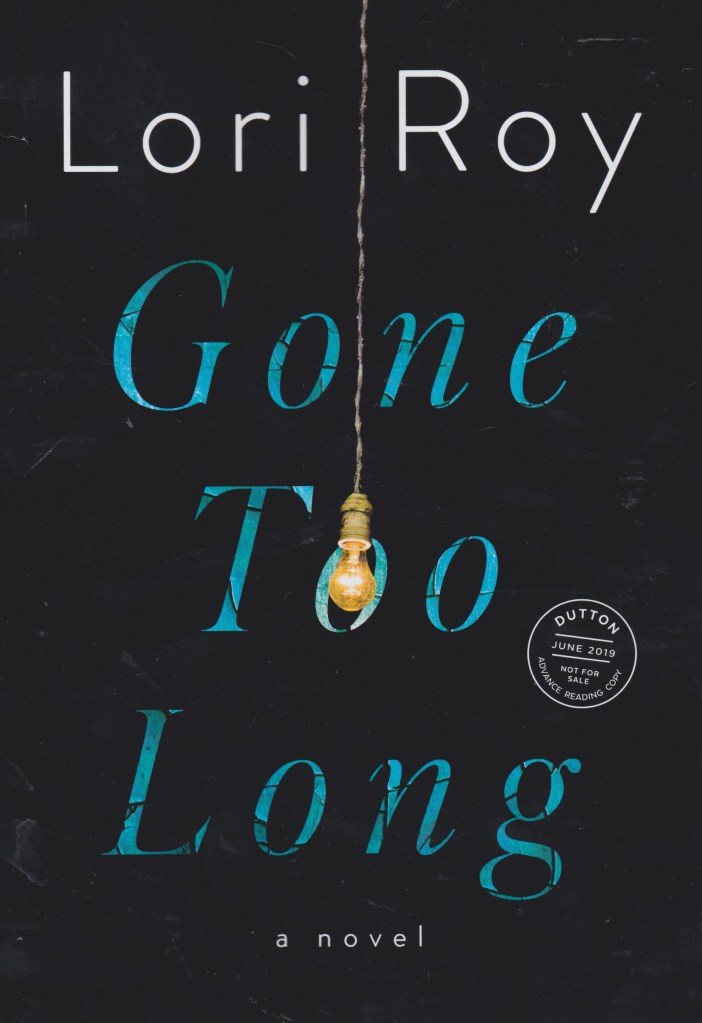
Lori Roy, on the other hand, decided to write a novel about it.

gone too long

The truck driving toward our house is black. Lots of cars drive past our house because there’s a good turnaround spot just down the road and the interstate is the other way. Most every car driving past wants to go the other way, and usually they’re in a hurry, but not this truck. It drives slow and it glitters when the sun hits it and the tailgate rattles like pennies in a mason jar. I hear it even though all the windows and doors are closed and locked, have to be. That’s the rule when Mama’s at work and I’m home alone.

The driver, he is a man. One of his arms hangs out the window, and something dangles from his hand. I don’t know what it is, but then he keeps slowing down, almost rolls to a stop, and as soon as he flings that something, I know. It has happened before. If Mama comes home and finds it, she’ll be angry and maybe even cancel her going-out plans for tonight. And if going-out plans are canceled, Julie Anna won’t come.

I wait until the truck rolls past before I slide off the sofa. Making sure no one will hear, I touch my feet down real soft, don’t jump like I sometimes do, and tiptoe to the front door. The lock is stiff and I have to use both hands to turn it. Mama’s big enough, it only takes her one hand to open the door, and someday, that’ll be me. The lock makes a loud click and I freeze. I tru to be quiet because I’m doing wrong and I know it. Someone is always watching, that’s what Mama likes to say, so I guess I’m sneaking so the someone, whoever that someone is, won’t see.

Lori Roy is one of our top crime writers publishing today–she has, over the course of four novels, won two Edgar Awards from the Mystery Writers of America and been nominated for a third. Gone Too Long is her fifth novel, and it, too, is an impressive achievement.

The book opens with the afore-mentioned first person characterization of a young girl named Beth, and the horrific thing that happens to her. She is kidnapped and held hostage in a basement somewhere, after witnessing the murder of her babysitter, Julie Anna. As if that isn’t horrific enough, we also know that it takes place seven years earlier, and that the action of the story is going to flash back and forth in time between the present and the recent past. The modern day character is a damaged young woman with red hair named Imogene, still recovering–through the use of alcohol and meaningless sexual experiences with men selected when she’s drunk–from the deaths of her husband and son in a car accident several years earlier.

Imogene just also happens to be the daughter of a recently deceased high-ranking member of the local chapter of the Ku Klux Klan. In the present day, her father has just been buried, and her mother has found a strange wire…and asks Imogene to follow where it leads from their house. She does, comes upon an older house on their property that has been abandoned for years, and finds, in a basement similar to the one where Beth was taken, a young boy who would be about the age her son would be had he not been killed. The discovery of this child–and the discovery that the new Klan leader’s son’s girlfriend has tried to sell two incredibly expensive watches–triggers a series of events and revelations that expose the ugliness of the Klan, the ugliness of human nature, and the ugliness of life in general when your family has been devoted to the Klan for generations.

Gone Too Long is a brilliant read, immense in its scope of human emotions and the nuances of how people can rationalize the irrational, and how that irrationality can lead to the self-justification  of doing the most horrible things to other human beings; yes I know it’s wrong but I didn’t have a choice.

This is an incredibly powerful novel, and I can’t recommend it highly enough. Alas, it won’t be available until its actual publication date on June 25th, but it can be pre-ordered, both on-line and from your local independent. Do so; pre-order it now so you can experience what is definitely going to be one of the top crime novels of 2019.

Stunning. Just stunning.

Cool Change

Saturday morning and I slept late, which felt positively marvelous. I feel rested and ready to kick some ass and take some names–at least for now, at any rate. Paul is going to be out of the house most of the day–appointments and going to the office–and therefore I have the Lost Apartment to myself for most of the day and no excuse not to get a lot of things done. I am still planning on walking over to the AT&T store to replace my phone–who knows how that is going to go?–but other than that, my day is pretty much set for cleaning, revising, and reading.

Last night, we started watching the new Netflix show The Umbrella Academy, based on the Dark Horse comic series–and while I didn’t madly love it, I am curious enough to continue watching. For one thing, it has both Ellen Page and Tom Hopper (who I’ve been crushing madly on since his days as Billy Bones on Black Sails), and it has an interesting premise. We will be continuing with it tonight, I think. I had just started reading Lori Roy’s Gone Too Long when Paul got home last night, and then was distracted by getting caught up on How to Get Away with Murder and then The Umbrella Academy.

And I’ve been dealing with yet another Apple upgrade issue that has fucked with my desktop, laptop, phone and iPad since last night. Now the cloud drive is missing from both my desktop and my laptop (I managed to resolve the handheld device issues last night) and so am trying to get that resolved this morning. Seriously, Apple–when you update/upgrade your systems, is it absolutely necessary to fuck up everything for your customers? 

Seriously, Apple. Do better.

So I am trying to resolve all this before scheduling a call from Apple Support…which I also don’t understand; you used to be able to do this in an on-line chat, but now of course they make you take a phone call. Why, precisely? And how able-ist is this? What about those of us who are hard of hearing, or those who are deaf? Seriously, fuck you in the ass without lubrication, Apple. HARD.

Thank you for allowing me to vent about these issues, Constant Reader. It’s helping me reduce the future body count.

This week I got a copy of Kyle Onstott’s bestselling Mandingo from the 1950’s. As Constant Reader is aware, I’ve been trying to diversify not only my fiction reading but to learn more about the horrible history of race in North America. Part of this has taking an amorphous shape in my head around a lengthy essay, tracing revisionism of slavery and the Old South and civil rights from such novels as The Clansman (which was filmed as Birth of a Nation) to Gone with the Wind to To Kill a Mockingbird and The Klansman, which I recently reread. As I was scrolling through Amazon Prime looking for something to watch the other night, I came across the late 1970’s film Mandingo, and remembered that it was also a novel. I bought a copy from eBay which arrived this week (I wasn’t able to get far in the movie because it was just incredibly bad; not even campy bad, like Showgirls, just bad.) The book arrived this week and….just looking at the note from the publisher in the beginning was horrifying. Yet Mandingo might just be the only novel about slavery and the Old South that actually tears the veneer of respectability and gentility away and exposes the true horror of what the “peculiar institution” was actually like. (Even John Jakes’ dreadful North and South series never delved deeply into the actual horrors; Colson Whitehead’s Underground Railroad was one of the first novels to truly explore this that I’ve read.) Barbara Hambly’s Benjamin January series, set in New Orleans before the Civil War, also does a terrific job of exploring how deeply entrenched and horrible racism/slavery were.

This essay I am thinking about would probably wind up, should I ever have the time to read the books and write it (it would, for example, require a reread of Gone with the Wind and it’s over eleven hundred pages, as well as some in depth reading of actual history) would probably be a part of Gay Porn Writer: The Fictions of My Life…which is a project I really do want to work on someday.  Mandingo takes on an aspect of slavery and the South that is rarely, if ever, touched on in fictions: the sexual abuse of the female slaves by their masters (come on, like it never happened. Really?) as well as the breeding of actual slaves for better, more valuable stock, as well as raising them for fighting–kind of a human version of cock-fighting or dog-fighting. Is it more likely that never happened, or that it did? Slavery, as Harriet Beecher Stowe repeatedly explained in Uncle Tom’s Cabin, debases both slave and master; are we really supposed to believe that slave-owners didn’t abuse their ‘property’?

Given how people of color–theoretically free and equal in the eyes of the law in the twenty-first century–are treated in the present day, I’m not buying the notion of the kind, gracious slave owner.

Take, for example, this passage from the Publisher’s Note to the movie tie-in paperback edition which I just received in the mail:

From today’s vantage point,, almost a hundred years after the cataclysm, the developing situation may be viewed objectively. Actually, the finger of blame should be pointed at no one geographical group of people. Although the factions that promoted the abolition of slavery were ethically in the right (emphasis: mine), Southern planters in general are shown to have been victims of circumstance rather than diabolical tyrants as they have sometimes been painted. (again, emphasis mine.)

Doesn’t get more apologetic than that, does it? Those poor planters. (massive eye roll)

And is it any wonder that we still have so many societal problems of racial injustice today?

And on that note, back to the spice mines.

Bfxx_LRCYAEPj_N

Pop Muzik

Friday, and a new month. Rabbit, rabbit, and all that, you know.

Or did I mess that up by typing something else first?

I’m so bad at these things.

Anyway, it is now February, and Carnival is just over the horizon. Parades literally start three weeks from today. #madness

I am taking vacation during most of the parade season; the new office is too far for me to walk to and from, so I decided to simply take vacation and actually enjoy parade season for a change. I should also be able to get a lot done during those days–kind of like a mini-staycation (although I loathe that not-a-word and can’t believe I still use it from time to time). I also can’t believe the first night of the parades is in three weeks. THREE WEEKS.

Of course, as Facebook seems to remind me on an almost daily basis, Carnival is late this year. Usually at this time parades are rolling and the city is full of tourists and I am exhausted from walking and working and going to parades. So, yes, Carnival is later this year than usual and yet somehow…it still snuck up on me? Go figure.

I finished reading The Klansman last night, but as I did some things occurred to me–namely, for a book about the Civil Rights struggle and racism in Alabama, there sure weren’t many characters that were people of color. Yes, a book about civil rights and racism placed the white people at the center of the story. Admittedly, the book wasn’t aimed at or written for people of color; the audience was white people…but I can’t see racist white people in the 1960’s reading the book and not being outraged by its “sympathetic” depictions of people of color. The book also sports the trope of the white savior–the “good white man” who stands up for the people of color and therefore becomes a target of the Klan.

There’s a really good essay–and one I might try to write–about the arc from The Clansman (the horribly offensive novel that Birth of a Nation was based on; it’s actually available for free from Google Books) to Gone with the Wind to The Klansman and how Southern people and authors rewrote history to not just romanticize and glorify the Southern Cause in the Civil War, but also the Ku Klux Klan; and how those narratives have changed perceptions not only of the war and racism, and the South itself. The Klansman is an attempt to reverse that trend, but to expose racism in the Jim Crow South not as something romantic and necessary, but as an evil on par with the original sin of slavery itself.

William Bradford Huie (who also wrote The Americanization of Emily, The Revolt of Mamie Stover, and The Execution of Private Slovik) deserves a lot of credit for writing this book, despite its flaws. He was born and raised in Alabama, and still lived there when he wrote and published this book–which couldn’t have earned him a lot of fans in the state. I’ve read any number of books by white people that have attempted to talk about the Civil Rights movement–and there are always these heroic white Southern people who stood up to the Klan and fought for the rights of people of color at great risk to themselves and to their families; as well as pushing the narrative that the real racists in the South were the working class and poor whites, while the middle and upper classes wrung their  hands with dismay but didn’t try to do anything. I think that narrative is false; white people aren’t the heroes of the Civil Rights movement by any means. And while class certainly played a huge part in Jim Crow and the codification of segregation and racism into law; I find it really hard to believe that more financially stable white Southern people weren’t racists. I first encountered the class discussion in David Halberstam’s The Fifties (which I do highly recommend); but while I do believe the class discussion has merit–and discussion of class/caste in America is way overdue–I don’t think it completely holds water, or holds up under close scrutiny.

Ironically, Jim Crow and codified racism is part of the reason the South lags so far behind the rest of the country economically.

We continue to ignore class in this country at our own peril, quite frankly.

I am going into the office early today to get my four hours out of the way, and then I am going to go run errands so hopefully I won’t have to leave the Lost Apartment this weekend. I hope to get all the cleaning and organizing done today, and then I am most likely going to either read Walter Mosley’s Devil in a Blue Dress or Caleb Roehrig’s White Rabbit, which I am picking up at the library today. I also am going to tackle some Stephen King short stories this weekend, rereading Skeleton Crew. I need to get back to work on both the Scotty book and the WIP this weekend; I also want to do some short story revisions so I can send some more stories out for submission. I also have some other projects in the beginning stages I’d like to organize and plan out.

And on that note, ’tis back to the spice mines. Have a terrific Friday, Constant Reader!

17523549_1306428822738512_2755094986544804343_n.jpg

Remember the Time

Friday morning! I get to go into work late because I am, as always, passing out condom packs tonight in the Quarter for Southern Decadence; when we finish, I am officially on vacation all I ever wanted until I return to the office on September 11 (gulp). Huzzah! Huzzah! Part of that time will be, of course, spent in St. Petersburg at Bouchercon. (huzzah! huzzah!) I am still trying to get my Bouchercon homework finished; I am nearly finished with James Ziskin’s delightful Cast the First Stone, and hopefully will be able to finish Thomas Pluck’s Bad Boy Boogie before our panel next Friday. (If I can’t, I really need to turn in my book nerd card.) I am also hoping to take Madeline Miller’s Circe with me on the trip to read.

I don’t want to give the impression that Cast the First Stone isn’t as good as it is by taking so long to read it; I’ve been in a late summer/dog days of August malaise that has had me having a lot of trouble getting anything done; the house is a mess (worse than usual) and I’ve gotten nowhere on the Scotty book and I’ve done very little writing of consequence at all this month. I’m trying very hard not to beat myself up over this; it is what it is, and it’s not a reflection on anything I do or my career. August, particularly late August, is always hideous when it comes to trying to get anything done; the heat and humidity this particular year has been particularly hideous, and it really sucks the life and energy right out of you. I am taking the manuscript for the Scotty with me to St. Pete; and I am hoping I’ll be able to carve out time to reread and make notes and so forth over the course of the weekend.

I’m also trying to figure out the rest of the story for “The Blues before Dawn.” I am also wondering whether or not this is more of a novel rather than a short story. I can’t make up my mind about my main character, or a time period to set the story in. I fucking hate when that happens. But it also means I need to think about the story some more, which is also not such a bad thing; as it’s a historical I’ll need to do some more research–I’ve been realizing lately how skimpy my knowledge of New Orleans and Louisiana history (with a few exceptions) actually is.

Another mental challenge for this is my decision, made over the course of the summer, to think about creating a new series. The Chanse series is pretty much over; after I decided to stop with Murder in the Arts District I wasn’t sure I was, in fact, finished with the character and series, but as more time passes the less I am interested in writing another novel about him. That might change, but I am now more convinced than ever that ending the series was the right thing to do. I have, however, written a Chanse short story and started another (I’ve still not finished “Once a Tiger”), and feel relatively certain Chanse will live on in short stories from time to time. The endless struggle and utter lack of motivation I have in finishing this Scotty book is also kind of a tell that maybe it’s time to wind this series down as well–a much harder decision, as I love Scotty much more than I ever cared about Chanse. But in the meantime, I’ve been thinking about writing yet another series. I had thought about spinning Jerry Channing, the writer, who first appeared in The Orion Mask and then again in Garden District Gothic his own series; as a true crime writer who often follows and writes about true crime for magazines, and is always looking for a subject for his next book, he seemed perfect as the center of another series. But the character’s back story was problematic, and I realized his background, in some ways, might be far too similar (and thus derivative) to Scotty’s. Then again, so what if Scotty and Jerry are both formerly personal trainers? if that and being gay is all they have in common…I do have an idea for a Jerry novel that might work; maybe I should write that and see if a series might work.

But “The Blues Before Dawn” also has grown in my mind as a possible start for a series, and maybe it should be a novel rather than a story (this, by the way, happens to me all the time). I think writing a historical crime series set in New Orleans might be an interesting idea; there are only two in existence that I am aware of–Barbara Hambly’s brilliant Benjamin January series (which is antebellum and opens with A Free Man of Color), and David Fulmer’s Valentin St. Cyr Storyville series, which opens with Chasing the Devil’s Tail. (Don’t @ me; I am sure there are others I can’t think of, even now I am thinking James Sallis’ Lew Griffin series, the first of which is called The Long-Legged Fly, is historical.) But the other day I came across an interesting article about Algernon Badger, who was chief of police in New Orleans from about 1870-1876, as well as Jean Baptiste Jourdain, who was the highest ranking mixed race police detective in 1870, and in charge of the Mollie Digby kidnapping investigation.  There is so much rich history in New Orleans that I don’t know, have barely scratched the surface of; one of the many reasons I roll my eyes when people refer to me as “a New Orleans expert.” The concept of a high ranking police detective after the Civil War and during Reconstruction in New Orleans fascinates me; and I kind of like the idea of writing about the Prohibition era here as well.

I think I need to have a long chat with my friend, historian Pat Brady.

I also got a rejection yesterday for a short story; and was enormously pleased that it didn’t spend me into the usual downward spiral of depression. Obviously, I am disappointed my story won’t be used, but it was just so lovely to actually get a notification that they aren’t using my story that it just rolled off my back. (It was also a lovely note, which included some thoughts on the story; ironically, what they thought would have made the story better was something that I had personally thought when reviewing and revising; but I didn’t trust my judgment and didn’t make those crucial changes. You’d think after all this time I would have learned to trust my judgment!)

And now, I am going to go curl up in my easy chair and try to finish James Ziskin’s delightful Cast the First Stone.

37974616_1901683620125872_4497797199568044032_n