I am off to Alabama later this morning. I have PT in a bit, some errands to run, and then home to get cleaned up and hit the road. Carol Goodman’s The Drowning Tree is cued up on Audible. It should be a nice day for a drive, but it’s going to be cold in Alabama. I’ve not taken a nice drive in almost four months, and it’s always good for firing up the creative synapses and loosening the bindings on my imagination. The worst part of the drive for me is always getting out of New Orleans through the East and I am not a fan of the twin spans to the north shore or getting through Slidell. But once you get on I-55 North, it becomes a very relaxing drive through rural Mississippi. Not much traffic other than around the bigger cities (Hattiesburg, Meridian, Laurel) and then you’re in Alabama. Alabama is also beautiful, and of course it always always always makes my mind wander back to my childhood and stories of the county, histories and legends and gossip and tall tales of a time so different it may as well be an another planet.
I submitted a story yesterday, which felt like progress back into my career again. I finished editing it last night and sent it off without a second thought, logged it into my spreadsheet (which didn’t include my last sale, so I included it as well) and started working on my swamp ghost story again. I made some necessary changes (correcting the wrong geography by using a map) and moved on a bit. I am very pleased with the story, but it’s already very very long so there will be some necessary cuts and revisions in future drafts–but again, it felt good to be writing fiction again. I’ve also been getting things written in my journal–lists of things to get for the apartment as well as what stories to write and submit where; what books I want to work and finish this year and when I’m going to write them. It feels good, frankly, to be creative again.
Paul didn’t make it home last night before I went to bed, which was a pity, but I’ll see him before I leave today; he should be up by then I would hope.
I did watch this week’s episode of Feud last night. The performances are amazing, the show’s production values (particularly in set and costume design), but it’s also not a lot of fun to watch someone on a downward self-destructive trajectory, either, particularly when they’re as talented as Capote was. That seemed to be a lot more common place with writers back in the day–they all seemed to have substance abuse problems, but I suppose if you had to type everything…it would eventually drive you to drink.
I also slept really well last night, too. Sparky woke me up by clobbering me in the face this morning, claws out, so I now have a scratch on my nose and another on my cheek. Perfect timing, right? Heavy heaving sigh. I also have some scratches on my shoulders and chest, from him riding on my shoulders. We really do need to learn how to trim his nails. I also caught him last night trying to get on top of the refrigerator again. He really is a mischievous child. Sigh.
And on that note, I am heading into the spice mines. I have to leave for PT in a moment, and I need to start getting everything together for the trip. Have a lovely Friday, Constant Reader, and bear with me–I may not be back until Monday.
Let me tell you about the very rich. They are different from you and me.
So F. Scott Fitzgerald wrote in his short story “The Rich Boys,” and he was, of course, very right in that observation, and that hasn’t changed in the hundred years since he typed the sentence.
It’s been very clear, since I started watching Capote v. the Swans, that my ignoring aspects of Truman Capote’s personal life because of my own internal distaste to his effeminacy (due to both internalized homophobia and self-loathing) was probably a mistake, and what I really needed to do was take a long hard look at myself as well as examine his life in more detail–I will read the Gerald Clarke biography at some point over the summer–and as such, while I was slightly aware of what happened between him and his swans, I didn’t know of the Ann Woodward involvement. When I bought the below book, I actually thought it was fiction, not true crime. Once I started watching the show, I decided to find the book and read it.
And I enjoyed it.
If Ann Woodward had resolved to live a quiet life in Europe, where she could mourn her late husband, Billy Woodward, far from the madding crowd of the American press, the town of Saint Moritz, high in the Swiss Alps, was certainly an unusual place to retreat to. Renowned for its winter sports, popular as a spa hamlet, and exclusive as a community where entertainers, celebrities, and assorted socialites gathered, Saint Moritzwas a lesser European sun around which various society moons revolved. While summer tourism was popular, it was in winter that this small city shined. Luminaries descended in head-to-toe furs inthe daytime and flashy jewels at night, their diamonds and bangles competing with the glittering snow. In the fall of 1956, Ann Woodward was once again the center of attention as she sat down for dinner at one of Europe’s most elite restaurants.
Back in the United States, those familiar with Ann Woodward–and lately there were few who had not heard of her, whether over lunch at the Colony on New York’s Upper East Side, or on the front pages of tabloids–believed that she had been banished to Europe by her formidable mother-in-law, Elsie Woodward, and was now likely leading a lonely life, without family or friends, much less a lover, with plenty of time to reflect on the transgressions that had forced her into exile.
But as Truman Capote watched her from a table across the restaurant, he saw that she was not the solitary widow they expected. Capote was not only surprised to see her in this particular location, but astonished to see her in the company of a man, which was cause for raised eyebrows, considering she had entered her widowhood by her own hand not so very long ago. But Ann Woodward did not seem rattled by the patrons staring with obvious disdain as she exchanged languid looks with her companion.
(The man with her was none other than Claus von Bülow, who would have his own notoriety splashed across newspaper headlines for decades, and about whose alleged attempts to murder his wealthy heiress wife, was the basis for the film Reversal of Fortune.)
I knew about the Woodward case before, but as I have mentioned numerous times, I didn’t know about Truman Capote’s role in her life and eventual suicide. I remember when Dominick Dunne published his first novel, The Two Mrs. Grenvilles, which was a huge bestseller and was made into a television film with Ann-Margret and Claudette Colbert. It was mentioned that the book was based on a real case, which I assumed was the murder of Zack Smith Reynolds, and the suspicion that his actress/wife Libby Holman might have done it and the tobacco rich Reynolds family covered it all up. (This was the basis for the Robert Wilder novel Written on the Wind, which was filmed–and altered–with Rock Hudson, Lauren Bacall, Robert Stack and Oscar-winner Dorothy Malone.) A few years later I heard about the Woodward case, and realized that it was the basis for Dunne’s book (all of his novels were based on actual murders; Dunne himself kind of took Capote’s métier after Capote’s death, writing about gossip and murder in the world of the rich and powerful; I could do another entry on Dunne’s work, and probably will. I downloaded the ebook of The Two Mrs. Grenvilles, as well as anthologies collecting his true crime reporting for Vanity Fair.) but still had no idea of the connection between Capote and Woodward.
I greatly enjoyed Montillo’s book. She covers the story of the Woodwards, and then moves onto the feud between Capote and Woodward; opening the book with the confrontation that made Capote viciously turn on her and nickname her “Mrs. Bang Bang,” and always talking about how she got away with murder. It’s well written and moves fast; it’s a marvelous and very quick read. If you’re interested in either true crime, Mrs. Woodward, or Capote, I do recommend it. I enjoyed it very much, and Montillo is kind to both of her main characters.
(While in one of the many Capote wormholes I’ve gone down, I’ve started getting an inkling of why Capote turned on his wealthy swans, writing about them so cruelly and viciously in that short story but the time is not right for this discussion–but I totally understand why he did, in terms of this explanation; whether it was true or not remains to be seen.)
Friday morning after Muses, and I am a little tired–physically. Mentally I am alert as ever and feel great, but I am not used to standing on the sidewalk for so long anymore. Chaos last night was my first parade (the floats were hilariously inappropriate; all I will say is the theme of the parade was “balls” and leave it at that), and we came home to rest before Muses arrived. We didn’t stay out for long, I was tired and sleepy and it got here around ten; we lasted out there for about an hour before I started flagging and came back inside. However, I realized I should have gone to parades to warm up for this weekend; I forgot that it takes a parade day to warm you up and get you in the proper spirit; I should be good to go tonight if my PT this morning isn’t too vicious.
And yes, we got a really cool shoe.
I had a good day at work yesterday, got a lot of things done and caught up and feel confident not being in the office again until Ash Wednesday will not be disastrous for me or put me really behind on things. I came home early (it took me an hour), and I came inside and watched this week’s episode of Capote v. the Swans, which was done in documentary style, which was an interesting take. I’m not quite as obsessed as I was about Capote when I first started watching, but I do want to read the Gerald Clarke bio of him, and maybe even George Plimpton’s Capote. It’s taken me awhile to get interested in Capote, and while I wouldn’t say it’s an obsession anymore, I am still very much interested in this incredibly famous openly gay man in the middle of the twentieth century. I have added Deliberate Cruelty, a true crime narrative about Ann Woodward’s feud with him by Roseanne Mantillo, to the books I am reading and I finished it last night.
And yes, I am beginning to understand precisely why he wrote “La Côte Basque 1965” and why he published it, but more on that when the show is finished and I give it, and Capote, an entry of their own.
As for me and the weekend, I have taken Monday off and so I am hoping that I’ll be able to get some reading and writing done today, Sunday and Monday (I will always take Saturday off from everything to go to Iris). I want to finish editing this one short story and finish writing another, and perhaps get them submitted somewhere. I have laundry going already and a dishwasher to unload and reload. I have PT this morning, a prescription and the mail to pick up, and then the car won’t move again until Monday at the earliest, as I will need to probably make a grocery run. I also should be able to finish reading Deliberate Cruelty so I can focus on Lina Chern’s Playing the Fool, which I am greatly enjoying. I also have some blistering blog entries to write, so this weekend should be fun on that score.
And hopefully I’ll be able to get this place ship-shape and get myself caught up on everything that needs catching up on.
And on that note, I am heading into the spice mines. Have yourself a lovely Friday, Constant Reader, and I may be back later.
Americans have always been fascinated by rich people.
We all want to be rich, after all; as someone once said, “The United States is a nation of temporarily distressed millionaires.” So, in lieu of actually being rich, we obsess about them. The rich used to be celebrities for no other reason than being rich. It’s always been interesting to me that in our so-called “classless” society (which was part of the point; no class privilege, everyone is the same in the eyes of the law) we obsess about the rich, we want to know everything about them, and we lap up gossip about them like a kitten with a bowl of cream. I am constantly amazed whenever I watch something or read something set in Great Britain, because that whole “royalty and nobility” thing is just so stupid and ludicrous (and indefensible) on its face that I don’t understand why Americans get so into it; the fascination with the not-very-interesting House of Windsor, for one. We fought not just one but two wars to rid ourselves of royalty and nobility…yet we can’t get enough of the British royals, or the so-called American aristocracy. (Generic we there, I could give a rat’s ass about the horse-faced inbred Windsors and their insane wealth, quite frankly.)
I wanted to be rich when I was a kid; I spent a lot of time in my youth fantasizing about being rich and famous and escaping my humdrum, everyday existence and becoming a celebrity of sorts with no idea of how to do so. I was intrigued by the rich and celebrities; I used to read People and Us regularly, always looked at the headlines on the tabloids at the grocery store, and used to always prefer watching movies and television programs about the rich. (Dynasty, anyone?) I loved trashy novels about obscenely wealthy (and inevitably perverted) society types and celebrities–Valley of the Dolls has always been a favorite of mine, along with all the others from that time period–Judith Krantz, Harold Robbins, Jackie Collins, Sidney Sheldon and all the knock-offs. I was a strange child, with all kinds of things going on in my head and so many voices talking to me and my attention definitely had an extraordinary deficit; I always referred to it as the “buzzing.” The only time I could ever truly focus my brain was either reading a book or watching something on television–and even as a child, I often read while I was watching television. (Which is why I read so much, even though that buzzing isn’t there anymore and hasn’t been for decades.)
As I get older and start revisiting my past (its traumas along with its joys) I begin to remember things, little clues and observations that stuck in my head as a lesson and remained there long after the actual inciting incident was long forgotten. I’ve always had a mild loathing for Truman Capote, for example, which really needs to be unpacked. Capote was everywhere when I was a child; there was endless talk shows littering the television schedules those days–Dick Cavett, Merv Griffin, Mike Douglas, John Davidson, and on and on and on–and Capote was always a popular guest on these shows. I wasn’t really sure what he did or who he was, but he was someone famous and he was on television a lot. I saw him in the atrocious film Murder by Death, and I know I knew/had heard that he was a homosexual, a gay; and I also knew I was a gay. It terrified me that I was destined to end up as another Capote–affected high-pitched speech and mannerisms, foppish clothing that just screamed gay at anyone looking; Capote made no bones about who or what he was and refused to hide anything…yet he gained a kind of celebrity and fame and success in that incredibly homophobic time period, and no one had a problem with putting him front and center on television during the day time.
But this isn’t about my own self-loathing as evidenced by my decades of feeling repulsed by Truman Capote; that I will save for when I finish watching Capote v. the Swans.
“Carissimo!” she cried. “You’re just what I’m looking for. A lunch date. The duchess stood me up.”
“Black or white?” I said.
“White,” she said, reversing my direction on the sidewalk.
White is Wallis Windsor, whereas the Black Duchess is what her friends called Perla Apfeldorf, the Brazilian wife of a notoriously racist South African diamond industrialist. As for the lady who knew the distinction, she was indeed a lady–Lady Ina Coolbirth, an American married to a British chemicals tycoon and a lot of woman in every way. Tall, taller than most men, Ina was a big breezy peppy broad, born and raised on a ranch in Montana.
“This is the second time she’s canceled,” Ina Coolbirth continued. “She says she has hives. Or the duke has hives. One or the other.Anyway, I’ve still got a table at Côte Basque. So, shall we? Because I do so need someone to talk to, really. And, thank God, Jonesy, it can be you.”
I do want to be clear that once I started reading Capote, he quickly became a writer whom I admired very much; I don’t think I’ve ever read anything he’s written that didn’t take my breath away with its style and sentence construction and poetry. He truly was a master stylist, and perhaps with a greater output he might have become one of the established masters of American literature, required reading for aspiring writers and students of American literature. In Cold Blood is a masterpiece I go back to again and again; I prefer his novella Breakfast at Tiffany’s to the film without question; and I was blown away by his debut novel, Other Voices Other Rooms, which was one of those books that made me think my childhood, and my being from Alabama, might be worth mining for my work.
I read “La Côte Basque 1965” years ago, and didn’t really remember it very much other than remembering I didn’t care for it very much. I was aware of the scandal that followed its publication and that all of Capote’s carefully cultivated rich society women friends felt betrayed by it and turned on him, which sent him into a decline from which he never recovered, before dying himself. I’ve always seen Capote as an example of wasted talents. Anyway, I read the story but not being familiar with his social set, I didn’t recognize any of the people gossiped about in the story or who the woman he was lunching with represented (Slim Keith, for the record), and so it kind of bored me; it was a short story about someone having lunch and gossiping about people the reader had no way of knowing who they were or anything about. I assumed this was because the story was an excerpt from the novel, and the novel itself would establish who all these women were and their relationships with each other. But I did know it was all thinly veiled gossip about his friends, and they never forgave him for it. (I also didn’t recognize “Ann Hopkins” in the story as Ann Woodward; I hadn’t known until the television series that he was involved in her story. I primarily knew about her from reading The Two Mrs. Grenvilles and articles in Vanity Fair, and I actually thought, when reading that book, that it was based on the Reynolds tobacco heir murder that Robert Wilder based his book Written on the Wind on; it wasn’t until later that I learned about the Woodward incident) so I thought, well, it was an entertaining if confusing read.
It was kind of like listening to two strangers talk in a Starbucks and gossip about people you don’t know; entertaining but nothing serious, not really a story of any kind, and I didn’t at the time see how it would all fit into a novel as a chapter in the first place. What purpose to the overall story did this nasty gossip play? Why was it necessary for Ina to share these stories at this particular lunch (and don’t get me started on White Duchess and Black Duchess)? Were these people she was talking about important to the book as a whole? It was hard for me to tell, and I put it away, thinking at the time probably a good thing he never finished the book.
Watching the show about fallout from the story’s publication, I decided to read the story again.
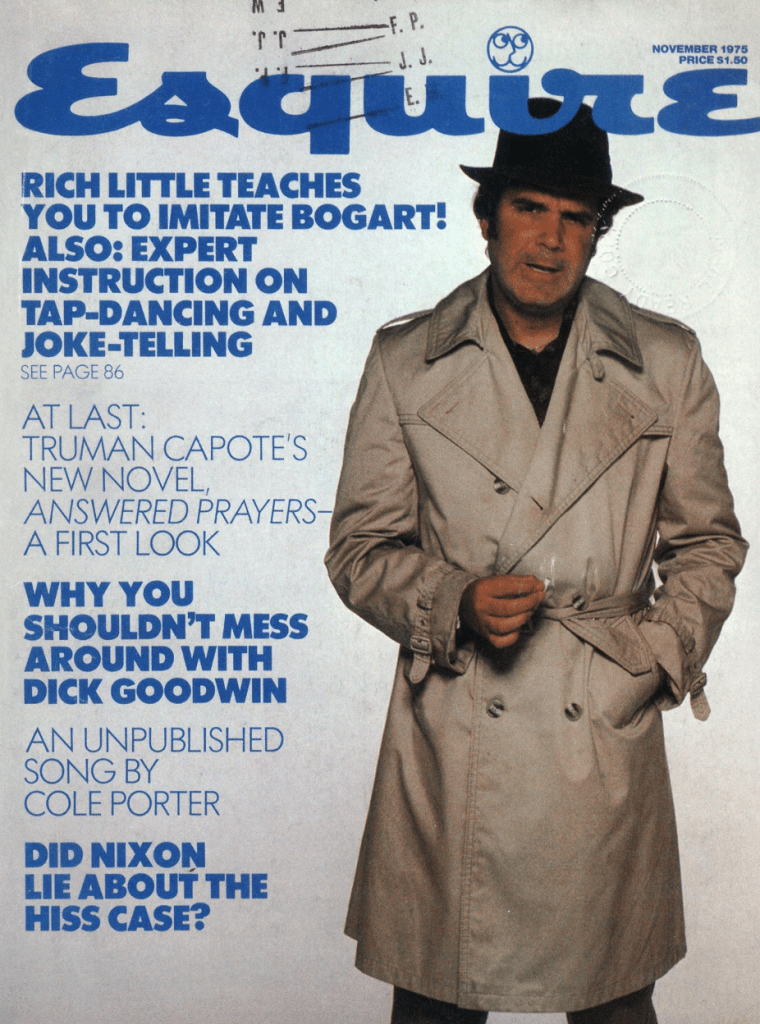
And I still question why Esquire chose to publish it, as well as why Capote thought this chapter was the one to send them. Capote was a genius, of course, and after In Cold Blood was one of the biggest names in American literature (he truly invented the true crime genre); of course they are going to publish whatever he sent them, no matter how bad it was. It wasn’t promoted as a story, after all, it was a novel excerpt.
What I’ve not been able to figure out from any of this is why he thought he could publish this without any fallout from his “swans.” I guess it went to the grave with Capote, who clearly didn’t–and I don’t think ever did–understand why they were so upset with him, which just astonishes me. (Someone once thought I based a character on her–I didn’t–and was very angry with me. I didn’t care, because I neither cared about the person nor her concerns, but I know how careful you have to be as a writer with these sorts of things.)
I wish I could say I liked it better on the reread. I did not. It’s still the same mess it was when I originally read over twenty years ago. It’s just a rich woman being bitchy to her gay friend she feels free to be bitchy about her friends with, and when you have no context (even knowing this time who the actual people were, and yes, he barely disguised them) about the women being discussed or anything about them…it’s just boring, gossip about people you don’t know and you don’t know enough to care about, so it’s just a bitchy little boring lunch. I don’t know what could come before that or after, as an author myself; had I been the fiction editor at Esquire I would have been pissed that was what he sent in, and I would have definitely taken a red pencil to it before I would have published it–and Esquire? Why did Esquire, a men’s lifestyle magazine, publish this when the right place would have been Vogue or Vanity Fair or even The New Yorker. None of it made sense then, none of it makes sense to me now; and if this is the best example we have of Answered Prayers, maybe it’s not such a bad thing that the manuscript–if it ever existed–disappeared.
Sorry, Truman, you were a great writer but this one was a swing-and-a-miss.
Sunday morning in the Lost Apartment and the sun is shining. It actually looks like a stunningly gorgeous day out there for parades, and of course King Arthur, the last of the day, is one of my favorites (a lot of gays ride in King Arthur). Yesterday was a slow day. I woke up after sleeping for ten hours feeling a little inside out, and the weather wasn’t a help. It rained off and on all day; the parades were all moved up because of the threat of weather (which was accurate; we had a flash flooding thunderstorm later on in the day), and since I was so tired and wrung out, I didn’t feel like attending any of them. I’ll probably go out for King Arthur, maybe for some of the earlier ones, and we’ll see how it goes.
As I said, I was extremely tired all day yesterday and decided to let my body and brain rest for most of it. I did do the dishes and I did get some things done early on, but I soon repaired to my easy chair, where I spent the rest of the afternoon reading–more on that later–but one of the things I wanted to reread was “La Cote Basque” by Truman Capote. I knew it was the story that turned his “swans” against him; I read it many years ago when I went through a Capote phase, when I was able to get past my distaste1 for him personally to start reading his work–which I quickly became a fan of; I love his writing, especially In Cold Blood, and I’ve always preferred the novella Breakfast at Tiffany’s to the film. I always thought he wasted his incredible talents, like so many did, and I am starting to appreciate him more as a person than I ever did before2 and now am curious about reading biographies of him. I never watched any of the films made about him, but now…now I am thinking I should watch them. Capote, Tennessee Williams, and Gore Vidal all knew each other and were contemporaries; openly gay men who didn’t give a fuck about morés and ignored the rule of “don’t ask don’t tell” that pretty much was the only way gay men or other queers could really survive the reality of the deeply homophobic world they existed in. I cannot imagine, but that was also the reality of the world I was also born into, creating internal conflicts that I am still trying to unravel to this day–like why I held Capote in so much distaste, which was really internalized homophobia, which I’ve been confronting since I first watched Capote v. The Swans, and trying to process my way through it.3
Ironically, I wound up rewatching those first two episodes again, because Paul wanted to watch–he also feels the same as me about Capote, which is partly why we never saw any of the earlier films about him–and it’s well done enough for me to easily sit through it again, and it surprised me because I never became bored, even though I’d already seen those episodes. We watched two more episodes of Lupin yesterday, despite my falling asleep during the second, after which we retired to bed.
And here I am this morning, feeling rested and not at all as tired and drug out as I was yesterday, which is a very good thing. I don’t know how much of anything I am going to get done today–I do know I want to spend some time reading and editing, if not writing–and of course there’s always picking up to do around here, and maybe I could vacuum.
I also spent some time yesterday finishing reading the novelization of one of my favorite movies of all time, The Last of Sheila, which I really enjoyed almost as much as I did the film,4 which will be covered in its own entry. I’ve been entranced by this film since I first saw it as a child one Sunday after church, and it still holds up; I’ve never once rewatched, knowing the surprise ending, and been bored or not entertained. (It’s also weird because there are scenes in Capote v the Swans showing Capote shooting Murder by Death, which was one of my earliest memories of seeing Capote, written by Neil Simon, one of the most popular playwrights of the middle part of the century that no one talks about anymore either but he was everywhere back then; I doubt Murder by Death holds up–and I didn’t really like it that much when I saw it in the theater back then, either.)
I’m also thinking it might be fun to revisit In Cold Blood and some other Capote works while I watch the show. I’ve always liked his short stories and his writing style…
And on that note I am heading into the spice mines. Have a lovely King Arthur Sunday, everyone, and I’ll catch you maybe later.
Definitely will be more on this later, probably once I’ve finished watching. Capote v. the Swans.↩︎
Friday morning and a work-at-home day; after I get home from a doctor visit and PT, and a brief grocery run to pick up the things I forgot last night on the way home. I didn’t make a list, of course, so once I got home I remembered the things I forgot to get, and remembered still more this morning, sigh.) Parades actually start tonight, with Druids, Cleopatra, and Alla, I think; I’d have to check to be sure. You’d think after all these years I’d have the parade schedule memorized, but no, I don’t. It’s supposed to rain all weekend and it looks rather gray out there in the morning light, but the sun isn’t all the way up yet either and it might turn out to be one of those gorgeous winter days with blue sky and sunshine and warmth.
I was correct about being tired when I got home from work last night, and so didn’t get a lot done other than hanging out and bonding with Sparky. I watched this week’s Real Housewives of Beverly Hills, which was a nice, no-stupid-arguments episode, and then decided to watch Capote v. the Swans because I was bored, and tired, and wasn’t sure that Paul would want to watch it anyway–and even if he did, he’ll never get home in time to watch much of it before the festivals anyway. I had seen some people hating it, the reviews are mixed, but I actually enjoyed watching. The acting is terrific, and like most Ryan Murphy shows it’s beautifully styled and constructed. The clothes and sets are impeccable. Naomi Watts is amazing, and Tom Hollander is pretty good as Capote. I have some of my own personal issues about Capote I clearly need to work through–it’s a long story and probably should be the center of its own entry, and probably will be once the show finishes its run and I review/blog about it. I had wanted to read more last night, and maybe do some chores, but once I went to the chair that was it for the night. I didn’t think I was that tired, but clearly I was. I even fell asleep in my chair and was snoozing away quite happily when Paul came home and woke me up.
I did sleep really well last night, too.
I’m not sure what this weekend holds for me other than being trapped here in the neighborhood during the parades. I want to get that story finished and I need to get the place straightened up/put back in order, not to mention all the chores I always end up having to do over the course of the weekend. There’s a load of clothes drying right now and I need to empty and reload the dishwasher so it can run while I am out of the house for the morning. I do have work-at-home duties to get done today as well. Tomorrow morning I am not getting up to an alarm–which is always lovely–and hopefully it will be a lovely, relaxing weekend of parades and beads and throws and watching stuff while writing and reading a lot.
I feel pretty good this morning too, which is also kind of nice. I feel rested, and since i am not rushing to get things done before heading into the office I canI’ve dy. PT is probably going to be quite rough, honestly; I’ve advanced more rapidly than anyone expected, so it gets a lot harder every time as the therapist tries to break me, LOL. I also need to make a list of things I need to buy for the house–a rolling cart for office supplies, some air filters for the HVAC system, a taller ladder, and so on–that I always forget about and I really do need to get more focused. None of the stuff can be delivered during the parade season, of course–or the windows for delivery are so narrow they can be easily missed–but the new microwave is delightful, and so are the new knives I bought. (I can’t believe how sharp they are!) There’s definitely something to be said for buying new things to replace old things you’ve had forever. I also want to get blinds for my windows so I don’t have to be blinded and so damned hot all summer in here when I am working, either.
And on that note, I am going to head into the spice mines and get this day rolling. The chores and work won’t do themselves, after all, and I do need to get ready for this morning’s round of appointments and so forth. Have a lovely Friday and I may be back later; if not I’ll report back tomorrow morning after the first night of parades.




 Queer and Loathing in America