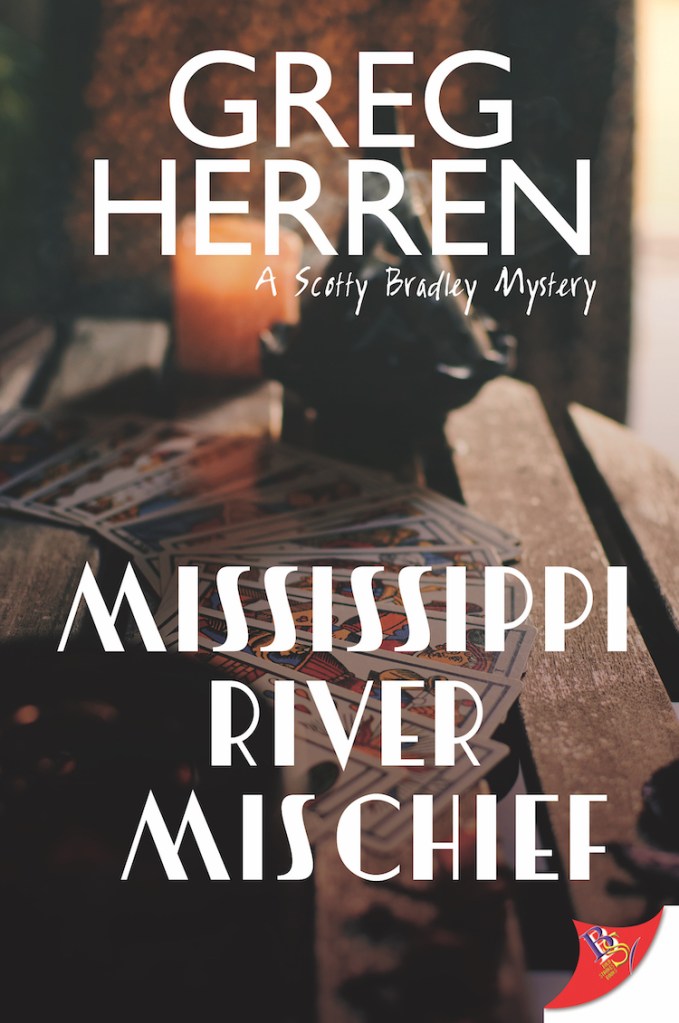
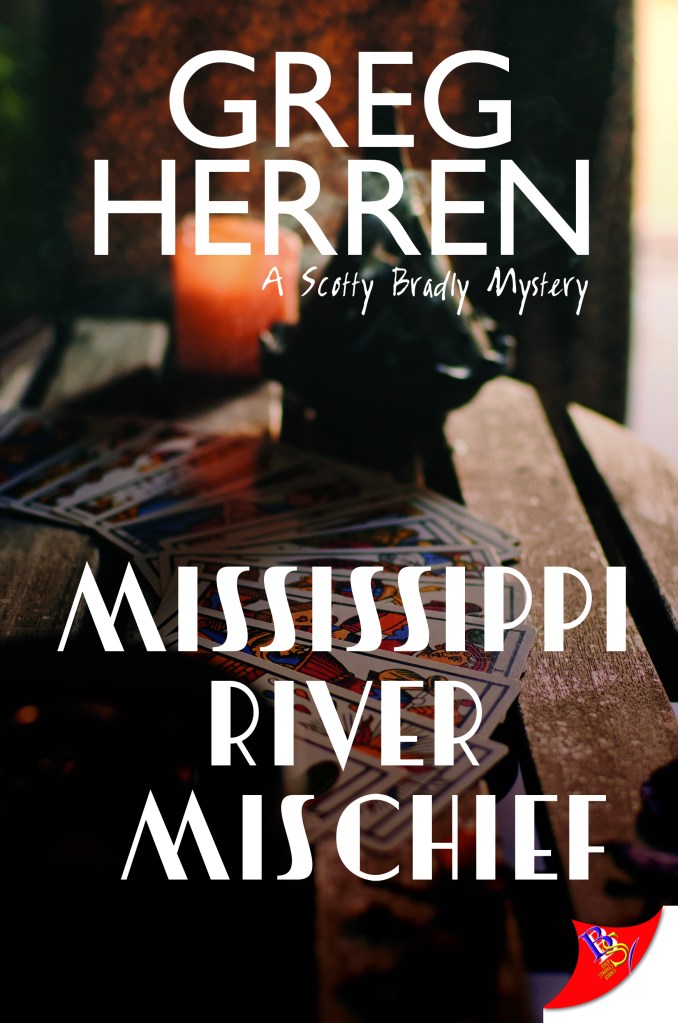
As if you weren’t sick of my self-promotion already, now I get to start promoting Mississippi River Mischief!
It’s hard to believe that this is Scotty’s ninth adventure. Not bad for someone who was just supposed to be a one-off, a stand-alone comic madcap adventure that took place during Southern Decadence. The idea for it came to me at Southern Decadence in 1999; on Saturday afternoon I somehow managed to get a prime spot on the balcony at the Parade to watch the massive crowd of sweating shirtless men partying down below at the intersection of Bourbon and St. Ann. I noticed a really hot guy wearing sweats and carrying a gym bag fighting his way through the crowd to get to the Pub downstairs, and I recognized him as one of the dancers for the weekend. In that instant, I had a mental flash of a dancer being chased through a crowd of shirtless sweating men at the corner by bad guys with guns and the dancer only wearing a lime-green thong. I held that idea in my head, and sometime later that weekend Paul said to me, “you know, you should write a book set during Decadence,” and I grinned and replied, “I already have the idea.” I had started writing a short story called “Bourbon Street Blues” a year or so before this; but realized that would make a better title for the stripper crime caper during Southern Decadence, so I made a folder for it and kept it in my files and in the back of my mind. Several years later, when talking with an editor about something else when I worked at Lambda Book Report, I asked if that might be something he’d be interested in. He said send him a proposal, which I did–having no clue what I was doing–and they offered me a two book deal, turning my stand-alone into a series. Having no idea how to write the second book in such a series, the money was too good for me to say no or to quibble, figuring I’ll figure it out when I need to–which is really the motto of my career.
The Scotty series has always had a bit of a “pantser” feel to it for me because I’ve always pantsed it. I knew that the first adventure–Bourbon Street Blues–was going to be that Southern Decadence story, and I also knew I was going to fictionalize a governor race, basing it on a senate race that occurred when we first moved here and we couldn’t believe that one of the candidates was actually a serious candidate (sadly, he was just a harbinger of what was to come in Louisiana; now he’d seem like one of the fucking sane ones), and I kind of borrowed, a bit unconsciously, from the Stephen King character of Greg Stillson from The Dead Zone. Bourbon Street Blues was a prescient novel in so many ways–and I had no idea of that at the time, seriously. There’s a scene where the Goddess shows Scotty the potential flooding of New Orleans after a levee failure (in the book it was deliberate though) and of course I predicted the Right’s move into full-bore hardcore neo-Nazism as well in that book…never dreaming it would become a reality.
Scotty has always been a fly-by-the-seat-of-my-pants series; I’ve never really outlined or planned the books or the series in any way, other than an amorphous idea that the love triangle situation I created in the first book would take three books to resolve. During the course of the third book I realized I needed at least one more book to resolve that story, and so it went from stand-alone to trilogy to quartet…and then Katrina happened. Katrina created an unplanned gap in the series, and I never really knew how to do Katrina from a Scotty perspective. It struck me that they wouldn’t have evacuated, but Scotty wouldn’t have ridden the storm out in his apartment, nor would his parents have done so at their place; they would have all gone to the Garden District where Papa and Maman Diderot have a generator. I just didn’t see how I could write a funny Scotty book about the levee failure and the city’s destruction. Also, we learned something about Scotty in the second book (Jackson Square Jazz) that I meant to deal with in the fourth book. By the time I was ready and able and willing to write that fourth book in the series…well, I forgot that I’d planned on dealing with that issue from Scotty’s past in it, and never did ever circle back around to that resolution of something from his youth.
I did remember when I decided to write Mississippi River Mischief, though. I kind of wrote myself into a corner with Royal Street Reveillon, in which something happened in Scotty’s personal life that was tied into the case, but I couldn’t write another book and pretend that never happened, even though it would be hard to deal with in the text of the book and story. But then, as I was trying to work it out in my head, I realized now you can circle around back to that issue from Scotty’s teen years because this is the right place and time for him to be reminded of it because of what happened to Taylor.
And you know what? I think it made for a better story now than it would have almost fourteen years ago.
Scotty has grown a lot over the twenty or so years (!!!) I’ve been writing him, but who he is at his core has never changed. Scotty is a good person, with a genuine sense of kindness, and is pretty level-headed and never really lets things get to him the way I let things get to me–and God knows, he’s dealt with a lot more shit than I have in life. I like his sense of humor, I like his spirituality, and I like his untrained, he-doesn’t-know-how-it-works psychic abilities, and of course, I love his family. His parents are amazing, his older brother and sister are also pretty cool characters, and of course Frank and Colin are also fun to write. I also never knew how subversive I was being by creating a throuple long before anyone ever talked about these kinds of relationships within the queer community–and it’s lasted all these years. There have been ups and downs, of course, but they always wind up coming back together again no matter what happens–and a lot has happened. Both Scotty and Frank have been shot a few times, not to mention all those car accidents–and he’s also helped cover up a crime (no spoilers here, no worries!).
(NOTE: I started writing this post back in January, after I’d returned to New Orleans from my last Mystery Writers of America board meeting–this is to give context to the opening paragraph– as you are no doubt well aware, Constant Reader, that I’ve not been back to New York since January; so this is that same trip where this happened and I started thinking about these things, which have never been far out of the forefront of my mind since then.)
While I was in New York recently, walking around to and fro, here and there, hither and yon, I was always checking my phone (and yes, I hate that I’ve become one of those people) and then shoving it back into my pants pocket without putting it to sleep first or closing the app that was open. As I walked around, of course this led to my phone doing all kinds of weird things –closing an app and opening another, etc.; but at least there were no butt dials, right? At one point, when I pulled out my phone as I took a seat on the subway, somehow what was open on the screen was a google search for my book A Streetcar Named Murder–and when I went to close that screen I touched one of the images by mistake, which took me to the Goodreads page for the book. Bear in mind, I never look at Goodreads for any of my books, let alone Amazon–the temptations to start reading the bad reviews is too great, and while I can usually laugh them off, occasionally–and it depends entirely on my mood, of course–one will get under my skin and it will annoy me, and that’s not good for anyone.
This particular day on the subway the Goodreads page opened to the bad reviews first–its average is four stars, which I will always take because I am not Lauren Hough–and the very first one made me laugh out loud on the subway. Paraphrased, it was basically someone taking umbrage at “someone who doesn’t live here or know the first thing about New Orleans” writing a book about New Orleans. The reason they had come to this conclusion was because Valerie referred to Mardi Gras as “Fat Tuesday”, and according to this one-star reviewer, no one from New Orleans would ever say Fat Tuesday instead of Mardi Gras.
Well, I’ve lived here for twenty-seven years and I have heard any number of locals say Fat Tuesday rather than Mardi Gras, and so of course I had to click on the reviewer’s profile…and grinned to myself when I saw that they actually live in Metairie, not New Orleans…which to locals is a bigger crime than getting something wrong about New Orleans: claiming to be from New Orleans when you actually live in Metairie. (the rejoinder is usually along the lines of “bitch, you live in Metairie.”)
It was also kind of fun to be accused of inauthenticity when it comes to writing about New Orleans, because I personally have never claimed to be an expert on anything New Orleans (others have said that about me, and I always am very quick to reply not even close); the more I learn about the city the more I realize how little I actually know about the city. There’s an extremely rich (and often incredibly dark) history here; it’s hard for me to wrap my mind around the fact that the New Basin canal was there as long as it was, or that there were several train stations around the French Quarter (including one that essentially was in Storyville–rather convenient for the whores and pimps, right?), or that where UNO is now used to be the lake shore resort of Milneburg, or that the only way across the river or the lake was by ferry until Huey Long built a bridge at the Rigolets (the narrow inlet between lakes Pontchartrain and Borgne).
I was on a panel once at the Tennessee Williams Festival with Bill Loefhelm (if you’re not reading Bill’s books, shame on you and correct that immediately) and the question of New Orleans authenticity came up, and Bill’s response (paraphrasing) was that New Orleanians have a tendency to play a game called “NOLier than Thou,” in which they try to one-up each other to see who the true New Orleanian actually is–which is, of course, gatekeeping. (And yes, I immediately turned to him and said, “I like that and am going to steal it” SO CONSIDER IT STOLEN.)
It does bother me somewhat when I read books set in New Orleans written by people who have never lived here; you can tell, but I also get over it pretty quickly; who is to say who can and can’t write about a place? There’s a significant difference between visiting and living here, which I realized almost immediately after we moved here, and that also becomes very apparent in fiction. I had started writing the book that would become Murder in the Rue Dauphine before I moved here, and I realized, once I did live here, that everything I’d written about New Orleans was completely wrong. I didn’t work on the book for another two years; and even then I wasn’t entirely sure I’d lived here long enough to write about the city. So…I kind of cheated by making Chanse MacLeod not a native either; he’d moved to New Orleans after getting his degree in Criminology from LSU, and had been here about six or seven years when the story opened. So he was an outsider, too; so his views on the city and how things work around here were from an outsider’s perspective, like mine; that was easier. With Bourbon Street Blues, I decided that Scotty was not only a native but came from two old-line society families, from the Garden District and Uptown. One of the greatest joys of my publishing career was having the Times-Picayune’s mystery reviewer, as well as the Books Editor, both say repeatedly that I got New Orleans right in my books. (Thanks again as always for all of your support, Diana Pinckley and Susan Larson!)
And I never really worried about it too much from then on. I wrote about New Orleans as I saw it–the potholes, the cracked sidewalks, the leaning houses, flooding streets, oppressive weather and hurricanes. As the years passed, I became more and more aware that my New Orleans writing was primarily confined to the Quarter, the Marigny, the CBD, the Lower Garden District, the Garden District, and Uptown–a very narrow slice of the city, but those were also my slices of the city, so that’s I wrote about. Sometimes I’d venture into another neighborhood–Lakeview, the Irish Channel, English Turn–and sometimes the story would take the characters to another part of Louisiana–the bayou and river parishes, the Maurepas swamp, the Atchafalaya Swamp, Baton Rouge–which, oddly enough, I had no qualms about fictionalizing. I’ve created numerous fictional towns and parishes surrounding New Orleans; I’ve even invented a sleazy gay bar in the Quarter (the Brass Rail).
So, was I doing New Orleans (and Louisiana) right by making stuff up, inventing places like the Royal Aquitaine Hotel, the Brass Rail, Bodytech Health Club, Riverview Fitness, etc.? Sometimes you have to fictionalize things, even if they are based on something that really exists. I never really thought much about it; I felt like I was getting the feel of New Orleans right, that my characters talked the way people in New Orleans do and react the way people here do, and that I was putting enough reality into the books for them to ring true to locals, natives, and tourists. Sometimes the cases are based on, in or around something that actually happened or exist; like the Cabildo Fire, the Fire at the Upstairs Lounge, Hurricane Katrina and the ensuing flood; termite swarms; Huey Long’s deduct box; and even the court case in, I think, Murder in the Irish Channel that triggered the murders was actually based on a civil trial I served as a juror on.
When I started writing A Streetcar Named Murder, I realized a lot of things I was writing about had to be fictionalized; I couldn’t set a murder at a Mardi Gras krewe ball and use an actual krewe that exists in real life, for one thing (like I had to invent a French Quarter hotel for a couple of murders to occur in) and while I didn’t want to use the cheat that Valerie had moved here again, like I did with Chanse, I wanted her to be of New Orleans but not be of New Orleans…so her parents are from Georgia and moved here after college and marriage, so Valerie was born here, went to school here, met and fell in love with and married her husband here–but her roots aren’t very deep, so she is both insider and outsider at the same time. I liked that idea; like how I am of the South but not of the South, she was of New Orleans but not of New Orleans at the same time. When creating Jem Richard in Death Drop, again, he’s a recent transplant to the city but his father is from New Orleans but relocated to Dallas, where Jem was born and raised. Jem spent a lot of his summers in New Orleans when he was growing up with his paternal grandmother, so he too is of New Orleans but not of New Orleans; which I am really liking as a method of storytelling about the city. I also moved Jem to a different part of the city; he lives in the 7th ward, on St. Roch Avenue in what is known as the St. Roch neighborhood (aka what realtors are trying to redefine and rename as the “new Marigny”, in order to raise prices) which is also very close to my office. Part of this was to move the action out of the neighborhoods I usually write about (although he does wind up in both Uptown and the Quarter) and so I could explore another neighborhood/part of the city than what I usually write about.
I also had recently–prior to the pandemic–started feeling more disconnected from the city than I ever had before. Primarily I think this was due to my office moving; we had been on Frenchmen Street in the Marigny, one block from the Quarter and where Scotty lives, so whenever I needed some Scotty inspiration I could walk a block, stand under the balconies of his building and just look around, drinking in the sights and sounds and smells of the block. To get past this, I started joining New Orleans history pages on Facebook, like Ain’t Dere No Mo New Orleans or the HNOC page and various others–you do occasionally run into Confederate apologists and racists there (they usually cry about the “crime” in New Orleans–you know, the usual dog-whistles from the white flight racists who fled to Jefferson Parish or the North Shore to escape desegregation of the public schools) and reading more histories of the city, state, and region–which are incredibly fascinating. That reading/research helped me write my historical Sherlock in New Orleans short story, “The Affair of the Purloined Rentboy”–but I have also since realized I got some things wrong in the story too, but there is just so much to know. I set the story in 1916 for example….without knowing New Orleans was hit by a MAJOR hurricane in 1915 that wiped out any number of settlements and villages around the lakes and the bay shores (that will turn up in a story sometime; the destruction of the lake front village of Freniere is just begging to be fictionalized and written about). When I mentioned this to another writer, who primarily does historicals, she snorted. “It’s impossible to know everything, and would people in 1916 still be talking about a hurricane from 1915?”
Probably, but if it doesn’t have anything to do with the story being told, why would I mention it?
A very valuable lesson, to be sure.
So, yes, lady from Metairie: you caught me. I’m not from New Orleans, you’re correct. But I’ve also published over twenty novels and umpteen short stories set here, and have even won awards for doing it.
And I’ll call it Fat Tuesday if I fucking want to.
The Huey P. Long Bridge at sunset, photo credit Marco Rasi
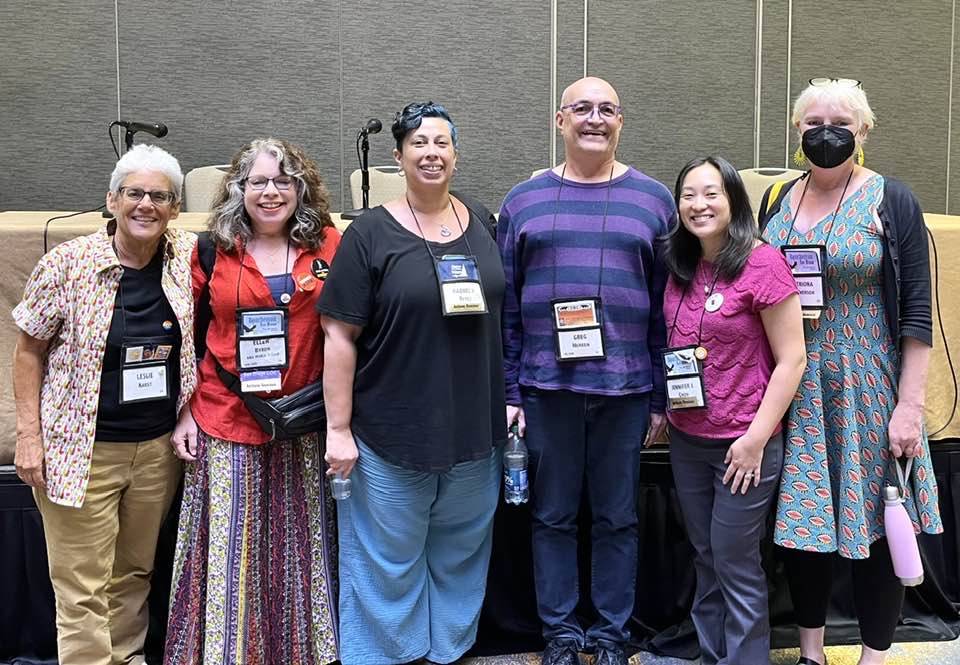
I was, somehow, on two humor panels at this past Bouchercon. I moderated one of those panels, which was a great time and one of the best experiences I had moderating a panel because of the amazing wit and talent of my panelists, whose work I look forward to reading. I was a last minute step-in, so I didn’t have time to read their books ahead of time or prepare anything; so the entire panel was extemporaneous–which is incredibly hard for a panelist because you literally have to think on your feet–and they rose to the challenge magnificently. However, I couldn’t use those questions as a self-interview, so instead, I will share the questions marvelous Leslie Karst came up with as the fill-in moderator for the Best Humorous Mystery Anthony panel, which I got to share with Ellen Byron, Jennifer J. Chow, Raquel V. Reyes, and Catriona McPherson…and a lovely time was had by all.
(You can only imagine how thrilling it was to be nominated for an award with these oh-so-talented and wickedly witty women. The imposter syndrome was strong in me on that panel.)
But, with a strong and heartfelt thank you to Leslie for these questions, away we go.
Did you set out to write a humorous (whatever that means) book?
I don’t. That would trigger my anxiety, I think, and I’d second-guess myself constantly. I’m not really sure how funny I actually am–and it’s not self-deprecation for me to say that I don’t think I’m being–or trying to be– funny most of the time. But people always have laughed. It took me a long time for me to realize that they weren’t laughing at me, but with me.
I believe humor should come out of the characters and how they react to, and/or see things, around them. New Orleans is a very easy city to write funny about because the daily paper is an endless source of unintentional humor. Our city government is weird and crazy, as is our history. Something that would draw stares and a crowd anywhere else isn’t even blinked at here. I tried mightily to resist, but have to shamefully confess that I, too, have walked to the Walgreens on the corner in pajamas and house shoes. Are the Scotty books camp? I’ve been thinking about that a lot lately, as I have been watching and reading about the camp aesthetic in the queer community, and I think they are, based on all the definitions I’ve seen and heard and read about. Scotty exists in a very close to reality as I can make it world, but the situations he and the other characters find themselves in are often over-the-top and ridiculous but normalized in that world, much as they are in real life. No one bats at an eye at any of it, because it’s normal. I think that makes my Scotty series camp.
The book that was nominated, A Streetcar Named Murder, was one in which I didn’t even think about being funny. I had the over-the-top character of the neighbor/best friend, Lorna, for comic relief, but my main character was supposed to be the one who sees and recognizes the ridiculousness but accepts it as reality. Catriona McPherson tagged me on Facebook because one scene in the book made her laugh for several minutes–which I took as a great compliment, because she is one of the funniest people I know–but I didn’t even think about writing that scene as funny; it’s actually when Valerie discovers a dead body, and the dying woman–wearing a pirate wench costume–says her last words, trying to identify who killed her. I remember making the conscious choice as to what those last words would be and tying it into her costume, but that seemed to me how it had to be, if that makes sense? And of course, when you’re writing a book and revising and reediting and rewriting and copy editing and page proofing…you do get so heartily sick of a book and its characters that it just seems tedious and tired and dull to you. Any humor I may have deliberately thought up and wrote into a manuscript no longer is funny to me by the final pass…which is worrying. I am never sure the book is funny or not.
What’s the most challenging thing about writing humor?
Being funny! The thing that always gets me about humor is how quickly and easily it’s dismissed when it comes to books–books aren’t supposed to be funny, you know; they’re supposed to be serious–which always puts funny books at a disadvantage, especially when it comes to awards, particularly juried ones. How do you say one book is funnier than another? Do you judge just the humor, or is that just a factor in the overall quality of the book? The odds of five to seven judges all agreeing on the same thing being funny are exponentially greater than the odds of five to seven judges agreeing on something tragic. Humor is harder than tragedy, and it’s even harder when you’re trying to find the humor in a tragedy.
Humor is incredibly subjective, and difficult to agree on. I’m one of the few people who thought Seinfeld went on for too many seasons and had stopped being funny long before they stopped; likewise with any number of other highly popular comedies, from Friends to Modern Family; shows that remain consistently funny for a long run are very rare, and I’ve always appreciated the comedies that went out before the quality began to decline (The Mary Tyler Moore Show, All in the Family, The Bob Newhart Show).
Have you ever gotten the giggles in a highly inappropriate setting, and how did that go?
My grandmother’s funeral. In fairness, my eldest cousin is one of the funniest people I know, and I made the mistake of sitting next to her and she kept whispering to me and I couldn’t help it. It did NOT go over well, and we’ll leave it at that?
Have you ever had to change anything in a book (funny or not) because of pushback from your editor?
Nothing major or significant, really; there was never anything like “this scene! What were you thinking?”
Is writing humor difficult for you, or does it come naturally? Any tips on writing humor for those writers in the audience?
Like I said, I don’t really try, it just happens. So I guess I would have to say it’s easy, with the qualifier being if I am not trying to be. The Scotty books were my first experience with really writing humor, and for me, it was more about him and his reactions to all the crazy things happening around him–which is why I’ve been wondering if the books are camp or not lately. The original idea for the first one did strike me as funny; I just saw one of the dancers working at the Pub during Southern Decadence weekend maneuvering through the big crowd in the street to start his shift. I had a mental flash of a guy wearing only a day-glo lime-green thong being chased through the crowd with bad guys with guns also trying to fight their way through the enormous crowd of scantily clad partying gay men. Likewise, the original idea for Vieux Carre Voodoo came to me when I was walking through the Quarter and passed under a balcony just as they started watering their plants–so got wet. (It’s a regular hazard in the Quarter.) I then had an image flash into my head of the same thing happening to Scotty–only he was wearing a white bikini that became see-through when wet. Why would he be walking through the Quarter in a bikini? Because he’s going to ride in the Gay Easter Parade dressed as a sexy gay bunny–white bikini, cottontail, and bunny ears. There was one scene in Jackson Square Jazz where he finds a dead body, and sighs resignedly and says, “not again.” I wasn’t sure if that would get past my editor, but it did.
I think it’s easier when the humor comes organically out of the characters and the situations they’re in. I don’t write jokes, but I do imagine a scene that I think is amusing and then fit it into something I am working on, if that makes sense?
Humor is hard.
Is there any type of humor that you would deem inappropriate for your books?
No. I’m a sixty-two year old gay man who lived through the 1980s and has been doing HIV/AIDS work for the last twenty years, so my sense of humor is very dark. I’ve been told I have a very dry, caustic wit; but there’s a very fine line between dry wit and being bitchy and cruel. I don’t like to cross that line, but have.
A Streetcar Named Murder was nominated for both the Lefty and Anthony Awards for Best Humorous Mystery. It was a thrill, an enormous compliment, and a complete surprise in both cases. I’m sorry the ride had to end….
Here we are–the Best Humorous Mystery Anthony nominees and our moderator. (And why do I look at myself in this picture and hear Bianca del Rio saying “horizontal stripes are not a good look in your third trimester, sir.”)
And somehow, almost twenty-one years have passed since Scotty Bradley burst forth into the world with Bourbon Street Blues, one of what I hoped was the most unconventional and original amateur sleuths in the history of crime fiction. This is neither the time nor the place to again tell the story of how I created him, or how what was supposed to be a one-off stand alone book became a series spread out over twenty years (!!!); I’ve told those stories endlessly over the last twenty years both here and on panels. But Scotty remains very precious to me all these years later, and I still care about getting him and his life right on the page. I don’t torture him or make his life as miserable as I do Chanse’s (poor, poor Chanse), but he has his own problems and issues that he has to face–but his endless optimism and willingness to face things head on and deal with them, rolling with the punches and always getting back up, has never once wavered in all the years I’ve been writing him. I love him, his family–even the stuffy Bradley side; I love that the unconventional family their son married into pushes every single one of their buttons–and I love his New Orleans.
The other night I was scrolling through Youtube and, just for the hell of it, searched for a song that I’ve been trying to find a digital copy of for my Spotify or Apple Music accounts; Erin Hamilton (Carol Burnett’s daughter) remade Cheap Trick’s “The Flame” as a dance song (she also did the same with that old 1970s classic, “Dream Weaver” and I prefer her versions to the originals), and I love the extended remix. I found the video on Youtube and as I listened to it, it brought back a lot of memories of going out to the gay bars, hitting the dance floor and staying out there all night, getting caught up in the music and just having a great time. I think this song predated the turn of the century, so it’s a late 90’s recording…anyway, it really made me think, put me back into a Scotty place in my mind, and as I listened, sang along, and bopped my head, the next Scotty book started forming in my head….and I realized that’s been part of the disconnection I felt writing the last few Scotty books; sure, I could and can still write him, and sure, I could get back into his head space, but it was much harder for me to do than it used to be. I thought it might be because I don’t go to the Quarter at all anymore, or that I don’t spend any time in gay bars anymore; that I don’t know what it’s like to be a gay man in his forties (almost fifties) today–my own memories are of a completely different world than the one we live in now. But now I know what I was doing wrong–I was listening to the wrong kind of music while writing him. If I want to ease back into Scotty’s mind and world, I need to listen to dance music I used to hear in the gay bars.
And can I say that it’s a real shame that it’s so hard to track down old gay bar dance remixes?
Knowing this means I’ll probably keep going with Scotty for a while longer, at any rate. I love him, I love the character, and I know I’ve been avoiding dealing with some things in that series that will eventually have to be addressed…but it’s absolutely lovely to know that I can slip back easily into his mind-space just by listening to great old gay dance remixes.
“I think we should turn it into a home gym,” I said into the gloom. “I mean, wouldn’t it be great to just have to go downstairs to work out? And we can put in a sauna and a steam room. What do you think, guys?”
It was the Monday night after Mother’s Day, and the termites were swarming.
That was why we were sitting around the living room in the dark. The only illumination in the entire building came from two blasphemy candles, flickering in the center of the coffee table. Modeled after Catholic prayer candles, one had a picture of Drew Brees in his Saints jersey with a halo and heavenly light shining on his head with the words Pray to Breesus around the base. The other was St. Chris Owens of Bourbon Street.
So, yeah—blasphemy candles. They’re very popular here.
Yet even the scant pale light from the teardrop shaped flames was enough to draw an occasional scout termite from the gloom. We wouldn’t see it until it landed on the glass lip of one of the candles, before dive-bombing into the flame. There would be a brief sizzling sound, and then the yellow flame flickered and turning briefly reddish as the termite immolated. Once it was consumed, the flame would be steady and yellow again.
The swarming rarely lasted more than an hour, but that hour seemed to last an eternity.
Termites have always been the bane of New Orleans’s existence. The domestic kind were bad enough. Houses and buildings were tented to get rid of infestations, the bright yellow and red stripes announcing to the world that a termite Armageddon was happening inside. The city’s original termite problem had grown exponentially worse since the particularly vicious Formosan variety had hitched a ride on a freighter to the fertile feeding grounds of our old, mostly wooden city shortly after World War II. The dampness of our climate must have made them feel like they’d arrived at termite Disney World. The little fuckers love wet wood, so the entire city was an all-you-can-eat buffet. They’d killed live oaks that had survived hurricanes, destroyed historic homes, and I’d heard that they could even chew through brick and mortar.
Maybe that was an urban legend, but it wasn’t one I was interested in proving.
Formosan termites swarmed.
The first rule of surviving Formosan termite season was speed. Every source of light had to be turned off the moment you spotted the first scout. They’re drawn to the light, like moths, but unlike moths, they’re drawn to the light in the hundreds of thousands, turning your home into a scene from Cecil B. DeMille’s ultimate cheesefest The Ten Commandments. The big streetlamps along Decatur Street outside drew the swarms, horrifying clouds of little monsters flying around, frantically trying to mate while shedding wings like revoltingly nasty snowflakes.
It is incredibly hard for me to believe that I have written seventeen or so books and countless short stories set in New Orleans and never have once addressed the swarms of Formosan termites we live through every spring. They return after Mother’s Day and haunt us in the evenings, usually between eight and nine pm, until Memorial Day, give or take. They aren’t a nightly occurrence, thank the heavens, but they are usually at their worst on Mondays and Tuesdays. No one had warned Paul and I about them, so the first time we were swarmed we didn’t know what to do. Remembering that horror from the old apartment on Camp Street (we had a massive security light attached to the house right outside our living room, so any light at all inside would draw clouds and clouds of them inside), how was it possible I had never written about the Formosan termite swarms? And with Scotty having bought the building on Decatur Street from Millie and Velma–who I sent into retirement along the Gulf Coast of Florida–and learning about the responsibilities and drawbacks to being a New Orleans home-owner, as well as trying to figure out how to redesign the interior for more functionality as a single-family dwelling? Of course, the question of what to do with the empty retail space on the first floor would be an issue; I wouldn’t want a living space right on the sidewalk of Decatur Street at any time of day or night or month or year. I also wouldn’t want to deal with renters, either, and thus neither would Scotty. But the space can’t just be left vacant, either. So, I thought it would be a great way to open the book with them sitting out the swarms in the dark, with a couple of candles lit, talking about the renovation plans?
After I finished writing Royal Street Reveillon, I was pretty damned pleased with myself. I thought it was perhaps the best Scotty book of the entire series, and reflected my growth as a writer along with Scotty’s growth and development as a character. When I finished it, I had the thought I always have whenever I finish writing a series book: maybe that should be the last one. But I immediately dismissed that thought from my head; I had left something in the personal story of Scotty and the boys hanging with a bit of a cliffhanger, so I knew there had to be one more book at least to tie off that loose end. I was also thinking about a local-ish political scandal of the last decade–the usual, a conservative Christian pro-family politician outed for having an inappropriate relationship with a teenager (who was over seventeen, the age of consent for boys in Louisiana), and a political powerhouse dynasty that had ruled a near-ish parish for generations was dead in the water. I had been thinking a lot also about taking Scotty and the boys outside of New Orleans and the safety of Orleans Parish for an adventure; as my knowledge of Louisiana grew exponentially along with my study of the state’s history, I really wanted to set a book in a part of Louisiana I could fictionalize and have some fun with. I had already created a couple of fictional parishes and towns in previous work; The Orion Mask particularly was set in fictional Redemption Parish–but Redemption wouldn’t work for this one, so I needed another one.
While I was thinking this through, I remembered that two Nancy Drew mysteries were connected to New Orleans–she was only here for a couple of chapters of The Ghost of Blackwood Hall, but most of The Haunted Showboat was set here, or just outside of the metropolitan area (a quick reread showed that “Carolyn Keene’s” Louisiana and New Orleans bore no resemblance whatsoever to the reality…but I knew I had a Nancy Drew Easter egg in Bury Me in Shadows (Blackwood Hall), and I wanted to put one in a Scotty book–so why not a showboat? The ruling dynasty of the invented parish–St. Jeanne d’Arc, for the record–was given the same name as the relatives of Bess and George’s that they and Nancy were visiting in The Haunted Showboat, Haver. I even named the house in Mississippi River Mischief the same name as the Havers’ home in The Haunted Showboat, Sunnymeade.
And yes, the Havers’ showboat/gambling casino was also named the River Princess.
I originally planned on the case coming to Scotty through his sort-of-nephew, Frank’s blood nephew Taylor; someone he met in group therapy (which he is doing to help get through what happened to him in the previous book), or possibly even a boyfriend, someone he’s seeing. I could never get it to work right…and finally, I realized it couldn’t come from Taylor. Taylor is going to continue growing as a person and as a character, but this was too soon after his own trauma for him to be trying to help other people. And then I remembered David, Scotty’s best friend, the music teacher. David’s not been in a book since Mardi Gras Mambo, but I’ve never forgotten about him. And it made sense–David has moved on from his old school and now teaches at NOCCA (our local Fame high school), and the kid is one of his students–and David finds out by confiscating the kid’s phone in class. I wanted to create a character based on this absolute sweetheart of a young man I met; I don’t remember how we met, but friends of a mutual friend were in New Orleans, and wanted me to meet them for drinks…and they had a daughter who went to school here. The kid was a friend of hers, absolutely adorable and sweet, and a ballet major at Tulane. After the daughter and her friend left, the parents immediately turned to me and asked me, “is he gay? <The daughter> think so, and so do we.” What I should have said was, “Well, he’ll let people know if and when he’s ready”; what I actually said was “absolutely.” (I did later find out the kid did eventually come out; wherever he is, I hope he is happy and living his best life. He was so sweet and charming and likable…) When I started writing the character, I made him unlikable, arrogant and sure of himself and his own beauty, and the effect it had on other people. That was wrong, and I went back and made him more of a naïve kid, with a strong sense of right and wrong; and the story worked a lot better. It wasn’t like Scotty to be so judgmental about this kid; if anything, especially after what happened to Taylor, he’s be super-protective.
And this tale–the corrupt old politician and the beautiful teenager working at the food court at Lakeside Mall–gave me a chance to dig into something from Scotty’s past that’s never been truly explored: that his first lover was his high school wrestling coach when he was about fifteen/sixteen. This came up in Jackson Square Jazz–which of course has been unavailable for thirteen years–and I always meant to circle back around to it, just never did…but over the years there have been throwaway lines in books about how Scotty has always preferred older men (Frank is fifteen years older; we’re not really sure how old Colin is), and so to bring it up again in this instance? Yes, perfect.
I loved my story about the corrupt politician, the wrecked showboat in St. Jeanne d’Arc Parish, and the teenager, but something was missing.
I realized two things: something very important was missing, and the crimes of the Haver family were just too big and too many to fit into this book, so I chose to focus on only one…and then the Murdaugh case broke. The Murdaughs were a real life Haver family, and their crimes were almost exactly the same! So, I ripped one of their crimes from the headlines and made that the primary focus of the story, and it was the right choice: the book started falling into place and the story began flowing. I was very nervous about the book–slicing out all the other crimes while building up only one was tricky, since they were all woven through the entire manuscript and the new one had to be as well. I also wasn’t sure if the subject matter was handled appropriately; the old/young daddy/boy thing is the gay community is often mistaken for something much worse than it is, and talking about gay teenagers’ sexuality is also kind of a third rail. But I trust my editor, and she loved it.
Your biweekly Pays the Bills Wednesday had somehow rolled around again, and yes, I have bills to pay before I put my sleepy head to rest tonight. I slept very well last night–didn’t even hear the alarm at first this morning–and certainly didn’t want to get up; the rain, however brief it was last night, apparently dropped the temperature and so it’s actually cold in the apartment this morning; I suspect the coldness overnight inside was part of the reason I slept so deeply and well, only getting up once. (It’s a chilly 79 degrees outside right now; I may need a jacket after this summer’s blistering heat.)
In very exciting news, I got my edits for Mississippi River Mischief yesterday, and my editor loved my book. Cue enormous sigh of relief. I was worried (I worry about everything) that it wasn’t good and that it didn’t do what I wanted it to do, but I can now breathe a sigh of relief. I am starting to feel–partly from all these Alfred Hitchcock Presents short stories–a lot more confident, more brave, and perhaps even more daring about my work and what I try to accomplish with what I am writing. John (Copenhaver, you can check out his books here, thank me later) asked so many smart and insightful questions of us on the Queer Crime Panel (which you can watch right here!) on Sunday afternoon–as well as listening to the brilliant answers given by my oh-so-talented co-panelists (Renee James, Robyn Gigl, Margot Douaihy, and Kelly J. Ford) made me start looking at my work, what I do with it, what I am trying to do with it, and what I can do with it. I’m starting to feel inspired again, which is absolutely lovely, and even if my creative ADHD is really flying off the charts lately, it’s been kind of nice. I’m always afraid I’m going to stop having ideas or being able to write. *shudders at mere thought*
But I ran my errands and got home relatively easily and efficiently, and I beat the short thunderstorm home. It didn’t last near long enough, but maybe it cooled things down a little for a bit, which is all any of us can even dare to dream of at this point in the summer. I got two more Alfred Hitchcock Presents anthologies at the post office: Stories to Be Told With the Lights On and The Master’s Choice. What I am really loving about these stories is they kind of exist in that shadow world between crime and speculative fiction. I should probably turn this into a project, as I tend to do to everything at some point. I am learning from every story I read, and I am also working on my critical skills while I do. What didn’t I like about this story? How could it have been made better? All of these things are subjective, of course, and then I also kind of try to analyze why I didn’t like the things I didn’t like; I think the concept behind every story is a good one–and authors don’t always succeed in pulling off what they are attempting with, and for, the reader.
I kind of was dragging a bit yesterday, and kind of have been all week thus far. I think part of it is the readjustment to Paul being home and my supervisor being back after her unexpected and unforeseen absence, which mirrored his almost exactly. But I am also digging myself out from under the malaise or whatever has been gripping me recently, and I really need to get back to the writing. I wrote a little yesterday, but not nearly enough–fatigue and inability to string a sentence together forced me to give up about one hundred words in. But it was a hundred more words than the day before, and it whetted my appetite a bit. I also did some more mindless research into the historical period I am thinking about setting a book in, which was interesting. It’s not really world-building since the world existed at the time, but rather world-reconstructing. This weekend I am going to try to get more writing done, and hopefully we’ll also be getting a cat (fingers crossed). I think the heat wave is going to be continuing, with a bit of a break; the temperature isn’t supposed to go above 93 today, which means no 120+…and how sad it is that it’s being called by local meteorologists (I think they’re in on the joke, however) a “cold front”?
Bouchercon is nigh, and my birthday is this weekend. I am trying to fit in a lot before San Diego because I am having oral surgery the Friday after I get back (at last) and at some point I’m going to probably have to have surgery to repair my left biceps (sorry if I’ve mentioned this before) so I don’t know how I will be or how long the recovery will be or what I’ll be able to do or deal with during said recovery. This is part and parcel, one supposes, of the decline and decay of my body as I get older, and it’s not like I ever took super good care of it before. Hell, when I was a personal trainer teaching aerobics I smoked cigarettes and spent my weekends drinking in the gay bars. (Facebook memories recently reminded me of how and who I was when I first broke into print with my first novels and short stories…my naïveté was really something. I was always who I was, only now I was a published author and I dressed like, well, like I always did. I rarely wore pants! I was always either in sweats, workout shorts, or shorts; T-shirts and sweatshirts and tank tops. That will be a topic for another time, though.) I’ll be sixty-two this weekend. Sixty-two! Lord, that will be an interesting blog post to write.
I also realized last night that this year the Scotty series turns twenty! I wish I had thought about that ahead of time; I could have done something to celebrate and mark this landmark in the series. Maybe I’ll do a Scotty-centric entry; I should be doing that anyway since Mississippi River Mischief is coming out this November….it was a bit of a jolt to realize it’s been twenty years–over twenty years, actually, since Bourbon Street Blues was a spring release–April 1 or May 1, I am not sure which. Twenty years of Scotty. My God, I can hardly believe it.
The joys of birthdays once you’re past a certain age, I suppose.
And on that note, I am. heading into the spice mines. Have a lovely, lovely Wednesday, Constant Reader, and I’ll check in with you again tomorrow. Or later; one never knows.
One of the great joys of my life has always been history. One of the many reasons I love New Orleans so much is because the city has never completely paved over and replaced its history; on a foggy night in the French Quarter, the sound of mules pulling tour carriage clopping on the streets can make you feel like you’ve somehow stepped through a window into the past, and I love that. I’ve never known much beyond some basics of New Orleans and Louisiana history; and I’ve been going down rabbit holes since right around the start of the pandemic, learning more and more about the history here. It’s humbling to realize how little I actually did know. I knew when the French arrived; I know how English Turn got its name and when Louisiana was turned over to Spain (1763, to be exact) and when it became American (1803). I also know Napoleon sold Louisiana to the Americans before he succeeded in forcing the Spanish to return it to France….so he could sell it to the Americans. I know New Orleans fell to the Union in 1862 during the Civil War; I know a little bit about Storyville and Huey Long; and I know that the landing boats used for the Normandy invasion in World War II in 1944 were built here. I know a smattering of things post-war about New Orleans–but the gaps in my knowledge are staggering, and I know even less about the rest of the state’s history.
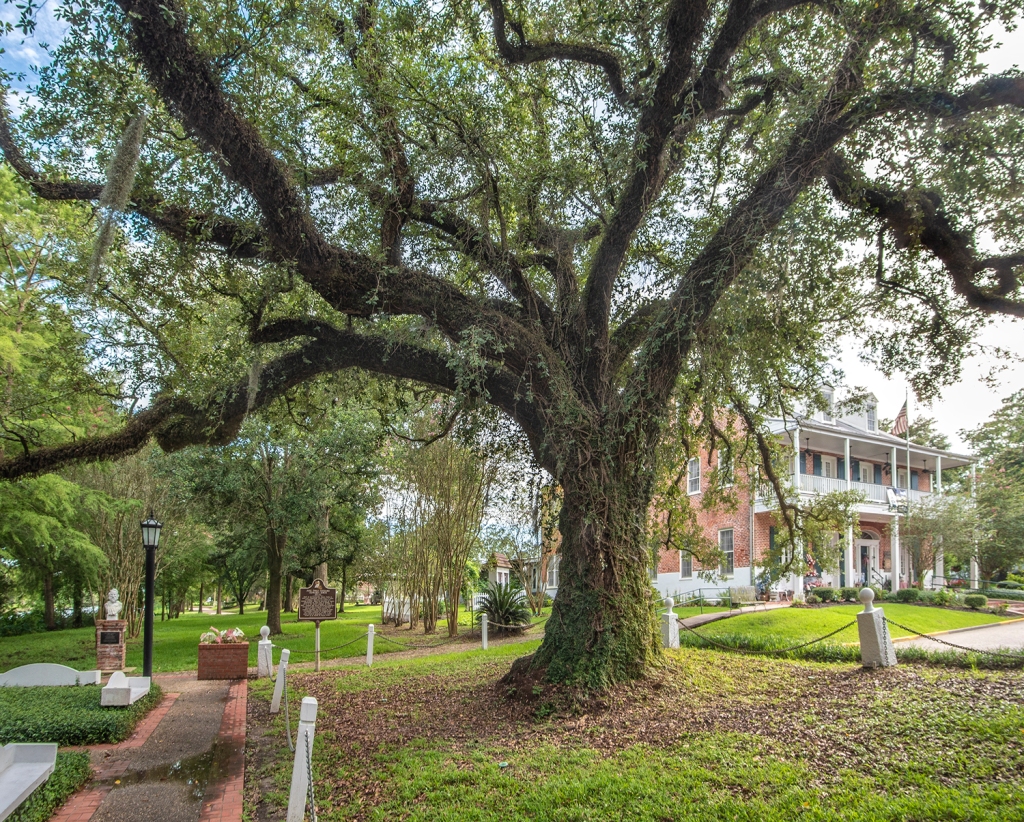
I know that the Cajuns are actually Acadians, from French Nova Scotia, kicked out after the French and Indian War and forced to resettle elsewhere–many of them, after a long and mostly horrific journey, arrived in the swampy wetlands of Louisiana and made their home here. I know that Longfellow’s epic poem “Evangeline”, about two lovers tragically separated during what is called le grande derangement–the Great Expulsion–who promise to find each other once they reach Louisiana. It’s a tragic poem, and of course the Evangeline Oak in St. Martinsville is supposedly the”place” that the fictional lovers finally found each other after so many years, but their pairing was simply not meant to be–the story is a tragedy, after all–but that was how the “Cajuns” came to be Louisianans, and even after they arrived it wasn’t easy for them here. The Creoles of New Orleans looked down their aristocratic noses at the lower class farmers, and so they settled in the part of Louisiana still known as Acadiana to this day.
I have a copy of Evangeline somewhere. I really should read it.
One of these years, I am going to explore my state more. I’ve lived in Louisiana now for almost twenty-seven years, and I’ve never done much in terms of exploration, sight-seeing, and research. The Atchafalaya Basin fascinates me, as does Acadiana. The more I read about the history of both New Orleans and Louisiana, the more I realize how little I know (I always laughed off being called a “New Orleans expert,” because there’s literally a library filled with information about the past of both the city and the state to completely humble me and make me realize I know actually very little about either, and definitely do not qualify to be called expert on anything Louisiana.
I’ve slowly started writing about the rest of Louisiana, but I often fictionalize the places I write about; they are loosely based on the reality but I get to play around with that sort of thing and that’s better for me than trying to write about the real places and making it all up. My first time outside of New Orleans writing about Louisiana was really Bourbon Street Blues, when Scotty is kidnapped by the bad guys and winds up deep in a swamp. “Rougarou” was when I came up with a fictional town and parish outside of New Orleans, which I’ve used since then again. Need had portions that were set in the rural parishes outside of the New Orleans metropolitan area. The Orion Mask and Murder in the Arts District also were heavily reliant on being set (at least partially) in a fictional parish between New Orleans and Baton Rouge. “Solace in a Dying Hour” is another one of these stories. Oh, and Baton Rouge Bingo also had a lot of action outside of New Orleans as well.
I probably should have majored in History for college, but what would I have done with that kind of degree other than teach? Ah, the paths not taken, since I never had any desire to be a teacher, probably my subconscious saying um, you cannot be a teacher because of who you really are which was probably smart. Besides, I wouldn’t have ever been able to pick a period to specialize in; I would have had to be like Barbara Tuchman, interested in everything and picking certain periods that intrigued me for study. How could I ever choose between the Wars of Religion and seventeenth century France, or the Hapsburgs in Spain and Austria? Although I suppose I could have specialize entirely in the sixteenth century, primarily because it was such a tumultuous transitional century. I wish I was a trained researcher, but I suppose I could still learn how to do research properly despite my great age; the problem is time. Fall Saturdays are given over to college football (and I am not giving up one of the great joys of my life) and of course Sunday I watch the Saints. But if I am going to write historical fiction set in New Orleans or Louisiana, why wouldn’t I avail myself of all of the magnificent research facilities here in the city? UNO, Tulane, Loyola and I’m sure Xavier all have archives in their libraries documenting the past here; there’s the Historic New Orleans Collection and the Williams Research Center and really, so so very much. I also need to explore the bayou parishes and the river parishes, and make my way further north to explore Acadiana…and if I ever want to write a book based on the Jeff Davis Eight, I would need to go visit that parish and look around, get a grasp for how it feels and looks there.
So much to do, so little time…and one of the great problems about Louisiana and New Orleans history is trying to decipher what is fact and what is fiction; as so many “historians” and “writers” (looking at you, Robert Tallant and Harnett Kane) often wrote legends and lore as historical fact. I’m not sure how much of Gumbo Ya-Ya is actually true or not, but for writing fiction…perhaps it doesn’t matter as much how right it is? I have this idea for a story, predicated on something I recently discovered again–I have a tendency to forget things–but there was a community just outside of New Orleans called St. Malo, which was settled by Filipinos who’d escaped bondage on Spanish sailing ships. Filipinos in Louisiana in the eighteenth century? But it’s true; and the community was mostly houses and buildings built over the water; the 1915 hurricane destroyed it completely and it was never resettled, with those who survived moving into the city proper. I have an idea for a story called “Prayers to St. Malo” that would be built around that, but the story is still taking shape. There is always more to learn about regional history here…and since I am doing such a deep dive into Alabama history, why not continue diving in regional here?
Louisiana is unique and special and different–which is why I think I felt at home here that fateful thirty-third birthday when I came to New Orleans to celebrate it. New Orleans was the first place I ever felt like I belonged, and I’ve never regretted moving here. I just wish I’d started diving into the local history sooner.
The first song I ever danced to in a gay bar was, quite naturally, “It’s Raining Men.”
I never said I wasn’t a stereotype, did I?
I was twenty-one the first time I ever set foot in a gay bar. (If there were gay bars anywhere near me in Kansas, I had no idea) It was in Fresno, California, of all places; where I spent the 80’s and which I often lovingly refer to as “Topeka in the Valley.” It wasn’t much of anything, really; a small building on Blackstone Avenue, I think just past Olive, and near the off-ramp for the new cross-town highway in an attempt to alleviate traffic on the main streets of the city (it may have been further north). The bar was called the Express, and someone I worked with–the first obviously gay man I ever knew, and certainly the first one who was out and proud and not ashamed of it–took me one night after work. I was nervous as hell. I had no idea what I was getting myself into, and I remember it was dark and crowded. There was a bigger front room with the bar, and there was a smaller dance floor further in the back. We arrived–I didn’t recognize the song that was playing–got a beer (he got a vodka and cranberry), and then the next song started up. I didn’t know it, had never heard it before, but he dragged me out onto the dance floor and yes, the song was quite a jam. I loved it, and rather self0-consciously danced my ass off (I always loved to dance). My friend later told me the song was by the Weather Girls, who used to sing back-up for Sylvester, and it was called “It’s Raining Men.” The song was utterly ridiculous–it still is–but those powerhouse vocals, the driving beat, and the absolute joy in the idea that all you had to do was “rip off the roof and stay in bed” so a hot man will drop in from the sky for you? How could gay men not embrace the song? I bought the single at Tower Records a few days later, and every time that song played, I’d be out on the dance floor. Even now, when I hear it, I always think back to that first night I went to a gay bar.
HIV/AIDS was already a thing, but we didn’t know much about it in Fresno; it seemed like something new and scary but maybe no worse than some other new diseases that had been discovered in the 1970’s/early 1980’s. The rare yet terrifying information and reporting on it referred to it as GRID. It eventually claimed that co-worker who took me to my first gay bar, and his roommate, who was the one who told me years later that the co-worker (whose name I cannot recall, I just know it started with a K) was in the hospital, dying. “It’s Raining Men” always reminds me of him; always takes me back to that first time when I so nervously paid my cover charge and flashed my ID and walked into my first ever gay bar. There was another gay bar in Fresno, the Red Lantern, that was in a much shoddier (“dangerous”) part of town. (Gay bars, back in the day, were never in the best neighborhoods. Tracks in Ybor City in the early 90’s–when I lived in Tampa–was also not in the best neighborhood. Ybor City did begin gentrifying before I moved away, but originally? Yeah, not the best neighborhood.) I went there a few times as well–made friends there, made friends in the other bar, too. I lost all those friends, of course, and their names and faces are also gone, more lives lost to the mists of time in my memory. It seems a bit shameful to not be able to remember the names and faces of the first people who knew a part of me I’d never let anyone see before, but they also didn’t know me in that I kept the other part of my life secret from them.
It’s very strange, because I decided to google the gays bars of Fresno while I was writing this and apparently the Express closed in 2013? I don’t think it stayed in the same location–according to the site I found it had also been called “708” before becoming the Express again; who knows what that was all about. But the Red Lantern is still there on Belmont Avenue, in the same location; how wild is that? That’s a pretty long-lived gay bar for a place like Fresno, really. I remember in Houston there was JR’s, and Heaven, and maybe another one there in the Montrose district. But I didn’t start spending a lot of my weekend evenings in gay bars until I moved to Tampa. Tracks in Ybor City and Howard Avenue Station were the two primary gay bars when I lived there; and there was Bedrox on Clearwater Beach–which was the gay section.
And of course, there are gay bars everywhere in New Orleans. I haven’t set foot in one in a number of years, and may never do so again. I’m old; spending the night dancing would end with me in the hospital, or needing days to recover.
I don’t know what gay bars are like now because I’ve not been a part of that culture for a very long time–we haven’t even done condom outreach during special weekends in the bars in years anymore–which is why it’s hard for me to write about Scotty being still a party-boy. His age in the book I just finished and turned in is roughly forty-three or forty-four; after Katrina when I had to actually pick a time for the books to have been set (Katrina couldn’t be ignored), I decided that the Southern Decadence where Scotty met both Frank and Colin was in 2004, Jackson Square Jazz was that Halloween, and Mardi Gras Mambo was Carnival 2005. Scotty had just turned twenty-nine in Bourbon Street Blues, which meant he was roughly born in 1976, which works with the other timelines, making him twelve or thirteen when the Cabildo caught fire the last time. While the other books can be more amorphous, obviously Who Dat Whodunnit was set in January of 2010, right before the Saints won the Super Bowl. With the pandemic starting in 2020–which I will deal with at some point–this one had to take place before the world shut down, so I am thinking it’s May of 2019. I don’t want to skip ahead a year to the pandemic, so Quarter Quarantine Quadrille will be further in the future. I kind of want to do Decadence again in another book–with Scotty older but not much wiser–but am not entirely sure. I also would like to really do a Scotty Halloween book, and maybe even a hurricane evacuation one, I don’t know.
I am, however, very glad that I did write those first three Scotty books, when I was enmeshed in gay bar culture, because I’m glad it’s preserved in fiction. That world is gone now–washed away when the levees failed and the city rebuilt. Someone once told me I was the only person to document that pre-Katrina gay male existence, of going out to bars and being promiscuous and dancing all night long and drinking too much and occasionally dipping into party drugs.
I’m also kind of glad modern gays don’t have to use the weekends and gay bars as a place to let loose and be as free and gay as possible, which they couldn’t do during the week. Friday nights were always a relief, a respite from a cold and unloving world that judged us harshly and wished us harm.
I don’t miss the bright lights, the cigarette smoke (that’s how long it’s been), the stench of male sweat and the smell of poppers in the air as the deejay spins another banger. I mean, I do, but not in a sad kind of way; those memories are lovely and they make me a little wistful for the days when gay bars weren’t clogged with bachelorette parties and obnoxious drunk straight girls. But those weren’t the good old days, really; we had no rights and our sex lives were against the law; the few legal protections we have now were goals back then, something we could strive to achieve sometime in the distant future. I certainly never thought Lawrence would decriminalize my sex life and Obergefell would make it legal for Paul and I to marry; I never thought those things would happen during my lifetime. I didn’t expect to see an openly gay member of the Presidential cabinet; out queer characters as leads in television shows and movies–none of these things seemed possible to that closeted twenty-one year old who walked wide-eyed into the Express and went out to dance to “It’s Raining Men.”
I had no idea what the future held for me or for my community that night. In some ways I wish I could let that kid know everything would be okay and his life would turn out so much better than he ever dared dream…but knowing might change things, and I wouldn’t want to change anything that would take away the life I live now, because I love it.
Someone asked me once, many years ago, about who I would cast in a movie or television series if the Scotty books were ever adapted. I honestly don’t remember who I originally cast, all those years ago, as Scotty, if given a choice; time has made Swiss cheese out of my memory banks, alas. I do remember thinking Christopher Meloni would be my choice for Frank, even though physically they aren’t alike (Frank is tall and more lean than Meloni) and I know I wanted to cast Pam Grier as Venus (God, what dream casting!), but the rest I don’t remember. Just as well, really, I suppose. If I were to cast them today, I’d probably go with someone like Jake Gyllenhaal as Scotty, or Tom Holland; someone like that. Frank would be a very good role for Alan Ritchson, but he’s not old enough, alas. Maybe Holland as Scotty, Gyllenhaal as Colin, and Ritchson for Frank?
That casting would make for some really amazing sex scenes.
But I don’t waste a lot of my time speculating about movie or television deals. The Scotty series was optioned once for two years, but nothing ever came of it (although I miss those quarterly checks I used to get before the option lapsed) and I don’t really see how one could film one of the Scotty books, anyway. Bourbon Street Blues would require a mob of hot male extras in various stages of undress, for one thing, and then a night shoot in a swamp. Jackson Square Jazz is more internal, and Mardi Gras Mambo would require the recreation of not only Carnival but one of the parades on St. Charles.
It’s fun to think about, but…truth be told I’d just sell the rights and sit back to wait and see how it all turned out. I really don’t have much desire to write for television or film; never have, actually. I also always remember James M. Cain’s response to a question about whether Hollywood had “ruined” his novels; he turned around, pointed to the copies on his bookshelf and said, “They look just fine to me.” (Caveat: at one point in my life I really want to be a writer for soaps. That is the only interest in writing for any type of live action entertainment I’ve ever had.)
Yesterday wound off not being such a great day, I’m afraid. I woke up feeling pretty good and seemed like everything was going to align for a pretty good day. I spent the morning doing touch-ups around the house between reading more of Lori Roy’s marvelous Edgar-winning Let Me Die in His Footsteps; I ran the errands that were needed; and I did some filing. But just when I was getting ready to settle in to work on the book…the Internet went out. Yes, we were having modem problems again, and after an extremely frustrating hour spent dealing with on-line tech assistance (which isn’t very helpful) I remembered something from the last time something went wrong with the Internet and I was able to get a stopgap fix into place, but by then my mood had gone down the toilet and I was feeling a lot of anxiety and frustration on top of anger. So, I sat down again my easy chair and reread the chapters again that I was supposed to be revising to see if the fixes I came up with the other night would actually work, and I believe that to be the case. It was also a reminder than I am still in the process of working through grief, because I really snapped and went down the dark path rather quickly and easily yesterday–so I thought it was probably best to simply go ahead and ride it out. Cox is coming out today to bring a new modem and get it set up, so hopefully this will put an end to this periodic Internet issue. (Our modem is ancient; so ancient they can’t even service them anymore, which is what we found out the last time there was an issue, and even as I type these words I am remembering the last tech advised me to get a new one and I never did because I forgot, of course.)
So today I am going to spend most of my day working on the revision and getting caught up. I have emails to answer but they can wait until Tuesday. I want to spend some more time with Lori Roy’s novel this morning, maybe even finishing it, and get a lot of writing done around other things, like touching shit up and more filing and cleaning the kitchen and so forth. I am pleased I got the errands handled yesterday and some cleaning around here, which was sorely needed. I also found my hearing test results so I can start trying to navigate the world of obtaining and financing hearing aids. There’s a part of me that thinks it will be marvelous to be able to hear at 100% again–if I ever did–and there’s another part of me that thinks it’s kind of nice that I don‘t hear everything. And I am trying to be kinder to. myself. That’s why I walked away from everything and just spent the day yesterday dealing with the negativity the day had introduced into my life. I knew I wouldn’t be able to really write anything because I was in too negative a place, and trying to work would make the darkness even worse (sometimes work can get me through the darkness, but yesterday I could tell–and this wasn’t me trying to be lazy or anything, either–it was one of those times when I would find the work frustrating and aggravating. The downward spiral was such that there was no spiraling up, and anything else would keep the spiral turning on its downward axis. I do know that much about myself–and even knew that I would probably try to beat myself up over losing a day to the moodiness and subconscious grief. But progress in the mental health sector of my life was made–I recognized and diagnosed where I was at yesterday and what would make it worse rather than better, and even this morning I am taking that as a win rather than berating myself for the loss of a day’s work.
And I am really enjoying turning this piece of shit into an actual Scotty book. (I was worried during the completion of the earlier drafts that I didn’t know how to write a Scotty book anymore; those worries were for naught. I just have to always remember that Scotty is there, inside my brain, and I will always find his voice again, even if it takes a while. I should always revisit one of the books before I try writing another one.) I have that sense of who he is again and what the books should be like and I am hearing his voice in my head again, all of which I am counting as wins.
I was also thinking about the next Scotty book–because when I am ever not looking ahead to what’s next on the horizon–as well as a call for submissions for an anthology I want to write something for. Crazy, right?
So, I think I am going to make another cup of coffee, go read for about an hour, and then dive back into the book. Have a lovely Sunday, Constant Reader, and I’ll talk to you again either later today or perhaps not until tomorrow.
Friday Eve! I had a touch of insomnia again last night, but I feel okay this morning. I got very tired yesterday in the afternoon, but survived the day but was very drained when I got home. I did do a load of dishes and a load of laundry, though, so there was some success to be had on the home front–glad the sink has been mostly emptied, for one thing–and tonight on the way home I’ll have to stop and make some groceries as we’re out of a few things, but I am just glad that I’ve made it through a relatively productive week here at the Lost Apartment. I’m adjusting to my new job responsibilities as I learn them, which is always nice (nothing too hard or stressful, which is cool, and I like learning how to do new things) and I suppose I should earn the raise I got.
I was too tired to write last night (ugh, the same old refrain, right?) but I did spend some time thinking about the book and this hellish transition chapter I’m stuck on. I really need to stop second-guessing myself, keep moving, and worry about it all later. A short story deadline looms, but I don’t think I am going to have either the time or the inclination to go ahead and try to get something done and turned in on time. I have a story but it needs revision and I am not exactly sure how to solve what the problem in the story actually is; and I really don’t want to turn in something inferior.
I was also thinking last night about, well, my writing career. It’s hard to believe I’ve been a published author now for almost one third of my life, which is quite a long time to be doing this. I was also thinking about my work and how often I am dissatisfied with my own work; I also kind of laughed at myself because I often express that feeling here and on social media–which is precisely the wrong thing to do when it comes to marketing yourself: if the author isn’t satisfied with his own work, why should I read it? I really am terrible at this part of being a writer. But I have never been comfortable praising myself–which is why, I think, I’ve never gotten far with day jobs; I don’t push myself forward because I was raised to believe that you don’t praise yourself–that’s for others to do, and if you do a great job or do something good, other people will notice and if they don’t, doing a great job or something good should be reward in and of itself.
That’s kind of fucked up, actually, now that I put it into writing.
But on the other hand I wouldn’t be me if I didn’t reread something I’ve written and think, oh you should have done this or you could have done this part better or ouch that’s a clumsy sentence/paragraph/transition. I am kind of a perfectionist in some ways; I always think i could have done something better–and that’s not just restricted to the authorial part of my life, either. There are situations I think I could have handled better in the past, but I also tend to look at those experiences as growth opportunities? And God knows I could be a better housekeeper, and don’t even get me started on my electronic files on my back-up hard drive (which I really need to back up again). But is all this self-criticism necessary? I don’t know.
I’m very proud of all of my work; I take all of it–erotica, crime, horror, romance, whatever–seriously and I approach every manuscript with the mentality that I am going to do my best with it. I also think that I need to be easier on myself and less critical of my earlier stuff; the truth is I like to think that I continue to evolve and grow and get better at my craft so yes, if I were to write Murder in the Rue Dauphine or Bourbon Street Blues they would be different books, for sure, but that’s true of every author. Would they be better? No, but they would be different because I am not only a different writer now but a different person. New Orleans is also a different city now than it was when I was writing those books, so it wouldn’t be possible to write those same books the same way today. I mean, Scotty’s rent in the French Quarter was $400 a month back when I wrote Bourbon Street Blues! And so many things I used to write about that aren’t there anymore–Kaldi’s Coffee Museum on Decatur Street; Matassas’ Market on Dauphine; Tujague’s has even moved from where it was for decades, and of course even the sleazy dive bar Rawhide is getting a facelift and a makeover. But that also makes those older books kind of a New Orleans as it was time capsule, which is also really lovely.
And on that note, I am heading into the spice mines. Have a lovely Thursday, Constant Reader, and I will check in with you again tomorrow morning.
Wednesday and another edition of the biweekly Pay The Bills Day! Woo-hoo! But this is also my last paycheck at my old rate of pay; I am curious to see what my paychecks will look like when they reflect my raise–check back, Constant Reader, in precisely two weeks to find out.
Can you stand the suspense? I barely can.
I was very tired yesterday, and I slept about the same last night so I can also plan on hitting the wall today around three. I took a long lunch yesterday to record Susan Larson’s marvelous radio show The Reading Life, which will air on December 6th, and that was naturally delightful as every moment spent with Susan is. But by the time I got back to the office and got settled back into the seeing clients routine, I was very tired. I had a ZOOM meeting when I got back home last night, which was interesting and fun–it’s always lovely seeing that group of people (queer crime writers! Woo-hoo!)–and then I settled into my chair to watch Reboot and another episode of Diary of a Gigolo, which is just so much fun. I did get some writing done yesterday–terrible writing, I might add–but am hopeful that tonight I’ll get back on track. I feel like I slept about the same last night, waking up several times and never really falling deep asleep again, but this morning so far I feel good. I managed to somehow get quite a bit finished yesterday, which I didn’t think would actually be the case, given how sleepy and tired I was yesterday afternoon, but looking back over the day I can see that yes, indeed, I did get a lot done despite the exhaustion. I am adjusting to the new work week schedule, methinks; tomorrow is my last day in the office and usually I am worn down the day before my last day in the office for the week, so this is a major plus.
And now to consult the to-do list…sigh. It can wait until later, surely?
I don’t know why this morning I feel like I’ve turned some kind of corner, which makes absolutely zero sense, but that’s kind of how I feel; like I’m shaking off some kind of malaise or stupor and my mind is functioning correctly again. It’s entirely possible the booster shot I got on Monday fogged my brain for a few days–I’m blaming the insomnia issues on it for fucking sure–and now this morning that fog has cleared. I don’t know, I really can’t explain it other than that, but this is one of those mornings where I feel like I am mentally rolling up my sleeves and taking a look at all and everything I need to get done and diving in headfirst. LOL, we’ll see how long this feeling lasts, won’t we? But I feel good–and that is reflected in my mood, I guess; I’m in a pretty good mood this morning (at least thus far) but it’s probably too much to hope for that it will last the rest of the day.
Probably not, but you never know.
I was thinking last night–after talking to Susan about the next book (should there be one) in the new series, and of course my copy of Raquel V. Reyes’ second novel arrived yesterday–about how important the second book in a series is, and how much different the second books in both of my series are from the first book in each series. In the first book you have to introduce the characters and their backstories and how they relate to each other (the kind of relationships they have with each other) as well as who your main character is and try to get the reader to relate to them and like them enough to buy into the series as a whole. In the second book, you’ve already done all of this work so all you need is little sound bytes here and there to recap those backstories and so forth and you can spend a lot more time developing your plot and story. Murder in the Rue St. Ann was very different than Murder in the Rue Dauphine; revisiting the Scotty series I can see how much more complicated and layered the story of Jackson Square Jazz was in comparison to Bourbon Street Blues, which had a much simpler plot. Likewise, A Streetcar Named Murder is the launching place for this series, and hopefully it will continue (my second one is tentatively titled The House of the Seven Grables, which will probably be changed by the publisher if there is a second book in the series), and the plot I have in mind for this second Valerie book is a lot more all over the place and complicated–especially as we dig deeper into the Cooper family mystery that was brought to light in the first book.
My favorite part of writing a book is the planning stage, really.
And on that note I am heading into the spice mines. Have a lovely day, Constant Reader, and I will chat with you again tomorrow.






 Queer and Loathing in America