We’re thrilled to announce the finalists for the 2026 ITW Thriller Awards:
BEST STANDALONE NOVEL
Megan Collins – CROSS MY HEART (Atria)
Ruth Knafo Setton – ZIGZAG GIRL (Black Spring Press)
Gilly Macmillan – THE BURNING LIBRARY (William Morrow)
Sarah Pekkanen – THE LOCKED WARD (St. Martin’s Press)
Olivia Worley – SO HAPPY TOGETHER (Minotaur)
BEST SERIES NOVEL
James Byrne – CHAIN REACTION (Minotaur)
Robert Crais – THE BIG EMPTY (Penguin/Putnam)
John McMahon – HEAD CASES (Minotaur)
Christopher Reich – THE TOURISTS (Thomas & Mercer)
Vincent Zandri – TERMINAL MOONLIGHT (Down & Out Books)
BEST FIRST NOVEL
Chris Chibnall – DEATH AT THE WHITE HART (Pamela Dorman Books)
Kelsey Cox – PARTY OF LIARS (Minotaur)
Sophie Stava – COUNT MY LIES (Gallery/Scout Press)
Zoe B. Wallbrook – HISTORY LESSONS (Soho Crime)
Liann Zhang – JULIE CHAN IS DEAD (Atria)
BEST AUDIOBOOK
S. A. Cosby – KING OF ASHES (Macmillan)
Narrated by Adam Lazarre-White
Mark Edwards – THE WASP TRAP (Simon & Schuster)
Narrated by John Hopkins, Anna Burnett
Marisa Kashino – BEST OFFER WINS (Macmillan)
Narrated by Cia Court
Xan Kaur – WHEN DEVILS SING (Macmillan)
Narrated by Michael Crouch, Anjali Kunapaneni, Jennifer Pickens, Landon Woodson
CN Mabry, N’Dia Rae – THE CHEATER’S WIFE (Simon Maverick)
Narrated by Ruffin Prentiss, Machelle Williams
Michael Robotham – THE WHITE CROW (Simon & Schuster)
Narrated by Katy Sobey
BEST YOUNG ADULT NOVEL
Liz Lawson – MURDER BETWEEN FRIENDS (Delacorte Press)
Margot McGovern – THIS STAYS BETWEEN US (Penguin Young Readers)
Clay McLeod Chapman – SHINY HAPPY PEOPLE (Delacorte Press)
Diana Rodriguez Wallach – THE SILENCED (Delacorte Press)
Julie Soto – THE THRASHERS (Wednesday Books)
BEST SHORT STORY
Katrina Carrasco – LEVEL UP (Bywater Books)
Scott William Carter – THE SEDUCTION OF DR. DIMENSION (Ellery Queen Mystery Magazine)
Lee Child – ELEVEN NUMBERS (Amazon Original Stories)
David Lagercrantz – FALSE NOTE (Amazon Original Stories)
Jessica Van Dessel – THE VIOLENT SEASON (Alfred Hitchcock Mystery Magazine) ITW will announce the winners at ThrillerFest XXI on Saturday, May 9, 2026 at the New York Hilton Midtown, New York City.
Congratulations to all the finalists!
Tosca Lee ITW Board of Directors, Vice President, Awards
Good morning to you, and how are we all feeling this lovely Saturday morning? Sparky let me sleep in a bit this morning, for which I am eternally grateful; it’s weird how he’ll try at first, but if the alarm doesn’t go off, he’ll just cuddle and wait. He really is a darling, isn’t he? I was thinking yesterday evening as he slept in my lap. Yesterday was a nice day, really. I got my meetings out of the way and did my work before my errands and some cleaning and reading. We started watching Harlan Coben’s Lazarus on Prime last night, and it’s very interesting and very different than Harlan’s other work. I like the idea of a psychiatrist losing his father and then starting to see ghosts of murder victims that his father saw as patients, and then sees his own father, who tells him he didn’t commit suicide but was murdered. Very enthralling and interesting, I must say.
LSU plays this morning; I believe the start time is 11:45. They’re playing Arkansas at home, and who knows how that will go? There are other interesting games to have on in the background (Alabama-Oklahoma could be interesting), but I also want to make progress on things today and at least finish cleaning the house. I have to run an errand this morning in a little bit, but other than that I’m not planning on leaving the house again until Monday. It was stunningly gorgeous yesterday, and is again today from the looks of things, which is marvelous.
I picked up three books I’d ordered: Without Consent by Sarah Weinman; More Adventures of the Mad Scientists’ Club by Bertrand R. Brinley, and The Late Great Planet Earth by Hal Lindsey. Sarah Weinman is one of the finest writers in our genre, and her nonfiction works–which study, through the lens of crime and the judicial system, the gradual rise of women’s rights and equality in this country. This, about the Rideout case, and protecting women from spousal rape, is going to be a very intense read. The Brinley is a sequel to one of my favorite juvenile books from the Scholastic Book Club, The Mad Scientists’ Club, which I’ve never forgotten but didn’t know there was more than just the one book in the series, so it should be very fun to read. The Lindsey is something I remember reading as a kid that I kind of wanted to revisit, with all the missed raptures of the last few years as well as an example of End Times mythology; it may have been one of the first books about this that may have ever been published. As a suburban Chicago teenager I was very interested in the occult and unexplained mysteries, which there seem to have been a lot of back in the day. Was the 1970s the heyday of bizarre conspiracy theory? Between this and the “ancient aliens” bullshit (and we must never forget the Bermuda Triangle and Area 51, either) it seemed like that was an intense decade for conspiracy theorists. (I also found a copy of Stranger Than Science on ebay during the shutdown…)
The Lindsey is the basis for my first entry (or the second) on religion for my newsletter, and how there probably could be no The Omen without it. See, I am making progress on the newsletters! One thing I definitely want to get this weekend is the two ongoing essay series for the newsletter (religion and masculinity) organized, as well as working on the background for Chlorine and finishing the first draft of “A Holler Full of Kudzu,” which will undoubtably either turn into a novella and perhaps even a short novel (I am not pushing that, though).
And on that note, I need to get going on the day. Have a terrific Ides of November, Constant Reader, and I will check in with you again tomorrow morning.
I cannot believe I am writing my tenth Scotty book–the series that wasn’t supposed to be a series, then turned into a trilogy, and here we are on the tenth volume. I started writing the first book when we moved back to New Orleans in August of 2001, and here I am, nearly twenty-four years later, writing another one. I never dreamed this series would last this long, would continue to draw readers (or keep the ones I had), and do so well for me. 1
I’ve told the story of how I came up with the idea for him many times before (sometimes I wonder how much that story has adapted and changed over the years), but basically I had the idea for the story of Bourbon Street Blues first; one year Paul and I had managed to get the prime balcony spots at the Parade to look out over the Southern Decadence crowd one afternoon and I saw one of the dancers from the night before trying to make his way through the crowd in his cut-off sweatpants and string-strapped tank top, carrying his bag of “dance wear,” and not having much luck, as he kept getting stopped and touched and flirted with when the poor guy was just trying to get to work. It was mildly amusing, and then I wondered about how hard it would be to try to get away from someone trying to harm you in such a crowd, and then it became about the dancer trying to get away from the crowd, and I actually scribbled it down on a cocktail napkin, which I put in my wallet and found, a few days later. I did open a document and type up the note and some other thoughts and ideas, but I never thought anything would ever come of “Decadence stripper thriller,” but it was always there in my files. Every so often I would come across it, and think, I really do need to do something with that. I had already written a short story called “Bourbon Street Blues,” which had nothing to do with the stripper (although it actually was the seed from which Death Drop sprouted from–so yes, the moral of this overarching story is never throw any ideas or thoughts away because they will come in handy someday.
And isn’t this cover magnificent?
Bold Strokes always does well by my covers.
This title was actually originally the title I was going to use for Scotty IV (which ultimately became Vieux Carré Voodoo)–only back then it was Hurricane Party Hustle, and it was supposed to be set during an evacuation; I wanted to do something Man in the Iron Mask-ish, with the boys being hired by a gay man who was disfigured by having acid thrown in his face, to find out where his attacker–scion of a wealthy and powerful local family–has escaped to, and if the family was lying about not having any contact with him–and the whole thing would take place during an evacuation for a hurricane that didn’t come here; which was my primary experience with hurricanes at the time, and I always thought it was kind of an interesting and surreal thing to experience. There would also not be a lot of cops around during that time, either, which could make it even more fun and interesting.
Scotty III was delayed for a year because of personal problems and issues, but I finally turned in Mardi Gras Mambo a year and four months late; I also included the proposal for the fourth book, Hurricane Party Hustle, which I intended to be Scotty’s last hurrah. I would tie up all the hanging threads from Scotty III and bring the series to its natural close, at which point I was going to do something different; I was also planning on ending the Chanse series after one more book. I decided I was going to go back to school and get my master’s in creative writing, and maybe even a PhD. I got all of that set into motion, but within a couple of weeks, Katrina came along and blew up the lives of everyone in its path, and obviously, I couldn’t write a hurricane book for Scotty after the catastrophic failure of the federally built and maintained levees. I certainly couldn’t write anything funny. After a few years had passed, I decided hurricanes were not something I should write about2, and came up with another idea for Scotty–the movie star lookalike book, which I thought could be absolutely hilarious. But time had passed, and the publisher didn’t think Scotty had an audience anymore, so they passed on it. (I eventually used that for a Chanse book, only he didn’t look like the movie star, it was someone else.)
And every time I finish writing a Scotty, I’m never sure if I am going to write another. I never say never to him, though, the way I did with Chanse; I’ll always write Scotty if there is a way to make it interesting for the readers and challenging for me. I don’t want to write them by rote (which is where I felt I was going with Chanse), and so, yeah, as long as fun ideas that are challenging keep coming to me, I’ll keep going. I never want to get bored writing him, you know what I mean? That’s just not any fun. I decided to write this one as a challenge to myself and I am having a lot of fun with it.
And I changed the title from party to season; and have it take place during an actual hurricane in the city. Party just seemed too frivolous, and I don’t to give anyone that wrong idea.
I’ll let you know when it’s up for preorder, Constant Reader, and thank you for always reading him.
I also just remembered that my first friend, as a child, was named Scotty. Interesting. He was the first friend, come to think of it, who decided not to be my friend one day and never spoke to me again without me ever knowing why. Hmmm. ↩︎
I dealt with Katrina and its aftermath, as well as another hurricane evacuation, in the Chanse series, which I did finally end in the teens. ↩︎
And another Sunday fun day has rolled around. It was cold in New Orleans yesterday, but I did drop books off at the library sale, picked up the mail, and made groceries. Irony of ironies, when I got home I realized I didn’t have one of my bags–containing the things I went to the store for in the first place. Sigh. So I will have to go out in the cold this morning to rectify that error, but that’s all right. I got some things done yesterday around here, and worked a bit on my editing of my own stuff (which is going slowly because it’s horribly depressing to see how shitty the writing is, despite reminding myself first drafts are always shitty first drafts are always shitty– it still wears me down).
Okay, I bit the bullet and went to the store to get the things I paid for yet didn’t have when I got home from the store yesterday It was actually pleasant; mayhap in the future I should go early in the morning to make groceries. It’s only forty degrees but sunny here this morning, that always odd combination where it looks like it’s hot and steamy outside but it’s not! Now that I have that out of the way–which is also part of it, the putting it off and putting it off until such time as my day is interrupted and never quite recovers. Now I have that out of the way and don’t have to worry about it, and because it wasn’t a crowded shitshow the grocery usually is right before a holiday, I feel neither tired or burned out from the experience. I know it sounds weird, but a crowded grocery store overstimulates me and wears me out.
I did sleep a little later than usual this morning, and the bed was warm and comfortable and inviting and I didn’t really want to get out from underneath the blankets. But Sparky was hungry and would not rest until I was up, which is just as well. He’s fed and if I’d lounged in bed even longer this morning I would have not gone to make groceries, so everything was a “win-win”. I did have the games on yesterday, for what it was worth. Talk about snooze-fests. Is this what we have to look forward to with this new system? Blowouts in the first round? I also don’t like the home field advantage half the teams get in the first round. It makes a difference. I was at least hoping, despite my antipathy toward everyone playing this weekend, for some good, fun games to watch.
It was a good thought.
Was anyone surprised that disgusting grifting POS Krysten Sinema is going out the way she has chosen to? What a despicably corrupt narcissistic bitch. May we never hear her name again except for her obituary and the outpouring of contempt sure to follow. She betrayed her constituency, she betrayed queer people, and she betrayed her party to cozy up to Fascists and block progressive legislation while taking bribes and enriching herself. One of the problems with our current situation is that anyone can run against a horrible MAGA candidate and look good, rally votes and win an election as a viable alternative to something worse–but there’s nothing stopping said person from selling out for personal enrichment once they are serving. I’d like to see an IRS investigation as well as a DOJ one to find out who’s been paying her to be Mitch McConnell’s little beta bitch since she took office. She was so hated in Arizona that Kari Lake would have beaten her in the general1. I hope she spends the rest of her life getting drinks thrown on her and pies in her fucking face, like the clown she actually is. Good riddance to some serious raw sewage.
I was thinking yesterday (fleeting thoughts I’ve had a lot over the last few months) about James A. Michener and how no one today would read any book as long as his were, back in the day. I enjoyed Michener–Hawaii was a bit much–but I’ve been thinking how amazing it would have been for books in that style to have been written about Kansas, Louisiana, or Alabama. I certainly would never write such a thing–I don’t have the patience to do that much research, let alone turning it into a million words or so of a novel. (Although Michener would have written about three hundred pages about the forming of the Mississippi River delta, let alone the lakes and the swamps.) I was revisiting one of my favorite New Orleans histories, Frenchmen Desire Goodchildren, and I was also remembering that Gallatin Street, one of the worst sections of the old French Quarter, no longer exists. It was a vile place of bordellos and sleazy, dangerous bars; murders and rapes and muggings happened there with a stark regularity until it was demolished to extend the French Market. I’ve been wanting to write another Sherlock story in the 1910’s Quarter, and having either him or Watson visit a nasty dangerous gay bar on Gallatin would be a fun scene to write…if Gallatin was still around by that time; I think it’s badness was over by the time Storyville was set up, but who knows? I’ve resisted writing about Storyville, because it’s already been done so many times…but I also think it would be fun to write about New Orleans during Prohibition, too, when New Orleans became known as the Liquor Capital of the United States. That…could be a lot of fun. Maybe even an ATF agent coming to the city to root out liquor sales, only to hang their head in utter and complete defeat?
Thinking of Michener also reminded me of how much I used to read when I was a kid. Granted, the distractions of a gazillion streaming services didn’t exist back then; there were only three real channels, and we didn’t spend most of our times looking at our phones because there were no images on it. It also has made me think about how my primarily formative years–the 1970s–were awash in cynicism and mistrust of everything and how huge conspiracy theories, or all kinds of other “unexplained phenomena” struck people’s fancies. There was, of course, the JFK assassination conspiracy theories–but there were so many others. The Amityville Horror (on which I called bullshit at the time and still do), the Bermuda Triangle, UFO’s…you name it, people were interesting in it. I read Erich von Däniken’s books about “ancient aliens”, and of course there was all kinds of deconstruction of religion and the Bible, which was also interesting–The Late Great Planet Earth was a huge bestseller, detailing how the prophecies of Revelations and the end times were coming true right before our very unseeing eyes! End times Christian theology took hold–and never really let go, either. The X-Files could have been made in the 1970s (although it would have never been greenlit) but there was a lot of media, especially film, that tried to cash in on all of this. During the shutdown I did my “Cynical 70s Film Festival”, and it’s really amazing how a thread of paranoia runs through so many films of that decade. It was a strange decade, that saw the further inward collapse of the social engineering that took place after the second world war–that excluded everyone outside of the straight white cisgender male. The center wasn’t holding, and now? We’re living in the midst of the backlash towards social progressivism in this country.
And on that note, I am going to make another cup of coffee and head into the morning spice mines. Have a lovely Sunday, Constant Reader, and I may be back later–one never truly knows, does one?
Monday morning and back to the office blog! I feel awake, but kind of not completely yet, if that makes sense? It does in my fevered brain, at any rate. I didn’t get as much done this weekend as I wanted to, but I did get some things done. I did some actual writing yesterday, and I did get some work done on something else I’m working on. Not a great weekend for productivity, but I feel like I can face the office this morning. That’s a plus, right? It’s always good to start off the week feeling refreshed and rested both physically and mentally, right? So I am not sorry the weekend was wasted, because it really wasn’t. Likewise, the writing isn’t very good, but at least I did some, you know? It was excruciating getting a thousand words down, but I did, and while it didn’t alleviate my mind about getting back in the writing saddle, it’s something.
Paul wasn’t feeling well yesterday, so last night we started watching the new Prime show Cruel Intentions last night, and it’s better than I was expecting. I am a big fan of the original story (the book was Les Liaisons Dangereuses by Choderlos de Laclos; obviously filmed as Dangerous Liaisons with Glenn Close and John Malkovich), so was curious how this adaptation would work. The remake of the story as Cruel Intentions, with Sarah Michelle Gellar and Ryan Philippe, set at an exclusive elite school for the rich, was quite excellent–so I was curious about the new version, which updates the story yet again, this time to an exclusive college’s Greek system. I love this story, and did an homage to it in one of my erotic novels–which I wish I could get a do-over on, to be honest. I may need to reread the book again at some point, too. I love my conniving nasty French nobles, you know?
One thing I’ve not remarked on yet–mainly because I keep forgetting every morning–is to mention the shockingly excellent news that four queer writers were included on Sarah Weinman’s Best Crime Novels of 2024 in the New York Times! Three of them–John Copenhaver (Hall of Mirrors), Margot Douaihy (Blessed Water), and Robyn Gigl (Nothing But the Truth) are friends; the other, Katrina Carrasco (Rough Trade) is someone I don’t know but have been aware of for quite some time. I actually blurbed Blessed Water, which is exceptional. I do want to revisit it in order to write about it, and I have yet to get to John’s book–and I am very behind on Robyn’s series. But how wonderful is this? Not just one, but four queer authors on an important Best of column in the paper of record (which I still haven’t forgiven for its crimes of the last decade at least)? When I was first starting in this business, we didn’t even dare to dream of that kind of outcome for our books; and Sarah is so smart and knowledgeable about crime fiction and the genre–she absolutely knows what she’s talking about. I always enjoy talking to her, and this is so awesome for the queer authors; it’s the first sign from the Times that queer work is just as valid as other crime fiction! So, thank you, Sarah!
And it’s nice to see some diversity of thought in that vile paper for a change.1
So, I am hoping to get this work done so I can get back to writing. I owe some short stories I need to get underway, I need to get back to work on Scotty, and I am also writing this other thing, too. I’m starting to feel like I’m lazy, more than anything else, and finding excuses not to work anymore. This shall not stand.
And on that note I am heading into the spice mines. May you have a Monday as lovely as you are, Constant Reader, and one never knows–I may be back later.
Screenshot
And no, this doesn’t mean I’ll resubscribe. I will never forgive them for their role in undermining democracy and the rule of law. ↩︎
It was lovely getting back into reading last week, and it’s amazing to me how I will just wave off doing things I enjoy; it’s more apparent now than ever that one of the things I need to do is schedule reading time for every week. I am very behind on my reading (always have been) and have been relatively successful at limiting my book purchases this year until I’ve made some more significant progress is working down the TBR pile. I didn’t read as much horror in October as I would have liked, so I was determined to read some more this past week, at least the ones I had planned.
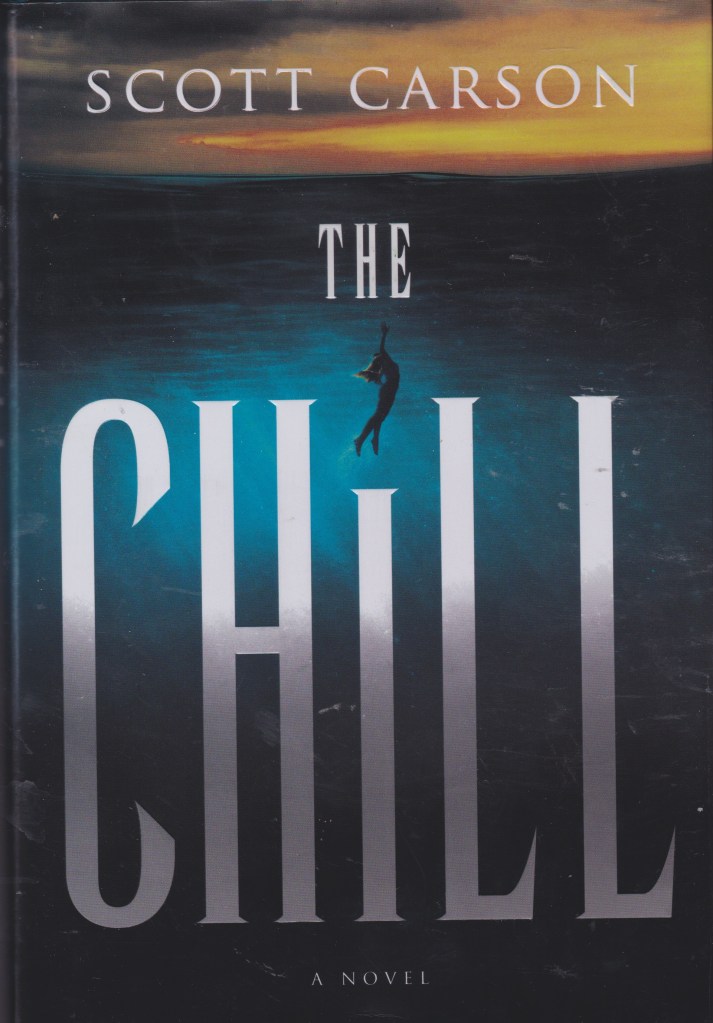
And I am really glad I took The Chill with me to read on the trip.
Molly packed a black silk bag that could be worn as a hood, because she did not want her eyes to open again until she was back in Galesburg.
The bag was soft and lovely but it was also thick and dark, a stronger shield than the burlap sack or simple white pillowcase that she’d considered. And a kinder shield than the black garbage bag.
She put the silk bag inside her purse beside the pools of heavy saltwater fishing line and the long stainless steel hooks. The iron chains and padlock were already hidden on the bluff above the lake.
I’ve always been fascinated by the concept of towns being flooded when dams are built to create reservoirs; Lake Lanier in Georgia is one of those places, and it seems like several times of year that lake claims victims, in vengeance for a black town that was destroyed because hey, who cares what Black people own when white people want the land, right? I’ve always had an amorphous idea about writing such a book, but was never really sure how to go about structuring such a novel. I digress.
Anyway, I was pretty excited when I realized that was what this book was about. I am big fan of his writing under both Carson and his actual name; I’ve loved everything he’s written that I’ve read and think he’s probably one of the greatest crime/horror writers that we have today. He is such a literate writer, and I love that he doesn’t mind writing about supernatural events in crime thrillers, really. God, he is so good.
Galesburg was such a town in upstate New York, flooded and abandoned when the Chilewaukee dam was built to create Lake Chilewaukee; known as The Chill to local residents. But the reservoir, intended to be part of the water system delivering water to new York City, was never connected to the rest of the system. The story was that the kind of rock in the mountain they’d have to tunnel through to make the connection wasn’t the right kind of rock for tunneling through and therefore that plan was abandoned (one of the things I really loved about this book was all the research Carson did on New York’s water system, and the engineering marvels created to do so).
The book centers on a few main characters; a reservoir police officer, the local sheriff, and the local sheriff’s ne’er-do-well son, whom he loves but is losing patience with. The book opens with him heading to the jail to bail out his son, arrested for his latest drug and alcohol binge. The son feels like a loser that his father doesn’t love or understand; he spent his entire life dreaming of being a Coast Guard rescue swimmer, but was dishonorably discharged and his been adrift ever since returning home. He doesn’t have a job, doesn’t cre about anyone or anything, and is on a downward spiral that easily could end with his own death–being older now, I can see the father’s side of it, even as a child who always felt he was never believed about anything and was always at fault; but I can also see that, as a man of his generation, he has no idea how to talk to his son and get him to open up about what young Aaron feels is the waste of his life; but worry and concern often interferes with getting your point across with love and compassion when you’re feeling frustrated.
The other two characters are a father and daughter; the daughter being the afore-mentioned reservoir cop. The father, Deshawn, actually works for the city of New York on digging a third water tunnel for New York, so that the others can be taken out of service and repaired for the first time in over a hundred years. His daughter, Gillian, was born out of a summer relationship he had up there in Torrance; he got spooked eventually, and while he supported her, he never visited or had her come visit. After her mother’s death, her grandmother raised her until she sacrifices herself in the opening chapter; why, we don’t know. Deshawn brought Gillian to New York and raised her; they love each other and are very close. Gillian took the job up there because of her own confusion about her past and this strange pull she has toward the lake that submerged Galesburg…which is where her mother’s family originally were from.
I also appreciated all the information about the water system and the engineering marvels that made it all possible; my dad was an engineer, and the work they do is amazing and often unsung; we take their achievements for granted and never think about them.
The book is also paced like a runaway train. I stayed up till two in the morning to finish it, and it was marvelous. Check it out; you won’t be sorry. And check out his other work as well.
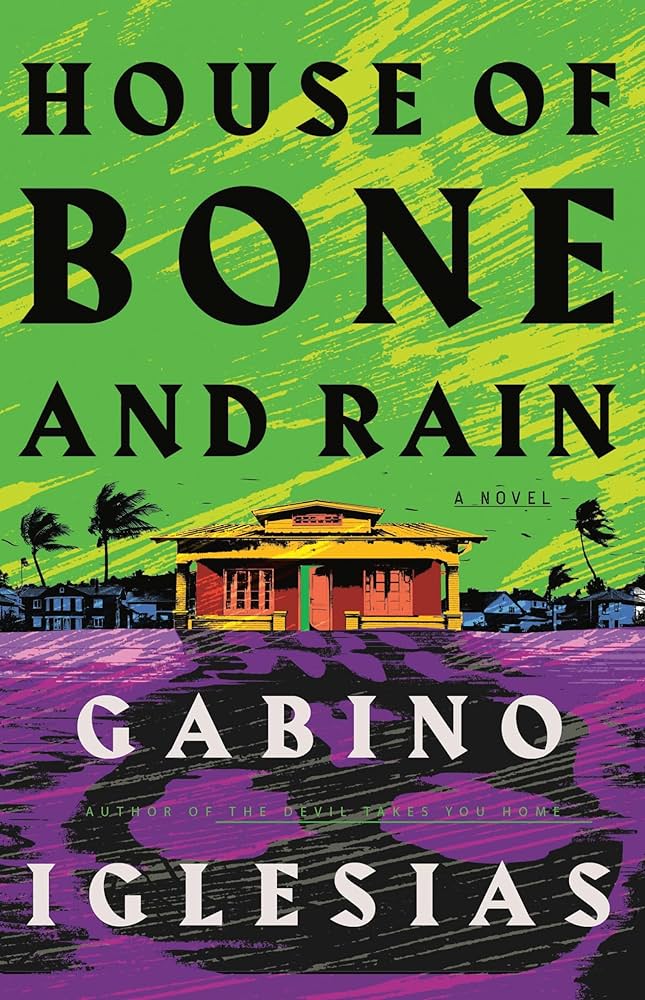
It was weird reading Gabino Iglesias’ latest, House of Bone and Rain, for any number of reasons that had nothing to do with the quality of the book. I was reading it when that “comedian” called Puerto Rico “a floating pile of garbage” (not that it mattered); while writing my own book, also set during a hurricane; and was thinking about writing another supernatural thriller about teenagers. This book is set in Puerto Rico before, during, and after a hurricane, and the main characters are teenagers. Serendipity? Synchronicity? An interesting series of events? I’m not sure if it’s anything other than a lovely coincidence, but there it is. I also really loved Gabino’s previous novel, the award-winning and critically acclaimed The Devil Takes You Home, which was exceptional, and had my appetite whetted for a follow up.
It says a lot about an author so good they make me overlook things I generally don’t like to read about–machismo, violence–because they are able to turn those things into art.
The last day of classes, our last day as high school students, marked a new era for us. We wanted it. we feared it. We had plans for it. Then Bimbo’s mom hit the sidewalk with two bullet holes in her face, and the blood drowned out all those plans.
Bimbo called to tell us the day after it happened. His real name was Andrés, but we mostly called him Bimbo because he was brown and chubby and looked like the mascot bear of a brand of cookies. It’s normal for people to report the death of a parent. Old age. Cancer. A heart attack. Whatever. Old people die and we expect it, accept it even. It’s normal. Murder is different. Murder is a monster that chews up whatever expectations you had regarding death and spits them in your face. Murder is an attack on someone’s life, yes, but also an attack on those left behind.
When Bimbo called to tell me about the death of his mother, María, I felt attacked. “They shot my mom, man.” Five words about the recent past that were heavy enough to crush out future.
It says a lot about an author so good they make me overlook things I generally don’t like to read about–machismo, violence–because they are able to turn those things into art. I generally don’t like to read about extreme violence, with bones crunching, blood spurting, and teeth flying. Because I do actually abhor the use of violence1, it’s very hard for me to relate to characters who turn to violence for whatever reason; it’s not easy to ever make me think yes, this is the right path. Violence and rage are very dark places to go, and while I completely understand embracing your rage, I will vent it a bit so it calms down before I go there. But Iglesias is the kind of writer who can pull a squeamish reader along the path of male rage and violence, which is emotion-driven rather than logical.
The book centers a group of five young friends who have just graduated from high school, and the brotherhood they develop by uniting as a group and fighting off everyone else; it’s very Three Musketeers-like; “anyone fucks with one of us, they fuck with all of us.” Iglesias also provides enough back story to make each character an individual–not easy to do with so many characters–as well as the group dynamic and why, despite any internal squabbling, they always try to present a united front on this dark odyssey of revenge and violence. Gabe, our narrator, is kind of at loose ends at the opening of the book and not knowing what he wants to do with his life. He has a girlfriend he genuinely cares about and wants to build a life with, who wants to move to the mainland and go to nursing school–and wants him to come with…but his own ties to Puerto Rico, including his mother, make it hard for him to make the choice. What if he does and it doesn’t work out? What will he do then? He is transitioning from callow youth into manhood at far too young an age, but…that’s what life is like for people living under colonization.2
Gabe is also the conscience of the story–if there can actually be one. He goes along with his brothers to get revenge for Bimbo’s mother’s murder, which puts them afoul of a drug cartel (seriously, who sets out to kill the head of a murderous criminal cartel?), but there’s also something else going on…there’s some supernatural elements involved with the cartel as well that either could just be gossipy stories to scare people into obedience, or might just be real.
The book barrels along at an excellent pace–the length of time it took for me to get through it had nothing to do with the quality; I was trying to savor it because I was enjoying the voice and the writing so much. It’s also very vivid and real; Iglesias writes in such a way that puts you right there in the room with the characters–and always, there’s this foreboding sense that time is running out for the boys, and not all of them may make it to the end.
An excellent mash-up of horror, crime, and noir stylings, I have to say this is terrific, so check it out.
Ain’t going to lie, there’s a part of my brain that does think that those who commit violence should get it back, repeatedly and far worse, than they dealt. ↩︎
After the Puerto Rico garbage insult, people thought Puerto Rico should become a state; which I found amusing. No, they should be granted their independence from their final colonizers and paid reparations. Who says statehood in a racist country is desirable for them? ↩︎
A month or so ago, Ira Levin’s A Kiss Before Dying was one of those “special deals for ebooks,” and I can never pass up a classic for a mere $1.99 (I generally replace my hard copy books with ebooks when they are on sale, so I can donate the real book; but Ira Levin novels will never be donated), which put me in mind of him again (the book is a crime fiction classic), and I started thinking about what is the best part of two of my favorites by him, Rosemary’s Baby and The Stepford Wives, which is the slow build of paranoia until the heroines are completely convinced that everyone is in on it and there’s no one she can trust. This is what I consider “women’s noir,” which is books that depict and explore women’s fears (which is why Gothics were so popular, I think; the wife can never trust the husband and always thinks he is trying to kill her–before the real culprit is exposed and they have their happily ever after. This, to me, mimics what it’s like for a woman when she gets married in real life; she wants to believe in her marriage and love, but how many times has that turned to ashes and dust in reality? Husbands kill wives or cheat on them or leave them; all these marriage fears were tentpoles of Gothics). I was going to revisit both novels–I had some other things I wanted to talk about with The Stepford Wives, and its similarities to Rosemary’s Baby, but I couldn’t find my copy of the latter so went with the former.
Since 2015, the term “gaslighting” has come back into vogue, with small wonder. Gaslighting can make you question your own judgment and your grasp on reality1; something many of us have experienced over the past nearly ten years and it isn’t an enjoyable experience.
Paranoia, combined with not being believed, makes for a fantastic novel that is very difficult to pull off; I can think of any number of films and books that use paranoia as a driving theme for their plots, and I always enjoy them. There really is nothing more frustrating than being being not believed about something that’s happened–or is happening–to you. It can make you crazy, make you question yourself and your own grasp of reality. It’s horrible and cruel in reality, and it’s something everyone can relate to because we have all not been believed at some point in our lives. It’s happened to me enough times (including losing jobs) that it certainly resonates with me. (I have an idea for a gaslighting/paranoia short story that I’ve been wanting to write for some time now.)
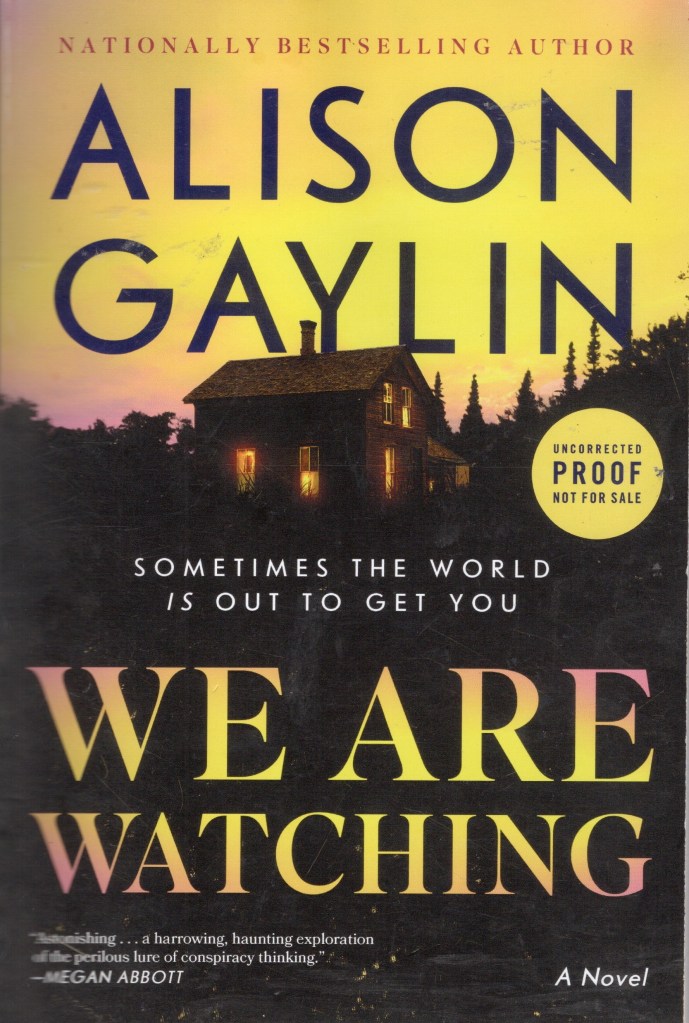
So, needless to say, I greatly enjoyed reading my advance copy of Alison Gaylin’s upcoming January release, We Are Watching.
It’s been the longest day of Meg Russo’s life, and it isn’t even half over. Her stomach gnaws at her, her hands heavy on the steering wheel. But when she glances at the clock on the dashboard, she sees that it’s a little shy of 11:30 a.m., which means that Meg, her husband, Justin, and their daugheter, Lily, have only been on the road for an hour. They’ve got at least three more hours on the thruway, and then they’ll have to contend with the series of veinlike country roads Meg and Justin haven’t traversed since their own college days. If they don’t hit too much traffic, they should be in Ithaca by five, which now feels like some point in a future so distant, Meg is incapable of envisioning it.
Time is strange that, the past eighteen years zooming by in an instant, all of it leading up to a single day that’s already lasted eons. Meg blames the stress of last night, wanting everything to be perfect for their daughter’s send-off, which led to thoughts of Lily’s first visit home for Thanksgiving break, which in turn made Meg think for the millionth time about how cold their house gets in the fall, and how Lily always complains about it. New windows, Meg had thought, lying in bed with her eyes open, envisioning insulated windows to replace those paper-thin sheets of glass, the same windows that were here when she and Justin bought the place twenty years ago–and it was a fixer-upper then. What if Lily came home to new windows? Meg mused, still awake in the wee hours of the morning. Will she have changed by then? Will she have grown too sophisticated to get excited over a warmer house? And so on, until the sky was pink and it was time to wake up and Meg had barely slept at all.
I’ve enjoyed Alison Gaylin’s work since I first read And She Was back in 2012, and have been a fan ever since, gobbling up each new book as she releases them. She has always been a terrific novelist, but what has been amazing to watch is how she pushes herself to do better with each book, tackling bigger themes and creating believable, relatable characters you can’t help but want to root for. We Are Watching may be her best yet, starting as a slow burn but building into an adrenaline boosting rollercoaster of a thriller.
The book opens with Meg and Justin taking their daughter Lily off to college, with all the emotions and fears and sense of loss that comes with a child leaving home and starting to move into their adulthood. Meg is likable, and so is her family. But as they drive a carload of skinheads pulls up alongside of them and start taking pictures. Meg reacts very strongly–so strongly that even I was like take a chill pill, girl!–which eventually leads to a crash that kills Justin, leaving the two women shattered shells of their previous selves. Lily decides to take time off from college and even Meg becomes housebound, despite needing to run her book store in the small Hudson Valley town they live in.
But things slowly begin closing in on both Meg and Lily; who were those skinheads in the other car? Why are truly strange, cult-like people showing up in the store or in town, chanting weird things at them? As Meg’s paranoia and fear grows, it soon becomes apparent that a religious cult is targeting her and her family, but why? But to find the truth, Meg has to not only survive the cult, which seems determined to kill her and her child, but when she has the time, to dig back into her own past to discover the truth–because the truth is the only thing that can set them free.
This book is fantastic, and I couldn’t put it down. It has all the hallmarks of a great Gaylin novel–a compelling and relatable main character doing the best she can in a terrible situation; a twisty plot full of surprises; and the kind of strong writing that makes her sentences and paragraphs sing.
Preorder it now and thank me in January when you finish reading it.
The film this term comes from, Gaslight, is a great movie and Ingrid Bergman is terrific as the wife who isn’t sure if she is losing her mind; she deserved her Oscar and the film still holds up–and a very young Angela Lansbury makes her screen debut in it. ↩︎



 Queer and Loathing in America