Glory Glory Hallelujah

One of the things I’ve always lamented is the shortage of Black Louisiana crime writers.

There have been Black characters who were the main characters in Louisiana crime series, but they were always written by white people and while I did enjoy some of the books, I always felt a little uncomfortable with reading them. Can a white person really do a Black main character in a Louisiana crime series justice? I am sure if I went back and reread them now I’d find them more problematic than I did in the first place.

So, when my friend Ellen Byron recommended that I should read Danielle Arseneaux’ debut novel, Glory Be, I couldn’t wait to get a copy and read it.

And I am so grateful that I did, because it’s an absolute joy.
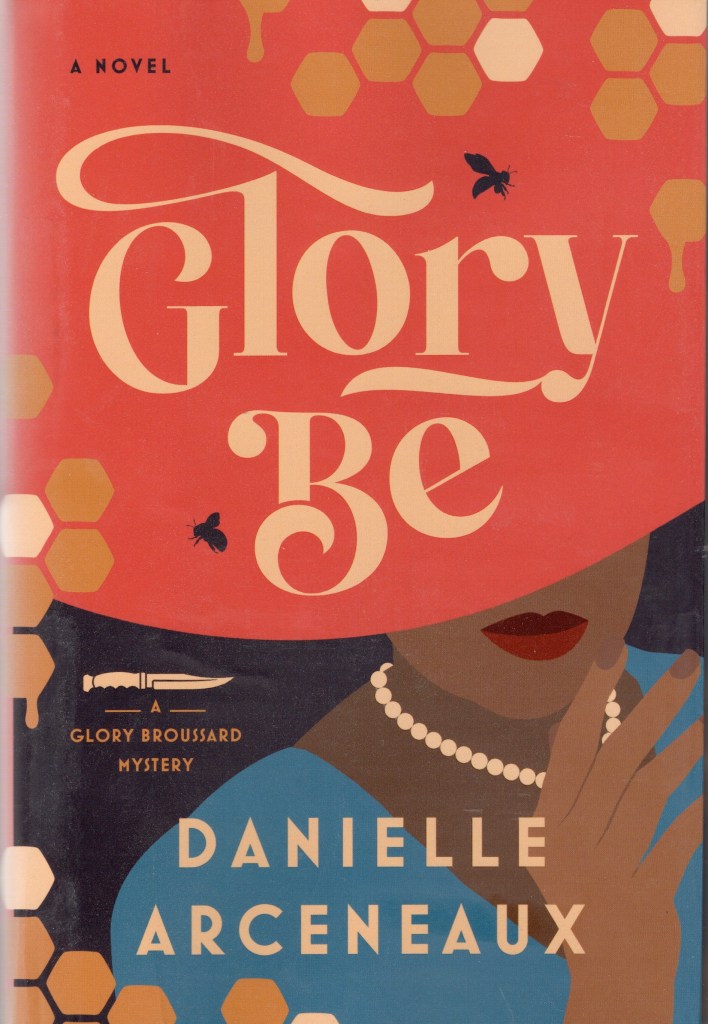
Glory Broussard was tired of waiting. She figured this barista was new, and she would know since she was a regular at CC’s Coffee House. With each drink order, he nodded and flipped through the pages of a thick manual, going back and forth between the espresso machine and the book.

It didn’t help that he was grinning like a goddamn fool at that white woman. She was wearing a pink ribbed tank top, and as far as Glory could tell, no bra.Her jean shorts were so scant that you could see the bottom curve of her ass. Glory had seen enough of this recently at the Acadiana Mall to know it was not an accident but a trend, and a disgraceful one at that. Wet hair crept down to her waist, making her look like a creature that had crawled out of the Atchafalaya Swamp.

Glory edges up to the counter, closely behind the braless woman. “Excuse me,” she said to the barista. “Are you the only one working behind the counter? Y’all should be better staffed for the after-church crowd.”

“I’m not sure. I’m new here.”

“Clearly.” She wiped the sweat from her forehead, a useless gesture in Louisiana this time of year.

What made this even more exciting to me was the book wasn’t set in New Orleans–as so many inevitably are–but in Lafayette, which was also refreshing. Lafayette is a more Cajun city than New Orleans, and is the heart of what we call Acadiana here. I really like Lafayette; I went up there with some friends who were touring Louisiana and had a great time and some truly great food. It’s also a gorgeous little city, too, with lots of charm and its own Carnival, and very different than New Orleans.

The above is the opening sequence in which Arsenault introduces us to Glory Broussard, a deftly drawn, deeply complex character who worked as the produce manager at a grocery store for years until she got custody of her ex’s betting book in the divorce and took over for him, spending every Sunday after church at CC’s and taking bets. Glory is prickly and proud, and never takes any slight lightly. By the end of the first chapter her best friend, a nun she grew up with named Sister Amity Gay, has committed suicide. Glory doesn’t believe it for a minute and is furious when the police write it off as a suicide, even though she is certain Amity would have never committed suicide…so she decides to take it upon herself to investigate for them.

The investigation itself is worthy enough for reading, but the way the book is structured, the way Arsenault slowly plays out her cards letting us get to know Glory better by revealing why she is the way she is at the opening of the book truly kicks into gear where her lawyer daughter Delphine shows up, ostensibly to help her fight the condemnation of her house the city is processing because of complaints–and by showing the house through Delphine’s eyes, as well as her mother, gives us an entirely new perspective on Glory herself, as she also recruits Delphine to help her look into Amity’s death…and oddly enough, there are any number of motives for someone to want Amity out of the way–including the corruption behind a new petrochemical plant’s approval that Amity is fighting–as well as a connection to the drug kingpin of Acadiana.

I loved getting to know Glory, I loved seeing her take charge of her own life again after several years of depression, and the pages simply flew past. Arsenault has an amazing gift for a turn of phrase, all of them purely Louisiana, and a masterful authorial voice.

I can’t wait to read the next one.

Knock on Wood

I was Executive Vice President of Mystery Writers of America for three years (2020-2022), and it isn’t something I talk about much. I never wanted to be seen as using this volunteer position (which basically was chairman of the board) to promote myself or my career, which is why I never really talked about it much other than referring to it here as “my volunteer work.” It was exhausting, exhilarating, and frustrating at the same time. I dealt with a lot of firsts–first EVP to cancel the Edgar banquet, first EVP who had a Grand Master die on him before the Edgar presentation, on and on and on–but one thing I am really proud of that I accomplished in the role was the creation of the Lillian Jackson Braun Award, facilitated by two board members. Cozies are often overlooked when it comes to awards–they are the romance novels of the crime fiction community, looked down on, mocked, and not taken seriously–and I’ve experienced crime writers talking smack about cozies from even before I was published. The establishment of this award was a first step, I felt, for MWA to appreciate and uplift this subgenre so that it’s taken more seriously.

I had always wanted to write one, and that became A Streetcar Named Murder. I’ve also been reading more of them, too, since I realized I had allowed the opinion of others to influence my reading habits. I’ve long enjoyed Donna Andrews’ and Ellen Hart’s series, and there are so many terrific cozy writers out there…Ellen Byron, Sherry Harris, Katherine Hall Page, Leslie Budewitz; the list could go on forever, really.

So I’d been meaning to get around to the first Lillian Jackson Braun winner, presented earlier this year–and what a pleasant surprise Buried in a Good Book by Tamara Berry turned out to be.

“There are at least three dead bodies in there.”

Tess Harrow stood in front of the log cabin, mentally calculating where each of the corpses would be found. The basement would have one of them. She could see damp seeping up from the underground barracks, the stonework crumbling with neglect. It would be a crime not to store a body there. The lean-to on one side of the cabin, which was living up to its name and looked one strong breeze away from toppling over, was ideal for another. The chimney was large enough for someone small, and…

“Four. Four dead bodies.”

She nodded once and hefted her suitcase. There would be an additional corpse under the porch–she was sure of it. The rotted wood and craggy slates made the perfect cover for one final interment.

“You are so weird,” muttered Gertrude. Tess’ s teenaged daughter didn’t bother lifting her own suitcase, opting instead to dragit on the ground. The bump of the bag matched the slump of her shoulders. The prospect of sharing her home with a few corpses wasn’t doing much to improve a mood that had been questionable to begin with. “Please tell me we at least have Wi-fi out here.”

At first, I wasn’t sure what was going on in this opening sequence, and Berry draws this out a little bit, as we slowly are introduced to bestselling thriller writer Tess Harrow and her teenaged daughter, Gertrude (Gertie). Tess and Gertie’s father divorced some six months before the start of the book, and he’s pretty much ignored her since leaving Tess for a younger woman. Tess, behind on her latest book–she hasn’t started it–decided to remove herself and her daughter from Seattle and come out to stay at her grandfather’s extremely rural cabin–no power, running water, or wi-fi–so she can focus on finishing her book and get Gertie away from the Internet so she won’t know her dad isn’t reaching out to her. Within moments of their arrival, they head down to the pond on the property just as the water explodes and it starts raining fish–and body parts. A dead body had been in the pond, and the “blast fishing” not only killed the fish but dredged up the corpse. Soon we meet the local sheriff–a dead ringer for Tess’s police detective, and she starts plotting her new book by basing it on what is happening around her.

This is an wickedly clever concept: Tess isn’t investigating the murder, but trying to figure out how to plot her book since it’s based on the criminal investigation going on around her. These are some of the most amusing parts of the book–as Tess tries to change the crime so it’s not obvious she is basing it on a true crime, and changing characters and relationships around so they don’t bear too close a resemblance to the real thing, but she keeps stumbling on clues–and the police detective is getting awfully tired of her bizarre theories and interruptions. Berry makes this even funnier, by having the cop actually be one of her readers, and constantly telling her how she gets things wrong in her books. There are a lot of weird things going on up on these woods–and every element, no matter how disparate, ties in to the mystery–a flock of toucans, an eccentric’s missing cat, Bigfoot sightings, and a town full of suspects, including identical triplets (I did this in a book too!)–and there were several points where I had no idea how this was all going to play out and work out, but I was also having an incredibly good time reading it. It’s funny, and I really like the characters of Tess and Gertie, as well as their supporting cast.

I am looking forward to the next for sure!

(It’s Going to Be a) Lonely Christmas

Merry Christmas to those who celebrate, and if you don’t–well, happy Monday off!

Yesterday was not a good day. I woke up feeling like crap, and it never really got much better until later in the day, when I realized it had started raining during the night. It rained all day, actually, and I was so tired and dragged out and felt so terrible that I didn’t put it together until late in the afternoon–oh, this is SINUS related, because of the rain–and took a Claritin-D, which made me feel somewhat better. I also slept super good and slept in, too. I did manage to get some things done yesterday too–I finished reading Buried in a Good Book (more on that later) and started reading another one. We also finished watching both Looking the series, and then watched the wrap-up film (more on that later as well). I am going to pick out my next read, spend some time with it this morning, and at some point today we are probably going to watch Saltburn. I also have to put the turkey breast in the slow cooker (pulled turkey is quite delicious) and put dishes away, but I also have tomorrow off, so am not overly concerned about getting things organized and cleaned up. I worked on the books some more and pruned some more out, and started learning how to use the microwave–which does make a difference.

Christmas is usually when I started looking back on the year, and 2023 was a bit of a rollercoaster for me (they usually are). My personal life really sucked balls this past year, but it was a very good year for me professionally. The year started with me behind on two deadlines, but I managed to get both books finally finished and turned in, once I was able to turn MWA over to my successor, which was part of the delay on the books. In late January I injured my arm, and got misdiagnosed by my primary care physician. As we rolled into Mardi Gras, Mom had a massive stroke and I drove up to Kentucky to see her one last time in hospice. She didn’t really know me, she was pretty much unresponsive unless she was in pain, and it was rough. I drove home that Sunday, and she died on Valentine’s Day, so I had to drive up to Alabama that last weekend of Mardi Gras for the funeral. Not going to lie, it was tough losing my mother, and it’s been tough all year. I have sublimated most of my grief into worry about Dad, frankly. I went up and met him in Alabama for their anniversary, and we convoyed up to Kentucky, where I stayed for a week. I met Dad at my aunt and uncle’s place in Panama City Beach in October for their birthdays. When my primary care finally recognized what was wrong with my arm (torn biceps), I got referred to a orthopedic surgeon–but I needed a specialist. I had all my teeth removed finally in September, right after Labor Day, but didn’t get my new teeth until the week before the arm surgery, so was on a soft diet for two months which sucked….and then had to go back on it after the surgery because I couldn’t really cut up food. I also got hearing aids, which was great and has helped dramatically.

I also finally realized what the core mental issue was, thanks to a conversation with Dad–when I found out she suffered from generalized anxiety disorder and the light bulb went on over my head: that is exactly what is wrong with me, and all these years what I thought was “normal” because I didn’t know any different and I just always thought I was like Mom…yeah, I am like Mom, and all these years all I’ve been doing is treating symptoms and not the root cause. In consultation with my new primary care doctor, I weaned off the old medication and started treating the anxiety and the insomnia (anxiety related) properly, and it has made such an amazing difference in my life. I think more clearly, and I can analyze myself better. I’ve also started thinking about how most of my life I’ve tried to avoid confrontation (like Mom) and whenever something has happened that hurt me…well, I’ve tried to avoid those kind of situations again. My trust issues come from the anxiety and being hurt before, and I also realized that my socialization as a child was delayed and/or stunted because of being unable to control my brain. I had undiagnosed ADD as a child, and I feel pretty sure that’s carried over to my adulthood, as well. I couldn’t focus or concentrate because I didn’t know how to shut my brain off or keep it until control. The only time I could find peace, really, was reading or writing.

Professionally, I started off the year by getting nominated for a Lefty for Best Humorous for A Streetcar Named Murder, which was a very pleasant surprise. I debated going, but the timing was bad and with all the traveling I was having to do for family stuff, I had to conserve and preserve paid time off. This was followed up by an Agatha nomination for Best Children’s/Young Adult for #shedeservedit, and this time I did go. I lost to Enola Holmes, but I also became friends with Elizabeth Bunce (we’d been nominated together for an Anthony the year before) and Frances Schoonmaker, who was an absolute delight. I was nominated for three Anthonys at Bouchercon this year–Children’s/YA again; anthology for Land of 10000 Thrills, and Best Humorous for Streetcar again. None of those nominations ended with a win, but for me the nominations alone were the real win. I never ever thought I would be shortlisted for mainstream mystery awards, and what a delightful surprise.

I did publish two novels this year–a new series debuting with Death Drop, and the ninth Scotty, Mississippi River Mischief. I also got an (undeserved) editorial credit for School of Hard Knox, along with Donna Andrews and Art Taylor, for publisher Crippen and Landru–which meant working with my dear friend Jeffrey Marks. I have a story in the book, too–“The Ditch”–which was something I’d been working on forever. I also published two more short stories, “Solace in a Dying Hour” in This Fresh Hell, and “The Rosary of Broken Promises” for Dancing in the Shadows. I’m pleased with both stories, but I also need to get more. I have any number of incomplete projects that are nagging at me that I would like to finish in the new year. SO MANY PROJECTS.

But I feel good today, and very rested. I’d intended to take today as a do-nothing day, but I will probably do stuff because I am not really wired to not do anything all day.

And on that note, I will wish you happy holidays for the moment and head into the…well, not the spice mines, but perhaps a spice resort?

Feliz Navidad

I do love me a good cozy mystery.

Cozy mysteries often get little respect from the other subgenres of crime fiction, and their authors likewise generally only get respect from their cozy colleagues; but the disdain they get from a lot of other crime writers is actually kind of criminal. It’s no easier to write a cozy than any other form of mystery; if anything, I would think it would be harder to write about a murder without much blood, no violence, no profanity, and no sex on the page. Part of the reason I decided to write A Streetcar Named Murder was the challenge of writing one, and it was far harder writing that book than it was writing the ones in other subgenres of crime; I wish I had a dime for every time I backspaced over a profanity I’d automatically typed; I curse a lot and so do my characters.

So while I am writing a new cozy–the sequel to Death Drop–I thought I’d read some while I wrote to get a good feeling for the subgenre.

And I am finding one can never go wrong with Raquel V. Reyes.

Halloween was a week away, and we didn’t have s single decoration up. The living room was littered with shopping bags, extension chords, four-foot-tall plastic jack-o’-lanterns, and one handsome Frankenstein.

“Babe, we’re going to need a ladder and a staple gun,” Frankenstein said.

“Can you borrow one from a neighbor?” I asked as I squeezed my foot into a shoe that had fit perfectlya few weeks ago but was now tight. My costume, like my husband’s, was a modification of something I already had. I’d taken a white apron and smeared it with beet juice. In red marker, I’d written Chef Vampira on a paper toque, the tall hat fancy chefs wore. I was not a trained chef, but I had reached local stardom with my two cooking shows, Cocina Caribeña and Abuela Approved.

“Do I look undead enough? Do I need more white makeup?” I asked.

I got a copy of Raquel’s Lefty Award winning novel for Best First at Left Coast Crime in 2022. I read it later that year, and kind of fell in love with the series and its main cast. After years of living in New York and working as a food anthropologist, Miriam, her husband and son all move to his hometown, Coral Shores–a town within Miami’s borders. As she found her footing in this rich and posh neighborhood of McMansions and racist snobs (including her mother-in-law) she gets involved in a murder when someone–her husband’s ex and whom his mother wanted him to marry–died of poisoning right in front of her at a charity luncheon–and Miriam develops a nose for mystery.

This second book in the series is a welcome second offering. This time out, there are bodies everywhere. Did the chef at the country club accidentally fall to his death, or was he pushed?The mother of the victim in the first book is found unconscious and incoherent on the side of Miriam’s house. Her neighbor is found unconscious and frothing in the mouth on Halloween night, so she has to take in his dog until he’s recovered. AND her mother-in-law has coerced her into putting together the charity fundraiser at her snooty country club, so she is constantly picking at Miriam…even in front of her grandson. And then there’s another murder. Miriam can’t help sleuthing, everything keeps building until the night of the gala–when Miriam gets to the truth finally and puts her own life at jeopardy.

I love this series. I love Miriam, and I love that Reyes doesn’t italicize Spanish words (she says she writes in Spanglish) and that she authentically sprinkles Spanish organically through the books. I love that the books focus on Caribbean cooking, and how it developed culturally and anthropologically. I cringe at the racism Miriam experiences (while getting angry at it; I despise bigotry), and I really care about Miriam; which is the key to writing a good cozy mystery: a main character the reader can identify with and like.

Do read this series. I can’t wait to get my hands on the third!

All I Want for Christmas Is You

All evidence to the contrary, I do love Christmas. I love the decorations, I love the mentality behind it, I love the festive spirit that people try to keep up during the season, and I even like the music for the most part. (I also find many things wrong with American Christmas, but that’s for another time.) I detest cheap sentimentality, or melodrama for the sake of a cheap emotional response from the audience/reader. I don’t enjoy Hallmark or Lifetime Christmas movies as a genre–predictable, sickly sweet, cloyingly sentimental like cheap perfume–but I don’t care that other people do; my preference is never to yuck someone else’s yum. Obviously, there’s a big market for those films and books, but they generally aren’t for me. I just don’t buy into them when I watch, I suppose, is the best way to put it?

This is also partly why I don’t read a lot of romance novels. But when I saw that David Valdes had written a young adult Christmas romance novel, I thought, you know what? I bet this is really good, so I procured a copy and spent a lovely afternoon reading it.

I loved it.

No one can accuse my dad of being subtle. He loves Christmas the way most guys in the Pioneer Valley love the Patriots. Instead of team jerseys, he has a collection of ugly holiday sweaters that would be kind of impressive if it wasn’t so embarrassing. (Seriously, the llama ones lights up. I can’t.) So I shouldn’t be surprised that when I arrive home for my first, or maybe last, winter break from college, the house looks like, I don’t know, Frosty Con. Snowmen everywhere.

I’m so not in the mood.

Don’t get me wrong: I like Christmas well enough. Even though Halloween is my favorite holiday because of the costumes, I love all the twinkling lights, and you can’t really overplay “All I Want For Christmas Is You.” But’s it been a long day on the bus from NYC, and before it was a long day, it was a long week in a long semester. Not that I’m ready to admit that to my dad.

I purposely chose a bus that would get me home to Lindell while he was working. Yes, it’s, like, almost two miles from the bus stop in front of the old town hall to our place, but dragging my bag for forty minutes was worth it for the chance to come home to an empty house. I need some time alone in the privacy of my own room before Dad gets here and I become the grinch, the carol killer, the fly in the eggnog.

I have to tell him that I’m failing out of school.

And so we meet Cam, first semester Theater major from the small town of Lindell, Massachusetts, coming home with his head bowed and thinking he’s failed at making it in the big city. He was THE theater kid at his high school, but once he’s made it to the city and school of his dreams, he’s just another face in the crowd–and doesn’t feel like he fits in. He’s doing fine in his required courses…it’s the theater ones he’s having trouble with, and his father is working two jobs and he may lose his scholarship. He doesn’t have the heart to disappoint his father and ruin Christmas, so he bides his time with the terrible news–like everyone teen, avoiding the bad news or put it off till later. A chance trip to the new mall in town winds up with him getting a job as an elf in Santaland, where he meets his fellow elves–an older retired military man; a blonde good two-shoes, a Goth girl, and perpetually happy, cheerful and annoying Marco. He also runs into his ex, LeRoy, and isn’t sure if he wants to start up with him again or not; he dumped LeRoy the summer before he left for college, thinking it was better to not try the long-distance thing.

The best part of the job? The elves are in a competition to win a five thousand dollar prize–which will make up for the scholarship he’s losing–by winning a popular on-line vote. As the days pass and he gets to know his fellow elves better, he starts opening up a little bit himself and seeing things from perspectives other than his own. All the other elves help with this process, but especially Marco–who seems to be the embodiment of the Christmas spirit and just a genuinely kind, empathetic soul.

The book is a romantic comedy, so there are funny moments as well as the ones that make you sigh and warm your heart–all of it earned, mind you, and not there for story purposes–but it’s also about Cam growing up into a better, less self-absorbed person who maybe doesn’t project his impressions onto other people and sees them with a kinder eye. Valdes nails the teen voice perfectly; Cam is at heart a good person, if a bit too wrapped up inside his own head with his own issues and problems, but he is deftly drawn and fully conceived, so you root for him even as you groan at his poor choices; you want him to do better, be better, because he really is a good person.

I loved this story from first word to last, and I really wish these kinds of books had been available when I was a teenager. Something like Finding My Elf could be a lifeline for a kid in a bleak rural area who feels so alone and lonely and hopeless.

Perfect Christmas gift for any queer teen you may know, and frankly, it’s a strong enough read for adults, too.

God Rest Ye Merry Gentlemen

Christmas and crime don’t get together often enough for my liking–although I always love to call It’s a Wonderful Life a Christmas noir, because it’s actually an incredibly dark film if you look below the effervescent sugary surface. (I’ve always wanted to write a book set in the world created had George Bailey never existed–Potterville.) Agatha Christie handled the holidays in a couple of books, most notably Murder for Christmas, and the occasional short story. (This is a good place to note that when I was talking about my own Christmas writings, I’d forgotten “The Snow Globe”, which is my most Christmas story of them all; the one I did remember to mention, “The Snow Queen,” was more a winter’s tale than a Christmas one.)

Lisa Unger is one of my favorite writers, and she’s also pretty prolific; I turned and looked away for a moment and suddenly I was way behind on reading her books. I had never caught up on the backlist, either; so I think focusing on that is a good plan for 2024. When i saw that she had written a Christmas novella, getting it was a no-brainer–and I read it in one day…and it reminded me again why I love her work so much.

I always loved Christmas. I still remember how magical it was to believe in Santa Claus, lying in bed at night, trying to stay up to hear the pitter-patter of reindeer hoofs on the roof. Then falling asleep and waking up to the tree glowing downstairs, the floor covered with gifts, my parents groggy and smiling.

I saw him, my sister would say. On the lawn, climbing out of his sleigh.

And I would be so jealous that she got to see Santa, while I couldn’t keep my eyes open long enough. She was always first. Always better. Still is.

I lean against the pole now, arching my back, all eyes on me. The music pulses and the stage lights beneath my high heels flash–purple, blue, orange, red. I am alive here, all of it moving through me. Tonight, I perform to various Katy Perry songs–a playlist I made. “Hummingbird Heartbeat.” “Peacock.” “Part of Me.” All songs that are sexy and upbeat but have a secret message. Like me. No one is listening to the music though. The smattering of men sitting on stools and in various booths, nursing drinks, are only thinking about one thing.

Ten years ago, Madeline Martin survived a brutal night in which her best friend was murdered, and two others disappeared. Maddie herself was stabbed multiple times and the side of her face slashed. Her boyfriend was convicted of the crimes and sent to prison–he was a rich bad boy exiled to their upstate New York town (but further south than the Hollows, the town Unger writes about a lot), and for whatever reason, he just kind of went nuts that night during a wild party at his home a few days before Christmas. The two sisters who vanished were never found, and the assumption has always been he killed them also and got rid of the bodies…which really doesn’t make a lot of sense. Maddie’s father was the sheriff, and he has recently had a stroke, requiring at home care, while she runs her own bookstore with some success. Maddie has also closed herself off from dating–who wouldn’t, when your high school boyfriend turned out to be a psycho killer–and at the very beginning of the book, true crime podcaster/writer Harley Granger has come to town, buying the home where the missing sisters once lived, to turn over the stones and interview people–he doesn’t believe for one moment that Evan Handy had the time and ability to not only do what witnesses saw (stabbing Maddie and killing her friend) AND kidnap and murder and hide the bodies of the missing sisters. Harley thinks Evan either had help, or there’s an unrelated serial killer operating in the area–and the disappearance of a stripper named Lolly from the area is proof–along with some other young women gone missing in the years since that nightmare of a night that Maddie can barely remember.

This is Lisa Unger at her best; she writes brilliantly, defining and developing realistic characters that the reader can identify with and relate to and root for; delving into the psychology of what it must be like to survive a night like the one Maddie did as a teenager allows for complexity and many layers and facets to her character, and despite the shortness of the story (compared to Unger’s novels), it’s fully realized, compelling, and hard to put down. Unger’s pacing is urgent, grabs you by the throat and refuses to let go until you’ve turned the final page.

Which is why she is one of my favorite writers.