Four to the Floor

Dream Lover: Monday morning back to the office blog; in which I had a productive weekend; finished a short story; figuring out what I need to do; thinking about being a Louisiana tourist; and back to the gym.

https://gregwritesblog.com/2024/02/26/dream-lover/ via @scottynola

Ah, the torturous path Murder in the Rue Ursulines took on its way to the book stores.

There was, if you will remember, a lot of turmoil going on at Alyson at the time. I had worked with a different editor for every Chanse book, and as I waited and waited and waited for an offer for the fourth book, my third editor was fired as the company reorganized its publishing arm yet again, with the end result that they didn’t make an offer on the book until they realized that the fall catalogue had been neglected during these transitions and they made the offer so long as the book could be finished in six weeks (I hadn’t started writing it yet) but I said yes on two conditions: I could work with an outside editor of my choosing, and the contract had to be for two books, rather than one–so I wouldn’t have to go through this again for the fifth book in the series. I kind of figured they wouldn’t meet my demands–but they did, of course, and then I had to write a draft of a book in six weeks.

Constant Reader, I managed it.

“Chanse MacLeod to see Loren McKeithen,” I said to the pretty woman at the reception table. She looked to be in her late thirties, and of mixed racial heritage, her skin the color of a delicately mixed café-au-lait, her hair copper-colored. She gave me a wide smile. There was a wedding ring on her left hand, and a diamond tennis bracelet on her right wrist. Her nails were done in a French manicure. On her forehead was a smudged cross made of gray ash. I was tempted to ask what she’d given up for Lent, but decided against it.

“Have a seat, and I’ll let him know you’re here.” She gave me a smile, picking up her phone. “It shouldn’t be more than a few minutes.”

I nodded and took a seat in an overstuffed leather chair, picking up an issue of Crescent City magazine and idly paging through it. I was tired, probably way too tired to be taking on a new job. The aspirin I’d taken hadn’t kicked in yet, either. Every muscle in my body ached. I’d planned on spending my entire Ash Wednesday in bed, or lazing around my apartment, recovering from the overindulgence of the last five days. But Loren was a good guy, and threw me some work every now and then. So, I’d roused myself out of my post-Mardi Gras stupor and come to his office.

Besides, it never hurts to have a prominent attorney in your debt. You never know when you’re going to need one.

This story actually started out as a Scotty book, what I thought would be the fourth in that series, Hollywood South Hustle. This book was inspired by something that happened to me on my way to work one morning. When I originally went to work part-time at the NO/AIDS Task Force part time, I worked out of the CAN (Community Awareness Network) office on Frenchmen Street in the Marigny. Full time staff had free parking in a lot around the block on Elysian Fields; I had to find street parking in the neighborhood, which was never a guarantee. This particular morning I found a place to park over on Kerlerec, and as I was locking up my car a family on bicycles was coming around the corner at Chartres. The adults raised a hand in greeting and I automatically said “Good morning” pleasantly back to them with a smile, and it wasn’t until after they rode past that I realized it was Brad and Angelina and two of their kids; they lived a few blocks away. As I continued on my way, I smiled at the coolness of the moment and I thought Brad has hair the same color as Scotty and is about the same age and size as Scotty and he lives right around the corner and wouldn’t it be interesting if Scotty was walking past their house and someone shot at him, thinking he was Brad? And that would be the start of something. The more I thought about it as I walked, stopping at the little Vietnamese grocery to buy cigarettes, the more i liked it, and by the time I sat down at my desk the entire story was taking shape in my head.

And yes, instead of doing work that day (I didn’t have any), I wrote up the story, the idea, the title, and began the proposal. I also wrote the first chapter and over the rest of that week I wrote the first five, feeling like I was onto something. I polished up the proposal and the first chapters, while continuing to write, and sent it to Kensington, who held the option on the series. While i waited to hear back from them, never doubting for a moment they would exercise their option and take the book, I kept writing. It was incredibly easy, and I was clocking between three and seven thousand words per day.

The day after I finished writing the first draft, Kensington didn’t exercise their option and cut the series loose.

So, when Alyson came back to me with a book contract offer and a due date that was only six weeks out from signing the contract…I thought, I can just turn this Scotty book into a Chanse book, easy-peasy.

NARRATOR VOICE: It was not, in fact, easy.

Scotty books are not easily adapted into something else, particularly when the new adaptation is more serious than something meant to be farcical and funny and over-the-top crazy…plus, Chanse and Scotty are completely different physical types. I had to change a lot of things, which took the “looks like” gambit down from three to two–but I think that worked better with fewer people and I was a bit concerned that the previous Scotty had also involved three look-alikes…problem solved. But it was a lot harder to do than I originally thought (nothing is ever as easy I think it is when I am pondering what to do), and in retrospect, it probably would have been much easier to simply write something entirely from scratch, but why do things the easy way when I can make it much harder?

Murder in the Rue Ursulines did well; it sold well and got decent reviews, and I’ve always felt it wasn’t a proper follow-up to Rue Chartres.

But…here we are.
Two Out of Three Ain’t Bad

Ah, Third Chanse.

If you will recall from my last entry about the Chanse series, I had a new editor for the second book in the series. I had also written a proposal for the follow-up, Murder in the Rue St. Claude, which was going to be about a nursing home and an angel of death. The second book ended with a tragedy for Chanse, and the last scene of the book was Chanse saying goodbye to someone before their life-support was turned off. I did a trickery and was going to have the person be in the nursing home, still living, only a suspicious death happens there and one of the workers talks to Chanse about her fears. The editor wasn’t the most professional or organized person, and I had to send the proposal to her three times on request with no contract offer. I was very irritated by this, but there were also a lot of changes going on there–including moving the offices from LA to New York, which I thought was an incredibly stupid business decision…and I wound up with yet another new editor right before Katrina hit. I honestly wasn’t sure if I would go back to writing ever again–one of the lulls in my career–but things eventually settled down and I started house sitting for a friend in Hammond over on the north shore while I waited for the city to reopen so I could drive into the city and get some more things from the house. I did, my friends’ trip was cut short, and I was going to return to Kentucky to my parents’ after one more swing by the apartment to pick up things. Imagine my surprise that my mail service was open, my grocery store and bank were open, and so was my gym. We’d moved into the main house from the carriage house, which hadn’t been rented yet as it needed some work before the hurricane, and so….I just moved back into the carriage house and cleaned up around the property and kept an eye on the main house, as well as emptying out the water from the machines that were trying to keep the insides of the apartments dry (the roof was gone).

While I was in Hammond, my new editor got me to reluctantly co-edit an anthology about New Orleans called Love, Bourbon Street (a title I hate to this day), and he was trying to talk me into writing a Chanse book about Katrina. I didn’t really want to, but he kept insisting and finally, I gave in and agreed to write it. However, the nursing home I was researching was a place they left people to die in–wasn’t touching that with a ten foot pole–and it occurred to me that I could wrap the case around Hurricane Katrina. He was hired by the client the Friday before Katrina, and obviously he couldn’t do the job now.

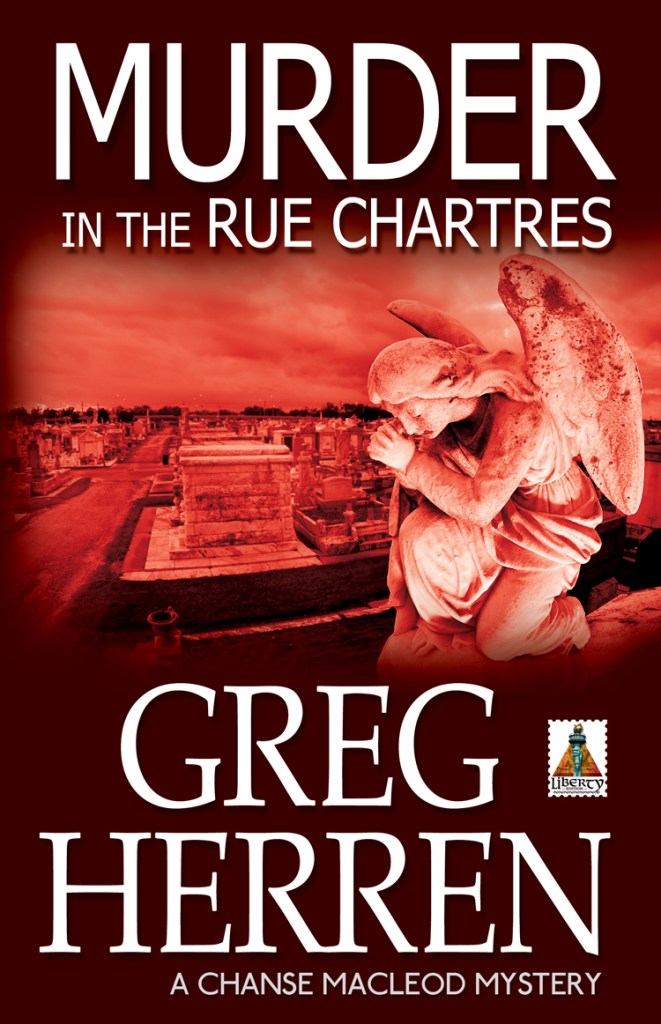
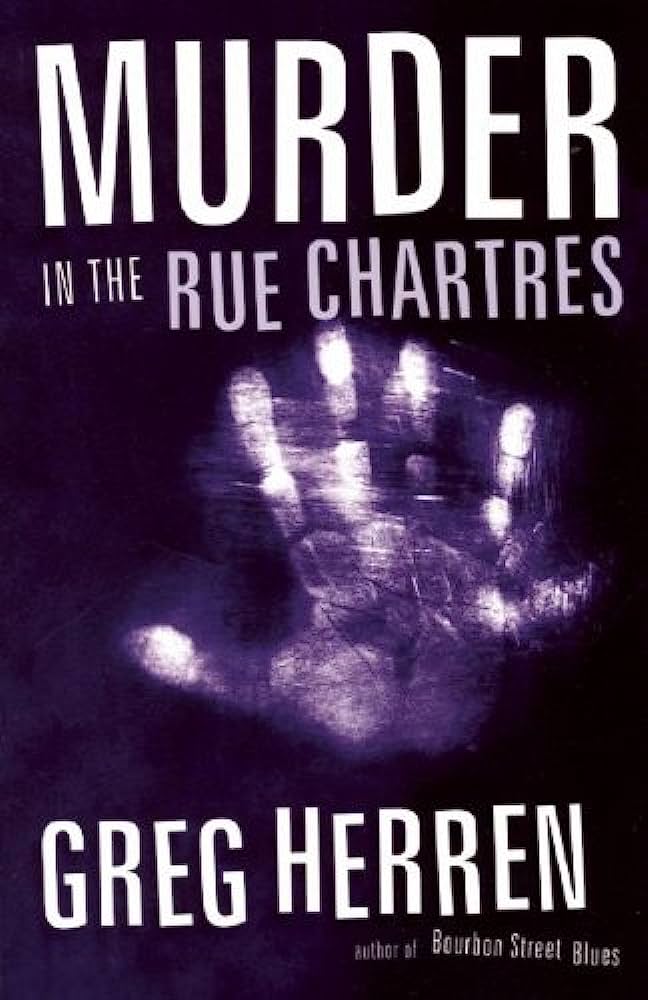
And that was the seed from which Murder in the Rue Chartres (no title at the time of contract) grew.1

It was six weeks before I returned to my broken city.

Usually when I drove home from the west, as soon as I crossed onto dry land again in Kenner, excitement would bubble up inside and I’d start to smile. Almost home, I’d think, and let out a sigh of relief. New Orleans was home for me, and I hated leaving for any reason. I’d never regretted moving there after graduating from LSU. It was the first place I’d ever felt at home, like I belonged. I’d hated the little town in east Texas where I’d grown up. All I could think about was getting old enough to escape. Baton Rouge for college had been merely a way station—it never occurred to me to permanently settle there. New Orleans was where I belonged, and I’d known that the first time I’d ever set foot in the city. It was a crazy quilt of eccentricities, frivolities, and irritations sweltering in the damp heat, a city where you could buy a drink at any time of day, a place where you could easily believe in magic. I couldn’t imagine living anywhere else. Any time I’d taken a trip before, within a few days I’d get homesick and started counting the hours until it was time to come home.

But this time wasn’t like the others. This time, I hadn’t been able to come home, and had no idea how long it would be before I could. Now, I was nervous, my stomach clenched into knots, my palms sweating on the steering wheel as I sang along to Vicki Sue Robinson’s “Turn the Beat Around” on the radio. It was everything I’d feared for the last few weeks when I thought about coming home, the anxiety building as the odometer clocked off another mile and I got closer to home.

It was different.

The most obvious thing was the lack of traffic. Even outside the airport, the traffic was usually heavy, sometimes slowing to a complete standstill. But other than a couple of military vehicles, a cement mixer, and a couple of dirty and tired looking sedans, I-10 was deserted. There was a film of dirt on everything as far as I could see, tinting my vision sepia. Huge trees lay toppled and debris was everywhere. Signs that used to advertise hotels, motels, restaurants, storage facilities, and pretty much any kind of business you could think of were now just poles, the signs gone except for the support skeleton. Buildings had been blown over, fences were wrecked and down, and almost everywhere I looked blue tarps hung on roofs, their edges lifting in the slight breeze. My breath started coming a little faster, my eyes filled, and I bit down on my lower lip as I focused back on the road.

No cars joined at the airport on-ramp, or the one at Williams Boulevard just beyond it. No planes were landing or taking off.

Most of the writing I did in the fall of 2005 was my blog, which at the time was on Livejournal. (The old stuff is still there, but I started making things private after a year because of plagiarism; I guess people thought they could steal my words if they were on a blog.) I documented as much of the experience as I could, so people outside of Louisiana could see that the city wasn’t fully recovered despite no longer being in the news. American attention had moved past New Orleans by the spring of 2006.

When I started writing the book, I was really glad I had done that with the blog, because more than anything else it reminded me of the emotions I was going through, that horrible depression and not remembering things from day to day, the need for medications, panic attacks, depression, and the way the entire city just seemed dead. I did repurpose a lot of stuff that was on the blog–rewritten and edited, of course–and I could tell, as I wrote the book, that I was either doing some of the best work of my life to that point or I was overwriting it mercilessly. You never can be sure.

But I also needed to flesh out the murder mystery I came up with, and I also wanted to write about a historical real life tragedy of the Quarter. The client who hired him that Friday before Katrina roared into the Gulf and came ashore was engaged, and she wanted Chanse to find her father, who’d disappeared from their lives when she and her brothers were very young. But what happened to her father? Who killed her, and why? Was her murder a reaction to her looking for him?

I had started using Tennessee Williams quotes to open my New Orleans novels with the third (Jackson Square Jazz: “A good looking boy like you is always wanted” from Orpheus Descending) and I liked the conceit so much I kept doing it. I knew someone who’d built a crime novel around the basic set up of Cat on a Hot Tin Roof, and I thought, what if the person who knows all the answers has been in a mental hospital for decades? Then what if Mrs. Venable had succeeded in getting Catherine locked up with all of Sebastian’s secrets lobotomized out of her head?

I named the family Verlaine as a nod to the Venables, and aged Mrs. Venable as well as gender swapping her (this was also a bit influenced by The Big Sleep), and I was off to the races.

My editor wrote me when he finished reading the manuscript and told me it was one of the best mysteries he’d ever read. The reviews! My word, I still can’t believe the reviews, and how good they were. I got a rave in the Times-Picayune, Library Journal and Publishers Weekly.

And yes, it won a Lambda Literary Award for Best Gay Mystery.

  1. The irony that two books I wanted nothing to do with, let alone write or edit, ended up with each winning Lambda Literary Awards, does not escape me. ↩︎

Lady Marmalade

He met Marmalade down in old New Or-leenz, strutting her stuff on the street, she said “hello, hey Joe, you want to give it a go?

That classic song by Labelle came out while I was in high school, during the early to mid-1970’s, and there was a lot of prurient young teenager thrill in knowing that the French lyrics translated to “do you wanna have sex with me tonight?” But the song–essentially about a hooker in New Orleans and a man’s experience with her–was an introduction to another side of New Orleans–one you wouldn’t find in the World Book Encyclopedia.

It was very important to me, for a variety of reasons, to make Scotty someone who embraced his sexual orientation and sexuality. I wanted to write someone who LOVED having sex, loved beautiful men, and felt no Puritan-American based shame about enjoying sex. Those kinds of characters were few and far between in gay fiction, let alone in gay crime fiction. After writing the typical miserable cynical bitter gay man with Chanse, I didn’t want to do that again. I wanted Scotty was to be the obverse of Chanse in everything, except their mutual love of New Orleans.

(This was, in part, in response to being briefly dropped by Alyson when I signed the Scotty series with Kensington, being told “two mystery series set in New Orleans would be too alike.” I took that personally, as an insult to my talent, ambition, creativity, and abilities…and I think I proved my point. Once Murder in the Rue Dauphine and Bourbon Street Blues were released–and Rue Dauphine sold super well for them and was nominated for a Lammy–Alyson changed their minds. I’m still mad at myself for not asking for more money.)

But while Scotty was highly sexually active, he never got paid for it. He also never did porn–although I did consider that at one point as an option; I thought a murder mystery built around a porn shoot would be interesting and kind of fun. And of course, in this book he mentions that he and the guys have recorded themselves having sex, and have sexted each other.

Scotty always preferred to keep his status amateur–but he was a go-go boy (stripper, exotic dancer, dick dancer, whatever you prefer to call the guys who dance for dollars in gay bars wearing various kinds of male undergarments), and he was certainly someone who was not averse to having a sexual encounter with a handsome stranger. (There’s a joke about this in Mississippi River Mischief where Frank comments after they’ve met someone, “I’ve been with you for almost twenty years. If you think I can’t tell by now that you’ve recognized someone but you’re not sure from where, which means you’ve probably slept with them, think again”–a paraphrase, but you get the gist; Scotty is often running into men who look vaguely familiar, and that usually does mean he slept with them a long time ago.)

New Orleans, despite it’s rather prim-and-proper high society set (on the surface, anyway), with the Pickwick Club and the Boston Club and the mysterious Mystick Krewes of Rex and Comus and so on, has always been a city of loose morals and freewheeling attitudes towards sex and sexuality. We had a zone where prostitution was legal for three decades or so (Storyville) and I wouldn’t be surprised if there were several bordellos operating within the city limits as we speak. There was the arrest of the Canal Street madam; and of course local author Chris Wiltz wrote The Last Madam, a biography of notorious Norma Wallace–the last well-known madam in the city. (Which I need to reread…) Bourbon Street was known for its strippers and vice for decades; there are still strip clubs on the infamous strip running from Canal downtown to Esplanade–and there are usually men in bikinis or something equally scanty on the bars of the gay clubs down down around the St. Ann/Bourbon queer nexus of the Quarter. When I was starting my deep dive into New Orleans/Quarter history, I wasn’t surprised to find out there were “stag” bars down along the riverfront along the levee; and if someone at one of the fancy houses in Storyville had a predilection for the Greek vice that needed scratching, the madam would send one of her bouncers down there to find someone willing to turn a trick, with a fair share going to the house, of course.

I think that’s fascinating, really; and something I want to explore in a story. I’ve started the story (it’s “The Blues Before Dawn” which I’ve mentioned from time to time) but can’t quite nail down the crime part of it. The set-up is great, though, he typed modestly.

I didn’t intend for Scotty to wind up in what is now known as a throuple–a three way couple, or a relationship of three people–on purpose. I wanted to create the dynamic of two men being interested in him at the same time, and have some fun with that in the first book. I absolutely did, and when I sent Colin away at the end of the first one, that was deliberate. I couldn’t decide who Scotty should wind up with, and I wanted Frank to be really who he logically should end up with–but this bad boy with a mysterious background who was so hot and sexy? I couldn’t NOT bring him back, and so I decided I had three books to wrap up the romantic dilemma. I wasn’t certain what the backstory of the dilemma would be, or how it would turn out, or how it would go–but when I was writing Jackson Square Jazz I found the perfect place and perfect way to bring Colin back. That book ended with them deciding to try a throuple to see how it works out. It was going pretty well until Mardi Gras Mambo–and I tried really hard with that book to not end the romantic story the way it ended in that book…and finally decided, since the series was actually turning out to be popular, that I would finish it by the end of the fourth book.

I’ve also not talked about it in the books or on this blog at all, but….they also have an open relationship. (Someone asked me about this at some point after the last book came out.) Nothing else would work for Scotty–he may not take advantage of the opportunities that pop up now the way he used to, but that’s because he has the freedom to make that choice. If he was forbidden from outside sexual relationships, he would cheat–and he doesn’t want to do that because that’s hurtful and wrong. He never wants to hurt Frank or Colin–but both of them are also away from New Orleans for long periods of time; Colin off doing his international agent stuff, while Frank is on the wrestling tour doing shows and promo events; so they are on their own a lot and temptation is always there–after all, all three of them are gorgeous–so while it is unspoken on the page, it’s an open throuple. And usually, Scotty finds outside sex to be kind of dull, unemotional, and not nearly as much fun as it is with one or both of the guys. That’s a character development arc. I also don’t show Scotty going out to clubs or waking up with hangovers with a stranger in his bed anymore, either. He does still go out–he loves dancing–but the gay bar scene has changed since he was younger and he doesn’t find it to be nearly as much fun as he used to.

Though he won’t say no to a hit of Ecstasy during Carnival or Decadence.

How subtle are the changes in Scotty as he has grown, aged and evolved? I think they are miniscule, but a revisit of the first two books in the series has shown a lot of change and growth over the years for him. He is definitely not that same flighty twenty-nine year old who booked a gig dancing at Southern Decadence all those years ago to make rent and wound up kidnapped by neo-Nazis deep in a swamp–I think he’s a little less flighty and a lot more responsible than he used to be…though he’s not as responsible as most people his age. Turning him into a property owner in the Quarter from a renter–and letting Millie and Velma ride off into the sunset in Florida as retirees–has also made him grow up, as now taking care of the property is his responsibility.

I will always be fond of my Scotty, though, and hope to keep writing him till I can no longer type into a computer or speak into a word-to-text app.

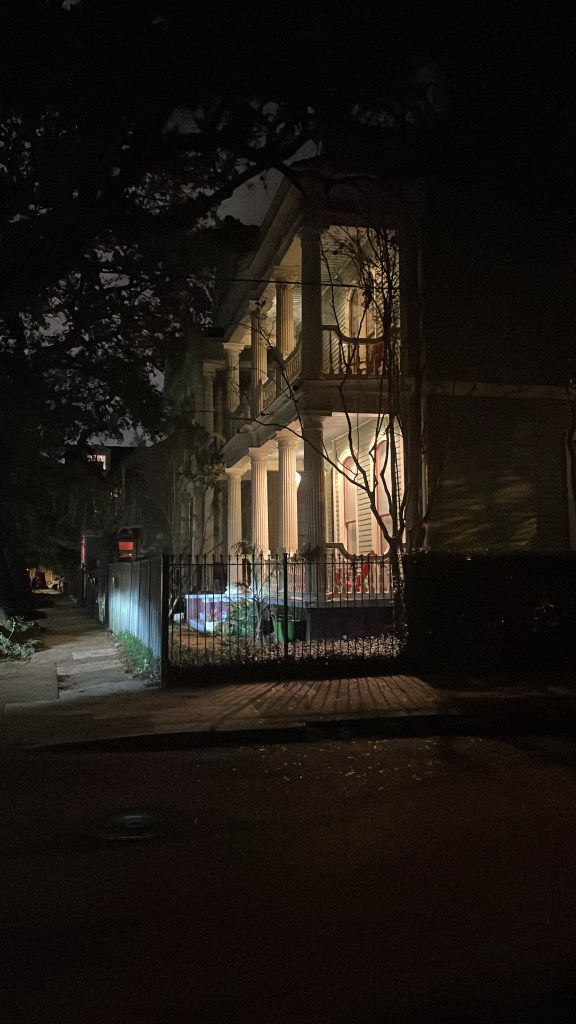
my neighborhood is so beautiful at night, isn’t it?

I Can’t Dance

Wednesday morning, and we have reached the halfway point of the work week; the weekend looms on the horizon, and I am trying to figure out how to maximize my time this coming weekend so I can still relax as well as get everything done that needs to get done–not always a possibility, often a challenge. But definitely worth trying, you know? I’ve been sleeping well and getting good sleep, and waking up relatively early every morning; around sevenish. The revision continues to flow nicely out of my keyboard, and I may even be able to finish this on time, by November 1, the way I’d hoped and planned.

Yesterday it was announced that Midnight Ink, a top small press for crime fiction with an impressive stable of authors and history of awards and quality novels, was shuttering after the summer of 2019. This was, of course, a huge surprise that sent shock waves throughout the crime fiction world. I’d always, personally, kind of hoped that someday something I wrote would find a home there; I liked, admired, and respected Terri Bischoff enormously as an editor and wanted to work with her. I hope some other imprint or publishing line recognizes Terri’s talents and acumen, snapping her right up so she can continue doing the great work she’s been doing.

I’ve had two publishers shut down out from under me in my career thus far, and both situations made me aware of how tenuous this business can be. Both were sudden, and only in the first case was there any announcement or notification; in the second case, they simply stopped paying me even though they continued selling my books for several years. In fact, they never paid me the final portion of the advance for Murder in the Garden District, although they certainly published it, sold subsidiary rights, and sold copies of it for years. I sent registered letters, tried to get the Author’s Guild involved, but they simply pretended I didn’t exist and continued making money from me for several years without paying me a cent that was owed to me. I repeatedly asked for my rights back–no response, because why be professional when you’re robbing someone?

But I bounced back from both disappointments, and while it’s always a gut punch, once you get past the shock and horror and oh my God what am I going to do my career is over nightmares, you just dust yourself off, and figure out what to do next. I’m fairly certain all the talent at Midnight Ink that just got cut loose will wind up somewhere; I only wish I had the money and time to start my own publishing company to pick up all this talent and keep their series going.

Interestingly enough, when Alyson stopped paying me and I was kind of at loose ends with the Chanse series, I considered writing a new series and pitching it to Midnight Ink all those years ago. I always kind of had a bit of regret that I never went ahead and did a pitch to them, and now I will have to scratch that off my publishing bucket list.

And now, back to the spice mines. I have some research reading to do for the WIP, as well as some planning to do, and of course, there’s the constant need to revise the Scotty.

Have a lovely day, everyone.

IMG_2519