Don’t Cry Out Loud

..when you check your 401k. I checked mine yesterday, which is risk-adverse and there’s not much in it, and it was still a shock. Mine had declined in value by 10%–and it’s risk averse. I can only imagine what happened to those that were higher risk/higher reward but also higher potential for loss.

Remember how the Republicans have always wanted to make social security investment accounts, just like they changed pensions to investment accounts under Reagan? How’s that working out for y’all? They have never had the best interests of the American people at heart, ever.

Gah.

We’re supposed to have thunderstorms all day today, which will be a nice way of dealing with the humidity we’ve been “enjoying” over the last few weeks. It’s also supposed to be in the fifties at night this week, which means better sleep. I slept pretty well this weekend, Sparky getting me up early for food but I’ve also been going to bed early every night; really getting tired around nine these last few nights and dozing off in the bed. We finished watching The Residence last night, which I highly recommend. It’s a witty, well done, and deeply clever murder mystery set in the White House, and it’s very Agatha Christie. WE then started watching season three of The White Lotus, which everyone has been talking about; we’d started season one but gave up after the first episode. Parker Posey is perfectly cast, as is everyone else; and God, Patrick Schwarzenegger’s character is such a douche bro; I despise him so far, about three or four episodes in? LSU also won their regional final yesterday was yet another score over 198.00; this is their sixth straight competition with a score of that or higher–and they left points on the board yesterday. GEAUX TIGERS!

I just looked out the windows and the sidewalk is wet, and it hasn’t rained…which means the humidity must be getting unbearable outside. I am looking forward to the thunderstorms arriving, because that’s when I am going to curl up under my blankets and read some more. I wanted to go to yesterday’s protests, but correctly assessed in the morning that I was fatigued, and other than some chores, I wasn’t going to get much of anything done. I’d planned to run an errand, but stayed inside and rested, hence the television bingeing. I hate that I wasn’t able to go; but I feel rested and good this morning (so far) so maybe it will last and I can get things done. There was insane turnout yesterday all across the country (and even across Louisiana!), and of course, it was largely ignored by State Media (Fox) and State Media-lite (everyone else). The utter failure of the legacy media to meet this moment in US History will be studied for centuries, provided the coming collapse of the United States doesn’t result in the world being plunged into a reoccurrence of the Dark Ages.

I hate that I am now so old that I can’t even go to protests anymore. But the massive turnout nation-wide yesterday gives me some hope–even as cishet white people don’t seem to quite understand what protests are, and they can be dangerous? Especially under this administration? Everyone who actually was able to attend yesterday was basically putting their bodies, lives and freedom on the line to take a stand; for those of you who still don’t get it try googling Kent State, or any of the protest marches in Alabama in the 1960s. The insanity I saw yesterday on social media–I still can’t believe the “bouncy house” thread was serious–just is another indication of why most marginalized communities don’t trust the cishet whites. One of the reasons I don’t feel sympathy for any MAGA voter with regrets or pulling the “I didn’t vote for this” Pilate handwashing of their crimes–is because you did vote for this. He didn’t lie to you about any of this. He told you he was going to do all of this, but he did lie about everyone getting rich; but…he was talking about rich people and corporations, not the voters who worship him. Sorry not sorry I don’t believe your claims that you aren’t transphobic or racist or homophobic now and were just misled; any rational adult could see you were being given Flavor-Ade to drink and were lapping it all up and asking for more. I feel so owned, you have no idea.

And on that cheery note, I am going to head into the spice mines while I wait for the thunderstorms to arrive (although the sun has just come out again). I have cleaning to do and taxes to organize, and I had hoped to make it to the gym today…but my shoulder is feeling sore again, so probably best to stay home and rest it, I guess. I hate being frail. I doubt I’ll be back before the morrow, so have a lovely Sunday fun day and I will see you in the morning.

Stagger Lee

Thursday last morning in the office this week blog. I get to go in a little later because I have to stay until five tonight; and of course tomorrow morning I have PT at the ungodly hour of seven a.m. Gah. But it’s okay, really. I slept super well last night–probably the best night’s sleep of the week–and I finally got my keyboard for the iPad yesterday: huzzah! It works beautifully, too…which is the last excuse I had for not getting any writing done (or as much as I would like). Now I have a functional laptop and a functional iPad for writing anywhere in the house, which is kind of fun. I can get my iPad in the morning and write in bed if I want, or I can take the laptop up there, or…so many plethoras of options, and NO MORE EXCUSES.

Oh, I’ll still make excuses, of course, to get out of doing the day’s writing. And I did do some yesterday–I wrote about seven hundred or so words on “Passenger to Franklin” (an Agatha Christie title homage that really pleases me far more than it probably should)–but very little of anything else other than watching Part II of The Real Housewives of Beverly Hills reunion (Kyle Richards remains a disgusting piece of shit bitch who doesn’t need to be on my television screen anymore). I then spent the rest of the evening watching the news (or clips from the news) and despairing further about the future of the country and grateful again that I am old. It’s about the only benefit to being old, really, and not having children: the future isn’t really my problem, but at the same time, I also don’t want the adults of the future to have to deal with a destroyed and/or increasingly hostile and damaged planet, either, because I am not a monster. Sometimes I think I worry about the future more than people who actually do have kids, or are young.

I watched a really interesting conversation between Rachel Maddow and Nicolle Wallace last night–and they were both right: the Republican Party of today wants to eliminate our democracy and set up an authoritarian state where they are always in charge and they can get rid of everyone they don’t like. Sound familiar? See Berlin, 1933. It’s scary to contemplate, and even scarier to realize The Handmaid’s Tale was actually very prescient. I became worried about authoritarianism coming to the US during the Reagan years and what followed, when the Republican party became convinced that they had a divine right and mandate to always be in power. As I watched people get subsumed by Fox Propaganda in the 1990s (when the character assassination of Hilary Clinton truly began), I saw it for what it was: definitely not a news organization, and it’s partisan nature had everything to do with the rollback on rules about what is and isn’t news…during the Reagan administration. It’s astonishing how little people think about the recent past, or even try to put the present in the context of the recent past.

Let alone thinking about the older history, which no one knows1. Then again, I am from a part of the country that proudly claims hatred and bigotry as their heritage, so maybe knowing history might not help as much as I would like to believe.

Heavy heaving sigh.

Those who don’t know history are doomed to repeat it.

I’m doing a panel for a Sisters in Crime chapter on-line event this weekend, do tune in to any or all of the antics this weekend. It’s called Murderous March, and it’s being put on by the Upper Hudson Sisters chapter, and you can register to view the panels here. My panel is at 2:30 eastern, it’s called “It Was a Dark and Stormy Night,” and is being moderated by the wonderful Richie Narvaez. My co-panelists are the amazing Carol Pouliot, Edwin Hill, Tina Bellegarde, and M. E. Browning. It should be a pretty good time, I think.

And on that note, I think I’ll head into the spice mines. Have a lovely day, Constant Reader, and I’ll probably be back later.

But I’m Not

Sunday and I slept late this morning and i am not a bit ashamed of it, quite frankly. The opportunities to sleep in are rare these days–getting up early so often for so long has adjusted and shifted my body clock in ways I’m getting used to but don’t like, and chief among those ways is the inability to sleep in. Yesterday I was up before eight, for example, but this morning it wasn’t even nine when I got up, and I could have easily stayed in bed longer. But there’s spice to mine today, and while there is still a lot of it to get done, I am feeling very good about things this morning. I actually felt really good about them yesterday if I am going to be completely honest. I got two chapters done and finished editing a manuscript (not my own) and turned it in to the publisher, which felt marvelous to be finished with that. Deadlines and juggling projects is something I’ve always done, but something I’ve noticed since the pandemic shutdown is deadlines are much more stressful and demanding on me, and take a bigger emotional toll than they used to. Probably part and parcel of the long COVID rewiring of my brain, but whereas before, I relished the pressure and it drove me to work harder, now it shuts me down and/or depresses me, which has the exact opposite reaction it used to have with me: instead of driving me, I think oh I’ll never get this all done so why bother and I end up blowing things off completely. Depression is quite the bitch, you know.

But I am very pleased with the work I got done yesterday and look forward to today’s work. I also did a load of dishes and laundry yesterday, and some cleaning. But after I was finished with work for the day, my brain was too fatigued to read so I watched movies on television, discovered two gems I’ve been wanting to revisit: Cruising and The Last of Sheila. I wanted to watch Cruising because I remember all the controversies about the movie while it was being filmed (yes, even in rural Kansas we heard about the gays being mad about the movie). I eventually watched it in the mid-1990’s. Paul is a huge Al Pacino fan, and when we moved in together he owned almost the entire Pacino filmography on videocassettes, so one night we watched Cruising. I didn’t much care for it when I watched it the first time, but I’ve wanted to watch it again–when I watched I wasn’t yet a published crime writer–because the story itself is interesting to me. A hot young ambitious cop sent undercover into the gay BDSM/leather community to look for a serial killer? The question of identity and sexual confusion that could arise from playing the part, which entailed going out and picking up (or being picked up) by gay men expecting some sex? I mean, you have to admit that’s a great set-up and concept for story. The Oscar winning director William Friedkin (he won for The French Connection but was much better known for directing The Exorcist) failed and ended up with a deeply flawed film. Pacino was also robbed of a far greater performance due to the homophobic cowardice of the either the director or the studio. Rewatching, the film’s flaws are even more apparent, but it’s a shame. It could have been a great film–and it does remain one of the few Hollywood films that actually depicts gay bar culture of the late 1970s the way it was–but I don’t know what went wrong with it, but it’s still a great idea. I also liked seeing New York as dirty and grimy, the way it was during that time period before gentrification came to Manhattan. It’s also fun seeing old movies where people who went on to greater stardom later had bit parts or cameos; Ed O’Neill popped up on screen at one point, as did several others that made me think, hmmmm.

If I had the time or inclination, I would take that basic framework of an idea and turn it into something stronger than the film. There was also a book it was based on, but it’s rare and used copies are insanely expensive. It also reminded me of a gay crime novel I read as a teenager living in Kansas; I may have been in college, I don’t remember, called A Brother’s Touch by Owen Levy. The book was about a brother who comes to New York to look into his estranged brother’s life after he is murdered–they were estranged because the dead brother was openly gay–and begins to question his own sexuality after being enmeshed into the gay community of Manhattan at the time. It was reprinted recently and I got a copy (by recently I mean in the years since Katrina; I have no concept of time and its passage anymore); I should move it closer to the top of the TBR pile. I wish I could still read as voraciously as I used to…something else that has slowed down with getting older.

After watching this I wanted to rewatch a classic old crime film of the old school, The Last of Sheila, which I’ve always loved. Co-written by Stephen Sondheim and Anthony Perkins and directed by Herbert Ross, it’s a whodunit worthy of Christie herself, in which a widowed producer invites some film community members on hard times for a week on his yacht. Everyone invited was at the party a year before where the producer’s wife Sheila wound up being killed by a hit-and-run driver, and the producer, whose known for loving to play games, has come up with a game for his guests to play. Everyone gets a card, and every day they will stop somewhere they will look for clues to the identity of whoever holds the card of the day–the first is a shoplifter, the second is a homosexual–and of course, the game turns dark and ugly when the producer host–played to sadistic asshole perfection by James Coburn, is murdered…and it turns out the game their host was playing had layers none of the guests knew about going in. The cast is a perfect time capsule of early 1970’s stardom: Richard Benjamin, Raquel Welch, Dyan Cannon, James Mason, Joan Hackett, a beautiful young Ian McShane, and of course, Coburn. It has twists and turns and surprises, and is so markedly clever that it’s hard to describe without spoiling anything…and the surprises are what make it such a great and fun film. This was one of our Sunday movie-after-church movies, I think; I do remember seeing it in the theater and being impressed and amazed. One thing I absolutely loved in the rewatch was the books scattered over every set–they are all mystery novels by Agatha Christie, Ngaio Marsh, Ellery Queen, and Erle Stanley Gardner, which should tip the viewer off that you are in for a mystery influenced by the master crime plotters of the time. It’s really a shame the film wasn’t a success, because it would have been amazing if Perkins and Sondheim had collaborated on more scripts like this one. As I was watching, I kept thinking how much I would love to write a puzzle-type mystery like this one; I’ve always feared such a thing was outside of my wheelhouse so I have always been afraid to try. Who knows? Maybe I will.

I feel very rested this morning and I am not dreading diving into the book this morning, which is nice. I don’t think I have the mindspace and bandwidth to work on multiple things all at the same time anymore, if that makes sense. I don’t know if it has to do with the long COVID rewriting of my brain waves or what, but the last few books I’ve written or worked on–going back to Bury Me in Shadows–have been more stressful than fun for me to write. Writing on a deadline is always stressful, and I rarely, if ever, actually make deadlines. But having multiple projects going on at the same time now feels like I am not devoting enough of my time and attention to any of them, let alone all of them, and that makes me feel uncomfortable about the work. Of course, my last three books–and my last anthology–have all gotten a lot of mainstream award attention, which makes it seem weirder. Which, of course, makes me wonder if the stress and the heavy burden pressure of multiple projects going is somehow making me produce somehow better work than before, and do I really want to mess with that at all? It never ceases to amaze me how neurotic I am about being a writer, and how afraid I am that any change or variation means it’s all over for me now.

I do wonder sometimes if other writers have that same secret fear: that the well will eventually run dry or that we’ll forget how to do what we do. People like to call me prolific; I’ve slowly come to the conclusion that I am and that it’s not a bad thing (I always try to figure out if being called something is bad–which goes back to being called a fairy as a child and thinking he was saying ferry and being very confused). John D. MacDonald was prolific; so were Ellery Queen, Agatha Christie, and Erle Stanley Gardner. I think my insecurities came into play when people started calling me prolific; I am so used to being insulted that I assumed it must be an insult as well, like it was something I should be ashamed of or something. I’ve decided to embrace it as a compliment. I am sure there are literary writers who produce one novel every ten years or so who would think it an insult, but I don’t respect them so don’t really care much what they think. And if I am not as prolific as I used to be–which I am not–it’s nothing to be ashamed of; I’ve gotten older, have gone through some things, and I don’t have the energy that I used to have. My imagination still rages out of control at any and all times, of course, but I don’t have the energy to fool myself into thinking every idea I have will turn into a short story, an essay, or a novel. I certainly won’t live long enough to turn all the ideas I already have into longer works of whatever style and kind.

And on that note, I am diving back into the book. I am getting another cup of coffee and putting some bread in the toaster for later, and I may or may not do another Pride month entry later today. Anyway, you have the loveliest Sunday possible, Constant Reader, and I will check in with you again later.

Play with Fire

Well, I met quota again last night which was marvelous. It’s still a bit chilly this morning. By the weekend it should be back into the seventies (it was yesterday as I ran my errands after work; it’s sixty-one this morning but it does feel colder outside of my bed and blankets), as the Alabama and Kansas State fans start arriving for the Sugar Bowl. LSU is also playing on New Years’ Day in the Citrus Bowl against Purdue, which will probably be the only game I actually watch that day.

There’s been a conversation going on over at Book Twitter lately that doesn’t really impact me in any way, but it’s been kind of interesting to follow. The conversation has to do with concerns about what is and isn’t considered y/a fiction as well as what is, or should be, considered age-appropriate reading material for teenagers and pre-teens. It doesn’t impact me because no one considers me a young adult writer, for one thing; despite having written numerous books with younger and/or teenaged characters (Sorceress, Sleeping Angel, Sara, Lake Thirteen, Dark Tide, Bury Me in Shadows, #shedeservedit), most people think of me as a gay mystery writer. Everything published under my own name is a mystery novel of some sort, whether it’s one of the series books or one of the stand-alones. I’ve never really marketed myself as a writer of young adult fiction, really; I shy away from that, I think, because of The Virginia Incident and the subconscious fear that one day that controversy might resurrect itself (which is ludicrous, and I know that; it certainly would have by now and it hasn’t, which further proves my belief that The Incident had nothing to do with me or my writing or my career and everything to do with systemic homophobia and othering used for political gain). It just seems weird to me that in less than five years after that happened–when I was deemed a menace to America’s youth–I could publish books for teenagers without a single whiff of complaint or scandal or even the raise of a single eyebrow.

Interesting, isn’t it? Almost like the whole thing was just more smoke and mirrors whose sole intent was to rile the homophobic base.

I just love that my existence is considered by some as a constant and continued threat to children.

One of the things that has always mystified me over the years is what is and isn’t considered age-appropriate. Intellectually I was far more advanced that most of my classmates (my emotional and personal maturity being an entire other subject–I’d say I am still behind on that score) and I started reading early. The library and the Scholastic Book Fairs were my best friends as a child, and I read everything I could get my hands on. I loved history, from which grew an appreciation and love for historical fiction (which I really don’t read much of anymore, which is odd. I really want to read Hilary Mantel’s Cromwell books…) and of course, my grandmother got me interested in “scary” movies and mysteries.

You’d think I’d be a huge fan of historical mysteries, but I actually don’t read many of them. I did love Elizabeth Peters’ Amelia Peabody series, and I’ve become a huge fan of Laurie R. King’s Mary Russell series…I think exploring historical mysteries might be a project for 2023.

But the point was I was reading books far too advanced for most people my age when I was young. I freely will admit that in my first read of Gone with the Wind at age ten I didn’t know Rhett raped Scarlett the night of Ashley’s surprise birthday party–it wasn’t until a reread in my late teens where I thought oh, this isn’t right–let alone that she enjoyed being overpowered and forced. I also read The Godfather when I was ten, and there was no mistaking anything about Sonny Corleone and Lucy Mancini. He had a cock the size of a horse’s and her vagina was apparently the Lincoln Tunnel. (Although the she felt something burning pass between her thighs still mystifies me to this day.) I also read The Exorcist when I was ten and I was also very well aware of what was going on in the crucifix masturbation scene. As a kid, I was fascinated by these sex scenes (aka “the dirty parts”), and it wasn’t until I was older than I began to question the entire Sonny-Lucy thing (and why it was even in the book in the first place); and while the crucifix scene was gross, shocking and basically icky to me at ten–when I reread the book sometime in the past decade it seemed prurient, to be honest–used primarily for shock value and to get people to talk about it.

So, yes, I started reading books for adults when I was around ten. I also read Antonia Fraser’s Mary Queen of Scots and Robert K. Massie’s Nicholas and Alexandra that same year–I remember doing a book report on Mary Queen of Scots and my teacher not believing that I had read the thick volume; he started opening the book at random and asking me questions–which I was able to answer, so he grudgingly accepted the book report and gave me an A. (Teachers have doubted me all of my life; can’t imagine why I am insecure about my intelligence…)

Over the course of my teens I also read books by Harold Robbins, Sidney Sheldon, Jackie Collins, Jacqueline Susann and Gordon Merrick-every last one of them crammed to the gills with racy sex scenes. I was also reading Stephen King, Irving Wallace, Herman Wouk, Agatha Christie, Ellery Queen, Jean Plaidy, Victoria Holt, Phyllis A. Whitney and any number of authors who wrote for adult audiences not teens. Were there things in the books I didn’t understand? Sure there were. Were there things in those books that were probably inappropriate for teenagers? Undoubtedly. (I’ve also never forgotten the scene in Joyce Haber’s The Users where a Liza Minnelli-based character fucked herself with her own Oscar; some images are simply too vivid to forget methinks.)

This is one reason I shy away from calling some of my books with teenagers “young adult” novels. Megan Abbott’s Dare Me centered teenagers, but I would never consider Dare Me a young adult novel. I was thinking about this the other night while watching Sex Lives of College Girls (it’s hilarious, you really should be watching); can I authentically write about teenagers anymore? Have I ever been able to? I don’t speak their language anymore, and I haven’t been one in over forty years (!!!!); I don’t know the technology they use or their slang or what they watch or listen to. I don’t know what today’s teens think about virginity and sexuality these days; do the tired old tropes still exist? Does that whole “good girl/bad girl” dynamic still exist, or are today’s teenaged girls a bit more sophisticated than they were when I was in high school when it comes to sex and sexuality? (Contrasting two high school shows with queer content makes you wonder–there’s the jaded cynicism of the rich kids in Elite vs the wholesome purity and innocence and sweetness of Heartstopper, which also had me wondering–although I feel certain Heartstopper might be closer to reality than Elite…or that’s just my hope?) Of course I have other ideas for more books about young people–I have another in-progress one that’s been sitting around for a very long time that I need to repurpose–and I’d kind of like to write more at some point, but I don’t know. My suburban 70’s serial killer preying on teenaged boys book would be told from the perspective of a twelve year old, but it would definitely not be a young adult novel–but will probably be marketed and sold as one.

And on that note I am heading into the spice mines on my last day in the office for 2022. Check back in with you later, Constant Reader.

Ooh Baby Baby

There is no question that Agatha Christie is one of the giants (if not the giant) of crime fiction.

Agatha Christie was one of my gateways to adult crime fiction (along with Charlotte Armstrong, Phyllis A. Whitney, and Victoria Holt); if I remember correctly the first book of hers I bought was Witness for the Prosecution (which I didn’t know was a short story collection) and the first novel of hers I read was Murder in the Calais Coach (best known as Murder on the Orient Express; the former was a short-lived American title for the book, and frankly, isn’t an improvement; why make the title about something no one would know what is was? Everyone knew the Orient Express). I eventually read everything she wrote, with a few exceptions (I still haven’t read Murder in Three Acts or Death in the Air) but the first Miss Marple novel I read was A Caribbean Mystery. I always preferred Miss Marple to Poirot, but I kind of want to give a Poirot or two a reread; Donna Andrews made a very clever observation about him on one of my social media posts which provides another lens for me to read through.

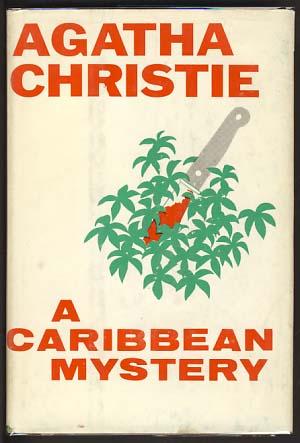
I found a hardcover copy of A Caribbean Mystery somewhere since we moved into the Lost Apartment; I’m not sure where. I certainly don’t remember buying it on eBay (the only other Christie I have in hardcover, Halloween Party, is missing its dust jacket, and I think I got it at a yard sale? But wait! It’s a Poirot! And has Ariadne Oliver, Christie’s stand-in! Yes, that’s a reread for the new lens for Poirot! And now that that’s sorted…), so there’s no telling where it came from. I don’t know why it took me so long to reread it–it’s actually on the short side–but it did take me a while. Maybe because there was no urgency because I remembered who the killer was?

“Take all this business about Kenya,” said Major Palgrave. “Lots of chaps gabbing away who know nothing about the place! Now I spent fourteen years of my life there. Some of the best years of my life, too–“

Old Miss Marple inclined her head.

It was a gentle gesture of courtesy. While Major Palgrave proceeded with the somewhat uninteresting recollections of a lifetime, Miss Marple peacefully pursued her own thoughts. It was a routine with which she was well acquainted. The locale varied. In the past, it had been predominantly India. Majors, colonels, lieutenant-generals–and a familiar series of words: Simla. Bearers. Tigers. Chota Hazri–Tiffin. Khitmagars, and so on. With Major Palgrave the terms were slightly different. Safari. Kikuyu. Elephants. Swahili. But the pattern was essentially the same. An elderly man who needed a listener so that he could, in memory, relive days in which he had been happy Days when his back had been straight, his eyesight keen, his hearing acute. Some of these talkers had been handsome soldierly old boys, some again had been regrettably unattractive; and Major Palgrave, purple of face, with a glass eye, and the general appearance of a stuffed frog, belonged in the latter category.

Miss Marple has bestowed on all of them the same gentle charity. She had sat attentively, inclingin her head from time to time in gentle agreement, thinking her own thoughts and enjoying what there was to enjoy, in this case the deep blue of a Caribbean sea.

I decided to reread this book for several reasons. First, I am reading a lot of “cozy” mysteries (mysteries with amateur sleuths as the main crime-solver) because I am writing one myself; second, because I’ve been wanting to revisit Christie on a smaller scale (there’s no way I could reread her entire canon again); and third, because I read a piece recently somewhere (Crime Reads, perhaps?) about the enduring legacy of Christie despite some problematic aspects to some of the books (I was well aware of the classism and anti-Semitism, and VERY WELL AWARE of the various problematic title changes for And Then There Were None over the years), and this one was mentioned. I remembered the book, I remembered the story; I remembered that this was the book where Miss Marple met Mr. Rafiel and she became, in some ways, Nemesis to the two of them (one of the later Marples was, in fact, Nemesis, and Mr. Rafiel sent her a murder to solve from beyond the grave); but I wasn’t so sure I remembered why precisely this book was problematic, could be see that way. So, I took it down from the shelves, and started reading.

The premise of the book is this: Miss Marple had a rough winter, having contracted pneumonia, and her nephew, bestselling novelist Raymond West, has decided to send his beloved elderly aunt to a warmer climate to recuperate–St. Honoré, to be exact, in the Caribbean, or the West Indies–at the Golden Palm Hotel resort. (St. Honoré is, of course, fictional; I may use it if I ever need a fictional Caribbean setting) As she sits in the warm sun, knitting and observing the people around her–she is always watching–and half-listening to the pompous bore rattling on to his captive audience (this scene, and her thoughts about Major Palgrave being of a type who really doesn’t need anyone to really pay attention, but to just be in hearing range with the proper noises being made when necessary, is quite insightful and brilliant; haven’t we all been there in that situation?), when he asks her if she wants to see the picture of a murderer? Since she isn’t really listening, she assents and continues to observe and watch everyone around her, and as he is reaching into his wallet to show her a picture of said murderer, he stops, turns quite purple, shoves the photo back into his wallet and loudly changes the subject. This does catch her attention, and she turns around to see what he saw–but doesn’t see anything or anyone that could explain this behavior change. He then makes excuses and leaves.

And of course, he dies that night–and this incident nags at Miss Marple. His death is explained away by him having high blood pressure, and having drank too much on top of his medication; but she isn’t so sure. And then she makes up a lie about the photograph, which she tells the doctor, and it turns out the photograph is missing.

Obviously, the Major was murdered, and did he really have high blood pressure, or is that merely gossip? As Miss Marple observes, “it’s very easy to get a rumor about, and people will just repeat it. There’s never any first-hand knowledge; it always A heard it from B who heard it from C and no one can really pinpoint where the story started.”

It’s a good story, with lots of suspects and suspicious behavior and trying to sort rumor from truth, but two more people wind up dead–a very common theme in Christie is a murderer having to kill others to cover up their original crime–before Miss Marple remembers something and figures out not only who the killer is, but who their actual target was from the very beginning.

And yes, there’s some serious problematic views of the islanders from the British paternalistic colonialist point of view. But Christie herself never says anything problematic–it always comes from the mouth of one of her characters, who, given the time period, would inevitably think that way–side comments about how many of the islanders are in committed relationships without benefit of clergy; etc. etc. etc.

So, I would say it held up about 95% on the reread; yes, there’s some problematic stuff that might be jarring for someone to read now for the first time and would probably not be allowed past the editorial process today–and excising it wouldn’t harm the book in the least.

Someday at Christmas

Yesterday was so beautiful here that I grilled burgers outside, taking a pillow for my back to rest against as I took my Agatha Christie reread out with me and basked in the glory of the gorgeousness of the day. And it was gloriously beautiful outside yesterday; hard to believe it was December…but then, early December is often quite delightful here. I did not, alas, get everything done yesterday that I wanted to get done, but that’s also kind of par for the course. Sundays are always hard-to-get-anything-done days here in the Lost Apartment. It usually is a day for Paul and I to hang out together–he usually doesn’t work on Sundays (he went to the office, for example, Saturday and didn’t get home until around eight that evening)so I generally try to get everything finished in the time before he gets up (he also sleeps late on Sundays). I didn’t manage that yesterday, so of course there’s still things for me to get done left over from yesterday, but that’s okay. I had a lovely time hanging out with him yesterday and watching Gossip Girl–the original show is really quite addicting–with the occasional break, during which I read more of my Agatha Christie reread.

Christie’s later books are often seen as lesser than her earlier ones, primarily, I think, because the earlier ones were so groundbreaking. Trying to figure out who the killer is was always part of the fun of reading Christie (spoiler: it was often hard to figure out because it was all-too-frequently two people, working together), and one of the interesting things about revisiting this particular Christie–any Christie,really–is that over the years I’ve read a lot of criticism of Christie, primarily that her characters weren’t developed well and she was so focused on the puzzle aspect of her books that the writing wasn’t strong. I guess those critics read a different Christie than the ones I’ve read? There were several times yesterday–and I am not very far into the book–where I was struck by her insights and cleverness about human nature, behavior, and how clever and wise some of her sentences were. One, in particular, stood out: And now he was dead, buried, and nobody cared very much…a rather chilling, if honest, insight. There’s also the fact that the primary reason Miss Marple is so successful at ferreting out information and solving crime is because no one takes her seriously for the simple reason she is old; she often uses that condescending attitude of the young towards our elders (well not our, I certainly am old now) against them, even at times playing the part expected of her, prattling on and on to distract her targets from her real objective, and then they are a bit startled by just how sharp her mind is, to the point they blurt out information they didn’t intend to ever share with anyone. We never get into Marple’s mind; she sometimes will tell us what Jane is thinking, but we don’t see it from her perspective; when Christie writes in the third person, it’s from a remove. There are also other point-of-view characters, but just to give the reader a bit more insight into what else is going on around the murder and how that impacts others. It’s also–I’d quite forgotten–how often old women are referred to as “pussies”, or Marple as a “nice old pussy”; I am sure the word meant something different then than it does now; or maybe it’s another example of the difference between UK English and American English–like how fanny means something entirely different in England than it does here.

I cannot imagine writing a book now and referring to an old woman–any woman–as a pussy now. But you know how I know Christie is a good writer? Rereading this book was inspiring–I was getting ideas for new projects of my own and about the current project, which means reading Christie triggered my own imagination, and writers who trigger my own imagination are, at least in my eyes, the best writers.

Today I am up and the sun is rising as I drink my morning coffee. I don’t think I slept all that well last night; it was a bit warmer than usual, not warm enough for the air conditioner to be necessary but I did need a fan. I don’t know if the whirring of the fan was why my sleep wasn’t deep–it wasn’t restless, just light–but I also don’t feel terribly tired this morning; we’ll see how that lasts through the day. I have errands to run after work today, so no gym this evening–saving that for tomorrow–so when I get home tonight I’ll do the dishes and try to get the kitchen/office finished (something else I’d intended to get done yesterday and didn’t) and work on the book some more. I also have a lot of emails to answer between clients this morning; I did make the to-do list (perhaps not as detailed as it should be) and have already started striking things from it. But progress is progress, after all, and one should never really beat oneself up over not making enough progress. Celebrate the wins, however small, rather than treat them as defeats.

LSU is going to a bowl game this year–next, really, not sure why it’s so late on the schedule–playing Kansas State, which is a sort of split loyalty thing…not as much as one might think. LSU is my team, and while I won’t be happy should they lose the game, at the same time that loss won’t be terribly disappointing or upsetting. It’s weird, I guess the new head coach won’t be coaching the game–there’s an interim head coach–but it’s also on a weird day of the week; a Tuesday after New Year’s, which is, as I said, very strange. But that’s okay, I suppose. Not sure how many of the bowl games I am actually going to watch this year–the National Championship game is, after all, on a Monday night, and since LSU isn’t going to be in it, I am not staying up late that night since I have to get up the next morning; it was an entirely different thing LSU was playing it it that lovely season two years ago–but I might have the games on in the background while I am doing something else.

Who knows? But Happy Monday and I am heading into the spice mines. Catch you tomorrow!

The Most Wonderful Time of the Year

Well, I suppose it’s time to start spreading Christmas hunk cheer around here, so enjoy today’s hunky elf–who actually makes me think about my story “The Snow Globe.” I’m not really sure when the anthology it is in will be coming out, but I am looking forward to it. I so enjoy getting short stories into print, and do wish I had more time to write them. Then again, perhaps if i stopped wasting so much of my time maybe I could get more stories written. I know I’ve committed to three more that I’ve got to finish (two only need a final edit/revision; one had to be written almost entirely from scratch) for the new year, and once I get this current book finished–well, after the new year and so forth I am going to be rather too busy to write a book for a while; at least, to focus on writing a book, at any rate. I have the Bouchercon anthology to work on, the release of #shedeservedit is right around the same time as the new book is due, and….yikes.

FOCUS, Greg, you need to FOCUS. And make lists.

And breathe.

Yesterday was a really good day, though. I got up early, got caught up on some blog entries about books I’ve read recently, made serious progress on the cleaning and organizing, and I worked on the book. I got another chapter finished; it’s not very good at the moment, but I know what I need to do to make it better, and I also made it to the gym yesterday afternoon, which was also lovely. I need to work on the book some more today–I also have to make a grocery run at some point–and finish the cleaning and organizing I got started on yesterday. The kitchen office looks a lot better than it has in a very long time, and while there are still some odds and ends to touch up, and file, and forth, I feel much better about everything.

Part of the organizing yesterday also included gathering and sorting all my notes for this book and putting them into one, easily accessible place–as well as sorting out the file folders, etc. that had been gathered at some point that have the same title or a similar title or may have some old notes and so forth; I was actually very surprised to see how many times I’d started writing a traditional mystery over the last decade or so–and in my head I conflated them all as the same story, which SURPRISE! They were most definitely not–but I filed those other fits and starts in an easily accessible place, where I can get to them if this first book turns into a series, or if it doesn’t–well, I can then try again with another idea I’ve already made lots of notes on in the past. (I am talking about physical files here, of course; my electronic files continue to be an utter and complete disaster.) But after a terrific day of getting things done and kicking ass and taking names (okay, Chapter Five isn’t very good but it’s a first draft, okay?) I went to the gym and saw some of the Georgia-Alabama game on the television there. After coming home and doing the dishes and some more filing (and making a protein shake), I curled up in my easy chair with Agatha Christie’s A Caribbean Mystery and turned on the television. I read while glancing up periodically to keep an eye on the game–Jesus, Georgia, even LSU was able to play decent defense when they played Alabama–and kept an eye on my iPad and watched part of the Michigan-Iowa game until Paul got home from the office (late) and we switched over to Gossip Girl (the original is so much better than the sequel that we probably won’t even bother going back to the new series, even though there’s only two episodes left). I also got a pretty good night’s sleep last night as well, which was quite marvelous–I seem to be sleeping better these days, which is lovely.

Today, as I said, I have to make a bit of a grocery run, and need to write and finish these odds and ends of filing around here, as well as write some more on the book–I should do another chapter today–and I’d also like to get some more reading done on the Christie; the murder/mysterious death has already occurred, and now I am wondering if Agatha Christie did, indeed, write cozies; there’s certainly no sense of community here in this book–how can there be, since Miss Marple is visiting a resort hotel on the fictitious island of St. Honoré (an island name I may abscond with at some point), but now that I think about it, the sense of warm community that is a hallmark of most cozy mysteries doesn’t really exist much in any of Christie’s books–but then again, my memory is faulty and I don’t remember much of the plots and stories and characters the way I used (and I do miss that recall skill I used to possess in abundance). But I read almost all of Christie’s books a million years ago, when I was in high school, and I simply cannot revisit all eighty or so of them (I never read the ones she wrote as Mary Westmacott, either), so I will leave commentary on the Christie canon (other than the ones I actually reread) to those who are expert.

But over all, I am feeling pretty good about life in general. As always, I am buried under and busier than any one person probably should be; but it’s how I function best–and I am not sure why that it, probably has a lot to do with the short attention span and having to always balance multiple things at once, and also why taking the time to actually sit down and get organized, making lists and so forth, is the best way to go for me. Paul is getting me an old-fashioned day planner for Christmas, because even though it’s become a thing of the past, I discovered that having a physical journal to write down random thoughts in or brainstorm plots and so forth in was much more effective for me than the electronic system modern technology had forced onto me–so it’s not really much of a stretch to think that having to physically write things down as opposed to making entries into a digital calendar will be even more effective and increase productivity and stop me from forgetting things. (I will continue to use the electronic calendar for bills; that is one thing that has worked remarkably well for me.)

And so now, I shall return to the mines for more spice. Have a lovely Sunday, Constant Reader!

(She’s a) Very Lovely Woman

Saturday morning and it looks kind of gray outside the windows this morning as I look out at the world blearily and drink my first cup of coffee. I slept very well last night–which is always welcome–but woke up feeling a bit groggy this morning. I am sure the caffeine will work–it generally does–but as I glance around at the chaos of my office/kitchen my inclination is to pour the coffee out and go back to bed and sleep the rest of the day away, hoping magical elves or something else will show up whilst I sleep to finish organizing and arranging this mess into something resembling workable order. On the other hand, I don’t think that’s going to happen, so I am going to need to wake up, buckle up, and put my nose to the proverbial grindstone. I’ve got to contain this mess–and do it properly, no more sweeping things under proverbial rugs to get mess out of sight–and I’ve got to work on the book today and I need to run some errands. I also have to go to the gym today, so I will most likely follow football championship games today by periodically looking on-line to check scores only. Paul is going into his office this afternoon to do some work as well, and I need to update my to-do list and…yes, it’s a very busy day for a Gregalicious.

I finished reading Murder Most Fowl by Donna Andrews last night–charming, as always, delightful and witty and funny–and decided, since I was talking about how much I preferred Miss Marple to Hercule Poirot the other day, that I should revisit one of the Marple stories. I have a hardcover copy of A Caribbean Mystery–I don’t recall where it came from–but it has some sentimental value for me in that it was the first Marple novel of Christie’s I had read all those many moons ago when I was a child, holing up in my room on Saturdays with a book and a bag of Bar-B-Q Fritos. (My first Poirot was actually Halloween Party, which I also have a hardcover copy of and again, do not recall where I got it or how long I have had it; I read most Christies in paperbacks purchased at the Bolingbrook Zayre’s off their wire paperback racks) In those first few pages of the book, it spelled out exactly what I loved about the Marple stories–about how living in a small village actually exposes one to almost every kind of human behavior there is in a smaller ecosystem, and the great irony that the smallness and rural aspects of the small community are all too frequently seen as provincial and inexperienced in the world (why Grace Metalious’ Peyton Place was so shocking when it was originally published some seventy years ago; that placid, idyllic on the surface looking village/small town/rural community has a lot more going on than one would think at first glance). This is an excellent set-up, really, for the story Christie is writing about this fictional resort on a fictional West Indies island; her nephew, the successful novelist Raymond West, has paid for this trip for her to get some sun and recover from an illness…and when she originally protested about the expense and “who will watch out for my home in St. Mary Mead”–this response (which I hadn’t remembered) hit me right between the eyes:

Raymond had dealt with everything. A friend who was writing a book wanted a quiet place in the country. “He’ll look after the house all right. He’s very house proud. He’s a queer. I mean–“

He had paused, slightly embarrassed–but surely even dear old Aunt Jane had must have heard of queers.

Now, what is one to make of that? It was a jolt, certainly. It put me in mind of something I came across on Twitter the other day, written by Wil Wheaton, in which he had answered at a con somewhere a question regarding the current debate of “can you separate the art from the artist?” This is something I’ve pondered about quite a bit–most recently, the feeling of guilt I experienced in rewatching Chinatown, knowing now what I–we all–know about Roman Polanski. I enjoyed Chinatown every time I’ve seen it, and I was now watching–rewatching–through a different lens than I had before; I was watching in terms of my own Cynical 70’s Film Festival, to see how a 70’s film that actually harkened back to old-style crime/hard-boiled/noir styles, but with a more modern (at the time) sensibility fit into that 70’s cynicism and darkness about humanity and human behavior. But the discomfort kept popping up, particularly because Polanski himself appears in the film…and I eventually decided not to rewatch another favorite, Rosemary’s Baby, because of it.

I am not going to consign Agatha Christie to the trash heap of history; she was an extraordinary writer, and one of the most influential in the field in which I myself write. Nor do I think a simple throwaway line or two in a book originally published in 1964 is enough to dismiss Christie and her canon as homophobic and never revisit her work. In fact, given the time period in which the book was written, I am surprised the two sentences weren’t, frankly, much worse. Reading the sentences didn’t offend or outrage me; it was just a surprise, primarily because I didn’t remember them at all in a book I’ve read multiple times over the years–and I think when this hardcover came into my possession (I won’t swear to it, but I think I got it during one of my many eBay buying frenzies after Hurricane Katrina, when I felt it necessary to get copies of books with some sentimental value to me) I did actually read it again because I didn’t remember the plot–and this either went right past me or I noticed and didn’t think much of it.

Revisiting this book and viewing it through a modern lens is going to be interesting. And like I said, the reference could easily have been worse–but seeing queer used in this way reminds me of how it used to be used. The younger generations are reclaiming the word, and I myself have been advocating for it as a generic term for the non-straight community for eons…but I also can see why there are people of my generation/the one before me/the one after me who object to its use and why.

But I would a thousand times rather see the word queer used in an Agatha Christie novel than faggot. And I also remember the sympathetic depiction of a lesbian couple in my favorite Marple, A Murder is Announced.

Interesting thoughts on a Saturday morning. The sun has come out now and it’s not quite so gray outside; the second cup of coffee is certainly hitting the spot right now and the grogginess is beginning to leave from not only my head but from my body. I still don’t want to straighten up this mess, but there’s no choice, really, and I want to get some good work on the book done today and tomorrow. I need to go to the gym either today or tomorrow as well; perhaps later this afternoon once I get some writing/cleaning/organizing completed. I cannot be completely lazy this weekend, much as I would like to be; I have to get things done, and the more things I get done now the fewer things I will have to do later this month (I am not, for example, going to want to write on Christmas). But once a procrastinator, always a procrastinator.

And now it occurs to me that perhaps I am procrastinating here, so I am going to bring this to a close. Have a lovely Saturday, Constant Reader, and will talk to you soon.

Silver Threads and Golden Needles

If you’ve been sensing a theme in my recent reading, Constant Reader, you are correct. I have been reading a lot of traditional mysteries lately–cozies, if you prefer–and there are any number of reasons why. One, I want to read more broadly across the genre; two, I actually enjoy them, a lot; and three, well, yes, I am writing one. I am only sorry that it took #3 in that sentence to really dig into one of my favorite sub-genres of crime fiction again, since I am having the best time since I started digging them out of the TBR pile and reading them. They are called cozies for a reason; they are generally warm stories about incredibly kind and likable people who wind up getting involved in murders–usually through no doing of their own–and through their own shrewd observations of behavior and brains, inevitably wind up finding the killer’s identity before the police do.

I know I am an anomaly when it comes to this, but I always preferred Agatha Christie’s Miss Marple to Poirot. I loved that the elderly, always under-estimated by everyone spinster from the little village, simply by watching and observing human nature in the microcosm of her village–and her theory about human nature, “people who are similar often behave similarly”, is kind of spot-on. I loved how the suspects in a case would remind her of someone she knew from the village in the past, and her observations were inevitably correct. A traditional mystery is one where there’s no violence or bloodshed on the page (mild, if there is–like a punch in the nose or something like that when trying to evade the killer, etc.), no sex, not much cursing, and so forth. I tend to think of them as stories that take place in the world we’d rather live in, rather than the actual real world we do live in.

Stephen King, in his seminal treatise on horror, Dance Macabre, described horror novels as examples of the conflict between the philosophical concepts of the Dionysian and Apollonian; in which the Apollonian signifies the status quo–peace, order, reason and balance–while the intrusion of the murder/crime into that Apollonian ideal sends the community reeling into the Dionysian: disorder, tragedy, emotional illogic. The solving of the crime brings the community back into balance and returns it to the Apollonian ideal, so the amateur sleuth in these books are agents of reason. And since one of the major precepts of the traditional/cozy mystery is that sense of community–see Donna Andrews’ Meg Langslow series–it is the duty of the amateur sleuth to return the community to the sense of peace, order and serenity that ruled before the Dionysian influence disrupted all of that.

But Mary Feliz’ first Maggie McDonald mystery kind of turns that theory on its ear.

“Awesome! I bet it has bats!” My fourteen-year-old son, David, exploded from the car and mounted the steps of the old house three at a time. He peered through the grubby porch windows.

“Is it haunted?” Brian, my twelve-year-old, leaned into my side as we stood in the front yard. I eyed the dust motes cavorting in a light beam that had escaped the shrubs and overgrown trees surrounding the 100-year-old California Craftsman house. I put a reassuring hand on Brian’s mop of curly hair. “I doubt it, honey.” I hoped it was true.

I swallowed hard and watched my husband, Max, ease his long legs out of the Prius. Like my minivan, Max’ car was overloaded. We’d packed both cars with everything too fragile to transport in the moving van. In among the breakables, our two kids, one golden retriever and two cats, we’d tucked picnic food, cleaning supplies, and sleeping bags.

Today was Thursday. The plan was simple. The movers would arrive tomorrow. Since Monday was Labor Dat, we’d have four days to get settled. The kids would start school on Tuesday, and Max would begin his first full day at the new job the same day. I was giving myself a month to focus solely on house and gamily. After that, I was determined to restart my career as a professional organizer.

Anyone who has ever moved to a new city and started over can relate to the opening chapter of this book. I myself have moved countless times to new communities–from Chicago to the suburbs to Kansas to California to Houston to Tampa to Houston to Tampa to Minneapolis to New Orleans to Washington and back to New Orleans finally. There’s something exciting about starting over in a new place–but there’s also that little thought in the back of your head, what if you were better off where you were before? It can be both scary and intimidating to move–especially when you have children, as Maggie does. Her family was happily living in Stockton when her husband’s aunt died, leaving them the property where he grew up and remembered fondly. They visited the property while the estate was in probate, and Maggie, too, fell in love with the big old beautiful house, and agreed to give up her own business–she’s an organizer, the person you hire when you can’t organize yourself and you need help–and move to Orchard View in Silicon Valley to this big beautiful house where her husband grew up…and right away, her worst fears are coming true. The house somehow has become incredibly run down, with broken windows and dirty inside; there’s a horrible smell coming from the basement, and the power doesn’t work. It doesn’t even look like the same house…and then they find the dead body of the caretaker in the basement.

So the house is soon crawling with cops, and Maggie wants to go back home to Stockton with the kids and wash her hands of the whole mess.

Who could blame her?

But the cops are actually friendly–even if the first neighbor she meets is kind of a dick–and helpful, introducing to people around the town who can help get the house back together and under control, so she and her family can get settled in. The principal of her kids’ school is a problem–as is the recurring acts of vandalism at the house. And then Max’s job sends him off to Bangalore, leaving Maggie to deal with everything on her own. The vandalism amps up, and before she knows it she is stumbling over yet another dead body. Who is killing people who have a connection to Maggie’s family? Is the vandalism connected to the murders, or is it something else entirely? Is one of her new friends and acquaintances actually the culprit?

It’s a fun read, and I appreciated the different spin on the community aspect of a traditional mystery. Having Maggie and her family (her boys are terrific, too) resettling into a new place means that, like the reader, she has no history with either Orchard View or the people who live there; we meet them and get to know them as she does. As Maggie grows more comfortable in her new home, so do we the readers–and that was a pretty big risk to take for the author, and I respect Feliz for taking that risk. It was actually kind of cool to see her establishing those relationships and creating a history with the characters, as opposed to having to dip into a lot of backstory, which is also hard to do with aplomb and without losing reader interest.

I am looking forward to reading more of this series!

Superman

So, on National Coming Out Day this past week, October 11th, the current Superman—Jonathon Kent, son of Lois and Clark—came out as bisexual. When I saw the New York Times piece I literally gasped out loud. This wasn’t some minor character in a team comic; this wasn’t even a second-tier lead of a less-popular title. This was fucking SUPERMAN, the Big Blue Boy Scout, the tentpole character on whom all of DC Comics, and the DC television and film franchises, are built around.

I literally had tears come up in my eyes. This was So. Fucking. HUGE.

I cannot even begin to tell you how much that would have meant to me as a deeply closeted and terrified gay teenager in the Chicago suburbs and later, small town rural Kansas. I really don’t know how best to explain what this meant to me as a sixty-year-old gay man, but here goes.

Oh, Superman. You are the ubiquitous comic book character; since your debut back before the second world war you have become the default; the super-hero every other super-hero is judged against. It’s even right there in your generic name: you are the super man, hence you are Superman.

Superman is kind of the Bill Jones or Joe Smith of comic book heroes: basic, simply named, and the best of them all.

I was a kid when I first started reading comic books about super-heroes. Before I bought my first Action Comics (all I remember is that Lex Luthor was the issue’s villain), I read Archie in all of its iterations; I also read Millie the Model, Dot, Little Lotta, and some others that have faded from memory. The Jewel Osco where my mom used to buy groceries when we lived in Chicago had a comic book vending machine near the entrance, right next to a soda machine dispensing cans of Pepsi and its variants. You put in a dime and two pennies into the appropriate slots, and pushed the appropriate buttons for the comic you wanted; the metal spiral thing holding the comics would spin and drop your comic down, so you could reach in through the door and pick it up. That particular day I wanted a Betty and Veronica, which was A5 but I was in a hurry and accidentally pressed B5 instead; voila, I got an Action Comics instead, much to my bitter disappointment. One of the local independent stations, Channel 32 (which also showed repeats of The Munsters, among other black-and-white classics) aired reruns of the old Superman television show; which I thought, even for my unsophisticated childish palate, was cheesy and silly. I remember grousing about it to my mother—whose response, “Boys read super hero comics anyway” was the kind of thing that usually would guarantee that I would never read a super hero comic book, but I picked it up after we got home and I started reading, certain that I would hate it.

It probably should go without saying that I didn’t hate it.

And it opened an entirely new world for me. Sure, it got a little frustrating from time to time for me (Superman was such a goody two-shoes, but that was kind of his job) and Lois being so desperate (and jealous) to either marry and/or expose his secret identity was annoying; especially because Lois otherwise was such a kick ass woman. There were any number of Superman or Superman-adjacent titles, Lois Lane and Jimmy Olsen had their own titles; Superman often appeared in (and was definitely a charter member of) Justice League of America; there was also Superboy (“Superman as a teenager!”) and Supergirl…it was like the comics readers couldn’t get enough of Superman and his world. I eventually moved on to other DC Comics titles, too—everything Batman (Detective Comics was always my favorite, because there was a mystery to solve) and Flash and Green Arrow and Green Lantern and…yes, my dollar allowance every week for a long time went to comic books (Nancy Drew and the Hardy Boys were $1.50 and my allowance was $1 per week; and no, I couldn’t wait until I had two dollars to get one; I always needed to spend my money as soon I got it on Thursday—Mom’s payday—at either Jewel Osco or at Woolworth’s…because I could always talk Mom into buying me a book if there were Hardy Boys or Three Investigators to be had). When we moved to the suburbs the Zayre’s didn’t carry comics, nor did the grocery store in town; the 7/11 only carried Marvel (I tried with The Mighty Thor, but the continuing story aspect Marvel used irritated me because I would inevitably miss an issue), and when Zayre’s finally started carrying comics, things had… changed. Wonder Woman was no longer an Amazon, and was just an every day modern woman running a boutique (somehow she’d given up her powers). Supergirl had been poisoned, which meant her powers came and went without warning; one moment she’d be super, the next she wouldn’t. It was an attempt to modernize the books, of course, make them appeal to the newer, more sophisticated modern audience of the 1970’s; some of them started addressing social issues and became a lot more adult in theme. (Green Arrow actually became my favorite book during this time; he was drawn naturally—had curly chest hair AND nipples—and he had no powers other than being an expert archer and skill at hand-to-hand fighting). I eventually moved away from comics because I started spending my money on novels—Agatha Christie, Ellery Queen, etc.—and comics were, I thought, really for kids.

Later on, when we moved to Kansas, I got back into comics again, and things had changed yet again. Some of the Legion of Super-Heroes’ costumes made them look like strippers (male and female); the drawing of the characters had become more natural and realistic (Superman, for example, went from being barrel-shaped to having a narrow little waist and abs showing through his skintight costume), and Wonder Woman was an Amazon again. This was my Howard the Duck period, when I also started delving into Marvel a bit more. Comics always remained of interest to me throughout my life, with me going through periods of collecting and reading in large volumes at different times…before moving on from them again. I am not an expert on comics by any means; I know the names of some artists and some writers, but for the most part, I always paid more attention to story and character (go figure). But I’ve always maintained a love for the characters; and yes, the original Christopher Reeve Superman movie (which I rewatched recently for the Cynical 70’s Film Festival) indeed made me believe a man could fly.

I’ve always had, and always will have, a soft spot for Superman.

To me, Christopher Reeve was Superman–the prior versions of the character, including the popular television show (which I watched religiously) always seemed, to me, to be an actor playing the part; Reeve somehow just was the character. He was so insanely and ridiculously handsome; the body was just right, and he had the right mix of charm and charisma the part demanded. Reeve’s Superman could never be seen as a threat–and he also made it completely believable that no one could tell Clark was him, with different hair, glasses, and street clothes; he physically changed how he stood, his posture, everything about him that was Superman, when he was playing Clark.

Reeve never got enough credit as an actor, frankly.

And while my memories of Margot Kidder as Lois Lane aren’t fond ones–I thought she was a fine actress, but miscast–overall, the first two Reeve films were good ones. They could have stopped there, but didn’t–and the last two weren’t good. I enjoyed Lois and Clark (despite what Dean Cain turned into) and Paul and I eventually succumbed to the simple pleasure that was Smallville…but I wanted to see Superman back up on the big screen, where he belonged. I was very excited when they cast Henry Cavill in the part (I’ve been crushing hard on Cavill since first noticing him on The Tudors)….and then came the movies. I enjoyed them for what they were, and I did think some of the changes made to update and modernize the story (how would Americans today react to the discovery of a super being from another planet?)–and you can never go wrong with Amy Adams, either.

But…they forgot the most important thing about Superman: his kindness and genuine concern for people. In the quest to make the DC Film Universe of all that is dark and angsty like the Batman movies–the direction Batman has gone in since the comic mini-series The Dark Knight Returns–was a bad one. Patty Jenkins got Wonder Woman so fucking right–and it was the same basic formula as Superman. Superman used to be derisively called “the world’s oldest Boy Scout”, but that can work with the character, and with the right actor. I think Cavill has the charisma and the charm–and the extraordinarily gorgeous smile–to pull that off; I just wish they would have let him have the chance.

The new show on CW, Superman and Lois, is also excellent; I absolutely love it, and I do think that Tyler Hoechlin is one of the best Supermans of all time, frankly. (The entire cast is stellar, frankly.)

So, as I said earlier, I was pretty fucking jazzed the other day to see the piece in the New York Times earlier this week about Superman “coming out”–on National Coming Out Day, no less–and even if it turned out to not be Clark Kent, but Lois and Clark’s son Jonathan (in the comics they have the one son; on Superman and Lois they have twin sons, one of whom is named Jonathan), and while I, in my white gay male privilege assumed this meant that he was gay–he’s actually bisexual. But he is attracted to other men, and even has a boyfriend.

There was one particularly noxious piece posted on Medium, which the homophobic piece of trash who wrote it proudly posted on Facebook (I reported his post on Facebook as well as the piece on Medium as hate speech; the Medium piece came down, but the last time I looked, of course Facebook had done nothing about it). I read the whole thing–poorly worded, not grammatical, would have given a C- grade on the construction basics level alone–but the part that I couldn’t get past, the part I can’t forget, was him saying this: But why take one of the few heroes left for the “Straight World” and make him abnormally offensive to us?

Abnormally. Offensive.

I guess I missed the massive closet exodus for the DC and Marvel Universes? Let me see–right off the top of my head, at DC aren’t Batman, Green Lantern, Green Arrow, Nightwing, Cyborg, Aquaman, the Flash, the Martian Manhunter, the Question, Beast Boy, the Elongated Man, and Shazam, all straight? (And that is just off the top of my head., and only DC.) But you know those people who are so afraid of the queers–you know, like the piece of shit who wrote the Medium piece–they just can’t help themselves or keep their fucking mouths shut. Oh, no, Mr. I’ve Never Brought a Woman to Orgasm just can’t let us have anything without letting us know how much it offends their delicate, needle-dicked sensibilities. You know, the same kind of guy who undoubtedly always complains about “cancel culture” and “social justice warriors” and “wokeness” and I don’t have a problem with gay people but why do you have to exist? Those kinds–sad, bitter little men with so little joy in their lives they have to spend their precious time on this planet letting everyone else in the world know how much they object to our existence.

But he has a right to his opinion and we are oppressing him if we call it out for the hateful trash it is…and him for the piece of shit he is.

As my editor at Kensington wrote on a note he included with a copy of a bad review of one of my books, this just reeks with the stench of failed author.

This guy claims to be a crime writer, and claims to work for a publisher (I’ve never heard of it or him before this moment)…but after reading this piece and another one he published on Medium, the real crime is his actual writing.

Fuck off, dude. And know that bisexual Superman is going to have way better sex than you could ever pay for, no matter how long you live.

God knows I have.