If You Talk In Your Sleep

Well, here we are in the cone of uncertainty for a tropical storm that should be forming due south of Louisiana in the Gulf, which should make for an interesting week, don’t you think? How things have changed since I posted my blog yesterday morning… I imagine we’ll be hearing about contingency plans today at the office.

Sigh. Wednesday is also Pay the Bills Day, which should make everything all the more interesting. According to the hurricane center, landfall should be around seven pm on Wednesday, so who knows? It might impact work on Thursday, too. And of course, I am writing about experiencing a Category 1 with this new Scotty, and this one will be a Category 1, too, if not stronger. Yay. Needless to say, we won’t be evacuating as this has come up a little too quickly; we’d have to get packing and on the road today, tomorrow morning at the latest. There’s no call for evacuation, so we should be okay. But…we may lose power, and that truly sucks. If the weather is going to be cool…it might be kind of nice, but I don’t think that’s going to be the case. Guess I’ll be getting that case of water down from the attic and tossing a few of them into the freezer. But there doesn’t seem to be much concern in the news or on the weather channels, so I am assuming it’s nothing to be terribly concerned or worried about. It’s 3’s and up that are the real problem…and of course, now that I’ve said that…

Since it’s a Monday, it’s back to the office with me this morning. I had a lovely, restful weekend, how about you? Yesterday was a really lovely day here. I overslept so was a bit off for the rest of the day, but the weather was gorgeous. I didn’t do a whole lot of anything, but one thing I did was start the Scotty Bible, going through the already post-it noted copy of Mardi Gras Mambo and getting some interesting (and necessary) information out of it (the first names of his grandparents and his dad; the street the Diderot mansion is on) that I needed, and I felt very accomplished getting that part of it done and it’s off to a start. It was also kind of nice revisiting the old book, something I wrote almost twenty years ago. I’d forgotten how insane the plot of this book actually was, and I’m kind of impressed that I managed to pull it off, especially given how many aborted starts I made on it. But I certainly picked the right back-list book to start compiling the Bible with; it had all the answers I needed for this one in it. Doesn’t mean I’m going to stop doing it, mind you; I am planning on getting through one book per day (I already marked the places I need to get information from in the entire series, many years ago); today is Who Dat Whodunnit when I get home tonight. I’m also going to correct the chapters I’ve already written with the right names and places and so forth.

I ran an errand and the weather was stunningly beautiful–the 70s and cool; the breeze was nice and cool, a lovely change from it feeling like the air coming out of a floor vent in Minneapolis in January. I watched the Saints win, which was also lovely, and then I had a ZOOM call with some friends before settling in for the evening, where we got caught up with Bad Monkey and Only Murders in the Building.

So, all in all, a pleasant if lazy weekend here in the Lost Apartment, if not a particularly productive one. Which is also fine, you know. Weekends don’t have to be productive anymore.

It’ll be interesting to see how this storm–which is now projected to be a Category 2 when the eye comes ashore–is going to interrupt the week and my work. If we lose power, we have plenty of candles and things to drink, and I can catch up on my reading. Now that I’ve broken through my “reader’s block” and binged an entire novel in one sitting (Alison Gaylin’s We Are Watching, available now for preorders and being released in January), reading isn’t going to be as big an issue as it was. I am also making progress on getting through Rival Queens, and am revisiting some Ira Levin classics, preparatory to a longer essay for Substack about one of my favorite writers that I sadly forget about when asked about influences; Levin’s work had an influence on mine in some ways, but he was definitely a master. He wrote one of the greatest crime novels of all time (A Kiss Before Dying, which still amazes with its twists and turns and surprises), and three others that became part of the zeitgeist and had a lasting impact on our culture: Rosemary’s Baby, The Stepford Wives, and The Boys from Brazil. (I also want to reread “A Rose for Emily” this week, too.) I also haven’t reread Rebecca in quite some time, nor The Haunting of Hill House, either. I am going to be trying to read horror all month for Halloween again; I have some terrific horror novels collecting dust that I need to get around to, and Halloween Horror Month sounds like a great idea to me.

I also want to watch The Deliverance this week.

And on that note, I am going to head into the spice mines. It’ll be an interesting day, for sure, and maybe I’ll be back later. Stranger things have occurred.

Eve of Destruction

Good morning to you, Constant Reader. Here we are on Saturday, after another rainy day and work-at-home duties. It is still raining this morning. I can see why it starts to get on people after a few days, but not me. I love it. I am up super early this morning again–I got up at six thirty (!!)–for the second day in a row that I didn’t have to, but I find I like getting up early when I don’t have to so I can get more stuff done, you know? It was great getting all my work stuff done early yesterday so I could run my errands and work on the house and so on, which I did go ahead and do. My eye appointment isn’t today, but I rescheduled it anyway for the first weekend in October.

I did start working on the Scotty Bible yesterday, which was very cool. I feel like progress is being made, you know? Paul was at the office for meetings and to finish a grant, so Sparky and I had a lovely time hanging out. I also started pulling together a cast list for the new book, and started working on the outline. I also figured out how to do the prologue, which I usually do when the book is done, and I have a great opening line to parody. As I was moving stuff around on my desk while cleaning, I pulled out my copy of Collected Stories of William Faulkner, and of course there was a place-holder marking the page where “A Rose for Emily” begins. I know, it’s not very original, but “A Rose for Emily” is one of my favorite short stories of all time, but its brilliant macabre twists and turns are absolute genius, and of course, Faulkner was a genius. Hard to navigate sometimes, but a genius none-the-less. I may reread it to dissect it again, but every small Southern town had a Miss Emily, back in the day. “I have no taxes in Jefferson” is such a great line.

I did read some non-fiction yesterday. I received a book called The Price: What It Takes to Win in College Football’s Era of Chaos by Armen Keteyian and John Talty and it’s interesting. It covers the 2023 football season, with all the conference realignments, NIL deals and money, and so on. The nice thing about it is every chapter is about a different coach or team or aspect of the “chaos”, so it doesn’t have to be read in order. I read the chapters about Nick Saban and Jim Harbaugh yesterday, as well as the one about the collapse of Jimbo Fisher’s career at Texas A&M. I’m keeping an open mind–my mantra being “change isn’t bad’–about it, but I’m watching college football with a wary eye this year; all the changes and this multi team play-off (the irony that the team that’s royal screwing last year emphasized the need for this has now lost two games already this early doesn’t escape me. They could of course run the table–look at what happened to Clemson already, too–the two powerhouses of the ACC.) But it’s a long season, and everyone counted Alabama out early last year after they lost to Texas, and they did just that–ran the table and went to the play-offs.

When I was running my errands yesterday, I had my first “understand the assignment” experience with a total stranger! I had stopped to get the mail, and of course, it was raining. So I dashed through the rain into the postal service, grabbed my mail, and ran back across the street to where I was parked. As I got into the car, I noticed Harris/Walz signs all over the iron gate of the house next door. I smiled, and decided to take a picture of it once I was safely in my car. I rolled down the window, but the gate started to open and a car pulled in. The woman got out, saw me taking a picture of her gate, and I yelled “love your signs” and gave her a thumbs-up (she also had them on her car) and we yelled it together at the same time: “I understand the assignment!” and we both laughed. As I drove off, I noticed the entire block had Harris/Walz signs, and I started noticing them on cars around the city yesterday, too. Usually all I’ve seen has been Trump decals and stickers all over those “I have a small penis so I need a massive truck” vehicles, but I also know those people aren’t from New Orleans. I mean it when I say I live in a blue dot in a red sea–New Orleans doesn’t play with that sort of thing. New Orleans is so fucking blue it’s almost black, kind of like the dark blue velvet of a cloudless midnight sky on the full moon. Think I’m kidding? Did Hillary get 81% and Biden 83% of the vote in your blue city? WHen we had more population, combining with the other blue dots in the state, New Orleans could swing a statewide election to the Democratic Party; it’s how Mary Landrieu was elected to the Senate twice here,…until she committed the colossal sin of agreeing with and backing our first Black president. The racists replaced her with Bill Cassidy1, that mental giant, because New Orleans didn’t have the electoral power in the state it enjoyed before Katrina–and don’t tell me that part of the response to Katrina wasn’t what it was because Karl Rove wanted to break the Democratic Party in Louisiana, and what better way than to traumatize and break up a solid block of voters? It’s never really recovered, either. That’s why we have those morons Cassidy and Kennedy in the Senate embarrassing us on a daily basis, and why we have a Project 2025 governor now.

The city will turn out for the Vice-President. The rest of the state may be as red as the old USSR flag2, but New Orleans thumbs its nose at their politics of division, hate, and Christian white supremacy. It’s why the rest of the state hates us, that plus we’re a majority Black city. It’s why the racists in the rest of the state are always whining about the crime in New Orleans and how ‘scary’ and ‘dangerous’ the city is; dog whistles, of course. I am white and I have lived here for almost thirty years, and yes, while we have been the victims of a violent crime committed by homophobes from outside of New Orleans, neither one of us ever feels fear here.

And on that note, I am going to get some more coffee and I am going to read for a little while before I get cleaned up and going on my day. Hope you have a great Saturday, Constant Reader; I’ll have the television on in the background during games today. I don’t think LSU’s game tonight is even televised? No big deal, really.

Screenshot
  1. Thanks again, Louisiana racists. ↩︎
  2. A very deliberate choice for that image, since it appears that Russia has owned the Right in this country for quite some time now. ↩︎

Let My Love Be Your Pillow

Saturday morning and Paul comes home today! Huzzah! Huzzah! I of course literally have no idea what time he will be arriving–he never tells me these things and I never think to ask–but it’s fine. Yesterday was a good work-at-home day. Sam the handyman came by in the morning to finish touching things up and clean everything up, which was marvelous, and now the apartment sort of looks like our apartment again. It’s great, and it makes me want to clean, which is something I’d forgotten that I enjoyed so much. I’ve really let the housework slide since the pandemic started (sure, let’s blame it on that, shall we?) but a lot of it had to do with the walls in the living room. tl;dr= we had some leaks, and water damage to the walls in the living room. The leaks were repaired, but the plaster and paint somehow never got finished and we’d been living with that for a while….and when you have places where the bare wall is showing…the apartment, even clean and sparkling from ceiling to floor, would look deranged and damaged and sloppy. I think I felt a little defeated, to be honest.

I’ve felt defeated a lot over the last few years, if I’m going to be honest. But I’ve been feeling oddly better lately about things lately, even optimistic at times. I know, right? It’s kind of scary. It’s like I don’t even know who I am anymore, but I have full faith in the universe to deliver yet another blow the way it always does when I start feeling like this again–a sense of contentment and peace. I’m sleeping better, getting better rest, and I am getting things done rather than sitting in my easy chair every night scrolling through social media while Youtube videos stream endlessly on continual play. Ironically, I remember feeling this way on another hot August Friday in New Orleans, two weeks before Hurricane Katrina. I had just finished Mardi Gras Mambo at long last and turned it in, and that Friday I had met with the Admissions office at UNO to see about finishing my degree in English and pursuing a master’s, and even potentially eventually a PhD. Yes, I had ambitions. The meeting had gone incredibly well. We scheduled a meeting with the chair of the English department, and it looked fortuitous and very good; I’d have to pay for the semester required to get the English degree, but it looked like I’d get the master’s not only without having to pay, but I’d also get an on-campus part-time job. I don’t reflect back very often, but sometimes I remember that last optimistic August before Katrina and wonder how different my life would look now had Katrina never happened…or at least had the levees held. I’ve always felt the lack of educational degree and study keenly; I was far too young when I started school and majored in English to really appreciate the in-depth examination of classic literature and other forms. None of what little I learned stuck, either. I have also always been made to feel that the books I actually did read and appreciate were lowbrow; on par for someone as uneducated and unserious like me. I’ve not read much of the classic writers, for example; I’ve never read Edith Wharton or Jane Austen or much of Henry James; I may give Hemingway another try at some point but I was unimpressed with both A Farewell to Arms and The Old Man and the Sea. Fitzgerald wrote beautifully about horrible people I’m not interested in; I love Faulkner but he’s a lot of work to read (but I will go to my grave loving “A Rose for Emily” and wishing I had written one thing that perfect), so I’m not going to read Faulkner for pleasure–even though I take great pleasure in the voice and the rhythm of the words and so forth, I’m still looking for characterization and story.

Hell, there are any number of classic mystery writers I’ve never read, for that matter. I had never read Ross Macdonald until I was on a panel with Christopher Rice who sang his praises highly enough for me to get a couple of his books…and have always been delighted that I did. I think I’ve read one Rex Stout novel, but I can’t remember anything about it and I think I am thinking of a television adaptation with William Conrad and Timothy Hutton? Or did I imagine that, too? One of the things I am loving about reading the short stories in these marvelous old Alfred Hitchcock Presents anthologies is getting to read authors I’ve heard of that I’ve not read. Yesterday night I read “Curious Adventure of Mr. Bond” by Nugent Barker, from Stories That Scared Even Me; “Four O’Clock” by Rice Day, “Of Missing Persons” by Jack Finney, and Paul Eiden’s “Too Many Coincidences”, from My Favorites in Suspense. I enjoyed them all, but the Barker was my least favorite of the four. It’s written in Ye Olde Timey Style, and it goes on for far too long, and it’s big twist I saw coming. I also didn’t much care for Mr. Bond. The Day story was one of those macabre little tales of irony with the kind of ending that Daphne du Maurier mastered and I’ve always loved–and aspire to write. (The trick is the ending has to be earned.) The Finney story was also one of those, but a bit more melancholic than macabre.

I also spent some more time with Superman last night. First I watched a documentary called Look Up In The Sky! The Amazing Story of Superman, which I followed with this week’s episode of My Adventures with Superman. I was very pleased to see Jimmy Olsen talked about in the documentary, and the actor from the television series, Jack Larson, was openly gay and was in a very long term relationship that lasted until he died in 2015, as someone very kindly reminded me on Twitter the other day in response to my talking about Jimmy on here. I am really intrigued at the idea of writing a Jimmy Olsen story…although I’m not exactly sure what I would do with such a thing, and I’m equally sure publishing it would be a trademark/copyright violation of some sort. I’ll make a note and keep chewing on it, though.

I also worked on the book some last night (at last) which felt marvelous and overdue. It was so hot yesterday–even with the air conditioner on full blast and desperately trying to keep up, you could tell inside that everything outside was roasting. I am quite pleased to have gotten past the revision of Chapter Five at long last and I have to say, I am most happy with what I did. Of course, Chapter Six is from scratch, which is going to be an enormous pain in my ass, naturally; writing anything where nothing other than a thought exists at the moment is always harder than revising. Revising can be either tedious or a lot of fun; it’s when your making the book better written and deepening characters and cleaning up shit and building on the ideas you’ve already gotten down but didn’t express particularly well as you were just madly trying to get words on the page and the story advanced and all of that.

Whew. Breathe.

I also woke up to a marvelous email–I just checked–from my editor on Mississippi River Mischief letting me know when the edits would come and included…”This book is fabulous, btw.”

Whew,

And on that marvelous note, off to the spice mines with me!

Love Vigilantes

Friday! Friday! Gotta get down it’s Friday! Although I kept thinking yesterday was Friday, actually. It occurs to me that I actually keep this blog so religiously primarily because it helps me keep track of what day of the week it actually is, if not the actual date so much. I am of course working at home today–lots of data entry to do once I got this posted, and of course, it’s laundry day for the bed linens. Yesterday I spent the day making condom packs and then went to the gym, afterwards coming home and feeling completely brain-dead and unable to make any progress on the book–which I will have to correct tonight; I need to be revised through Chapter 10 by this weekend was the goal, which means I need to get four chapters revised tonight or tomorrow, so Sunday I can spend the day copy-editing and coming up with some plans for the second half of the book. If I have some spare moments that I wish to use not being a vegetable, I may work some more on “The Sound of Snow Falling,” which I am actually enjoying writing.

Shocking, right? And at some point I need to get back to Jess Lourey’s marvelous Edgar finalist, Unspeakable Things.

I also went into a bit of a wormhole last night about Louisiana’s “cancer alley,” and have long thought, in idle moments, that I need to address Cancer Alley in a Scotty book; I can think of nothing local that would drive his parents into full-on protest mode than that. (For those of you who don’t live in Louisiana,”Cancer Alley” is what Louisianans call the strip of petrochemical plants along a stretch of the Mississippi River between New Orleans and Baton Rouge. The plants are generally located in relatively poor parishes and areas,; there is also a very high prevalence of cancer in those communities, hence “Cancer Alley.” Since the petrochemical companies have deep pockets and Louisiana politicians have always gone relatively cheap, nothing is ever done about it….Louisiana is slowly being destroyed from within because our state legislature, many of our state politicians–including those we send to Washington–are owned these companies in tandem with the oil companies, who are responsible for our gradually eroding coastline and increased vulnerability to hurricanes) Cancer Alley has been back in the local news (it never makes the national news) again because people are protesting again–this happens periodically–but this could be an enormous departure for a Scotty book, which is why I’ve never done Cancer Alley Canard (yes, I came up with the title for it yesterday), but it also doesn’t make any logical sense for Scotty’s parents to never ever talk about, or protest, Cancer Alley…and of course, it would have to begin with a protest (perhaps Scotty and Storm bailing their parents out from yet another arrest) and then an activist would have to be murdered–maybe even a journalist, I don’t know. But corporate evil is something I have always wanted to write about, and perhaps it’s getting closer to the time I do that with Scotty. (For those who are paying attention, that means I have ideas for at least four more Scotty books–this one, Twelfth Knight Knavery, French Quarter Flambeaux, and Quarter Quarantine Quadrille, with Hollywood South Hustle also in the mix.)

But I have to write Chlorine next. That’s the most important thing once I have this one sent off to my publisher.

As Constant Reader is aware, one of the things I do to entertain myself while making condom packs is to continue improving on my vastly inferior education in film. I decided to take a bit of a break from the Cynical 70’s Film Festival, and am again saving horror films for this coming October season. I had wanted to do a study of teen films and how they changed and evolved from the 70’s to the 80’s; but yesterday as I scrolled through those options I really didn’t feel like any of them were particularly appealing, given my mood. But as I scrolled, I came across A Room with a View, an 80’s classic from Merchant-Ivory, and I recognized that I had, in fact, never seen a Merchant-Ivory film. I’ve never been a particular fan of E. M. Forster, and while I do recognize the appeal in fictions set during the high noon of the British Empire (likewise, I felt much the same about the Regency period, but found myself thoroughly enjoying Bridgerton and have thus had to alter my thinking about that period, so why not?) at the same time, I have also recognized that the appeal of most of those fictions lies in there being about the privileged–those with country homes and scores of servants, and the ability to travel abroad. The Imperial English were also horrific racists and nationalists as well as classists, so while I was relatively certain Merchant-Ivory films were well made and well done, my attitude towards viewing them was more of a “meh” than anything else. Yet…I had never seen one; this film was one of Helena Bonham Carter’s first big roles; and you really can never go wrong with a cast filled with English actors. So, I queued it up and began watching.

Imagine my delight when within minutes of the film opening I discovered the cast included one of my all-time favorite actresses–the magnificent Maggie Smith–and Judi Dench! And of course, the first section of the film is set in my beloved Florence and Tuscany! I settled in, starting stuffing condom packs with a very delighted sigh, and began watching. The film seemed a bit slow at first–I felt the build-up into the love story between Lucy and George (gorgeous young Julian Sands) perhaps took a little too long, and then the whole matter of the “scandalous” secret that he kissed her in a poppy field during a rainstorm a bit silly (fully acknowledging that in their class, this was the kind of thing that could ruin a young woman’s reputation; one of my frustrations with older periods is how atrociously stifled women were), but once they were all back in England and Daniel Day-Lewis appeared on the scene as a fiancé for her, it got really going. (Might I add how marvelous it was seeing Day-Lewis, who would go on to win three Best Actor Oscars, in an early role as the pompous and very straight-laced Mr. Vyse? He was marvelous in the part, and of course, watching him I couldn’t help but marvel that the man inhabiting this role so perfectly would go on to My Beautiful Laundrette, My Left Foot, The Last of the Mohicans, There Will Be Blood, Gangs of New York, and Lincoln–yes, what an exceptional talent indeed) And of course, Rupert Graves is so astonishingly beautiful as a young man. Visually the story is sumptuous; the writing witty and clever; and of course, the acting is top notch. I shall indeed have to watch more Merchant-Ivory films…and it also occurred to me, as I watched, that I have also never seen A Passage to India, and really should correct that oversight.

And perhaps should give Forster another try.

After completing my daily tasks and chores and the gym, I came home to clean and reorganize a bit. As I was putting books away, I came across my copy of Sanctuary, which I had taken down recently thinking about rereading it. I did reread the first chapter, but then I got caught up in Alyssa Cole’s amazing When No One Is Watching and digressed away from it. One of the reasons I was thinking about Faulkner again was, naturally, because I had been working on Bury Me in Shadows, and the whole world I’d created in that book– as well as a couple of published short stories, and numerous others unfinished–was rather inspired, not only by the region my family is from, but by Faulkner; I wanted to write about Alabama much the way Faulkner did about his jawbreaker of a county in Mississippi (Yoknapatawpha?) and writing various books and stories that were all set there and loosely connected; I also wanted to revisit Faulkner a bit because I wanted to remember the way he wrote; the dreamy texture and atmosphere of his prose, and how he presented his world as honestly and realistically as he could. (I know there are those who consider Faulkner’s works to be racist, and yes, of course they are; the use of the n-word is prevalent, of course, as well as depictions of racial inequities and racist white people; but he also doesn’t excuse them or try to present them as heroic or being right–he leaves that to the reader. Usage of the worst racial slur will never cease to make me recoil or flinch, which makes rereading his work more challenging than it did when I was younger, I am sad to confess.) I had originally read Sanctuary when I was in high school, and really do need to revisit it as an adult and as a published writer, so I can grasp it better and I am also curious to see how I will react to it. I began reading other Faulkner works after I had a very encouraging creative writer teacher in California (as opposed to the monstrous troll in Kansas); he recommended As I Lay Dying to me, and I not only devoured it, but then moved on to The Sound and the Fury, which remains to this day one of my absolute favorite novels. “A Rose for Emily” is also one of my all time favorite short stories as well–and I think it was this story that actually pushed me along the path to coming up with ideas for a fictional county in rural northwest/central Alabama; that story is so beautifully Southern Gothic…and so many small Southern towns have those kinds of eccentrics that it seemed like writing about those eccentrics was the proper way for me to go with my own writing.

My writing career has truly had so many stops and starts over the years…

And on that note, tis time to. head into the spice mines for today. It’s gray outside my windows this morning, and today is a day when I most likely won’t be leaving the house at all, which is also kind of lovely. I am going to be doing data entry until I finish it all; if there’s time left in my work day I shall then go back to my easy chair and condom packing….and seeing if I can find Maurice on a streaming service for free, or A Passage to India.

Have a lovely Friday, Constant Reader!

Round and Round

So, I did it. I went to the gym yesterday for the first time in months, and God knows when the last time I went without a trainer appointment. I am very proud of myself for taking this first step, and I have to remember to stay motivated. It felt fantastic. I’d forgotten how great endorphins feel. I went in, and did some stretches before heading to the weight machines. I went all the back to my origins (something I seem to be doing a lot this year), and started doing my work outs the way I did when I first got back in shape way back in 1995: a full body workout (chest, back, shoulders, biceps, triceps, leg press, and calf raises, then abs and cardio) and did low weights, tried to not overdo it, and only did one set of 15 on everything. I will go up to two sets of everything on the fourth workout; three sets on the seventh, and up the weights on the tenth, and then on every fourth thereafter. I am not concerned about gaining size; this is more of a cardiovascular than strength workout. Maybe by the summer I might change to something more muscle building, but any workout with weights is going to gain some size. I’d like to hit my goal weight of 200 by July; we shall see. I also am not certain what that is going to do to my build, to be honest. But I can adapt…and posting publicly about this is also going to shame me into being more consistent.

And this morning I still feel good; I can tell I exercised, but am not sore. Yay! SO lovely to know I am doing it right. It’s hard to believe that it’s been so long since I learned about the body and how to exercise properly. I wonder–yes, I just googled my old gym in Tampa; it closed in 2003 and was still owned by the same person when it closed as when it opened. Good ole Metroflex and Alan. When I wrote Murder in the Rue Dauphine I based the gym Chanse worked out at on Metroflex; I even named the manager Alan. I’d completely forgotten about that until just now….

We watched I, Tonya last night and really enjoyed it. I have a lot of thoughts about it, but I’m going to let them digest for a few days before I post about it. The cast is excellent, and I think the movie is, too.

I have lots I want to get done on this holiday Monday; I am making an excursion to Metairie, and have lots of writing to do, and lots of editing, and tons of emails to anwer and get caught up on.

The Short Story Project continues. Yesterday I read the first story in Sue Grafton’s Kinsey and Me, “Between the Sheets”:

I squinted at the woman sitting across the desk from me. I could have sworn she’d just told me there was a dead man in her daughter’s bed, which seemed like a strange thing to say, accompanied, as it was, by a pleasant smile and carefully modulated tone. Maybe I’d misunderstood.

It was nine o’clock in the morning, some ordinary day of the week. I was, I confess, hungover–a rare occurrence in my life. I do not drink often or much, but the night before I’d been at a birthday party for my landlord, Henry Pitts, who’d just turned eighty-two. Apparently the celebration had gotten out of hand because here I was, feeling fuzzy-headed and faintly nauseated, trying to look like an especially smart and capable private investigator, which is what I am when I’m in good form.

My name is Kinsey Millhone. I’m thirty-two years olds, divorced, a licensed P.I., running my own agency in a town ninety-five miles north of Los Angeles. The woman had told me her name was Emily Culpepper and that much made sense. She was very small, one of those women who at any age will be thought “cute,” God forbid. She had short dark hair and a sweet face and she looked like a perfect suburban housewife. She was wearing a pale blue blouse with a Peter Pan collar, a heather-colored Shetland sweater with grosgrain ribbon down the front, a heather tweed skirt, hose, and Capezios with a dainty heel, I guessed her to be roughly my age.

“Between the Sheets’ is a delight, if for no other reason than the fact that it’s actually a traditional mystery story; one that is solved by viewing the crime scene, interviewing people, and observing the clues left behind by the killer and making deductions. This is particularly fun because the Kinsey novels are hardboiled style private eye novels, tough with sparse prose and told from Kinsey’s slightly cynical, world-weary point of view. This short story, still in that voice, though, has several moments os humor, and could easily have been an Erle Stanley Gardner Perry Mason story, or an Agatha Christie–although Christie’s short stories always seemed to me to border on the noir side.

The other story I read was “Barn Burning” from The Collected Stories of William Faulkner, an enormous volume I’ve only occasionally dipped into:

The store in which the Justice of the Peace’s court was sitting smelled of  cheese. The boy, crouched on his nail keg at the back of the crowded room, knew he smelled cheese, and more: from where he sat he could see the ranked shelves close-packed with the solid, squat, dynamic shapes of tin cans whose labels his stomach read, not from the lettering which meant nothing to his mind but from the scarlet devils and the silver curve of fish–this, the cheese which he knew he smelled and the hermetic meat which his intestines believed he smelled coming in intermittent gusts momentary and brief between the other constant one, the smell and sense just a little but of fear because mostly of despair and grief, the old fierce pull of blood. He could not see the table where the Justice sat and before which his father and his father’s enemy (our enemy, he thought in that despair; ourn! mine and him both! He;s my father!) stood, but he could hear them, the two of them that is, because his father had said no word yet:

“But what proof have you, Mr. Harris?”

Faulkner is one of my all-time favorite writers; his “A Rose for Emily” is one of the greatest short stories ever written–if not the greatest–and both Sanctuary and The Sound and the Fury are works of art most writers can only aspire to. There’s no sentimentality in Faulkner, at least not to me; he doesn’t romanticize poverty, he doesn’t romanticize the rural Southern experience, nor does he write about heroic figures. He writes about damaged and flawed human beings, and while his work is called “Southern Gothic,” I’m not sure if gothic is the right word. For me at least the descriptor gothic conjures up an entirely different image and style of story and writing. Reading Faulkner reminds me of home, reminds me of relatives and summers spent in rural Alabama, of orange-meat watermelons and fireflies and  four o’clocks and screen doors and ticks on dogs and red dirt and big red Coca-Cola coolers with a bottle opener on the side. “Barn Burning” is told from the perspective of a young boy, Colonel Sartoris Snopes, and opens with his father being found not guilty, for lack of evidence, of burning the Harris barn after a dispute about a loose hog; but despite the lack of evidence the Snopes family is banished from the county and sent on their way to the next sharecropping farm, where things go bad yet again, but this time Sarty can’t let it happen. It’s about learning the difference between right and wrong, and learning that sometimes loyalty to blood simply because of blood isn’t enough. It’s a terrific story, with great imagery and beautiful language use, and yes, reminded me of my long love affair with Faulkner’s work. He’s not easy to read by any means; but so worth the effort.

And now,  back to the spice mines.

tumblr_o5h18dblnH1uzn77yo1_540

I’ll Set You Free

This week was so crazy and intense. We were so busy at the day job this week; combined with a couple of not good nights of sleep, and by last night I was like the walking dead. I didn’t have time to blog, was too exhausted to even write when I had free time–my brain was even too fried to do much of anything other than read and watch some television before going to bed and trying to sleep. All of my muscles were tired and sore and aching; this morning before my first workout with Wacky Russian in three weeks I headed over early so I could spend some time stretching first–it was horrifying to me how tight my muscles were! But as I stretched, slowly and patiently, the muscles gradually began to stretch and loosen, knots being released, and as a result, the workout was great and I felt terrific afterwards. I know I am going to be tired later–but after my daily chores and errands, Paul and I are going to go see Spiderman Homecoming (which I originally wasn’t very interested in seeing–until I saw Tom Holland on Lip Sync Battle nailing Rihanna’s “Umbrella”, and became a fan). Tomorrow I have to make a Costco run and we’re going over to our friend Susan’s to watch Game of Thrones and eat pizza.

Moral of the story: I need to stretch regularly. I have always been naturally flexible, and never needed to stretch much; but now that I am older my muscles tighten up without being stretched, so I need to do that on a fairly regular basis. And I should, anyway; because it feels amazing.

Last weekend I not only started rereading The Great Gatsby but also started reading William Faulkner’s crime short stories. They are collected into a book called Knight’s Gambit, and feature County Attorney Gavin Stevens. I always forget Faulkner dabbled in crime fiction from time to time; I was reminded by a piece on the Ellery Queen’s Mystery Magazine website blog (“Something is Going On”), about how the magazine had published some of Faulkner’s short stories (“A Rose for Emily” would have been perfect for Alfred Hitchcock’s Mystery Magazine, come to think of it), and I remembered my copy of Knight’s Gambit, never read, still in the TBR pile where it has been collecting dust for God knows how long. I’ve only had time to read the first story, “Smoke,” which was very Faulkner-esque. It wasn’t “A Rose for Emily” Gothic-good, but it was very Southern Gothic, very rural Southern; it was about the murder of a judge probating the will of a really awful man who owned two thousand of the best acres in the county and was estranged from his twin sons; and how Gavin figures out who the killer was and gets him to confess. It was kind of clever, and kind of reminded me of Mark Twain’s Pudd’nhead Wilson, which I read in my twenties and absolutely loved (another one due for a reread).

It poured while I was running my errands today; I got drenched getting into the grocery store, and while it had stopped raining when I was leaving, the parking lot was near the doors was under about three inches of water. So, my shoes and socks got soaked; which was deeply unpleasant, but hey–summer in New Orleans. It’s rained every day for the last two months, I think, and the humidity has been kind of intense.

IMG_2380

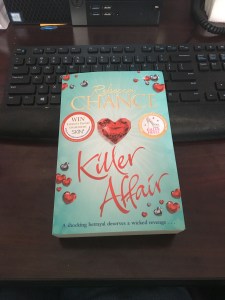
This was also a really good week for books; I got the new Rebecca Chance (Killer Affair) in the mail, as well as The Complete Stories of Flannery O’Connor and Geronimo Rex by Barry Hannah (a signed copy of the new Bill Loefhelm is waiting for me at Garden District Books; I intended to pick it up today but it was pouring, I didn’t have my umbrella and there was no place within two blocks to park, so I decided to put that errand off until someday next week). I’ve never read Barry Hannah other than a short story in college: “Love Too Long.” As Constant Reader is aware, my very first attempt at taking a writing class in college was a disaster; the instructor basically told me I’d never be published and “if being a writer is your dream, you need to find another dream.” Oy. Anyway, flash forward a few years and I started attending Fresno City College, a junior college in the Tower District of the city, to try to get my GPA back up to a point to where I could get accepted into the California State University system. Bravely, I enrolled in another creative writing class, and the teacher was a man named Sid Harriet. He required us to buy, for the class, two short story collections: Airships by Barry Hannah, and Will You Please Be Quiet, Please? by Raymond Carver. He asked us to read the afore-mentioned Hannah story, as well as Carver’s “Neighbors.” Both stories were unlike anything I’d ever read before; and I decided to try to stretch myself creatively with the two stories I had to write for the class. The first story I wrote (seriously) was called “Bottles, Booze, and Bette Davis,” about a young couple having a disagreement about their commitment to each other in a diner–and their interactions with their waitress, Marge. It wasn’t a good story by any means, but when critiqued in class, it got some favorable comments and some good criticism, actually. Sid was very supportive, as well–and after my previous experience, this was a revelation for me. The second story was worse than the first, “A Single Long-Stemmed Red Rose” was the title; and it was an alternating point of view story about an encounter between a young college student cutting through a cemetery with a beautiful young widow. Again, it didn’t work; the points of view weren’t delineated enough to justify using this technique and the story itself didn’t work. Sid was highly enthusiastic about my attempt to push myself, though, and he was the one who recommended I read Faulkner’s  As I Lay Dying (which I did, and was blown away; that was, interestingly enough, when I became a Faulkner fan). You were allowed, as a student, to take the class twice; so I took it again the next semester and decided to take full advantage of the class by writing and turning in as many stories as I could–the minimum was two; which is what everyone did. Amongst the many stories I turned into that class were “Seminole Island” and “Whim of the Wind”, which everyone in the class loved; Sid even turned them both back to me with the note, “You need to send these out for submission.”

Manna from heaven for someone who hadn’t gotten any encouragement to be a writer since graduating from high school. I can even remember having a meeting in his office, and I told him what Dr. Dixon said. He just shook his head and said “that man shouldn’t be anywhere near students.”

The funny thing is, I would have told this story years ago but I couldn’t remember his name. Isn’t that awful? The person who, in addition to Mrs. Anderson from high school, was supportive of my desire to write, and recognized my ability was someone whose name I couldn’t remember until today. 

I bought the Barry Hannah novel because it was on a list of ‘essential Southern Gothic novels’; and I remembered reading that story back in 1983 in Fresno. And when I started writing this blog entry, I knew I had to talk about Sid, owed it to him really–and as I started typing his name popped into my head.

Funny how that works.

Okay, I am now going to make some lunch, and get this kitchen cleaned and organized; maybe I can get some work done on “A Holler Full of Kudzu” before we leave for the movie.

Have a great day, Constant Reader!

Sister Honey

It’s currently thirty-one degrees in New Orleans, and I suspect it is close to that here in my office in the Lost Apartment. My fingers are tingling with cold as I type, and my space heater is going full roar close to my chair. I have on a T-shirt and a sweatshirt, a blanket wrapped around my sweatpant-clad legs. At some point I have to venture out there to go to the grocery store and pick up the mail, and still later I have to go to the convention center for a panel on villains. It was so cold this morning I didn’t want to get out from underneath the five blankets on the bed until slightly after ten o’clock. It’s only supposed to be this weather this weekend; Monday it’s back in the sixties and then next week we are back in the seventies again.

Crazy New Orleans weather.

As Short Story Month continues, yesterday I curled up in my easy chair with Collected Stories of William Faulkner. I’ve not really read much of Faulkner’s short fiction; but I do love Faulkner. Reading Faulkner is never an easy task, and I often think to myself that I should not only revisit some of the novels of his that I have read–Sanctuary, The Sound and the Fury, Light in August, As I Lay Dying–but should also try to read more of his work. I read Sanctuary when I was in high school, and read the other three novels when I was in college–but not for a class; I read them for pleasure. The Sound and the Fury is one of my all-time favorite novels, and every time I read something of Faulkner’s–or think about him and his work–I get inspired to write about Alabama. It was during that period that I was reading Faulkner that I wrote most of my Alabama short stories, and whenever I dip back into that well, I don’t know, I can see the Faulkner influence on them. (I am very aware how pretentious that probably sounds; Faulkner was a great writer and comparing ANYTHING I write to him is the ultimate in pretension and arrogance.)

I had not read “A Rose for Emily” in a long time; if it isn’t my favorite short story of all time (and it probably is), then it is definitely one of them. It’s the perfect story, really; the way it’s worded, the use of language, the rhythm of the words, and the story itself, which is grim and dark yet very matter-of-fact. Small Southern towns, whether the Jefferson, Mississippi of the story or the Maycomb of To Kill a Mockingbird, are no different than any other small American town; Peyton Place with a magnolia-scented accent. I have created an entire county in Alabama, along with a county seat–a small town–and have written a lot of mostly unpublished short fiction set there. (It also made a brief appearance in Dark Tide; it was where my main character was from) Every so often I think I should focus more on my Alabama fiction, and rereading Faulkner certainly has that effect on me.

When Miss Emily Grierson died, our whole town went to her funeral: the men through a sort of respectful attention for a fallen monument, the women mostly out of curiosity to see the inside of her house, which no one save an old manservant–a combined gardener and cook–had seen in at least ten years.

It was a big, squarish frame house that has once been white, decorated with cupolas and spires and scrolled balconies in the heavily lightsome style of the seventies, set on what had once been our most select street. But garages and cotton gins had encroached and obliterated even the august names of that neighborhood; only Miss Emily’s house was left, lifting its stubborn and coquettish decay above the cotton wagons and the gasoline pumps–an eyesore among eyesores. And now Miss Emily had gone to join the representatives of those august names where they lay in the cedar-bemused cemetery among the ranked and anonymous graves of Union and Confederate soldiers who fell at the Battle of Jefferson.

Alive, Miss Emily had been a tradition, a duty, and a care; a sort of hereditary obligation upon the town, dating from that day in 1894 when Colonel Sartoris, the mayor–he who had fathered the edict that no Negro woman should appear on the streets without an apron–remitted her taxes, the dispensation dating from the death of her father on into perpetuity. Not that Miss Emily would have accepted charity. Colonel Sartoris invented an involved tale to the effect that Miss Emily’s father had loaned money to the town, which the town, as a matter of business, preferred this way of repaying. Only a man of Colonel Sartoris’ generation and thought could have invented it, and only a woman would have believed it.

Isn’t that a stunning opening?

I first read “A Rose for Emily” for an American Lit class in college. Unlike almost everything else I was ever forced to read and talk about in a class/write about for class, I actually loved this story (I am actually planning on rereading some of the stories I was forced to read and hated this month; to see if I still hate them: “The Minister’s Black Veil” by Hawthorne, “The Girls in their Summer Dresses” by Irwin Shaw, etc.), and have gone back to reread it any number of times. There is so much truth in this story; this is exactly what small Southern towns and the people who live in them are like; and almost every small town seems to have that strange, eccentric spinster who is the last of a good family living in a crumbling once-proud house.

As you can see by the opening, the story takes place after Miss Emily has finally died; the narrator–whose name we never know, and we never learn anything about other than he is a resident of Jefferson–then proceeds to relate the sad story of Miss Emily, or rather, what the townsfolk know about her. This is all casually pieced together from years of observation and town gossip; the story is told (with incredibly beautiful language) in the tone of someone sharing a good story across the kitchen table, with sweating glasses of iced tea and a bowl of wild blackberry cobbler.

Miss Emily never had a prospect for a husband, other than Homer Barron–who, the people in town viewed as not worthy of a Grierson; he wasn’t a local and moreover, he was a day laborer, brought in to supervise the installation of cement sidewalks. No one really knows what happened between Miss Emily and Homer; but there was a lot of talk. And then he vanished, from town and from Miss Emily, never to be heard from again.

Until now.

Rereading the story, I caught something I’d never noticed before, this particular passage:

When she had first begun to be seen with Homer Barron, we had said, “She will marry him.” Then we said, “she will persuade him yet,” because Homer himself had remarked–he liked men, and it was known that he drank with the younger men in the Elks’ club–that he was not a marrying man.

Emphasis mine.

First, it surprised me that I’d never noticed that throwaway line of Faulkner’s before–really, if you aren’t paying attention, you wouldn’t really notice it as anything more than what it says; Homer wasn’t a marrying man. But the combination of sentences: “he liked men” and “he was known to drink with the younger men in the Elks’ club” in combination with him not being a marrying man–well, it may not have been intended that way in Faulkner’s mind, but those are codes for ‘gay’ in the Old South; no one ever said the word ‘homosexual’ but instead said things like “not a marrying man’ or ‘confirmed bachelor’.

As you can imagine, this has caught my curiosity.

Faulkner is often called a ‘Southern Gothic’ writer, along with Carson McCullers, Erskine Caldwell, and Flannery O’Connor, among many others; but I’ve always felt that some of his fiction, and this story in particular, certainly can be considered noir, or noir adjacent. The story doesn’t really answer any questions, but if it was told from another point of view, rather than unknown narrator–her black manservant’s, for example, or even Miss Emily’s herself–the story would definitely become something else than what it is.

But as it is, it is perfect: beautifully written, painfully honest and real, and macabre.

I’ve always wondered if the story inspired the songs “Delta Dawn” and “Angie Baby,” both recorded by Helen Reddy; both songs always make me think of the story, as does “Sister Honey” by Stevie Nicks.

Something to think about, I guess.

And now, off to the spice mines. Here’s a hot Southern guy for you:

Me and You and a Dog Named Boo

As I continue to muddle my way through this manuscript–honestly, I don’t know sometimes why it’s like pulling teeth and other times it’s just comes right out–I am constantly amazed at how many other ideas I get when I am working on something; ideas that are infinitely more interesting and sound like more fun to write than whatever it is I am actually working on. AND IT HAPPENS EVERY SINGLE TIME. And once I am finished, the creativity and urge to work on something else goes right away.

Surely I can’t be the only writer who experiences this?

AUGH.

Madness.

But as I think about these short stories, I remember probably the two finest collections of short stories ever–Echoes from the Macabre by Daphne du Maurier and Night Shift by Stephen King. I recently bought another copy of Night Shift on ebay, as my copy is in a box somewhere. Both du Maurier and King were short story masters; in fact, when I was a kid I loathed short stories and loathed reading them; this was primarily because I had to read things like “The Minister’s Black Veil” ad nauseum in English classes. I wasn’t lucky enough to be exposed to the truly great stories, like Faulkner’s “A Rose for Emily” and Jackson’s “The Lottery” until I got to college; but even by then the damage was done; that, along with the assigned short stories in writing courses (if I ever have to write an essay on Irwin Shaw’s “The Girls in the Their Summer Dresses” again I cannot be held responsible for what I do) had conspired to create a mentality that I loathed short stories. My experience writing short stories in writing courses in various colleges and universities had also taught me that I wasn’t a good short story writer; any good short stories I might write for a class were good purely by accident because I did not know what I was doing. That still stands true for today; I would rather write a novel than a short story.

But I am digressing, as is my wont.

Reading the du Maurier and King short story collections made me aware of what was possible for a truly gifted author to do with a short story; just as Jackson did with “The Lottery” and Faulkner with “A Rose for Emily.” My own difficulties with writing short stories comes from not, I realize now, having an actual system; I get an idea–usually both a title and a first line; maybe a character–and then I just kind of write with no idea of what’s to come, or what the story is about. This is the issue I had with “The Weeping Nun”; I wanted to write a story to submit to an anthology about Halloween stories, and I had this great title with an amorphous idea for a story, a point of view character, and an opening line: Satan had a great six pack. The problem, as I started writing the story, was realizing that as it came to me it had nothing to do with a weeping nun; but I was determined to somehow force that into the story so I could use the title.

On reflection, it seems perfectly insane and ludicrous now; but I am nothing if not obtuse and I am incredibly stubborn in stupid ways. I liked that title, and damn it, this story was going to fit that title if it fucking killed me.

The end result was the story was never finished, I missed the deadline for submission, and there was just frustration left in the wake of yet another short story failure.

And of course, this week as I struggled with writing the novel, it came to me in a flash: the story I was writing had nothing to do with the story of the weeping nun; I should have simply retitled the story and followed it to its logical conclusion and saved the story of the weeping nun for another time.

Idiocy, really. So simple, but I just couldn’t see it at the time.

And now I want to finish writing the damned story, which I now see as being about the gates of Guinee on Halloween night in the French Quarter.

Heavy heaving sigh.

And now, back to the spice mines.

Here’s a hunk to cheer you up, Constant Reader:

hot-firefighters-with-puppies-calendar-charity-australia-1