Not that the day of the week matters anymore, frankly; yesterday I thought it was Friday all day and even when corrected (I sent an email to the MWA Board of Directors and opened with HAPPY FRIDAY!) I still continued to think it was Friday.
I’m stubborn that way.
We finished watching We Are the Wave last night, after I did one of those on-line promo reading/discussion things for The Faking of the President. I recognize that these things have become a part of what is reality these days, but I’m still uncomfortable doing them. I hate the sound of my own voice, and being able to see myself staring back at me from the computer screen is far worse than any mirror I’ve ever looked into. But I suspect that even once the pandemic has come to its inevitable end–even bubonic plague eventually ran its original course–these things will become part and parcel of promotion for writers henceforth. For one thing, publishers would much rather you “tour” virtually than having to pay to send you, for one, and for the vast majority of writers, virtual touring is much more, obviously, affordable than an actual tour.
But last night I slept extremely well, which is lovely; I actually feel very rested this morning and not tired, mentally or physically, and it’s been a hot minute or two since I could say that. There are some errands I have to run today–most importantly, a prescription refill that needs to be picked up–but I am going to be spending a lot of the day doing my day job stuff here at the Lost Apartment, and yes, that includes more hours of condom packing, which means finding some movies on HBO MAX or Disney to watch. The TCM app on HBO MAX is quite marvelous, actually; there are a lot of wonderful films on there I’ve always wanted to watch, and since I spend several afternoons a week making condom packs, I can now watch them while my hands work. Alas, there are a lot of films I want to see that aren’t on there; there’s some great Hitchcock movies (I really enjoyed Foreign Correspondent, despite how dated it was) and there are some lesser known Hitchcocks which will be fun to watch as well (I could also go through Amazon Prime, but their app on Apple TV is not user friendly in the least). I was looking to rewatch Rebecca and Notorious the other day, but neither were on the TCM app, and neither was Suspicion, which was my next default. I think Shadow of a Doubt is on Prime–that’s the next one I’m looking for–and there might be some on there that aren’t on the TCM app.
I’ve also been thinking a lot about the films of the 1970’s a lot lately as well; watching Eyewitness made me think more about that decade, and we talked about it some on the virtual event last night–and there are some terrific films from the 1970’s I’d like to rewatch or see for the first time. I’d like to see Chinatown again, despite my aversion to Roman Polanski and his work–which is a whole other conversation, the old artist vs. the art thing–and there was a darker, grittier aspect to the films of the decade, despite it also being the decade that gave us Star Wars. I’d actually like to watch Cruising again, and numerous other Pacino/De Niro/Scorsese films of the decade.
I also am going to spend some time this weekend writing, and I am also going to spend some time with S. A. Cosby’s Blacktop Wasteland. I also have some anthologies and short story collections I’d like to start dipping into; I hate that I’ve allowed myself to let the Short Story Project collapse by the wayside. I also want to spend some time this weekend trying to get organized; I have so much going on, between various writing projects and volunteerism and so forth that I am always playing catch-up, and I much prefer, as Constant Reader is very well aware, planning; the problem is that I am always juggling things as they come at me (bullets-and-bracelets from the old Wonder Woman comics is a very apt analogy) with the result that I always feel like I am getting dragged down into quicksand.
And don’t even get me started on emails. Jesus.
But it’s a good morning, I have energy and feel rested, and am hopeful this will help carry me through the rest of the day and I can get a lot done.
Well, Constant Reader, we’ve made it to Thursday again; how lovely is that?
I have a busy day ahead of me, so I am priming myself with as much coffee as I can hold–which I will undoubtedly regret later, when I can’t sleep tonight. I did sleep well last night–only waking up around six when Scooter decided to lie on me, purring and kneading me with his paws, but I fell back asleep relatively easily. I could have slept for another three or four hours, frankly.
While making my condom packs yesterday I watched two movies on HBO MAX: Eyewitness and Foreign Correspondent. Both were enjoyable, if flawed; the second more flawed for being a product of its time (1940) more than anything else. Eyewitness was also very much of its own time–the late 1970’s/early 1980’s, and is particularly memorable for being the first major film roles for William Hurt and Sigourney Weaver. Watching the movie put me back in mind of the 1970’s and all of its bitter cynicism. Hurt plays Darell Deaver, a Vietnam vet who now works as a janitor in an office building in the evenings; yet can afford a fairly decent apartment in Manhattan–which I suppose was still possible in the 1970’s–and his best friend is Aldo, played by a very young James Woods (also playing a racist Vietnam vet). In the building where Darell works is the office for a Vietnamese businessman (played Chao-li Chi, best known as Chao-li from Falcon Crest; obviously, back then it wasn’t an issue having a Chinese-American actor play a Vietnamese character) whom both he and Aldo remember from Saigon. Mr. Long has gotten Aldo fired from his job, and one night Mr. Long is brutally murdered while Darell is in the building. Darell, thinking Aldo killed him, pretends he didn’t find the body…but the newspaper reporter covering the case (Sigourney Weaver) he’s been watching on the news and has a big crush on, so he begins a minor flirtation with her. She thinks he knows more than he’s saying, and so plays along with the flirtation….not knowing she is more connected to the murder than he actually is. It’s a nice neo-noir film, if a bit flawed, and watching it reminded me of how much things have changed in our society and culture since then–and also reminded me of other things about the 1970’s; the rampant paranoia, for one, and how New York was in decline (or at least, seen to be in decline by the rest of the country), and was a much grittier, messier place. It also reminded me of how much public perception in the United States towards Jews and Israel have shifted–there’s a subplot about Sigourney Weaver’s parents being Russian Jews who managed to escape that is more important than is let on at first, and Christopher Plummer has a role as Weaver’s actual lover who is an activist helping Russian Jews escape from behind the Iron Curtain. Morgan Freeman and the guy who played Adam Schiff for years on Law and Order play the police detectives investigating Long’s murder–which was an interesting twist.
Foreign Correspondent was one of Hitchcock’s first American films, and since it was made in 1940 and was about the possibility of war breaking out in Europe (it already had; the movie was set in August of 1939), as one can expect it was very anti-Nazi and pro-Britain. Joel McCrea plays a reporter for the New York Globe who, as a crime reporter, is seen by the publisher as someone better equipped to handle reporting the double-dealing and backroom deals prior to the possible outbreak of war. McCrea does a good job in the role–if his character is quite a bit naive–and eventually he falls (as one does so frequently in Hitchcock films) madly in love with the daughter of the head of the Peace Party, who is supposedly working very hard to prevent the outbreak of war. There’s a typical Hitchcockian plot about a Dutch diplomat who is party to a secret treaty between Holland and Belgium and a secret clause only known to the signatories who is being pursued by the Nazis; a double stands in for him and is murdered very publicly–but the McCrea character knows he’s a phony and the search is on for the real diplomat. The suspense that Hitchcock is known for is there, and props to the studio and Hitchcock for doing a plane crash at sea in the third act–it’s totally not how a plane crash would work, of course, but no one in 1940 would know that–and, of course, as required by the Hays Code there is a rousing happy-ever-after ending with McCrea reporting from London during a bombing raid a la Edward R. Murrow, and as the credits roll a rousing rendition of a patriotic American song plays.
I had a headache for most of the day yesterday, so I didn’t read or write at all, but despite the headache, I couldn’t help but think about both movies, and how their stories couldn’t really be updated very much to a modern era–perhaps Eyewitness could be, more so, since television reporting isn’t going anywhere, but do newspapers even have foreign correspondents anymore? I don’t think so.
Paul and I are also watching a German Netflix series called We Are The Wave, which is interesting and rather well done; it’s based on the old “Wave” experiment that was actually done at a high school and then made into a movie, with a book adapted from it later; about how easy it is for fascism to take hold. It was done as an experiment, a teaching moment for an instructor for his class to show them–who wondered about how the Germans could embrace such a toxic political philosophy as Nazism–precisely how easy it was. This show is a bit different in that it shows that Nazism is again on the rise in Germany, and the “wave” in this show is actually a resistance movement towards both capitalism and Nazism. It’s interesting, only about six episodes long, and we are almost finished. We won’t be able to finish tonight because I am doing one of those Zoom on-line promotion things for The Faking of the President anthology.
And on that note, I am heading back into the spice mines. Have a lovely Thursday, Constant Reader.
I am from the South, which is probably something Constant Reader is sick of hearing about–but I feel like I always need to make that clear. While I grew up in Chicago and Kansas, I have always identified as Southern, as being from Alabama. It’s where I was born, and it’s where, as we say down here, my people are from. I was raised and shaped by natives of Alabama, who were raised and shaped and became who they were in Alabama, because of Alabama, and who identify completely as Alabamians.
I’ve now lived in the south for twenty five years this coming August 1st; even though many Southerners don’t think of New Orleans as Southern. (I would not dispute that thought, either; New Orleans is of the South but is not the same as the rest of the South…but once you cross the Orleans Parish line you are definitely back in the South, but southern Louisiana, while still similar, isn’t the same because of Acadiana.)
My relationship with the South, and with being Southern, is a complicated one, and one that I am constantly evaluating and examining, over and over again. I have pride of region, which is definitely a Southern trait; woe be to those who might condemn or stereotype or insult the region to my face. I am aware of the faults, and the flaws, and the horrors; I don’t need anyone to tell me or lecture me about its history and how it came to be the way that it is now., or of it’s racist history or of the current racism which still seems to be the majority opinion here. I’ve heard all the inbreeding jokes, and jokes about toothless people and hillbillies and white trash and people of Wal-mart and so forth; so by all means, keep them to yourselves. I also have always understood the difference between heritage and hate; I may have been very young but I remember the Civil Rights Movement vividly.
I was never a fan of Confederate statues, for example; I never understood the insistence on venerating men I didn’t consider heroes but traitors, even when I was young. I remember always thinking, but they lost, and they hated the United States, why should we revere that? The cognitive dissonance of being “patriotic Americans” while venerating those who fired upon the flag and tried to start their own country disturbed me when I was a kid and it never made sense to me, and no matter how many times the mythology of the happy slave was spoon-fed to me, whether it was Gone with the Wind (both book and movie), or any of the many other examples from fiction, film and television. The Biblical example of Pharaoh and Egypt (beyond their reject of the one God), holding the Hebrews in bondage as slaves was always right there, too.
And if might equals right, hadn’t the complete and utter defeat of the Confederacy, in such an incredibly humiliating fashion, a complete defeat that left the rebellious slave states in smoking ruins and their economy wrecked (much as Germany was after World War II), further proof that slavery and secession were wrong?
And yet it is an incredibly beautiful part of the country, whether it’s the gorgeous Smoky Mountains in Tennessee and North Carolina or the massive live oaks of New Orleans, the swamps of Louisiana andthe pine forests of Mississippi and Alabama, the lower Ozarks in Arkansas, the beaches of Alabama and Florida’s Gulf Coast. Savannah and Charleston and New Orleans are beautiful cities; the college campuses of the Southern states are breaktaking in their beauty.
Driving through Mississippi and Alabama, the countryside is so beautiful, the , with the pine tree forests and the red earth, the sloping hills and flowing rivers, that it always inspires my creative brain to think about stories and writing and books. I love the South, despite all the things that are wrong with it, because it’s also a part of me, of who I am. I love its contradictions–like how when you drive through the Smoky Mountains at night you will come across three enormous crosses rising out of the fog that announce the presence of a megachurch…and the same highway exit also plays host to Triple X Super Store.
It’s also interesting that I am returning to my first real manuscript about Alabama, set in a fictional recreation of the part of Alabama from which I came originally, while reading Kelly J. Ford’s debut novel, Cottonmouths–because even though Ford’s book is about Arkansas, the small country town and its surrounding rural area is very similar to my Alabama.
From behind, the woman standing with a guy next to the Love’s Truck Stop air pump looked like any other woman: long hair, too skinny, big purse, big sunglasses. But when the woman turned and smiled, Emily’s chest tightened and her insides tingled in a forgotten but familiar way. Rumors of Jody’s return had come as whispers around town, but until now Emily had lacked proof.
A warm breeze blew petroleum fumes and cigarette smoke into her face while she sought further confirmation of who she’d seen. Gas spilled onto her hand. Startled, she released the trigger on the pump and swiped her hand across her jeans. She sheltered her eyes from the sun to scan the parking lot. But the woman and the guy were gone.
Back on the highway, Emily tried to keep her mind as empty and barren as the farmland that rolled by. When that didn’t work, she turned up the radio and hit scan, unable to settle on the station offerings from the nearest town–country or Christian or the same four pop songs on repeat interspersed with commercials for pawn shops and car lots. Midway through the miles she punched the radio off and tried to tell herself that her new fast food job and her time at home were temporary, though she’d been back a month already.
Cottonmouths is many things, all wrapped up into a compelling story told with gorgeous language. Emily, the main character, has essentially flunked out of college and is wrestling, as so many Southern queers do, with the bipolarity of a deeply Christian small town/rural upbringing struggling against her deepest secret of desire for other women. She’s an outsider, which gives her the ability to see everyone and everything around her with brighter clarity than the insiders have the chance to see–she can see the hypocrisy in her deeply Christian town, and the abhorrence of difference, which makes her feel not only like an outsider but horribly, terribly lonely. It is this lesbian desire within her that ultimately led to her flunking out of college, an inability to come to terms with who she actually is despite being raised in a way that makes her loathe who she actually is. So she has returned to the dying little town of Drear’s Bluff, with its explosive boredom, feeling like a failure for flunking out of college and terrified to admit to people outside her parents that she has failed. She can only find a part time job working fast food in nearby Fort Smith–a job she is too ashamed to admit to her parents she has had to take.
And more than anything, she feels trapped. She wants to escape this town, escape its suffocating claustrophobia, and be free–but she needs money to do that, and without money–as is all too true for most people, she cannot escape.
The return of her best friend from high school, Jody, whom she sees at the Love’s Truck Stop, is the trigger that starts the story in motion. Jody, whom the good people of Drear’s Bluff consider “white trash”, has a baby and is unmarried and living in the old trailer parked on her family’s land. Emily’s past with Jody is also fraught; her family took Jody in when she was a teenager when her mother took off, and one night Emily made a move on her–and the next day Jody was gone, back to her mother and out of her life. This guilt has always plagued Emily; wrapped up in the strict confines of the narrow-minded Christianity she was raised with, and with Jody back now, Emily isn’t so sure what she wants or needs–but those unresolved feelings of first love and desire have now bubbled back up to the surface again.
Cottonmouths is what I would call “rural Southern noir;” while crime and criminal activity is a driving force to the story, it’s also more than that–it’s a compelling portrait of a slice of American life so many Americans it doesn’t affect do not want to face: the death of the small town way of life, the loss of employment opportunity, the collapse of hope for something better. It’s about different kinds of yearnings, and how hope can be twisted into seeing criminality as the only way out. Like Daniel Woodrell and Tom Franklin, Flannery O’Connor and so many others, Ford shows us the reality of rural Southern life; how the deep religious belief can go hand in hand with smug superiority and class warfare–how those who theoretically follow Christ, who ministered to the poor and sick, can somehow hate the poor and look down on them.
There are so many little touches here that ring so true–Love’s Truck Stops, which are scattered throughout the south along its highways and byways; the prayer circles where they drink Virgin Bloody Mary mix; the judgment for not attending church twice on Sundays and for Bible study on Wednesdays; and the viciousness of gossip and the fear that everyone will talk about you, and judge you, and laugh at you–or rather, passive-aggressively shake their heads while murmuring Christian platitudes while the gleam of enjoyment shines in their eyes.
I enjoyed this, and I am really looking forward to what comes next from Kelly J. Ford.
Well, it’s more like weeks are forever in this pandemic-riddled world in which we live these days, but onward we go.
As I often say–and you may perhaps be tired of hearing–the best writing and the best television/films always somehow give me inspiration–whether it’s to do better as a writer myself, or with story ideas. I’ll Be Gone in the Dark, as previously mentioned, has flooded me with memories of life in suburbs and in California ones, specifically. I’ve never done a lot of writing about California–the Frat Boy books are my primary novels set in California, and both Sorceress and Sleeping Angel are also set there (the latter, though, are set in a small town in the mountains rather than a small city, like Fresno, which is what I converted to the small city of Polk in the first two Frat Boy books; the coastal small city in the final Frat Boy novel is based on Santa Barbara)–so maybe I’ve done more writing than I would have initially thought about California. But I’ve never done anything suburban in California, I guess, which is the correct way of phrasing that.
And as I said to my friend Megan once, what is more noir than the suburbs?
I did finish reading Cottonmouths finally last night; more on that later, but for now I will say it is wonderful. I greatly enjoyed it, and I am really excited to sink my teeth into Blacktop Wasteland now.
I also decided to change the title of “After the Party” to “A Dirge in the Dark,” which is creepier. I didn’t like that original title, and this was a most unusual story for me in that I had started writing something that not only didn’t have a title, but one didn’t leap out at me–and for me to save the document I needed to name the file. I know, it’s insane, but that’s just how my mind works around here in the Lost Apartment; I think I have two folders in my entire computer that are “untitled noir story” and “untitled haunted house story”; which really tells me nothing so when I go in search of the files to work on them some more I would never find them–especially if I had about a million other folders with “unnamed” in the title somewhere.
Today is my work at home day–one of two–which is nice, which means I don’t need to shave or even shower, if I don’t want to–but I probably should, as it always makes me wake up and feel better just in general. I’m a bit groggy this morning, certainly more groggy than I have been the last two mornings–which is NOT a good sign by any means–but I am hoping the coffee will take care of that. I’ve not had a good deep sleep now for several nights running–I have slept, but I’ve not gone deep into the sleep; I wake up sporadically and then it takes me a while to get back to sleep, and I noticed, for example, yesterday that my legs were tired when I was climbing the steps in the house. I am sure a lot of this had to do with lack of physical activity since my gym closed, but with our cases going up again here in New Orleans (thanks, stupid people!) I am pretty confident the city is going to be shutting back down almost completely again soon, and it simply doesn’t make a lot of sense to spend the money to join a gym that may only be open again for a few days.
I guess I can start stretching here at home, doing crunches and pushups and weightless squats. It’s a thought–and seriously, anything that will help me to sleep better is certainly going to be welcomed.
It’s just so disappointing because I was really making progress at the gym before it closed for good.
And on that note, I am heading back into the spice mines. Have a lovely Wednesday, one and all.
So, of course rather than working on Bury Me in Shadows, yesterday I spent some time writing the opening scene of a short story inspired by watching I’ll Be Gone in the Dark. This is why nothing ever gets done around here, seriously. It’s called “After the Party,” and I’m not really sure where to go with it from where I got to with it–about nine hundred words in, actually, which isn’t bad, really. But I always have to write these snippets down; they nag at my brain the way your tongue will worry a loose tooth, and nothing will get it out of my head other than to write it down.
I don’t know if it’s the show that haunts me so much as it is seeing those suburban middle class cookie cutter houses where so many of the victims of the East Area Rapist–later upgraded to the Golden State Killer–lived; having lived in a similar style house in Clovis, a suburb of Fresno, and of course, our suburb of Chicago was essentially housing developments all in the same area; Bolingbrook was never a town but was rather incorporated as a “village”; the “village of Bolingbrook”–which always struck me as a little too cutesy for words. The developments all had model houses that were “modern”–split levels, ranch houses, etc–and they had folksy names; the original one was Westbury , and I honestly don’t recall what ours was called; there was another that was townhouses and I don’t recall its name either. But the newer ones had names like Winston Woods (more expensive) and Indian Oaks (same area, less expensive) and then the newest, which start going up down the street from us a few years after we moved there: Ivanhoe, which was fancier and the most expensive of them all; the 1970’s version of McMansions, I suppose. The village of Bolingbrook grew up so fast with all those working class and middle class white people fleeing the city to get away from “crime” (read: desegregated school systems) that parents were willing to commute an hour or so up the Dan Ryan Expressway to get to work. We were bussed ten miles or so over to Romeoville for junior and senior high school; the “village” grew so quickly that Romeoville High School couldn’t accommodate everyone, and even my junior high school went to a split schedule: kids from Romeoville started junior high at 7 and classes ran till 12; the Bolingbrook kids had class from 12-5–no lunch period, homeroom, or study hall. My freshman year we got our own high school but it wasn’t finished in time for school to open; so the high school went to the same schedule: RHS from 7-12 in the morning; BHS from 12-5. It was rough for sports teams and after-school activities for both schools; pretty much everything but sports was suspended until BHS was ready for us–the gym wasn’t finished, and neither was the cafeteria and an entire wing of the school, so some classes had to make do.
It was very strange, and made even stranger because we were on a “track” system of schooling as it was, so the school could handle the student load; the village was divided into four sections, and where you lived determined which track you were on; either A, B, C, or D. Three tracks were in at all times, one track was out. You went to school for nine weeks, then rotated out for three, then back in for another nine. We were in B Track, which was kind of the best–the school system shut down for two weeks at Christmas and two weeks in the summer, and those two weeks always began right as we cycled out–so B track got five weeks in the summer and five weeks in the winter.
It was different, and for the most part, I didn’t thrive in that educational environment.
But it would also be interesting to write about.
I spent some time with Cottonmouths yesterday and am really, as I have said all along, enjoying it. But that story was nagging at my brain, and I finally had to put the book aside to write it. But I think I am willing to put aside at least an hour or so a day for reading going forward, and I look forward to not only finishing the book but giving you all the glowing book report it so richly deserves.
I’ll Be Gone in the Dark continues to enthrall–we watched another two episodes last night–and I’m already, with two episodes to go, wondering about what we will watch next. Hopefully, there’s insanely fabulous Spanish-language show just waiting for us on Netflix; perhaps something else German or French; there’s bound to be something on there somewhere.
And on that note, it’s back to the spice mines with me. Have an awesome Tuesday, everyone.
So, who had “this revision won’t be as easy as Greg thought it would be” on their Gregalicious trials-and-travails bingo card?
Well, congratulations, you were correct. This reminds me of the time when I thought, oh I’ll just turn this Scotty manuscript into a Chanse, it’ll be easy and no, it really wasn’t. It was actually a nightmare, but eventually, after much anguish, stress, and aggravation, I did get it done and I was pretty pleased with the final outcome. I got up early yesterday morning and wrote an entirely new first chapter of Bury Me in Shadows, and one that was much better than any of the original attempts, so there’s that. Chapter Two was more of a slog, since I was trying to save more material so I wouldn’t have to write new material, but it’s going to need some going over again to make sure the transition from the old original story to the new is seamless. On the plus side–there’s always a plus side, even if I have to really dig deep down for it–the new material I am writing is good, and I like this iteration of the character much better than I did in the previous drafts; and his backstory is much better than it was originally. I also love the new opening. And making these changes actually eliminates a big hole in the story–something I could never really quite figure out–it was one of those things that had to happen for the story to happen, but it only made sense in THAT context, and that was driving me completely insane.
You can’t do that. It’s called “contrivance,” and there’s nothing that makes me more irritated or annoyed with a writer (or a movie or a TV show) where something happens only because it’s necessary for the story and only makes sense in that particular context. (I mean, obviously you can, and plenty of writers do, but it’s fucking lazy, and you shouldn’t, and if you do, and your editor doesn’t stop you…yeah, well.)
I also spent some time with Kelly J. Ford’s Cottonmouths, which I am really enjoying. I just wish I had more time to read, you know? I am so fucking far behind on my reading.
We also started watching HBO’s I’ll Be Gone in the Dark, which is very well done and very creepy. One of the things that terrifies me–which therefore also interests and fascinates me–is the concept of not being safe in your own home; that we all have this incredible illusion of security and safety in our homes–and neighborhoods, for that matter–and so we often are caught off-guard or by surprise by violence, or, as the theorists would say, the introduction of a Dionysian element into our safe, secure worlds. “The Carriage House” is that kind of story; so is “Neighborhood Alert” to a degree, as is the one I just sold, “Night Follows Night,” which is about not being safe in a supermarket because that was something I thought was interesting; you never think you aren’t safe in a bright public place full of employees and other shoppers until you actually aren’t. This is something Stephen King does very well; the introduction of something Dionysian into an ordinary, sedate, everyday kind of environment, and how normal everyday people react in those kinds of situations; some rise to the challenge, others do not.
Anyway, I’ll Be Gone in the Dark is just that–a true crime documentary based on the book by the late Michelle McNamara about her investigation into the Golden State Killer, and how that all came about. When you listen to the stories of the victims, and remember what it was like in in the 1970’s for women who were raped (not that things have gotten much better since then, but at least as bad as it is now it’s not as bad as it was then–not a laurel we as a society should be resting on any time soon, frankly), but how the rapes and murders happened in these quiet middle class suburban type enclaves where no one ever expected anything bad to ever happen (I’ve always wanted to write a book based on a murder that happened in the suburb of Chicago I lived in during my early teens; the killer and one of the accomplices were students at my high school; I knew the accomplice’s two younger sisters quite well); and I also lived in Fresno during the later part of the Golden State Killer’s run–but he had moved on to Southern California by then. I was stuck by the old footage of these neighborhoods in Sacramento, and how like our neighborhood in Fresno (Clovis, actually; a suburb of Fresno) and how closed off the houses were from their neighbors and the street–with small front yards and an enormous garage in the very front of the houses, which were in U shapes. My bedroom was the other side of the U from the garage and there were bars on the windows so no one could ever come in. My curtains were always closed so I could never see out onto the street or no one could see in; every once in a while on nights when I couldn’t sleep I would scare myself by thinking if I opened the curtains someone would be there–because it was very easy to get to, even if the bars precluded anyone from getting inside. Sliding glass doors were also very popular in houses back then, if not the most secure thing to have in your house, really.
And naturally, I started writing a short story in my head while I watched, about a bickering couple who come home early from a party because they got into a fight and are still fighting as they pull into their driveway and arguing still as they go into the house where they find their fifteen year old daughter bound and gagged in the living room with the sliding glass door to the backyard and pool area open, the curtains blowing in the night breeze. I don’t know the whole story, or how it ends, or even where it goes from there–which is why I have so many unfinished short stories in my files.
Heavy sigh.
There’s a tornado watch in Terrebonne and Lafourche parishes this morning, which probably means rain for most (or part) of the day here as well. It seems kind of gloomy and overcast out there, but brighter than it has been the last three mornings–when it rained a lot–so we’ll see how this day goes.
But it’s Monday, the start of a new week, and here’s hoping that I’ll be able to find time to not only read this week but time to work on the manuscript. Perchance to dream, I suppose.
I woke up to a marvelous thunderstorm this morning–probably something to do with Hurricane Hannah, undoubtedly–and while last night’s sleep was also sporadic, with waking up regularly and not falling back asleep right away, I feel somewhat rested this morning.
I did reread Bury Me in Shadows yesterday, and it’s actually not bad at all. It needs tweaking, of course, and there were some paragraphs/sentences/dialogue that made me wince a bit as I read, but overall it’s a fairly solid story with some really good writing already done. I have to throw out the entire first chapter and start over with it–now that the character isn’t a too-smart-for-his-age gay teenager and I’ve aged him to college student, the opening and the tone are all different, which is also going to require some changes here and there in the overall manuscript,and I think the opening of the story is much, much stronger with the new first chapter I started writing yesterday. I like the way the first chapter is going, and I like this new direction for the story, which makes it even stronger. It’s always lovely when you are pleased with your work, I think.
And I really need to not be so hard on myself about my writing. I’m pretty good at it, actually, and need to stop being so self-deprecating/down on myself.
Yesterday was, overall, quite lovely and relaxing. I ran my errands around noon to get them over and done with, which was lovely, and then I curled up in my easy chair with Scooter and started rereading the manuscript. That took me a few hours, along with the occasional break to do some chore–the house still really needs to be thoroughly cleaned–and then I wrote about 900 words of the new first chapter. Paul went and got us shrimp dinners from the Please U–a usual Saturday ritual–and then we finished watching Control Z, a really marvelous Mexican Netflix high school drama which is very intense and very well done. It’s amazing to me how different high school dramas are from other countries as opposed to the saccharine sweetness (and complete unreality) of American shows. Control Z had bullying, homophobia, transphobia, sex, drugs, alcohol, suicide, attempted murder, violence and our main character, Sofia, was emotionally vulnerable and damaged, which led to her cutting herself (her arms are decorated with scars) and a mental breakdown that sends her to a mental hospital for about a month. This was high school in all its ugliness and cruelty, and there were a few times it was hard to watch. The story focuses on Sofia, who is mentally fragile and everyone knows about her breakdown; they avoid her and think she’s a freak. But because no one talks to her and she has no friends, she observes everyone and notices things about them–very Sherlock Holmes–and then she is paired with the really cure new boy, Javier, for a science project. Javier’s father is a major soccer star, and Javier played for the national junior team–but he refuses to play soccer at his new school. That first day, during an assembly, the prettiest girl in school, Isabela, is outed as transgender when someone hacks into the computer system and plays a video stitched together from information in her phone and laptop computer. Her boyfriend knows–he’s the school’s resident hot guy–but part of the video also reveals that he is cheating on her with someone only known as Honey Bunny, and the nude videos he’s sent to Honey Bunny are a part of this video. Isabela is played by Carmen Carrera, a transgender actress who originally came to broader notice on RuPaul’s Drag Race and later came out as a transwoman; she’s terrific in the role, and it’s lovely to see such progressive subjects handled and a television show take the long overdue step of casting a trans actress in a trans role. She is also depicted sympathetically, and the cruelty of her ignorant classmates over the course of the season is heart-breaking and real; you really can’t come away from the show and still not be affected by what transfolk have to go through in their lives. (I’ve never understood why “difference” is most often met with hostility and sometimes violence, rather than with empathy and kindness) The following day more secrets are revealed with videos with other students’ secrets sent to everyone’s phones. Raul, whose father is a politician (and corrupt), and whose video exposes his father and destroys his political career, asks Sofia to find out who the hacker is. As she investigates, she and Javier become closer and soon it becomes apparent Raul is interested in her as well….but Sofia also has a damaging secret of her own. Paul and I were very impressed with this show and how well written and plotted it is; and it ended with a magnificent cliffhanger. We certainly hope there’s a season two.
I did not, however, get around to working on “A Holler Full of Kudzu,” because, as I suspected, my plans for the day turned out to be more ambitious than I had the energy or the will to complete. It was nice, though, to be relaxing, and I feel a lot less fried this morning than I have in quite a while. I also love that it’s raining. I don’t know how I lived in California with it’s lack of rain for eight years, but now I don’t think I could ever live in a dry climate ever again. (There’s a lot of rain in Bury Me in Shadows; in fact, I write a lot about rain and thunderstorms, now that I think about it.)
The plan for today is to get some more work done on Bury Me in Shadows, do some more cleaning, grill out at some point (another Sunday tradition around here; in the fall we do it on Saturdays as a makeshift LSU tail-gate), and keep on relaxing so I can get a lot done this coming week as well. I can’t believe it’s almost August already–but then again this year seems to have already lasted for-fucking-ever.
It’s Saturday, and how lovely that feeling is. I am going to try to avoid social media as well as email interactions this weekend, as I want to be productive and I really don’t need any help with getting distracted. I was a condom packing machine yesterday, and Scooter was happily cuddled up to my feet as I had my lap desk and was working. I finally came up with the working system for maximum efficiency, and ultimately I was able to double my productivity in the same amount of time, which was quite impressive. It had been bothering me that I wasn’t as fast at home as I was at the office–or rather, in my old office on Frenchmen Street–but I also didn’t have the proper set-up until yesterday. I also had taken some time on Thursday to fold inserts, which also sped up my time yesterday. I also watched this week’s Real Housewives episodes, rewatched “The Bells” episode of Game of Thrones season eight (it’s quite a spectacle; more on that later) and then Dangerous Liaisons and The Maltese Falcon on the TCM menu on HBO MAX (which I love; there’s so much excellent film on that menu–things I want to rewatch and things I’ve always wanted to see). After dinner we finished off watching Into the Night, which had a lovely cliffhanger, and then started a Mexican Netflix drama, Control Z, which is quite intense. I do have to run an errand today, and I do have to spend some time cleaning out my email inbox–it’s ridiculously out of control again (doesn’t take long!)–and then I am going to reread Bury Me in Shadows and make notes on what to keep and what has to change. I’d also like to spend some time with “A Holler Full of Kudzu,” but there’s only so much time in one day and I only have so much attention span, really.
It’s gloomy and overcast out there this morning; we’re expecting rain off and on for most of the weekend because of now-Hurricane Hannah. I slept fairly decently most of the night, but still woke up feeling a little tired this morning. As much as I would like to be lazy for the day–and really, rereading a manuscript is the epitome of lazy, since I’ll be doing it in my easy chair–but it’s quite interesting and sort of amazing how much of a difference a good night’s sleep makes in my productivity when it comes to writing. The more tired I am, the more snappish I become–so it’s always a good idea to not be on social media or answer emails, as little things really get under my skin when I’m in that condition–but hopefully that won’t be an issue this evening. We shall see, I suppose.
I’m not really sure why I got the bug in my ear to rewatch that episode of Game of Thrones–it’s really amazing, given what a cultural phenomenon the show was while it was airing, how little anyone talks about it anymore. I think this is primarily due to the enormous disappointment the majority of viewers felt with its conclusion, and I certainly can’t disagree with those disappointed feelings. I, too, wasn’t terribly pleased with how the show ended, but at the same time, I wasn’t expected this world–which mirrored actual history with all its gore and good-doesn’t-always-win and evil-sometimes-goes-unpunished reality–to come to a happy ending; although Sansa did wind up as Queen of the North, so at least there’s some sense of justice in that, after everything she went through. And with her red hair, and all the suffering she endured, an argument could be made that she was sort of based on Queen Elizabeth I–who against incredible odds and twenty-five years of living in the shadow of the executioner–finally climbed to the throne. But I want to talk more about “The Bells” and the sack of King’s Landing–which was another episode that had fans disappointed and outraged. I was one of the few fans who was all about the city being destroyed; and I was also really pleased that they showed it from the ground for the most part–with Daenarys and Drogon only seen from below as the city burns and people die. It was exactly how I imagined the sacking of cities throughout history to look–rape and murder, blood in the streets, pillaging, hysterical terrified crowds running for their lives and praying for sanctuary as their world collapses around them. Conquerers never showed mercy; the concept everyone was hoping for that to happen once the bells were rung is very modern. Cities have historically been subject to such sackings throughout history; maybe not with a dragon involved, but read accounts of the many times Rome fell, or the fall of Constantinople–this wasn’t a modern world by any means, and modern concepts of justice and mercy weren’t in play. Cersei herself said it in Season One: “when you play the game of thrones, you either win or you die.” She played, she died, and she took her capital city with her. Power politics in medieval history–the closest proximation to the world of Game of Thrones–were bloody and cruel and merciless, and the Popes and the Church were just as involved and as ruthless as any king or emperor. Arya even alluded to this when she was wearing the face of Walder Frey and wiping out his entire house: “You didn’t kill all of the Starks. You should have ripped them out, root and stem. Leave one wolf alive and the sheep are never safe.” Ergo–if you don’t kill all of your enemies, you have no one but yourself to blame when they kill you.
Dangerous Liaisons is a great movie, and a great story as well. When the film came out, I bought a copy of the novel and was enthralled by the petty games of seduction and revenge that played out in its pages. (I didn’t see the film until years later, when I rented the video; I’ve seen both the Glenn Close version and the Annette Bening, Valmont; and of course the modern day remake with Ryan Philippe and Sarah Michelle Gellar, Cruel Intentions. There was an earlier, modern day version made in the 1960’s I’ve not seen; it’s in French and I’ve always wanted to see it.) The novel is exceptional; originally published (and banned) in France in 1782, it was quite a cause celebre at the time; depicting the immorality and debauchery of the aristocratic class, it has sometimes been described as being one of the initial steps on the road to revolution in 1789. It’s an epistolary novel; you are reading the letters the characters all write to one another, so you see how the Marquise and the Vicomte are playing with their innocent, naive friends and relatives quite well. They are only honest with each other–although, of course, in this modern age the lesson I took from it was never put anything in writing, which is just as true today as it was then–and I had always wanted to do a modern, gay version. I eventually did, with Wicked Frat Boy Ways, but while I am proud of the book I also wish I could redo it some, revise and add to it more.
The film is extraordinary, and Glenn Close was certainly robbed–as she has been many times–of the Oscar for Best Actress.
As for The Maltese Falcon, it’s still a great movie, but I didn’t finish watching–and would prefer to rewatch when I can give it my full attention. It really is marvelously written, acted, directed, and filmed. I should probably reread the novel someday.
And on that note, I am going to dive back into the spice mines. The kitchen and living room are both a mess; I have errands to run, and of course, that manuscript to read. Have a lovely, safe Saturday, Constant Reader, and I will see you tomorrow.
Looks like we made it to Friday again, Constant Reader, and believe you me, these small victories matter.
I kept thinking, last night, for some reason all evening long that it was Friday, and I’m not exactly sure why that was, to be honest. I was well aware all day, as I made go-bags for syringe access for three hours and then came back home for more condom packing (it’s not as dirty as that sounds) that it was Thursday. I’m really not sure at what point in the evening my mind decided it was Friday. AT some point while Paul and I binged this marvelous Belgian/Netflix scifi thriller called Into the Night (a Scandinavian show called The Rain didn’t last an entire episode) I realized that tomorrow (today) was actually Friday and it was quite a jolt.
It’s raining this morning–there’s a tropical storm out in the Gulf heading for Texas–Hannah, I believe is her name–and it’s heading for the southern coast of the state. We’ll be getting rain from the system apparently all weekend–they’re thinking it’ll be spread out over the weekend rather than all at once so there’s no chance of flooding, or very little, at least–so it’s a good weekend for camping out inside. I am working from home today–lots of condom packing to do (again, not as dirty or fun as it sounds)–and some other things I need to get done today for the day job. I slept pretty well last night–although at some point Scooter cuddled up to me and woke me up with his purring, and he never stopped the entire time he was lying curled up inside my arm. The coffee is helping, as it always does, but I always wonder what it’s like to be one of those people who wake up instantly.
I will never know, apparently.
Into the Night is quite entertaining, I have to say. The episodes are all between thirty-three and forty minutes long, and the premise is relatively simple. A flight to Moscow at Brussels Airport has started it’s boarding procedure when a crazed man grabs an automatic (or semi-automatic) weapon from a military guard and runs down the jetway and forces the pilot to take off, with about ten or so passengers on board. He has a crazy story that is hard to believe–he works for NATO, and something has happened to the sun so that when it rises, everyone dies when exposed to the sunlight. It sounds crazy, but slowly they begin to realize he is right, and they have to keep flying west to stay in the dark. They also face almost every possible crisis an airplane could face–I told Paul at one point, “This is like every Airport movie ever made”–but it’s done incredibly well, and the tension is completely dialed all the way up. There are only six episodes to this first season, and we made it through the first four–and stayed up later than we should to watch the fourth (hence my shock when I realized it wasn’t Friday night, but then didn’t care and watched the fourth anyway), and I am looking forward to finishing it tonight.
This weekend I intend to reread Bury Me in Shadows and also work on trying to sew together all the pieces of “A Holler Full of Kudzu.” I still want to finish reading Cottonmouths–and I have S. A Cosby’s Blacktop Wasteland on deck as well. I was also thinking I might want to reread a Travis McGee novel this weekend; those novels were a huge inspiration to me when I was creating Chanse, after all, and I really enjoyed them when I first read them. I know there are sexism issues with the books–as there is with most everything from that time period–but I think it will be interesting to reread one and catch it this time; plus I loved the writing style and the voice of Travis McGee so much I want to see if I still feel the same way now that I am thirty-some books into my own career.
I also want to reiterate that my inability to finish reading Cottonmouths is not an indication of its quality at all; it’s amazing, but I only have a very short period of time to read every day, and I am always afraid that if I start reading it I won’t want to put it down–and that is very likely, as it is very good and I know myself–and if I do that I won’t get the things done I need to get done which will cause me stress. I used to do this thing where I would read for an hour and then write for an hour and go back and forth…well, would try anyway, because as soon as the book grabbed me it was all over.
And on that note, I’d best head into the spice mines.
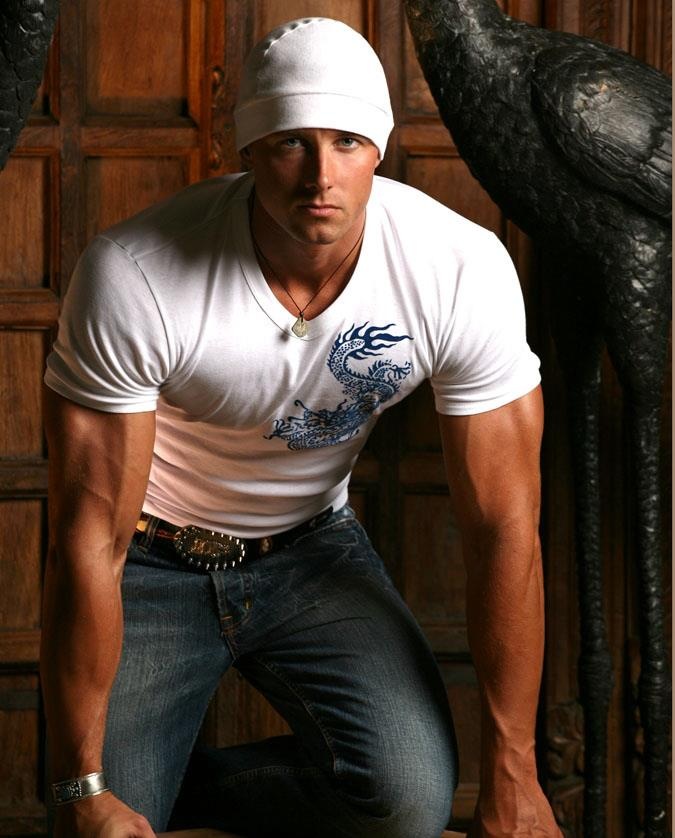
Today’s sexy man objectification photo certainly doesn’t seem like the right illustration for today’s title, does it?
He kind of looks like the alternate world Flash from the television show and turned out to be the villain of Season 2, Zoom, Teddy Sears, and I think he is in the second season of Netflix’s The Politician, as part of the throuple relationship Judith Light’s character is involved in. He is really pretty, even if he is not the guy in today’s picture, who is also really pretty.
But then assuming that a big muscular handsome man can’t be vulnerable as well is misandry, I suppose. Everyone, after all, can and should be–and definitely shouldn’t be afraid to be–vulnerable.
Yesterday was a good day–which seems to be par for the course lately, which is absolutely lovely. I got a lot of work done yesterday–granted, most of the day was spent making condom packs, which is my lot in life when it comes to working from home these days–but they are needed and necessary for the works kits we pass out during syringe access, and it’s hard to keep up with the demand. One of the nice things about making condom packs is I can watch something while I make them; the last two Wednesdays I’ve been watching The Mickey Mouse Club production of the Hardy Boys serial, The Mystery of the Applegate Treasure, which is loosely based on the first Hardy Boys adventure, The Tower Treasure. It was interesting to see the changes Disney made to the Hardy Boys to appeal more to their young audience–the Hardy Boys weren’t seventeen and eighteen, as they were in the books (I don’t recall how old they were in the original texts; Nancy Drew went from sixteen in the originals to eighteen in the revisions), and of course, Mrs. Hardy doesn’t exist in the serials. In fairness, their mother was never much of a character in the series–her name even changed from Martha in the original texts to Laura in the revisions–and their father’s sister, Aunt Gertrude, was more of an adult parental figure in their lives than even their father, and she replaces Mrs. Hardy in the Disney serials completely. The basic premise of the book is that the Tower Mansion is robbed, and suspicion falls on the father of their friend, Perry Robinson, who worked there; the burden of being fired means Perry has to drop out of school and of course, everyone in Bayport believes his father is guilty. Even in the revised texts, where a lot of the characterizations and color is dropped from the plot and the Hardys themselves become more two-dimensional, the way the Robinsons are shamed and ostracized by the town is very well-done; naturally, the Hardy boys, who want to be detectives like their famous father, go to work to clear the Robinsons.
In the serial, Perry is a juvenile delinquent from “the city” who is sent to Bayport to get away from bad influences, and works for crazy old Silas Applegate (in the book, his name was Hurd and he had a sister; both were known as “eccentrics”); soon Perry is framed for stealing tools and the Hardys, taking sympathy on him, take him on as a client. The Applegate treasure is an old pirate treasure of Jean Lafitte’s that was stolen from the mansion some ten years before; and no one really believes that it ever existed as Silas isn’t exactly mentally stable. It’s actually not a bad adaptation, and two of Disney’s biggest child stars, Tim Considine and Tommy Kirk, play the Hardys; any flaws it has are flaws of the time and the need for Disney (and pretty much all television shows) to sanitize and clean up small towns (well, life in general); what i always call the “Mayberritization” of American life. (Peyton Place, which was published during this same period, is far more accurate–which is partly why it was so scandalous.)
I started watching the second Hardy Boys serial, The Mystery of Ghost Farm–but I can also see why the Hardy Boys serials ended with this second one. It’s not as well done or as well plotted as the first; primarily because it isn’t based on one of the books and is wholly original…and while I can certainly understand why they didn’t base it on the second boo, The House on the Cliff (the plot of which centers on the boys looking for their father, whose been kidnapped by a gang of smugglers), they could have just as easily used Book Three, The Secret of the Old Mill.
These are, oddly enough, on Youtube rather than Disney Plus, as are some of the other serials, like Annette, and some of the two-part mysteries that originally aired on The Wonderful World of Disney.
And, as I’ve talked about recently, I’m thinking about reviving my middle-grade mystery series that I’ve been tinkering around with ever since I was about eight years old and started reading the kids’ series in the first place.
We also finished Dark Desire last night, and there were a lot of surprising plot twists in those final four episodes, and a great season cliffhanger at the end as well. I do recommend it, because it’s great fun and trashy yet engaging; and of course Alejandro Spietzer is gorgeous and charismatic. It’s apparently been renewed for a second season; Paul discovered this yesterday while searching for other series and/or films starring this gorgeous Mexican actor. Yes, we’re fan, and yes, we’re just that shallow.
And on that note, I am heading back into the spice mines. Have a lovely Thursday, Constant Reader, and I’ll shout at you again tomorrow morning.









 Queer and Loathing in America