True Colors

I wrote this entry two years ago, in the wake of the Pulse shootings.

06/16/16

The phone ringing woke me up that morning.

I sometimes wonder if that is when my aversion to the telephone really began; I’ve always blame my dislike of telephones on jobs that involved a headset and taking phone calls. But I can remember, before that Sunday morning, always answering the phone; I never screened calls. I always checked the voice mail the moment I got home and called people back right away. Now, the ringing of the telephone, any phone, grates on my nerves and tears at my subconscious. So maybe that was it; I cannot say for sure because my memory is foggy and I’ve learned, far too many times, that my memory has lied to me.

But the phone was ringing as I woke up, and as I started to sit up in bed I seemed to recall hearing it ringing earlier, in my sleep; aware of it but too asleep to get out of bed. But this time it woke me, and as I considered ignoring it and going back to sleep, I noticed on the alarm clock that it was nine in the morning…

…and Paul wasn’t home.

As I put on my glasses and slipped my shoes on and ran over to the phone, I remember the number on the caller ID was one I didn’t recognize; UNKNOWN CALLER with no number. I picked it up and said “Hello?”

“Is this Greg?” asked a very small, quivering female voice.

“Yes,” I replied.

“I’m sorry to have to tell you this but Paul is on his way to the emergency room at Charity Hospital,” she went on.

I sat down in the desk chair and listened to her tell me the story, hiccuping and crying and trying to keep her voice steady. I listened, not entirely sure this was really happening to me, hoping that I was asleep and this was a bad dream, as she told me how she and her roommate, both waitresses, had gotten off work and decided to stop by Verti Mart and get something to eat on their way home from work. They were on bicycles, and they were both college students, I think she said at Tulane. She told me how they were standing at the counter, deciding on their order, when they saw a lone guy walking by himself on the sidewalk across the street. As they watched, a white van pulled up to the corner, five guys jumped out and attacked the guy, punching and kicking him and screaming at him even after he went down. Her friend shouted at the store clerk to call the police and the two girls, college students, ran outside screaming. The guys jumped back in the van and took off….with the girls getting on their bicycles and chasing after them, trying to get their license plate number, to no avail. When they finally realized they weren’t going to get close enough to seem the plate number, they went back and stayed with him until the police and the ambulance came.

“He just kept saying you have to call Greg, please call Greg,” she said, finally starting to sob. “I’m so so sorry, I don’t know if he’s okay. I just know they took him to Charity Hospital, and he told me the number to call, he made me promise I’d call.”

I said thank you, thank you very much, and didn’t think to get her name or her phone number or any of her information, which I regret to this day.

I hung up the phone, and knew I had to get to the hospital.

I know at some point as I brushed my teeth and put on clothes, I was aware that I was going into shock. It was the first time in my life I’d ever heard my heartbeat in my ears, and I had no peripheral vision, and I couldn’t really hear anything. It was a very very strange feeling; I don’t remember every feeling that way before, or experiencing anything like it (I may have, but as I said earlier, my memory lies to me). I was shaking, and I knew I couldn’t drive.

So I called my best friend, who answered the phone the way he always did whenever I called him, cheerfully, “Hey whore!”

“Um, I need a favor. Paul’s at the emergency room and I don’t think I can drive. Can you come pick me up and take me?”

“I’ll be right there.” He hung up.

Charity Hospital was enormous. It’s still there, even though it’s not longer open. It became, of course, notorious after Hurricane Katrina, but before then, it was one of the top trauma centers and training hospitals for emergency trauma in the country. I vaguely remember sitting there in the emergency room waiting area, on those hard wooden benches that were so like church pews, while people were being brought in and rushed past, as other people sat there around us, worried, crying, some screaming every once in a while in pain while they waited to be taken in to see a doctor. It was surreal, and again it felt like something I wasn’t actually experiencing but was happening to someone else. I felt like I was out of my own body, watching.

And then finally they called my name.

A nurse led me back into the triage area, I guess it was called, I don’t know. On television emergency rooms always seem to be big rooms with sheets or dividers up separating the areas, but at Charity they actually had rooms. As the nurse led me back, she told me they were about to take him into surgery, and the surgeons would explain everything to me before I was taken in to see him.

All this time I didn’t know what was going on, and had been hoping it was something minor; a broken arm, a concussion, ribs, something where I’d be able to take him home.

Surgery. They were taking him in to surgery.

“He’s been given pain medication so he’s also going to be kind of out of it,” she said gently, and I will never forget her squeezing my arm when she said it.

She led me to a door–it was big and wooden and there was one of those small windows set into it at about eye level, with crisscrossing mesh wires set in the glass, where two men in scrubs were waiting for me.

In a low voice one of them, who had a Japanese last name, explained to me that he had sustained a lot of cuts and bruises but nothing serious; they had examined him and there was no concussion or internal damage. “But his eye–” he hesitated for a moment. “His eye was damaged.”

“His eye?”

The nurse was holding my arm still and she gave it another squeeze.

“Think of the eye like a grape,” he said softly. “If you put a lot of pressure on one side of a grape, it will explode out the back side. That’s what has happened to his eye. We’re going to try to save it.”

I think my knees buckled a little bit at this point, both in horror and relief; relief that it wasn’t something life-threatening, horror that his eye may have been destroyed.

The doctor also took me by both arms and looked me in the face. “He wants to see you. But you need to be prepared. It looks really bad. The surgery will also take a couple of hours. Once we take him in, you should just go home and relax, take care of things. Waiting here won’t do you any good, and just come back in a couple of hours. We’re going to take very good care of him, but if we’re able to save his eye, the recovery is going to take a really long time…and the psychological trauma can take even longer. You’re going to have to be strong for him.”

I nodded, and the nurse led me inside. Paul was lying on a hospital bed and when he saw me he just kept saying, over and over again, in a broken voice, “I’m so sorry, I’m so sorry, I’m so sorry.”

My heart broke. His eye…even now I can’t describe what that looked like. He was covered in dried blood. I just kept saying it was okay, everything was going to be okay, and then it was time for them to take him into surgery.

I felt so helpless. It was the most horrible feeling in the world, when someone you love is suffering and in pain and there’s nothing you can do to make it better.

The nurse handed me a clear plastic ziploc bag with his clothes and shoes inside of them.

They were soaked in blood.

I had Mark take me home. I don’t really remember the drive back home, I don’t really remember anything. I know that I didn’t break down until I was safely inside my apartment, and I sat on the couch for a really long time holding the bag of bloody clothes before I remembered that, no matter how much I wanted to wallow in it, I had to be strong.

I had to call his mother.

I had to call his boss.

I had to let friends know what was happening.

I know I did all of those things, but I don’t remember that afternoon very much. I just know that I kept calling Charity Hospital to find out if he was out of surgery but every time I called, I went into a nightmarish phone tree that I couldn’t figure out how to navigate, and finally I called a cab and went back.

Charity Hospital was enormous, as I said before, but one of the things that was really strange was I wasn’t able to find a reception desk, anything, anywhere, where I could find someone, anyone, to tell me anything.

There were phones in some places where you ostensibly could call for information, but a recording answered and I was too upset, too numb, to be able to figure out their phone tree system inside the hospital anymore than I had been able to at home.

I wandered around Charity Hospital looking for anyone for what seemed like hours.

Finally, I just sat down on the floor near an elevator bank, buried my face in my arms, and started sobbing in frustration and grief and pain.

Then someone knelt beside me and asked, in a very kind voice, if I was okay.

It was a nurse, a young African-American man with braids, and I sobbed out that my partner had surgery and I didn’t know where he was and I didn’t know how to find him and I couldn’t find anyone to ask.

He got me up, took me to a lounge, bought me a bottle of Coke from the machine there, dried my eyes, and made some calls. “He’s still in surgery,” he finally said, sitting next to me again. “I can take you up to the waiting room for that surgery. I’m so sorry.”

And he did, and he talked to the nurses on the floor, who came and checked in with me every half hour, making sure I was okay, making sure the television in the waiting room was on something I didn’t mind watching, or asking me if there was something else I’d rather watch.

They were so unbelievably kind.

This was before everything changed, you know, when I’d heard horror stories about how gay couples weren’t allowed to see each other in hospitals and how badly we were treated.

This was Charity Hospital in a state so red it practically glowed; yes, it was New Orleans, but it was also a city where my partner had just been beaten badly for the crime of walking while gay.

And they couldn’t have been nicer to me.

Finally, at ten o’clock, a nurse came to tell me he was now in the recovery ward, and she took me to see him. His head was bandaged but they’d cleaned off all the blood. He had tubes hooked up to him and monitors, but he was breathing, he was asleep.

I leaned over and kissed his forehead.

The recovery ward nurse told me I could stay if I wanted to, but she added that I’d be better off going home and sleeping in my own bed. “He’s going to need you to be rested and strong for him,” she said, rubbing my arm, “and so you’re going to need to make sure you take care of yourself. Will you promise me that? That you’ll take care of yourself? Because he’s going to need you.”

I nodded. “I don’t want to lose him again.”

She gave me her card, and wrote her cell phone number on the back. “I will call you and let you know where we’ve moved him, once he’s ready to be moved out of here. But you keep this card, and if you have any questions or anything to worry about, you call me any time. I’m so sorry you couldn’t find him earlier.”

I sat with him about an hour, and then I went home in a cab.

It was the longest and definitely one of the worst, days of my life.

I have never told this story publicly before, and I do not tell it now to try to make the Orlando tragedy about me. But what happened last Sunday wounded me very deeply, and dredged up a lot of these memories. As I tried to avoid social media, the news, etc., as much as possible–but you never really can–because of the arguing, the nastiness, the absolute viciousness, the attempts to erase the sexuality of the victims, and so on…I started thinking about what I personally have been through.

Paul wasn’t saved by a ‘good guy with a gun,’ he was saved by two brave college students–girls--who saw something wrong happening and did something about it even though those five assholes could have turned violence on them.

Two girls whose names I never knew, but to whom I will always be grateful.

And I also realized that in not telling my story of that awful day, that I was also being complicit. Complicit in not letting people know what it’s like to be gay in America, even in a tolerant city like New Orleans: that we are always at risk, we are always looking over our shoulder, we never can feel truly safe.

Ever since that day I have always, always made sure I was aware of my surroundings, of who was where and doing what. I observe and I watch, no matter what else I am doing, when I am out in public. I do it in the grocery store; I do it in the CVS; I do it when I am walking in the Quarter.

Tonight I have to go do bar testing, and it’s Pride Weekend in New Orleans. I’m not afraid; I have never been afraid. Being aware that you’re a target doesn’t make you afraid, but it means you just have to always pay attention and never let your guard down.

I never wrote about that day because Paul was the victim, not I; because it was Paul’s story to tell rather than mine. But I also realized that it is also my story.

The recovery for both of us from that day took a long time to heal, both physically and mentally. Reading the news reports about Orlando, paying attention to what was going, what had happened, the grief, made me realize that it’s still there, buried deep inside my soul.

My life changed that day. I changed. I am aware of some of the ways I’ve changed, but at the same time I also know I’ve changed in ways that even I may not be aware of. I didn’t write this for sympathy. I didn’t write this to try to make the tragedy about me. My heart breaks for everyone in Orlando. Even now when I run across things on my feed, stories of the survivors, stories of the dead, I can start crying again–so I try to limit my time on social media.

Orlando made us all change, I think. I think for the first time many people realized, maybe just a little bit, of what we as LGBTQ Americans go through, experience, on a daily basis; what it is like for us to live in a society and a culture where some people want us to die and celebrate our deaths.

Maybe things can change now. As I said the other day, I always try to make sense of the senseless; hope that things happen for a reason.

I just hope that those who died so horribly last Sunday morning, those whose last hours of life went from happiness and celebration to horror and fear–I hope that their deaths will mean something to this country, that their awful deaths weren’t just another statistic.

They are all at peace now.

May they never be forgotten.

I am posting this picture of two of the victims, a loving couple who hoped to be married but whose families will now bury them together, in a happier time, so that I, too, will never forget.

515769_300

May none of you ever be forgotten.

Say You, Say Me

Congratulations to everyone on the Anthony Award short lists, and especially thanks due to the volunteers who organized this!


BEST NOVEL

  • The Late Show by Michael Connelly
  • Magpie Murders by Anthony Horowitz
  • Bluebird, Bluebird by Attica Locke
  • Glass Houses by Louise Penny
  • The Force by Don Winslow

BEST FIRST NOVEL

  • Hollywood Homicide by Kellye Garrett
  • She Rides Shotgun by Jordan Harper
  • The Dry by Jane Harper
  • Ragged; or, The Loveliest Lies of All by Christopher Irvin
  • The Last Place You Look by Kristen Lepionka

BEST PAPERBACK ORIGINAL

  • Uncorking a Lie by Nadine Nettmann
  • Bad Boy Boogie by Thomas Pluck
  • What We Reckon by Eryk Pruitt
  • The Day I Died by Lori Rader-Day
  • Cast the First Stone by James W. Ziskin

BILL CRIDER AWARD FOR BEST NOVEL IN A SERIES  

  • Give Up the Dead (Jay Porter #3) by Joe Clifford
  • Two Kinds of Truth (Harry Bosch #20) by Michael Connelly
  • Y is for Yesterday (Kinsey Millhone #25) by Sue Grafton
  • Glass Houses (Armand Gamache #13) by Louise Penny
  • Dangerous Ends (Pete Fernandez #3) by Alex Segura

BEST SHORT STORY

  • The Trial of Madame Pelletier by Susanna Calkins from Malice Domestic 12: Mystery Most Historical
  • God’s Gonna Cut You Down by Jen Conley from Just to Watch Them Die: Crime Fiction Inspired by the Songs of Johnny Cash
  • My Side of the Matter by Hilary Davidson from Killing Malmon
  • Whose Wine Is It Anyway by Barb Goffman from 50 Shades of Cabernet
  • The Night They Burned Miss Dixie’s Place by Debra Goldstein from Alfred Hitchcock’s Mystery Magazine, May/June 2017
  • A Necessary Ingredient by Art Taylor from Coast to Coast: Private Eyes from Sea to Shining Sea

BEST ANTHOLOGY     

  • Just to Watch Them Die: Crime Fiction Inspired by the Songs of Johnny Cash, Joe Clifford, editor
  • Killing Malmon, Dan & Kate Malmon, editors
  • Coast to Coast: Private Eyes from Sea to Shining Sea, Andrew McAleer & Paul D. Marks, editors
  • Passport to Murder, Bouchercon Anthology 2017, John McFetridge, editor
  • The Obama Inheritance: Fifteen Stories of Conspiracy Noir, Gary Phillips, editor

BEST CRITICAL/NON-FICTION BOOK 

  • From Holmes to Sherlock: The Story of the Men and Women Who Created an Icon by Mattias Boström
  • The Story of Classic Crime in 100 Books by Martin Edwards
  • Killers of the Flower Moon: The Osage Murders and the Birth of the FBI by David Grann
  • Chester B. Himes: A Biography by Lawrence P. Jackson
  • Rewrite Your Life: Discover Your Truth Through the Healing Power of Fiction by Jessica Lourey

BEST ONLINE CONTENT  

32190840_616637735356684_1241434076133457920_o

Freedom

Thursday. I don’t have to go in until later today, which is nice; it gives me the morning to slowly wake up and get going. I didn’t sleep well last night for some reason so I am going to be really tired this evening; which is fine, I suppose. Maybe I’ll sleep well tonight, who knows? Paul came home just as I was getting ready to go to bed, which was nice. Normality, such as it is, has returned to the Lost Apartment. I started reading William J. Mann’s Tinseltown: Murder, Morphine, and Madness at the Dawn of Hollywood. It won the Edgar several years ago for Best Fact Crime, and I’ve been wanting to read it for years. I’ve know Bill for years–I was also there at the Edgars the night he won–and have always enjoyed his work.

I started writing that short story “Burning Crosses” yesterday, and am trying really hard to not allow fear to stop me from working on it. I think it could be a really good story, but…it’s also potentially a dangerous one to try to tell. but I can’t let fear of reaction stop me from working on something. That’s just not a good thing, you know?

51AFYZxNRhL._SX304_BO1,204,203,200_

“Everyone in Venice is acting,” Count Girolamo Marcello told me. “Everyone plays a role, and the role changes. The key to understanding Venetians is rhythim–the rhythm of the lagoon, the rhythm of the water, the tides, the waves…”

I had been walking along Calle della Mandola when I ran into Count Marcello. He was a member of an old Venetian family and was considered an authority on the history, the social structure, and especially the subtleties of Venice. As we were both heading in the same direction, I joined him.

“The rhythm in Venice is like breathing,” he said. “High water, high pressure: tense. Low water, low pressure: relaxed. Venetians are not at all attuned to the rhythm of the wheel. That is for other places, places with motor vehicles. Ours is the rhythm of the Adriatic. The rhythm of the sea. In Venice the rhythm flows along with the tide, and the tide changes every six hours.”

Count Marcello inhaled deeply. “How do you see a bridge?”

“Pardon me?” I asked. “A bridge?”

“Do you see a bridge as an obstacle–as just another set of steps tp climb to get from one side of a canal to the other? We Venetians do not see bridges as obstacles. To us bridges are transitions. We go over them very slowly. They are part of the rhythm. They are the links between two parts of a theater, like changes in scenery, or like the progression from Act One of a play to Act Two. Our role changes as we go over a bridge. We cross from one reality…to another reality. From one street….to another street. From one setting…to another setting.”

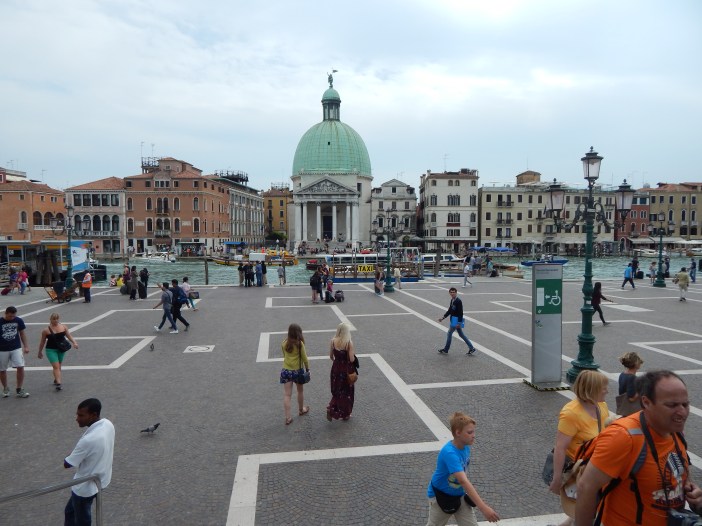
I love Venice. We spent a mere twenty-four hours there on our trip to Italy several years ago, taking the train from the magnificent station in Florence through the Italian countryside north and then across the lagoon to the Venetian station. I walked ahead of Paul through that Italian station, unable to wait to catch my first glimpse of the city from the top of the stairs rising from the piazza and vaporetto station on the Grand Canal.

DSCN6269

I was enchanted from that first glimpse.

I’d always wanted to visit Venice–ever since reading Daphne du Maurier’s brilliant story “Don’t Look Now” and seeing the film version, which is incredible–and also Anne Rice’s Cry to Heaven. Seeing Venice, even if was only for twenty-four hours, was wonderful. We were also incredibly lucky because Venice wasn’t crowded; apparently that’s become a huge problem (goo.gl/ePMQjT). It was even a problem when Berendt was writing The City of Falling Angels.

The title comes from a sign Berendt saw one day while strolling around Venice, near an old church that was crumbling and in need of restoration: BEWARE OF FALLING ANGELS. Apparently, the statues of angels on the sides of the church and along the rooftop had become loose with the rotting of the masonry, and one had fallen, almost hitting a pedestrian. The book reminded me so much of Venice, and why the city had enchanted me during my all-too-brief visit. I want to write about Venice; I’ve been toying with a story for years, and as I am just now starting to write my Panzano story, maybe I will soon write the Venice story.

Anyway, Berendt is best-known, of course, for his book about Savannah: Midnight in the Garden of Good and Evil, which I read decades ago when it was new. I enjoyed it; it was an examination of the quirks and curiosities of the city, built around the lens of a murder committed by a member of Savannah society. The City of Falling Angels is the same type of book, only viewed around the lens, not of a murder, but the burning of the Fenice Opera House. It did turn out to be a crime; two men were convicted of arson, but Berendt uses the fire, the investigations, and the subsequent trial, to view Venice; and along the way he takes a look at the quirks, eccentricities, and curiosities of a place that, like Savannah, is quaint and historic and beautiful–yet also very small. A lot of the things he talks about in the book–the concerns of locals that Venice is no longer for the Venetians, that the city is losing its neighborhoods to tourism; that poorer and middle class Venetians are being pushed out in the name of tourism–are concerns that we locals now have about New Orleans, so that made the book even more interesting to me. When we were there, we stayed overnight at a wonderful little family run hotel just off the Rialto Bridge and on one of the side canals; the Hotel San Salvador. We, too, had a lengthy conversation with two of the young women working there–members of the ownership family–who told us the same thing: Venice is no longer for the Venetians. Their family can no longer afford to live in the city, despite owning a hotel there; they live on the mainland and commute into the city. Most of the city’s apartments are being bought up by foreigners who then rent them out to visitors, so it is also affecting business for establishments like the Hotel San Salvador. I loved the hotel, it was charming and quaint and cozy; I loved the second floor lounge overlooking the canal below, and the family who owned and operated it were so nice, friendly, and charming. If and when we return, we will undoubtedly stay there again.

I’ve met John Berendt exactly once; he was very nice, and I liked him. I like his books, too. My character, Jerry Channing, who appears in both The Orion Mask and Garden District Gothic, and whom I’ve considered spinning off into his own series, is based on him only in that he writes the same kinds of books and articles Berendt does; kind of a cross between Berendt and Dominick Dunne. (I still might spin Jerry off; a lot of my short stories, which have first-person narrators who are never identified, are told in what I imagine Jerry’s voice to be) In fact, Jerry’s biggest success is a book called Garden District Gothic (very meta of me), which is about the quirks and curiosities and eccentricities of New Orleans, viewed through the lens of a society murder in the Garden District. The Scotty novel that bears the same title is an investigation into that case twenty-five years later, in fact (again, very meta of me).

16903185_10210905674210634_792277906514866377_o

Anyway,  I highly recommend The City of Falling Angels. I think I enjoyed it a lot more because I’d been to Venice, but it definitely made me want to go back. It’s very well-written, and a lot of fun to read.

And now back to the spice mines.


I Can’t Hold Back

2018 ITW Thriller Awards Nominees 
We’re thrilled to announce the finalists for the 2018 ITW Thriller Awards:
BEST HARDCOVER NOVEL

Dan Chaon — ILL WILL (Ballantine)
Denise Mina — THE LONG DROP (Little, Brown and Company)
B.A. Paris — THE BREAKDOWN (St. Martin’s Press)
Gin Phillips — FIERCE KINGDOM (Viking)
Riley Sager — FINAL GIRLS (Dutton)

BEST FIRST NOVEL

Steph Broadribb — DEEP DOWN DEAD (Orenda Books)
Daniel Cole — RAGDOLL (Ecco)
Walt Gragg — THE RED LINE (Berkley)
K.J. Howe — THE FREEDOM BROKER (Quercus)
Sheena Kamal — THE LOST ONES (William Morrow)

BEST PAPERBACK ORIGINAL NOVEL

Christine Bell — GRIEVANCE (Lake Union)
Rachel Caine — STILLHOUSE LAKE (Thomas & Mercer)
Layton Green — THE RESURRECTOR (Layton Green)
Adrian McKinty — POLICE AT THE STATION AND THEY DON’T LOOK FRIENDLY (Seventh Street Books)
Lori Rader-Day — THE DAY I DIED (William Morrow)

BEST SHORT STORY

Lee Child — “Too Much Time” (Delacorte)
Mat Coward — “What Could Possibly Go Boing?” (Ellery Queen Mystery Magazine)
Zoë  Z. Dean — “Charcoal and Cherry” (Ellery Queen Mystery Magazine)
Willy Vlautin — “The Kill Switch” (Hachette)
Ben H. Winters — “Test Drive” (Hachette)

BEST YOUNG ADULT NOVEL

Gregg Hurwitz — THE RAINS (TOR Teen)
Gregg Olsen — THE BOY SHE LEFT BEHIND (Polis Books)
Sheryl Scarborough — TO CATCH A KILLER (TOR Teen)
Rysa Walker — THE DELPHI EFFECT (Skyscape)
Diana Rodriguez Wallach — PROOF OF LIES (Entangled Publishing)

BEST E-BOOK ORIGINAL NOVEL

Sean Black — SECOND CHANCE (Sean Black)
Jeff Gunhus — RESURRECTION AMERICA (Seven Guns Press)
Alan McDermott — TROJAN (Thomas & Mercer)
Caroline Mitchell — WITNESS (Thomas & Mercer)
Kevin Wignall — A FRAGILE THING (Thomas & Mercer)

Congratulations to all the finalists!

The 2018 ITW Thriller Award Winners will be announced at ThrillerFest XIII, July 14, 2018, at the Grand Hyatt (New York City.)

In My House

Monday and sort of a normal work week; I don’t have to go in until later today, which is lovely, so I kind of have my morning free. I overslept–I’d intended to go to the gym this morning, but just couldn’t get out of bed. I don’t know what that’s all about, but I am tired of skipping the gym all the time. Skipping has become a habit, when going was developing into a habit. I am most unhappy about this development.

Yesterday I worked on “Don’t Look Down,” which was incredibly difficult; the story didn’t want to come nor did it want to finish. I managed to get about two thousand words, and finish the first draft; but I think the story is going to wind up being around eight thousand words long. This is actually fine, to be honest; it’s going into the short story collection rather than trying to be sent out for publication anywhere, and so length isn’t an issue for it. I’m going to let it sit for about a week or so, and maybe revise it over the next weekend. I am going to start working on Scotty again today; I am sort of dreading it, but I have to do it; I’ve been putting it off for far too long. I also want to get the Chanse story, now titled “My Brother’s Keeper,” revised this week. Once I’ve whipped “Don’t Look Down” and “My Brother’s Keeper” into shape and written an introduction, the collection will be finished, which is a lovely thing.

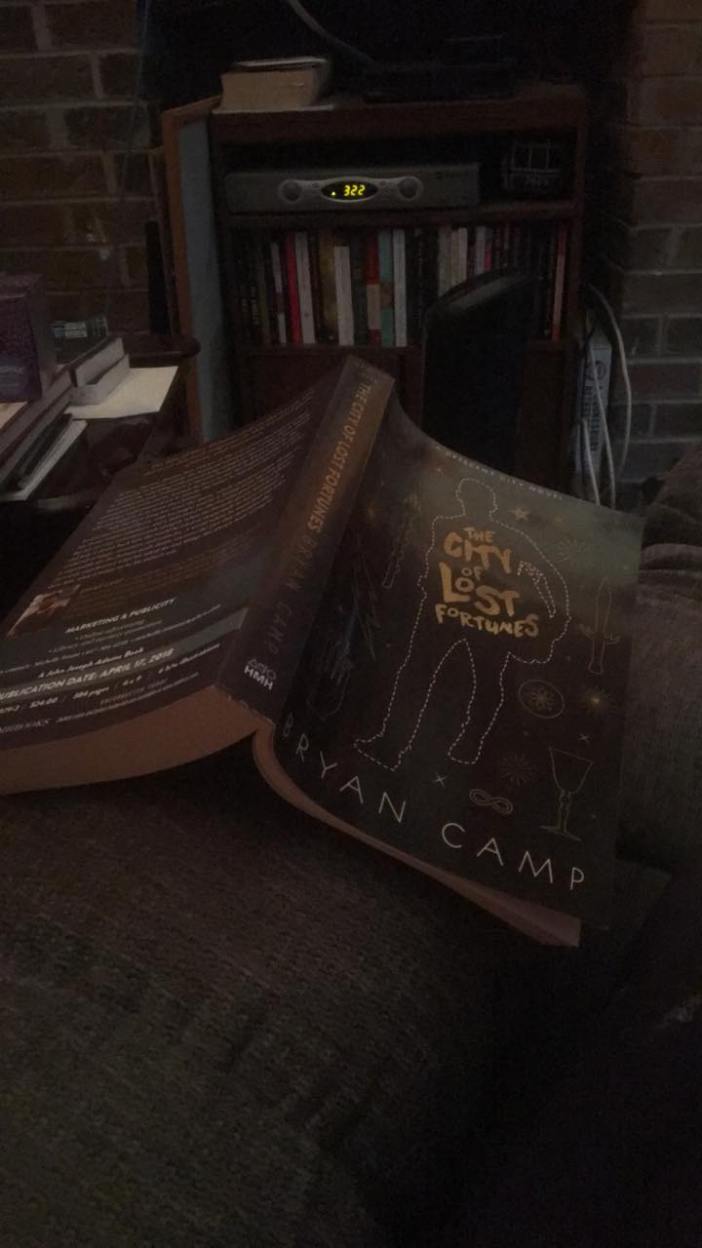
I’ve almost finished Ronson’s So You’ve Been Publicly Shamed, which I am finding to be fascinating. I also started reading Bryan Camp’s The City of Lost Fortunes, which I am also really enjoying. It’s smart, well-written, and interesting. A rather impressive debut.

29745013_10157444118224012_5732163382933471268_o

I also read some short stories. I actually finished the Kinsey stories in Sue Grafton’s collection Kinsey and Me–there are some other stories and an essay in the book, but I’m not finding it pressing to get to them or read them. I greatly enjoyed reading the Kinsey short stories, and they actually inspired me to try writing private eye short stories; these two Chanse stories I am struggling with wouldn’t have even occurred to me had I not read the Kinsey stories, along with the Ross Macdonald Lew Archer stories and Laura Lippman’s Tess Monaghan stories. The first of these last Kinsey stories was “A Little Missionary Work”:

Sometimes you have to take on a job that constitutes pure missionary work. You accept an assignment not for pay, or for any hope of tangible reward, but simply to help another human being in distress. My name is Kinsey Millhone. I’m a licensed private eye, in business for myself, so I can’t really afford professional charity, but now and then somebody gets into trouble and I just can’t turn my back.

I was standing in line one Friday at the bank, waiting to make a deposit. It was almost lunchtime and there were eleven people in front of me, so I had some time to kill, As usual, in the teller’s line, I was thinking about Harry Hovey, my bank-robber friend, who’d once been arrested for holding up this very branch. I’d met him while I was investigating a bad-check case. He was introduced to me by another crook as an official “expert” and ended up giving me a crash course in the methods and practices of passing bad paper.

And the second was “The Lying Game” :

This is my definition of misery. Pitch-black night. Cold. Hunger. Me in the wilderness…well, okay, a California state park, but the effect is the same. I was crouched in the bushes, peering at a camp-site where identical twin brothers, alleged murderers, were rustling up supper: biscuits and a skillet full of eggs fried in bacon grease. The only bright note in all of this was my Lands’ End Thermolite Micro insulation. On a whim, I’d ordered the parka from a Lands’ End catalog, little knowing that within weeks I’d be huddled in the woods, spying on fellows who cooked better than I did.

Both stories are satisfying reads–the second is only a few pages long, and very clearly a riff on the Menendez brothers–and move quickly. Grafton knew Kinsey’s voice and there was never a misstep in any of the novels or the short stories; which is, I think, part of what made reading the stories so enjoyable. I’ve always loved that character, and loved the way Grafton wrote her; it’s sad to think there won’t be any more Kinsey novels. I’ve been hoarding the last few, wondering what she was going to do when she finished the alphabet; sadly, she didn’t, and I know when I finish the series I will be done with Kinsey. That kind of makes me sad.

And now, back to the spice mines.

The Heat Is On

Ash Wednesday, and Valentine’s Day, to boot.

Another Carnival is in the books, and a good time was had by all. We didn’t do as much parading as we usually do; me being in Alabama for the first weekend had a lot to do with that, and I was a lot more tired, physically, than I usually am during parade season. I suspect I am getting to that sad place in life where I am too old to handle the walk to and from the office all of those days in a row. I am, however, going to continue with my new workout routine and hopefully that will make a difference the next time Carnival rolls around.

Fingers crossed, at any rate.

Today an anthology I contributed a story to drops; The Trouble with Cupid. I was very happy and thrilled to be asked to contribute a story–I always am thrilled and happy when I’m asked to contribute to anything, frankly–but therein lay a conundrum for me: what would I write about? I still struggle to write crime short stories, and this call was for romantic suspense, or some combination of romance and crime, possibly; and I was frankly absolutely clueless what to write or how to go about writing something.

So, I decided instead to write a sequel to my story “Everyone Says I’ll Forget In Time,” which I wrote a long time for the Fool for Love anthology, edited by R. D. Cochrane and Timothy J. Lambert. In that story, Terry, my main character, was still coming to terms with the death of his partner; his best friends have decided it’s time for him to move on and set him up with a sort-of-blind-date thing; and the blind date turns out to be a guy he had a crush on before; that he met when he and his partner had briefly separated during a rough patch. I’d always wanted to do a sequel to the story, and even had the title picked out: “Passin’ Time,” which is a phrase we here in New Orleans use to describe waiting when you have no other choice; it’s most frequently used to talk about waiting for a parade during Carnival; what we do on the street while waiting for a parade to show up is passin’ time.

the trouble with cupid -%0D%0A final2.jpg

I OPENED THE front door and Trouble wasn’t there.

The food bowl I’d set out for him was empty. The water bowl was upside down next to the cement step. He had a habit of doing that, I’d noticed. I wasn’t sure why, but it was just one of his quirks. I picked it up and walked it over to the sink and refilled it. I set it down and sat down on the step, looking around. This was the first morning since he’d shown up that he wasn’t out there, waiting for me with his eager eyes and twitching black tail.

And it made me sad.

You need a pet of your own, I said to myself, looking up at the blue sky. It was a gorgeous morning, not even ten yet, and already warm. The ladies of Iris and the gentlemen of Tucks had lucked out this fine Saturday before Fat Tuesday. Fat Tuesday was early this year, so I’d worried my favorite parade day might be cold—or worse, rainy. There had been a downpour on Iris Saturday a few years earlier, but the parades still rolled—the floats speeding past at breakneck speed, the marching bands and dance groups sitting out the parades—and I’d stood out there, soaked through and having the best time, even if my glasses were covered with beads of water and it was also cold out there. It had taken me a while to warm up again after that, curled up on my loveseat under woolen blankets and drinking hot chocolate spiked with peppermint Schnapps while I watched Endymion roll through mid-city on television.

Endymion.

I hadn’t been to Endymion since Paul died.

Trouble is a crime-solving black cat, I should probably add; Carolyn Haines has gathered an extraordinary group of writers together to write a series of books about Trouble; I hung out with the Mad Catters in Alabama at Murder in the Magic City and Murder on the Menu, and even agreed to try my hand at writing a Trouble book, when I have the time. Every story in the anthology had to include Trouble (hence the title The Trouble with Cupid), and all proceeds from the book are going to the Best Friends Animal Sanctuary; if you know Carolyn, you also know she’s all about helping the animals, and I can certainly get behind that–given that we have somehow wound up with five outdoor cats and one indoor rescue.

I hope you’ll check out the anthology, Constant Reader, and I also hope you like my story.


I Want to Know What Love Is

It’s been raining pretty much most of the weekend, which is fine. I went to get groceries, pick up a prescription, and get the mail before getting home and starting to work on the mess that is my home; I also finished writing a chapter of one manuscript and started writing another–which was my writing goal for yesterday. Today’s is to do second drafts of two short stories to prepare them for submission. I also have to go to the gym and finish the cleaning of the apartment and organizing my office. I started reading the big y/a best seller One of Us Is Lying by Karen McManus yesterday; I can see why it’s a bestseller and I can also see why it’s being developed into a television series a la Thirteen Reasons Why; it’s a deceptively simple yet surprisingly complex story, and likewise–well, I’ll talk some more about it once I’ve finished.

I’m enjoying writing again for the first time in years, which is a good thing, and I am actually putting a lot of thought and planning into what I’m writing, which is a really good thing. What I’ve written over the last six or seven years has been a lot more organic, coming to me as I wrote it from a basic premise and perhaps knowing what the end was; without putting near as much thought into theme and what I am trying to say, what I am trying to explore with the story, than I used to–I mean, it worked, but it also made the work a lot harder than it needed to be. I think this is particularly true of short stories; I think that’s primarily what I’ve been doing wrong in writing them–my entire approach to short stories has been wrong, and I’ve been, as I said, making it a lot harder on myself than it necessarily needs to be.

Which is, sadly, what I always tend to do for myself: make things harder than they need to be.

Heavy heaving sigh.

In addition to cleaning and everything else I did yesterday, I also managed to start watching Season 2 of Black Sails, which continues to enthrall. I am still liking the idea of finally writing my pirate novel (Cutlass), but not as much as before; it remains one of those dreams that I hold on to for when I am making a living as a writer again and able to not have a day job any longer. (There are several of those; they also require not only making a living but making enough money to travel and do research.)

Some day. I never give up on the dream.

The Short Story Project also continues; yesterday I read a story by Ross MacDonald from The Archer Files and one by Karl Edward Wagner from the gorgeous two volume collection The Best Horror Stories of Karl Edward Wagner, produced by Centipede Press maybe seven or eight years ago.

MacDonald’s story, “The Bearded Lady,” was quite good, as everything written by MacDonald is.

The unlatched door swung inward when I knocked. I walked into the studio, which was high and dim as a hayloft. The big north window in the opposite wall was hung with monkscloth draperies that shut out the morning light. I found the switch beside the door and snapped it on. Several fluorescent tubes suspended from the naked rafters flickered and burned blue-white.

A strange woman faced me under the cruel light. She was only a  charcoal sketch on an easel, but she gave me a chill. Her nude body, posed casually on a chair, was slim and round and pleasant to look at. Her face wasn’t pleasant at all. Bushy black eyebrows almost hid her eyes. A walrus mustache bracketed her mouth, and a thick beard fanned down over her torso.

The door creaked behind me. The girl who appeared in the doorway wore a starched white uniform. Her face had a little starch in it, too, though not enough to spoil her good looks entirely. Her black hair was drawn back severely from her forehead.

Lew Archer, on his way from Los Angeles to San Francisco, decided to stop in the small town of San Marcos and look up an old army buddy, inadvertently stumbling into a murder case. The story is interesting, the writing whipcrack smart, with MacDonald’s trademark, cynical short paragraphs immediately getting to the essence of a character. Don’t we, as readers, already have a strong impression of who that young woman is as a person after those three sentences? I’ve often wondered how one solves a murder in a short story–or writes a detective short story. I’ve tried and failed often enough. But the great thing about the Short Story Project is I am starting to understand how to write them, how they work, and how to make them work; which is a lovely thing. I have several ideas for Chanse short stories that I’ve never written because I didn’t know how; now I rather do, or at least have an idea, thanks to The Archer Files and Kinsey and Me (Sue Grafton). Both books are great learning tools for people who want to write detective stories, and MacDonald’s influence on Grafton is clear. (Although I’d still love to see someone do an essay, or book of criticism, comparing and contrasting MacDonald’s work with that of his wife: The Murderous Millars would be a great title.) MacDonald’s stories usually have to do with damaged and dysfunctional families; “The Bearded Lady” is another one of those, and is very well done. I highly recommend it.

The Wagner story I read was from the second volume of he Best Horror Stories of Karl Edward Wagner, which was titled Walk on the Wild Side, and was titled “The Last Wolf.”

The last writer sat alone in his study.

There was a knock at his door.

But it was only his agent. A tired, weathered old man like himself. It seemed not long ago that he had thought the man quite young.

“I phoned you I was coming,” explained his agent, as if to apologize for the writer’s surprised greeting.

Of course…he had forgotten. He concealed the vague annoyance he felt at being interrupted at his work.

Nervously the agent entered his study. He gripped his attache case firmly before him, thrusting it into the room as if it were a shield against the perilously stacked shelves and shelves of musty books. Clearing a drift of worn volumes from the cracked leather couch, he seated himself amidst a puff of dust from the ancient cushions.

I received both volumes of Wagner when I was judging the Bram Stoker Award for Best Single Author Collection, or whatever it is called; it was so long ago that I don’t even recall who the finalists were or who actually won. My memory is perforated like Swiss cheese nowadays, with holes and gaps; it also works like a sieve as new knowledge, and new books I’ve read, tend to pass through it without catching hold (I used to be able to name every book I’ve read, the plot, the main characters–and even some of the minor; over the years that ability has been sadly lost to time). I don’t, for example, remember the titles or the contents of the Wagner stories I read; but the books are beautiful volumes and I remember being impressed by his writing, so I kept them on my shelves. It was only a week or so ago that I realized, that I remembered, them; and that they might make a good addition to my year-long study of short fiction.

I’ve often said that writing about writers, about the business of writing and publishing, sometimes (often) feels masturbatory to me; only other writers would be interested in such a story. And yet writers pop up in my work all the time; Paige is a journalist and wannabe novelist in the Chanse series (and now that I’ve retired that series she’s migrated, apparently, over to the Scotty); another writer character I’ve created has appeared in several novels of mine–one Scotty, The Orion Mask, and one pseudonymous; he also appears to be the voice I used in several first-person short stories, including “An Arrow for Sebastian.” I have another such short story in process; I’ve not quite worked out how to make the story work, but there you have it. I was tempted to write an entire series about a writer, but as I started to develop my gay male writer character more I soon realized I had turned him into a hybrid of Scotty and Chanse; there was nothing new or original about him other than he was a writer and not a private eye. (I really do want to reread Azimov’s Murder at the ABA, though, and Elizabeth Peter’s brilliant Die for Love and Naked Once More.)

“The Last Wolf” is also about a writer, a writer who firmly believes in himself and his work, and that his work is art, and art should never be compromised for commerce. The world in which he lives is one where he is the last (apparently) person attempting to still write fiction; novels have fallen by the wayside and short stories are no longer published; the world has completely changed and his agent wants him to try to write for television shows–which, as described, sound horrifically awful. The writer refuses, the agent leaves, and he goes back to his typewriter. This story could easily be seen as angry, or even whiny; in the hands of a lesser author, the story would be precisely that. But Wagner paints a picture with his words, and maybe it resonated with me more because I am an author myself, but the sympathy rests entirely with the author. (Although I am one of those whose eyes roll so hard that  they almost unscrew when I hear another author speak of their ‘art’; but that’s a topic for another day.) I am looking forward to digging back into Wagner’s work again this year.

And now, I need to file and organize, perhaps vacuum, before I head to the gum. I want to get some things written today, and I need to revise those stories.

Hello, spice mines.

Sigh.

26196451_321860411641954_3040436925599999815_n

Magic

Congratulations, everyone!!!

Edgar Statues

January 19, 2018, New York, NY – Mystery Writers of America is proud to announce, as we celebrate the 209th anniversary of the birth of Edgar Allan Poe, the Nominees for the 2018 Edgar Allan Poe Awards, honoring the best in mystery fiction, non-fiction and television published or produced in 2017. The Edgar® Awards will be presented to the winners at our 72nd Gala Banquet, April 26, 2018 at the Grand Hyatt Hotel, New York City.

BEST NOVEL

The Dime by Kathleen Kent (Hachette Book Group – Little, Brown & Co./Mulholland Books)
Prussian Blue by Philip Kerr (Penguin Random House – G.P. Putnam’s Sons)
Bluebird, Bluebird by Attica Locke (Hachette Book Group – Little, Brown & Co./Mulholland Books)
A Rising Man by Abir Mukherjee (Pegasus Books)
The Twelve Lives of Samuel Hawley by Hannah Tinti (Penguin Random House – The Dial Press)

BEST FIRST NOVEL BY AN AMERICAN AUTHOR

She Rides Shotgun by Jordan Harper (HarperCollins – Ecco)
Dark Chapter by Winnie M. Li (Polis Books)
Lola by Melissa Scrivner Love (Penguin Random House – Crown)
Tornado Weather by Deborah E. Kennedy (Macmillan – Flatiron Books)
Idaho by Emily Ruskovich (Random House)

BEST PAPERBACK ORIGINAL

In Farleigh Field by Rhys Bowen (Amazon Publishing – Thomas & Mercer)
Ragged Lake by Ron Corbett (ECW Press)
Black Fall by Andrew Mayne (HarperCollins Publishers – Harper Paperbacks)
The Unseeing by Anna Mazzola (Sourcebooks – Sourcebooks Landmark)
Penance by Kanae Minato (Hachette Book Group – Little, Brown & Co./Mulholland Books)
The Rules of Backyard Cricket by Jock Serong (Text Publishing)

BEST FACT CRIME

Killers of the Flower Moon: The Osage Murders and the Birth of the FBI by David Grann (Penguin Random House – Doubleday)
The Road to Jonestown: Jim Jones and Peoples Temple by Jeff Guinn (Simon & Schuster)
American Fire: Love, Arson, and Life in a Vanishing Land by Monica Hesse (W.W. Norton & Company – Liveright)
The Man From the Train: The Solving of a Century-Old Serial Killer Mystery by Bill and Rachel McCarthy James (Simon & Schuster – Scribner)
Mrs. Sherlock Holmes: The True Story of New York City’s Greatest Female Detective and the 1917 Missing Girl Case that Captivated a Nation by Brad Ricca (St. Martin’s Press)

BEST CRITICAL/BIOGRAPHICAL

From Holmes to Sherlock: The Story of the Men and Women who Created an Icon by Mattias Bostrom (Grove/Atlantic – The Mysterious Press)
Manderley Forever: A Biography of Daphne du Maurier by Tatiana de Rosnay (St. Martin’s Press)
Murder in the Closet: Essays on Queer Clues in Crime Fiction Before Stonewall by Curtis Evans (McFarland Publishing)
Chester B. Himes: A Biography by Lawrence P. Jackson (W.W. Norton & Company)
Arthur and Sherlock: Conan Doyle and the Creation of Holmes by Michael Sims (Bloomsbury USA)

BEST SHORT STORY

“Spring Break” – New Haven Noir by John Crowley (Akashic Books)
“Hard to Get” – Ellery Queen Mystery Magazine by Jeffery Deaver (Dell Magazines)
“Ace in the Hole” – Montana Noir by Eric Heidle (Akashic Books)
“A Moment of Clarity at the Waffle House” – Atlanta Noir by Kenji Jasper (Akashic Books)
“Chin Yong-Yun Stays at Home” – Alfred Hitchcock Mystery Magazine by S.J. Rozan (Dell Magazines)

BEST JUVENILE

Audacity Jones Steals the Show by Kirby Larson (Scholastic – Scholastic Press)
Vanished! By James Ponti (Simon & Schuster – Aladdin)
The Assassin’s Curse by Kevin Sands (Simon & Schuster – Aladdin)
First Class Murder by Robin Stevens (Simon & Schuster – Simon & Schuster BFYR)
NewsPrints by Ru Xu (Scholastic – Graphix)

BEST YOUNG ADULT

The Cruelty by Scott Bergstrom (Macmillan Children’s Publishing Group – Feiwel & Friends)
Grit by Gillian French (HarperCollins Publishers – HarperTeen)
The Impossible Fortress by Jason Rekulak (Simon & Schuster)
Long Way Down by Jason Reynolds (Simon & Schuster – Atheneum Books for Young Readers)
The Hate U Give by Angie Thomas (HarperCollins Publishers – Balzer + Bray)

BEST TELEVISION EPISODE TELEPLAY

“Episode 1” – The Loch, Teleplay by Stephen Brady (Acorn TV)
“Something Happened” – Law and Order: SVU, Teleplay by Michael Chernuchin (NBC Universal/Wolf Entertainment)
“Somebody to Love” – Fargo, Teleplay by Noah Hawley (FX Networks/MGM)
“Gently and the New Age” – George Gently, Teleplay by Robert Murphy (Acorn TV)
“The Blanket Mire” – Vera, Teleplay by Paul Matthew Thompson & Martha Hillier (Acorn TV)

ROBERT L. FISH MEMORIAL AWARD

“The Queen of Secrets” – New Haven Noir by Lisa D. Gray (Akashic Books)

GRAND MASTER

Jane Langton
William Link
Peter Lovesey

RAVEN AWARD

Kristopher Zgorski, BOLO Books
The Raven Bookstore, Lawrence Kansas

ELLERY QUEEN AWARD

Robert Pépin

* * * * * *

THE SIMON & SCHUSTER MARY HIGGINS CLARK AWARD

The Vineyard Victims by Ellen Crosby (Minotaur)
You’ll Never Know Dear by Hallie Ephron (HarperCollins – William Morrow)
The Widow’s House by Carol Goodman (HarperCollins – William Morrow Paperbacks)
Uncorking a Lie by Nadine Nettmann (Llewellyn Worldwide – Midnight Ink)
The Day I Died by Lori Rader-Day (HarperCollins – William Morrow Paperbacks)

# # #
The EDGAR (and logo) are Registered in the U.S. Patent and Trademark Office by the Mystery Writers of America, Inc.


Church of the Poison Mind

Sue Grafton very famously said that if you want something, you have to voice that desire out loud; say it to someone.

It’s very strange; we are often taught–at least I was–that ambition in slight moderation is a good thing, but over-weaning ambition is a bad thing. I was taught that bragging is unbecoming; because if you truly did something well or a great job at something, you wouldn’t need to boast, would you? This was drilled into my head for as long as I can remember: you get complimented, you don’t brag, and if you do get complimented, you are gracious and self-deprecating.

This is so deeply ingrained in me that it is very hard for me to be ambitious, or share my ambitions with anyone; it’s hard for me to take pride in what I’ve accomplished; and I always look for a way to turn any compliment into a “if I can do it, anyone can” kind of thing.

Another friend of mine thinks daily affirmations is also a way to get what you want; if you say what you want out loud to your mirror (or your computer, whatever), you can create the kind of mindset that will help you attain your goals. I wrote some out last year, at the beginning of the year, but after a few weeks I started feeling self-conscious about doing it, kind of silly, and I stopped.

Self-defeating, isn’t it?

So, in the interests of breaking this cycle, and of getting better at taking compliments and believing more in myself, here are some goals I want to achieve:

I will take my career to go to the next level.

I will get an agent.

I will write reviews for the New York Times.

I will sell short stories to high paying markets.

I will get a story selected for the Best American Mystery Short Stories series.

I will get a short story published as part of the Bibliophile series.

I will win a major writing award.

Whew. I already feel like writing all the down is going to jinx me in some way. NO NEGATIVITY NO NEGATIVE THOUGHTS.

So, there’s that. I’ve also made some great progress on the Short Story Project, including “Dear Penthouse Forum (A First Draft” and “The Babysitter’s Code.”

You won’t believe this, but this really did happen to  me just last fall, and all because I was five minutes late, which seemed like a tragedy at the time. “It’s only five minutes,” that’s what I kept telling the woman behind the counter, who couldn’t be bothered to raise her gaze from her computer screen and make eye contact with me. Which is too bad, because I don’t need much to be charming, but I need something to work with. Why did they make so many keystrokes, anyway, these ticket clerks? What’s in the computer that makes them frown so? I had the printout for my e-ticket, and I kept shoving it across the counter, and she kept pushing it back to me with the tip of a pen, the way I used to with my roommate Bruce’s dirty underwear, when we were in college. I’d rounded it up with a hockey stick and stashed it in the corner, just to make a pathway through our dorm room. Bruce was a goddamn slob.

“I’m sorry,” she said, stabbing that one key over and over. “There’s just nothing I can do for you tonight.”

And so begins yet another delightful Laura Lippman story, only written in the style of a letter to Penthouse Forum. That premise, very clever in and of itself, also makes the story a bit of a time capsule; does Penthouse and it’s sister digest of letters, Penthouse Forum Letters, even exist anymore? How long before no one even remembers their existence anymore? And why did I not ever try to write them? It was good money. But I am digressing. This clever story goes on to have our main character trapped in the Baltimore airport overnight; unable to swing the money for an airport hotel or can back to his apartment, and then a beautiful woman in her thirties shows up to not only save the day for him, but to entice him with the possibility of incredible, strings-free sex. (Which was pretty much the theme of every letter to Penthouse Forum; there were erotic flash fiction.) But being a Lippman story, there’s more going on than just incredible, no strings attached sex, and when the story turns, it’s unexpected and quite delightful.

This second story from Hardly Knew Her, “The Babysitter’s Code,” was originally published in Plots with Guns in 2005; and this is the period when Lippman moved from her delightful Tess Monaghan series (which I should reread) to writing her stand-alone thrillers; or literary fiction about crime, which is what they really should be described as. That broadening of her scope, and stretching of her talents, is very clear in this story.

The rules, the real ones, have seldom been written down, yet every girl knows them. (The boys who babysit don’t, by the way. They eat too much, they leave messes, they break vases while roughhousing with the kids, but the children adore the boys who babysit, so they still get invited back.) The rules are intuitive, as are most things governing the behavior of teenage girls. Your boyfriend may visit unless it’s explicitly forbidden, but the master bedroom is always off-limits, just as it would be in your own house. Eat what you like, but never break the seal on any bag or box. Whatever you do, try to erase any evidence of your presence in the house by evening’s end. The only visible proof of your existence should be a small dent on a sofa cushion, preferably at the far end, as if you were too polite to stretch across its entire length. No parent should come home and peer into the Pringles can–or the Snackwell’s box or the glass jar of the children’s rationed Halloween candy–and marvel at your capacity. There is nothing ruder that a few crumbs of chips at the bottom of a bag, rolled and fastened with one of those paper clips, or a single Mint Milano resting in the last paper cup.

This story is more of a character examination than an actual story, and it’s also slightly reminiscent of Raymond Carver’s “Neighbors,” and talks about an essential truth we all tend to really ignore: when someone is alone in our homes, whether they are watching our children or pet-sitting or cleaning, they are privy to our secrets. And this house has plenty of secrets, in this affluent suburb of Baltimore; secrets that are too hard for our young babysitter to resist, as she snoops through the lady of the house’s closet and underwear drawers, and observes the crumbling marriage of the wealthy homeowner, his much younger trophy wife, and their genetically damaged baby. This story is both wistful and sad, more so than suspenseful, although the fear of being caught is always there. It’s also a very insightful look at how a teenage girl’s mind works. Brava, Ms. Lippman, brava.

I also discovered a volume I’d forgotten, and was very excited to rediscover. I’d forgotten that one year Sue Grafton skipped a book in the Alphabet Series and instead published a short story collection, Kinsey and Me, and I am really looking forward to diving into it. Yay!

I am really enjoying the Short Story Project of 2018.

Here’s a hunk for you.

47e2523bc858fca1cffee55a6058b425--sexy-guys-sexy-men

Give It Up

It rained overnight, and is still damp and gloomy this morning. There really is nothing like sleeping during a downpour, is there, the constant strumming of the rain, the comfort and warmth of the mattress and under the blankets, is there?

Yesterday was a crazy busy day for one Gregalicious, who got up in the morning and did some work, cleaned, and then walked to Comic Con for a signing and a panel. The signing was fun, and the panel discussion about creativity and creativity triggers was also a lot of fun; as exhausting and draining as it is to do public appearances, I also always somehow forget, in the nervousness and terror of having to speak in front of a room full of people, how much I actually enjoy talking about writing and creativity. So, there’s that. I then came home, watched the ice dance final at US Nationals, and then the Saints play-off game, which was a nail-biter down to the very last play of the game (GEAUX SAINTS!). We stayed up and watched the Golden Globes before going to bed; I also managed to get some brainstorming done in my journal, and I also read a short story, to keep the Short Story Project going.

One of the truly fun things about the panel was that Tom Cook was on it. Tom was an animator/director for Hanna-Barbera in the late 1960’s/1970’s, and of course, one of the shows he worked on was Scooby Doo Where Are You, which tremendously influenced me in the direction of mysteries and crime when I was a kid. So meeting Tom, and thanking him for the influence, was kind of a thrill for the weekend for me. I am starting to feel energized about writing again, which is very cool.

The short story I read was “East Wind,” from Daphne du Maurier’s The Doll and Other Lost Stories.

the doll

Nearly a hundred miles west of the Scillies, far from the main track of ships, lies the small, rocky island of St. Hilda’s. Only a few miles square, it is a barren, rugged place, with great jagged cliffs that run deep into deep water. The harbour is hardly more than a creek, and the entrance like a black hole cut out of the rock. The island rises out of the sea a queer, misshapen crag, splendid inits desolation, with a grey face lifted to the four winds. It might have been thrown up from the depths of the Atlantic in a moment of great unrest, and set there, a small defiant piece of land, to withstand forever that anger of the sea Over a century ago few knew of its existence, and the many sailors who saw its black outline on the horizon imagined it to be little more than a solitary rock, standing like a sentinel in mid-ocean.

“East Wind” is an early du Maurier tale, from early in her career (which people seem to want to divide into ‘pre’ and ‘post’ Rebecca); and in some ways the inexperience shows. The story is, as so many of her later stories are, very matter-of-fact; simply told with a move this  to that to the other; unemotional and simple. However, what is actually missing from this story that shows up in her later stories are layers of detail and complexity; stories like “Don’t Look Now” and “The Birds” have so many layers to burrow through, so much detail, and so much creepy, quiet horror that they continue to haunt the reader once the story is told. “East Wind” is an equally unpleasant tale, but doesn’t have the impact of the later stories in its telling.

As I started reading it, it reminded me of one of my favorite Stephen King stories, “The Reach”, which was the final story I think in Skeleton Crew, and was originally called “Do the Dead Sing?”, which is, in my opinion, a far superior title. That story was from the point of view of an old woman, dying in her bed on a cold, blustery winter night, and remembering something that happened many years ago–while also hearing her beloved dead one’s calling to her to join them. The story was brilliant and beautiful and haunting, and as I said, remains one of my favorite King stories to this day.

The du Maurier tale is similar in that it is about a remote island, where the inhabitants have very little contact with the outside world and because of a limited pool, have become more than a little inbred. The east wind of the title is brutal, blasting away at the little island and making the seas rough, so a brig of foreign sailors is forced to take shelter in the harbor, foreigners who don’s speak the same language. These exotic to the islanders strangers have an odd impact on the islanders, who become intoxicated in the strangeness and newness of this experience, which eventually leads to seduction and murder, changing and scarring the island forever; and of course, once this has happened and the east wind stops blowing, they get back in their ship and sail away because, of course, it was nothing to them. This is, of course, a terrific theme that du Maurier returns to again and again in her work; the dionysian influence of an outside force that causes trouble and then moves on without a care, leaving damage in its wake. The story itself, which is short and unemotional, is important as an early work because the reader, the duMaurier afficionado, can see how she developed themes she used extensively in her later career; her fascination with the concept of the unfeeling outside force on ordinary people’s lives, and the disruption such an influence can cause.

And now, back to the spice mines.