2021 ITW Thriller Awards Nominees We’re thrilled to announce the finalists for the 2021 ITW Thriller Awards:
BEST HARDCOVER NOVEL
S.A. Cosby – BLACKTOP WASTELAND (Flatiron Books) Joe Ide – HI FIVE (Mulholland Books) Richard Osman – THE THURSDAY MURDER CLUB (Penguin) Ivy Pochoda – THESE WOMEN (Ecco) Lisa Unger – CONFESSIONS ON THE 7:45 (Park Row)
BEST FIRST NOVEL
Jasmine Aimaq – THE OPIUM PRINCE (Soho Press) Don Bentley – WITHOUT SANCTION (Berkley) Kyle Perry – THE BLUFFS (Michael Joseph) Francesca Serritella – GHOSTS OF HARVARD (Random House) David Heska Wanbli Weiden – WINTER COUNTS (Ecco)
BEST PAPERBACK ORIGINAL NOVEL
Alyssa Cole – WHEN NO ONE IS WATCHING (William Morrow Paperbacks) Layton Green – UNKNOWN 9: GENESIS (Reflector Entertainment) John Marrs – WHAT LIES BETWEEN US (Thomas & Mercer) Andrew Mayne – THE GIRL BENEATH THE SEA (Thomas & Mercer) Benjamin Stevenson – EITHER SIDE OF MIDNIGHT (Penguin Random House Australia)
BEST SHORT STORY
Steve Hockensmith – “The Death and Carnage Boy” (Ellery Queen Mystery Magazine) Laura Lippman – “Slow Burner” (Amazon Original Stories) Alan Orloff – “Rent Due” (Down & Out Books) Elaine Viets – “Dog Eat Dog” (Untreed Reads) Andrew Welsh-Huggins – “The Mailman” (Down & Out Books)
BEST YOUNG ADULT NOVEL
Demetra Brodsky – LAST GIRLS (Tor Teen) Andrea Contos – THROWAWAY GIRLS (Kids Can Press) Kit Frick – I KILLED ZOE SPANOS (Margaret K. McElderry Books) Lily Sparks – TEEN KILLERS CLUB (Crooked Lane Books) Heather Young – THE DISTANT DEAD (William Morrow)
BEST E-BOOK ORIGINAL NOVEL
Sean Black – AVENUE OF THIEVES (Sean Black) Jeff Buick – A KILLING GAME (Novel Words) Diane Capri – FULL METAL JACK (AugustBooks) Jake Needham – MONGKOK STATION (Half Penny) Kirk Russell – NO HESITATION (Strawberry Creek) The winners will be announced on Saturday, July 10, 2021 during Virtual ThrillerFest.
I grew up in a very different world than the one we live in currently.
In some ways, it’s better–in others, possibly worse; still others, sadly, remain the same–unchanged by the tide of time and the course of human events. I grew up in the shadow of the mushroom cloud; in elementary school we did “nuclear attack drills” which including getting under the desk (because that would help if Chicago received a direct hit) and I also remember that the basement of Eli Whitney Elementary was a bomb shelter; I remember those nuclear triangles hanging above the stairs (the bathrooms were also in the basement). I remember air raid sirens being tested in the afternoons, and while I didn’t spend a LOT of time worrying about nuclear annihilation and war, it was always there in the back of my head. When we moved to Kansas, you can imagine my shock to learn from a PBS documentary that Kansas and the midwest were riddled with nuclear missile bases–there was an abandoned one not far from my high school we used to goof around and explore–and when the little town (Bushong) that was nearest the abandoned base was LISTED AS A TARGET you can imagine how freaky that was…especially since the base was abandoned. (The Day After, a television movie in the early 1980’s about nuclear holocaust, was set in Kansas City and its environs and really played up the fact that those Midwestern bases would be Russian targets)
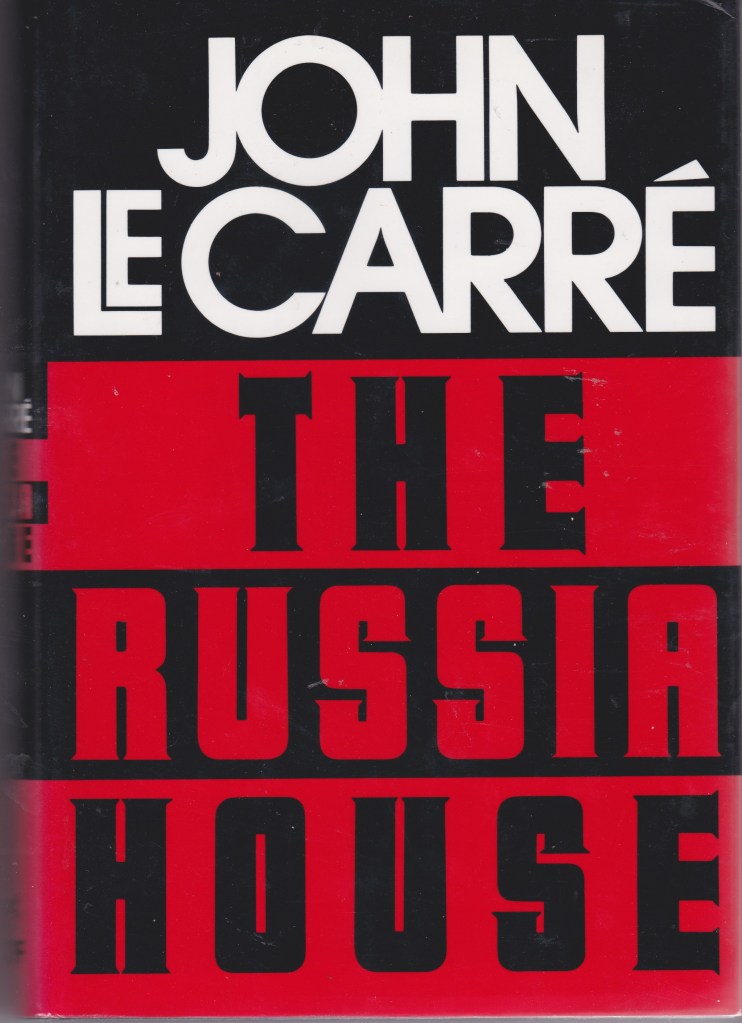
A while back I read my first John LeCarre novel, The Spy Who Came in From the Cold, last year and loved it. So when I saw a hardcover of The Russia House at the library sale for two dollars, I bought it.
In a broad Moscow street not two hundred yards from the Leningrad station, on the upper floor of an ornate and hideous hotel built by Stalin in the style known to Muscovites as Empire During the Plague, the British Council’s first ever audio fair for the teaching of the English language and the spread of British culture was grinding to its excruciating end. The time was half past five, the summer weather erratic. After fierce rain showers all day long, a late sunlight was blazing in the puddles and raising vapor from the pavements. Of the passers-by, the younger ones wore jeans and sneakers, but their elders were still huddled in their warms.
The room the Council had rented was not expensive but neither was it appropriate to the occasion.–I have seen it. Not long ago, in Moscow on quite another mission, I tiptoed up the great empty staircase and, with a diplomatic passport in my pocket, stooging in the eternal dusk that shrouds old ballrooms when they are asleep.–With its plump brown pillars an gilded mirrors, it was better suite to the last hours of a sinking liner than the launch of a great initiative. On the ceiling, snarling Russians in proletarian caps shook their fists at Lenin. Their vigor contrasted unhelpfully with the chipped green racks of sound cassettes along the walls, featuring Winnie-the-Pooh and Advanced Computer English in Three Hours. The sackcloth sound-booths, locally procured and lacking many o their promised features, had the sadness of neck chairs on a rainy beach. The exhibitors’ stands, crammed under the shadow of an overhanging gallery, seemed as blasphemous as betting shops in a tabernacle.
The Russia House is set during the late 1980’s; during the time of glasnost and perestroika; greater and more open relationships with the West rather than the adversarial relationship that existed since the fall of the Tsars and the collapse of communism (with the exception of that time when the Soviets were allied with the West against the Axis during World War II). It’s extremely well-written; Le Carre was a magnificent writer, and the images he creates with his words (I mean “described by Muscovites as Empire During the Plague” literally made me laugh out loud), plus LeCarre had a marvelous wit that was evident on every page.
It took me a lot longer to read than I thought it might, primarily because I didn’t really engage with the story, partly because I felt the main character–Barley Blair–wasn’t particularly likable; don’t get me wrong, I love unlikable characters. I just felt like I didn’t really get to know him well enough to engage with his character, and what LeCarre chose to share of his life (he treats women terribly, drinks too much, isn’t very good at his job and doesn’t really give a shit that he isn’t) simply wasn’t enough. Same with the female lead, Katya–she and Barley, through the course of being really incidental characters in the espionage war between the USSR and the West, fall in love; yet again, I never really learned anything about her, or enough, to care about her or the burgeoning romance between the two of them.
I can’t say that I didn’t enjoy the book–I did; because I love the way LeCarre uses language, but in the hands of a lesser writer, I would have probably given up without finishing.
Gore Vidal was one of three rather important gay male writers who emerged from the wreckage of World War II (the others being Tennessee Williams and Truman Capote), and I have always enjoyed reading his work–even if it’s not page turning material; I like the way he writes and I like the way he tells his stories.
He wrote six or seven major works of fiction based in American history that tell, in their own way, a more clear-eyed vision of what American history was and how the nation developed; called the Narratives of Empire, they certainly weren’t published in order but rather, I gather, in the order that struck his fancy; he was also busy writing other things and feuding with other writers–notably Capote, Norman Mailer, and William F. Buckley–and he obviously had a flair for the outrageous and controversial; The City and the Pillar, a very frank and daring and sympathetic look at the experiences of one young man navigating the world as a gay man, made him so controversial he was unpublishable for a number of years; he spent the time writing mysteries under the name Edgar Box and writing screenplays. Myra Breckinridge, which undoubtedly does not hold up to modern scrutiny and eyes; the book was clearly intended as satire, examining societal gender constructs and views on sexuality as well as the role of women. I read it for the first time maybe ten years ago, and it struck me as quaint; an artifact of a time certainly less enlightened, but trying to head for the light. (It may be worth a reread.) He also wrote Julian the Apostate, which I greatly enjoyed and read one year beside the pool during Saints & Sinners, back when it was in May and we used to always spend the weekend at the Olivier House on Toulouse Street.
But the Narratives of Empire began with, I think, Washington DC, followed by 1876 and later Burr; he also wrote about the aftermath of the Spanish-American War and the growth of the American empire in Empire, which I have also read and greatly enjoyed. I’ve not read all the titles yet; but reading Lincoln next after Empire made the most sense to me as some of the real-life characters depicted in that book are also in Lincoln, and it’s been a very long time since I read anything about Lincoln.
Elihu B. Washburne opened his gold watch. The spidery hands shows five minutes to six.
“Wait here,” he said to the driver, who said, “How do I know you’re coming back, sir?”
At the best of times Congressman Washburne’s temper was a most unstable affair, and his sudden outbursts of rage–he could roar like a preacher anticipating hell–were much admired in his adopted state of Illinois, where constituents proudly claimed that he was the only militant teetotaller who behaved exactly like a normal person at five minutes to six, say, in the early morning of an icy winter day–of the twenty-third of February, 1861, to be exact.
“Why, you black—!” As the cry in Washburne’s throat began to go to its terrible maximum, caution, the politican’s ever-present angel, cut short the statesman’s breath. A puff of unresonated cold steam filled the space between the congressman and the Negro driver on his high seat.
Heart beating rapidly with unslaked fury, Washburne gave the driver some coins. “You are to stay here until I return, you hear me?”
Growing up with Southern parents and the so-called “Southern heritage”, Lincoln’s place in history was, to say the least, still resented. The lionization of Lincoln after his death was, in some part, made possible by his murder; there’s not telling what the judgment of history would be on him had he lived to serve out his second term. Would we revile Lincoln for the reconstruction policies he would have followed? How different would the face of our present day nation be had he lived? An enormous mythology has sprung up around Lincoln since his death; “Honest Abe the rail-splitter” is a tale told to school children to this day, or how a young girl told him to grow a beard, and so on and so forth. The Civil War has been analyzed and written about endlessly; no one person could ever hope to read and digest all the documentation that exists of the conflict, let alone all the books published centering the war. I was always interested in Lincoln–even as a child I couldn’t wrap my mind around the mentality that people claiming to be “patriotic Americans” reviled Lincoln and glorified the Confederacy; I still am unable to consider such without triggering a massive amount of cognitive dissonance in my brain–and read lots of children’s books about him, but by the time I was an adult I was no longer interested in reading further biographies of the man. I am relatively uninterested in the possibility that he may have had relationships with men; without definitive proof that will always be a theory, and let’s face it, there is more evidence (although nothing conclusive) about his predecessor James Buchanan’s sexuality than there ever will be about Lincoln’s–hence my story “The Dreadful Scott Decision” I wrote for The Faking of the President.
Lincoln’s task was to preserve the Union in the face of its collapse, and that is what he strove to do. Was secession constitutional? Lincoln didn’t think so; the Constitution did not provide for the dissolution of the Union but at the same time it stated that any rights or restrictions not granted to the federal government in the document thereby fell to the individual states. So, does that mean the states held the right to leave the union? Andrew Jackson certainly didn’t think so, since he threatened to send federal troops into South Carolina during the nullification crisis. Part of the reason I actually wanted to read this book at this time was because of the stark reminder that Lincoln’s presidency, and the Civil War, serve as proof that mollifying white supremacy and continually compromising with an angry volatile minority, never ends well. (We are seeing it again now with the old Confederate states allied with their rural midwestern states…and of course as always, the ones threatening insurrection or secession claim to be “true patriots.”
Whatever, Mary.
Lincoln serves to humanize the man, and is also equally frank about Lincoln’s own white supremacist beliefs. Is Vidal’s assertion that Lincoln wanted to take the freed slaves and colonize them into Central America or somewhere back in Africa while reimbursing the slave owners for the loss of “property” accurate? It’s not the first time I’ve heard this (never heard it in school, though) and it seems likely to me. I also liked how Vidal got the panic of what it was like to live in Washington during there war so spot on; we never think about that, or how Maryland was a slave state surrounding the district, or that slavery existed and was legal in the district itself; slaves built the White House and the Capital. We never see into Lincoln’s head or from his point of view in this book–a masterful trick of Vidal’s, who thus leaves Lincoln a mystery to the reader.
It’s a compelling narrative, and it also shows us the point of view throughout of one of the conspirators who were hanged for plotting to kill him–David Suratt–and this jumping around from points of view–either of those who admired Lincoln, hated him, or thought him incompetent–gives a more three-dimensional view of the man we have deified for the last 156 years. He was definitely smart, a master politician, and, as Vidal says in the closing paragraphs of the book–if Washington was the father of our country, Lincoln was the father of our modern country.
I’ve decided to launch a new reading project for this year: one in which I tackle rereading middle-grade mysteries. I am not going to limit myself to merely the series books I loved (although they will play a big role in the project), but will also include other mysteries I have, either in one of my reading apps or an actual hard copy, that do not belong to the series. My childhood memories aren’t as clear as I would perhaps like; then again, that period of my life was around fifty years ago, so it would be more of a miracle if I did have stronger memories.
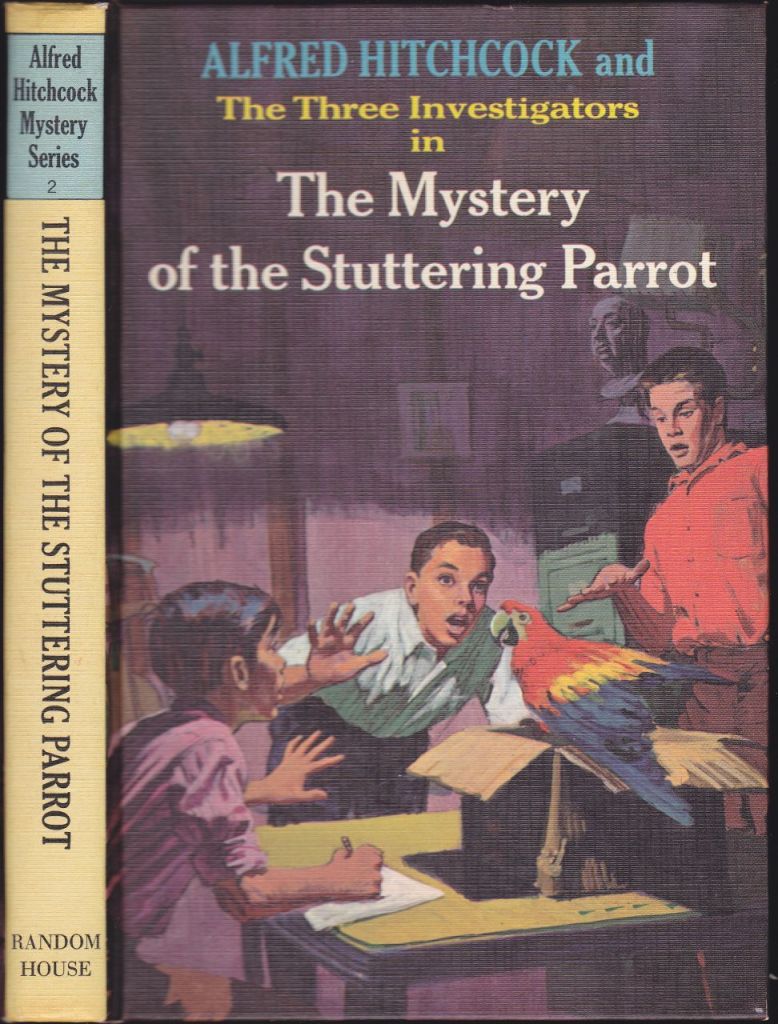
The first two series books I ever read were not from either the Nancy Drew or Hardy Boys series; they were from the Trixie Belden series (The Red Trailer Mystery) and The Three Investigators (The Mystery of the Moaning Cave). Both series wound up being favorites of mine once I eventually got back to them and remembered them; I remember buying five Trixie Belden books at a store at the Ford City mall in Chicago, and I got my first five Three Investigators books from a Toys R Us, I think in the Chicago suburb of Berwin? The two series weren’t as ubiquitous or available as Nancy Drew and the Hardy Boys; which made finding more of them a kind of triumph for me. I’ve already blogged about The Secret of Terror Castle, which was the first Three Investigators book in the series, so I won’t cover that one again. But recently I sat down and reread the second book in the series, The Mystery of the Stuttering Parrot, and remembered again why I love this series so much.
“Help!” The voice that called out was strangely shrill and muffled. “Help! Help!”
Each time a cry from within the mouldering old house pierced the silence, a new chill crawled down Pete Crenshaw’s spine. Then the cries for help ended in a strange, dying gurgle and that was even worse.
The tall, brown-haired boy knelt behind the thick trunk of a barrel palm and peered up the winding gravel path at the house. He and his partner, Jupiter Jones, had been approaching it when the first cry had sent them diving into the shrubbery for cover.
Across the path, Jupiter, stocky and sturdily built, crouched behind a bush, also peering toward the house. They waited for further sounds. But now the old, Spanish-style house, set back in the neglected garden that had grown up like a small tropical jungle, was silent.
“Jupe!” Pete whispered. “Was that a man or a woman?”
Jupiter shook his head. “I don’t know,” he whispered. “Maybe it was neither.“
The Three Investigators cases often began this way; with two of them (sometimes all of them) landing smack dab in the middle of something mysterious; whether it was the sight of a weird ghost as they walk past an abandoned house being demolished (The Mystery of the Green Ghost) or biking past an enclosed estate (The Mystery of the Laughing Shadow) or simply riding in the gold=played Rolls Royce limousine and almost getting into an accident (The Mystery of the Silver Spider). Many of their other cases begin with them being hired to find a lost pet, which turns into something more complicated and complex: The Mystery of the Coughing Dragon and The Mystery of the Whispering Mummy fall into this category….while the majority of their cases come by way of referrals from Alfred Hitchcock himself (and why has no one ever done a book about the licensing of the Hitchcoc name, and all the products the great director attached his name to? It’s far overdue.). The Mystery of the Stuttering Parrot combines all three: the boys were referred by Hitchcock to a friend whose recently purchased parrot has either been stolen or gotten free; they are on their way to visit Professor Fentriss to talk to him about the missing parrot–which stuttered–when they hear the cries for help coming from within the house. They are confronted outside by a man with a revolver (he is described here, and throughout the book, as a fat man–even by Jupiter, who hates being called fat), who claims to be Mr. Fentriss and that the bird has returned; he also claims that Hitchcock had called him to say the boys were on their way over. As they are leaving they realize that the house had no telephone wires (which used to actually be a thing, before cell phones), so they go back. Indeed, the man they met was an imposter and Mr. Fentriss is also tied up in his home. They rescue him, discover that he bought the missing parrot from a sickly Hispanic man selling the birds (there were others) out of his donkey cart, and that his friend Irma Waggoner sent the peddler to them. (Note: the man is described, and referred to, over and over as a Mexican; he actually is Mexican, so it’s not necessarily problematic–other than the fact that no one knew he was Mexican at first; referring to all Latinx/Hispanic people as Mexican when they may not actually be Mexican is problematic. In an update they would undoubtedly change it to Hispanic–as he did speak Spanish as a first language and his English isn’t good–which we see when the boys find him later in the book.) Miss Waggoner’s parrot has also disappeared; it also spoke, as did Mr. Fentriss’. (I kept thinking as I read it for the first time but parrots don’t stutter; he would have to be taught to do that. Very early on Jupiter also mentions this; I always feel inordinately proud of myself every time I read Jupiter saying this) Eventually, it turns out that the man who taught the birds special speeches had a masterpiece painting in his possession, and each parrot speaks a clue to the location of where he hid it when he realized he was dying–so the boys not only have to find all the parrots to get all the messages, they also have to decipher the clues and find the painting. Eventually they do–while also trying to avoid a flamboyant international art thief and his thugs–in a spooky, abandoned graveyard in the fog. A little bit of luck, and the boys solve the mystery–but despite that piece of luck, the entire case is actually solved by deductions based on the evidence presented thus far, with Jupiter revising his theories whenever new evidence is presented.
I love this series, and the books still make for compelling reading today. Some of the story is dated of course–no cell phones, no computers for research (Bob does all their research at the library, where he works part time), the casual racism of the time–but many of the books still hold up. Hitchcock’s death obviously impacted the series, but I’ve never understood why The Three Investigators never became as popular as–if not more so–than Nancy Drew and The Hardy Boys. The three boys have distinct personalities–you know Pete will never want to investigate anything complicated, but will inevitably prove how courageous he actually is; Bob is studious and not as easily excitable as Pete, and he’s the one who usually follows Jupiter’s train of thought while Pete always gets confused; and Jupiter himself is a young Sherlock Holmes. Robert Arthur, who wrote the original series up through number 11, The Mystery of the Talking Skull (someone else wrote number 10, The Mystery of the Moaning Cave, which also ironically is the first of the series I actually read). Arthur won two Edgars from Mystery Writers of America for his radio plays; he also ghost edited some of the Alfred Hitchcock Presents anthologies I remember from my childhood. The Three Investigators are no longer in print, because of legal disputes between the Arthur estate and Random House about who owns the characters and so forth; it’s a shame. The books are still in print in many different languages–and are especially popular in Germany–where two of the books were actually filmed.
Most of my series books are in storage, but there are some still in the Lost Apartment–and I think when I am too tired to read something new, I may just get down a series book as an homage to my childhood and revisit some of these kids’ series.
This is the Saturday of the year where I’d ordinarily be putting Bailey’s in my coffee while a bottle of Prosecco chills in the fridge for my mixed drink of the day, which I would start indulging in around eleven: the Iris. Yes, today would ordinarily be the Iris parade followed by Tucks; Saturday afternoon parades being my favorite, absolutely favorite, since my first time at Mardi Gras back in 1995. I love the ladies of Iris, who are generous with their throws and bury me in beads; I love them so much that the only parade scene I’ve ever written in a novel–Mardi Gras Mambo–is the Iris parade. I have already decided that I am undoubtedly going to write at least two more Scotty books during Mardi Gras–last year’s benighted one, French Quarter Flambeaux, and of course this year’s no parades one, Quarter Quarantine Quadrille. I have ideas for at least two other Scotty books, so be happy, Scotty fans: there will be at least four more Scotty books…the series may even continue in some form or another, but suffice it to say there are plans for four more. Who knows, I may never write another–and the faster time passes, the less likely it seems–but you never know and let’s be honest….I thought the series had ended with Mardi Gras Mambo.
And Bourbon Street Blues was only supposed to be a one-off to begin with.
Man plans, and God laughs, indeed.
It’s forty-two degrees this morning in New Orleans (another blessing, really, that Iris was cancelled); the space heater is on and blowing very warm air on me and it feels quite marvelous. The bed was warm and comfy; I certainly didn’t want to get out from under the cocoon of my many blankets. It’s gray again this morning outside my windows. I have to run some errands and go to the gym later this morning–neither of which I am looking forward to (as Constant Reader knows, I hate nothing more than being outside when it’s cold) but the hope is that I won’t have to go outside again, other than going to the gym, for the next few days. I definitely need to get a lot of work on the book done; may even delve into one of the (ridiculously) many short stories I have in some sort of progress and of course, there’s a lot of cleaning that needs to be done.
We watched the LSU-Florida gymnastics meet last night–the top two ranked teams in the country–and LSU lost by only one-tenth of a point, while not competing at their full strength and an uncharacteristic fall on floor exercise cost them the win. It was very exciting to watch, and I am curious to see how LSU does in the post-season this year. (Last year’s post-season was cancelled, but LSU–after a bad start to their season–were making great strides towards peaking in the post-season.) We also watched this week’s episode of Servant, which just continues to get more and more bizarre as the second season progresses, managing to get even creepier with every episode.
I decided to continue my education in horror films while making condom packs and wound up selecting two terrible movies; the second so bad I couldn’t finish and had to find something else to watch. I am still puzzling over how I managed to sit through the completely laughable Final Exam, with it’s flat stereotyped characters and plot that made no sense–if you’re in finals week, fraternities and sororities no longer have pledges because they are initiated several weeks before finals; the dialogue was laughably bad; and as the movie went on–it seemed much longer than it’s ninety minute run time–the dialogue continued to get worse and worse and the story–such as it was–made even less sense. Given how amateurish the writing, directing, and acting all was–I’ve seen more convincing performances in high school plays–it’s no surprise that everyone in the cast didn’t have much of a career afterwards. I then moved on to Body Count–an Italian production that was somehow even worse than Final Exam, and the racism (it was built around the “oh no turns out the camp was built on an Indian burial ground!” trope; of course it’s the spirit of a shaman killing everyone, and I just couldn’t take it after thirty minutes or so) was so bad I couldn’t take it. Instead, I switched to the 2005 remake of The Fog. I had recently seen the John Carpenter original (speaking of Carpenter, the soundtrack for both Final Exam and Body Count were clearly plagiarized from the Halloween score Carpenter wrote; take my word for it and don’t watch to compare the scores, I beg of you) and thought it would be interesting to see the differences between the original and the remake. Kudos to the remake for casting Smallville’s Superman, the incredibly handsome and well-built Tom Welling, as the lead. It was actually better made than the original….the original was clearly made on a very low budget, and the remake had the advantage of all the advances in visual effects in the decades since. But….Selma Blair, whom I like, just wasn’t as good or compelling as Adrienne Barbeau (who really is irreplaceable), the absence of Jamie Lee Curtis left a void in the center of the film, and the revisions to the plot and story (moving it from California to Oregon; giving more of the back story of the history and why the dead are coming back for vengeance on Antonio Bay) were improvements on the original, as were the visual effects. But it was missing that John Carpenter core somehow, despite Carpenter being a producer; I found myself not necessarily caring about the characters and whether they survived or not. There was also a reincarnation story tacked on for good measure–and while I do love a good reincarnation story (see Lake Thirteen), it just didn’t really seem to work. If you’re a completist and a fan of John Carpenter, it’s worth a look to see how it was done with a bigger budget and more modern technology, but if you’re simply a fan of horror films, it’s probably best for you to just skip it.
I must say, one of the better side effects, though, of this pandemic and having to work at home is this long-neglected education in American film that I’m getting.
I also hope to find some time to spend with Jess Lourey’s Edgar nominated Unspeakable Things over this long weekend, as well as Alabama Noir–which I’d forgotten I had a copy of–and trying to get back into what I call The Short Story Project, in which I read more short stories to improve my education in–and hopefully, my skill at writing–short stories. I was idly paging through some of my Tennessee Williams volumes (yes, I have several volumes of his collected plays) and found several lines (his writing is so poetic) that could work as titles for short stories (I also generally use Williams quotes to open the Scotty books, just as the opening of the prologues is always a parody of a more famous work’s opening), which was kind of fun–I’ve been coming up with rather pulpy titles lately (I came up with one earlier in the week called “I Woke Up in Blood This Morning”–thanks to the Partridge Family wormhole I went down on Youtube recently, and the idle paging through Williams got me another: “I Married a Whore”, which could also be a lot of fun….I was this close to rewatching American Gigolo yesterday, and for the record, there’s a movie that deserves a remake, without the homophobia and with a tighter script; there are any number of beautiful young actors in Hollywood now who could play the part perfectly–Ryan Philippe ten years ago would have been perfect–but Kyle Allen or the guy from Bridgerton…I think Tom Hiddleston is still young enough to play it as well. I just feel that American Gigolo could have been a much better film–and given how excellent it’s production values were (not to mention that AMAZING soundtrack) it’s a shame that it didn’t have a tighter script that focused more on the noir (or Neo-noir, I should say) aspects of the story; especially it’s political aspects and the murder. I enjoyed it when I watched it a few years back, but couldn’t help but see all the unexplored potential that was wasted.
And on that note, I am heading into the spice mines. May your Saturday be all that you deserve, Constant Reader, and I will check in again with you later.
January 25, 2021, New York, NY – Mystery Writers of America is proud to announce, as we celebrate the 212th anniversary of the birth of Edgar Allan Poe, the nominees for the 2021 Edgar Allan Poe Awards, honoring the best in mystery fiction, non-fiction and television published or produced in 2020. The 75th Annual Edgar® Awards will be celebrated on April 29, 2021.
BEST NOVEL
Djinn Patrol on the Purple Line by Deepa Anappara (Penguin Random House – Random House) Before She Was Helen by Caroline B. Cooney (Poisoned Pen Press) Thursday Murder Club by Richard Osman (Penguin Random House – Pamela Dorman Books) These Women by Ivy Pochoda (HarperCollins Publishers – Ecco) The Missing American by Kwei Quartey (Soho Press – Soho Crime) The Distant Dead by Heather Young (HarperCollins Publishers – William Morrow)
BEST FIRST NOVEL BY AN AMERICAN AUTHOR
Murder in Old Bombay by Nev March (Minotaur Books) Please See Us by Caitlin Mullen (Simon & Schuster – Gallery Books) Catherine House by Elisabeth Thomas (HarperCollins Publishers – William Morrow) Winter Counts by David Heska Wanbli Weiden (HarperCollins Publishers – Ecco) Darling Rose Gold by Stephanie Wrobel (Penguin Random House – Berkley)
BEST PAPERBACK ORIGINAL
When No One is Watching by Alyssa Cole (HarperCollins Publishers – William Morrow) The Deep, Deep Snow by Brian Freeman (Blackstone Publishing) Unspeakable Things by Jess Lourey (Amazon Publishing – Thomas & Mercer) The Keeper by Jessica Moor (Penguin Random House – Penguin Books) East of Hounslow by Khurrum Rahman (HarperCollins Publishers – Harper 360)
BEST FACT CRIME
Blood Runs Coal: The Yablonski Murders and the Battle for the United Mine Workers of America by Mark A. Bradley (W.W. Norton & Company)
The Third Rainbow Girl: The Long Life of a Double Murder in Appalachia by Emma Copley Eisenberg (Hachette Book Group – Hachette Books)
Death in Mud Lick: A Coal Country Fight Against the Drug Companies that Delivered the Opioid Epidemic by Eric Eyre (Simon & Schuster – Scribner)
Yellow Bird: Oil, Murder, and a Woman’s Search for Justice in Indian Country by Sierra Crane Murdoch (Penguin Random House – Random House)
Veritas: A Harvard Professor, a Con Man, and the Gospel of Jesus’s Wife by Ariel Sabar (Penguin Random House – Doubleday)
BEST CRITICAL/BIOGRAPHICAL
Howdunit: A Masterclass in Crime Writing by Members of the Detection Club edited by Martin Edwards (HarperCollins Publishers – Harper360/Collins Crime Club)
Phantom Lady: Hollywood Producer Joan Harrison, the Forgotten Woman Behind Hitchcock by Christina Lane (Chicago Review Press)
Ian Rankin: A Companion to the Mystery & Fiction by Erin E. MacDonald (McFarland)
Guilt Rules All: Irish Mystery, Detective, and Crime Fiction by Elizabeth Mannion & Brian Cliff (Syracuse University Press)
This Time Next Year We’ll be Laughing by Jacqueline Winspear (Soho Press)
BEST SHORT STORY
“The Summer Uncle Cat Came to Stay,” Ellery Queen Mystery Magazine by Leslie Elman (Dell Magazines) “Dust, Ash, Flight,” Addis Ababa Noir by Maaza Mengiste (Akashic Books) “Fearless,” California Schemin’ by Walter Mosley (Wildside Press) “Etta at the End of the World,” Alfred Hitchcock Mystery Magazine by Joseph S. Walker (Dell Magazines) “The Twenty-Five Year Engagement,” In League with Sherlock Holmes by James W. Ziskin (Pegasus Books – Pegasus Crime)
BEST JUVENILE
Premeditated Myrtle by Elizabeth C. Bunce (Workman Publishing – Algonquin Young Readers) Me and Banksy by Tanya Lloyd Kyi (Penguin Random House Canada – Puffin Canada) From the Desk of Zoe Washington by Janae Marks (HarperCollins Children’s Books – Katherine Tegen Books) Ikenga by Nnedi Okorafor (Penguin Young Readers – Viking BFYR) Nessie Quest by Melissa Savage (Random House Children’s Books – Crown BFYR) Coop Knows the Scoop by Taryn Souders (Sourcebooks Young Readers)
BEST YOUNG ADULT
The Companion by Katie Alender (Penguin Young Readers – G.P. Putnam’s Sons BFYR) The Inheritance Games by Jennifer Lynn Barnes (Hachette Book Group – Little, Brown BFYR) They Went Left by Monica Hesse (Hachette Book Group – Little, Brown BFYR) Silence of Bones by June Hur (Macmillan Children’s Books – Feiwel & Friends) The Cousins by Karen M. McManus (Penguin Random House – Delacorte Press)
BEST TELEVISION EPISODE TELEPLAY
“Episode 1, The Stranger” – Harlan Coben’s The Stranger, Written by Danny Brocklehurst (Netflix) “Episode 1, Open Water” – The Sounds, Written by Sarah-Kate Lynch (Acorn TV) “Episode 1, Photochemistry” – Dead Still, Written by John Morton (Acorn TV) “Episode 1” – Des, Written by Luke Neal (Sundance Now) “What I Know” – The Boys, Written by Rebecca Sonnenshine, based on the comic by Garth Ennis and Darick Robertson (Amazon)
ROBERT L. FISH MEMORIAL AWARD
“The Bite,” Tampa Bay Noir by Colette Bancroft (Akashic Books)
* * * * * *
THE SIMON & SCHUSTER MARY HIGGINS CLARK AWARD
Death of an American Beauty by Mariah Fredericks (Minotaur Books) The Cabinets of Barnaby Mayne by Elsa Hart (Minotaur Books) The Lucky One by Lori Rader-Day (HarperCollins Publishers – William Morrow) The First to Lie by Hank Phillippi Ryan (Forge Books) Cold Wind by Paige Shelton (Minotaur Books)
* * * * * *
THE G.P. PUTNAM’S SONS SUE GRAFTON MEMORIAL AWARD
The Burn by Kathleen Kent (Hachette Book Group – Mulholland Books) Riviera Gold by Laurie R. King (Penguin Random House – Ballantine Books) Vera Kelly is Not a Mystery by Rosalie Knecht (Tin House Books) Dead Land by Sara Paretsky (HarperCollins Publishers – William Morrow) The Sleeping Nymph by Ilaria Tuti (Soho Press – Soho Crime) Turn to Stone by James W. Ziskin (Start Publishing – Seventh Street Books)
* * * * * * SPECIAL AWARDS
GRAND MASTER
Jeffery Deaver Charlaine Harris
RAVEN AWARD
Malice Domestic
ELLERY QUEEN AWARD
Reagan Arthur, Publisher – Alfred A. Knopf
We are pleased to announce that this year’s recipient of the Ellery Queen award is Reagan Arthur. She is currently the publisher at Alfred A. Knopf, after a lengthy career in editorial and editorial development. Amongst the authors she has worked with over the years include names like Michael Connelly and Kate Atkinson, and also the enormously successful Catch and Kill by Ronan Farrow. When informed of her selection as recipient of the Ellery Queen Award, Ms. Arthur commented, “Crime fiction has always been an important part of my life as a reader and as an editor. So it’s a great honor to join the illustrious list of recipients of the Ellery Queen Award, and to be selected by the MWA, an organization that has done so much on behalf of writers, booksellers, and readers.”
And we have made it to Wednesday! A big, hearty clap on the back for everyone! We survived to the midpoint!
At this point, clearly I will take my victories where I can.
When I went to bed last night the election was still too close to call, but I couldn’t stay up–having to get up so early–to watch the returns come in, and so was absolutely delighted to wake up this morning to see the news. I didn’t sleep well again last night–this is becoming too regular of a thing, really–and each time I woke up, I thought, I am afraid to check the news. Yesterday was not a good day–I was tired for most of it (the sleep issue thing) and got some bad news about a dear friend before I went to the gym after work. Bad news from Georgia literally may have been too much to take this morning…so thank you, Stacey Abrams and Georgia voters, especially the Black women.
I am, when I don’t feel like I am knocking at death’s door from being tired, getting prepared to dive into the final revision of the Kansas book, aka #shedeservedit. I have the most recent full draft printed out and sitting in a pile on my desk, with the four chapters of the most recent partial draft–when I tried to write it in first person present tense, and the less said about that the better–to reread and start pulling out threads and seeing what unravels and unspools and what holds true. I wrote the manuscript originally in one month over the summer about six or so years ago–I wrote it partly in response to several horrific rape cases involving high school students and the subsequent on-line bullying of the victims in Steubenville, Ohio and Marysville, Missouri–and wrote pretty much a three thousand word chapter almost every day to get it up to sixty thousand words (it currently sits at over seventy -two thousand), and I also never wrote the final chapter–still haven’t–because there was a gaping hole in the plot I needed to sew up…and over the years, I could never quite figure out how to do that. I did finally figure it out about a year or so ago, but have never had the chance to get back to the manuscript in the meantime, so now I am going to finally finish this thing and send it out into the world.
I also have to write a guest blog post at some point today–and I still don’t know what I am going to write about. Heavy heaving sigh–this is the problem with insomnia, you get too tired to think clearly. Caffeine isn’t working as well as I would like this morning, either, and I am hoping that the shower will do the trick. But at least tomorrow I can sleep a bit later, and it’s a work-at-home day, so I will be making condom packs and watching movies in my easy chair for a good portion of the next two days, and then it’s the weekend. Of course, the weekend doesn’t really matter when you’re fighting insomnia….
And I have so much work to do, not just on the writing front. I have to get that blog entry written, and I have to finish a short story over the course of this weekend, not to mention all the other stuff I have to do for other projects and volunteer work. This is partly why it’s so important for me to be able to sleep–my brain just doesn’t function properly without the right amount of sleep for the evening, and when it runs over the course of several days, as it has done lately–well, as you can imagine, it’s not the best for me.
Even sadder, I think my espresso machine is on its last legs, alas. I got it after our wonderful week in Italy–whenever that was (I looked it up; 2014, so nearly seven years ago. Ironically, the easiest way for me to find the date is to look up what year the LSU-Wisconsin game was; it was played the day we flew back, so I was checking the score repeatedly on my phone at Pisa Airport) and I’d been spoiled by having the marvelous cappuccinos you can literally get anywhere that serves coffee. It’s had a good run, and while it is still sort of working and it’s not something I need to replace immediately, I need to start making those plans because it’s going to suck the morning I get up and it has expired….
And on that note, I need to get ready for work. Have a lovely day, Constant Reader!
So, as you have undoubtedly noticed–were you paying attention; I always assume you were–I didn’t have a book come out in 2020. Since my first book came out way back in 2002, I have only had a couple of years where something with my name–or that of a pseudonym–wasn’t released. 2005 was one, and there were a couple of those years in this past decade. I have two books coming out in 2022, though, and while neither are a Scotty nor a Chanse, I am pretty pleased with both of them. I am wrapping up the edits and revisions on the first, and then will be diving headfirst into the second to get it finished on time.
Here’s the jacket copy–and gorgeous cover–of Bury Me in Shadows, the first to be due and the first to come out.
After landing in the hospital after a bad break-up and an ensuing drug-and-alcohol binge, college student Jake Chapman is given two options: rehab, or spend the summer at his dying grandmother’s decaying home in rural Alabama. The choice is obvious.
His grandmother’s land has been in Jake’s family since the early nineteenth century; the ruins of the old plantation house are a short walk through the woods behind her home. An archaeological team is excavating the ruins, looking for evidence to prove an old family legend—and there’s a meth lab just over the ridge.
Once Jake is there, he begins having strange experiences—flashes of memory, inexplicable emotions—that he can’t explain, and he keeps seeing something strange out in the woods. As he explores his family history, he uncovers some dark secrets someone—or something—is willing to kill to keep hidden.