Pink Houses

Another cold morning in New Orleans. The Saints are up in Minneapolis playing the Vikings today, with the winner going to the NFC championship game to play Philadelphia in Philadelphia, so I shouldn’t complain about how cold it is here! I am hoping to finish cleaning the kitchen this morning so I have to time to go lift weights for the first time since AUGUST before the game. And stretch, and do some cardio. I am taking this get back in shape goal for this year seriously, Constant Reader.

I also didn’t read a short story yesterday, but I started reading one of the Kinsey Millhone stories in Kinsey and Me, and it’s quite good; I look forward to finishing it today during the game, and reading another to get back on track. But I am doing much better this year on the Short Story Project than I ever have in past years, and I have so many short story collections and anthologies to choose from; which is part of the reason I decided to make 2018 the year of the short story. I was also inspired yesterday to start writing two short stories–“Sorry Wrong Email” (which is going to take a lot of work to get right) and “Neighborhood Warning”, which I think can be really really good. I also want to work on finishing the final draft of another short story today, and this week I need to start reading the submissions for Sunny Places Shady People. With no offense to my Blood on the Bayou contributors, I think this one might be even better, I also need to finish an interview for my Sisters newsletter column (basically, writing the introduction and putting the questions in the proper order for flow) and I also need to work on my two manuscripts, and of course the Scotty Bible languishes. Heavy heaving sigh, the work of a Gregalicious is never done. I also want to read a novel; another goal for the year is getting the TBR pile down to a workable size. Tomorrow I am going to Target, and probably going to make it Leg Day at the gym in the afternoon (I have a long work day on Tuesday, so I can’t do an every other day; the nice thing about Leg Day is no cardio; just stretch, do legs, and some abs).

I watched the 1970 film Airport yesterday, based on the Arthur Hailey novel, it was one of the year’s biggest hits and was nominated for lots of Academy Awards, and even got great reviews. It was also the movie that kicked off the ‘disaster movie’ trend of the 1970’s, and spawned several sequels. The opening sequence of the movie was pretty interesting, as they showed all the ticket counters for the various airlines at “Lincoln International” in Chicago; obviously a stand-in for O’Hare. What made it interesting was how none of the airlines whose counters were shown, or were mentioned in the PA announcements over the opening credits (Continental Airlines Flight 220 is now boarding) exist anymore: Northwest, Eastern, TWA, Continental, Braniff, Pan Am. It’s hard to imagine today, with our limited choices, but just twenty years ago they were a lot of options.

The movie had, as all these types of films usually did, what was called an ‘all-star cast’; Oscar winners Burt Lancaster, George Kennedy, Van Heflin, and Helen Hayes (who would win a second Oscar for her role); as well as other bankable stars as Dean Martin and Jean Seberg; newcomer Jacqueline Bisset, stunningly beautiful who would hit major stardom later in the decade in The Deep; stage actress Maureen Stapleton in one of her first roles and who would later win an Oscar of her own; and assorted others (Gary Collins, for example) in small parts early in their career. The premise of the film is simple: a major airport is in the throes of a several day long snowstorm; it was inspired by the blizzard of the winter of 1966 (which I remember), and how the airport operates in such a crisis, and the personal stories of the airport employees intercrossed with those of several people who pass through the airport. Burt Lancaster plays Mel Bakersfeld, general manager of the airport, who is married to his job and ignores his wife and family as a result. His marriage to Cindy (Dana Wynter) is in shambles, and he’s strongly attracted to the widowed Tanya Livingston (Jean Seberg) who is some sort of manager for Trans Global Airlines (her job is never really defined in the movie; it certainly was in the book–Hailey was nothing if not thorough). They of course don’t act on their attraction, but it’s there–and she is considering a transfer to San Francisco and  ‘fresh start’ since they have no future. He fights with his wife several times on the phone, mostly to show how unreasonable she is–obviously his job should come before his wife and family! Dean Martin plays asshole pilot Vernon Demerest, who also happens to be Mel’s brother-in-law, married to Mel’s sister (played by Barbara Hale, best known for playing Della Street on the original Perry Mason series). He’s a great pilot, but a dick–and he and Mel disagree frequently about airport operations, etc. He’s also having an affair–the latest of many–with co-worker Gwen Meighan (Jacqueline Bisset), who tells him before they work their flight to Rome that she’s pregnant–including the icy line “You can stop twisting your wedding ring, I know you’re married”–which in turn doesn’t really either of them sympathetic. The head of Customs and Immigration’s niece is also going to be on the Rome flight…as it soon becomes apparent that this particular flight is going to be the film’s focus and everyone’s paths are going to cross in some way regarding Trans Global Flight 22, The Golden Argosy. Helen Hayes plays Ada Quonsett, an older woman who stows away on flights to try to visit her daughter and grandchildren in New York, caught and being sent back to Los Angeles, but she manages to evade her watcher and sneak aboard Flight 22. Also on the flight is D. O. Guerrero, a bankrupt failure with mental problems and lots of debts who also happens to be a demolitions expert, and his briefcase, which contains a bomb. He wants to blow up the plane so his wife (coffee shop waitress Inez, played by Maureen Stapleton) will collect on his flight insurance. (He’s played by Van Heflin.) This is before security, metal detectors, etc., and the rash of hijackings in the late 1960’s and early 1970’s started the change to tighter airport security (so many New York to Florida flights were hijacked and redirected to Havana that it became a joke in the zeitgeist; “my flight was hijacked to Cuba.'” Of course, after the flight takes off it becomes apparent to those on the ground that he must have a bomb; the flight crew tries to get it from him with the end result he sets it off in the bathroom, blowing a hole in the side of the plane and causing explosive decompression. Gwen was trying to get into the bathroom to him when the bomb goes off and experiences severe injuries. The damaged plane has to return to Chicago as all other airports are closed; and of course, the issue of the big runway being blocked by a plane stuck in the snow that opens the movie now becomes crucial; the plane must be moved because the damaged aircraft needs as much room as possible to land, since its rudder, and steering are damaged which means the brakes might be as well.

Complicated, right? Of course the plane gets moved, and the flight lands safely. Mel’s wife admits she is having an affair and wants a divorce, and it looks like asshole Vern might do the right thing with Gwen after all. At least if Mel and Tanya get involved, they’ll be together at the airport all the time, although as they prepare to drive off together at the end, there’s another crisis…but this time Mel says “let him handle it” which means…what, exactly? He’s not going to be a workaholic anymore?

The acting in the movie isn’t good, but then again they aren’t really given a lot to work with. Hailey’s books probably don’t hold up, but they were huge bestsellers in their day–I read them all. He always focused on an industry or business–medicine, hotels, airports, hospitals, banks, power companies–did a lot of research, and then wrote enormous, sprawling books that not only showed how the businesses worked but told melodramatic stories about the people who worked there or were involved somehow. His novel Hotel was also filmed, and then turned into a Love Boat like weekly television series in the 1980’s; in the book and movie the St. Gregory Hotel was in New Orleans (based on the Monteleone, actually), in the TV show it was moved to San Francisco. The book, written in the 1960’s, also dealt with racial issues; I should really reread both it and Airport. The Moneychangers, which was about banking, I read when I worked for Bank of America, and I was amazed at how spot-on he got working in a bank. I should reread Airport to see how different airports were in the 1960’s than they were in the 1990’s, when I worked for Continental. But his male leads, who usually ran the business, were Ayn Rand-ian style supermen: married to their jobs, good at them, and devoted to the point there was no room in their lives for a personal life, which also kind of made them unlikable.

But back to the film–as corny and badly acted as it was, despite the terrible dialogue, they did a really great job of building up the suspense about the bomb as well as would the plane be able to land safely; and since that was the most important part of the film, it worked on that level. It was also hard to not laugh a bit from time to time, having seen the spoof Airplane! so many times I can speak the dialogue along with the movie when watching; it’s weird seeing this stuff not being played for laughs  (although Airplane! was primarily based on Zero Hour! with elements from Airplane 1975. In an interesting aside, Arthur Hailey did the novelization of Zero Hour!, which was called Runway Zero-Eight). It was also interesting seeing how much things have changed since this film was made: divorce isn’t the societal horror it was back then; people don’t stay in bad marriages “for the sake of the children” anymore; abortion wasn’t legal in the US when the film was made so Gwen’s abortion would have to be in Sweden, if she chose to have one; and of course, all the changes in airport security. The plane itself was a Boeing 707; which aren’t used anymore. Stowaways can’t really get onto planes anymore, either.

Plus, back in the day the concept that airline crews were boozing and sexing it up all the time, and that flight attendants (then stewardesses) were good time girls fucking every pilot they could lure into their clutches was such a stereotype–one the airlines actually bought into because they had age, size and looks standards for the women, and ran print and television ads playing up the sexiness of their stewardesses–that it took years for that to be changed…and it still exists to a certain extent.

It was certainly not something I learned from the Vicki Barr Stewardess mystery series for kids! I’ve always wanted to write a crime series about a flight attendant–kind of an update of Vicki Barr but not for kids–but can never really figure out how to make it work. Maybe someday.

Back to the spice mines! The kitchen ain’t going to clean itself!

26167850_2049469171964082_7159993896036773975_n

Wrapped Around Your Finger

The temperature took a dip here Thursday evening, and has kept falling, even further than was projected. That means the heat is on and my space heater is back at work here in the kitchen/office, as I try to get the kitchen cleaned and the bed linens laundered. I slept later than I’d intended this morning–not a big deal, just got me off to a later start on my day than I’d wanted–and am now in the process of getting the things done that were on my Saturday agenda. I remembered that the last cold snap, coupled with my illness, had knocked me off my daily abdominal workout plan, so I got that started again this afternoon after running my errands, and it really is amazing what a difference that makes. I have an errand to run on Monday, but tomorrow if I rise early enough to get the things done that I want to, I am going to venture out into the cold temperatures and head to the gym to lift weights, stretch, and get on the treadmill. (I have all those lovely films on Starz to watch; movies I want to rewatch and others–like Friday the 13th–that I’ve never seen. Yes, I’ve never seen any  of the Jason movies, can you believe that? Shame on me! Bad, bad Gregalicious!)

Also, when I was talking about watching The Towering Inferno, I neglected to mention that the film was based on two books (I am a firm believer in mentioning the source material; so many people don’t know films were based on books, which is a shame). Two novels about fires in skyscrapers were released in the same year, so when the film was being prepared Irwin Allen bought the screen rights to both books to protect against another similar, competitive film being made. The two books were The Tower by Richard Martin Stern (which I did read) and The Glass Inferno by Thomas N. Scortia and Frank M. Robinson (I didn’t see any need to read a second book about a fire in a skyscraper). Whew. I feel better having giving them credit now.

As you are probably aware, the Short Story Project is really proceeding apace. Last year I tried to read a short story a day for January; I am reading a lot more than two a day this year, particularly since I decided to expand the project to last the entire year. In fact, blogging only once a day (although I blogged twice yesterday) isn’t enough for me to devote an entire entry to simply one story; I am having to at the very least double them up per entry, and I am still getting behind on the blog entries! Madness!

But after these three stories, I am caught up through Saturday.

Whew! The pressure is so intense.

These next three stories, of course, are from Sarah Weinman’s anthology Troubled Daughters Twisted Wives. The first is Helen Nielsen’s “Don’t Sit Under the Apple Tree.”

It was exactly ten minutes before three when Loren returned to  her apartment. The foyer was empty–a glistening, white and black tile emptiness of Grecian simplicity which left no convenient nooks or alcoves where a late party-goer could linger with her escort in a prolonged embrace, or where the manager–in the unlikely event that he was concerned–could spy out the nocturnal habits of his tenants. Loren moved swiftly across the foyer, punctuating its silence with the sharp tattoo of her heels on the tile and the soft rustling of her black taffeta evening coat. Black for darkness; black for stealth. She stepped into the automatic elevator and pressed the button for the seventeenth floor. The door closed and the elevator began its silent climb. Only then did she breathe a bit easier, reassuring herself that she was almost safe.

There was an apex of terror, a crisis at which everything and every place became a pulsing threat. Loren wore her terror well.

Loren, you see, is a second wife; thoroughly organized and ruthlessly efficient as a secretary, she first became the other woman when he was married to another woman. When that marriage inevitably ended in divorce, Loren not only got her man but she also got a big promotion. But Loren, you see, has a secret past she doesn’t want her husband to know about, lest he might go back to his former wife. And when the man who knows her secrets shows up–in the company of the first wife–she knows she has to do something about it. So, thoroughly organized and ruthlessly efficient, Loren comes up with a plan. But…even the best planner can get caught off-guard by a twist of fate they never foresaw, never considered. And as the suspense rises, as does Loren’s paranoia and fear…well, what a fantastic story.

The next story is by Dorothy B. Hughes, the master of suspense who crafted such brillaint novels as In a Lonely Place, The Blackbirder, and The Expendable Man, amongst others. I can attest to the particular brilliance of the first and third mentioned novels; the middle is in my TBR pile. Her other books are sadly out of print, and hard to find; but I am on a quest to read her entire canon, and I will not be denied.

Her contribution in this collection is a strange little story called “Everybody Needs a Mink.”

One was dusty rose brocade, tranquil as an arras in a forsaken castle. One was a waterfall of gold, shimmering from a secret jungle cache. And there was, of course, the stiletto of black, cut to here and here–the practical one, as it would go everywhere–and she had the black evening slippers from last year, like new for they only went to the New Year’s Eve and Mardi Gras dances at the club, and the annual office executive dinner at the Biltmore. With her pearls, single strand, good cultured, Christmas present two years ago from Tashi–black and pearls, always good.

She selected the gold. She’d dash down to Florida and pick up a copper tan before the Christmas party, or maybe Hawaii. Or a week in Arizona, quite chic. She could buy gold slippers and hunky gold jewelry. When you were selecting, you didn’t have to think practical, you could let yourself go.

This is an excellent character study of the interior life of women, or at least this woman, shopping the before school sales for her children at a department store in Manhattan, pretending that she’s a socialite with money to burn, trying on clothes she couldn’t possible afford and pretending for a moment, before she has to get back to reality, get the sale items for her kids and catch the train to her little suburb north of the city, Larksville-nearly-on-the-Hudson and her life as a middle-class wife and mother who must scrimp and save…but she tries on a mink, encouraged by an older man. an eleven thousand dollar coat, which he buys for her without her knowledge and then disappears. Terrific stuff.

The last story to catch me up on the Short Story Project is a deeply disturbing little tale called “The Purple Shroud” by Joyce Carrington. Originally published in Ellery Queen’s Mystery Magazine, it won the Edgar for Best Short Story for 1972. Dark, told in a distant, observational voice, it’s the kind of dark little story with a twist that would have been perfect for an episode of Alfred Hitchcock Presents.

Mrs. Moon threw the shuttle back and forth and pumped the treadles of the big four-harness loom as if her life depended on it. When they asked her what she was weaving so furiously, she would laugh silently and say it was a shroud.

“No, really, what is it?”

“My house needs new draperies,” Mrs. Moon would smile and the shuttle would fly and the beater would thump the newly woven threads tightly into place. The muffled, steady sounds of her craft could be heard from early morning until very late at night, until the sounds became an accepted and expected background noise and were only noticed in their absence.

Then they would say, “I wonder what Mrs. Moon is doing now.”

You see, every summer Mr. and Mrs. Moon come to an art colony at a remote lake in the woods, and Mrs. Moon weaves while her husband George instructs others in art, because he is the best instructor the art colony has ever had. But George has a bad habit of having affairs with young girl students at the colony every summer, ending them when it’s time to go home again, of course, and everyone knows and kind of feels sorry for Mrs. Moon, but this summer…this summer it’s different.

And now back to the spice mines.

23032766_10159569670925290_5398154575532610393_n

Time Will Reveal

Last night I got home from work early; after stopping at the grocery store to alleviate some of the errands I must run today. I cleaned the living room and worked on organizing the books some, did some laundry, and did the living room floor, as well as laundered the living room blankets and vacuumed the love seat and my easy chair. Mindless chores, as I mentioned on both my panels at Comic Con last weekend, are marvelous for brainstorming and thinking; which I did a lot of. The Short Story Project is also inspiring me, which is really cool, too. The Facebook ban is freeing me up to do a lot more reading, a lot more brainstorming, and so really, I have to thank not only the Puritan trash who keep reporting my pictures of shirtless men but the equally puritanical censors at Facebook, whose word is law and cannot be questioned. As I mused early on in the ban, all this is really succeeding in doing is breaking me of the Facebook habit. How horrible! What a punishment!

Assholes.

So, last night I repaired to my easy chair once I had made myself something to eat and the living room was cleaned and organized. I started looking through my Amazon Prime app on the Apple TV–I can’t tell you how nice it is to have that app now, so I don’t have to switch over to the Prime function of the TV, which doesn’t work as well–and realized that I had subscriptions to both Acorn and Starz through it! I found a bunch of wonderful movies that I’d like to see again, or haven’t seen and want to, on the Starz menu; likewise for some series on Acorn. I settled in with my book and started watching The Towering Inferno, which I had actually never seen. Highly entertaining, badly acted, and starring a smorgasbord of Oscar winners and other interesting casting choices (O.J. Simpson! Mike Lookinland! Soap diva Susan Flannery! Susan Blakely! Richard Chamberlain! Robert Vaughn!), I kept rolling my eyes at the terrible dialogue and immensely stupid situations, not to mention the insane solutions to the fire they kept coming up with–um, it was an electrical fire; yes by all means use water so people will get electrocuted. 

Seriously.

I also noticed a rather obvious theme that runs through all disaster movies–human hubris, and human greed and incompetence always seem to play a part in the disaster. To bring the construction in under budget, Richard Chamberlain cut corners in safety features  as well as in the specifications for electrical wiring. In The Poseidon Adventure the ship is top-heavy because they didn’t take on enough ballast-in fact, removing some–to try to make it to their final port on time as they are running behind; which of course made the ship prone to capsizing in the case of a tidal wave. But next up on my Starz viewing is the 1969 film Airport, based on the Arthur Hailey novel and the blockbuster hit that really kicked the Disaster Movie craze of the 1970’s off–even though the movie is about more than just the imperiled airplane. I’ve not seen this movie, or reread the book, since I myself worked for an airline at an airport; this could make it really interesting.

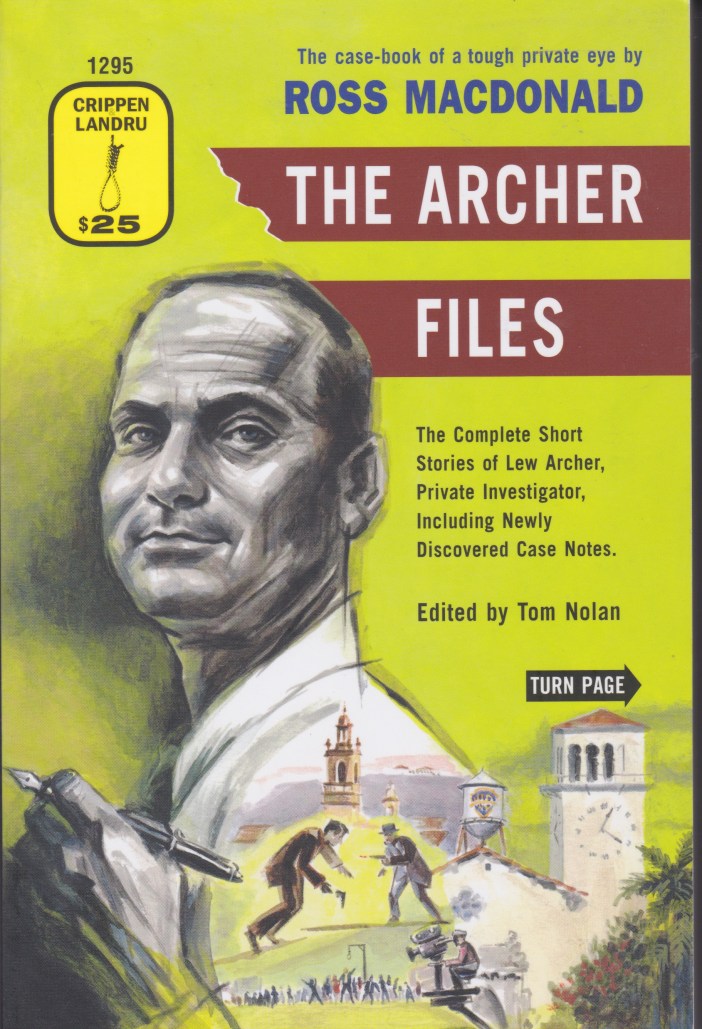
As for the Short Story Project, I may have mentioned sometime this week that I discovered a collection of Ross MacDonald short stories on my shelves that I’d forgotten I had, The Archer Files.  I read the first two stories in that collection this week. I came to MacDonald rather late in life; I became aware of him in the 1970’s, but his book covers, with their lurid scantily clad women and back cover blurbs that promised machismo and tough guy behavior, didn’t interest me. I didn’t start reading MacDonald until years later, when Christopher Rice recommended him on a panel we both were on. I’d come to love John D. MacDonald in the 1970’s, and so I decided to give Ross a whirl. I think the first one I read was The Drowning Pool, and after that, I was completely in on Ross MacDonald. I have also come to a great appreciation for the extraordinary talent that was his wife, Margaret Millar…I love to imagine what their dinner conversation was like.

the archer files

The two stories, “Find the Woman” and “Death by Water,” were not originally written or published as Archer stories; they were adapted and turned into Archer stories later, after MacDonald was dead and this was authorized by the estate. The stories work as Archer stories, which is really all that matters. I’ve not yet read any of his non-Archer novels, but some of them are in the TBR pile; I’ll be curious to see if there’s a stylistic difference, or a significant change in voice.

I sat in my brand-new office with the odor of paint in my nostrils and waited for something to happen. I had been back on the Boulevard for one day. This was the beginning of the second day. Back in the window, flashing in the morning sun, the traffic raced and roared with a noise like battle. It made me nervous. It made me want to move. I was all dressed up in civilian clothes with no place to go and nobody to go with.

Then Millicent Breen came in.

I had seen her before, on the Strip with various escorts, and knew who she was; publicity director for Tele-Pictures. Mrs. Dreen was over forty and looked it, but there was electricity in her, plugged into to a secret source that time could never wear out. Look how high and tight I carry my body, her movements said. My hair is hennaed but comely, said her coiffure, inviting not to conviction but to suspension of disbelief. Her eyes were green and inconstant like the sea. They said what the hell.

That is how “Find the Woman” opens, and what a great example of the hardboiled, noirish style of crime writing. Not a lot of words, not a lot of sentences, and yet we get a strong sense of Archer’s character, just out of the war and chafing restlessly at his new life and existence, and the danger inherent in Millicent Breen. She is beautiful, older, sexy and dangerous; she wants Archer to find her daughter, a movie starlet who has disappeared, and this leads Archer into the  dangerous world of movie stars and film people, of love gone astray and a slightly sexist depiction of restless women who might love but need someone in their bed every night. I enjoyed it, not only as an example of the writing style but as a time capsule; it was easy to picture this in black-and-white, with Bogart as Archer and maybe Myrna Loy as Millicent Breen.

He was old, but he didn’t look as if he were about to die. For a man of his age, which couldn’t have been less than seventy, he was doing very well for himself. He was sitting at the bar buying drinks for three young sailors, and he was the life of the party in more than the financial sense. In the hour or so that I  had been watching him, he must have had at least five martinis, and it was long past dinner time.

“The old man can carry his liquor,” I said to Al.

“Mr. Ralston you mean? He’s in here every night from eight to midnight, and it never seems to get him down. Of course some nights he gets too much, and I have to take him home and put him to bed. But next day he’s bright as ever.”

And so begins “Death by Water.” Again, note the writing style; the sparse use of words to get a point across, the inherent toughness in the words chosen and how they are put together. Mr. Ralston ends up dead later on, of course; drowned in the swimming pool, and Archer is on the case. It’s a great little crime procedural, with Archer taking mental notes as he talks to witnesses and the people involved, and once the case is actually solved, it’s pretty clear that the solution was right there in front of our faces all along. Well done!

And now, back to the spice mines with me. Paul’s going into the office, I have some errands to run, and we’re going to go see I, Tonya tonight; I intend to do a deep, overdue cleaning of the kitchen today as well, around writing and editing.


That’s All

Nostalgia is something I rarely indulge in, because I consider it to be dangerous in its apparent innocence. We tend to look back at the past with a rosier glow; see it through cheesecloth and Vaseline smeared on the lens to take away the wrinkles and ugliness, make it seem prettier than it actually was.  My childhood actually ended when I was thirty-three and decided to live my life rather than continue to allow it to just happen; the events of my life prior to that influenced me and helped make me into the person I am today, so I cannot have any regrets or ‘what-ifs’; I love my life now and I like who I am. I try to live in the present and look ahead; plans and goals are helpful to keep one focused, but they also leave one at the mercy of whimsical fate. You never know, for example, when a hurricane is going to come to your city or a wildfire burn down your home and your plans turn out to be for naught; we are all at the mercy of nature and fate.

Nostalgia perhaps explains my love for the Star Wars films; the first film opened when I was a senior in high school, and I have been a fan ever since. I waited in line for three hours to see the very first showing of Return of the Jedi when it opened; the prequel trilogy was a sore disappointment to me. Yet The Force Awakens and Rogue One tapped into that magic I remembered as a teenager, looking up at the big screen and seeing an epic tale of magic and mystery, the battle between good and evil, between freedom and authoritarianism, play out with space ships and droids and light sabers, with heroes and villains that were easily identifiable, and American cinema, for good or bad, was changed forever.

Yesterday Paul and I went to see The Last Jedi.

nfattq4uglcz

 There are spoilers hidden behind the ‘more’ cut, so don’t say you weren’t warned. Continue reading “That’s All”

Caribbean Queen

It’s raining this Sunday morning in New Orleans, with the occasional growl of thunder and a constant leak from the gray skies overhead. When I woke up, this leak was a faucet, turned all the way to high and so loud I wasn’t certain it could actually  be rain; my first thought was I wonder if the streets are flooding again and my second we have tickets to see The Last Jedi at one fifteen; will we be able to make it to the Palace theater in Harahan? As my first cup of coffee brewed this morning I checked to see if there are any reports of flooding in the city; there aren’t, and none are, apparently, expected. And yet any rain here carries with it the possibility of rising water and ruined cars, fears of hundreds of dollars in repairs if you are lucky, scrambling to find the money for a new one while battling with your insurance company and your lender in the meantime.

I worked yesterday, ran some errands, came home and made myself barbecue-flavored chicken nuggets in the oven; the TGIFriday’s brand, frozen food, heated for ten minutes on each side at 375 degrees in the oven. It’s easy and quick, doesn’t taste horrible, and fills the emptiness; Paul was also at work and we were going to a Christmas party last night in Uptown so I didn’t see any need in actually making any food that would make a mess; I’ve not had time to clean and organize and file this week; but I am hoping to get all of that done this morning before we brave the storms to see our movie. There’s something comforting and relaxing about rain, though, despite its imminent and constant threat here, I’ve always found rain to be a relaxing experience, a cozy one; safe inside from the wetness and able to witness it through windows, warm and dry and somehow protected.

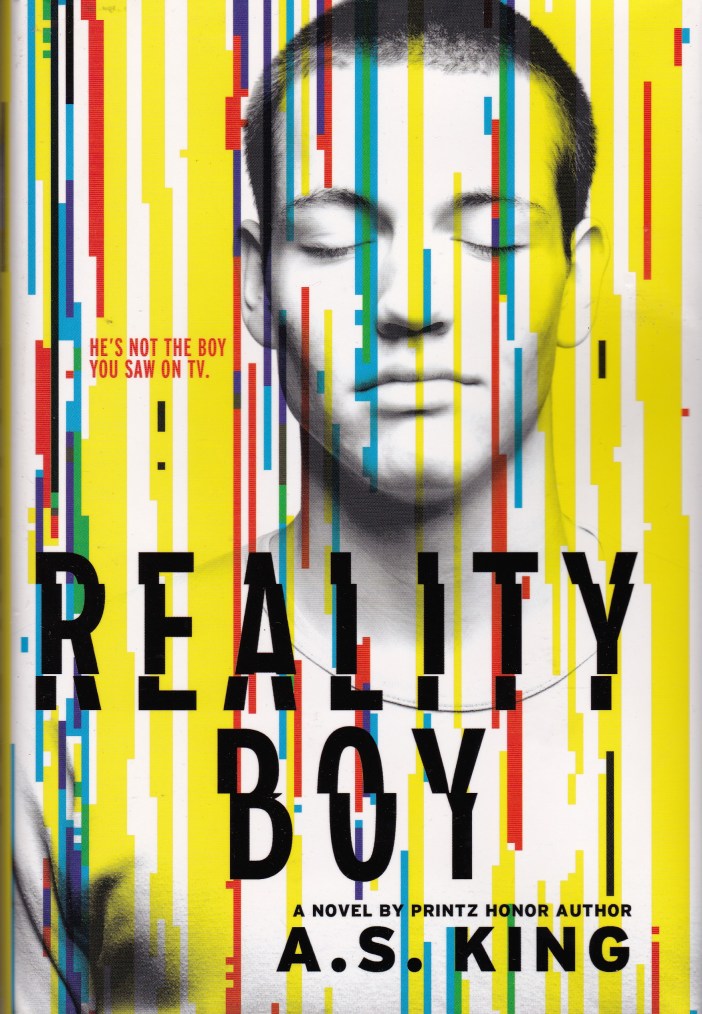
Yesterday I finished reading yet another book, another one that I enjoyed tremendously; Reality Boy by A. S. King. I’ve had the book for quite some time, it’s been in my TBR pile for years now. I don’t remember why I bought it, other than an interest in the subject matter; the after-effects of being a reality show celebrity as a child. I’ve always watched, enjoyed and been fascinated by reality television; one of my early ideas for a Scotty novel involved a Real World type show being filmed in New Orleans (that show has filmed here twice; the first time in my neighborhood). Even early on, I saw, in The Real World, the classic Agatha Christie set-up: a group of strangers thrown together in a confined space, forced to interact with each other and all for the benefit of cameras, some hidden and others hand-held. It seemed perfect for a classical-style locked room murder mystery; the locked room, of course, being the cameras. I toyed with it and played with the notion for several years, before finally deciding on the bizarre plot that became Mardi Gras Mambo; the first iteration of that novel was the reality show plot that I eventually lost interest in and threw away so I could start over. Reality television has taken over our culture in so many ways; you are just as likely to see a reality “star” staring at you from the covers of the tabloids and celebrity magazines in the check-out line at the grocery store as you are to see an actor or an actress or a member of British royalty. I do watch some reality television still to this day, primarily franchises of the Real Housewives, some more so than others, and other shows I absolutely will not watch, as though some of these shows are somehow more highbrow, more morally and intellectually pure, than others.

As I said the other day, I had decided to get through some of the young adult fiction in my TBR pile once I’d finished Krysten Ritter’s Bonfire, and I greatly enjoyed The Truth About Alice. Reality Boy has been in my pile for quite some time; and I pulled it out and started reading it Friday night once I’d finished the Ritter and Alice. Reality Boy was, in a word, quite extraordinary; I’m not sure that I would classify it as full-on noir, but it’s definitely domestic suspense bordering on domestic noir.

reality boy

I’m the kid you saw on TV.

Remember the little freak who took a crap on his parents’ oak-stained kitchen table when they confiscated his Game Boy? Remember how the camera cleverly hid his most private parts with the glittering fake daisy and sunflower centerpiece?

That was me. Gerald. Youngest of three. Only boy, Out of control.

One time, I did it in the dressing room at the mall. Sears, I think. My mom was trying to get me to try on some pants and she got the wrong size.

“Now you stay right there,” she said. “I’ll be back with the right size.”

And to protest having to wait, or having to try on pants, or having to have a mother like her, I dropped one right there between the wicker chair and the stool where Mom’s purse was.

And no, it wasn’t excusable. I wasn’t a baby. I wasn’t even a toddler. I was five. I was sending a message.

As much as I enjoy the reality shows I watch, one thing that has always put me off about them is when adults use their children as props on these shows. It’s one thing when you’re an adult, or when your children are adults and have the kind of agency to decide whether they want their life to be turned into a circus or not. It’s entirely another when parents decide they want their young children trotted out for the cameras like some dog-and-pony show to show off what great parents they are, or how talented their children are, or how cute they are. I particularly loathed those ‘nanny’ shows, where ‘problem’ children were trained by a some Mary Poppins stand-in to be behave better when their parents can’t control them; those videos and tapes are going to, I have often felt and believed, haunt those kids for the rest of their lives.

The premise of Reality Boy is precisely that.

Gerald, at ages five and six, appeared with his family on one of those nanny shows, and his particular problem was that he defecated as a sign of rebellion and protest; in his mother’s shoes, in the hallway, etc. He became viral and forever known as the Crapper. He is now sixteen going on seventeen, his family is still just as dysfunctional as ever, and he is regularly taunted, mocked and bullied for his reality show past. Being a teen is hard enough for any number of reasons–as explored in The Truth About Alice, for example–but imagine being famous/infamous for behavior when you were a small child, on television.

Reality Boy is about Gerald’s learning to cope with his past, learning to cope with his future, and recognizing, at long last, that he could have a future. It’s exceptionally well done, and as King reveals the layers of dysfunction that led to Gerald’s behavior, the truth of his life and his own reality, why he is been labelled a problem child and a disgrace, are even more horrible. And yet Gerald has to find the strength to cope, to deal, and to by the time the book ends, there’s hope that Gerald’s life is going to get better. It’s extremely well done, Gerald comes to fully-realized life beautifully on the page, and his burgeoning relationships with new friends and maybe, even, just possibly, a girlfriend–help him to grow and understand. It’s incredibly well done, and it’s also a cautionary tale that needs to be sent to anyone who’s ever trotted their children out for the cameras for fame and money. It makes you wonder what Honey Boo-Boo’s life is going to be like when she’s seventeen, or Teresa Giudice’s daughters (they’ll probably still be on television). It also makes you wonder just how complicit those of us who watch these shows are in the possible damage being wrought on these children.

My current Scotty book has me returning to the reality well, only this time with a Real Housewives-type show. I’ve already done nine chapters, and had already decided to toss those and start over because it wasn’t going in the direction I wanted it to go; I wasn’t saying what I wanted to say in the book. I had planned on starting it over again, but now…now I am thinking I need to sit down and think through what I want to say in it, maybe plan it a little more than I’ve ever planned a Scotty book before. I don’t know, but I’ll be keeping you posted.

Twist of Fate

It snowed yesterday in New Orleans, and it is still cold today–albeit sunny. I am sitting at my desk this morning wearing fingerless gloves so I can type, a  knit LSU cap on my head, and a blanket wrapped around my legs. I also have to go to Costco at some point today, and I also have to get some things done. Needless to say, a temperature around fifty at my computer doesn’t make that more likely. I may check into space heaters at Costco today–although I may check the attic. There should be another one around here somewhere.

When I got home last night I turned on the heat and cleaned the upstairs, then grabbed a blanket and headed for my easy chair.I stopped reading The Last Picture Show when I got to the bestiality part (which I’d completely forgotten about) and even though there’s an even more important part of the story after the cow-rape (seriously), I just couldn’t pick the book up again. I know I can skip over that part, but honestly. I didn’t remember it, or the relatively nonchalant way McMurtry talked about it in the book–like it’s very common place amongst farm boys (literally, “every farm boy has done it”)–and I don’t know…I still have fond memories of the book, but despite the fact that it’s still really well written, I don’t know if I’m going to keep reading it; although I suppose if I continue reading it as an example of toxic masculinity…and the homophobia in it–what would toxic masculinity be without some good old homophobia?–is also not easy to read; because it’s so casual. 

Then again, that was the thing about the culture back then (it’s set in the 1950’s); the hate was so casual and matter-of-fact. It’s a short book, I may go back to it later today. (And interestingly enough, Larry McMurtry also co-wrote the screenplay for Brokeback Mountain, so there’s that.)

Speaking of homophobia, I was scrolling through HBO Now last night looking for something to watch, and noticed they had American Gigolo available. I had watched that movie only once, years ago on videotape, when a female friend had rented it. I didn’t remember much about it, other than Richard Gere was so incredibly beautiful and at the end Lauren Hutton came through for him at the end, and Blondie’s “Call Me” played over the opening credits and it was criminal that the didn’t at least get an Oscar nomination for Best Song. It should have WON, damn it. It’s a great song and it still holds up today.

91uUHSjYBpL._SY445_

I also remembered that it wasn’t very good.

That memory was correct, but watching it again…so much wasted potential in this movie. It could have been a noir classic.

Gere plays Julian, or Jules, who basically is a gigolo, and not cheap. He works for several different pimps–one a blonde woman with a great beach house, the other a black gay man–but Jules is so in demand and so good at what he does-and let’s face it, Gere smolders. You can see why he catches everyone’s eye when he walks into a room, and no one wears an expensive suit like he does–but he’s also become incredibly arrogant because he is so good. Both of his pimps argue with him about the split on jobs they get for him–but he’s so good he always gets his way, but both warn him that his attitude and ingratitude to them is going to bite him in the ass one day. The gay pimp sets him up with a kinky job in Palm Springs–he has to be abusive to the woman while the husband watches–which makes him incredibly uncomfortable but he does the job well because the pimp tells him they want him back. Jules throws the word ‘fag’ around a lot–“I don’t do fags” etc., which, as someone who is paid for sex, I can certainly see why he would want to be clear on what he does and what he doesn’t, but again–casual homophobia. He meets and falls for Lauren Hutton in a restaurant at a posh hotel, who turns out to be an unhappy politician’s wife. They embark on a secret affair, but she turns out to be his alibi for the night the Palm Springs wife is murdered…and he can’t tell the police about her. This is also kind of where the movie goes off the rails. The crime itself is treated as an afterthought, and Jules being suspected and investigated–and he is being framed–are all secondary to his development as a character; all of this is just a moral lesson for him about being humble and how you shouldn’t treat people badly because they won’t stand by you when you need him, all the while he’s making this incredible noble sacrifice for the woman he loves.

A woman is brutally murdered as a plot point and pivot so Jules can learn humility.

Whoa. And wow.

And even the resolution doesn’t make sense. Turns out the gay pimp pulled off this elaborate ruse and frame just to teach Jules a lesson in humility? I wasn’t really clear on this at the end; it didn’t make sense to  me the first time I watched and it still didn’t make sense this time. The confrontation with the pimp ends with him accidentally knocking him off the balcony, but Jules tries to save him, but he can’t hold him. He falls to his death with Jules literally left holding his boots. He is taken in by the police and arrested, refuses to speak to his lawyer, but then Lauren Hutton comes forward and alibis him for the original murder, because she loves him…and they speak to each other through glass in the prison’s visiting room when she tells him she’s cleared him because she loves him. The end. And my first thought was, well, your alibi isn’t going to do him any good NOW that he’s killed the pimp, even if it was an accident. So you just blew up your own life for no reason because he’s still going to jail.

None of that was resolved. It’s really a shame, because it could have been a great noir classic. And it many ways it is actually a good film, and highly original: it was one of the first movies to ever focus so heavily on male beauty, and Gere is often in underwear or naked (full frontal, at that) or shirtless; the camera lingers over him lovingly the way it previously only did for women; the soundtrack by Giorgio Moroder was excellent and also the first time electronica music was used for a film score; and the entire film is beautifully shot. But the writer/director didn’t see it as a film noir or a crime film; he saw it as a character study with a redemptive arc, and that was where the film fell flat.

Pity.

And now back to the spice mines.

I Just Called To Say I Love You

How was your Thanksgiving? Ours was rather lovely; we had our deep dish pizza and a lovely visit with our friend Lisa; then Paul and I watched three movies on Netflix: Fourth Man Out, Closet Monster, and Handsome Devil. We also watched another episode of a Hulu original series, Future Man; which we had given one more episode to get better. And the fourth episode definitely delivered. We laughed a lot all the way through it; and it finally started delivering on its premise.

The three movies were all gay films, which we generally don’t watch very often. I know I should be supportive of gay films, but so often they’re aren’t very good–or at least that used to be the case. When a major studio makes one (Philadelphia, In and Out, To Wong Foo, etc.) they’re awful; indies always mean well but don’t have the budget to really do them well or cast good actors, so we stopped watching them a long time ago. Every so often, a film like Beautiful Thing or Latter Days will come along, but still, fairly rare. My incredibly cynical self is very pleased to say that the three films we watched yesterday were enjoyable in varying degrees, which also makes me tend to think that perhaps we should watch more gay cinema. And really, isn’t mainstream film always a crapshoot, too?

Fourth Man Out was the first movie we watched; its about a group of four guys who’ve been best friends since they were kids and then one of them comes out to the others. It was a comedy, so the coming out was handled in a comedic fashion; the friends were a little taken aback, and then there was some awkwardness about what you can or can’t say around your gay friend which was sweet and kind of cute. The gay character was a mechanic, so there was a sense to me of ‘see, a gay guy can be just a regular guy’ about the movie which was well-intentioned but…the really charming part of the movie was watching the friends try to help him navigate the gay dating world, and there was a really charming scene where they take him to his first gay bar. And the ‘meeting someone from on-line’ trope was treated as comedy (and who hasn’t met someone whose picture wasn’t them?) and there were some moments that I thought might have been in questionable taste–but overall the film was charming. The lead, gay Adam, was played by Evan Todd, who’s very good-looking:

tumblr_o9jmg5lCng1urvepco3_1280

His best friend, Chris–and their relationship/chemistry was quite charming, was played by the impossibly good-looking Parker Young:

mgid_uma_image_logotv

Another one of the guys was played by Glee’s Chord Overstreet, almost recognizable in a heavy beard. But the movie’s true charm was the relationship between Adam and Chris; how they learn from each other and grow and finally find their perfect matches because of their friendship.

Closet Monster starred Connor Jessup from American Crime, who is an appealing and talented young actor I would pretty much watch in anything.

la-et-vn-emmy-contenders-chat-connor-jessup-20160510

This movie was apparently very popular on the indie art film festival circuit and won lots of awards; for me, it was the weakest of the three and were it not for Connor Jessup, we would have probably stopped watching. As a little boy, around the time his parents broke up in a very nasty and volatile break-up, young Oscar witnessed a violent hate crime against a gay teenager–and that, plus the divorce, have been deeply internalized and traumatized him as he comes of age as a gay teenager with an interest in horror movies and a desire to become a make-up artist for horror films. He’s applied to the best school for this in New York, and cannot wait to get away from this awful town he lives in. He’s desperately unhappy–who can’t relate to that–with big dreams, and is developing a crush on another boy he works with at a Home Depot type store. Wilder, played by Aliocha Schneider, is coolly confident in himself and tries to draw Oscar out of his own shell, with some success.

MV5BMTgxNTcwNTI1M15BMl5BanBnXkFtZTgwNTczOTQyNjE@._V1_UY317_CR10,0,214,317_AL_

The point of the movie is ultimately that Oscar needs to stop spinning his wheels and move in a positive direction in his life; and it does eventually get there after a bizarre costume party where he has his first sexual experience with a stranger and comes to terms with his feelings for his mother; his relationship with his father remains unresolved. But it was an arty film; Oscar’s hamster speaks to him in Isabella Rossellini’s voice–he got the hamster originally the day his mother left his father so it symbolizes the last time he was happy; and there’s a lot of moments where the director slaps the viewer in the face with his symbolism and hidden depths. There are some gorgeous shots, particularly at the end, but there are also some serious plot holes. But as I said, Connor Jessup is a very talented and appealing young actor, and he carries the entire movie.

The last film we watched, Handsome Devil, was by far and away the best of the three. Set in an Irish boarding school obsessed with its rugby team, it’s from the point of view of young Ned, who is bullied by his schoolmates in no small part because he doesn’t care about rugby and doesn’t fit in; he is played charmingly by Fionn O’Shea. He comes back to school against his will–his father and stepmother live in Dubai and for some reason he can’t live with them there; it’s kind of implied that he’s an inconvenience for them. He’s delighted when he gets to school to find out he’s got a single room and won’t be sharing. There’s also a really funny sequence where he talks about his English teacher; he simply turns in the lyrics to old songs for papers and get’s A’s; the song that is handed back to him with an A written on it to illustrate this voice over is Lou Reed’s “Walk on the Walk Side,” which is hilarious if you know the words.

Handsome-Devil2-1024x512

But he winds up with a roommate after all, Connor. Connor can’t go back to his old school–he was kicked out for ‘fighting’–AND it turns out Connor is a great rugby player; the long-missing piece for the school’s team which will make them champions. Ned reacts by moving all of their furniture to the center of the room, kind of forming a Berlin wall. They also have a new English teacher this term, Mr. Sherry, who is played by Sherlock’s Andrew Scott. Mr. Sherry, and his class, reminded me of Dead Poets’ Society, and I don’t think that was accidental. But Ned and Connor slowly become friends–Connor is Ned’s first friend, really–and of course there’s the requisite homophobia (they all treat Ned like he’s gay, but we never really know for sure) and obstacles for the boys to face before the film’s end. This movie is really charming, and is about friendship, and has some absolutely lovely moments. O’Shea is fantastic as Ned, and you can’t help but root for him as he learns who he is and what being a friend really means; Nicholas Galitzine plays Connor and does a fine job with a less complex part; but the chemistry between the two boys is terrific. I highly recommend this movie.

MV5BMjI4ZmRkMTYtNTFmOC00NDFjLWFhYjEtMTJhYjg4ODc5NjQyL2ltYWdlXkEyXkFqcGdeQXVyNDY5NTM2NjY@._V1_UY317_CR20,0,214,317_AL_

It was also highly educational to watch these films, and it also made me realize that I’m a bit of a snob when it comes to gay-themed films; I should probably watch more of them in the future–and I think I’m going to. Watching these movies reminded me of the kinds of novels Kensington used to publish after the turn of the century; particularly the novels of Timothy James Beck. I miss those novels, and Kensington did a great job of finding and publishing fun gay-themed novels in those days. I was one of Kensington’s authors; Kensington was where the first three Scotty books were published, and pulling together the Scotty Bible has also put me in mind of those days again. Kensington first published Rob Byrnes,  and also those wonderful novels by Michael Thomas Ford. Kensington was also home to William J. Mann’s fiction, from The Biograph Girl to The Men from the Boys, All-American Boy, and several others; Kensington also published Andrew Beierle’s The Winter of Our Discotheque, which remains to this day one of my favorite gay novels.

Sigh.

And now back to the spice mines.

What’s Love Got To Do With It

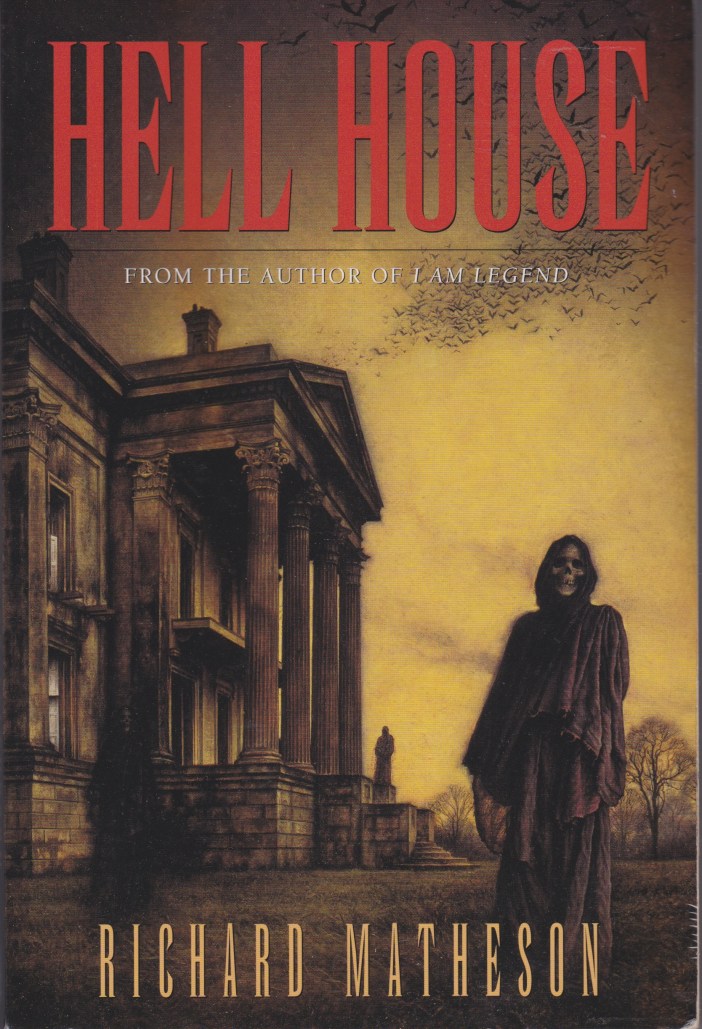
I finished my reread of Hell House last night, and it does, in fact, hold up rather well. It was, frankly, a most satisfying way to close out my Halloween Horror month of reading; even if it was a reread, and a book I’ve read several times before.

I first read it when I was a teenager; it was one of the many mass market paperbacks I found on the wire racks at the Zayre’s in Bolingbrook. The cover was rather non-distinct; black, with a photograph of a woman in a red halter dress, carrying a candelabra and looking back over her shoulder, a terrified look on her face, her long dark hair being blown backwards by the same wind pushing the candle flames backwards, with the title above it in red letters: HELL HOUSE. I had watched The Haunting several years earlier, and was absolutely terrified by it; I hadn’t yet realized that it was based on a Shirley Jackson novel. So when I saw Hell House, I did think that it might be the same story, and of course Hollywood had to change it to Hill House. So I bought it, took it home and started reading.

It was similar, but it wasn’t the same story. By any stretch of the imagination.

Scan

It had been raining hard since five o’clock that morning. Brontean weather, Dr. Barrett thought. He repressed a smile. He felt rather like a character in some latter-day Gothic romance. The driving rain, the cold, the two-hour ride from Manhattan in one of Deutsch’s long black leather-upholstered limousines. The interminable wait in this corridor when disconcerted-looking men and women hurried in and out of Deutsch’s bedroom, glancing at him occasionally.

He drew his watch from its vest pocket and raised the lid. He’d been here more than an hour now. What did Deutsch want of him? Something to do with parapsychology, most likely. The old man’s chain of newspapers and magazines were forever printing articles on the subject. “Return from the grave”; “The Girl Who Wouldn’t Die”–always sensational, rarely factual.

Wincing at the effort, Dr. Barrett lifted his right leg over his left. He was a tall, slightly overweight man in his middle fifties, his thinning blond hair unchanged in color, though his trimmed beard showed traces of white. He sat erect on the straight-back chair, staring at the door to Deutsch’s bedroom.

What Deutsch, an old and dying billionaire, is proof that either that afterlife exists, or that it doesn’t. In order to get that proof, he is willing to pay an almost obscene amount of money, and do pretty much anything. He is, in fact, assembling a team to send to the “Mount Everest of haunted houses,” the Belasco house in Maine; more commonly known as Hell House.

Like in The Haunting of Hill House,  a team of four people are going to go into the haunted house to, basically, see the phenomena, observe and document it, and, if possible, cleanse the house of the infernal spirits haunting the house. Two teams have gone into the house in the past; with one exception, all of them were either killed or went insane.

That one survivor, Ben Fischer, is a part of this expedition.

Dr. Bartlett, though, is no Dr. Montague; who merely wanted to experience the phenomenon at Hill House and write a paper about it; Dr. Bartlett’s life’s work has been based on the theory that hauntings, or so-called paranormal phenomena, are not actually caused by ghosts or spirits, but are simply residual energy. He has designed a machine that will reverse that energy and therefore cleanse Hell House–or any other haunted house. His much-younger wife, Edith, believes in him and his work…but there are issues within their marriage; he is a polio victim and the polio has also left him impotent; Edith herself has issues with sex and her own sexuality and this sterile, sexless marriage is a refuge for her.

The other two members of the party, Ben Fischer and Florence Tanner, are both mediums. Ben was a mere teenager when he went into Hell House the first time; he was the lone survivor, the one Hell House could not kill or drive insane. He has since stopped used his psychic gift. Florence is a beautiful woman who has her own ministry and believes her gifts come from God; she believes ghosts are spirits that have not moved on and it is her duty to use her gift to help them move on, through love and the power of prayer. She and Dr. Bartlett have competing beliefs and values…and once they are all inside of Hell House, the terror truly begins.

Richard Matheson was a great writer; many of his writings were made into films–Stir of Echoes, Somewhere in Time, I Am Legend, The Incredible Shrinking Man–and many of his short stories became classic Twilight Zone episodes–he wrote “Terror at 20,000 Feet”–and Hell House was filmed as The Legend of Hell House, which I also saw as a teen and it absolutely terrified me.

It’s awesome that the book holds up.

Mickey

My wonderful book about the classic horror novels of the 1970’s thru the 1990s, Paperbacks from Hell, attributed the boom in horror fiction to three bestselling novels that set the stage: Thomas Tryon’s The Other, Ira Levin’s Rosemary’s Baby, and William Peter Blatty’s The Exorcist. I read all three of these books when I was in junior high school; the Tryon and the Levin remain two of my favorite novels, and I reread them periodically. But after reading The Exorcist one time, I’ve never felt the need to have a copy on hand, nor have I ever felt the desire to go back and reread it. It did occur to me sometime within the past few years that I should give it another go; my primary memory of the book is, of course, the crucifix masturbation scene which everyone in the seventh grade discussed in breathless whispers whenever someone new had read the book. I may not have ever owned a copy; I may have borrowed it from someone. There were any number of paperback copies floating around my junior high school, the binding bent and broken and covers battered as they were passed around from kid to kid. It also occurred to me that many of my memories of The Exorcist were not from the book, but from the incredibly disturbing film; it was a huge hit and was nominated for ten or eleven Oscars (winning maybe one or two). Mike Oldfield’s “Tubular Bells,” used extensively in the score, was also hugely popular. (All three of the books were made into films; The Other the only whose film version wasn’t a success–but it’s hard to see how it could have been filmed successfully; although it would be really cool if someone tried it again.) So, Labor Day morning, I took down the copy of The Exorcist that I bought recently and read it again.

the exorcist

The Exorcist is undoubtedly an important work in the horror genre; it helped create a boom and directly resulted in a lot of really talented writers getting some great books published over the next thirty years or so. I had noticed, though, that not many people who write horror ever include it on those “Best Horror” lists, or list it as an influence. I read a book in the last year or so that was undoubtedly influenced by The Exorcist; Paul Tremblay’s A Head Full of Ghosts, which I really enjoyed and also put me in mind of a reread of Blatty’s blockbuster. The fact that Blatty is a homophobe made me a bit uncomfortable going back to the book–okay, he may not be a homophobe, but he certainly felt welcoming and admitting LGBT students at Georgetown University meant the school had betrayed its Jesuit heritage and should be stripped of its standing as a Jesuit university (you can read about that here: http://www.nytimes.com/2013/08/04/education/edlife/how-georgetown-became-a-gay-friendly-campus.html?mcubz=1).

So making millions of dollars about a child masturbating with a crucifix is kosher–I guess because, literally, the devil made her do it–but treating LGBT college students as human beings is a crime against Catholicism. Got it.

And to be fair to Mr. Blatty, I only vaguely remembered the above incident; and wasn’t 100% sure I was correct, so that didn’t play into my reread of the book (I didn’t go looking into it until this morning, while actually writing this entry).

Part of the issue with The Exorcist is that once you are aware of it, it’s really not that shocking anymore. This book was a shocker when it was first released; it was denounced far and wide as demonic–including by the Catholic Church (which is even more perplexing on the reread, because the book is very very Catholic), and the scares involved how shocking it was. I seem to recall Blatty based the book on an actual case of an exorcism from the early 1960’s, or perhaps the 1950’s–I don’t recall exactly. So, after forty-odd years the shocks and scares are no longer shocking or scary; my memory of the first read of the book is vague so I cannot remember if it was more pruriently shocking or if it was, indeed, scary to the twelve year old who read it all those years ago. But knowing the story, and what is coming, and knowing that the shock value has completely worn off in the intervening years, I was able to read it and evaluate it simply as a novel.

And it doesn’t, sadly, hold up very well.

I was torn about blogging about The Exorcist, because I generally don’t like to criticize other writers and other books publicly; but it’s an old book, and the author has made a fortune off it. There’s also the suspicion that knowing how homophobic the author is might have played into my disappointment in the reread, but let me give you some sentences:

Looking down at the pain in those sensitive eyes, Chris surrendered; couldn’t tell her what she really believed. Which was nothing.

In fact, Chris had smelled nothing, but had made up her mind she would temporize, at least until the appointment with the doctor. She was also preoccupied with a number of other concerns.

She seemed to be thinking, and still in this posture, she stepped outside and joined her son, who was waiting on the stoop.

Her eyes still on her notes, Sharon probed at the silence in a strained, low voice.

Chris looked at him appraisingly, with gratitude and even with hope.

There are lots more examples; weird analogies, and strange character behavior. It’s also really hard to tell who is the main character. Chris MacNeil, the mother, is a divorced atheist actress; her marriage failed, according to the book, because her husband couldn’t bear being Mr. Chris MacNeil; his wife’s success and fame was too much for his ego to handle, and Chris not only understands but doesn’t blame him. He is a neglectful father to Regan, which also doesn’t bother her too much. She is renting the house in Georgetown because she’s appearing in a movie being filmed there, a musical remake of Mr. Smith Goes to Washington which has an added subplot about campus unrest and protests (which sounds absolutely terrible) shoe-horned in; her main home is in LA. Yet once her role in the movie is finished, she stays in Georgetown inexplicably; Regan is being home-schooled by Chris’ secretary, who does double duty as Regan’s teacher–so there’s no reason for them to stay other than the fact that it’s necessary to the plot for her to remain in close proximity to Georgetown University’s campus. The filming is over before the possession truly gets going; so…

There are also some bizarre behaviors exhibited by Chris as well–she will have an encounter with her strangely acting daughter, be terribly upset, and then go downstairs and have a pleasant conversation with her housekeepers about the film they went to see. It becomes very difficult to have sympathy for her, because she isn’t really fleshed out as a character. The book is also told from an omniscient point of view, so the reader has a very hard time engaging with the characters or feeling deep sympathy for them; certainly it’s hard to identify with any of them. Sharon, the secretary, is a complete cipher; as are the Swiss couple who work as housekeepers. Burke Demmings, the director of the film and a friend of Chris’, is a vicious and cruel drunk who openly mocks her servants; which she just dismisses as “oh, that’s just Burke.”

Because her housekeepers aren’t people who should at least be treated with a modicum of respect as human beings?

The police detective who becomes involved in the case–Burke ends up dead at the foot of the steep staircase down to M Street behind the house–is incredibly annoying; he never gets to the point and dances around the subject and is one of the most unbelievable cops I’ve ever encountered in fiction; he seems a bit like Columbo, but at least the viewer knew that Columbo was actually incredibly smart and that was his method. You never get that sense with Detective Wilderman; he’s just annoying.

Father Karras is by far the most likable and interesting character in the book; and I suppose the reason it’s called The Exorcist. Damien Karras (it’s funny; at the time the book was published the name was unusual but interesting; of course The Omen has forever altered the perception of that name) is having a crisis of faith; his own homosexuality is hinted at but subtextually; his ‘friendship’ with Father Dyer is hinted at, they have a lightly teasing homoerotic kind of friendship but it’s never really gotten into; although one of the insults the demon throws at Karras is an accusation of homosexuality, which rattles him. There’s also a scene where Father Dyer mentions that ‘the gays are leaving the priesthood in droves.’

But the underlying premise, and theme that drives the book, is that Catholicism is real, the one true Faith; even though the demon is apparently an old Babylonian god named Puzuzu–who predates Catholicism and Jesus–the power and faith can defeat him. The ultimate sacrifice of Father Karras in taking in the demon and then killing himself–what happened to the demon? What happened to his soul? Does he redeem himself with this act?

Father Karras was interesting to me (he is constantly described, not just in the text but by characters, as ‘looking like a boxer’–whatever that means: “they told me you looked like a boxer”.) as a character, and I would have loved to have seen the entire story through his eyes; the loss of faith, his struggle with choosing the church over his mother; the relationship with Father Dyer; his doubt that Regan is actually possessed and the slow dawning that demons, and therefore, his faith, are real; and why he would make that ultimate, final sacrifice.

I’m glad I reread the book, even though it was kind of disappointing. I greatly enjoyed the television series, which was recently renewed for a second season (yay!), and it is an important book in the genre; no matter what quibbles I have with it, its importance cannot be denied, and I think horror aficionados should read it.

Jeopardy

So, yesterday was my birthday. Fifty-six officially; although I always add a year to my age on New Year’s Day for the sake of simplicity. I had some trouble falling asleep on Saturday night; a combination of restlessness and heartburn. I wound up sleeping in till almost ten; which is late for me but since I didn’t really fall asleep until around three in the morning it wasn’t that much sleep. But I had a lovely day, really. I kind of just laid around and reread In a Lonely Place by Dorothy B. Hughes, rewatched The Philadelphia Story on TCM (Katharine Hepburn and Cary Grant were both robbed of Oscars), then watched The Nineties and The History of Comedy on CNN before finally watching last night’s Game of Thrones.  I also thought about the new Scotty some; I have today off from work as my birthday gift to myself, so I plan on doing some writing, line editing, and revising, and thinking about what I’m going to write next before actually sitting down at the computer is always a wise thing to do (although usually I never had the time to do that, thanks to deadlines). There’s a serious moral dilemma coming for Scotty in this book; one that really has been needing to be dealt with in the series for quite some time, but I’ve dodged it and avoided it; this is the book where I am finally going to have to have him face up to it, the way I am bringing it to the forefront so he can no longer avoid it is, if I do say so myself, rather clever.

Or it’s just going to be a steaming pile of shit. There’s no middle ground, really.

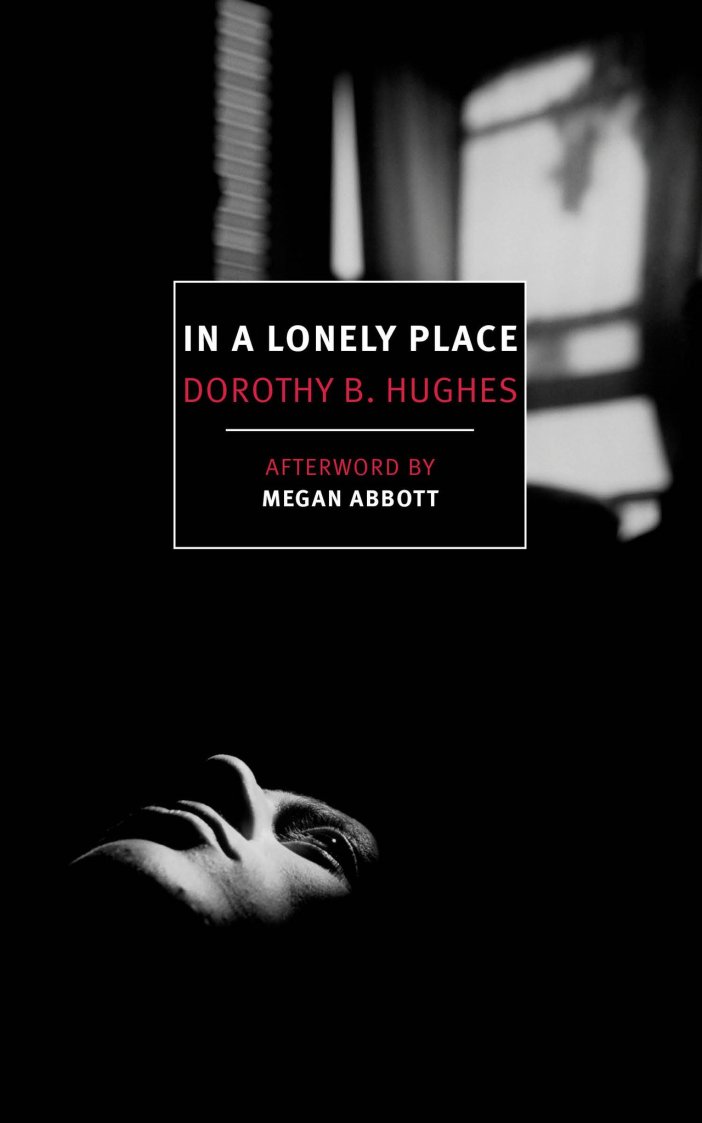
It was kind of fun to reread the Hughes novel; it is a masterpiece of noir that has been sadly overlooked for many years. Hughes was an exceptional writer, and I do admit that opinion is based on my having read only two of her novels, this and The Expendable Man (which, sadly, was her last and published in 1962). It’s not easy to find Hughes’ novels. I do feel safe in calling Hughes one of the best writers of her generation, and certainly one of the best noir writers of all time, based on those two books because they are just that good. I do have a copy of her The Blackbirder, which I want to read before the end of the year. In A Lonely Place was also filmed, directed by Nicholas Ray and starring Humphrey Bogart and Gloria Grahame; the film is significantly different from the novel, but it’s also outstanding. The new edition of the novel, from New York Review Books (who also have republished The Expendable Man and The Blackbirder), includes an afterward by the wonderful Megan Abbott, who is not only one of this generations greatest writers but also one of crime fiction’s most knowledgeable critics; her literary criticism is intelligent, thoughtful, incredibly well-written, and certainly puts me in my place whenever I am lucky enough to read some of it; I would love to read her study of literary and film noir, The Street Was Mine. (Whenever I read her criticism, any thoughts I might have about pursuing academic criticism–gay noir, gay representation in crime fiction, the heyday of romantic suspense from the 1950’s till its unfortunate death in the 1980’s–go out the window.)

Her all-too-short essay in the back of this edition alone makes the cover price worthwhile.

hughes.final_hi-res_2048x2048

It was good standing there on the promontory overlooking the evening sea, the fog lifting itself like gauzy veils to touch his face. There was something in it akin to flying; the sense of being lifted high above crawling earth, of being a part of the wildness of air. Something too of being closed within an unknown and strange world of mist and cloud and wind. He’d liked flying at night; he’d missed it after the war had crashed to a finish and dribbled to an end. It wasn’t the same flying a private little crate. He’d tried it; it was like returning to the stone ax after precision tools. He had found nothing yet to take the place of flying wild.

It wasn’t often he could capture any part of that feeling of power and exhilaration and freedom that came with loneness in the sky. There was a touch of it here, looking down at the ocean rolling endlessly in from the horizon; here  high above the beach road with its crawling traffic, its dotting of lights. The outline of beach houses zigzagged against the sky but did not obscure the pale waste of sand, the dark restless waters beyond.

He didn’t know why he hadn’t come out here before. It wasn’t far. He didn’t even know why he’d come tonight. When he got on the bus, he had no destination. Just the restlessness. And the bus brought him here.

Isn’t that an incredible opening?

Not being an expert in crime fiction–there’s so much of it to read, and there’s more new stuff all the time, so it’s hard to keep up with the new let alone trying to read everything already published–I am unable to place In A Lonely Place into any kind of context as far as the history of crime fiction is concerned, but Abbott does this beautifully in her afterward. But it’s very clear in this opening paragraphs that Hughes is addressing alienation in this book, and toxic masculinity, which may have seen its ultimate pinnacle in the second World War (the alienation of returning veterans, and the difficulty of readjusting from war to peace was also being addressed in films like The Best Years of Our Lives) and by having Dix, her main character, pretend to be writing a novel also took on the glut of post-war war novels that so many returning soldiers were writing; novels that continued to proliferate for several decades beyond the war.

The first time I read the book, having already seen the film, I was more focused on the story itself rather than an examination of how deftly Hughes creates her story, the language and imagery she chooses, and the nuanced way she creates her character. On this read, knowing how it’s going to end, I was able to pay more attention to these things, and was able to marvel at how brilliant the entire package is.

A recurring motif in the novel is fog; Hughes uses the fog as a metaphor for the fog in Dix’s brain; and we are never sure when Dix’s mind changed, making him lethal. He was raised by a puritanical uncle, Fergus, who is currently supporting him while he writes his novel–but there is a limit to the support, and while in our time $250 a month may not seem like much, at the time of the novel it was a fortune, just over $2500 in today’s dollars. Dix’s resentment of the uncle–we never learn what precisely happened to his parents–who is rough on him and has always made him work, even when he was in college at Princeton trying to fit in with the idle rich sons of privilege and then goes into detail how humiliating it all was, doing things for them for ‘tips’ until he could manipulate events to make it look as though he were the wealthy one and the sad unfortunate, unpopular boy he used for money were the dolt. In this way, Hughes also makes a sly commentary about class and privilege (which, in my opinion, she does far better than Fitzgerald did in an entire novel with The Great Gatsby, and she does it only in a few pages). So, there was always some kind of a chip on Dix’s shoulder; the war simply gave him a way to channel that anger and discontent and alienation. Now the way is over, and Dix is having to find a new way to channel those diabolical energies–and he does, in committing murder.

The entire tale is told through Dix’s perspective, which also makes him one of the first unreliable narrators in crime fiction. (It was done before, but never quite so lethally.) So, when we see the other characters–and there are only three: his old war buddy Brub, now a police detective; Brub’s wife Sylvia, whom Dix despises on first sightl and of course, the love interest, Laurel Gray–is she the femme fatale he thinks she is, or is that just a product of his own warped sense of right and wrong? Who is Laurel, of the reddish gold hair and the tempting figure? Is she the hard-as-nails user he thinks she is, or is she an entirely different character altogether?

In  A Lonely Place is a masterpiece of noir, and hopefully, this edition will elevate Hughes to the position both she and the book deserve in the annals of our genre.

And now back to the spice mines.