Sunday morning in the Lost Apartment and I slept late yet again–Sparky tried, but I wasn’t having it until almost eight this morning. I feel very well-rested this morning, which is great, because I do want to get a lot done this morning/afternoon/today. I didn’t do a whole lot yesterday–I ran the errands, ordered groceries for delivery–and then watched the LSU game. I was going to cook out for it, but we had a thunderstorm so that was out; I’ll have to do that today so the fresh meat doesn’t go bad. I did work on my story yesterday but it was kind of like pulling teeth, so didn’t get much of that done…but I did read some yesterday. Incident at Loring Groves, after a slow start, has picked up some; I’ll probably finish it today because it’s short. I did check in with my other books, too–reading a chapter in each.
LSU did win its game against Arkansas 4-1 last night, which was fun to see (we’re also leading the Jello Shot Challenge again, quelle surprise), and plays UCLA on Monday night, and it’s an early start so I should be able to see most of it after work. I have my first infusion tomorrow morning, in Metairie (sigh), and I don’t know what all that will entail, or what I’ll be like afterwards, for that matter. I’ll stop for lunch on my way to the office after I am finished, and then we’ll see, I suppose. I have some trepidation about it, of course, so I should probably read up on it today. We’ll see. (My avoidance of unpleasant things I don’t want to deal with hasn’t, apparently, changed much.)
We also finished watching Caught yesterday, and started The Good Girl’s Guide to Murder, which is interesting and really grabbed our attention. It reminds me some of that Adnan Syed case up in Baltimore, and also is kind of a modern twist on the kids’ series and books I loved reading as a kid; Nancy Drew and the Hardy Boys, for example, never solved a murder case, which always kind of struck me as odd for literary detectives, you know? And yes, watching it made me think about my next attempt at y/a, if I should ever try another one. I may have to read the Good Girl novels by Holly Jackson.
I’ve been overflowing with ideas lately, which is fun, I just need to harness that creative energy and direct it into, you know, actually writing. I hope to get some done this morning while I do the chores and clean up this mess down here. It looks sunny and bright outside, which is also nice–but it’s probably hot and incredibly humid out there. According to Accuweather, today’s thunderstorm won’t arrive until five, so yes, will have to grill burgers in the early afternoon.
This is also a short work week; we have Thursday off, and of course, I work at home on Fridays so I don’t have to go in for four days, which is lovely. Next week I am leaving work after the morning to head to Alabama to meet Dad, so another short week, and I believe the week after that is the 4th? I really do need to get my shit together and start planning. I still need to make a to-do list and I need to update some things and above all else, I need to be writing and editing. Sparky will undoubtedly have some thoughts about that, as he loves to spend the afternoons and evenings in my desk chair, and will annoy me until I finally give up and let him have it. But I can edit and reread in my easy chair, after all; the problem is I always end up turning the television on, which then sucks me into something, usually on Youtube–which is where I check the news, really; I don’t trust many news sources anymore, and even on Youtube there’s a lot of slant to everything. I’ll never trust legacy media again, since the C in their acronyms seems to stand for “collaboration” now.
I really need to make a to-do list, and I need to make it overly ambitious to push myself harder to get things done, you know? I’m still resting, of course, and I need to always prioritize getting healthy again–and not overdoing it because I feel good one day and think oh I am healthy again let’s go only to relapse into exhaustion the following day. I mean, I do feel better for the most part–this morning I feel really good–but there’s a fine line between trying to rest and not overdo it vs. I don’t feel like doing anything today and I DO need rest…as we all know, I will always choose rest over work!
And on that note, I should get to work this morning. This kitchen is disgraceful, and I already have the stories I am working on–as well as my next newsletter essay–queued up, so I literally have no excuse for not getting things done today. I’ll do the dishes and then make a to-do list, as well as prepare some things for the week (making watermelon gazpacho, for one) and hopefully having a terrific and productive day. Have a lovely Father’s Day and/or Sunday, Constant Reader, and I may be back today or tomorrow morning before the infusion.
Saturday morning in the Lost Apartment and all is well–at least so far. Sparky is behaving himself (for now; I am sure he’ll be attacking my ankles and feet at any moment before going to sleep for the rest of the morning on the couch, because that’s just how he rolls, you know?). He got me up before six yesterday morning, which was fine. I managed to tumble out of bed and head to the kitchen and poured myself a cup of ambition; and I got the chores caught up that I had left so that I don’t have to play catch-up this morning. I also finished my Vicki Barr newsletter, but won’t be posting that until after Pride because, for this entire month, my newsletter is all gay all the time! Woo-hoo! I’ve also been picking up new subscribers, which is kind of nice, too–I generally don’t pay much attention to that kind of stuff because it makes me nervous, and I worry about writing for the audience instead of writing what feels right for me at the time–that kind of thinking is anathema for a writer, and it happens much too often for me when I am working on a novel or a short story than I would prefer.
But it was a good, productive day, and we did make it to Costco–we even got out spending less than four hundred, a rarity indeed–and the traffic on the way home wasn’t bad other than the usual occasional stupid white man nonsense. I read some more of Summerhouse, and The Dark on the Other Side, both of which I am enjoying thoroughly (I don’t remember the plot of the reread of the Michaels, so it’s like reading a whole new book), but also fell asleep in my chair after I finished the laundry–not really asleep, actually, but just sitting there kind of staring into space while my mind raced around, and before I knew it, it was seven and time to make dinner. But…I got a lot done around here, I got my work done, and we were able to get in two episodes of Department Q last night, which was lovely. The characters are all so interesting and complex! I think I am watching more for the characters than the cold case (which, to be fair, is interesting) they are working on.
And that’s saying a lot for a crime show, but of course, it’s British, not American.
I am feeling a bit tired and low energy this morning. Sparky the Alarm Kitty let me sleep till quarter past six this morning, which was odd, but my coffee is tasting good. The kitchen is still kind of a wreck–I still have stuff to put away from Costco, the dishwasher needs to be unloaded and reloaded, and the rugs are all messed up–but I can get that all taken care of in a jiffy before retiring to my chair to read some more. LSU plays at 1 in the super regional, and I am going to have some food delivered today from the grocery store so I don’t have to leave the house. We had a marvelous thunderstorm and downpour last night (while the sun was out; it’s very disorienting to have it be so bright in the evening while the walk is covered in water and it sounds like a waterfall outside, the sound of falling water only disrupted by the occasional clap of thunder) but much as I hoped it would last all night, it did not. The heat index for today is forecast to be 105 (!!!!), which is another reason I don’t want to go outside if it can be helped today.
But the first part of my breakfast, already eaten, is making me feel more alert and awake and alive, which is, of course, quite marvelous. I want to write this weekend, too–I have two short stories that I want to finish first drafts of, I need to reread some old manuscripts to get back into writing them, and I need to make another to-do list. I’ve also organized all the short story submission calls I want to submit to–one of the new stories is for a deadline on June 20th, so I need to get moving on that one, for sure; I have something already that might be able to be tweaked and revised to fit, but that requires me sitting with my butt in my desk chair writing, doesn’t it?1
And on that note, the writing and cleaning and organizing (I also cleaned out my inbox and filed some yesterday like a good Gregalicious) isn’t going to do itself, so let me get my bowl of Cheerios, bring this to a close, and head into the spice mines. Have yourself a lovely little Saturday, Constant Reader, and I’ll be back on the morrow.
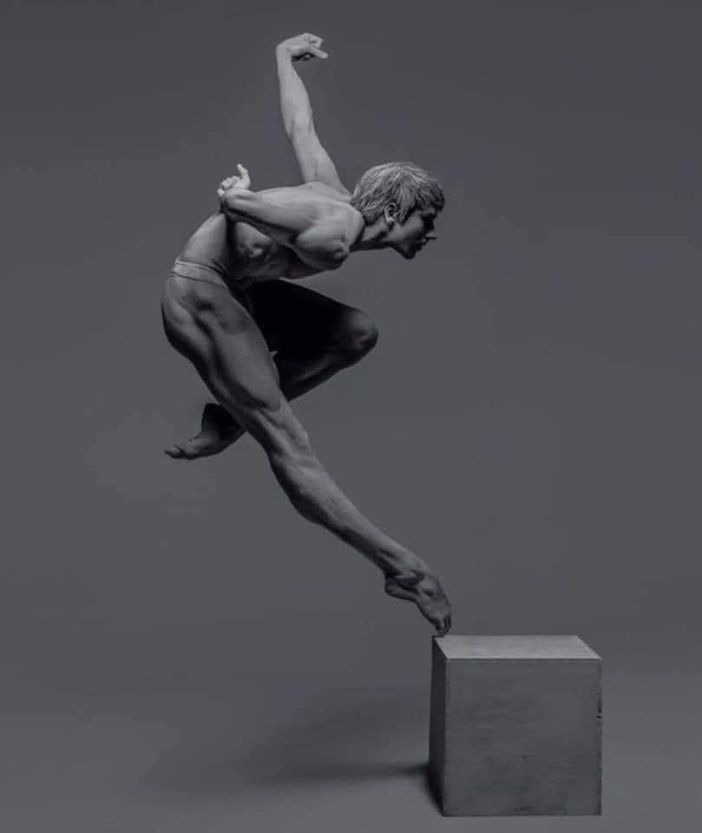
Ballerinos have always fascinated me with what they can do with their incredible bodies. I’d like to write a ballet noir at some point, bec
Which is why I don’t mind getting up early the way I used to; I’ve been able to get so much more done on the weekends not sleeping in, plus it makes it much easier to get back into the swing of getting up early on Monday. Win-win? ↩︎
Thursday morning and my Sparky alarm-cat has me up before six! It’s fine, I was tired and sleepy last night so went to bed around nine, and I slept really well, too. The coffee is hitting the spot this morning, and I’ve already had some breakfast. I am now back up over 190, and my face isn’t gaunt, skeletal and frightening to see in the morning mirror anymore. Tomorrow is of course Remote Friday, and then it’s the weekend, huzzah! I am hoping to finish a newsletter today, too.
I was saddened to hear the news about Edmund White yesterday. It seems like our queer literary icons are all dying now, doesn’t it? Dorothy, Felice, Victoria, and now Ed. I didn’t know Ed very well–well enough to call him Ed, I suppose–but every interaction we ever had was pleasant, and he was always kind to me. I saw a lot of people talking about A Boy’s Own Story yesterday, but my favorite of his works that I’ve read will always be The Farewell Symphony. I fell way behind on his work over the years, but that doesn’t mean I didn’t appreciate him for his talent and what he has done and meant to queer literature over the last fifty or so years. My condolences to his husband, Michael Carroll, and all his friends and family who are grieving.
I also realized last night that we are losing that last generation of gay writers whose careers straddled HIV/AIDS; those that were publishing before, during and after. That’s some history being lost, but most of Ed’s books were autobiographical novels, so that history is still there. As I get older, I am also beginning to understand the drive to write memoirs.a It’s gay history that doesn’t otherwise get recorded, and we need to leave records behind of what it was like to be gay during our lifetimes and the changes, both good and bad, that we’ve witnessed.
I did some chores–not enough, of course–when I got home from work yesterday, but I was pretty tired from the day. I usually have a second person working with me in clinic, but she was out sick yesterday so I did it all by myself. I also stayed on top of my Admin work and was highly efficient, if extremely tired, when it was time to make groceries and come home. I unloaded the dishwasher and finished the laundry (there’s still another load to put in the dishwasher), and we watched another episode of Department Q, which we are really enjoying.
I was worried last night, as I dozed off in my easy chair, that I may have overdone it yesterday and would be worn out this morning, but since I am up earlier than my norm I am going to have to assume that I am not, in fact, worn out. The thing is I have to keep pushing myself to do more and be more active rather than being the slug that I prefer to be; because that first time might exhaust me, but the second time it doesn’t.
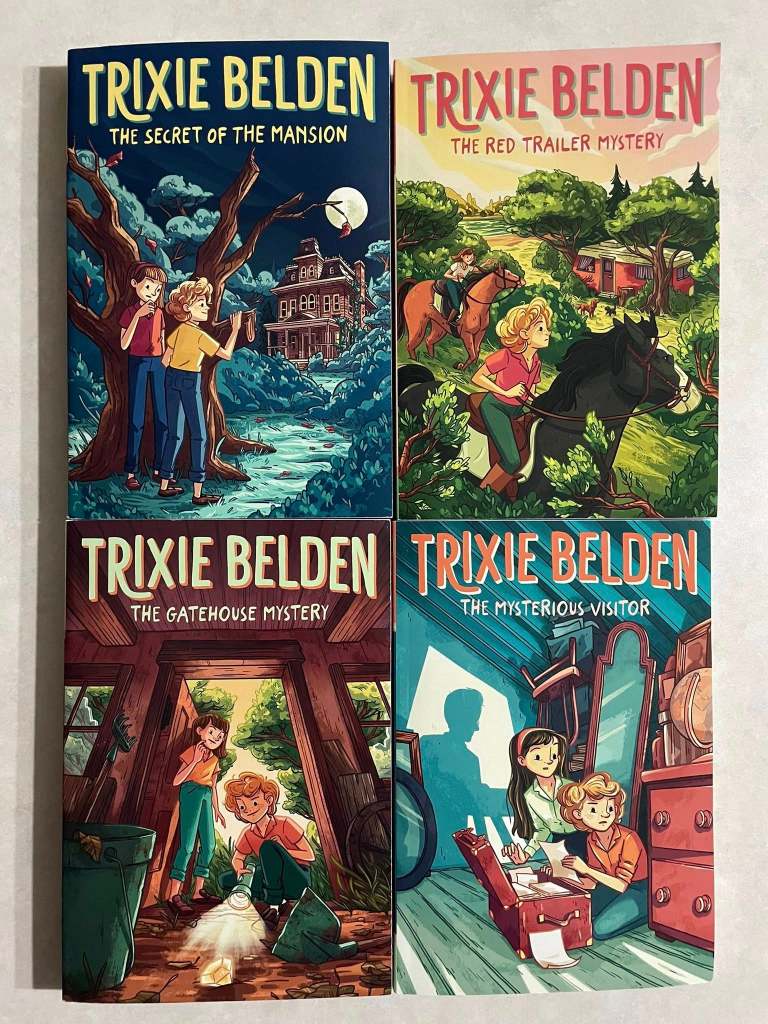
In other interesting kids’ series news, Random House is rereleasing the Trixie Belden series with new covers and using old illustrations from previous editions. I don’t know if they are going to do the entire series or not, but so far the first four (The Secret of the Mansion, The Red Trailer Mystery, The Gatehouse Mystery, and The Mysterious Visitor) are out in the wild now. I’m debating whether or not to get the new editions–it’s just more clutter for the house, actually–but it might be fun to revisit them, and I don’t know where my copies are. I always preferred Trixie to Nancy Drew, but Nancy was ubiquitous you were always more likely to find those while Trixies were harder to find. (They were also a lot cheaper–I was getting the ones referred to by collectors as “Whitman uglies” because the covers were bad–I didn’t think so, but I am not a Trixie expert.)
I was too foggy and tired last night to either write or read, so hopefully that will be different tonight.
And on that note, I am heading into the spice mines. Have a lovely day, Constant Reader, and I’ll be back on the morrow.
Not sure how I feel about these new covers, but Trixie and Honey look age-appropriate at least!
It’s Sunday, which means it’s June, so HAPPY PRIDE MONTH, everyone! Woo-hoo! (Cue the bigots and homophobes: why do they get a whole month when the military doesn’t? Sorry you don’t care enough about the actual military, self-styled “patriots,” to know when Military Appreciation Month is–read a fucking book sometime, okay?)
And by the way, assholes, if y’all didn’t come at us with shame all the fucking time, we wouldn’t need Pride in the first place–and remember, the first one was a riot.
My alarm Sparky let me sleep until just after six this morning, which is actually fine. My new sleep patterns had me awake before he started purring and poking at me; I was actually wondering where he was when I woke up, but I wait until he comes to get me up. Yesterday was a lovely, relaxing day for the most part. I finished reading all three of my books (!), which was delightful (enjoyed them all, too) but created a dilemma for me: I wanted to write newsletters about each book, but does anyone really want to get three newsletters from me in one day, especially when it’s Pride Month and I had intended to spend the month writing about being gay in America, and my sordid gay past? That would be four newsletters in one day, were I to do that, so I am on the horns of a dilemma1 this morning. I think I’ll write them all up and save the extras as drafts for later. I do highly recommend Murder Takes a Vacation by Laura Lippman, and I really enjoyed revisiting Moonraker.
And I plan on writing about all the kids’ series I enjoyed as a kid, so the Vicki Barr entry can be saved for later.
I did some chores yesterday, and was actually writing my newsletter about the new Lippman when our power went out yesterday afternoon. Only for an hour, unlike those poor people who went without for over twenty-four hours the weekend before, and I don’t know what caused it–it was a beautiful sunny yet cool day yesterday here in New Orleans–but I used that time to finish the Vicki Barr and barbecue dinner. Ironically, when I brought the hamburgers in when they were finished, the power came back. I watched some of the French Open, we watched this week’s Murderbot, the season finale of Hacks, and then binged some more of The Better Sister, which is superb. We’ll most likely finish that tonight.
I had already decided to bump queer writers and books up the TBR pile for Pride Month2, so my next new-to-me read is going to be Summerhouse, which Kristopher Zgorski recommended on his blog. My next reread will be The Dark on the Other Side by Barbara Michaels, and my next kid’s mystery reread will by The Mystery of the Haunted Mine, which has remained one of my favorite books from when I was a kid, and I got my copy from the Scholastic Book Fair; amazing that I still have it despite all the moves since then, right?
I feel very rested and relaxed this morning. I am still getting stronger (and more mentally back together) every day, which is terrific; My legs still tire easily, but that just means I need to exercise and walk more. I did doze off in my easy chair for about an hour yesterday–getting up early every day does that to me sometimes–but I also got some chores done, and have more to do today if I don’t get lazy. I have to run make some groceries later this morning–better to do it today than on the way home from work tomorrow, right? It’s so much easier to take I-10 home from work, even if the ramp to 90 and the west bank backs up; it’s still easier than navigating through Tremé and the CBD.
I also watched LSU’s baseball game last night against Dallas Baptist before going to bed, certain they would win, and they did; they are in the regional championship today. GEAUX TIGERS!
I’m still feeling good about things overall, too, which is definitely a good thing. I’ve got my to-do list (some things are ready to be scratched off) to work through, as well as these chores to finish up, so I am going to head into the spice mines. Have a great Sunday, Constant Reader, and I’ll be back tomorrow morning–keep an eye out for the newsletter, too!
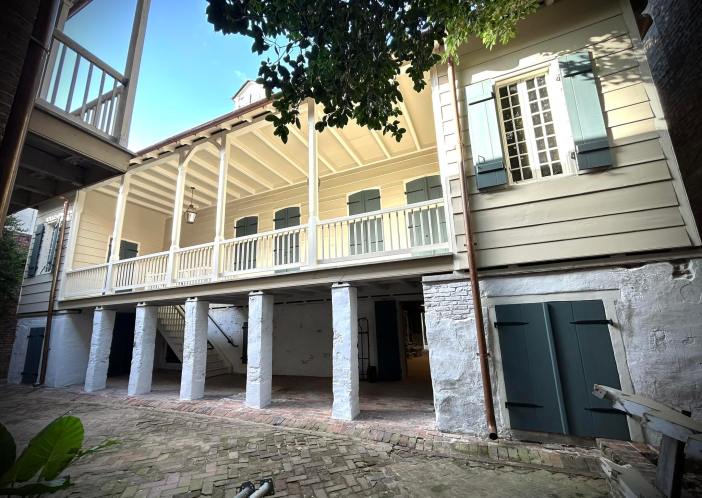
The courtyard of Madame John’s Legacy in the French Quarter
Which also begs the question of what should I make my newsletter thematically in the first place? Do I even need a theme? This is what happens when I stop to think about things, you know, which is why I try not to ever stop to think about things. ↩︎
Making me just as bad as cishet readers, right? “I only read queer books during Pride.” Ah, well, something else for me to deconstruct, right? ↩︎
…drove my Chevy to the levee but the levee was dry.
Which also doesn’t make sense; levees are neither wet nor dry, simply an earthen man-made wall to keep water in or out. I do wish I had a twenty, though, for every class where we had to dissect the meaning of “American Pie.”
I feel good today, and alert, and like I can get things done today. I wasn’t tired physically yesterday, but there was some mental fatigue so I didn’t get much writing done. It was literally like banging my head into a brick wall, but I did get almost a thousand words done. We also finished watching The White Lotus, which was good and interesting and all, but was it great? I don’t know, but the acting was on fire, which was terrific. We then spent the rest of the evening watching news clips of the world burning to the ground (my favorite are the tears of the MAGA grifters losing money now; sucks to be you, live by the MAGA die by the MAGA), and ironically, I started thinking about the book and the closed door in my brain that had been constraining and holding back everything I was trying to do with this book suddenly burst open in my head and I know exactly what to do with this book going forward. Huzzah! Now to get the words down…
As you may well also remember, I am researching the 1970s (mostly the early to mid) for my next book, and yesterday I went down the wormhole of short-shorts for men. The 1970s wasn’t maybe the best time for men’s fashions, but for the first time in a long time men’s clothes became more showy, and everything was super-tight, to show off the bodies. (Sadly, most men still neither worked out much–and those who did, often skipped leg day so they really didn’t have much of an ass to show off in their tight jeans.) Shorts were short–sometimes barely covering the full butt cheeks, and those ragged strings everyone had in their cut-offs that were barely more than a square cut today. It was a tragic decade for fashion–for most styles of everything, really. Cars were big and ugly, so was furniture, and the middle class’s tract homes all looked the same with the dark shag carpeting, the wood paneling (even on some cars!), and linoleum. And the memories these forays into research wormholes bring back! And the nice thing is those memories aren’t painful anymore? So what if I didn’t have any real friends because most everyone was afraid of fag cooties? I read a lot of books, made up a lot of stories, and was always able to entertain myself so I was never lonely. Sometimes I would just pick out a kids’ mystery to reread. I didn’t leave the house much, really, other than for school or the occasional shopping foray with my mom until we started going back to church (a tale for another time). But I didn’t get into trouble, I kept to myself, and it didn’t bother me that I was solitary because…my natural default is solitary. Whether solitude was meant to be my default, or not minding being alone developed it that way or not, is a mystery for the ages.
And now that I’ve grown up into a published author, I find that I really do prefer solitude. It’s lovely to get together with people I care about, but…much as I enjoy that (and I do), I wouldn’t miss it terribly if it went away tomorrow and I spent the rest of my life as a hermit in my apartment. Oh, probably enforced solitude would probably not be my thing either, but it’s something one can dream about, at any rate.
And on that note, I am going to head into the spice mines. Have yourself a lovely little Tuesday, and I’ll be back to check in with you again tomorrow for Pay the Bills Wednesday!
Let’s get to it, strike a pose there’s nothing to it VOGUE vogue vogue…
Sorry, couldn’t help myself there! Hard to believe how old that song is now, isn’t it? Still a bop, too.
It’s forty degrees outside this morning and it’s a biting cold today. I overslept this morning, not stirring out from underneath my comfortably warm pile of blankets; I also laundered the linens yesterday so they were clean so it was that marvelous snug, clean feeling beneath the blankets, and maybe, just maybe, it’s the weight that makes me sleep better, like how a weighted jacket will help keep a dog calm. Who knows? I have some things to do today, but this morning I am just going to drink my coffee and read for a bit before I get to work on chores and writing and some other things I need to get done. The kitchen/office isn’t nearly as messy as it can be, so won’t need much effort to get it together. There’s also LSU Gymnastics to watch today–some kind of quad meet with some of the top teams in the country–so that could be fun to watch, and I can also read during it, too. I read more into my new read, Herman Raucher’s Ode to Billy Joe, which reads well but sometimes seems inauthentic, but more on that later. We also started watching Disclaimer, which is exceptionally good, and what incredible performances from the cast! I am really curious to see how this all turns out, to be honest–and I may even want to read the book on which the show is based–because yes, I need more books on hand to read, but I’ve been good about buying books for the last two years and so splurging on another isn’t a terrible idea. (I’ve been trying to only buy non-fiction, if I buy anything. Caveat: I am still buying the books by writers I love to read when they release a new one–or an impressive debut or something. But I also don’t bulk buy anymore, either. My book budget has dramatically declined over the last two years while I try to get my spending and my overall finances back in order.)
I’m still doing my German lessons on Duolingo, and I am kind of pleased with not only how much is coming back to me (and it’s been decades), and how much I am retaining that’s new. I am hoping that doing a German lesson or two every day will also help me with my short term memory loss.
I had a lovely time dancing on Anita Bryant’s grave yesterday, how about you? I also blocked some people who dared to tell me I was a terrible person for celebrating her death; I don’t need your permission to feel, nor do I need your sanctimonious self-righteous judgment,1 nor do I need to either explain myself to you, nor do I give two fucks about what you think–so, yeah, bye bye bitch, it’ll be my great pleasure to never under any circumstances ever deal with or talk to you again. I’m too old for your nonsense, nor am I going to waste any of my time educating your stupid ass. Some gay on Threads posted about not understanding the vitriol toward Anita Bryant–who made “life difficult for a few people in the 1970’s.”2 How can anyone be so fucking stupid as to not draw the connecting line from Anita Bryant and her principle backer, Jerry Falwell, to his involvement with Ronald Reagan to the callous Republican response to HIV/AIDS. So, she is indirectly responsible for the deaths of everyone in this country from AIDS, not to mention all the kids who committed suicide because of her “christian love.” Yes, I am officially embracing my ‘grumpy old gay” persona, so watch yourselves. I am reclaiming my time, and if you ever say something stupid or ignorant or bigoted–whoooooosh, that’s the sound of you exiting through an airlock. Have fun trying to breathe in airless space, okay? (Just kidding, enjoy suffocating.)
Get back to me when you’ve acquired a soul.
And on that note, I am heading into the spice mines. Have a lovely Saturday doing whatever you so choose, okay, Constant Reader? I may be back later, one never knows.
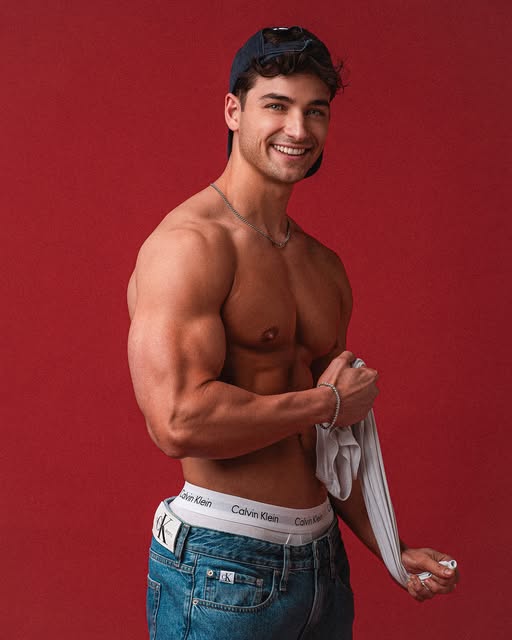
Tom Holland in Men’s Fitness.
I laughed really hard at one older gay writer who pulled out the old “I’ve forgiven Anita Bryant, and how you react to her death tells me more about you than it does about her.’ How he can breathe up there on his high horse of moral superiority, but then again I didn’t become famous for writing the stupidest episode of a popular television series, so CLEARLY he’s a better person than the rest of us! However will I go on, being judged by such an enormous talent? For the record, I turned on Stephen King after aftr decades of fandom, beginning with Carrie, for lauding The Chatelaine of Castle TERF and asking about her next book under a man’s name about a man when her most recent work was a transphobic hate crime. Donated all my copies of his books–including unread ones, stopped following him everywhere, and haven’t bought anything new of his in several years. I stopped reading STEPHEN KING; you think you mattered more to me than my favorite writer for forty fucking years? ↩︎
I am still shaking my head at the stupid ass (whose profile picture was of him flexing his muscles shirtless). Maybe fucking crack a book before opening your stupid mouth and making an ass of yourself publicly? ↩︎
Christmas Eve Eve, only day in the office for the week. It’s in the forties here in New Orleans this morning, and it feels every degree of it here in my office nook this morning. I think we’re going to be fairly slow today–although I’ve been wrong about these things before. Cold makes me ache a bit and not want to get up from the bed, but here I am. I can sleep late in my warm bed the next two mornings, after all. Yesterday was nice. I got up and ran my errand, thus remaining ensconced inside for the rest of the day. I worked some, got some chores accomplished, and we watched Alien Romulus (which I enjoyed, but felt derivative) and then went back to The Day of the Jackal, which we’d started the night before. It’s a fun watch, with a little too much extraneous filler (I really do not care about the Jackal’s private life, or that of the MI6 operative trying to catch him), but Eddie Redmayne is pretty good as the Jackal.
Of course, The Day of the Jackal takes me back to the 1970’s, and the search for Carlos, both terrorist and assassin. He got a lot of press back then. Frederick Forsyth wrote the novel The Day of the Jackal, and it was originally made into a film back then. When “Carlos” first emerged, people started calling the assassin/terrorist “the Jackal” because he was similar to the character in the Forsyth novel–already a bestseller, the branding of a real life person as the fictional character drove even more sales of the book. Everyone in the 1970s, it seemed, knew about Carlos; we even did a week on him in my Current Events class in high school. I know I read the book but didn’t see the film; and I’ve essentially forgotten most of it since then. Terrorism was seen as a major issue for the world at the time; and Americans were very smug because there had been no terror attacks inside the United States at the time, so we saw terrorism primarily as a “foreign” problem (until 9/11). Carlos was so known and prevalent that Robert Ludlum created Jason Bourne in The Bourne Identity to fight and either catch/kill Carlos. The 1970s were such a different time, or at least it was for me. I was old enough to be aware of the news and the world, but I wasn’t educated enough to understand what it all meant, what the root causes of international problems actually were, and I was in the midst of my indoctrination into the mythology of American exceptionalism and its equally awful twin, White Supremacy. It wasn’t until the Reagan administration that I began to unlearn everything I was raised to believe and began seeing the reality beneath the propaganda.
Alien Romulus, on the other hand, was quite fun but seemed to me, at least, to be a bit derivative; with scenes that were direct callbacks to the first two movies, with lots of dramatic tension and suspense and more than a few excellent jump scares (although at one point I said aloud, “There’s always at least one more, people”–only to have one appear within seconds. The idea of a soulless corporation looking to use and exploit the incredibly dangerous creature(s) at the cost of any number of human lives certainly resonated, since that’s where we’re at in this country at the moment. I recommend it–I think in the chronology of the movies this one comes after the original–but you don’t really need to have seen any of the earlier films to enjoy this one. They are all linked, of course, but each movie (at least the ones I’ve seen) can stand alone on their own individuality.
I also blame George Lucas for the entire concept of prequels and filming series out of order.
I’m looking forward to the holidays this week primarily because of two days off from work, more than the holiday itself. I don’t feel very Christmas-sy this year, frankly, and I certainly didn’t last year with my arm in a brace and all the irritation that entailed. I’m going to get us a deep dish Chicago-style pizza pie from That’s Amore tomorrow, and on Christmas day we’re planning on seeing Babygirl, which will be our first trip to a movie theater since before the pandemic. I think I have to come into the office on Friday this week–not a big deal, since I have two extra days off this week–to cover for someone for the holidays. I work one day, then am off for two, come in for two more, am out for another two, in for another two and then out for another. Yes, these next two weeks are going to be completely disruptive.
SIgh.
I did start getting back into the Scotty book yesterday, rereading and editing as I go on what is already done on the book and plan out the rest of it. I also have some short stories due that I need to write, too. Yikes, indeed. I have a lot to do, don’t I, and I really need to stop blowing off my free time and getting back to serious work on my writing. This Scotty book is going to be a lot of fun; wild and crazy and endlessly silly and full of “really, Greg?” moments. I love when my mind finally snaps back into Scotty mode; it seems like every time I write one I go into it with an overly serious mindset that needs to be snapped out of somehow. I also worked on one of my essays yesterday, about racism in the original texts of a Hardy Boys mystery (The Mark on the Door) that I am hoping to finish and post this week, as well as a meandering essay about Christmas and the holidays and how easy it is to offend the very weak faith of most Christians. (Or I could finish my lengthy diatribe about being groomed as a Christian–and fuck you in advance if you @ me about this; I don’t want to hear your dismissal of my very real experiences, thank you very much.) Although I do suppose setting a goal of writing a Substack essay every week might be a bit much. I write one of these posts every day, not to mention emails and so forth…so yes, I do already write quite a bit, at least 500-1000 words per day on here (closer to the 500 count, and averaging probably less than that, more like). It is a conceit of mine that I do not consider writing this post every morning as words written for the day; I never have. Perhaps I should start?
And on that note, I am getting cleaned up and putting on some warm clothes to face the day. Have a lovely pre-Christmas Eve, Constant Reader, and I’ll be back at some point, I am sure.
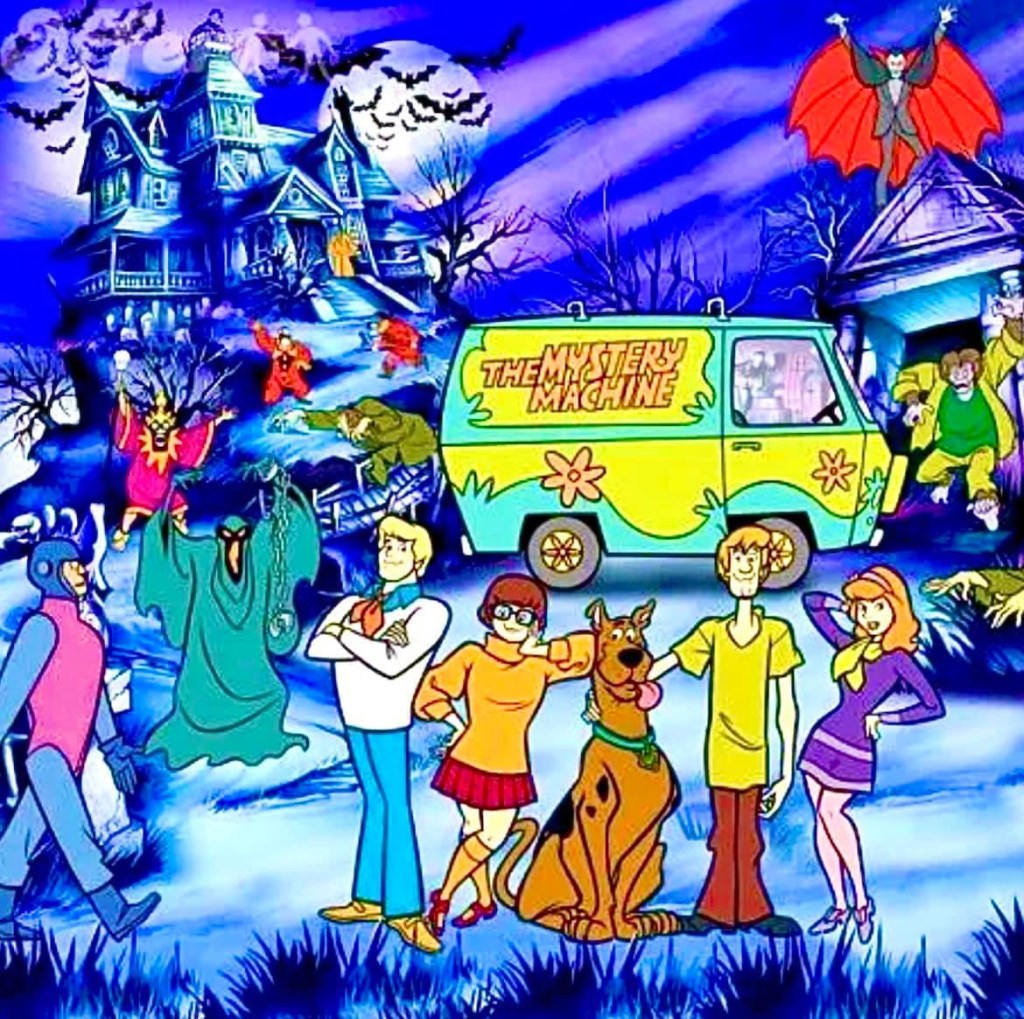
The other day after work I was too tired to write and so I settled into the easy chair with one Sparky for cuddle time, but needed something to watch. I finished burning through the news to get caught up as I do every day, and then started searching for something else to watch when I saw Scooby Doo, Where Are You? in my “Up Next” list as I scrolled through it. It’s always tricky when I need something to watch on my own without Paul–it has to be something he’s not interested in watching–and at some point over the last four years I started revisiting this show from my childhood but never finished the rewatch–mainly because I am now in my sixties; far too old for the audience they were going for.
While I wouldn’t say Scooby Doo Where Are You? was necessarily a huge influence on me and my life, I did love it and watched it every Saturday. It started sometime after Jonny Quest and The Hardy Boys cartoon was cancelled, and a kid who was devouring kids’ series books by the stacks and checking out every book in the school and public library that had the words mystery, secret, clue, haunted, ghost, riddle, or phantom in the title, the adventures of the Scooby gang was usually the highlight of my Saturday morning cartoon experience. I have not been a fan of anything that came in the wake of the original half-hour show (we will never discuss the abomination/hate crime that was Scrappy Doo), and for the purpose of this entry (and really, in my heart and mind) we will pretend that the show was cancelled after the original series run and nothing was rebooted, restarted, revamped, or overhauled in the years since the original Scooby Doo money train was derailed.
But saying Scooby Doo didn’t cement my interest in mysteries wouldn’t be true. The show did, silly as it was (watching as an adult I couldn’t help but wonder, “why would the bad guys go to such extremes to scare people off?”–which also is a contrivance often used in the Nancy Drew/Hardy Boys type books, too), but I watched it every Saturday morning. I kept watching through the next iteration, the hour long show with guest stars, but after that I was too old and had better things to do on Saturday morning than watch cartoons. I’ve always had a soft spot for Scooby, just as I did for the animated Hardy Boys show and Jonny Quest, and unlike many others, I never see reboots or remakes or re-imaginings as “destroying my childhood” because I am not a moron. I can see how the show appealed to kids–you can never go wrong with a sentient Great Dane with limited speaking abilities–and I remember writing Scooby fan-fic when I was young. I started out “novelizing” episodes, and started writing my own. I’d forgotten about that when I was originally rewatching, but in my head the kids’ series I eventually came up with was linked very much, not only to other kids’ series, but Scooby Doo as well.
I don’t want to adapt Scooby or write Scooby books anymore, but I do occasionally want to go back to my kids’ series and think, why don’t you give this a try? Often times, the reason I don’t write things I think might be fun challenges is mostly cowardice and Imposter Syndrome. Can I really write kids’ fiction? Can I really write historicals? However, writing Jonny Quest might be interesting, especially with a reading of the Quests as a queer family.
One of the things about Scooby Doo that always interested me as a kid, and continues to interest me as an adult: Velma. Velma was clearly the smartest of the gang1, which was fun and unusual, and Daphne (‘danger prone Daphne’) wasn’t dumb despite being the pretty one, even though she often needed rescuing. Over the years the character of Velma was really interesting to me–being a brain, of course, meant she had to wear glasses and was hopelessly far-sighted–because she wasn’t easily scared and she was often the one who figured everything out. It was also interesting to me over the years to see many people read Velma as a coded lesbian, which begs the question why? She never has any interest in the opposite sex, but none of them do, really–it’s not that kind of show. We have no background on the gang, either–how are they able to just drive around the country at their age without having to check in with parents, and where does their money come from?
Of course, this is asking a lot out of a children’s cartoon series, which is also why I find it odd to revisit these shows looking for queer coding, and you can usually find it. The all-male environment of Jonny Quest, which is also a kind of “found family” show or Velma not being a late 1960’s/early 1970’s stereotyped girl are good examples of this.
I’ve always wanted to do a reread of all the kids’ series (I still have the books) to reread them for queer coding. I’ve already mentioned before that there was homoeroticism in both the Ken Holt and Rick Brant series–deliberate or not, it’s hard to say–but does this exist in the more popular Nancy Drew and Hardy Boys books. Is tomboy Trixie Belden a budding butch lesbian, with Honey her future femme wife? What about cousins Bess and George in the Nancy Drew series, who are also almost a parody of butch/femme dynamics?
This is the kind of stuff I would love to write–critical queer theory about kids’ mystery series, books, and television programs.
Maybe when I retire.
Calling themselves that also always amused me, since gangs usually are criminals of some sort or another; gang is usually mean that way, even though it’s just a descriptor for a group of people with a similar interest. ↩︎
I’ve always been weird, even when I was a little boy. I was different from other kids. I didn’t want to play outside, I wanted to read or play with my toys and make up stories. My parents were always urging me to go outside to play, so I’d just take a book and go sit on the back stairs of that little apartment on Komensky in Chicago. When I started school, I remember it being a bit of a shock to me. There were other kids in our neighborhood, but I didn’t really play with them much; they were mostly girls and friends of my sister’s, and while she let me tag along a lot (a running theme of her unfortunate childhood–always being saddled with her weird younger brother), I preferred my solitude and a book. School was strange for me; thrust into a world where I was surrounded by kids I didn’t know, and I didn’t understand how they all seemed to know each other and be friends already. I stayed by myself for the most part until someone asked me to join a game or something, and entertained myself for the most part. No one picked on me, no one said anything hateful to me or called me names, and for the most part I got on with my classmates. I got up in the morning, went to school, went to Mrs. Harris our babysitter’s house for lunch, back to school and then finally home. We only lived a block away from my elementary school, which made life ever so much easier for my parents; they didn’t have to worry about us coming and going to school safely. We only had to cross two streets to get there–down one block and across to the other side–and there were crossing guards. I knew instinctively that somehow I was different from the other kids; no one liked to read as much as me1, and only as an adult did I find other people who read as much, if not more so, than I do.
But reading–and watching television and movies–began defining “normal” to me; and I couldn’t understand in my childish brain (so advanced in so many ways but lacking in just as many) why the real world was so different from the fictional realities I lost myself in while consuming media. Riverdale in Archie comics seemed like such a nice place, but that was definitely not my high school experience. Whenever I took a chance on reading something age-appropriate (ah, those Scholastic book fairs!) I generally didn’t like it unless it was a mystery. I read so many of the kids’ series books for many different reasons; ironically liking the two most popular (Nancy Drew and the Hardy Boys) the least (Ken Holt, Judy Bolton, and the Three Investigators were much better).
It was when we moved to the suburbs that I began to realize that I was not only different but I was weird. I was a boy who didn’t care that much about sports, didn’t want to play them, and there was all kinds of stuff messing with my brain. Sixth grade wasn’t too bad, but that was also the first time that other kids began to wonder about my masculinity, but the worst it got was being taunted by other boys as a “sissy,” and then the next day the group of boys in the neighborhood I met through school acted like nothing had happened the day before–which was when I first learned that you couldn’t really trust other people; they would be your friend one day and cruel the next; and then back to being your friend again. (That group did turn on me completely in junior high school one day; it was weirdly coordinated with other kids at school who weren’t in our neighborhood.)
I hated being shamed more than anything else, for something I couldn’t control. It was in junior high also that I began to understand my sexuality at the same time so many kids began understanding mine and laughing and mocking me for it. I was always in fear of violence, and the kids in my middle-class mostly white desegregation-refugee suburb weren’t above ganging up on one person and beating them. (The suburbs, where we moved for “more stability” and “to have our own house” was far more dangerous for me than living in the city.) I ignored it all, but inside I burned with shame and embarrassment because I also knew the other kids were right about me; I did like boys, and how on earth did I ever learn, in a world that in which homosexuality was erased from public view, what men did together sexually? How did I know? I don’t remember reading about it anywhere, and whenever a gay person appeared in any media it was very negative. But there we were.
The irony lies in the fact that I never really cared that much about having friends or being popular–but media convinced me otherwise; that it was important to be liked and popular and have lots of friends. So I would always allow myself to try to imagine what that would be like. So, I kind of made myself miserable as a teenager, more so than I should have been, because it had been made very clear to me that no one could ever find out. I felt like a pariah, and I also felt like the few actual friends I had weren’t really my friends, because if they knew I was gay they wouldn’t like me anymore. It wasn’t even that I really wanted to be popular, but I thought if I was, the cruelty would go away and no one would question my sexuality.
High school and college was more of the same, really. Lonely and wishing I had friends, forgetting that I didn’t need any. I even joined a fraternity, but even that wasn’t enough; some of the brothers were homophobic trash who loved making fun of me and laughing at me behind my back–which is where I also learned the valuable lesson that men are bigger gossips and much crueler about it than women. Such fraternal love, right? But it was in the fraternity that the seeds of not giving a fuck were beginning to be sown. It was a very bad decade, and it was the last decade of darkness controlling my life.
I was tired of being afraid all the time, you know?
I decided, when I was thirty, to leave that closet behind and get on with my life. It took another three years before I started the long reboot of my life, and when I found Paul I realized I don’t need anyone else, do I? I had long thought, for any variety of reasons, I would always be alone for the rest of my life, and once I’d accepted that (also, part of the shame PTSD went along with believing that I wasn’t deserving of someone’s love) I decided to embrace being weird and different from everyone else. The one piece that was still missing was being a writer…and once that really got started, I didn’t need anyone else. I had Paul, and I had my characters, and devoting myself to a writing career made things a lot easier. I mean, I still prefer being liked–who doesn’t–but if people don’t like me, it’s not my problem.
I’m weird that way. I think everyone who is a creative is weird. You have to be disconnected from the main fabric of society in some way to create; I don’t believe you have to suffer in order to create, either; but I’ve done my fair share of suffering over the years. I am always startled to hear how other people view me and my work; I prefer being liked, as I said, but it’s really not essential for me. It makes writing conferences a lot more fun to have friends to hang out with, but I always have my guard rails up.
Being weird, to me, is a good thing. It’s who I am and I don’t want to fight it anymore. I’m not going to worry if people like me or not; and I don’t owe any apologies to anyone. As Bette Davis once said, “other’s people’s opinions of me are none of my business.” I don’t mind being disliked; no one is liked by everyone and there certainly are a lot of people I wouldn’t cross the street for if they were on fire unless I’m carrying a can of gasoline (you know who you are, but you wouldn’t be reading this anyway because you’re sewage).
And people who dismiss me because I’m gay–or whatever surface reasons they may have–aren’t people I want to know in the first place because homophobes are never good people. Homophobia is usually the first step on the ladder to a soul full of bigotry and prejudice, and rarely if ever do homophobes stop with hating queer people.
Who wants to be normal? I saw that as a horrific existence when I was young, and part of my own misery for the first thirty years of my life was from being gaslit so constantly into what I knew would be a hellish adulthood that would most likely end in suicide.
One of the reasons that the MAGAts hate being called weird so much is because their entire identity is vested in being “normal”–it’s everyone else who is weird, strange, and different. But it’s not normal to want to check everyone’s genitals. It’s not normal to interfere in other people’s lives and tell them how they should live. It’s not normal to think you and your fellow believers are the only ones who have it right and everyone else is going to hell. It’s not normal to think skin tone makes a difference to intelligence, ability, and work ethic. It’s not normal to fetishize Israel because of your apocalyptic religious fantasies. It’s not normal to worship guns over other people’s lives. It’s not normal to see attacks on your faith when no one is even thinking about you. It’s not normal to want to regulate and track women’s menstrual cycles and fertility. It’s not normal to prioritize the unborn over the living. It’s not normal to hate your country unless your golden calf is elected. It’s not normal to claim to be religious but not follow the teachings of your holy book.
They’ve never been normal. Never. But they think they are, and it’s really all PTSD from NOT being popular in high school. They weren’t homecoming queens or cheerleaders or football players; and if they were, they peaked then and are still bitter that their personal glory days are far behind them. (Also: not normal.) Being called “weird” in a dismissive, you don’t matter way gets under their skin because they are not used to be questioned. They claimed to be the normal ones, the correct ones, the true American patriots–and we just let them without challenge. They aren’t used to being challenged, and when they are, it just causes them to melt down completely. They wore their hates and prejudices proudly–embracing being racists and homophobes and TERFs and misogynists3—but challenging their normality hits them hard because they know they aren’t really normal deep down inside.
The best way to deal with bullies? Withering scorn and contempt and outright mockery, as well as constant reminders that they aren’t normal and actually have sociopathic tendencies.
And it’s working. They have no response other than “no, you’re weird!” That doesn’t work on me because I am weird and I’ve embraced my individuality rather than being bullied into being like everyone else. I have no desire to go back to some fantasy halcyon past for straight cisgender white men, where everyone else is merely here to be used for their convenience. I’ve lived in that world and I have no desire to go back to it, in any way.
And wanting to? Is very fucking weird.
I also recently realized that the reason I loved to read and watch movies/television is because that was the only time I could get my brain to calm down and focus. So…my bad mental health as a child set me on the path to being a writer, which is also why getting the anxiety under control–which also has helped dramatically with mood swings–has me worried about being able to write again. But again–anxiety. ↩︎
And another Wednesday Pay the Bills Day has dawned anew. It rained over night, and I suspect we’re going to be getting a lot more rain over the next few days; the weather forecast certainly believes it to be so. I do love rain, and outside of the constant fear of flooding out the car, I don’t even mind driving in it. There’s something about being warm and cozy and comfortable while everything outside is getting wet that just makes my entire body relax. I remember thinking about this when I was a kid once–I was in the car, we were heading for Alabama from up north, it was raining outside and I had a blanket wrapped around me while I was reading The Mystery of Cobbett’s Island, which opens with Trixie and her Bob-White friends in a station wagon in the rain heading for the ferry to the island. Ever since then, whenever it rains all I want to do is curl up with a book under a blanket. I it rains a lot this weekend, I should get a lot of reading handled.
I was a bit tired and drained when I got home from work last night. I did a load of laundry and hung out with Sparky for most of the evening while I scribbled in my journal while doing 1970’s research on Youtube for my next book. I also worked on the book some last night, and feel a lot better about what I am doing. The Imposter Syndrome has been finally chased away by the need to tell this story and develop these characters, and that’s always a good sign. I also thought about that Sherlock story a lot more, too, and may even start writing it this weekend, one never knows. I also figured out how to solve the problem of another short story that’s been bedeviling me for over ten years, and I want to include it in my collection. I still haven’t made a to-do list, so I seem to be floundering around looking for something to do every day but can’t remember what I need to do, and that’s always a problem. I also need to make sure I update the bills list before Monday, too–but that will have to wait until I pay the bills and wait for everything to update. I know Entergy is due today, which absolutely must be paid; the summer is the only time I really don’t care about my carbon footprint.
And football season is drawing closer with every passing day.
Sigh.
Politics and the news continue to be dumpster fires and I really need to avoid social media. I don’t know why I let people infuriate me on social media, but I do, and it’s dumb. What do I care about a total stranger’s beliefs and values? Sure, I hate racism and the phobias and misogyny and fascism as much as any sentient human being, but you’re never going to change someone’s mind on social media when most people are there to provoke anger and arguments and I keep falling for the bait. Social media hasn’t been fun in nearly a decade, and it continues to get worse with every passing day; but we’ve all become addicted to it and I need to step away from it. Publishing and publishers have been insisting for quite some time that we authors need to be there and build a following and so forth to market our books and sell copies, but is that really effective? I think maybe the next time I have a book coming out, I may invest in some ads on social media and see if that makes the needle move at all…it may also bring trolls and assholes in its wake, as well.
And I checked the weather and we are not only in a heat advisory but also rain through next week with thunderstorms every day through the weekend. Woo-hoo! Definitely a good stay inside and read forecast. I really need to get going on my reading…but it’s hard to read when you’re writing something new, at least for me, at least now. I don’t know if I stopped reading when I was writing before, but I don’t think that is the case. I think my abilities to do everything that I was able to do before has slowed down and I don’t have the brain function anymore to juggle many different projects the way that I used to, and it’s also nice to finally be in a place where I can primarily focus my brainpower entirely on the writing without it being diluted by other responsibilities. I like that idea an awful lot, quite frankly.
And on that note I am going to get cleaned up and head into the spice mines. I may be back later as there are some drafts I need to finish–they’re building up again, and I don’t like that one bit–but you never know. But have a lovely middle of the week, Constant Reader, and I always do appreciate it when you check in on me, so thank you again.


 Queer and Loathing in America