Wednesday morning in the Lost Apartment, where it is a staggering 39 degrees outside. Brrr! But I slept pretty well (even if I didn’t want to get up), and my mind is slowly but surely coming back to life. Yesterday wasn’t a bad day at all, but I was out of sorts and off-track for pretty much the entire day, because my routine was disrupted when I got to work and so…yeah. I did run my errands on the way home from work last night and got home to a needy Sparky, so I had to spend some time playing with him and then transformed my lap into a cat bed for a little while. Tomorrow morning I have to get up super-early for PT–which I am not looking forward to, and of course there’s a department meeting on Friday morning, that I think I’ll go into the office for despite it being my at-home day and having the ability to call in for it. I have some on-line events Saturday for the January Bold Strokes bookathon, which I should post more about, and then the rest of the weekend is mine.
I did some more research into a story I am writing last night, and yes, I actually started writing the story. I’m writing about Julia Brown, the “witch” of Manchac Swamp who worked as the healer in a small town inside the swamp and along the lake shore, which was only accessible by railroad. Frenier was a small community, and it was completely destroyed by the 1915 hurricane; all that is left of it is the cemetery and it’s only accessible by boat now. I’ve always wanted to write about the 1915 hurricane since I first learned of it–it came up when I was down a rabbit-hole about the Filipino settlements on Lake Borgne, which were also destroyed in the 1915 hurricane, which led me to reading about Frenier, and the so-called curse of Aunt Julia Brown. (I do wish I’d known about all this before I wrote a Sherlock story set in 1916; no mention of the previous year’s destruction in that story is odd but maybe unnecessary; it didn’t impact the plot of the story at all, but…if I set another Sherlock story in that same time period I need to address that elephant in the room.)
I also went down another research wormhole last night, too–inspired by Mary & George–about George Villiers, Duke of Buckingham and his close relationship not only with James I but with his son, Charles I…although the relationship between Villiers and Charles I wasn’t quite the same kind of erotic friendship as Villiers enjoyed with the senior Stuart. Buckingham was also one of the real historical figures that appeared in Dumas’ The Three Musketeers, which I still want to retell one day from the point of view of Milady deWinter. It’s such a fascinating period, really, and the clothes! MonDieu, the clothes! I’ve always been fascinated by Cardinal Richelieu, and really need to get over my fear of writing about a historical period and just buckle down and write that damned book, don’t I? Sigh. I also need to get back to both Chlorine and Muscles, too.
Heavy heaving sigh.
But I am also starting to feel like I am settling back into my normal, every day life, and I feel better than I have in years. That cloudy feeling in my brain seems to be gone, and I am adapting to getting back up early in the morning without much hassle; I suspect the sleeping pills are working their magic and sending me into a deep healthy sleep every night, which pays off in being both awake and lucid in the morning. I’ve also got some blog entries to finish writing–my thoughts on Saltburn, because I know everyone is just waiting to hear what I have to say about it, and some analysis of the most recent chapter of the graphic novel Heartstopper, both of which are destined to be queer cultural artifacts.
And I hope to finish reading Tara Laskowski’s The Weekend Retreat before the weekend, too. I should have spent some time with it last night, but it was after six when I got home and by the time I was finished with putting stuff away and quality Sparky time and writing, it was later and so I just went down the Villiers wormhole. I also watched the final episode of season 2 of War of the Worlds, and am officially tapping out now. Not only was the shark jumped, the story became preposterous. I thought it might be a bit more interesting and intriguing once I realized the direction they were going in, but no. I also forgot part one of the Real Housewives of Salt Lake City was airing last night, so I’ll be catching up on that tonight after reading. I get to go straight home from the office tonight, so fingers crossed that I’ll get some good reading time in before I shut my mind off and dig into some reality television.
And on that note, I am heading into the spice mines. Have a lovely Wednesday, Constant Reader, and who knows? I may be back later.
Monday morning and back to the office blog. I have my final PT for dexterity today, before I take a couple of weeks off before starting the strength PT, which will be the final step of getting recovered from the surgery. It seems like it’s been forever, but the truth is I injured the arm initially almost a year ago–so I have been dealing with this for almost a year, and it will be well over a year by the time I finally get through the recovery. It’s taking me a moment to get used to not wearing a brace, frankly–but god DAMN I am so glad to not have to wear that fucking thing anymore. The weather is supposed to be horrific today–heavy winds and flooding rains–which I am not terribly excited about, in all honesty, since I’ll be out and around in it. But I slept really well last night, and am feeling awake and good this morning so far, so we’ll see how the rest of the day goes, shall we?
I read more of Tara Laskowski’s The Weekend Retreat yesterday morning over my coffee, and it is truly addictive and mesmerizing. I am having the best time reading it, and shouldn’t have an issue spending about an hour or so with it again today. I also did some more filing and organizing and cleaning yesterday, as well as made dinner and some other things for the week. There’s another load of dishes that needs doing tonight when I get home from work and PT and everything else, but if I manage to stay caught up on these things, maybe the three day weekend won’t be as disrupted by needing to clean. I’ve narrowed down the stories I have on hand for the possible anthology submissions, so they’ll require reviewing again in addition to revising and editing. I watched some more War of the Worlds, which is interesting, and then I watched a bit of the Golden Globes before I went to bed–you can tell how much I cared about them by the fact that I couldn’t tell you who won any of them, really. I used to care about awards shows, but I don’t anymore. There are rarely any surprises, and there are so many of them now…by the time the Oscars roll around, it’s relatively easy to figure out who’s going to win most everything.
I can’t believe it’s already Carnival, too (but am loving that it’s also king cake season). Parades will be starting in a few weeks, and the Australian Open, and the figure skating championships, and the Festivals are on deck…Lord. I do get tired just thinking about it, in all honesty. But at least the brace is gone. It’s taking some getting used to–not having it on–and periodically I’ll experience some new sensation in the arm, but that’s also the nerves getting used to not having the brace support anymore. Thank God for the new meds, because I’d be a ball of anxiety by now otherwise.
I also saw the previews for a new show I am rather excited about–Mary & George, which is about George Villiers, Duke of Buckingham, and his ambitious mother, who essentially groomed her handsome son to charm and seduce King James I (he of the King James Version of the Bible, no less), who preferred the company of men and had male favorites at his court. I’ve been meaning to track down a copy of Antonia Fraser’s biography of him, just to see how she handles the questionable sexuality of England’s first Stuart king, or if she erases or elides it. There were several queer kings of England–Richard I, Edward II, James I, Queen Anne–and I’ve also seen things questioning the sexuality of William III, too. (James was also the son of Mary Queen of Scots.) I can’t think of as many French kings that were queer; of the top of my head I can only think of Henri III and Louis XIV’s brother Phillippe duc d’Orléans, Monsieur. It’s also early and I’m not caffeinated enough, frankly, to face the day or put any more thought into gay French royalty. Anyway, one of the guys from Red White and Royal Blue (Nicholas Galitzine) is playing George Villiers, the handsomest man of his age, and if you remember your Three Musketeers, the British minister who was in love with Anne of Austria, Queen of France.
George got around, apparently.
The seventeenth is also one of my favorite centuries.
And on that note, I should head into the spice mines. We’re going to have some bad weather today–potential hail and tornadoes–as well as heavy rains. Hopefully I’ll be able to get to PT this afternoon and then home safely. Have a great Monday, CR, and I may see you again later.
And here we are on the third day of the new year, and I am starting to feel more like me again, which is great. I did get tired yesterday afternoon at work (getting up at five for physical therapy truly sucks), but not as bad as I was last week–last week was horrifying, how tired I felt; literally like I needed a jump start or something. It’s also pay-the-bills day, and it has rained all night, which has made it a little warmer outside than it has been. The rain is supposed to let up by noonish, but the colder snap seems to be over for a little while, at least.
Yesterday when I got home I wasn’t super-exhausted, and I did some chores. I finished the laundry I’d started on New Year’s, and also did a load of dishes. I finished reading Glory Be by Danielle Arsenault (more on that later), but Paul was working upstairs once he got home, so I just sat in my chair and watched some documentaries on Youtube. Nothing interesting or new, just some more folklore and legends of the South on the “Dixie After Dark” channel–and all the stories are of murder and ghosts and vengeance and brutality…the South the Lost Cause folks don’t like to mention because it isn’t genteel enough to fit their narrative of a “lost civilization now gone with the wind”, and these stories kind of show up the lies that false narrative creates–like Aunt Jenny, whose husband was strung up in front of her and her children by the Home Guard, and made her sons swear on his corpse that they wouldn’t rest until the men who hanged their father (who opposed the war–Southerners opposed the war?) were all dead. And she got her revenge too, and used the skull of the captain to drink water from for the rest of her life. Learning the history of northwest Alabama in greater detail over the last few years has opened my eyes to a lot of things–and given tons more ideas for things to write.
Which is exactly what I need, right? More things to write?
But overall, it was a nice, relaxing evening and I can’t get over how awake and alive and like a Gregalicious I feel this morning. It’s been a hot minute, you know, and I’m glad to see my decision to not be a slug as much as I would like in the new year is already working out for me. I see my surgeon on Saturday and hopefully can say goodbye to this goddamned brace once and for all. I did also work on the book a bit last night, which also felt good to be getting back into that groove again. I can head straight home from work after my time in the office today, and hopefully will be able to do some writing in addition to cleaning and organizing. I cleared out a shelf in the cabinets last night, and am going to use it for some things I store in the bottom cabinet (espresso machine, milk frother, coffee grinder) which will open up some more room on that side of the kitchen.
I’m not sure what I am going to read next, but the TBR pile is chock full of great books by terrific writers, so I won’t be disappointed by anything I choose. I was thinking about revisiting Larry Kramer’s Faggots, thinking that it might be interesting to revisit it now with the perspective of being in my sixties and looking back at those wild and crazy 1970’s in Manhattan and on Fire Island…but if I am going to do that, I also need to revisit its flip side, Andrew Holleran’s Dancer from the Dance, which I’ve also not read in decades. Or I could just read another mystery. So many choices, so many options.
And on that note, I am heading into the spice mines. Have a lovely Wednesday, Constant Reader, and I’ll be back later, most likely.
Good morning and happy New Year’s Eve eve. It’s cold again in New Orleans this morning–a mere forty-one degrees–which will make today’s errands a challenge, or at least something I will want to get over with quickly. Mail, prescription, and groceries will be dealt with as quickly as possible so I can get back into the warmth of the apartment.
Yesterday I actually felt like myself for the first time since the surgery, which was an absolutely lovely thing. I slept a ridiculously long time Thursday night, and felt like I’d caught up on my sleep adequately. I woke up at seven this morning, laid around in bed for another quarter of an hour before rising and digging into coffee and breakfast pastries. I did do a lot of straightening and catching up on household chores yesterday after my work-at-home duties were completed. I started watching the Cotton Bowl last night, but Paul came downstairs at half-time, and we watched this week’s Monarch: Legacy of Monsters (Paul slept) and Reacher. I also started reading Glory Be by Danielle Arsenault yesterday and I am enjoying it so far. I am probably going to have bowl games on after I get home from the errands while I continue to read and do some clean-up around here.
I was also pretty pleased to check the final score of the Cotton Bowl to see that Missouri–who only lost to LSU and Georgia this year–had rallied to defeat Ohio State 14-3. GO MIZZOU!
Tomorrow is the last day of 2023, and there’s no telling what 2024 will bring. It’s an election year (groan)–which of course means my rights as an American are up for a vote again–and also means that it could be just as horrible as 2016 and 2020. But I am going to go into 2024 with my head up and my Wonder Woman bracelets on to deflect any and all negativity that comes my way. I want to have a good year this year, and I do believe if I keep focusing on positivity, and keeping a positive mindset, that I can have a positive outcome for the year. Overall, 2023 was difficult personally but excellent professionally; the excellent professional developments, both at my day job and as a writer, made dealing with the grief somewhat easier on me emotionally. I’m sure the new and proper medications are working their magic within the brain synapses that don’t fire properly, which has had a lot to do with my feeling more centered these last few weeks, and sleeping so well. I do have a lot of PT to get through yet–we haven’t even started trying to strengthen the left biceps again, and that’s going to be harder and more painful than the dexterity PY, but I am also hoping to ride that into going back to the gym regularly. Paul and I are also committed to eating better in the new year, which means more ground chicken and turkey and less red meat; and more fat-free products than not, including my creamer. (I also have a recipe for making my own, which would be healthier since less chemicals, but I also don’t know how long that will be good after making, either.) I’ve started making turkey sandwiches to take for lunch at the office this past week, and I am going to try to keep that going. I do have some unhealthy fare still that will need to be consumed, which I plan to start easing out throughout January.
I also feel pretty good this morning. I got some great books for research this week–a bio of 90’s porn star Joey Stefano, Creole: The History and Legacy of Louisiana’s Free People of Color, edited by Sybil Klein1, White Flight: Atlanta and the Making of Modern Conservatism by Kevin M. Kruse, and some fiction as well–Hayley Scrivenor’s Dirt Town and Penny Mickelbury’s Two Wings to Fly Away, and having spent a lot of yesterday pruning and rearranging the books–I still need to work on the laundry room–I am very excited to start digging into my TBR pile. I think I am getting more books today, too–I think some stuff arrived yesterday at the post office–and I am looking forward to delving into those as well. I was also looking through the research books I’ve acquired over the years with book projects in mind, and there’s a lot. I also spent some time brainstorming free-form last night, and of course, came up with great titles for books or stories and some more ideas for both. Heavy sigh–the last thing I need is more ideas, really.
And on that note, I am going to head into the spice mines. I have those errands to run and some more clean-up around the house that needs to be done, and I do want to spend some time writing and catching up on emails. Have a terrific Saturday, Constant Reader, and I may be back later, you never know.
Despite being published by LSU Press, one always has to read anything about Louisiana history carefully, because so much of it is rumor, legend and made up. But the free people of color before the war have always interested me, and I want to know more about them. ↩︎
Work-at-home Friday. I had early morning PT this morning, but when I checked my phone when I got home from work my surgeon had called to reschedule, so the rest of the morning for me is free. I’d taken sick time for this morning, which I can now cancel and use at another time, I guess for when the appointment is rescheduled. This was a bummer for me, because this was the removal of stitches and hopefully cleared from the brace appointment. I’d planned all of this out so that I can get it all taken care of on my old insurance, since I have new health insurance in January and a deductible to meet. Ironically, I had just been thinking that despite everything, this wasn’t ruinous financially. I was also hoping to be cleared from PT until late February. Here’s hoping I can be rescheduled next week sometime, but it’s the week between Christmas and New Year’s, so what are the odds that he’s either working or has anything available? I am trying really hard not to get anxiety over this, but it’s kind of hard. Sigh. No sense in stressing about something unknown, so when I finish this I’ll go ahead and call his office.
I knew it was all too good to be true.
But I’m glad I got it taken care of, anyway.
I was tired yesterday. The adventure of making a red velvet cheesecake one-handed and assembling it while making frosting with a nosy high energy kitten exhausted me, and once my caffeine wore off I was exhausted. I did get a great Secret Santa gift–a rechargeable battery operated hand-held vacuum I can use in the car, which I’d been wanting for a while–and I cannot wait to use it. If the weather is sunny this weekend, I may even wash the car. Ooooh, crazy talk, right? And I am getting my new microwave this weekend, which I am unnaturally excited about, frankly. This time I am keeping the instruction manual and teaching myself how to use it properly, rather than just reheating stuff.
I do have a lot to get done this weekend, which was partly why I was hoping to lose the brace for good today. But I can work around it and the High Energy Kitten, who slept so adorably in my lap last night while we watched Reacher and started watching Looking, which we are really enjoying. At the time it came out, it got terrible reviews and queer people seemed to hate it, and no one watched much. At the time I only knew Jonathan Groff from Glee, and not one of its highlights, so it didn’t take much for me to decide not to watch. But now having seen him in Hamilton (on Disney) and in Mindhunter, I was more open to it when Paul suggested it last night, and I was very pleasantly surprised with how realistic it was. It’s very well done, and while I personally didn’t identify with any of the characters, it showed a part of gay life and culture that I know exists. (One of my primary disappointments about the Queer as Folk reboot was the writers clearly weren’t from here–maybe they were, I don’t know–but it wasn’t a real New Orleans I saw on that show, and it was such a missed opportunity. Queer life in New Orleans is very rich and very much a part of the city’s culture in and of itself; imagine doing a queer show set in New Orleans and not mentioning the gay krewes, the leather community, and Southern Decadence is just sitting there, waiting for it’s film/television debut! I primarily watched the entire season for friends who worked as extras–my former supervisor Joey’s drag persona, Debbie with a D, was in the show a lot.)
I also want to finish reading the Tamara Berry novel and move on to the next. I am really enjoying the Berry, despite not being able to focus on reading this week in the evenings, so hopefully part of my cleaning plans this weekend can be broken up with an hour or so of reading every day. I really miss reading. I was scrolling through my ebooks on my iPad, lokoking for a cookbook which was one of the earliest ebook purchases tlast night and was stunned to see how many books I’ve gotten electronically over the years since I got my first iPad back in 2010. (I’d purchased the cookbook in 2011.) So, yes, my TBR stack is much larger than assumed because I never think about the ebooks. Sigh.
And on that note, I need to get to work. Have a lovely Friday Christmas Weekend Eve, Constant Reader, and I’ll probably be back at some point today.
Imagine my shock and horror last evening when I realized that Christmas is next weekend. What the hell happened to December? Where did it go? Suddenly, I am almost out of time to do and mail my Christmas cards, and I really don’t want to save the awesome ones I bought for next year. Sheesh. But…I also didn’t/am not get(ting) down on myself about that fact, either; which is a really positive place for me to be in at the moment. Is the reset of my brain that I was determined to get taken care of during my recovery from surgery actually working? Perhaps…and the surgery recovery kind of was a blur where I was lucky to remember what day of the week it was, let alone the date. The new meds seem to be taking care of my anxiety, which is precisely what I needed–it’s so nice to not freak out or spiral about things over which I have no control, and calm Greg is always the best Greg. (I do know people rather enjoy when I go on a Julia Sugarbaker rant, though.) I slept well again last night, which was marvelous, and of course Sparky’s body clock alerted him that my alarm was going to be buzzing away annoyingly soon, so he emerged from his under-the-bed cave around five thirty-ish to climb up into the bed and cuddle until it was time for me to rise from the depths of Morpheus and fill his food bowl.
There’s really nothing quite so comforting as a soft kitten resting on you, purring, is there? I also think it’s kind of amazing that he’s left my injured arm alone ever since the brace went on it. My right arm is a battlefield of scabs and scars from his claws–as is my right leg (that’s the one he likes to use to climb me), but my left arm? Other than the surgery incisions and the purplish netting over them, it’s pristine. He also will stretch out in my lap to sleep–just like Scooter, he wants my lap as soon as I get home from work, and also like Scooter, my desk chair belongs to him and he refuses to sleep in my lap if I am sitting there–and always rests his cute little arm in the crook of my left elbow and purrs contentedly as his little purr engine soothes my soul.
How did I manage to live so long without having a cat? So many years wasted when I could have been saving cats from shelters. Ah, well.
We were super-busy at work yesterday–we’re heavily scheduled today too–but I applied myself and got caught up on most of, if not all, of my desk duties around my clients. I also felt better yesterday–certainly more alive and awake and present than I was on Tuesday, for sure, for sure–and I feel like today is going to be a good day overall as well. I am feeling better about most things, really (though I do wonder if the anxiety and eager-to-please mentality that comes out of it is what has motivated me to write so much over the last twenty or so years), and it’s much easier to stay positive even as the world burns to the ground around us.
It’s weird to be in the midst of the Christmas season, venerating the birth of the prophet/savior of the Christian religion (and why is a religious holiday a legal one?) while at the same time the people who claim to be his followers have put our democracy under attack and are going after everyone else’s rights–because make no mistake, if one group’s rights are under attack, everyone’s rights are under attack. (And don’t #notallChristians me; if you aren’t speaking against your Christo-fascist brethren, you’re a collaborator at worst or complicit at best. Remove the mote from your own eyes before coming for the one in mine, thank you very much….and I bet I know the Christian religion and your holy book better than you do.)
The part I don’t get about bodily autonomy opponents is this: if you believe the government has the right to interfere with women’s health care choices over the recommendations of the medical field, you really can’t at the same time object to government intervention in health insurance and health care, either… yet it’s always the same thing. (And you can’t break the law by claiming you do so because of your faith gives you a fucking free pass. “Render unto Caesar”, remember that Jesus quote? He’s saying the government is an authority to be respected, not that “if you follow me you can use me to do whatever you want!)”) Surrendering bodily autonomy means giving the government a say in your health care–so if you oppose abortion and choice, you better shut the fuck up and get vaccinated and wear masks when the government tells you to; and you need to shut the fuck up about the Affordable Care Act, Medicaid, and Medicare (I’m looking at you, demon-spawn from hell Nikki Haley). You love to talk about slippery slopes when it comes to the Second Amendment, but you’re all about the government telling women what they can and can’t do with their wombs and bodies? The fact they don’t give a fuck about child care and child health and public education and ensuring all children have the basic necessities of life is all the evidence anyone needs to know the “save the precious babies!” argument is shallower than a salad bowl. They don’t care about babies, they don’t care about women, and they don’t care about freedom, period.
They only freedom they care about is the freedom to control–and how is that freedom?
And the real slippery slope is that if the government can tell you that you have to have a child…means that the government also has the right to order you to have one…and the right to not let you have one when you choose.
Funny how the only slippery slope they care about is the one about guns.
And all the hate speech around transpeople and calling all queer people groomers while not going after organized religion–where it seems most of the child-rape happens–is another indicator of cognitive dissonance so powerful that you seriously have to wonder about the functionality of their brains, and people who don’t have a logic-based brain aren’t people I want to listen to about anything.
Rant over…for now, at any rate.
I was, however, thoroughly exhausted yesterday when I got home from work. Adjusting to being back at work is taking a little more time than I would have liked, but it is what it is. Tonight I have to do some errands on the way home from work, so I am hoping I am not as dog-tired when I get off tonight as I was yesterday. I did get some things done once I got home, but not nearly enough, and of course Sparky was very needy after his first long afternoon home alone in almost a month. He’s such a mischievous little brat sometimes. Did I mention he turned the washing machine on the other day? He’s lucky he’s also incredibly cute and sweet–but he is still an evil genius. I’ve always thought the entire point of Lucifer/Satan having been the most beautiful of the angels before the fall was a warning to humans to not be fooled into thinking beauty means good…and the degeneration of what he looked like during the late Dark and early Middle Ages into a horned, red monster with claws and a tail was just another step in the demonization of non-Christian religions; as there are any number of different pagan gods who looked like that who were also not evil.
But here it is, a mere eleven days before Christmas. It’s such a tired and boring cliché to even attempt to add anything to the conversation about the commercialization of the holiday season; that ship has long since set sail. I mean, as I always point out, it was already such a problem in the early 1960’s that Charles Schultz wrote and animated A Charlie Brown Christmas to illustrate the point. What could I possibly add to that? Paul and I have decided not to get each other gifts this year; we both buy anything we want or need whenever we think about it. All I ever want is books, anyway, and I am trying to cut back on adding books to the house unless books are going out of the house–and trying to ensure more are going out than coming in is the optimal at this moment. I’ve also decided to dispose of marked up manuscripts and early drafts of things; everything is digitized anyway, and it will clear up a lot of room in the storage attic and the apartment. Any boxes of books in the attic can also be donated, so that’s the new plan for when I have the full use of my arm again–getting rid of all that shit. I also need to cut back on streaming services I pay for, as they are all jacking up their prices for the holidays; and some of them I rarely, if ever use. It would be cheaper in the long run to simply buy the full seasons from Apple than pay for the service every month…and that would also make me more selective about what we actually watch.
It’s nice to feel good about myself and my life again, despite the state of the world, you know?
And on that note, I am heading into the spice mines. Have a lovely Thursday, Constant Reader, and I’ll check back in with you again later.
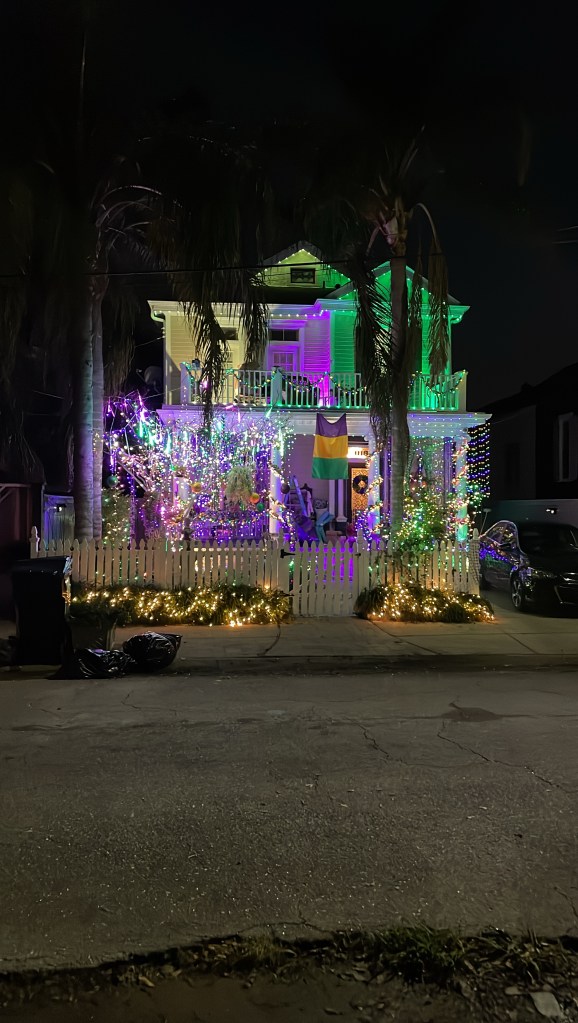
I really need to start taking walks around my neighborhood in the early evening to look at, photograph, and document the Christmas decorations. New Orleans loves holidays, loves costuming, and loves holiday-themed decor; everyone just goes to town for every holiday, and it’s one of the things I love about New Orleans. New Orleans always feels somehow more Christmas season-y than any place I’ve ever lived before, even though we very rarely have a white Christmas here (we did back in 2004); the only place that seems more Christmassy to me is New York–and that has everything to do with Miracle on 34th Street and Macys. When I worked for the airline I used to go to New York for a day every December and buy my mom an ornament from Macys–their Christmas floor was so amazing, always–but now I don’t work for an airline and Mom is gone, so that’s just another one of those nice but bittersweet memories now.
I’ve really been falling down on the job since the surgery about doing blatant self-promotion for Mississippi River Mischief; having major surgery within a few weeks of having two new books drop was perhaps not the smartest decision I have ever made. I always feel weird and uncomfortable doing self-promotion, anyway; I always think people don’t want to hear about this constantly and as you can tell, I’m not really good at it. I know I should be out looking for reviews that are positive and sharing them; but looking for positive reviews inevitably leads you to finding negative reviews, and at this point in time especially I have no interest in reading about how I’ve failed at my job. My books aren’t for everyone–but that doesn’t mean they suck, either. (If I don’t like a book I’m reading, I don’t finish it and I don’t talk about it; I simply say it wasn’t for me when/if asked.)
This enforced rest from the surgery has been an interesting time. I’ve read a lot–mostly short stories, some novels–and streamed a lot of things to watch, but I’ve also been going down a lot of wormholes in my own brain; trying to remember things with a memory that was already starting to fade a bit with age, but it accelerated dramatically after my COVID experience in the summer of 2022…I had already come to realize, recognize, and accept that my memories were faulty all along anyway; we always remember things differently than other people remember the same things because of who we are and how our minds work and how our experiences–and all those little things that make up our personalities and our perspectives–shape us into who we are. I like to paraphrase Joan Didion and say we tell ourselves lies in order to live–we don’t see ourselves as bad or as the villain in any given situation; we reshape events and remember them in ways that exonerate ourselves and push the fault onto others. Over the last years–pre-pandemic, I know that is the case if I can’t remember precisely when–I know I’ve been trying to look at occurrences in my own personal history and trying to be more objective about them all.
In some ways, that was where the story of Mississippi River Mischief came from; I wanted to deal with something from Scotty’s past that I’d brought up in one of the first books in the series (the long out of print Jackson Square Jazz, which hopefully will be available again in time for its twentieth birthday next year) and I’d always wanted to go back and reexamine that incident from Scotty’s past, with an older and much wiser Scotty reflecting on it and how it shaped and developed who he is–only to have it not be how he remembered it in the first place. It crossed my mind briefly while writing Royal Street Reveillon that “oh, the aftermath of this is a good place to deal with this thing from his past1,” and given how and why the underlying case in the new book comes to the Scotty and the guys, and what happened in the last book, this was the book where I had to go there and bring it all back. Yes, Jackson Square Jazz had been out of print since 2010, so the only way anyone could get it was from second-hand sources or libraries, so a couple of pages about Scotty’s past in an unavailable book–well, I did think for a while I wouldn’t have to dredge that up in this most recent book, but it didn’t take long for me to realize that I had to–it was cowardly not to deal with it and pretend I never wrote about it in the first place (especially since I’ve always intended for the book to be rereleased), and it fit in with not only the new story but what happened in the previous book.
And the fact that it was an extremely loaded subject made it all the more important that I address Scotty’s past–being seduced by his wrestling coach in high school–so that he could see it for what it actually was rather than what he remembered it as.
And the fallout will continue into the next one. (Yes, there are going to be at least three more, and I promise not to go four years between Scotty books again.)
Sorry, I’m trying not to give spoilers on a book that is almost six years old! ↩︎
I am up earlier than I have been since before the surgery (no, I don’t want a cookie–never been a cookie fan, even as a kid), and feel pretty good this morning. Yesterday was a pretty good day, over all. I didn’t really leave the house at all, but I worked on getting things more under-control around here–the kitchen has been a mess since the ceiling collapse, and the cabinets and drawers need some serious organizing–and also spent most of the day doing other chores around here, while thinking about getting back to work writing. The brace is still awkward to work around, but it feels like I’m getting more used to working with it on–and having a cleared and cleaned off desk surface also helps with that as well. I am going to run some errands this afternoon, but there’s not college football today to distract me or send me to the easy chair for the day, so I have little choice about blowing the day off, methinks, which is not a bad thing. I also did laundry and more dishes yesterday, and I have some other things I need to do here in the kitchen/office today as well. I also spent some time reading the second book in Raquel V. Reyes’ delightful Caribbean kitchen cozy series (Calypso, Cooking and Corpses), which is just as delightful as the first, and then…well, I fell down a Youtube/Twitter wormhole that was eye-opening and shocking before Paul got home from the gym and we watched this week’s Fellow Travelers, which, interestingly enough, kind of tied into the wormhole in some ways; as you may recall, just the other day I was talking about how these stories (Fellow Travelers), while sad and depressing, were necessary to remind people of how awful the past was for queer people not that long ago; we don’t have much of a societal memory for things that happened as recently as twenty years ago. There’s a large gap in our community that was created by the HIV/AIDS pandemic, so the oral traditions within the community of passing along our history was horrifically interrupted and many younger queers–and those that aren’t that young–have no way of connecting to the past, and don’t even know where to start looking.
During the shutdown I spent a lot of time in my easy chair making condom packs for the day job to justify getting paid for being at home–there were other job duties I could do at home, but mostly I made a shit ton of condom packs–and so I spent a lot of time looking through streaming apps on my Apple TV for things to watch while my hands worked. This was how I discovered the endless wormholes of Youtube video essays and documentaries; and of course, algorithms started suggesting other videos and channels of “influencers” similar to the videos I had watched and was finding on my own. Discovering Matt Baume’s delightful channel about queer rep in popular culture was a joy for me; he named sources for his information, was very clear about what was fact, what was unknowable, and what was his opinion–and since most of it was stuff that aired or happened while I was alive, it was a lovely trip down memory lane for me, reminding me of the few things that resonated with me growing up as a lonely queer kid and what shaped my views on what it was like to be a gay man in America. (Also, once I discovered there was such a thing as queer books and queer publishing, spent most of the 1990’s reading mostly queer stuff…and I’ve always been a voracious reader.) Anyway, watching Matt’s videos and subscribing to his channel shifted the algorithms, and I started getting other videos and channels suggested to me….and one of those belonged to a queer video essayist named James Somerton, and one of them–called Evil Queens and having to do with Disney–I don’t remember the actual name of the video, and he has since scrubbed his entire Youtube channel (more on that drama later)–and thought, interesting–a long time ago I read and reviewed a book called Tinker Belles and Evil Queens by Sean Griffin, but you can’t copyright a title and can you talk about queer coding and such in Disney and not use the words “evil queens”? Disney has always fascinated me, since I turned into a Disney queen after The Little Mermaid (I was never a big Disney kid; that waited until my adulthood and coming out, oddly enough), and Griffin’s book was so astonishing and good and insightful that I never forgot it. I watched Somerton’s video, and it all seemed incredibly familiar to me–and I did note he said some things that were wrong; mainly Gay Days/Gay Nights at Disneyworld were never official, Disney-sponsored events…which I know because I lived in Florida and used to gofor Gay Day. I also thought it was odd that he left out how the Southern Baptists tried to boycott Disney to stop Gay Days…and were ground completely into the dust by the Mouse. But it didn’t fit the narrative of the video essay–how Disney queer baits us for money then betrays us by not giving us rep in their films1. I also thought it was weird that the book–which so much of the video’s content was dependent on for its facts; the stuff that was wrong I assumed was from Somerton himself–wasn’t credited for anything, or even mentioned as a companion reading piece to the video itself. Periodically, after that, Youtube would suggest other videos to me from him, and I’d watch them, mainly out of curiosity…and began noticing things.
Like how his entire video about queer coding in Hollywood film seemed incredibly familiar–like I’d read it all already in the uncredited The Celluloid Closet by Vito Russo, which had already been made into a documentary in 1996…so much so that I bought an e-book of it to see and yes, it was used almost word for word with no attribution. And some of his other videos…were not only offensive but just bald-faced lies, things he’d made up, or okay, let’s be fair–conclusions he drew were from cherry-picked facts and broad speculations made from those facts; it seemed, in his video on gay body image issues, that he took the old 1990’s term for gym and body culture (the “you have to be a ripped muscle god to have any sexual currency”), which was “body fascism”, and somehow extrapolated from there the bizarre notion that Nazis created body culture and American GI’s brought it back from Europe after the war…and even weirder, somehow we didn’t get it from the Soviets because they were so “bundled up” we couldn’t see their bodies. (Maybe he should have read Michelangelo Signorile’s Life Outside, which explored how body culture morphed into something even bigger after the advent of AIDS because a strong, muscular, defined body was the antithesis of the wasting most people dying from AIDS experienced at the time; fit body= not infected; seriously, dude.) He was also horribly misogynistic at times–he didn’t like lesbians, and he hated straight women, and was also borderline transphobic at times despite trying to champion transpeople? It was all very weird, but I would periodically put on one of his videos that sounded interesting, even as he made claims that didn’t make sense or was simply restating things I’d already read somewhere. I didn’t think much of it, but I was idly curious–the way I often am; periodically I think about influencers and how to write a crime novel around one, and Youtube influencers seemed like the way to go if I were going to do that, and so I always chalked it up to research…and sometimes, the wrong things he said would send me off in search of the actual facts, so it was kind of educational by reminding me of things I’d forgotten about.
Turns out, he plagiarized almost all of his videos, never credited or named sources unless called out for it (he took down the videos about Disney and queer coding and put them back up as “based upon” the books he literally was quoting verbatim); the scandal dropped this week–I only found out yesterday–with two other Youtube influencers making really long videos about the plagiarism and the harmful lies he was spreading, as well as the self-loathing, misogyny, and transphobia. I went down that wormhole yesterday, watching both videos–which were long as the crimes were plentiful–and now his Youtube channel is gone, completely. As I said, I didn’t put a lot of thought into it–but he had a Patreon, and his Youtube channel was monetized, which meant he was profiting from the work of other queer creators that he was plagiarizing and stealing, then playing victim when caught…until he was literally destroyed by these other two Youtubers this week. He was apparently making a shit ton of money–and you know, there’s the plot for an influencer crime novel.
It was very eye-opening.
But it extrapolates further to what I’ve been thinking about since starting to watch Fellow Travelers–dark and sad and depressing as these stories are, they are important because our history is always erased; how are queer kids supposed to feel pride and understand where we’ve come from and what we’ve fought for, if they never hear about it, can’t find it, and are never told? The kids I work with (with an age range from early thirties to early twenties) don’t remember how horrible HIV/AIDS was because they hadn’t been born yet or weren’t old enough to really pay attention before the cocktail and the new meds changed it from a fatal disease to a chronic one (with treatment). There’s SO MUCH bad information out there about sexually transmitted infections, and so little education, that it frightens me on an almost daily basis as I work with my clients.
Obviously, this is what I’ve been wrestling with lately, with myself and my own artistic work (yes, I am starting to think of myself as an artist, which I should have done all along); what responsibility do we have to the younger people who don’t know our history, the history I lived through? It’s part of the reason I started writing “Never Kiss a Stranger”, and set it in 1994; I wanted to show what gay life in New Orleans was like during the time when HIV/AIDS was still a death sentence, and the city was also crumbling and dying itself before the wave of renewal and gentrification that started before Katrina and kicked into high gear; who is going to write that story if I don’t?
And what responsibility do I have to current and future generations of queer people as an artist? Do I have any? Or is my only responsibility as an artist to myself?
Something to think about, at any rate.
And on that somber note, I am heading into the spice mines. Have a marvelous Sunday, Constant Reader, and I’ll probably be back later; I can never stay away for long.
Uh, I guess he never saw the Disney documentary about Howard Ashman, who was partly responsible for the Disney animation renaissance and who died of AIDS before the release of the last film he completed, Beauty and the Beast; to date the only animated film to be Oscar nominated for Best Picture, and won three other Oscars, including two for Ashman? ↩︎
It’s a gray Friday morning here in the Lost Apartment and I might need to turn on a light–that’s how gray it is this morning. I was also a lag-a-bed and didn’t get up until after eight; not sure what that was about but the bed was incredibly comfortable. I also forgot to turn the heat off last night before I went to bed…and that kind of was a smart thing to do as I am not shivering this morning as I sit here. The brace still makes typing awkward, but I’m getting more used to it, or something.
Yesterday was my first real day of physical therapy; the first was clearly simply an assessment, and yesterday the actual therapy started. It was almost an hour, and it was all mostly dexterity movement with my hand and fingers, as well as working on squeezing and flexing, and some little forearm curls with a two pound weight. I ran errands after, including making groceries and getting the mail. I was exhausted. I wrote some emails and then did my book reports on two of the three books I read recently (I still have one more to do, on the Donna Andrews Christmas murder mystery), and when I was done with that…I was done. I was so fatigued I couldn’t even read very far into my next read (Raquel V. Reyes’ Calypso, Corpses, and Cooking, an absolutely delightful cozy series set in a small town within Miami–check the series out if you’ve not yet), and wound up watching an episode of Moonlighting and my standard go-to; documentaries about history on Youtube, and episodes of Real Housewives (I am currently watching Salt Lake City and Beverly Hills), and then Paul came home later and we started watching The Curse, an odd show with Emma Stone and Nathan Fielder; per Showtime the series explores “how an alleged curse disturbs the relationship of a newly married couple as they try to conceive a child while co-starring on their problematic new HGTV show, Flipanthropy.” I wasn’t sure if it was supposed to be funny when we started watching–I did laugh a few times, but it’s also one of those “cringe comedy” shows where you’re kind of embarrassed and mortified for the characters’ behavior so you don’t feel comfortable laughing? But now that I know it’s supposed to be funny (laughing with instead of at)…I really shouldn’t go into shows blind anymore because I am too literal-minded. I’m hoping to get a lot done today around the house; I feel very rested this morning and I guess we’ll have to see how long that lasts, and how long before my energy flags. This week I’ve felt more myself than I have since the surgery–clear-headed and so forth–so I am hoping that’s a sign that I am slowly getting back to normal.
I’m also hoping to watch Indiana Jones and the Dial of Destiny this weekend. Hoping it ranks with the first and third movies in the series and not the second and fourth.
The construction work around the apartment seems to be finished; they reinforced the patio deck overhang (which is over our front steps) with steel and removed that horrible long wooden plank that was supporting it for like the last twelve years, which was ugly and annoying and in the way–and not particularly effective, either. The kitchen ceiling is repaired, and now all we need is to have the plasterboard painted and the ceiling fan rehung, which I’m hoping can be done after I go back to work Tuesday. I like our construction guys–super-friendly and nice, and very good at their jobs; they are also going to reinforce our living room floor, which is getting soft in places; also incredibly thoughtful and considerate of me being home while they were working on the place–apologizing for noise, checking to make sure I was okay (they asked about the arm brace and I had to explain, after which they became incredibly solicitous, which I never–no offense–expect from straight men), keeping me updated on progress and so forth. They even told me everything they’re going to be doing around the house for the next few months, which is great; I’d kind of gotten used to never being told anything by workers and having to work around them over the years.
The kitchen is also a mess and needs to be straightened up some; I need to empty the dishwasher, do another load, and get started on the bed linens (it’s FRIDAY! Laundry day!). Tomorrow I’ll run some errands; I am not going to make groceries again until Monday, since I have PT that morning and have to go uptown anyway. Tuesday I get to go back to the office, which will be interesting. I’d of course hoped I’d be able to get a lot more accomplished and done during my time out of the office, but…that proved to be overly optimistic. I am recovering quickly–everyone is amazed, at PT and the doctors–but even my recovery wasn’t as quick and easy as I had hoped. I tire easily–gee, it’s not like my body is recovering from a MASSIVE TRAUMA or anything–so I’ll be curious to see how things go when I return to work.
I also have Christmas cards to do, too, which should be interesting. I actually have the cards already and the stamps; I ordered some gorgeous Louisiana Christmas cards from a local photographer, and a box of funny ones on-line; I also ordered Mississippi River stamps, which will be super fun to use. I always put doing the cards off, then lose track of time until it’s too late, and then just think well it’s the thought that counts. This year, however, I am ahead of the game–everything was ordered and has been here since well before Thanksgiving, so if I don’t do it this year I literally have no excuse. Maybe this weekend; it’s something I can do while sitting in my easy chair.
And Sparky is really making himself at home. I am so happy we got his energetic hyperactive little fuzzy butt. He’s getting so big, and he’s so smart and determined. He now open the bathroom door (so we can’t shut him up in there anymore) and he literally climbs drawers now to get to the kitchen counters or on top of the dressers–he actually looks like he’s scaling a rock cliff as he climbs the drawers, and it’s hard to get aggravated at him for doing it because it’s so smart of him to have figured that out. He’s very determined, and he’s also starting to answer (or at least react) when we say his name. I also call him Boop sometimes; it’s hard to get out of the habit of calling the cat “Boot” (nickname for Scooter we used more than his real name) but I managed to start saying “boop” instead, and he likes that and answers to it. He still prefers boxes and bottle caps to any toys we’ve gotten him, but I would like to get one of those toys that entertains them for hours…but then I think but what if he doesn’t care about it and ignores it?
Always an issue with a cat.
And on that note, I am heading into the spice mines. Have a lovely Friday, and I’ll check back in later.
Up earlier than I’ve been since the surgery to go to physical therapy at nine this morning. I don’t mind getting up earlier, to be honest; I’ve been sleeping so much since coming home from the hospital I was actually getting worried that I may not ever want to get up early again. Six next week for work is definitely going to be an adjustment, but in some ways I am really looking forward to going back to the office and getting back into that routine. I slept well last night–Sparky of course was looking to be fed around five, but I went right back to bed. I think Sparky will work as my first alarm, before the actual alarm starts blaring at six. It feels a bit chilly this morning in the apartment, and I do need to shower before I head uptown for my appointment.
They finished the ceiling yesterday, thank heavens. All that is left to be done is rehanging the ceiling fan and painting, and I think that’s not going to happen until I am back to work. The roofing guys (I think they are construction of all types, actually) are super nice and helpful–you never know what you’re going to get with blue collar workers, but they didn’t seem to have any issue with Obviously Homosexual Greg; they even rigged a temporary fix for the soft spot in the living room floor–and shared with me that eventually they will be getting around to reinforcing the floor with steel so we never have to be worried about falling through the floor (one of the great and many joys of old homes in New Orleans), which is kind of a relief…although we had gotten used to that soft spot in the floor, I sure as fuck won’t miss it if and when it’s gone.
While they were working, there was naught for me to do except sit in my chair and read, so I finished Donna Andrews’ Let It Crow!Let It Crow!Let It Crow! yesterday, and greatly enjoyed it. (It really doesn’t feel like Christmas until I’ve read Donna’s annual Christmas murder mystery.) Paul also worked from home yesterday, so we got all caught up on Fellow Travelers last night, which is really quite excellent, if horrifically sad and tragic–but as I said to a friend in an email yesterday, these stories still need to be told–if for no other reason than to remind people that what conservatives and right-wingers call “the good old days” weren’t so good for anyone who wasn’t white or straight. The story is built around the Lavender Scare of the 1950s–we all know about the Red Scare, but not about the full throttle purging of queer people from government employ–and it was, indeed, a horrible time of lives being ruined and people committing suicide. A lot of the things that happen in the show (and probably in the book) really happened; I think they fictionalized some people so they could easily maneuver around their story without having to stick to facts or create a potentially false narrative.
And as someone who spent longer in the closet than he needed to, and spent so much time completely terrified that someone would find out and my life would be ruined–I can understand and relate to these characters completely. The closet punished everyone–and it certainly punished the wives and children of these closeted, terrified men. I actually wrote a story set in that time period called “The Weight of a Feather”–my first ever historical fiction–about a State department employee targeted by someone working for McCarthy for blackmail, and how he handles the situation. John Copenhaver also writes marvelous novels set in the DC of the fifties with queer characters, Constant Reader, so if you haven’t checked out his work you really should, especially if you are interested in the period and even if you aren’t; these stories are important and need to be known. He’s also a marvelous writer; I do envy and admire the way he bends and twists language to create images and story.
After PT today I have errands to run–prescriptions to pick up, groceries to make, the mail–but it’s all going to depend on timing. The postal service doesn’t open until ten, but I suppose I could swing over to Midcity and get my prescriptions and groceries and swing by the mail on the way back home; after all, other than the PT appointment I don’t have to be anywhere by a certain time. And since there’s not going to be anyone doing construction work in my workspace today, I should be able to get some writing done, too. I’m behind, as always, but I feel like a strong push over the course of the next few days before I return to work can get me right back on schedule. And I haven’t yet picked out my next read–turns out my Christmas reading isn’t going to work because I don’t have a lot of Christmas books in the TBR pile; Donna’s was the only other one I had on hand. I’m thinking I should read cozies, to keep my mind in that world since that’s what I am writing–but my word, I have so many great books to get to! A delightful problem to have indeed, right?
And on that note, I am going to get cleaned up and head into the spice mines. I need to make a grocery list, and I need to list everything I am going to do today, too, so I don’t forget anything. I paid the bills yesterday, so everything is caught up at least that I am aware of, and so that was quite a relief. Enjoy your Thursday, Constant Reader–I’ll be back later to write up my thoughts about Donna’s latest two mysteries at some point.








 Queer and Loathing in America