Fortress Around Your Heart

It’s Monday, and I didn’t get near what i wanted to get done over the course of the weekend; which is something I should simply refer to as Monday’s Lament from now on. I did get Chapter Twelve finished, and I got started on Chapter Thirteen; and I sort of know where the (meandering) story is going; and there are some things I am definitely going to need to go back and fill in later. And it’s Monday, of course; the start of a new week in which I can certainly hope to get a lot finished.

We watched a wonderful series from Australia this weekend on Netflix, called Deep Water. It’s a crime show, and it opens with the discovery of the body of a brutally murdered gay man. As the investigating officer starts digging into the case, she begins to suspect that this murder is somehow connected to some other murders–over twenty years earlier–of gay men in the same part of Australia. The more she digs, the more convinced she becomes, and she soon begins to suspect the accidental drowning of her older brother, on Christmas Eve, 1989, is yet another one of a string of murders, hate crimes, committed against gay men all those years ago. It’s extremely well-written, and powerfully acted; it also deals with sexism against women in the police department; the old boys’ network of the police; homophobia; cover-ups; and how much–and how little–society has changed in the past twenty-five years.

We also watched the second episode of Season 2 of The Handmaid’s Tale. I had wondered if the second season of this show would be near as bleak, depressing, and heartbreaking as the first, and so far the show continues to deliver. This particular episode, in addition to dealing with Offred’s situation, also brought back Alexis Bledel’s character, off at the brutal world of the Colonies, where the unwomen are sent. If you will recall from the first season, Alexis Bledel played the lesbian Ofglen/Emily; she was originally punished and then committed another crime, resulting in her being sent to the Colonies. This episode, while focusing on Offred/June as always, shows the Colonies and what her life is like there, while she remembers how the downfall of democracy and the rise of religious fascism and its impact on her as a married lesbian with a child. I love how The Handmaid’s Tale is not afraid to go there, quite frankly; and its message is quite plain: women and queers have common cause against the patriarchy.

Coupled with Deep Water, watching this episode put me into a deep, contemplative place. I haven’t really quite formed the thoughts yet, but there are some nascent ideas and thoughts forming in my head. I read a piece this weekend about Mort Crowley, The Boys in the Band revival on Broadway, and the disappearance of gay culture. I also have had come conversations with younger gay men over the course of the past two weeks. Paul and I were also listening to some gay dance remixes from our partying days of going to clubs and dancing the night away last night before bed, and we recalled those times with a bit of sadness; I do miss the fun we used to have, but do I want the full-on oppression that came with it?

It wasn’t that long ago, as Deep Water showed, that we were seen as disposable, human garbage on the fringes of society and no one cared if we were assaulted, murdered, disappeared. (There’s a serial killing investigation going on in Toronto right now that has been glossed over, ignored, despite all evidence to the contrary, for years: Toronto.) One of the reasons I originally wrote Murder in the Rue Dauphine  was precisely for this reason: who cared if some gay man was murdered? I think about the story line for that book from time to time, and often shake my head, thinking, “oh, that book could never be written today; it wouldn’t hold up, no one would believe that a closeted man would or could be blackmailed today.” And yet there is a story line in my current book along those same lines, that i struggle with; is this realistic in this day and time? Is this a secret someone would be willing to protect today? On the other hand, we do still see outings; there was a recent scandal in Metairie where the parish president was outed for pursuing a teenaged boy who worked at Lakeside mall. So, it’s not completely out of the question for a crime storyline anymore.

And this also makes me reflect, again, on ambition, and my tendency to self-defeat myself; my fear of failure, and how I built my career in such a way as to guarantee that I would never become hugely successful; writing gay characters and gay themes in crime fiction essentially guaranteed, almost from the first, that i would never be a New York Times bestseller or would win an Edgar Award or get reviewed in major newspapers; I could be published, but as a gay writer of gay stories, the expectations were low; no one would expect me to sell hundreds of thousands of copies in my little niche within a niche within a niche market. Did I subconsciously set out to sabotage my own career from the very start, setting myself up for low expectations from the start? I’d always intended–and it is there, in my journals–to eventually move to writing mainstream fiction; mainstream crime fiction. And yet, in all these years, of writing millions of words and creating hundreds of characters and telling all these stories, I’ve only recently (in terms of the years of my career) begun to try to write something more mainstream. It would take very little work to make that book appealing to my current publisher; it’s always there in the back of my head as I struggle with it and try to place my finger on what’s wrong with it and why no agent seems to want it–and then I remember that I’ve actually only sent tentative queries to a handful of agents, and am I giving up on it too soon? The amount of time I’ve actually spent on this piece of work isn’t that long in the overall scheme of things; I’ve worked on it around other things I’ve had under contract.

The entire point of last year was to work on it, get it finished and polished and ready for submission, and yet I allowed myself to waste most of the year in feeling sorry for myself and paralyzed and unable to write anything; was this simply another way of defeating myself, of fearing to fail and therefore not even trying?

You cannot succeed unless you aren’t afraid to fail.

Failure is the best way to learn.

And now, back to the spice mines.

17191400_1290543300993731_6767665762992739786_n

Private Dancer

Jessica Knoll, whose debut novel Luckiest Girl Alive I absolutely loved, wrote an op-ed for the New York Times recently in which she unabashedly talked about her ambition, how she wanted to not only be a writer but to be a successful one; that she wanted to make as much money as she possibly could from her writing. Called “I Want to Be Rich and I’m Not Sorry” (you can read it here), I thought it was terrific. I thought it was lovely to hear a writer talk about how much they wanted or desired success in their chosen field; I also thought it was interesting to read about how she had always been underestimated because she was a woman; that somehow success isn’t expected for women; and that women are often not only talked out of ambition but derided, mocked, and shamed for having it. It was kind of refreshing, honestly; I also loved reading an author talking, unashamed, about wanting to be successful and make money at writing–as much money as possible.

The comments on the piece were mostly, not surprisingly, negative; everything she talked about in the essay were right there in the comments, posted without any sense of irony by the posters: I’m also a woman writer but I’m looking for books to read that have something to say. I won’t be reading yours.

Oh, the pearl-clutching.

It’s been a while since I read Luckiest Girl Alive, but I do remember it having a lot to say; about class, about success, about being a woman, about dealing with public shame and then trying to insulate yourself from pain and suffering by marrying a successful man and shielding yourself behind his money. The book carried two time-lines: the present day, where the main character was planning her wedding to a wealthy man while filming a documentary about what happened to her back in high school, flashing back to her high school experience and everything that led up to the subject of the documentary. I thought it was rather well done.

I’ve never understood this mentality that writers shouldn’t want to make money from their work; that somehow wanting to be financially successful somehow lessens what we do, somehow makes our work somehow less important; that we shouldn’t, somehow, want to make a living writing. I guess we’re all supposed to hold down full time jobs and treat it as a hobby, carving out some spare time here and there to pursue making art simply for the joy of doing so. I spoke the other day about how my primary sense of self, my primary identity, is author, and I wouldn’t quite know what to do with myself if I wasn’t able to write, if I wasn’t able to publish, if I wasn’t able to keep my writing career going. I do know how awful last year was when I wasn’t really writing, when I wasn’t able to commit to anything, when I stayed away from the computer and the open word documents and kept the word files closed; it fucked with my mind, it fucked with my self-confidence (always shaky, at best) and it was horribly unpleasant. This year I am writing again, and back to berating myself for not spending every spare moment working on something; I’ve written a ridiculous amount this year and yet at the same time, I’m not all that much closer to finishing the Scotty novel or the draft of the WIP as I should be. I find myself being easily distracted by writing short stories, with ideas for new ones popping into my head all the time–thank God for my journal, and thank God for remembering that was a key component of my writing for years, jotting down notes and ideas and thoughts before they slipped away inside my mind–and even now, this morning, I should be working on either Chapter Twelve of Royal Street Reveillon or the WIP, and am doing neither; have already thought about simply cleaning and reading more short stories, avoiding the work that needs to be done, despite knowing that actually doing it will make me happy and feel satisfied.

I am frequently my own worst enemy.

So, bearing that in mind, and bearing in mind Jessica Knoll’s op-ed, I am going to embrace my ambition. I am going to do whatever it is I need to do to become more successful, to reach for every brass ring that I can.

The only thing stopping me is, after all, me.

And bearing that in mind, I shall now bring this to a close.

16836462_1277495445631850_375592218010177997_o


Born in the USA

Were I to ever write a memoir, I suppose the easiest thing to do would be divide my life into chapters of every ten years or so; my life has sort of been divided that way, almost corresponding with the calendar decades. I was born in 1961; ten years later one chapter of my life closed and another opened when we moved from the city to the suburbs; ten years later we left Kansas for California; 1991 marked my move to Florida, and 2001 was the return to New Orleans from a year in Washington D.C. (what I often refer to, in my head, as ‘the lost year of misery’). 2011 was the year I turned fifty, the aughts being my first full decade of living in New Orleans. Those chapters could then be divided into smaller brackets; the years in the suburbs, the years in Kansas, the bridging year in Houston, the transitional months in Minneapolis, the pre-published years in New Orleans; the pre-Katrina time as a published author, the post Katrina recovery years; I supposed I could mark 2011 as the beginning of another time, the manic productive years when I wrote so many novels and edited so many anthologies and so many short stories. 2017 was the year I took off, to catch my breath and relax and recharge and recover; it was also the year of paralyzing self-doubt and terror that I was never going to write again. Sometimes I wonder if the manic years were precisely what they were because of that fear: the fear that if I ever stopped I would never start again, that I would never start again.

One would think now, after the prodigious output of the last seventeen years or so, I would never doubt myself anymore, would never fear the fount might run dry; but I am just as worried and nervous and as full of doubts as I was in the years I dreamed of making this my reality and wrote and wrote and wrote. It never gets easier, the doubts and fears never go away. At least not for me; I cannot speak for other writers. But I do define myself as a writer. That has been my identity since I signed that first contract all those years ago; above every other identity I can be labelled, be it male or gay or American or New Orleanian or Southern; above and beyond all else I identify as author. 

In an interview recently about Lindsey Buckingham’s departure from the band and Fleetwood Mac’s decision to continue, and tour, without him, Stevie Nicks said, This is terribly sad for me, but I want to be happy and enjoy the next ten years. That may not be the exact quote, but its very close to what she said, and it hit me right at the core of my being. She–and the others–have always been about writing and creating and performing their music; but now they are getting older and wondering how much more time to do they have to do this thing they love so much? I would imagine Tom Petty’s death weighed pretty heavily on her; they were very close. It also made me feel my own age, and wonder about my own future. How many more years do I have to write the books and stories that I want to? What will I do if the day ever comes when I cannot do this anymore, when people don’t want to read what I’ve written, when no publisher wants to invest in getting my work out to readers?

Heavy thoughts, indeed, my own mortality isn’t something I’ve ever cared enough about to think about. But I would imagine, that no matter what else happens in my life, as long as I can type, as long as I can sit up in my chair and see my computer screen, I will keep writing. This compulsion will probably never go away; I know the stories will most likely never stop coming to my mind. Even when I wasn’t writing last year, the ideas were still coming; characters and stories and plots and those stray thoughts that always begin wouldn’t it be interesting if or I wonder what would make a person do such a thing or I wonder what would happen if…

My conscious decision at the beginning of this year to focus on writing, on rediscovering the joy I once always felt when I was creating, the sense of satisfaction felt upon finishing my work for the day, was perhaps the smartest thing I’ve ever done. I do enjoy doing this, even when it frustrates me, when the words won’t come, when I get behind, when I procrastinate and don’t do it even when I know I must, and that the best way to fight off those horrible self-doubts and fears and insecurities is to just fucking do it.

Nothing else matters, really, when it all comes down to it.

Who’s Zoomin’ Who

And Chapter Twelve of Royal Street Reveillon is coming along nicely. The draft isn’t terrific–there are holes in the plot that will need to be plugged, and scenes missing, etc.–but it’s moving along. I am actually thinking this could wind up being twenty-five chapters long, making it one of the longest Scottys ever.

Then again, it’s been a while since there’s been a Scotty, hasn’t it?

Paul’s birthday is this weekend, too–it’s actually tomorrow–so that will probably interfere with my plans to get a lot of work done this weekend, but that’s fine. I would prefer to get back on schedule with both the book and the short story collection–and I have another short story to write, as well, for an anthology I’ve been asked to submit to–and of course, as always on Friday morning, the house is an utter disaster area. How does this happen every week? I try to keep up with it, I really do, and yet here I sit this morning in a disaster area, with files and paper and mail piled up everywhere I can see, the sink full of dirty dishes, and a load of laundry needing to be folded. Heavy heaving sigh.

But today is my short day at work, so i can get some of this done before I head in to the office, and hopefully I’ll be able to get some of the cleaning done tonight after work so I can focus on the writing/editing I need to do this weekend.

One can dream, I suppose.

I read two short stories for the Short Story Project as well.

First up is “Sleeping Dog” by Ross Macdonald, from The Archer Files:

The day after her dog disappeared, Fay Hooper called me early. Her normal voice was like waltzing violins, but this morning the violins were out of tune. She sounded as though she’d been crying.

“Otto’s gone.” Otto was her one-year-old German Shepherd. “He jumped the fence yesterday afternoon and ran away. Or else he was kidnapped–dognapped, I suppose is the right word to use.”

“What makes you think that?”

I am very sad to report that with “Sleeping Dog” I finished The Archer Files; the only things left in the book are short story fragments, which I may read, just for the hell of it and to see how those fragments might have been incorporated into other stories or novels of MacDonald’s; God knows I’ve done this any number of times myself. (The most recent example of this is my story “The Silky Veils of Ardor,” which is the story I recently revised from editorial notes and sent in earlier this week. It started as a story called “Death and the Handmaidens,” which no one would publish. I liked the story structure–in which a woman comes to a gathering of people she usually doesn’t see; in the original story it was a writer’s conference hotel bar. However, I took that character and that setting and turned it into a 25 year high school reunion weekend, rather than a writer’s conference, and even used the hotel bar setting. It worked, I have to say, much better in the newer version. I am, however, going to use the title “Death and the Handmaidens”, and the basic premise behind the original story to revise it yet again. I am far too stubborn to ever let something go, as we all know.) “Sleeping Dog” breaks the cardinal rule of crime fiction: never kill a dog or a cat. But the missing dog is the thread that leads to the solving of an old murder, and the disappearance of the dog also sets into motion events that lead to yet another murder in the present day. Terrific story, dead dog aside, and I am rather sad to say goodbye to The Archer Files.

Next up was “Wall Street Rodeo” by Angela Zeman, from the MWA anthology Manhattan Mayhem, edited by Mary Higgins Clark.

“Mr. Emil Bauer, I’d hope to see here. Especially today.”

I had rubbed against a hunchback this noon. Accidentally, of course. I’d never be so crass as to touch the poor fellow on purpose. Besides, everyone knows the luck comes from an accidental touch. Thus, you understand my excitement. Then I positively tripped over little James here, who dropped his five-dollar bill right in my path! Don’t tell ME that’s not luck! So, I hustled him and his cash right here. To Emil’s spot. “Please meet my friend, newly minted, you might say, heh, in this neightborhood.” I flourished my hand toward the child. “Mr. James Conner.”

Emil glanced fuzzily at the boy. “How old is it?”

This is a fine story, about a long ago crime and a hidden cache of stolen money, and it takes a roundabout way to get to the point, but it’s kind of clever in how it dodges and feints and fools the reader. It’s not one of the stronger stories in Manhattan Mayhem, but in fairness, some of these stories are so fantastic it would be hard to compete with them.

And now back to the spice mines.

13082527_1298944620118917_9066161767416363977_n

Jungle Love

Well, I finally got those story edits done yesterday, and it wasn’t that hard to do. I don’t know why I was resisting looking them over, reading the notes, and looking at the story; and frankly, the story is stronger for them. I now await whether or not there will be further notes–if I did a good enough job correcting things for the editor–and I feel as though a millstone has been lifted from around my neck. I honestly don’t understand myself sometimes. This wasn’t a big deal, and yet I avoided it for at least three weeks, not only letting it hang over my head like the sword of Damocles but it was always there, in the back of my mind as I worked on other things, nagging at me from the darkened recesses of my brain, worrying me the way I’d worry a loose tooth with my tongue.

And getting it done? Such an enormous relief.

And of course, once I conquered that beast, I went back to that pesky chapter and yep, sure enough, I was able to start whipping it into shape and what’s more, it was relatively easy. I guess I’d had so much trouble getting the damned thing done in the first place–and yes, for the record, it wasn’t the mess I thought it was–that I thought fixing it would be nearly as painful as writing it was. Nope, it wasn’t. Sigh. And now I know I can get back on track and on schedule. HUZZAH!

Seriously. This is why writers drink.

So I, for one, am really looking forward to this weekend and getting a lot of things done. Hurray!

I also read two more Ross MacDonald stories, from The Archer Files.

First was “The Angry Man”

I thought at first sheer terror was his trouble. He shut the door of my office behind him and stood against it, panting like a dog. He was a gaunt man in blue jeans, almost black with sweat and dirt. Short rust-colored hair grew like stubble on his hatless scalp. His face was still young, but it had been furrowed by pain and clawed by anger.

“They’re after me. I need help.” The words came from deep in his laboring chest. “You’re a detective, aren’t you?”

“A sort of one. Sit down and take a little time to get your breath. You shouldn’t have run up those stairs.”

Next was “Midnight Blue” :

It had rained in the canyon during the night. The world had the colored freshness of a butterfly just emerged from the chrysalis stage and trembling in the sun. Actual  butterflies danced in flight across free spaces of air or played a game of tag without any rules among the tree branches. At this height there were giant pines among the eucalyptus trees.

I parked my car where I usually parked it, in the shadow of the stone building just inside the gates of the old estate. Just inside the posts, that is–the gates had long since fallen from their rusted hinges. The owner of the country house had died in Europe, and the place had stood empty since the war. It was one reason I came here on the occasional Sunday when I wanted to get away from the Hollywood rat race. Nobody lived within two miles.

Until now, anyway. The window of the gatehouse overlooking the drive had broken the last time that I’d noticed it. Now it was patched up with a piece of cardboard. Through a hole punched in the center of the cardboard, bright emptiness watched me–human eye’s bright emptiness.

“Hello,” I said.

The stories are pretty good; I’m glad I took a break from reading the MacDonald stories because the style and voice were starting to grate on me. Don’t get me wrong; I think MacDonald–despite the occasional casual racism and misogyny–is one of crime’s best stylists, and I love Archer’s voice. But reading story after story consecutively was starting to grate a bit, particularly since some were clearly better than others. Both of these are gems; both of them wind up twisting and turning far away from their simple, casual beginnings.

I also have to say that reading the MacDonald stories, as well as Sue Grafton’s Kinsey and Me collection, along with Laura Lippman’s Tess Monaghan short stories in Hardly Knew Her have not only inspired me but kind of taught me how to write a private eye short story. We’ll see how my Chanse stories turn out, I suppose…but at least now I am willing to try writing them, whereas last year I never would have dared try.

IMG_1234

Do What You Do

Ah, it’s only midweek and I’ve not made much progress on anything; the kitchen is a mess, and time is just slipping through my fingers on a daily basis. It’s a frustrating feeling, made even all the more frustrating because I know, even as I procrastinate, that I am going to deeply regret the procrastination the following day; and yet, I do it. I suppose this would be fodder for my therapist; why do I defeat myself all the time, or set myself up to fail? Is it a fear of failure, so if I do it to myself it won’t feel like failure?

These are the mysteries of Greg that I ponder on a daily basis.

I did work on a story yesterday, rather than the Scotty book or the website writing I’d promised to do, which I need to do, both of which I should just fucking do and get out of the way. Eye roll.  The story isn’t one I am sure about; it’s one that I originally wrote back in the late 1980s during one of my I’m going to take this writing thing seriously even though I have no idea what I’m actually doing periods when I used to write piles of short stories (rather like I have done this year already), and it’s one that I’ve always thought would work. I’ve taken a run at it again several times over the years, but at last I think I have it in a place where it will actually work. The voice is the key to this story, and I think I’m getting it right; the story itself is working itself out, but once I am finished with it this time around I need to go back and make sure I’ve got the voice right. This is, of course, not one of the stories I’m including in the collection, or the one I need to get the edits done on (of course, see what I mean about being self-defeating?), and the irony, of course, is that the edits aren’t that involved; and yet somehow I just can’t make myself do them.

Idiot.

But so it goes, and how it goes every day of my life. I am often called prolific, which always amuses me to a degree; I think of myself as lazy, because I know how much more I could get–or should be getting–done. I also know about all the time I waste, and how that time could have been used ever so much more productively.

In my own defense, however, I will say that I like this story I am working on–“Fireflies”–and I’ve always liked the story, and am glad that I am finally getting to it. I have so many story partials; so many stories that have been dancing around elusively in my brain for so long, yet whenever I try to finish them they dance away just out of the reach of my fingertips; “Fireflies” is one of those stories. It’s nice to finally be getting it finished, even though I should be working on other things. But I’ve diagnosed what’s wrong with both “Don’t Look Down” and “My Brother’s Keeper” this week; I’ve also figured out what’s wrong with “Once a Tiger” and how I can move forward with it. These are good things, really; and I am getting somewhere with the Scotty book as well with my brainstorming.

I just need to get past this feeling that Chapter Eleven is such a sloppy mess that I don’t want to even look at it again. I either need to go fix it, or move on to Chapter Twelve instead of agonizing over it like an idiot.

We started watching Shooter, a really terrific Ryan Philippe series last night; I think it was a limited series–a one-off, because I don’t really see how it could go another season. He plays one of the top Marine sharpshooter/snipers, who has retired; he is dragged back into the business by an old Marine buddy who now works for the Secret Service to figure out how someone is going to try to assassinate the president. He doesn’t realize he is being set up to take the fall for the assassination, and the conspiracy runs pretty fricking deep; but he manages to get away from the authorities and has to prove his innocence. It’s pretty good–and Ryan Philippe never disappoints. I’ve been a fan since his days as gay teenager Billy Douglas on One Life to Live back in the early nineties; and I am glad to see him keeping his career going on television now that he’s no longer in demand for film roles. He really makes a hot dad.

I also read two short stories for the Short Story Project. First up was “A Bus Ticket to Phoenix” by Willy Vlautin, from Jim Fusilli’s Crime Plus Music:

Otis woke that morning to Lenny in the bathroom yelling on the phone. It was past 11 a.m. at Winner’s Casino in Winnemucca, Nevada. Under the covers he shivered in the cold and could his breath fall out and disappear into the room. He got up to find the window open and the heat off.

He set the thermostat to high, shut the sliding glass window, and looked out to see some snow falling. It covered the van and trailer and the houses behind the motel. He stood seventy-seven years old, tall and thin with greasy brown hair. He found his clothes on the floor, dressed, and walked across the street to the casino. He used the toilet, lost five dollars on video poker, and went to the casino restaurant for breakfast.

Vlautin, the author, is a seasoned professional musician, which explains why this story rings so true and authentic, I suspect. Some old guys, professional musicians who are now getting old and have never made it big, just always managed to find work and have spent almost their entire lives on the road, are now touring with some musclebound young up and comer in country music. The crime is that their stuff keeps disappearing, with something being stolen at every stop on this tour. The singer is kind of a dick, and so is his manager…and while the crime aspect of the story isn’t it’s strength, the depiction of the lonely, melancholy life on the road–and coming to the end of your lives without ever having made it big while continuing on because you can’t do anything else, is the most poignant and powerful part of this story.

I then moved back to Ross Macdonald’s The Archer Files, for another Lew Archer story, “Wild Goose Chase.”

The plane turned in towards the shoreline and began to lose altitude. Mountains detached themselves from the blue distance. Then there was a city between the sea and the mountains, a little city made of sugar cubes. The cubes increased in size. Cars crawled like colored beetles between the buildings, and matchstick figures hustled jerkily along the white morning pavements. A few minutes later I was one of them.

The woman who had telephoned me was waiting at the airport, as she had promised. She climbed out of her Cadillac when I appeared at the entrance to the waiting room, and took a few tentative steps towards me. In spite of her height and her blondness, the dark harlequin glasses she wore have her an oddly Oriental look.

“You must be Mr. Archer.”

A man is on trial in this unnamed northern or central California city for the murder of his much older, much wealthier wife. He clearly killed her for her money, or so the prosecution would have you believe. His only defense is at the time of the murder, he was with another woman–another woman whom he will not name, despite her being his only real chance at acquittal since everyone thinks he’s guilty. It is this woman who has hired Archer, and she has her own reasons for not wanting to be named…and so as Archer goes about his investigation, another murder is committed and he finally solves the case by finding the real killer…and yet everyone involved is guilty to some degree; perhaps not legally, but at least morally. This is the kind of case where the detective needs a long hot shower after to wash the stink off; which is of course, for me as a reader, the best kind of story. (Oh, yes, all that time period racism and misogyny is on display in this story; which kind of, as always, put me off–as you can see in the above opening paragraphs of the story.)

And now, to stop procrastinating and get back to the spice mines.

97612dfb2e439db8a71f6394e6f11103

Lonely Old Night

Monday morning, and a pretty good weekend of sleep has worked it’s magic. I’m not tired this morning, neither mentally nor physically, and that has to count for something. I was getting rather down on myself last evening , as we watched Friends from College on Netflix; I hadn’t gotten nearly enough done as far as writing and editing are concerned, managing to procrastinate almost the entire weekend. Oh, sure, I got chores done and errands run, but yeah, didn’t really do much of anything yesterday other than work on the revision of a story and read some more short stories. This means I am behind schedule yet again, but feeling good this morning has to count for something. I tend to think having days like yesterday–days with zero motivation to write/edit–are my subconscious telling me I need to take a break and let my mind relax a little bit.

Or, that could just be my justification.

And on the other hand, if that’s the case, so be it.

But I also realized, over the course of this incredibly lazy weekend, that part of the problem I am having with some of these short stories is that I don’t know the characters as well as I should–particularly with “Don’t Look Down”–and I need to know them better; I also need to know what their story is. Same with the Scotty; part of the reason I am having such an issue moving forward with Chapter Twelve isn’t just that Chapter Eleven is a sloppy mess; I need to at least have a better understanding of where the book is going rather than trying to write my way into it. So, I’m going to brainstorm a bit between clients today and tomorrow; as I said before, this is probably the most complicated Scotty book since Mardi Gras Mambo, and so I need to be a lot more careful with it than I’ve been with the previous ones. It can easily go off the rails, and I don’t want that. God, how I don’t want that!

But i am hoping–hoping–to break through on it today; I’d love to get the short story collection finished by this weekend and at least four more chapters of the Scotty so I can have the entire thing finished by the end of May. Goals.

I also read two short stories from Jim Fusilli’s Crime Plus Music.

The first was “1968 Pelham Blue SG Jr.” by Mark Haskell Smith.

While one of us was fucking the middle-aged Goth chick against a dumpster in the alley, we went and got beer. We didn’t think it would be a big deal. This kind of thing happened all the time and we tried to give each other space for a quick bang whenever we could. It made being in the van easier and gave us stories to share. For some of us, the sex was the main reason we played these gigs. It wasn’t for the money.

We found a bar a block away. It was one of those places that calls itself a tavern and has a list of beers written on a chalkboard behind the bar. They had mismatched sofas and coffee tables scattered around the room and shitty electro-groove music dripping out of the speakers. Maybe this is what people are into these days. It’s not like anyone came to our show. We had seventy-nine paying customers and one horny soccer mom wearing vintage Hot Topic. Maybe everyone else was sitting in thrift-store living rooms listening to laptops making music.

The second was “Are You With Me, Dr. Wu?” by David Corbett.

Shocker Tumbrel first encountered the loving Buddha inside a padded holding cell at San Francisco County Jail.

Twelve hours earlier, a SWAT team had dragged him out of a shooting gallery two blocks from the Bottom of the Hill, the club where his band had joined a handful of other outfits in a benefit to save the venue, one of the few left in town to offer live music, now targeted for condo gentrification at the hands of the usual cabal of city hall sellouts and bagman developers.

In all honesty, I didn’t care for either of these stories. The first is a Barry Hannah-style stream of consciousness story, about a band who go out for a beer after a show while one of their own, for want of better phrasing, “fucks a middle-aged Goth chick behind a dumpster.” When they come back, both of them are gone along with a lot of their equipment; they track them down and that’s the end of it. A lot of telling, not much showing, and characters I didn’t care much about. The second story was kind of all over the place; opens with two older guys from a punk band, with one of them overdosing on heroin while the other is too high to do anything about it, and he winds up in rehab, and that’s when the story gets really strange and all over the place. Not two of the stronger stories in the book, but the book is still worth reading–don’t get me wrong!

And now, back to the spice mines.

1026-1

Lay Your Hands on Me

I managed to get all the errands done yesterday, and didn’t feel exhausted until I was in the process of putting away all the groceries and things. I went to both the grocery store and Costco yesterday; I was rather impressed that I wasn’t worn out much sooner. I did get the bedding laundered as well. But I didn’t get any writing done; I am going to need to do that today.

There are a lot of things I am going to need to do today. Sigh.

I’ve been invited to contribute to an anthology; and I am not certain I have anything ready to send along. I do have this one incredibly disturbing story that I would like to make even more disturbing–that’s just how I roll–and I need to get back to work on the Scotty draft. I’d like to revise Chapter 11 a bit today, get it cleaned up more so it isn’t nearly as sloppy as it currently is, and I want to get these other two stories cleaned up as well. I need to spend some more time with “Don’t Look Down” than I have been; I need to get inside the characters more, understand who they are better, and then I think the story will wind up being a lot more strong. The same goes with the Chanse story; the story is really about his relationship with his brother and that’s not strong enough in the story as it sounds right now. That is also, I think, the problem with the Scotty book. I need to spend some time today with it as well, figuring out motivations and so forth.

Ah, being a writer. Always such a challenge.

We finished watching Collateral last night, and I was rather pleased with it; it was written by David Hare, the playwright, and you could tell it was written by someone good. Carey Mulligan was terrific, and I highly recommend it for anyone who enjoys complex, multi-layered crime dramas. I think tonight we may watch Justice League, to just to see if it really is as terrible as everyone seemed to think; I didn’t hate either Man of Steel or Batman vs. Superman, so I am not going into it as a hater.

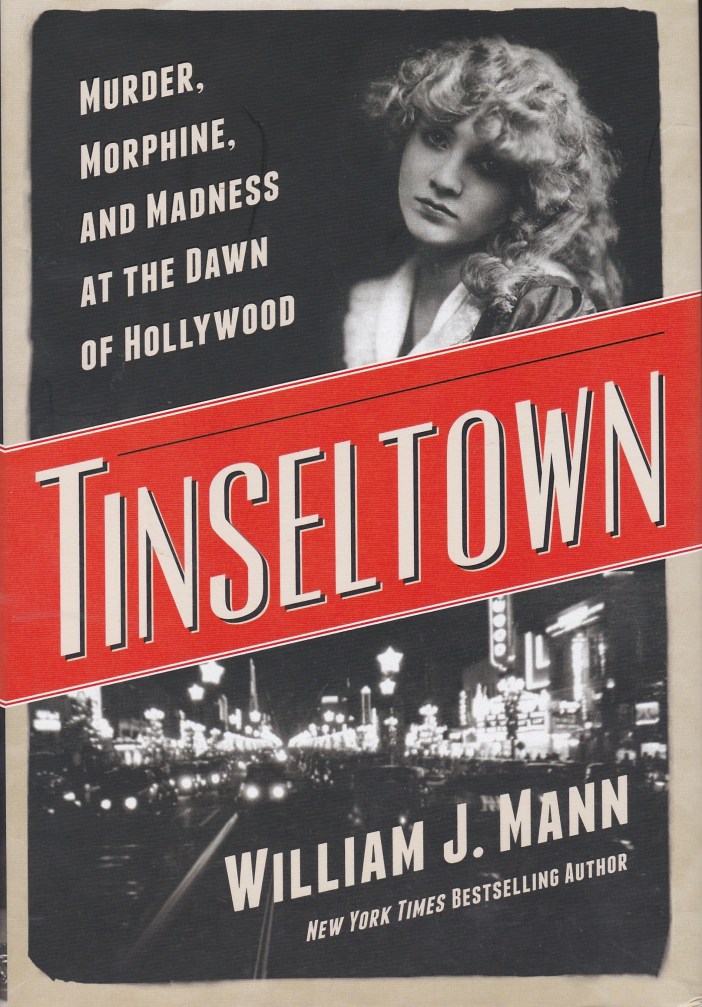
I’m also still reading Tinseltown, which I am greatly enjoying. I don’t know a lot about the early days of Hollywood; the early 1920’s and late 19-teens, other than what I know from reading biographies of David O. Selznick, whose father was a producer and tried to build up a studio at the same time Adolph Zukor was building Paramount, and before the big merger that created Metro-Goldwyn-Mayer (MGM). So all this is new information to me, and William J. Mann is a terrific historian and researcher. (I am more familiar with later periods of Hollywood, but hardly an expert.) I’ve always wanted to write about Hollywood’s past; I have an idea for a noir novel to be set in the late 1940’s, but my lack of familiarity with the nuts and bolts of Hollywood in that period makes it difficult–or rather, makes my already vast insecurity about writing about another period even stronger. Although I’ve already written one short story about that time–an ambiguous setting of the early 1950’s–I don’t know. Maybe I should try it as a short story first, see if I can get the sense of the period?

I don’t know.

I’m also saddened to say that I’ve now finished reading both of Lawrence Block’s art-inspired anthologies, In Sunlight or in Shadow and Alive in Shape and Color, but I’ve heard through the grapevine that he is putting together another, which is great. So, for today’s edition of the Short Story Project, I am sad to say this is the last story from a Block anthology: “A Woman in the Sun,” by Justin Scott, from In Sunlight or In Shadow.

Could she change his mind? Four steps to the open window, lean out and call, “Don’t.”

Or walk to the window and call, “Go ahead, do it.Good luck.”

Or stand here and do nothing.

He had left her his last cigarette. She had talked him into leaving the gun and he had kept his word. It was still on the night table, wrapped in one of her stockings. She had the time of the cigarette to make up her mind. More time, if she didn’t smoke it. Let it smoulder.

This is an interesting story; in that it leaves more questions unanswered than it actually answers. We never know the characters’ names, nor do we really know what has brough them to this point. All we do learn, as the story progresses, is that both are at the end of their ropes and done, basically; they are both ready to die. The only question is whether she will stop him or will she join him, and this rather uninvolved, distant approach makes the story even more poignant and sad; there’s a very strong sense of melancholy that runs throughout this story, and the reader soon realizes you don’t have to know the whys and hows and whats of their pasts–all you need to know and feel is their now.

Powerful.

I then started reading through Jim Fusilli’s Crime Plus Music, and the next story up was”Me Untamed” by David Liss.

She covered the black eye with makeup, but I could still see it was there, something alien and unaccountable. Like a vandal’s scrawl across a museum painting, the dull outline of her bruise was an outrage. Carla smiled and greeted everyone good morning, defying us to say a word, to let our eyes linger too long. It was, I supposed, how she protected herself.

Jim Baron, the senior partner in the practice, met my gaze and flicked his head toward Carla as she walked past with a stack of case folders under her arm. Carla was getting ready, as we did every Tuesday and Thursday, for surgeries–no office visits on those days, just procedures. The practice felt a bit like a gastrointestinal assembly line, and sometimes I hated how we moved patients in and out, hardly taking the time to look at them, but Jim cracked the whip. It was volume, volume, volume as far as he was concerned. We were there to heal, not to socialize, and the more healing, the better.

The point of view is that of a divorced, shy, quiet Milquetoasty doctor,  who is kind of in love with Carla, or maybe he is not. She’s married to a thug of a guy, a man’s man, who works out and so forth, the kind of man a Milquetoast would hate. And he decides to do something about Carla’s abuse…decides to make himself into the kind of man he’s always wanted to be, the kind of man that he thinks Carla would like and love. This is a terrific story, with a terrific twist at the end that lifts it up even higher in terms of craft. Well done, sir!

And now, back to the spice mines.

KONICA MINOLTA DIGITAL CAMERA

I’m on Fire

Friday, and the day and the weekend stretch out before me like an unpainted canvas; blank and full of possibilities. I have a short day at work today, and I slept relatively well last night, so am feeling fairly good this morning. My left shoulder is mysteriously sore, tbough. Not sure what that’s about, but there you have it.

We finished watching Episodes last night, and it ended perfectly; very meta, and very funny. The entire show was kind of meta, really, and I have to give Matt Leblanc credit for not only playing himself, but playing himself as a complete egotistical self-absorbed asshole actor. Not sure what we’re going to watch now that we’ve finished both The Alienist and Episodes, but I have faith in us to find something–although we haven’t had much luck lately in finding something new; although The Alienist was absolutely a lucky find.

My kitchen is a mess this morning, which indicates that I need to get this mess cleaned up, and the sooner the better. Heavy heaving sigh. But….since I don’t have to go into the office until later, perhaps I could spend this morning cleaning the kitchen so I don’t have to do it tomorrow, which makes all the sense you can imagine, you know? I generally try to do some cleaning when I get home on my early day as well, so the weekend is freer to write or edit or do whatever it is that I want to. I need to write this weekend, as I’ve not been doing as much of that lately on the weekends as I need to. I’ve been asked to contribute to an anthology this week; which means I need to either find something I already have in a draft form, or write something entirely new. I don’t know how I feel about writing something entirely new, if I am going to be completely honest. I have the book to catch up on, some other stories that need to be finished so the collection is done, once and for all–primarily work on “My Brother’s Keeper” and “Don’t Look Down”–but there are an awful lot of stories that I have in various stages. I NEED TO REVISE THAT STORY BASED ON EDITORIAL NOTES AS WELL. WHY CAN’T I EVER REMEMBER I NEED TO DO THAT?

Heavy sigh.

Okay, I read a couple more stories for the Short Story Project, and first up was “Thinkers” by Kristine Kathryn Rusch, from Lawrence Block’s Alive in Shape and Color:

1970

Leo’s blood, warm against her cold hands, steamed in the frosty night air. Like hot coffee in a paper cup.

Lisa tried not to giggle, because she knew the giggle would be hysterical. She ran a hand over Leo’s face. He was leaning against the marble edge of the empty pool surrounding the Fountain of the Waters, legs splayed, head pointed toward Wade Lagoon.

Irv was just staring at him, and Helen–God knew where Helen had gotten off to, because Lisa didn’t. Her ears still rang from the explosion, which had been louder than she had expected.

This is a good story, flipping back and forth through time. In 1970, it’s about a group of student revolutionaries, planning to blow up Rodin’s “The Thinker” statue as a blow against the ruling class. The bombing goes awry and one of them is killed, and the viewpoint character, seeing death and destruction in person for this first time, starts rethinking her own radicalism and the ‘revolution.’ In the present day, the viewpoint character is a docent/intern/volunteer, working at the museum to advance herself, and she witnesses eventually a confrontation between a museum volunteer and a museum donor, and it doesn’t make any sense to her…but for the reader, they can see that’s the two women from the group in 1970, and how they, themselves, have gone from counter-culture revolutionaries to the ruling class they once despised. It’s very The Big Chill in some ways, and these theme–youthful radicalism aging into conservatism–has been explored in crime novels/films/television shows, and it’s always interesting, at least for me.

Next was “Gaslight” by Jonathan Santlofer, also from Alive in Shape and Color:

It was true, she hadn’t been feeling well, hadn’t been herself, the headaches, the nausea, the slight vertigo. But she was fine. She’d always been predisposed to colds and flu, periods of time when she didn’t feel quite right, sensitive, her mother used to say, and that was true. It was a virus, that’s all, at least she’d thought so for the first few weeks. But now, after three months, she wasn’t so sure.

“Give it time, Paula, you know how these New York colds can linger, especially in winter,” Gregory, her husband of six months, always so sweet, always trying to reassure her.

But what sort of cold lasted three months?

I loved this story; about a young, wealthy woman married to a struggling artist, who soon begins to suspect her husband might have married her for her money and might just be poisoning her…and what is she going to do about it? This is a classic romantic suspense trope, from the title being borrowed from the film that won Ingrid Bergman an Oscar to the trope which was the plot of almost every Victora Holt novel and was also used by any number of romantic suspense writers back in the day–but Santlofer turns it on its head, and shows how the line between romantic suspense and noir is actually rather blurry. The twists in the story are fantastic and earned, and the way Santlofer builds the suspense is magnificently done. Bravo, sir!

And now, back to the spice mines.

30728171_10155109528711486_2604031885516472320_n

Angel

Wednesday morning.The sun is shining outside, Scooter is on my desk staring outside at the outdoor kitties, and my kitchen is a disaster area. In other words, it’s a typical morning here at the Lost Apartment.

We continue to watch, and be enthralled by, The Alienist. There are only three episodes left, which is disheartening, but all good things must come to an end, and we shall simply have to find something else to watch.

I continue to work on “Don’t Look Down,” which is probably the longest short story I’ve ever written and will undoubtedly wind up either a novelette or a novella or however they determine what those things are. Which is fine; it’s just taking a lot longer to pull together than I thought it would, but I am also working on it piecemeal; a bit here, a bit there, and I am not worrying about language or sentence structure or so forth as I sort of map the story out. I’ve worked my way through the first half again, and now I have to work  my way through the back half, which needs to be strengthened and made more creepy. I also worked on “My Brother’s Keeper” a bit yesterday, filling in a couple of scenes that were missing–again, structural issues being repaired and filled in; I’ll go back over it and make it resonate stronger emotionally in a future draft. I also realized I never got around to doing the edits on a short story I got from the editor; I need to get that done, as well as some website writing I forgot about. My bad! Oops! Must get on that….

So here are some short stories. First up is “Trial by Combat,” by Shirley Jackson,  from The Lottery and Other Stories:

When Emily Johnson came home one evening to her furnished room and found three of her best handkerchiefs missing from the dresser drawer, she was sure who had taken them and what to do. She had lived in the furnished room for about six weeks and for the past two weeks she had been missing small things occasionally. There had been several handkerchiefs gone, and an initial pin which Emily rarely wore and which had come from the five-and-ten. And once she had missed a small bottle of perfume and one of a set of china dogs. Emily had known for some time who was taking the things, but it was only tonight that she had decided what to do. She had hesitated about complaining to the landlady because her losses were trivial and because she had felt certain that sooner or later she would know how to deal with the situation herself. It had seemed logical to her from the beginning that the one person in the rooming-house who was home all day was the most likely suspect, and then, one Sunday morning, coming downstairs from the roof, where she’d been sitting in the sun, Emily had seen someone come out of her room and go down the stairs, and had recognized the visitor. Tonight, she felt, she knew just what to do. She took off her coat and hat, put her packages down, and, while a can of tamales was heating on her electric plate, she went over what she intended to say.

Again, what Shirley Jackson is able to do so beautifully is also what, I think, Raymond Carver tried to do in his stories: the small details and foibles that make up human personalities. Emily’s struggle to get up the nerve to confront the person she thinks is stealing from her, how she goes over it again and again in her head before marching down the stairs–it’s just so utterly human, and real. I wish someone would do a movie like Short Cuts from Jackson’s short stories. She’s better than Carver.

“And Now to God The Father” by Daphne du Maurier, The Doll and The  Lost Short Stories

The Reverend James Holloway, Vicar of St. Swithin’s, Upper Chesham Street, was looking at his profile in the glass. The sight was pleasing to him, so much so that he lingered a considerable time before he laid the mirror back upon the dressing table.

He saw a man of about fifty-five years of age, who looked younger, with a high forehead and magnificent iron-grey hair, that was apt to curl slightly at the temples.

The nose was straight, the mouth narrow and sensitive, and he had been told that his deep-set eyes could be in turn humorous, dangerous, and inspired. He was tall and broad-shouldered; he carried his head a little to one side, and his powerful chin was tilted in the air.

This is another of du Maurier’s lost gems. It isn’t so much a story as a character study, of a particular kind of cleric; one who is more interested in his social position and the invitations he gets than actually doing anything to help unfortunate people, which is supposed to be his calling and his purpose. We see him flit through meetings and flirtations with wealthy and titled women…and then he actually causes harm and damage, trying to clean up a mess created by a profligate earl’s son. Of course he does the wrong thing, because he is the worst kind of cleric. Brilliant character study, absolutely brilliant, with that macabre du Maurier twist.

IMG_1242