Love Touch

Sunday morning, as I sit here in my cool workspace swilling coffee, trying to wake up and figure out what to do with the rest of my day. I need to go to the grocery store and I should also probably make an attempt to go to the gym; but I can’t seem to find my iPad, which makes doing cardio pointless (I read or watch TV on my iPad while on the treadmill; perhaps not having my iPad is simply an excuse for not going; what if it’s gone, lost, stolen? I am trying not to think that way and am hoping that I simply left it at the office. If not, I am terribly screwed because I don’t know where it is and I currently don’t have the cash on hand to replace it. So, yes, let’s just continue pretending happily that it’s as the office, shall we?)

I could, of course, just go to the gym and do weights. That always feels good, at any rate. Perhaps once I finish swilling this coffee….

I slept late yesterday, and I slept even later today. I spent most of yesterday not only reading but doing chores around the house, on the pretense that today I would not only go to the grocery store and the gym, but I would also spend some time writing today. I need to finish a short story; I need to revise still another, and there’s that new one struggling to take root in my brain that I haven’t really decided what to do with just yet. There are two others swirling around up there in my head, as well as others I’ve not thought about or have forgotten about in the meantime. But now, now as I wake up I feel more confident about running the errands and going to the gym and actually doing some writing today.

I’ve been reading The History of Western Philosophy by Bertrand Russell, and greatly enjoying it; is there anything quite like well-written non-fiction? It’s why I love Joan Didion and Barbara Tuchman; one of the things I love to do while reading is to learn, and non-fiction fills that need quite beautifully. I also like non-fiction that makes me think; which is why I am looking forward to reading Dead Girls by Alice Bolin. I still would love to do a collection of my own essays, book reviews, and so forth; but egad, what an odious chore pulling all of that together would be. I struggle with essays, but I also think that the writing of essays; the ability to pull thoughts from my head and extrapolate them out to their fullest meaning, is vitally important and a skill-set I wish I had honed more properly. A friend once pointed out to me, as I bemoaned my inability to write essays, that my blog itself is nothing more than years of personal essays. That took me aback, because it was, in many ways, correct; there is definitely some truth to that, but it’s hard for me to take the blog seriously in that fashion, because so much of it is simply written off the top of my head in the morning as I wake up and drink coffee and try to figure out what to do with the rest of my day.

One of the problems for me with personal essays is, ultimately, the issue of self-deprecation, which I’ve addressed in previous blog entries about my writing and my career and my books; who am I to write about this subject? Am I expert enough in this to write about it, or am I simply talking about things that smarter, better-educated people have written about long ago and having the hubristic belief that I am the only person to see this truth for the first time? 

And, in considering myself self-deprecatingly as not that special or particularly smart, I defeat myself and never write the essay.

And of course, there is the problem of all the lies my memory tells me.

But yesterday, I took the afternoon to finish read an ARC of Lou Berney’s new novel, November Road, and was blown away by it.

Scan.jpeg

Behold! The Big Easy in all its wicked splendor!

Frank Guidry paused at the corner of Toulouse to  bask in the neon furnace glow. He’d lived in New Orleans the better part of his thirty-seven years on earth, but the dirty glitter and sizzle of the French Quarter still hit his bloodstream like a drug. Yokels and locals, muggers and hustlers, fire-eaters and magicians. A go-go girl was draped over the wrought-iron rail of a second floor balcony, one book sprung free from her sequined negligee and swaying like a metronome to the beat of the jazz trio inside. Bass, drums, piano, tearing through “Night and Day.” But that was New Orleans for you. Even the worst band in the crummiest clip joint in the city could swing, man, swing.

A guy came whipping up the street, screaming bloody murder. Hot on his heels–a woman waving a butcher knife, screaming, too,

Guidry soft-shoed out of their way. The beat cop on the corner yawned. The juggler outside the 500 Club didn’t drop a ball. Just another Wednesday night on Bourbon Street.

Lou’s previous novel, The Long and Faraway Gone, won every crime-writing award under the sun that it was eligible for: Edgar, Anthony, Macavity, and I don’t know what all; it was the crime publishing equivalent of the EGOT. It was, obviously, an exceptional novel. I met Lou when we were on a panel together at the Raleigh Bouchercon, along with Lori Roy and Liz Milliron; moderated by the amazing Katrina Niidas Holm. It was funny, because the panel topic was, I think, writing about small towns which, in fact, none of us on the panel really did, but we had fun with the topic and I know I brought up Peyton Place at least once and pointed out that suburbs are small towns with the primary difference being suburbs are bedroom communities for cities while small towns aren’t attached in any way to a larger city. It was fun and spirited and I liked Lou, thought he was incredibly smart, as were Liz and Lori. Lori and Lou went on to win Edgars for that year; and I admire their work tremendously. I’ve not had the opportunity to read Liz’ work; but she did have a terrific story in the New Orleans Bouchercon anthology, Blood on the Bayou.

Anyway, I digress.

I’ve been looking forward to November Road since I finished reading The Long and Faraway Gone, but I still need to go back and read Lou’s first two novels, Whiplash River and Gutshot Straight. 

I also have to admit, I was a little hesitant about Lou’s new book; it’s built around the Kennedy assassination in 1963, which always gives me pause (I have yet to immerse myself in Stephen King’s 11/22/63). I’m not sure why I don’t care to read fiction around the Kennedy assassination, but there you have: an insight into my mind. But the Kennedy assassination, while a primary plot device, is just that: a device to set the story in motion. Frank Guidry is involved with a mob boss in New Orleans, and after the Kennedy assassination he is given instructions to fly to Dallas, retrieve a car, and drive it to Houston to dispose of it. While he is doing this, he realizes that he is getting rid of evidence that may be of vital importance to the investigation into the president’s murder–and as such, is a loose end who knows too much and figures out he’s got to disappear now because they’re going to want to kill him. And sure enough, they do send someone after him, Paul Barone, a remorseless killer and tracker. The cat-and-mouse game between them builds suspense throughout the book.

But it’s not just about Frank, and it is a credit to Berney’s talent, creativity and imagination in that he throws in another primary character, constructed carefully in all the facets and layers that make her live and breathe: Charlotte. Charlotte is a wife and mother in a small town in Oklahoma, married to a useless drunk fuck-up with whom she had two daughters, and her salary working for the local town photographer is the primary thing keeping a roof over their heads. Her own ambitions for being a photographer herself are constantly shat upon by her boss, her society and culture and environment: she is a woman, a wife and mother, and in 1963 that so thoroughly defines her that any other ambition she might have throws her identity as wife and mother into question. Trapped, with the walls closing in on her closer every day, Charlotte takes the president’s assassination as a sign for her to run away with the girls and start over. Charlotte is an extraordinary character;  her relationship with her daughters is the strong backbone of this story. You root for her, you want her to make her escape and make her dreams come true.

Frank and Charlotte cross paths in New Mexico, and Frank sees them as his salvation; his murderous pursuers might be thrown off as they are looking for a single man, not one traveling with his wife and kids; the book becomes even stronger and more suspenseful once they are all together. Frank and Charlotte become close, despite not being completely honest with each other; they are both keeping their cards close to their vests, but yet form a loving bond. WIll they escape, or will they not?

November Road reminded me a lot of Laura Lippman’s Sunburn; the same kind of relationship building between a man and a woman where a lot of information, important, information, is held back from each other, and that lack of trust while falling in love is an important theme in both books: women trying to make their best lives, even if it means making morally questionable decisions, while becoming involved with a man who isn’t completely honest with her. Berney’s writing style, and tone, and mood, also put me in mind of Megan Abbott’s brilliant Give Me Your Hand. If you’ve not read yet the Lippman and Abbott novels, I’d recommend getting them and holding on to them until Berney’s book is released in October and reading them all over the course of a long weekend.

Bravo.

Life in a Northern Town

Today is our twenty-third anniversary.

It sometimes seems hard to believe we’ve been together that long, but there it is, you know? When I think back to what my life was like back then, and how much things have changed, not just for me personally but for the culture and country, it seems like a million years ago.

Bill Clinton was president. Same-sex marriage was something we didn’t even dare dream about. I was getting to the stage of my life where I was sort of settled emotionally; figuring out what I wanted from life and realizing I wanted a lot more than working at a ticket counter for an airline in Tampa. I was starting to think about making a serious run at pursuing writing, and boy did I ever weigh a lot less than I do now! It’s been an amazing twenty-three years so far, and it just gets better all the time. We’ve certainly weathered some hard times (levee failure, anyone?), but we are still happy, still together, and every day I wake up grateful that I was lucky enough to find him. Or he found me. Our mutual friend Lisa was the one who thought we’d make a good couple, and I have to hand it to her–she was right. “I know someone who would be perfect for you,” I remember her saying to me, and of course, I took it with the proverbial grain of salt.

Boy, was she right.

I also woke up this morning to discover I am the BOLO Books composite sketch! How fun is that?

What a lovely anniversary!

But I should get started making our anniversary dinner and cleaning this messy apartment. Sigh.

Today’s short story is “The Book Thing” by Laura Lippman,  which is one of the Bibliomysteries published by Mysterious Press:

Tess Monaghan wanted to love the funky little children’s bookshop that had opened almost two years ago among the used bookstores that lined Twenty-Fifth Street in North Baltimore. There was so much to admire about it–the brightly painted miniature rockers and chairs on the converted sun porch, the mynah bird who said “Hi, hon!” and “Hark, who goes there!” and–best of all–“Nevermore!”

She coveted the huge Arnold Lobel poster opposite the front door, the one that showed the bearded man-beast happily ensconced in a tiny cottage that was being overtaken by ramshackle towers of books. She appreciated the fact that ancillary merchandise was truly a sideline here; this shop’s business was books, with only a few stuffed animals and Fancy Nancy boas thrown into the mix. Tess was grateful that gift-wrapping was free year-round and that the store did out-of-print searches. She couldn’t wait until her own two-year-old daughter, Carla Scout, was old enough to sit quietly through the Saturday story hour, although Tess was beginning to feat that might not be until Carla Scout was a freshman in college. Most of all, she admired the counterintuitive decision to open a bookstore when so many people seemed to assume that books were doomed. She just thought it would be nice if the owner of The Children’s Bookstore actually liked children.

Lippman is one of my favorite writers, and has been for quite some time now. Her short stories are also amazing–this one, which is about a book thief, manages to be both smart and clever and touching at the same time. Highly recommended.

And now, back to the spice mines.

34162949_10214084442958222_2617324714808311808_o

Rumors

I wrote a short story the other day; or rather, I finished writing one. It’s called “This Thing of Darkness” (I love that title. It’s from Shakespeare; The Tempest, to be exact.) and it’s one I started writing several months ago and then set aside to work on other things. I’ve always wanted to finish it, and while the story I should have been working on was kind of stalled out for me, rather than trying to force it or work some kind of voodoo magic somehow, I thought, oh, I should just finish “This Thing of Darkness” and soon enough have the first draft banged out. It needs work, of course, but I am very pleased, as the writing has been very slow going this month.

The second story I am writing, the one I really need to finish, continues to be a slog. Heavy sigh. But I am hoping to have a breakthrough on it really soon; otherwise I am just going to have to push myself to write through it.

I really hate when the writing stalls, don’t you?

I also started another story this week. It was one of those things where it came to me Monday night as I was sitting in my easy chair watching the news unfold, and shaking my head in disbelief, frankly. It’s called “Please Die Soon” and I think it’s kind of a clever idea; we shall see if I can deliver on its original promise, shan’t we?

Our anniversary–the twenty-third–is this Friday, and to celebrate we are going to go see a movie on Saturday and go out to dinner. There’s no end to the living large, is there?

And hurray for Thursday! I’ve almost made it through the week.

Today’s short story is “Prey” by Richard Matheson, from The Best of Richard Matheson:

Amelia arrived at her apartment at six-fourteen. Hanging her coat in the hall closet, she carried the small package into the living room and sat on the sofa. She nudged off her shoes while she unwrapped the package on her lap. The wooden box resembled a casket. Amelia raised the lid and smiled. It was the ugliest doo she’d ever seen. Seven inches long and carved from wood, it had a skeletal body and an oversized head. Its expression was maniacally fierce, its pointed teeth completely bared, its glaring eyes protuberant. It clutched an eight-inch spear in its right hand. A length of fine, gold chain was wrapped round its body from the shoulders to the knees. A tiny scroll was wedged between the doll and the inside wall of its box. Amelia picked it up and unrolled it. There was handwriting on it. This is He Who Kills, it began. He is a deadly hunter. Amelia smiled as she read the rest of the words. Arthur would be pleased.

The thought of Arthur made her turn to look at the telephone on the table beside her. After a while, she sighed and set the wooden box on the sofa. Lifting the telephone to her lap, she picked up the receiver and dialed a number.

Her mother answered.

“Hello, Mom,” Amelia said.

“Haven’t you left yet?” her mother asked.

Amelia steeled herself. “Mom, I know it’s Friday night–” she started.

She couldn’t finish. There was silence on the line. Amelia closed her eyes. Mom, please, she thought. She swallowed. “There’s this man,” she said, “His name is Arthur Breslow. he’s a high-school teacher.”

“You aren’t coming,” her mother said.

Amelia shivered “It’s his birthday, ” she said. She opened her eyes and looked at the doll. “I sort of promised him we’d…spend the evening together.”

Every one who was old enough to watch television in the 1970’s knows this story, because everyone watched the made-for-TV movie Trilogy of Terror, which starred Karen Black. Trilogy of Terror was an anthology film; three short stories adapted into thirty-minute stories, all starring Karen Black, and “Prey” was the final story. It was completely unforgettable, because it was absolutely terrifying. It gave me nightmares for weeks, and I had to sleep with a night light on for months. All three were stories by Matheson; Matheson only wrote the screenplay for the third segment. It’s equally chilling as a short story as it was a short film; Amelia buys a fetish doll for a male friend with whom she has a date that night. She has to cancel a visit to her mother, who is very controlling, but while she is on the phone with her mother the gold chain that keeps the spirit of the fetish doll imprisoned and trapped falls off….and the real terror begins.

Absolutely unforgettable.

The movie was also produced by Dan Curtis, of Dark Shadows fame, who also produced and directed Burnt Offerings.

And now back to the spice mines.

cc6e6dfd49c9e69c42e1389395e1ba25

Typical Male

The male gaze.

Per Wikipedia (which isn’t always accurate):  In feminist theory, the male gaze is the act of depicting women and the world, in the visual arts and literature, from a masculine, heterosexual perspective that presents and represents women as sexual objects for the pleasure of the male viewer.

Or, as Laura Lippman likes to quip about crime fiction written by men: A beautiful woman is dead and a man feels bad about it.

Lippman is joking, sort of; much of male-centered crime fiction can be boiled down to that sentence. The sexualization of women in crime fiction, particularly in hard-boiled fiction or noir, has been a thing since the early pulp days; classic English crime fiction, like that written by Agatha Christie and Dorothy L. Sayers and their other contemporaries, probably didn’t sexualize their women characters…although I do seem to recall that Arlene Marshall in Christie’s Evil Under the Sun was not only sexualized, but also highly misunderstood; it isn’t until Poirot solves the crime at the end of the book that we finally begin to understand Arlene as something other than a sex object who devours men like a praying mantis; the Christie version of a femme fatale being softened, as it were, in the final reel.

It is surprising to read books published in prior decades with their attitudes towards women–sometimes my jaw literally drops at how writers used to describe women, reducing them to their sexuality and their sex appeal; older, or less attractive, women, are written about in an almost contemptuous manner. This still pops up from time to time in modern fiction, but it’s not nearly as common as it used to be.

I was sitting at a literary luncheon, for example, while the speaker was talking about his admiration for John D. MacDonald–an admiration I share–and in particular, about MacDonald’s Travis McGee series. I was nodding and smiling when a female author friend leaned over and whispered to me, “I wonder if he’ll mention McGee’s magic wand.”

I was startled at first, and then I stifled a laugh–it wasn’t the appropriate time in the talk to laugh–but the more I thought about it, the more I realized she was right. One of the major things about Travis McGee, and the novels written about him, was how he ‘sexually healed’ the damaged women he was assisting during the course of the book; even his friend and cohort often referred to him as a ‘knight-errant coming to the rescue of the lady.’ It never really dawned on me, when I was reading the books–either the first time or any of the successive times I’ve reread them–that he was actually fucking them back to good emotional and mental and physical health; I always thought, since it usually involved them going sailing on his houseboat and fishing and doing the mindless, physical work while relaxing and getting tan and enjoying life away from the worries and problems of the world and day-to-day life.

I missed the bit about the magic wand because I’m gay and it never crossed my mind.

Which is doubly ironic, considering how much MacDonald and McGee influenced my Chanse MacLeod character and the series I wrote about him; but despite the influence in the creation of the character/series, my series was dramatically different from MacDonald’s.

Being a gay crime writer, while limiting in many ways, is incredibly freeing in others. I fully acknowledge that my books are firmly centered in the gay male gaze; that when I write either Chanse or Scotty, I often devolve in description of male characters the way male writers used to/sometimes still do write about women; their looks, their sex appeal, their fuck-ability factor. Sometimes I wonder if that’s what people mean when they talk about my books being all about sex; because Chanse and Scotty view men as sexual beings and that is something readers aren’t accustomed to seeing?

Perhaps.

Something to ponder.

Today’s short story is “Born of Man and Woman” by Richard Matheson, from  The Best of Richard Matheson collection:

X–This day when it had light mother called me retch. You retch she said. I saw in her eyes the anger. I wonder what it is a retch.

This day it had water falling from upstairs. It fell all around. I saw that. The ground of the back I watched from the little window. The ground it sucked up the water like thirsty lips. It drank too much and it got sick and runny brown. I didn’t like it.

Mother is a pretty I know. In my bed place with cold walls around I have paper things that was behind the furnace. It says on it SCREENSTARS. I see in the pictures faces like of mother and father. Father says they are pretty. Once he said it.

And also mother he said. Mother so pretty and me decent enough. Look at you he said and didn’t have the nice face. I touched his arm and said it it alright father. He shook and pulled away where I couldnt reach. Today mother let me off the chain a little so I could look out the little window. Thats how I saw the water falling from upstairs.

Richard Matheson isn’t as well known as he should be; he is a giant in the horror community and deservedly so, but he should also be highly acclaimed as one of the great writers of any genre from the twentieth century. His novels were filmed frequently–so even if you don’t think you know his work, you do. SOme of the films based on his novels include The Incredible Shrinking Man, Legend of Hell House, I Am Legend (The Omega Man), Somewhere in Time, Stir of Echoes, What Dreams May Come, and countless others. His short stories were often adapted for episodes of Twilight Zone or Night Gallery–probably the most famous being “Nightmare at 50,000 Feet.” Just a creative genius.

This story is chilling, absolutely chilling. We never really know much about the poor young man (or woman) chained in the basement of this family’s home; other than he was born of their union and something went terribly wrong. He is treated terribly and not educated well and they feed him, but they also are so repulsed and horrified by him that they beat and abuse him and keep him chained against the wall…but as the story progresses his pathetic need for love and company turns.

And it’s hard to feel any sympathy for the rest of his family…who are about to become his victims.

And now, back to the spice mines.

33984489_1851989305095304_8619000950679404544_n

Sweet Freedom

Ah, Monday, which this week is my short day. I didn’t (of course) get as much done this weekend as I would have liked; but the truth of the matter is I really need a day to run errands and do chores–which exhausts me–and then another day to just chill out and relax to get ready for the next week. But I am not beating myself up over not getting things done as planned any more; a to-do list is merely a list of things that have to be done at some point, without deadlines and/or pressure. (Well, actual deadlines do have to be followed, but you know what I mean.) I did spend the weekend getting caught up on things I watch (Animal Kingdom) and some movies I’ve always meant to watch (The Faculty, which was amazingly and gloriously ridiculous) and an absolutely brilliant documentary about Psycho (78/52: Hitchcock’s Shower Scene) and how it changed everything and influenced everything that came after it. It also called to mind how Anthony Perkins deserved the Best Actor Oscar that year and wasn’t even nominated–one of the biggest crimes in Oscar history.

I also did some reading; I read some short stories, which was fun, and I also read more of  Lou Berney’s November Road, which I am trying to read slowly, so as to savor every word and every moment. It really is brilliant; I have to say this is a top notch year in the world of crime fiction, with terrific novels being released left and right–this year has also seen Laura Lippman’s Sunburn and Alison Gaylin’s If I Die Tonight, with Lori Roy’s exceptional The Disappearing and Megan Abbott’s Give Me Your Hand being released this week, and so many amazing others I haven’t gotten to yet. My reading isn’t as public or as frequent this year as I would like, simply because I am judging an award yet again so am trying to focus on reading for that–hence the Short Story Project–and I worry that the great books are going to continue to stack up in my TBR pile, and thus defeat me in the process of ever catching up.

I really need to stop agreeing to judge prizes.

One of the stories I read yesterday was “Almost Missed It By A Hair” by Lisa Respers France, from Baltimore Noir, edited by Laura Lippman:

Had it not been his body in the huge box of fake hair, I like to think that Miles Henry would have been amused.

At least, the man I once knew would have seen the humor in it: a male stylist who made his fame as one of the top hair weavers in Baltimore discovered in a burial mound of fake hair at the Hair Dynasty, the East Coast;s biggest hair-styling convention of the year. It had all the elements that guaranteed a front page in the Sunpapers, maybe even a blurb in the “Truly Odd News” sections of the nationals. Television reports swarmed the scene, desperate for a sound bite from anyone even remotely connected to Miles. Yes, it all would have been sweet nirvana to Miles, publicity hound that he was. If he had lived to see it.

I knew him pretty well. I knew him when he was Henry Miles, the only half-black half-Asian guy in Howard Park, our West Baltimore neighborhood. His exotic looks ensured that he never wanted for female attention, although they also made him a target for the wannabe thugs who didn’t much cotton to a biracial pretty boy spouting hiphop lyrics. He was a few years older than I was, so our paths crossed only rarely. Besides, he was the neighborhood hottie and I was a shy chubby teenager with acne. The different in our social statures, as well as the difference in our ages, limited us to the socially acceptable dance of unequals. Meaning, I stared at him and he didn’t know I was alive. It was only when we were grown and found ourselves cosmetology competitors that we began to talk to each other.

This is a great story, and yet again further proof of how important the voices of diverse writers are. A murder that takes place at a convention for African-American hair and nail technicians? And frankly, I can’t remember the last time I enjoyed a short story as much as I enjoyed this one. I know nothing –or at least, very little– about African-American hair, although I know it’s a very fraught issue. But from the wonderful opening of the discovery of a dead man’s body in a box of fake hair all the way through the finish, the authorial voice is strong, and what makes it even stronger is how she deftly explains, in a non-info-dumpish way, about weaves and wigs and styles and hair sculpting and everything that goes into what women of color deal with when it comes to hair.

Brilliant, and brava.

33922821_10214050210062421_1612661903551627264_n

True Blue

I got up this morning to watch Wimbledon, and while I was sad to see Serena not tie the record for most slam titles ever–I always enjoy watching her play. The men’s semi-final between Nadal and Djokovic was also amazing and great to watch. I have errands to run this morning, but have already started on my household chores. I want to get the errands done and then go to the gym, then come home and finish my chores.

All right, I am home from all my errands and I am exhausted. I still have my chores to do, too. The heat and humidity just sucks the energy right out of you. I may–I may skip the gym today and go tomorrow; I can actually watch the tennis while there on the treadmill, which might be the smarter thing to do. Right now all I really want to do is curl up into a ball and go back to sleep somewhere, but I have to do my chores.

I started reading Lou Berney’s November Road last night, and it is amazing, as I suspected it would be. Maybe I could curl up in my easy chair for a while and just read it. Or maybe after I’ve made some progress on my chores. I’d love to do some writing today; but right now I am so drained and tired…perhaps getting cleaned up might do the trick? Perhaps it might.

Sigh.

Yes, I’m not seeing any writing getting done today, although making notes and thinking about writing might be in the cards. I remembered a tremendous loose end in the Scotty book that needs to be tied up–and it’s a big one. I am also going to do the epilogue differently (every Scotty book has both a prologue and an epilogue; the prologue is where Scotty introduces himself and his family to the reader, while i use the prologue to tie up things and let the reader know what happened after the story) in that this time, for the first time since I think Mardi Gras Mambo, it will actually take place at a reveillon meal, probably at Brennan’s, and while the family is having their meal, Scotty will look around the table and think about everything that’s happened since the end of the story. As I have mentioned before, this is probably the most complicated Scotty plot I’ve done thus far–which makes it the most complicated plot I’ve ever done–and it’s a challenge that, when I think about it more, gets more and more daunting and intimidating.

That could be the exhaustion talking.

And on that note, tis back to the spice mines.

33848324_1851391058488462_4519213658852556800_o

Silent Running (On Dangerous Ground)

Thursday! Yesterday was strange; I was enormously tired all day, it felt like I’d never woken up mentally the entire day. I wasn’t physically tired, I was mentally tired all day, and had little or no energy. I guess I didn’t get good rest on Tuesday night, despite sleeping fairly well. As such, I made little to no progress on anything yesterday.

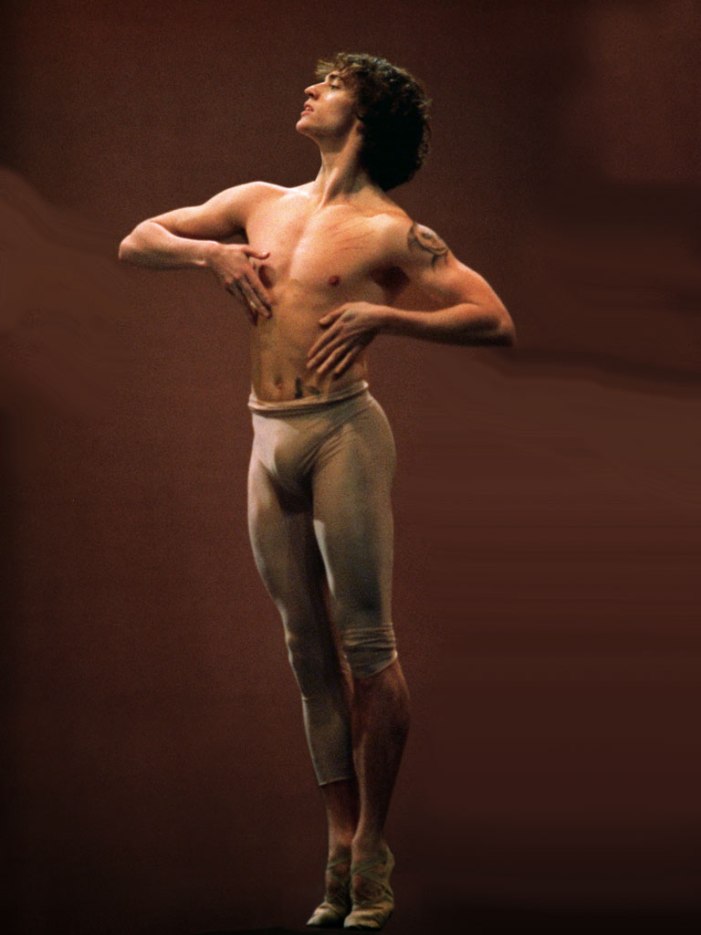
The other night Paul and I watched the documentary Dancer, about Russian ballet dancer Sergei Polunin. (I guess that makes him a ballerino, which term has never really caught on; most male ballet dancers are just called ballet dancers, which is interesting.) The documentary was pretty amazing; particularly when it focused on showing him dance. I will be the first to admit that I have not watched nearly as much ballet as I would like to have; not as many ballets are recorded on film as perhaps we should wish. I have spent time on Youtube watching Nureyev and Baryshnikov and the gorgeous Italian Roberto Bolle, which is how I originally came across “Take Me to Church,” the video of Polunin dancing to the song and shot by Dave LaChappelle (if you haven’t seen it, you really need to; the things he can do–how high he can leap, how gracefully he can spin–just take your breath away). I really do want to write a noir about ballet; it’s on the list of things I want to write.

Sergei:

balletPolunin

Roberto Bolle:

blogdicultura_c2bae99094e552bbf9904e0e0068c53e

I will never, I fear, have the time to write all the books I want to write. This is one of the reasons I always beat myself up when I have either an unproductive day (yesterday) or a lazy one (say, last weekend, for example). But I somehow cannot write every day; no matter how much I try. I need to get focused on finishing my short story “A Whisper from the Graveyard,” and I need to start getting the Scotty rewritten as well as some work done on the WIP. July is slipping through my fingers, and with less than three full weeks left, time is running out. Which is how I then start berating myself and sliding into negativity, which usually correlates with self-flagellation, and a further downward spiral.

Lather, rinse, repeat.

But, as I said earlier in the week, I did have a massive breakthrough on both the WIP and the Scotty; both are going to take some serious work, but I feel confident that I can get them done. Just not so confident that I can get them done by the end of this month, but hey, focus is the key. I want to get the short story finished, or at least a draft of it, before I can focus totally on the Scotty; and I really need to reread the entire WIP from start to finish, to make notes and figure out what and where can be salvaged and what needs to be jettisoned.

But I do highly recommend Dancer. I think, even if you aren’t a ballet fan or don’t know anything about ballet, if you’re an artist of any sort you would enjoy it; it’s really about sacrifice in the name of art and success; Sergei was separated from his family at a very early age in order to pursue his talent for dancing–the sacrifices his own family made are extraordinary (his went to Portugal to work to pay for the training; his grandmother moved to Greece to do the same, and neither saw their family for years; his family never even had the opportunity to see him dance after he went away to London to train) and how the enormous early success, plus not having any family to ground him, caused him to crash and burn–not in a dramatic way, he just had an emotional breakdown and walked away from his career not once, but twice.

One of the things I found most interesting was his own take on things–basically, he reached the pinnacle of dance at an early age, and then, what was there left to achieve? Which is an interesting concept, an interesting question, for any artist: when you’ve reached the top of your field, or produced your best work, what do you do next?  I kind of crashed and burned early last year, which resulted in a desultory year where I not only didn’t write but didn’t really want to; it is incredibly easy to fall into that trap. I failed to see the point in it anymore, and I once heard myself saying to someone during that miserable year, well, I’ve published this many books, no one can ever take that away from me, I will always be an author no matter what, and as the words came out, as I heard them, they bothered me.

It took me a while to realize that they bothered me because I hadn’t accomplished everything I had set out to do when I decided to take writing seriously some twenty-odd years ago; and there was a hint of resignation and defeat in the words. But I do think last year was necessary, for my personal growth as well as my professional. It made me take stock of things, made me remember what I wanted, and even though it took me a long while to get to a point where I was ready to write again and felt invigorated and recharged enough to do so.

I do feel like the work I am doing now is some of the best of my career thus far; so there is also that. Maybe I’m fooling myself and maybe I am not; we shall see.

And on that note, tis back to the spice mines.


Why Can’t This Be Love

Wednesday and I am very tired this morning; not sure what that’s all about, but there you have it.

I had yet another breakthrough this week on something I’m working on–which brings the breakthroughs in recent weeks to an almost ridiculous level. I finally recognized, through my own stubbornness, that the story I was trying to tell in the WIP is the wrong story; I kept trying to  make it fit the story I wanted to tell, ignoring the little voice I would hear every once in a while telling me no, this is the real story, why won’t you listen to me? Finally, on Monday night, it hit me upside the head with a two-by-four; and when I finally stopped fighting it and  listened to the voice, the entire plot fell into place and all the problems I couldn’t seem to iron out completely magically answered themselves. And you know what? Once again it all comes down to me being ridiculously stubborn when I didn’t need to be, and not listening to  my inner voices.

Seriously, you’d think I’d know better by this point. But I never seem to learn. And of course, rereading the previous paragraph now I realize it sort of makes me look sort of insane. But you know, I don’t know any other way to say it than a voice in my head. I kept trying to make this manuscript, characters and town fit this story I was trying to tell, with the end result that I wasn’t seeing their real story.

And now I can’t wait to fix it and make it better.

I am so behind on so many things I need to get done–I need to get the Scotty revisions done; I need to get to work on this; I have a short story I need to write….madness. And I have so much reading to do! I need to get back on the Short Story Project, and I want to read Lou Berney’s November Road and Sarah Weinman’s The Real Lolita and Alex Segura’s Blackout and…heavy heaving sigh.

We watched a really good Australian show this weekend, Secret City, which starred Anna Torv (been a fan since Fringe, and she was also terrific in Mindhunter), which had a lot going for it–the cutthroat world of domestic and foreign politics is at the core of the story, which opens with a young man being murdered and a reporter (Torv) happening upon the crime scene and starting to investigate. I do recommend this show highly, and there’s also a wonderful subplot where it turns out that Torv’s ex-husband is a transwoman, and I thought the show handled it beautifully, with one slight quibble.

We also started watching HBO’s Sharp Objects, which I thought was spectacular. I actually preferred this Gillian Flynn novel to Gone Girl, the book that made her famous and a publishing superstar, and I still need to read her other novel, Dark Places.

And now, back to the spice mines.

columbo

Word Up!

So, the staycation is over and it’s back to work for me today. Heavy heaving sigh. I shall miss the halcyon days of getting up when I felt like it, of leisurely spending my morning over coffee as I responded to emails or edited a story or wrote something new, the casual approach I could take to chores and errands. Heavy heaving sigh, indeed.

But at least it’s a short work week–only four days–which makes the adjustment back to not having my own schedule much easier to live with.

I didn’t get as much done on this staycation as I had hoped–when do I ever–but I am pleased with the progress made. I am checking things off on my to-do lists, making new ones, and as always, moving forward even if it appears, at times, to be at a glacial pace. Glacial pace, after all, is better than staying put or sliding backwards. And I am seriously trying to not beat myself up about things as much as I did before. It’s a new me.

We’ll see how long he lasts, shall we? But change doesn’t happen overnight, and I am aware that one doesn’t change a lifetime of self-deprecation overnight. I am determined, however, to break this hideous cycle. ’tis a process, my friends, and one that I fully intend to complete. I doubt very seriously that I will rid myself of all my neuroses, but I suspect I shall come rather close.

One of the things I did yesterday was pull all of the individual chapters of Royal Street Reveillon into one document; part of my new let’s try something new with this manuscript experiment. Usually I write each chapter as a separate file, labeled accordingly: “Chapter 12-2” being the second draft of Chapter Two, etc, and that also enables me to measure my daily progress–“oh got another two chapters done today,” etc. etc. However, I am now going do this second draft completely differently; still chapter by chapter, but as one big document and I am going to try to revise it backwards; in other words, I am going to start with the last chapter, revise it, and work my way back to the front. I’ve become, as a result of the chapter method, very rigidly adherent to a mathematical process by which every chapter is the same length, or within 100 words of the same length; I am hoping that by doing the manuscript in this way the chapters will be as long as they need to be while I keep an eye on the overall length. Right now, at 25 chapters it comes in at slightly more than 77,000 words and that is without either the prologue or the epilogue….and this book’s epilogue is going to be longer than previous ones, so I need to be more mindful of length. I am also going to follow the outline I did Sunday, so I have a better idea of what needs to go in. (I am going to start the revising by grabbing the notes I made while outlining and going back in to fix those issues up.) I also think there are two important characters I’ve let languish on the sidelines a bit much; I’m going to try to figure out how to work them into the story more completely. This is a bit of a chore, since I am juggling one of my biggest casts ever, but it simply must be done.

And above all else, I’ve got to get Scotty’s voice right.

The voice must be right.

And I have to say, I do enjoy being in Scotty’s headspace.

And with a bit of trepidation, I venture back out of my home and into the world again; back to the spice mines. Wish me luck.

32228774_1842882939339274_3554824450987786240_n

Who’s Johnny

Yesterday I spent a few hours rereading (skimming) the manuscript and I really need to stop being self-deprecating; as a whole, it actually holds together very well and there are some mistakes and loose ends that I did manage to catch; but overall, it’s a very solid, workable first draft and I am enormously pleased with it. I’ll probably do some more futzing with it tomorrow–time-lines and so forth–but I think with the notes I made and a very strong eye to line editing, I can have this finished by the end of the month after all.

HUZZAH INDEED!

I also went over the final edits for my story “The Silky Veils of Ardor” and approved them for editor extraordinaire Josh Pachter, and send them off. Yet another huzzah! This pleases me to no end, Constant Reader, you have no idea. I was, as always, deeply concerned about the novel manuscript; I’m not certain when and where and how I developed this horrible mentality (an off-shoot of Imposter Syndrome or simply another deeply psychotic self-loathing version of it) that everything I write is terrible or garbage or whatever negative thing I can possibly think to say about it while in process; maybe it’s the familiarity and closeness to the story, knowing what I want it to be and what it’s not turning out to be on the page as I struggle through the first draft, but I’d hoped to avoid that with writing this book. This is why I went off deadline for the first time since 2001; so that I could take my time (other than my own personal deadlines) and not feel rushed to finish. My usual methodology for writing a manuscript evolved into writing on deadline and going back, when stuck, to the beginning and revising, with the end result that I usually wrote the last chapter or two the week (or days) before turning it in, and almost always after the original deadline. The end result of this was, to me, that the first two-thirds of my books were often rewritten, revised and polished repeatedly, while the final third maybe got a good going-over maybe once; which quite easily produced the mentality that my work fizzles out at the end rather than delivers.

Obviously, it never crossed my mind as a possibility that that final third of the book needed less work than the first two-thirds precisely because so much work went into the first two-thirds. When I reread my novels now, they seem seamless to me as they move from beginning to end; there’s no place where I can ever identify as definitely being, ah yes this is where I had to start rushing. In other words, it’s part of the self-loathing that comes from a lifetime of self-deprecation, the mentality that if it’s better if I point out my own flaws in a gently mocking, funny, amusing manner before someone else does it in a more cruel fashion.

As you can tell, the part of Hannah Gadsby’s Nanette that had to do with self-deprecating humor resonated particularly strongly for me; this notion that I can head off humiliation at the hands of others if I voluntarily humiliate myself first, and that way I can be queer in public with a slightly higher degree of safety. I shall continue to reflect on this, think about it, blog about it more–but the truth is, self-deprecation is really not a good thing. Humility, the knowledge that your success is not only the result of hard work but also involved a healthy dose of what can only be described as sheer luck–whether that’s simply timing or whatever else it might be–is a completely different thing from self-humiliation. I know I’ve always been incredibly lucky with my career; most of it has benefited from being in the right place at the right time or making the right connection at the right time, but none of that would matter without the work. 

If I hadn’t done the work–if I hadn’t written the books or the stories or edited the anthologies, none of the timing would have amounted to anything. So I need to stop allowing myself to think that luck is the sole source of my writing career. Yes, luck did, and has, played a part in my career, but it wasn’t all luck. And there’s nothing, nothing, wrong with allowing myself to take a little credit for the work I’ve done.

It’s really kind of sad that it’s taken me this long to get here–and I’m still not completely here; my default is automatic self-deprecation, and I’ve got to stop that. It’s certainly not healthy, and it’s certainly not helpful in any way.

The final story in Promises in Every Star and Other Stories is “Someone to Lay Down Beside Me”:

“You really see some tragic drag in this place at four in the morning,” Dennis said, shaking his head. He said it a little too loudly, and I glanced over at the counter nervously. He rolled his eyes and smiled at me. “Don’t look so worried. She didn’t hear me.” He looked over at her with disgust on his face. “Besides, she’s so fucking wasted she doesn’t know what day it is.”

He plucked a packet of Sweet ‘n’ Low out of the little caddy next to the ketchup and mustard bottles, and shook it a few times before dumping it into his red plastic cup of iced tea. He took a big swig before using a paper napkin to wipe beads of sweat off his forehead.

It wasn’t quite four in the morning, but I wasn’t going to be sleeping anytime soon. The digital jukebox was blasting a remix of Rihanna—“Only Girl in the World,” which weirdly enough seemed like the appropriate soundtrack for episode of The Real Housewives from Hell playing on the flat screen television mounted on the wall I was facing.

I wiped my own forehead with a napkin. It was hot in the Clover Grill and the air seemed thick and heavy with grease. Burgers were frying on the grill, and French fries were sizzling in the deep fryer. The smell was making me more than a little nauseous. I didn’t know how Dennis could possibly eat anything. I felt a wave of nausea coming on, so I closed my eyes and took some deep breaths till it passed. My lower back was aching, so I turned in my chair and put my back up against the wall. We were sitting at the table in the absolute back, and Dennis had his back to the front door. I put my feet up on the extra chair at our table and leaned forward a bit, trying to stretch the ache out of my back.

I took another big drink out of my red plastic cup of water and couldn’t help smiling to myself. I recognized the tragic looking drag queen sitting at the counter. I’d seen Floretta Flynn perform any number of times at various clubs in the Quarter. She was one of the better drag performers in the city, and was actually quite funny. She’d been hostess of the show we’d caught earlier in the evening at the Parade, while we were waiting for our dealer to show up. She’d clearly had too much to drink since then—Dennis swore drag queens were always smashed when they went on stage, but I couldn’t tell.  It was obvious now, though. She was seated at the counter on one of the revolving stools, leaning against a hot muscle boy who didn’t seem quite as wasted as she was. Her massive 1970’s country-singer wig was askew and her lipstick was smeared around her mouth. Her mascara was also smudged around her eyes, and it looked like she may have tried to wipe off some of the foundation and rouge on her cheeks. Her bright red sequined dress looked dirty, and she’d spilled something down the front of it.

This story was written for Jerry Wheeler’s Dirty Diner anthology; I’d written the beginning years earlier, based on the exact same conversation I had with a friend at the Clover Grill around four a.m. as we stopped to get something to eat on our way out of the Quarter. I originally saw this story, when it was conceived, as part of the ‘four-friends-in-the-quarter’ book The World is Full of Ex-Lovers; and it really ties in with some of my other stories about the same characters; though I’m not sure anyone else ever made the connection. This story has a theme that I’ve returned to over and over again in my fiction: finding validation after rejection.

That particular theme also calls for some further reflection, frankly.

And now back to the spice mines.

32116196_1843045152656386_5063644486387630080_n