King for a Day

Ah, Monday. Blue, blue Monday, and yet the beginning of still another work week.

I worked quite a bit yesterday, and even made it to the gym. I was one of six people in the gym, and if you guessed that at one point in my workout four of the other five people had taken up all the options for my next exercise, you’d have guessed correctly. And no one apparently notices the signs posted everywhere that read Please rerack your weights when finished.

No. One.

Back when I used to work in fitness environments, I was always amazed at how people just leave their weights on the machines or dumbbells wherever they used them rather than putting them back–as though they assumed that the staff people working were there to clean up after them. It used to happen in aerobics classes I taught, too–the attendees would finish, then leave their steps, dumbbells, and sometimes their sweaty towels there for me to put away.

It would be so lovely to one day be wealthy enough to have my own workout room in my home. All I want, really–a room that’s a dedicated office space and a workout room. Is that really so much to ask for?

Lately, so many things have been getting on my nerves that I’ve wondered if I am on edge, or if something’s going on in my subconscious that’s bubbling up by making me highly annoyed and irritated with people, or something, I don’t know what; but the more I think about it, the more I tend to think, no, you’re just sick of assholes.

Seriously. And then I remembered the most important thing of why I am a crime writer: I can kill off assholes fictionally.

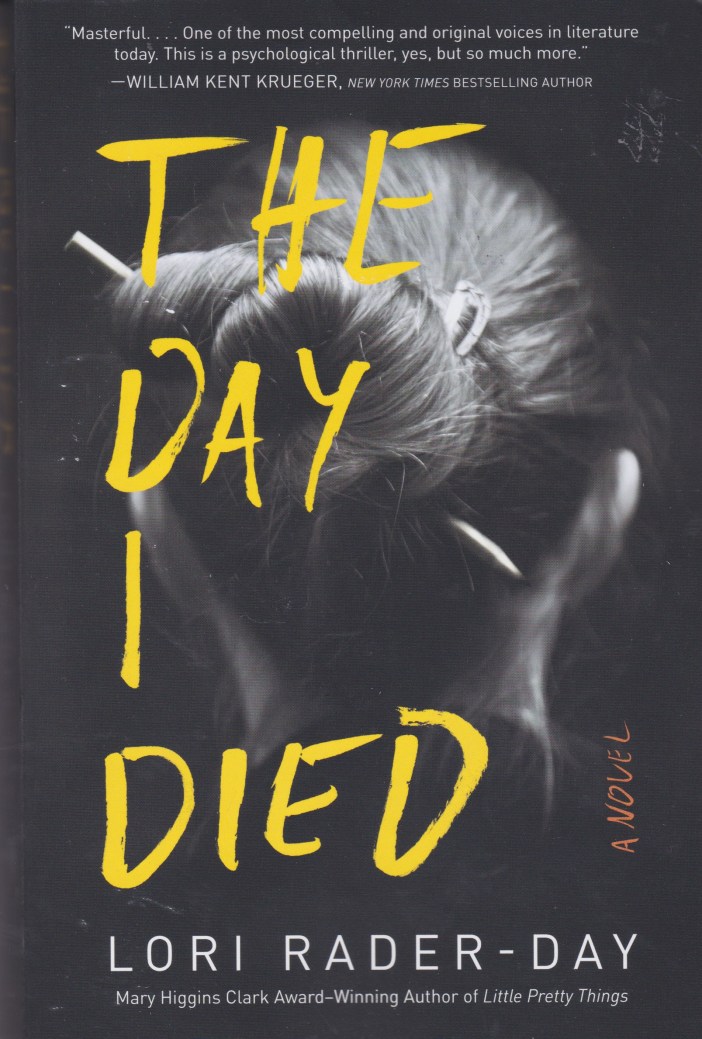
I also finished Lori Rader-Day’s The Day I Died, and started reading Nadine Nettman’s Uncorking a Lie.

the day i died

On the day I died, I took the new oars down to the lake. They were heavy, but I was saving myself the second trip. The blades rode flat along the ground, flattening two tracks through the wet grass.

It was morning. The air was cool, but down on the dock, the slats were already hot. I noted a lone fishing boat out on the water. Inside, two men hunched silently over their tackle, their faces turned out across the lake. Beyond them, mist rose off the water, nearly hiding the far shore.

This moment. This is what I return to.

Later, I will note the long crack on the new oar, just before my head goes under, just before the flume of blood rises off my skin under the water like smoke. I will come back to othis moment and think, if I had just gone back up the steps to the house immediately. If I had just stayed up at the house in the first place.

If I had just.

Lori Rader-Day’s Anthony Award shortlisted 2017 novel is quite excellent. Thematically, it’s about desperation–what people do when they have no other options. In the case of Anna Winger, Rader-Day’s main character, her childhood was desolate and bleak; the child of an alcoholic abuser, she moved from there to an abusive relationship with a boyfriend before fleeing for her life and that of her unborn child. Now, she lives in a wretched little town in Indiana, working as a freelance handwriting analyst. A child has gone missing in Parks, Indiana, and the local police bring her in for her expertise, bringing her into the case sideways. The case also stirs up dark memories of her own past for Anna, and her child–now thirteen and entering that rebellious stage–is becoming more and more closed off from her, difficult to know; and she has to wonder, as a mother, if this life they’ve led of constantly moving and never establishing roots anywhere, is messing up her own child. The parallels between the missing child case of the present and her own disappearance from her own life brings her to her own breaking point–and to where she can no longer ignore or deny her past, but most confront it.

Rader-Day’s strengths–her depiction of how claustrophobic yet lonely small towns can be; her ability to create sympathetic, damaged characters–are all here, and the book is structured beautifully; each incident and scene flowing into the next until the reader has to keep compulsively turning the page.

And now, back to the spice mines.

Spies Like Us

SATURDAY! Sorry, I was too tired to post yesterday.

And yes, Constant Reader, we somehow managed to make it through yet another week. I think we deserve a round of applause.

Thank you, thank you.

Thursday I had a late day at the office, so I managed to do three loads of laundry, a load of dishes, and made it to the gym before going to work. I know, right? Who am I, and what have I done with Gregalicious? 

I am looking forward to the weekend, to be honest. I want to clean the hell out of my apartment, have some errands to run, would like to get to the gym, and get some writing done. I think I unlocked the key to “Please Die Soon” last night, but I also realized I need to talk to a friend of mine for research purposes. (I actually need to talk to two friends for separate research purposes, so I should probably get going on that as well. Heavy sigh.) MAKE A GODDAMNED LIST ALREADY.

And now we move on to Florida Happens, and our first story, “The Burglar Who Strove to Go Straight”, by Lawrence Block.

(‘Excerpted from The Burglar Who Liked to Quote Kipling by Lawrence Block, originally published in 1979, when St. Petersburg was decidedly less scenic than it is now.)

Browsers came and went. I made a few sales from the bargain table, then moved a Heritage Club edition of Virgil’s Eclogues (boxed, the box water-damaged, slight rubbing on spine, price $8.50). The woman who bought the Virgil was a little shopworn herself, with a blocky figure and a lot of curly orange hair. I’d seen her before but this was the first time she’d bought anything, so things were looking up.

I watched her carry Virgil home, then settled in behind the counter with a Grosset & Dunlap reprint of Soldiers Three. I’d been working my way through my limited stock of Kipling lately. Some of the books were ones I’d read years ago, but I was reading Soldiers Three for the first time and really enjoying my acquaintance with Ortheris and Learoyd and Mulvaney when the little bells above my door tinkled to announce a visitor.

I looked up to see a man in a blue uniform lumbering across the floor toward me. He had a broad, open, honest face, but in my new trade one learned quickly not to judge a book by its cover. My visitor was Ray Kirschmann, the best cop money could buy, and money could buy him seven days a week.

“Hey, Bern,” he said, and propped an elbow on the counter. “Read any good books lately?”

This is a charming story, and as you can imagine, I was thrilled to death to have something by Lawrence Block to kick the book off. I’m a big fan–although I’ve not read the entire backlist, I certainly have loved everything of his I’ve read–and of course, his anthologies of crime stories inspired by paintings (Alive in Shape and Color, In Sunlight or in Shadow) were also fantastic. I never thought I’d see the day when I edited an anthology that would have a story by Lawrence Block as the lead-off–so you can imagine the thrill; and it’s a story about books and a bookstore. How could I not love that?

Have I mentioned lately how much I love my life?

And now back to the spice mines.

IMG_2383

Your Wildest Dreams

Good morning! It’s Thursday, everyone, and with a short day at the office ahead of me and just one more day before the weekend, I am feeling good. Not as good perhaps as I should, but I slept really well last night, don’t have to be at work until later this afternoon, and I am going to even go to the gym this morning before it’s time to go to work.

I call that a winning day, don’t you?

I am reading Lori Rader-Day’s The Day I Died as prep work for my moderating duties at Bouchercon next month. I am, in case you weren’t paying attention, Constant Reader, moderating the panel highlighting the Anthony Award finalists for Best Paperback Original. After I finish Lori’s book I’ll be reading Bad Boy Boogie by Thomas Pluck, What We Reckon by Eryk Pruitt, Cast the First Stone by James Ziskin, and Uncorking a Lie by Nadine Nettmann. I’m enjoying Lori’s book–I also enjoyed the previous one of hers I’d read, Little Pretty Things, and as I’ve said before, there’s no one more fun to traverse the back roads of rural Alabama on a rainy morning with. All of these books had been in my TBR pile for quite some time, so it’s great to have an excuse to pull them out and read them.

I worked a little more on “Please Die Soon” yesterday; the story is becoming even creepier the more I work on it–although I think I may have done some overkill with it. But I am going to keep going with it, and once I am finished with the first draft I’ll figure it out in the revision process. I am also letting “A Whisper from the Graveyard” sit for a while–I know there’s some serious tweakage needed in it as well before submitting it–and I am starting to get to work on the August/September project as well. Exciting times for a Gregalicious.

And before I go to the gym this morning, I’m going to try to get the house straightened up a bit.

And while I know I’ve already talked about my story in Florida Happens (“Cold Beer No Flies”) I intend to spend the rest of this month’s focus on The Short Story Project on the stories and authors in the book, to try to whet your appetite for either preordering the book or buying it at Bouchercon. We are doing a launch for the book there on Thursday at 1; all the authors present gathering to sign and/or discuss the book and their story. And of course, it’s just easier for me to start by talking about my own.

Dane Brewer stepped out of his air-conditioned trailer, wiped sweat off his forehead and locked the door. It was early June and already unbearably hot, the humidity so thick it was hard to breathe. He was too far inland from the bay to get much of the cooling sea breeze but not so far away he couldn’t smell it. The fishy wet sea smell he was sick to death of hung in the salty air. It was omnipresent, inescapable. He trudged along the reddish-orange dirt path through towering pine trees wreathed in Spanish moss. The path was strewn with pine cones the size of his head and enormous dead pine needles the color of rust that crunched beneath his shoes. His face was dripping with sweat. He came into the clearing along the state road where a glorified Quonset hut with a tin roof stood.  It used to be a bait and tackle until its resurrection as a cheap bar. It was called My Place. It sounded cozy—the kind of place people would stop by every afternoon for a cold one after clocking out from work, before heading home.

The portable reader board parked where the parking lot met the state road read Cold Beer No Flies.

Simple, matter of fact, no pretense. No Hurricanes in fancy glasses like the touristy places littering the towns along the gulf coast. Just simple drinks served in plain glasses, ice-cold beer in bottles or cans stocked in refrigerated cases at simple prices hard-working people could afford. Tuscadega’s business was fish, and its canning plant stank of dead fish and guts and cold blood for miles. Tuscadega sat on the inside coast of a large shallow bay. The bay’s narrow mouth was crowned by a bridge barely visible from town. A long two-lane bridge across the bay led to the gold mine of the white sand beaches and green water along the Gulf Coast of Florida. Tourists didn’t flock to Tuscadega, but Tuscadega didn’t want them, either. Dreamers kept saying when land along the gulf got too expensive the bay shores would be developed, but it hadn’t and Dane doubted it ever would.

Tuscadega was just a tired old town and always would be, best he could figure it. A dead end the best and the brightest fled as soon as they were able.

 He was going to follow them one day, once he could afford it.

Towns like Tuscadega weren’t kind to people like Dane.

“Cold Beer No Flies” was originally conceived of back when I lived in Kansas, as far back as when I was a teenager. There was a bar in Emporia called My Place, which was an okay place–it had a concrete floor, just like the one in my story–and it also had one of those rolling readerboard signs along the road, and it literally read that: MY PLACE COLD BEER, NO FLIES. I always thought that was funny, and I always wanted to write a story called “Cold Beer No Flies.” I think I wrote the original first draft of the story in the 1980’s, and it languished in my files all these years. When it came to be time to write something for Florida Happens, I picked out “Cold Beer No Flies”, read the first two drafts of what I had written before, and decided to reboot the story and adapt it to the Florida setting. I’d always seen it as a noir story, and in rewriting/adapting it to fit this I needed to obviously move the setting from Kansas to Florida. I also had the bright idea to set it in the panhandle; I figured (rightly) that the majority of stories would be set in the beach communities literally the southern coasts of the state, and not many people would be moved to right about either the interior parts or the panhandle. I picked a dying, rotten little small town and placed it on a panhandle bay, similar to the little town my grandparents retired to in the early 1970’s. I also wanted to look at, and explore, what it’s like to grow up gay and working class in such a place–very redneck, very conservative, very backwards, very religious, very homophobic. The story turned out very creepy, I think, which was precisely what I was going for, and I hope you enjoy it when the time comes, Constant Reader.

And now, back to the spice mines.

536a946bd2915add3da2f3ce62e4968b--rugby-men-rugby-players

Take Me Home

Saturday morning and I feel great. If you think that means I slept well last night, you would be correct in that assumption.  It’s amazing what a difference it makes; those of you who have no trouble sleeping at night and can get amazing rest every night? You have no idea how lucky you are, and how much I envy you.

Today I have errands to run, a house to clean, a workout to do; as long as I stay motivated I can easily get all of these things done. I also have writing to do–I want to finish “A Whisper from the Graveyard” this weekend, and I also want to finish making my notes on the Scotty book, at which point I need to revise the outline I did (after finishing the first draft) so I can start the massive edit/rewrite for the second draft I need to get done. As I also mentioned the other day, I also need to start reading the books on the Anthony shortlist for Best Paperback Original, since I am moderating that panel at Bouchercon this year. To jog your memory, those books are, as follows: The Day I Died by Lori Rader-Day; Bad Boy Boogie by Thomas Pluck; Uncorking a Lie by Nadine Nettman; What We Reckon by Eryk Pruitt; and Cast the First Stone by James Ziskin. I got some good reading ahead of me, don’t I? Yes I do!

Huzzah! This is, after all, always a good thing.

I am, alas, as always, behind on my writing schedule. I had wanted to get Scotty finished this month (ha!) before embarking on an a project that will consume August and September; and then I had wanted to work on the WIP in October and November before starting on Bury Me in Satin in December. I don’t see that happening now, alas, since I got so little done on Scotty this month. Then again, you never know. If I can maintain good sleeping habits and maintain meeting goals and staying motivated every day in the face of the oppressive heat of a New Orleans August, I just might be able to get back on schedule.

Here’s hoping.

I did finished reading Jessica Knoll’s The Favorite Sister this week.

the favorite sister

A man whose name I do not know slides his hand under the hem of my new blouse, connecting the cable to the lavalier mic clipped to my collar. He asks me to say something–sound check–and for a single reckless beat, I consider the truth. Brett is dead and I’m not innocent.

“Testing. Testing. One. Two. Three.” I’m not only dishonest. I’m unoriginal.

The sound guy listens to the playback. “Keep your hair off your left shoulder as much as you can,” he tells me.  I haven’t had my ends trimmed in months, and not because my grief has bested my vanity. I’m hoping viewers are better able to see the resemblance to my sister. I have nice hair. Brett had beautiful hair.

“Thanks,” I reply, wishing I could remember his name. Brett would have known it. She made a point of being on a first-name basis with the crew–from the gaffer to the ever-rotating harem of production assistants. My sister’s speciality was making underappreciated people feel appreciated. It’s a testament to that quality that we are all gathered here today, some of us prepared to tell heroic lies about her.

This is Knoll’s second novel; her first, Luckiest Girl Alive, was stunningly brilliant and I loved it. I also believe she may have made the Edgar shortlist for Best First Novel. In this book, Knoll again takes as her theme ambitious women and the conflicts they have with each other, set against the backdrop of a reality television series which is clearly based, in some ways, on the Real Housewives shows. The show, Goal Diggers of New York, ostensibly focuses on five women who are all entrepreneurs, don’t have kids, and in most cases are also single. Goal Diggers has the same pedigree as the Real Housewives shows; originally intended as a docu-series focusing on real women and the struggles they have running businesses and so forth, it has descended into a ratings-hungry juggernaut predicated on pitting the women against each other emotionally and forcing them into feuds. The ultimate cleverness of the book is it follows, basically, the same trajectory as if it were, indeed, a reality show about women; it reads like a season of a Real Housewives franchise. There are three main point-of-view characters–sisters Kelly and Brett, and Brett’s former best friend, an author of color named Stephanie. Kelly narrates the action in the present, after all the events of the book are finished–the device used is her filming what is known as a ‘talking head’ interview; where the camera is trained on the cast member and asked questions. The rest of the book is about the filming of the most recent season of Goal Diggers, which ended in tragedy; that is shown from the alternating POV’s of Brett and Stephanie, who manufactured a feud for the season as a storyline but the ‘fake feud’ actually runs far deeper, with a far worse betrayal at its heart, than anything that was taped for the series. The book addresses a lot of current hot topics in our culture and society: racism, homophobia, same-sex marriage, sexism. It’s very hard to talk about the book without giving spoilers; like a season of a reality show, the twists and turns the plot takes are part of the joy the reader gets from the story, and to discuss them would spoil it for new readers. But it’s very well-written, and the characterizations are quite strong.

I have to say, I enjoyed every second of reading this book, and I can’t wait for Knoll’s next one.

And now, back to the spice mines.

Love Touch

Sunday morning, as I sit here in my cool workspace swilling coffee, trying to wake up and figure out what to do with the rest of my day. I need to go to the grocery store and I should also probably make an attempt to go to the gym; but I can’t seem to find my iPad, which makes doing cardio pointless (I read or watch TV on my iPad while on the treadmill; perhaps not having my iPad is simply an excuse for not going; what if it’s gone, lost, stolen? I am trying not to think that way and am hoping that I simply left it at the office. If not, I am terribly screwed because I don’t know where it is and I currently don’t have the cash on hand to replace it. So, yes, let’s just continue pretending happily that it’s as the office, shall we?)

I could, of course, just go to the gym and do weights. That always feels good, at any rate. Perhaps once I finish swilling this coffee….

I slept late yesterday, and I slept even later today. I spent most of yesterday not only reading but doing chores around the house, on the pretense that today I would not only go to the grocery store and the gym, but I would also spend some time writing today. I need to finish a short story; I need to revise still another, and there’s that new one struggling to take root in my brain that I haven’t really decided what to do with just yet. There are two others swirling around up there in my head, as well as others I’ve not thought about or have forgotten about in the meantime. But now, now as I wake up I feel more confident about running the errands and going to the gym and actually doing some writing today.

I’ve been reading The History of Western Philosophy by Bertrand Russell, and greatly enjoying it; is there anything quite like well-written non-fiction? It’s why I love Joan Didion and Barbara Tuchman; one of the things I love to do while reading is to learn, and non-fiction fills that need quite beautifully. I also like non-fiction that makes me think; which is why I am looking forward to reading Dead Girls by Alice Bolin. I still would love to do a collection of my own essays, book reviews, and so forth; but egad, what an odious chore pulling all of that together would be. I struggle with essays, but I also think that the writing of essays; the ability to pull thoughts from my head and extrapolate them out to their fullest meaning, is vitally important and a skill-set I wish I had honed more properly. A friend once pointed out to me, as I bemoaned my inability to write essays, that my blog itself is nothing more than years of personal essays. That took me aback, because it was, in many ways, correct; there is definitely some truth to that, but it’s hard for me to take the blog seriously in that fashion, because so much of it is simply written off the top of my head in the morning as I wake up and drink coffee and try to figure out what to do with the rest of my day.

One of the problems for me with personal essays is, ultimately, the issue of self-deprecation, which I’ve addressed in previous blog entries about my writing and my career and my books; who am I to write about this subject? Am I expert enough in this to write about it, or am I simply talking about things that smarter, better-educated people have written about long ago and having the hubristic belief that I am the only person to see this truth for the first time? 

And, in considering myself self-deprecatingly as not that special or particularly smart, I defeat myself and never write the essay.

And of course, there is the problem of all the lies my memory tells me.

But yesterday, I took the afternoon to finish read an ARC of Lou Berney’s new novel, November Road, and was blown away by it.

Scan.jpeg

Behold! The Big Easy in all its wicked splendor!

Frank Guidry paused at the corner of Toulouse to  bask in the neon furnace glow. He’d lived in New Orleans the better part of his thirty-seven years on earth, but the dirty glitter and sizzle of the French Quarter still hit his bloodstream like a drug. Yokels and locals, muggers and hustlers, fire-eaters and magicians. A go-go girl was draped over the wrought-iron rail of a second floor balcony, one book sprung free from her sequined negligee and swaying like a metronome to the beat of the jazz trio inside. Bass, drums, piano, tearing through “Night and Day.” But that was New Orleans for you. Even the worst band in the crummiest clip joint in the city could swing, man, swing.

A guy came whipping up the street, screaming bloody murder. Hot on his heels–a woman waving a butcher knife, screaming, too,

Guidry soft-shoed out of their way. The beat cop on the corner yawned. The juggler outside the 500 Club didn’t drop a ball. Just another Wednesday night on Bourbon Street.

Lou’s previous novel, The Long and Faraway Gone, won every crime-writing award under the sun that it was eligible for: Edgar, Anthony, Macavity, and I don’t know what all; it was the crime publishing equivalent of the EGOT. It was, obviously, an exceptional novel. I met Lou when we were on a panel together at the Raleigh Bouchercon, along with Lori Roy and Liz Milliron; moderated by the amazing Katrina Niidas Holm. It was funny, because the panel topic was, I think, writing about small towns which, in fact, none of us on the panel really did, but we had fun with the topic and I know I brought up Peyton Place at least once and pointed out that suburbs are small towns with the primary difference being suburbs are bedroom communities for cities while small towns aren’t attached in any way to a larger city. It was fun and spirited and I liked Lou, thought he was incredibly smart, as were Liz and Lori. Lori and Lou went on to win Edgars for that year; and I admire their work tremendously. I’ve not had the opportunity to read Liz’ work; but she did have a terrific story in the New Orleans Bouchercon anthology, Blood on the Bayou.

Anyway, I digress.

I’ve been looking forward to November Road since I finished reading The Long and Faraway Gone, but I still need to go back and read Lou’s first two novels, Whiplash River and Gutshot Straight. 

I also have to admit, I was a little hesitant about Lou’s new book; it’s built around the Kennedy assassination in 1963, which always gives me pause (I have yet to immerse myself in Stephen King’s 11/22/63). I’m not sure why I don’t care to read fiction around the Kennedy assassination, but there you have: an insight into my mind. But the Kennedy assassination, while a primary plot device, is just that: a device to set the story in motion. Frank Guidry is involved with a mob boss in New Orleans, and after the Kennedy assassination he is given instructions to fly to Dallas, retrieve a car, and drive it to Houston to dispose of it. While he is doing this, he realizes that he is getting rid of evidence that may be of vital importance to the investigation into the president’s murder–and as such, is a loose end who knows too much and figures out he’s got to disappear now because they’re going to want to kill him. And sure enough, they do send someone after him, Paul Barone, a remorseless killer and tracker. The cat-and-mouse game between them builds suspense throughout the book.

But it’s not just about Frank, and it is a credit to Berney’s talent, creativity and imagination in that he throws in another primary character, constructed carefully in all the facets and layers that make her live and breathe: Charlotte. Charlotte is a wife and mother in a small town in Oklahoma, married to a useless drunk fuck-up with whom she had two daughters, and her salary working for the local town photographer is the primary thing keeping a roof over their heads. Her own ambitions for being a photographer herself are constantly shat upon by her boss, her society and culture and environment: she is a woman, a wife and mother, and in 1963 that so thoroughly defines her that any other ambition she might have throws her identity as wife and mother into question. Trapped, with the walls closing in on her closer every day, Charlotte takes the president’s assassination as a sign for her to run away with the girls and start over. Charlotte is an extraordinary character;  her relationship with her daughters is the strong backbone of this story. You root for her, you want her to make her escape and make her dreams come true.

Frank and Charlotte cross paths in New Mexico, and Frank sees them as his salvation; his murderous pursuers might be thrown off as they are looking for a single man, not one traveling with his wife and kids; the book becomes even stronger and more suspenseful once they are all together. Frank and Charlotte become close, despite not being completely honest with each other; they are both keeping their cards close to their vests, but yet form a loving bond. WIll they escape, or will they not?

November Road reminded me a lot of Laura Lippman’s Sunburn; the same kind of relationship building between a man and a woman where a lot of information, important, information, is held back from each other, and that lack of trust while falling in love is an important theme in both books: women trying to make their best lives, even if it means making morally questionable decisions, while becoming involved with a man who isn’t completely honest with her. Berney’s writing style, and tone, and mood, also put me in mind of Megan Abbott’s brilliant Give Me Your Hand. If you’ve not read yet the Lippman and Abbott novels, I’d recommend getting them and holding on to them until Berney’s book is released in October and reading them all over the course of a long weekend.

Bravo.
Sweet Freedom

Ah, Monday, which this week is my short day. I didn’t (of course) get as much done this weekend as I would have liked; but the truth of the matter is I really need a day to run errands and do chores–which exhausts me–and then another day to just chill out and relax to get ready for the next week. But I am not beating myself up over not getting things done as planned any more; a to-do list is merely a list of things that have to be done at some point, without deadlines and/or pressure. (Well, actual deadlines do have to be followed, but you know what I mean.) I did spend the weekend getting caught up on things I watch (Animal Kingdom) and some movies I’ve always meant to watch (The Faculty, which was amazingly and gloriously ridiculous) and an absolutely brilliant documentary about Psycho (78/52: Hitchcock’s Shower Scene) and how it changed everything and influenced everything that came after it. It also called to mind how Anthony Perkins deserved the Best Actor Oscar that year and wasn’t even nominated–one of the biggest crimes in Oscar history.

I also did some reading; I read some short stories, which was fun, and I also read more of  Lou Berney’s November Road, which I am trying to read slowly, so as to savor every word and every moment. It really is brilliant; I have to say this is a top notch year in the world of crime fiction, with terrific novels being released left and right–this year has also seen Laura Lippman’s Sunburn and Alison Gaylin’s If I Die Tonight, with Lori Roy’s exceptional The Disappearing and Megan Abbott’s Give Me Your Hand being released this week, and so many amazing others I haven’t gotten to yet. My reading isn’t as public or as frequent this year as I would like, simply because I am judging an award yet again so am trying to focus on reading for that–hence the Short Story Project–and I worry that the great books are going to continue to stack up in my TBR pile, and thus defeat me in the process of ever catching up.

I really need to stop agreeing to judge prizes.

One of the stories I read yesterday was “Almost Missed It By A Hair” by Lisa Respers France, from Baltimore Noir, edited by Laura Lippman:

Had it not been his body in the huge box of fake hair, I like to think that Miles Henry would have been amused.

At least, the man I once knew would have seen the humor in it: a male stylist who made his fame as one of the top hair weavers in Baltimore discovered in a burial mound of fake hair at the Hair Dynasty, the East Coast;s biggest hair-styling convention of the year. It had all the elements that guaranteed a front page in the Sunpapers, maybe even a blurb in the “Truly Odd News” sections of the nationals. Television reports swarmed the scene, desperate for a sound bite from anyone even remotely connected to Miles. Yes, it all would have been sweet nirvana to Miles, publicity hound that he was. If he had lived to see it.

I knew him pretty well. I knew him when he was Henry Miles, the only half-black half-Asian guy in Howard Park, our West Baltimore neighborhood. His exotic looks ensured that he never wanted for female attention, although they also made him a target for the wannabe thugs who didn’t much cotton to a biracial pretty boy spouting hiphop lyrics. He was a few years older than I was, so our paths crossed only rarely. Besides, he was the neighborhood hottie and I was a shy chubby teenager with acne. The different in our social statures, as well as the difference in our ages, limited us to the socially acceptable dance of unequals. Meaning, I stared at him and he didn’t know I was alive. It was only when we were grown and found ourselves cosmetology competitors that we began to talk to each other.

This is a great story, and yet again further proof of how important the voices of diverse writers are. A murder that takes place at a convention for African-American hair and nail technicians? And frankly, I can’t remember the last time I enjoyed a short story as much as I enjoyed this one. I know nothing –or at least, very little– about African-American hair, although I know it’s a very fraught issue. But from the wonderful opening of the discovery of a dead man’s body in a box of fake hair all the way through the finish, the authorial voice is strong, and what makes it even stronger is how she deftly explains, in a non-info-dumpish way, about weaves and wigs and styles and hair sculpting and everything that goes into what women of color deal with when it comes to hair.

Brilliant, and brava.

33922821_10214050210062421_1612661903551627264_n

True Blue

I got up this morning to watch Wimbledon, and while I was sad to see Serena not tie the record for most slam titles ever–I always enjoy watching her play. The men’s semi-final between Nadal and Djokovic was also amazing and great to watch. I have errands to run this morning, but have already started on my household chores. I want to get the errands done and then go to the gym, then come home and finish my chores.

All right, I am home from all my errands and I am exhausted. I still have my chores to do, too. The heat and humidity just sucks the energy right out of you. I may–I may skip the gym today and go tomorrow; I can actually watch the tennis while there on the treadmill, which might be the smarter thing to do. Right now all I really want to do is curl up into a ball and go back to sleep somewhere, but I have to do my chores.

I started reading Lou Berney’s November Road last night, and it is amazing, as I suspected it would be. Maybe I could curl up in my easy chair for a while and just read it. Or maybe after I’ve made some progress on my chores. I’d love to do some writing today; but right now I am so drained and tired…perhaps getting cleaned up might do the trick? Perhaps it might.

Sigh.

Yes, I’m not seeing any writing getting done today, although making notes and thinking about writing might be in the cards. I remembered a tremendous loose end in the Scotty book that needs to be tied up–and it’s a big one. I am also going to do the epilogue differently (every Scotty book has both a prologue and an epilogue; the prologue is where Scotty introduces himself and his family to the reader, while i use the prologue to tie up things and let the reader know what happened after the story) in that this time, for the first time since I think Mardi Gras Mambo, it will actually take place at a reveillon meal, probably at Brennan’s, and while the family is having their meal, Scotty will look around the table and think about everything that’s happened since the end of the story. As I have mentioned before, this is probably the most complicated Scotty plot I’ve done thus far–which makes it the most complicated plot I’ve ever done–and it’s a challenge that, when I think about it more, gets more and more daunting and intimidating.

That could be the exhaustion talking.

And on that note, tis back to the spice mines.

33848324_1851391058488462_4519213658852556800_o

R.O.C.K in the USA

Happy Sunday and a good morning to all y’all.

I didn’t get as much done yesterday as I would have liked; running my errands in the pre-rain humidity literally wore me out, and then when I got going again I started cleaning and doing laundry and well, once I start doing that–as well as going through and trying to organize the books–I am pretty much done for the day….especially after I discovered Burnt Offerings was available for streaming on Prime. Oliver Reed! Karen Black! Bette Davis (who was totally wasted in her role)! I’d seen the movie years ago, I think when it first aired on television after it’s theatrical run, and while it’s still has some moments, it overall doesn’t hold up as well as I would have hoped. I read the book for the first recently in the last few years, and it was wonderful. But watching Burnt Offerings put me in mind of an essay about horror in the 1970’s; the 1970’s was a time when the suburbs really developed because of ‘white flight’ from the cities and desegregation; this was this whole movement of back to the country from the urban centers, and at the same time, there was horror that specifically focused on this phenomenon (without the racism and white flight issues); namely this book, Harvest Home by Thomas Tryon, The Stepford Wives by Ira Levin, and even Stephen King lightly touched on this in ‘salem’s Lot; the dangers of the country to people from the city.

One could even argue that James Dickey’s Deliverance also belongs in this category, and it put me in mind of an essay that I may never write. I also thought up another yesterday while running my errands, after car after car after car violated traffic rules and almost caused me to be in in accident (three times, to be exact; which might be a new record): “Right of Way,” in which I would extrapolate the American contempt for traffic rules and laws for everyone’s safety can be directly correlated to contempt for law and order, the system, taxes, everything. I made some notes, and this is one I may actually write. Essays are fun and I do enjoy writing them but I don’t very often, unless one is requested of me for something, and perhaps that’s the wrong approach.

Today I am going to go to the gym and I am going to start rereading Royal Street Reveillon and make notes for the big revision that is coming. I’m also going to start reading Jackson Square Jazz out loud for copy editing purposes, and I’d also like to work on “A Whisper from the Graveyard” today. I should at some point also work on finished “Never Kiss a Stranger,” which means I should also make a to-do list for everything I want to get done in July.

Hmmm. Perhaps not a bad idea, at that.

I also remembered I have notes on a short story I need to read and decide what revisions I need to be make.

It never truly ends, does it? But I am looking forward to Sharp Objects tonight on HBO; I actually liked this book by Gillian Flynn better than Gone Girl, which of course made her hugely famous and hopefully hugely rich. I still haven’t read her Dark Places, but that’s because I still subscribe to the “if I don’t read all the canon then I still have something by her to read” mentality, which is partly why I still have not read the entire canon of either Daphne du Maurier or Shirley Jackson or Patricia Highsmith.

So, I have a lot to do today–only one more day after today before I return to the office, but at least it’s only a four day work week–and so I should probably get back to the spice mines.

The next story up in Promises in Every Star and Other Stories is “Bloodletting”:

The damp air was thick with the scent of blood.

It had been days since I had last fed, and the desire was gnawing at my insides. I stood up, and my eyes focused on a young man walking a bicycle in front of the cathedral. He was talking on a cell phone, his face animated and agitated. He was wearing a T-shirt that read Who Dat Say They Gonna Beat Dem Saints? and a pair of ratty old paint-spattered jeans cut off at the knees. There was a tattoo of Tweetybird on his right calf, and another indistinguishable one on his left forearm. His hair was dark, combed to a peak in the center of his head, and his face was flushed. He stopped walking, his voice getting louder and louder as his face got darker.

I could smell his blood. I could almost hear his beating heart.

I could see the pulsing vein in his neck, beckoning me forward.

The sun was setting, and the lights around Jackson Square were starting to come on. The tarot card readers were folding up their tables, ready to disappear into the night. The band playing in front of the cathedral was putting their instruments away. The artists who hung their work on the iron fence around the park were long gone, as were the living statues. The square, so teeming with life just a short hour earlier, was emptying of people, and the setting sun was taking the warmth with it as it slowly disappeared in the west. The cold breeze coming from the river ruffled my hair a bit as I watched the young man with the bicycle. He started wheeling the bicycle forward again, still talking on the phone. He reached the concrete ramp leading up to Chartres Street. He stopped just as he reached the street, and I focused my hearing as he became more agitated. What do you want me to say? You’re just being a bitch, and anything I say you’re just going to turn around on me.

I felt the burning inside.

Desire was turning into need.

I knew it was best to satisfy the desire before it became need. I could feel the knots of pain from deprivation forming behind each of my temples and knew it was almost too late. I shouldn’t have let it go this long, but I wanted to test my limits, see how long I could put off the hunger. I’d been taught to feed daily, which would keep the hunger under control and keep me out of danger.

Need was dangerous. Need led a vampire to take risks he wouldn’t take ordinarily. And risks could lead to exposure, to a painful death.

The first lesson I’d learned was to always satiate the hunger while it was still desire, to never ever let it become need.

I had waited too long.

“Bloodletting” is an unusual story for me in that it’s actually a short story that bridges the gap between my novella “Blood on the Moon” and the novel Need; I eventually used it as the book’s first chapter. I have always wanted to give vampire fiction a try; I created an entire world that I first wrote about in the novella “The Nightwatchers,” which I always intended to develop into a series. I still would like to develop that series, and when the opportunity came to write “Blood on the Moon” I realized I could simply still use the world I’d created for “The Nightwatchers” and move on to different characters. The second book in the series, the one that was to follow Need, Desire, was going to tie the two story-lines together but Need didn’t sell as well as the publisher would have liked and so Desire died in the water. I may still go back and write it, of course, but I have no publisher for it and I am not particularly interested in self-publishing that much. But…I never say never. I wrote “Bloodletting” for Blood Sacraments, and only had to change the original concept a little bit; in the original idea Cord, my vampire, was actually sitting on the roof of St. Louis Cathedral watching the crowd for his next victim. I still love that image, and may use it sometime, but I did eventually change it to how it reads now.

57921a3ee18a224b7db94cbb1638e3d2

Living in America

So, I sent two more stories out into the submission wilderness yesterday. I also had lunch with a friend at the Company Burger and got caught in the rain on the way there from where I parked the car. And for once I actually had an umbrella in the car.

I know, right?

What are the odds?

I slept late this morning; part of that I believe is resistance to having to leave the house. I need to get the mail and I need to make groceries–not much, just a little bit–and at some point I should go to the gym. But I am feeling rather lackadaisical this morning; I ‘d like to start rereading the Scotty manuscript as well as taking notes on it (I was taking notes last night, just from my memories of it) and  I also want to get back to reading  (Lou Berney’s November Road is calling my name and I should get back to the Short Story Project), but I am also thinking about other short stories that are in progress that I’d like to get done…but if I focus, I can also get Scotty finished by the end of this month and then turned in.

Decisions, decisions. I also have two full days left of my staycation. so there is that, as well. And the apartment looks kind of slovenly, again. I don’t know, sigh. It is what it is, I suppose, and the more coffee I swill the more awake and lively I feel. This second cup is really hitting me marvelously, I must say.

We watched A Very British Scandal  last night, the limited series about the Jeremy Thorpe scandal in the 1970’s, where an MP tried to have a former gay lover murdered. It was very well done, the acting was top notch–High Grant was properly narcissistic and monstrous–and the young man who starred in London Spy was also quite marvelous as the young man who had a years’ long affair with Thorpe only to wind up the target of a murder plot. I also have to say, as I watched, I remembered how just twenty years ago being in the closet and wanting to stay there was made someone a terrific suspect in a crime novel, and also an excellent thread to hang the plot of an entire novel on (Murder in the Rue Dauphine comes to mind). I suppose it would still work, but the stakes have to be higher than embarrassment and/or losing one’s family unit–it would have to be a politician on the right, or a church leader, or an anti-gay crusader, or some such; which has also kind of become a tired cliche.

Progress of a sort, I suppose.

Just a quick glance around the workspace is also letting me know that I need to seriously file and organize….so perhaps I should return to Le Spice Mines.

The next story in Promises in Every Star and Other Stories is”Will You Love Me in September?”:

“Will you love me in September?”

Kevin’s voice, his words, echo in his head even after he hangs up the telephone, placing the receiver back into its cradle. He gets out of the bed slowly, gently, not jarring the mattress, and walks over to the patio windows, turning the cord that opens the blinds so that the sunlight spills into the room. The heat of a summer morning in Tampa comes in with the sunlight, and he turns and looks back at the bed, where he could see the smooth outline of—

Sean? Scott? Steve? Sean, that was it, wasn’t it? Did it really matter?

–sleeping, snoring softly, and he feels it then, what he knew would feel last night in the barr when Sean? Scott? Steve? came over and started talking to him, flirting with him, knowing full well that he should not be responsing, but he was nice looking, had a nice body, and he was so obviously interested, and he felt the interest stirring in his groin, and he knew if Sean wanted him, he would bring him home.

“Will you love me in September?”

It had been so long since he had seen Kevin, almost a month, that month stretching into eternity, a bottomless abyss that cannot be conquered, and the phone calls, each one at least an hour in duration, making him think that he should buy stock in AT&T and maybe that way he could get some of the money back they were spending on long distance, the phone calls were nice and made me feel warm and reassured and loved, but he could not curl up with the phone in bed at night, he could not get a hug from the phone after a particilarly bad day, Kevin was two thousand miles away in Minneapolis, the phone calls were just not enough. But I do love him, he thinks again, looking at Sean? Scott? Steve?’s form and feeling like a whore, feeling unworthy of Kevin’s love, undeserving of anyone’s devotion.

“Will you love me in September?”

And Sean? Scott? Steve? began to make the unmistakable signs of interest, the gay mating ritual, the occasional touches, brushing up against him, and he knew that Sean wanted him, it wasn’t just his imagination, he was being cruised and he was being cruised hard, it was not going to be a relationship, it was just a one night stand, it had nothing to do with Kevin, or how he felt about Kevin, it was just a fucking one night stand and he didn’t have to tell Kevin about it. Kevin didn’t have to know, he was two thousand miles away, Kevin knew no one in Tampa except for him, so how woulod Kevin ever know? Only if I tell him, he thought, and he wanted Sean? Scott? Steve?, he wanted to be kissed and hugged and held, and loved, even if love had nothing to do with it. It was just a one night stand. It meant nothing.

“Will you love me in September?”

I wrote this story when Paul and I were first seeing each other and starting to think this was the real thing, but we hadn’t committed completely to each other absolutely yet (I always say we met in person on July 20th, which we celebrate as our anniversary, and add we’ve been together ever since but it wasn’t that simple or that easy; there were steps and issues to be deal with and so forth along the way; mostly because, in the interest of total honesty, I couldn’t believe someone as kind and loving and lovely as Paul could actually care about me. Like I said, issues) and so I was still, you know, going out to clubs and occasionally hooking up with people. One day in mid-August, right before my birthday, we were planning on me coming to Minneapolis to see him in September and he asked me will you still love me in September?

It was such a lovely sentence, really, and it moved me; and I sat down and wrote the story. It languished in my files for years before I dug it out and rewrote it and revised it and included it in this collection; it has a personal feel to for me, especially now that our twenty-third anniversary looms.

fa2266cf060d85e56f1a5aa108382099

Perfect Way

I submitted a story to Cemetery Dance yesterday, and felt very accomplished after having done so. As I have said before, getting a story published in Cemetery Dance is a bucket list item for me, and I am reasonably proud of the story; we’ll see what happens. But I’m glad I did it; glad I spent the morning and early afternoon revising and polishing it. And hopefully,  if they don’t use the story I’ll get a chance to submit to them again at some point.

To celebrate, I went to the gym and did cardio, continuing my iPad screening of Troy: Fall of a City–which is starting to, sadly get a little boring. I’ll keep watching, though–I want to see how they play the story out, plus it’s helping me with my pronunciation of all their names; most of which I’ve been saying wrong my entire life, since I was a kid and read The Windy Walls of Troy.

I also spent some time last night with my journals; basically going through them and marking the pages where I wrote notes on the Scotty book, which should make the next revision much easier. Huzzah! I am also glad that I did this because not only did I find some ideas for short stories I’d forgotten, as well as how some of the short stories I have written since the first of the year were born, but I also discovered that I had roughly sketched out a couple of scenes for Bury Me in Satin, which I typed up last night–remember, I’d started writing the opening on the 4th, but was incredibly pleased to see that I’d actually handwritten not only the opening but some other scenes from the first and second chapter that needed to be transcribed. So, I am pretty far ahead on this one already, which is kind of awesome. I’m having lunch today with a friend, which will be lovely, and then I am going to run a couple of errands before coming home and doing some more writing.

I may even (gasp) return to the gym for the third consecutive day: madness.

I also spent part of the day reading about the Dreyfus Affair in Barbara Tuchman’s book The Proud Tower, which takes a look at life and the issues confronting the great powers from 1895-1914; basically, the set-up for World War I. I’d heard of the Dreyfus Affair, of course, and Emile Zola’s participation; but I didn’t know the entire story, and, well, you really can’t go wrong with reading Barbara Tuchman on a subject you want to know about.  I love reading history, and I always make a point of trying to read some around the 4th of July (I also took down Catherine Drinker Bowen’s history of the Constitutional Convention Miracle at Philadelphia, which should be required reading for all Americans); Tuchman is the kind of historian I would have liked to have been, writing the kinds of things I would have liked to have written had my career path gone in that direction (I still toy with The Monstrous Regiment of Women, a history of the sixteenth century, built around all the women who held power–more women held power in that century than any before or since). The Dreyfus Affair was really something, and even more horrific, in many ways that time in France is reflected in modern day American society as well.

The next story in Promises in Every Star and Other Stories is “The Porn King and I”:

He is beautiful.

He is everything I want in a lover.

Thick curly black hair.

Blue eyes.

Muscles rippling under tan skin.

A hard, round, beautiful ass.

The cock of Apollo.

I first saw him in a poster in the adult book store on Decatur Street. The poster was black with just a picture of him, hands on hips, wearing a jock strap. His face was smiling, a warm, inviting smile that would melt anyone’s heart and stir their groin. His tanned skin gleamed. At the bottom of the poster in red capital letters it said: CODY DALLAS IN THE SEX SENSE. I stood, staring for a few moments, my glance going from that pretty face down the neck to the beautifully shaped chest, smooth and silky, down the abs that looked carved out of stone, to the top of the jock. His hard-on was unmistakable beneath the white cloth. I walked over to the counter. “Do you have that film?” I pointed back over my shoulder with my thumb.

The counter boy was just that; a boy. He didn’t look old enough to be working in a sex shop. Hell, he didn’t look old enough to have hair on his balls. Bleached blonde hair standing up spikily over black roots. A straggle of hair on his chin that was supposed to be a goatee. He weighed maybe 130 pounds. His baggy jeans hung off his hips. A black Marilyn Manson t-shirt. Pierced nose and eyebrow. Tattoos on both arms. He grinned at me. Braces.

“Yeah. Only $59.95 or did you want to rent?”

“I’ll buy.”

I walked home to my apartment on Chartres Street. Opened the door. Switched on the television with the remote. Opened the box and popped the video in. Hit play as I pull off my shirt, kick off shoes, strip naked. Reach underneath the couch for the fresh bottle of poppers and the lube. Fast forward through the opening credits. First scene.

It’s him. He is wearing Daisy Dukes and work boots. No shirt. The sun glistens on the muscles in his back. He is trimming a bush with garden clippers. Every movement he makes causes muscles to ripple. Someone is watching from the house. Behind the curtains a face appears. Cut away to from behind the curtains. He looks beautiful, oh so beautiful. Camera pulls back. The man at the window is naked. Thinner. Not as muscled as Cody. Lean wiry muscle.

Cody looks up at the window and smiles. The man in the window beckons. Cody puts the clippers down and walks to the door. It opens.

I open the bottle of poppers. My eyes are glued to the screen. I lift it up to my right nostril. I close off the left and start inhaling. Deeply. The scent fills my nose, my sinuses, my lungs. I shift it to the other nostril. Inhale.

“The Porn King and I” was, ironically, inspired by something that actually happened; I was walking into the Quarter on a warm early summer evening. I walked past a house right on the sidewalk with its enormous windows open–anyone could have climbed into the house; something that has always amazed me about the Quarter and those that live there–and on the wall was a framed and mounted poster of a porn star (I do not recall, all these years later, precisely which porn star it was; I am thinking Kris Lord but that might be wrong). It inspired a story about a lonely man who talks to the poster, like it’s real, and eventually there’s a scene where a young man catches him talking to the poster, climbs in through the window, and they have nasty hot passionate sex. When I was asked to write this story for one of the Best Gay Erotica volumes, I stripped out the poster and the guy walking by on the street, leaving the main character’s obsession with a porn star, and renting the video from Tower Videos on Decatur Street (which is, sadly, no longer there); the sex scene thus became three-sided: there’s the main character watching the video and masturbating; what he’s imagining in his head as he masturbates; and, of course, what is actually happening on the television screen. I thought it was a clever take.

And the stuff I stripped out? I eventually used in a story about a lonely guy who lives in the Quarter and how a gorgeous young man talks to him through the window, and what transpires then. The story was called “Mr. Lonely” and was published in the original Saints and Sinners anthology.

And now, back to the spice mines.

35955028_10214570345151125_1878586835202998272_o