Okie from Muskogee

Thursday morning, and I am working from home today; or taking a mental health day–I’m not sure which it will be as of yet. This week has been fraught, to say the least, and by the time I got home yesterday I was exhausted and literally just collapsed into my easy chair for cat cuddles and mindless Youtube viewing. I don’t precisely remember what led me down that particular rabbit hole, but I at one point found myself listening/watching music videos of the Archies, Josie and the Pussycats, the Monkees, and the Partridge Family. (Hanna-Barbara animation, by the way, wasn’t very good–and the voices! My God, the speaking voices of the characters was like fingernails on a blackboard.) We also continue to watch The Chilling Adventures of Sabrina, and seriously–if you’re home, have Netflix, and are looking for something really fun to binge, you can’t go wrong with Sabrina.

I think what is making this week particularly hard is knowing that this weekend was when the Tennessee Williams Literary Festival/Saints & Sinners was supposed to be taking place; I was looking forward to seeing friends and making new ones, hanging out in the Quarter, staying in our posh suite at the Monteleone while coming home from time to time to keep Scooter company, and then launching into the next week energized and ready to get back to writing. Instead, I am physically and emotionally drained; the weather is spectacular (although I would imagine those from up north would consider this too hot–it is much warmer than it usually is in late March), and who knows what fresh hell tomorrow will bring? This morning I woke up at seven, but stayed in bed almost another two hours simply because I didn’t want to face my emails or whatever the new reality for today was going to be. But I can’t, in fact, stay in bed all day–no matter how much I want to–so I finally rolled out of bed and am now on my first cup of coffee and thinking already about how best to make use of the day.

I did read “The Masque of the Red Death” again finally last evening; I found a pdf on-line free for download (thank you, public domain!) so I downloaded and printed it out and read it while a cat purred in my lap. As I was reading it–it’s really more of a fable or fairy tale than an actual story; there’s no real characters, and the only one who has a name–Prince Prospero–is never developed into anything remotely human or three dimensional; as I said, it’s more of a fable illustrating the futility of trying to escape from death than an actual short story. And yet–yet it still resonated with me more than “Death in Venice”, which, though, I am still thinking about a few days later, which means it affected me probably more than I originally thought.

Either that, or all these stories–linked by plagues and Venice, in some ways; it was easy to imagine Prospero’s palace being on the Grand Canal–are linking and fusing together in my mind somehow; so perhaps the essay I am thinking about isn’t so far-fetched and out of touch with reality as perhaps I may have originally thought. I am going to spend some time today reading du Maurier’s “Death in Venice” pastiche, “Ganymede”, and I will let you know how that goes. I still don’t seem to be able to commit to a full-length novel, but I also do remember that I did read an awful lot in the aftermath of Katrina–in fact, I remember rereading All the President’s Men as well as a book about the criminal conduct of Nixon’s vice president, Spiro Agnew–and so am thinking I might be best off turning to my non-fiction reading. I am still reading Jason Berry’s City of a Million Dreams, and I am thinking about getting down my copy of Barbara Tuchman’s A Distant Mirror and rereading her chapters about the bubonic plague’s first, and most deadly, visits to Europe.

I made a post on Facebook yesterday, a little annoyed, about how the condos being built on my street two lots over is continuing despite the shelter-in-place order, essentially saying so glad the condo construction going on two lots over from my house is considered essential. Don’t get me wrong, I’m glad the guys are working and getting paid; these are scary times, particularly for those living paycheck to paycheck, and I certainly don’t begrudge anyone getting paid-, but I can’t help but think about their safety, and I also can’t help but wonder who in the hell is going to buy a condo in this economic climate? As of yesterday Louisiana had 1,795 confirmed cases and 65 deaths, most of them in Orleans Parish, but it’s spreading gradually to the outer parishes, who are even less equipped to deal with a pandemic than Orleans. Anyway, this led to an idea for a noir short story called “Condos For Sale or Rent”, and I actually scribbled down the opening to the story last night…and it also kind of made me think about, as is my wont, quarantine/pandemic fiction. I wonder what post-flood New Orleans fiction would be like; now I wonder about how this whole pandemic/quarantine event will impact not just crime fiction, but fiction in general.

And here I am, already thinking about a pandemic short story, and even last night, before switching on Sabrina (that’s how the Youtube wormhole started; I was thinking about Sabrina, and how she was originally a character on Archie–so I looked for the old show on Youtube, found the video for “Sugar Sugar”, which featured Sabrina working a kissing booth, and then I got sucked in), I was thinking about a Scotty book during the pandemic/quarantine. Obviously such a book cannot be written now–without knowing what’s going to happen with COVID-19, you cannot tell the entire story–but it’s not a bad idea to take notes and come up with thoughts about it.

I also just remembered Katherine Anne Porter’s Pale Horse Pale Rider is set during the Spanish flu pandemic of 1918; perhaps I should read it again. Not a huge fan of Porter, either, to be honest; I read The Collected Stories of Katherine Anne Porter (I was looking for “Miss Brill,” not realizing at the time that was written by Katherine Mansfield rather than Porter) and was underwhelmed by them. Maybe I should give it another whirl? Maybe my tastes have matured and deepened enough by now for me to develop an appreciation for Porter. I should probably take another run at Hemingway–I only read The Old Man and the Sea and A Farewell to Arms, both of which were required for a lit class in high school and I hated them both–although Hemingway is precisely the kind of writer I’d hate if I knew in real life.

And on that note I am heading back into the spice mines. Have a lovely day, Constant Reader, and do whatever you need to in order to keep yourself safe and uninfected.

Chris-Mears

Harper Valley PTA

Hey, hey, Saturday, what have you got to say?

I feel very good this morning, after another deep and restful night’s sleep. I’ve been allowing myself to stay in bed longer than usual–figuring if I have a mild case of the virus, as I suspect I do–that more rest certainly can’t hurt and might even help. It looks overcast this morning in New Orleans, and one of the things I did last night with the buzz I got from the Chardonnay was start the organization process in my kitchen. It was lovely, actually, to wake up and come downstairs to an organized and neat desk. My next thing to do is get my MWA stuff organized, and this morning I am going to get through everything in my email inbox, if it kills me.

I honestly don’t think it will.

And I want to get some writing done today as well. As I said, I feel terrific this morning; I can’t remember the last time I woke up in the morning and felt great, rather than however it was I was feeling when I got up. I think I’ve turned a corner, and here’s hoping that I can start whipping everything back into shape and getting my life back under control–which is something I’ve not really been feeling lately. That’s the problem with crises like the pandemic; they are so big and enormous and overwhelming that you can’t really grasp them, with the end result you’re almost paralyzed and unable to get anything accomplished. The truth is you can’t worry about it too much, you can’t worry about the future, and you have to let go–which is incredibly difficult, not as easy or as incredibly simplistic as it sounds–and simply focus on what you can do to keep yourself going and get your mind off it. Stress and worry isn’t going to solve anything, and in fact might make things worse by draining your energy and making you feel everything is so hopeless that it can easily turn into depression and lethargy. (I’m genuinely concerned about the suicide rate and mental health issues over the next few months; I remember that Katrina aftermath far too well.

Simply put, the entire country kind of needs a Xanax prescription.

Paul is going into his office today. He assumes the building is going to be completely closed down soon, and is assembling everything he needs to continue working from home. It looks as though I will be able to start going back into the office, if to do nothing else than helping out with the screenings to let people into the building, so that’s going to get me out of the house. I was very tired yesterday after all the interaction and five hours of screening in the very warm garage of our building, but I’ll also be able to retreat into the air conditioning of the building and head up to my desk where I can do some work up there as well. I do like the idea of having to leave the house every day, even as the city continues to shut down more and more; the lack of traffic and the ease of getting around the city certainly makes a difference.

One thing I’ve been wrestling with–and perhaps other writers have been as well–is what do we do with our writing? It is, at best, an enormous national trauma we’re dealing with; do we pretend in our fictional worlds that the pandemic never happened? As with Katrina, it was difficult to do while it was ongoing because you didn’t know how it was all going to play out; so since the end wasn’t in sight there was no happy ending with the Katrina story and we also don’t know how this is going to play out. How can I start writing another Scotty book, other than setting in the past before the pandemic, without knowing how this is going to play out? It was easy to never talk about 9/11 in the Scotty or Chanse books, but obviously I couldn’t ignore Katrina, and I suspect this pandemic is going to be roughly the same. It also occurs to me this morning as I type this–this is how my mind works; as I type I start thinking who in Scotty’s world would die from this? and immediately I went to the grandparents. When I think about ages and so forth I realize how old Scotty’s grandparents–and his parents–have to be now that he’s in his forties and the youngest of three; and I realize I’ve always alluded to their being more relatives on the Diderot side but have never really explored it any further than that. I touched on the Bradley side of the family a little bit more than usual in Who Dat Whodunnit, but for the most part, at least for Scotty, his family primarily consists of his siblings, his parents, his Diderot grandparents, and the boys. Maybe this is the time to explore the extended family a bit more?

I don’t know, I was kind of torn about whatever the next Scotty may be; I have a list of titles to chose from and some amorphous ideas about what the next one will be, ranging from Hollywood South Hustle to Bywater Bohemia Bourgie to Congo Square Conga–I have so many of these titles already thought up, you can rest assured that I will never run out of Scotty titles–and the plots to go with them. Scotty plots are always amorphous and ambiguous when I start writing them; I don’t feel like I did the entertainment industry and movie stars the proper treatment in Murder in the Rue Ursulines, which, if you will recall, was originally intended to be a Scotty book, and then was adapted into a Chanse instead. The original idea behind Hollywood South Hustle was that Scotty would be minding his own business as he walked home from his parents (or the bars) when someone shoots at him in front of a walled-in house on one of the side streets in the lower Quarter, because it turns out from behind he can pass for a Brad Pitt-like movie star who has moved to New Orleans and is being targeted for some reason–and this draws him into the weird world of Hollywood celebrity. I don’t know that I would use that same opening and methodology of drawing Scotty into the case–particularly now that he and the boys have sort of adopted Frank’s college student nephew–but there’s also a good local scandal from the last ten year about the film industry I could use; and perhaps graft that onto another abandoned idea for a Scotty–the book I was going to write next when Katrina happened; Hurricane Party Hoedown, because I was interested in exploring the corruption of wealth and power, in which the young scion of a wealthy Louisiana family becomes obsessed with a a handsome young gay man and ends up throwing acid in his face, only to escape to Europe to avoid prosecution and now, ten years later, the runaway heir is returning to New Orleans to face the music and his victim is obviously worried. (One night as I sat in my easy chair wishing I was finished with Royal Street Reveillon and thinking about the next Scotty and going through all the story ideas I have for him, it occurred to me how I could graft that particular story onto the movie scandal and tie the two separate storylines into one book; I may go ahead and do that.)

But once I get everything unfinished here in the Lost Apartment under control I am going to start writing Chlorine. That is the next and most important thing for me to get done, and in order to get to that I have to get this other stuff finished. As I was organizing my files and filing last night I realized that over the last month or so I have started a ridiculous amount of short stories without finishing a first draft of any of them: “Smoky Mountain Rest Stop”, “Festival of the Redeemer”, “You Won’t See Me”, the Sherlock story, “He Didn’t Kill Her”, and “Gossip”–in addition to all the unfinished ones I already have on hand, which is frankly insane. But today I am going to work on the Sherlock story, get back to the Secret Project, and start writing down ideas for the next Scotty.

And while I am doing that, I am going to clean my apartment and maybe even do a little bit of pruning with the books–which are slowly but surely starting to take over the apartment again.

Have a lovely Saturday, Constant Reader, and stay safe.

augDaniel-McCarroll2

I Hope You Dance

New Orleans is almost completely shut down.

Yesterday I ventured forth to the office, to do my data entry and to clean my desk area. We had several meetings via the Internet, and several trainings–including one in which we were taught how to do work from home–and I wound up bringing my work home with me. We also had a department meeting on-line, to explain things we could be doing while self-quarantined and to make up hours lost by the shutting down of our testing programs. After my enormous freak-out on Monday (yes, it wasn’t a pretty thing when I got home from the office Monday afternoon), I feel a bit better about my job. It’s so weird, because I am used to being out there on the front lines doing testing and getting people treated…and to be instead isolated at home is a strange thing. What was even weirder was driving home. Under normal circumstances I would never leave the office at six; if I did, I wouldn’t take the highway home because I have to take the big off ramp from I-10 West to I-90 to the Westbank, and the bridge traffic usually has the highway backed up to Claiborne, where I get on the highway. Yesterday I didn’t even have to brake, that’s how light the traffic was–at six pm on a Tuesday. There were cars on the highway; I could see cars on the streets below (the highway is elevated as it passes through downtown)–and there were some peoples strolling on St. Charles…but other than that, nothing.

We finished watching Toy Boy last night, which was terrific and a lot of fun, and ending its first season with a terrific cliff-hanger to set up the second season. It’s great for bingeing, y’all; good trashy escapist fun to make you forget that we are trying to survive and live through a terrifying pandemic and the even more terrifying economic fall out from said pandemic. I also have to remember that I cannot stay inside the entire time; I need to get out of the Lost Apartment and take walks, enjoy the sunshine and the weather, and to take my phone or camera with me. No matter how introverted you are, you need to get out of the house sometimes–unless, of course, your introversion has turned into agoraphobia, which naturally means going outside would be the absolute worst thing for you to try to do.

I still have three stories to try to get written by the end of the month, and I am definitely going to give it the old college try. My mind has clearly been somewhere else over the last week or so–it’s hard to believe it’s only fucking Wednesday; this past weekend seems like it was years ago, last week a different life entirely and Mardi Gras? A different reality completely.

I haven’t even been able to focus enough to try to read–which is weird, as reading is always where I go for escape.

But the nice thing about working from home is that I can clean while taking a break from my data entry; I can also have trainings or webinars on my computer to listen to while I clean and organize the kitchen–and I can even broadcast said trainings and webinars to my television while cleaning the living room. This is a strange new work reality–it’s been years since I worked at home primarily–and one I am going to have to adapt to. I saw someone posting on social media yesterday a poll over whether people thought once this has passed, if things will go back the way they were or will be different. It’s a silly question, because this is a big cultural and societal change; it can never be the way it was before again–just like New Orleans isn’t the same city it was before Katrina, and it will never be that city ever again. Things never go back the way they were; just like the United States will never be the same country it was before 9/11 again.

We don’t know what our new reality is going to look like once we get past this crisis, so trying to speculate is kind of an exercise in pointlessness.

But one of the things, the mantras, that helped me get through the aftermath of Katrina was to focus on the things I could control. One of those things was my body; post-Katrina was probably the most dedicated periods I’ve ever had to my health and fitness and my physical appearance. Since the gyms are closed that’s not really a possibility this time around; although I can still stretch every day and go for nice walks, it’s not the same thing as hitting the weights three times a week. I also focused on my writing and editing; I didn’t write as much as I did before the interregnum–there were times I thought I’d never write again–but that didn’t stop me from my editorial duties, and I did eventually start writing again; this was the period that produced Murder in the Rue Chartres and “Annunciation Shotgun” and Love Bourbon Street. I also think writing–particularly since I’d be writing about a non-virus non-pandemic world–will provide a nice escape for me.

I also signed the contract with Mystery Tribune yesterday for my story “The Carriage House”–remember how last week actually started out with good news in my world? That also seems like a million years ago, doesn’t it? I’m always happy to sell a short story, and it’s always lovely to sell one to a mainstream market with a gay main character. (You can talk about how publishing needs to diversify all you want, but it’s still not easy to sell a story with a gay main character to a mainstream market.) It’s a terrific story, or at least I (and the people at Mystery Tribune) think it is, and it’s a concept that’s been lying around in my head ever since we first moved out of the carriage house and into the main house the first time, in June 2005, and came back to me when we moved back into the main house in December 2006. Many years ago–probably when I was far too young–I read a book by (I think) Gerold Frank, a true crime account of The Boston Strangler. There was a bit in the book about a woman who ran a boarding house, and began to suspect one of her tenants might be the Strangler; he was always agitated and acting strange the day of the murders, etc.; lots of circumstantial evidence but nothing ever definite. She remembered one day him staring at an advertisement in a magazine featuring an African-American woman for about ten minutes or so, rather obsessively; and she thought to herself, the next victim will be a black woman and sure enough, it was. You know, that sort of thing; the sort of thing that would be the basis for a Hitchcock movie (I’ve never seen The Lodger, which is a Hitchcock film–possibly based on a novel–about a woman who begins to believe one of her tenants is Jack the Ripper. I’ve always wanted to see it.) and it’s always been something that’s fascinated me. I used to joke that I never wanted to be one of those people interviewed on the news with a caption under my name (NEIGHBOR OF ACCUSED SUSPECTED NOTHING), but the concept of living in close quarters with a serial killer, or a thrill killer, or a killer of some sort–and beginning to suspect that you do, has always been an interesting thought and something I’ve always wanted to write about. “The Carriage House” is a culmination of all those thoughts and inspirations, and I am delighted you will finally get a chance to read it.

It’s also one of those stories that I originally thought would be a short novel, but it works much better as a short story.

More on that to come, of course, and now, back to the spice mines.

augenzo5

Delta Dawn

What’s that flower you have on?

I’ve always thought the song “Delta Dawn” was kind of Faulknerian in its story-telling; I’ve always felt a little bad for the poor, slightly demented woman wandering around her small Southern town waiting for her lover to come back. Because make no mistake–she was definitely from a small Southern town. Up north, they wouldn’t let her wander around the way they would down South. As Julia Sugarbaker said once on Designing Woman, “we’re proud of our crazy people down here. We put them out on the porch so everyone can see them. We don’t ask if you have crazy people in your family, we ask which side are they on.”

It’s a very strange day this morning in the Lost Apartment. Yesterday the Tennessee Williams Festival/Saints & Sinners were cancelled because of the COVID-19 outbreak–we are up to 19 cases here in Louisiana now (the majority of them in the New Orleans area and its environs) and it seems as though some people who traveled here for Mardi Gras have tested positive. If it was already here during Carnival…it staggers the imagination on what that means for transmission and infection. The cancellation of the two festivals also felt like my soul and heart were being ripped from my body. Both have been a major part of my life–Saints & Sinners since we founded it all those years ago, and TWFest since that first year Paul and I volunteered back in 1997. For so many years now my life has been built around those two events. It’s going to be weird to not have them.

I often talk about my Imposter Syndrome–just yesterday, in fact–but one of the things I use to combat it is events like the two festivals, Bouchercon, serving on the MWA board, etc. Spending time around other authors, just talking about books and writing and marketing and the struggle and publishing, is always refreshing and invigorating for me. I always, for example, come away from TWF/S&S inspired to do more work and to do better work. I missed Bouchercon last year because of a sinus infection; this year I don’t get my adrenaline shot from TWF/S&S. As I am struggling at the moment with a severe case of Imposter Syndrome (an outbreak?), I was looking forward to that weekend to talk about books and writing and creativity to chase that away. Now I am going to have to somehow manage to muddle through it all on my own.

I am debating on whether I should go to the gym today or not. I have rubber gloves to wear, but it really is a matter of touching my face with the gloves on more than anything else. I absolutely hate to lose the momentum I’ve gained from the working out since I went back to the gym, but I also missed Wednesday because of emotional and physical exhaustion and missing again seems counter-intuitive. On the other hand…

I tend to be fatalistic when it comes to infectious diseases. By all means, take every possible precaution necessary–but having spent most of my twenties and thirties just assuming it was a matter of time before I seroconverted and became HIV positive (it’s still amazing to me that I am not), I kind of am fatalistic about this sort of thing. I think perhaps the most disturbing and frightening thing I learned about pandemics and their spread from The Stand was how basic human nature contributes to it. There was a brilliant scene in the book at one of the CDC centers–the one in Bennington, where Stu Redman was eventually moved to, to be studied as to why he didn’t get the superflu–where one of the nurses sneezes and thinks to herself, oh great, just what I need, a cold and then went about her business….and she was standing by a sign that said REPORT EVERY SIGN, EVEN IF IT’S JUST A COUGH OR A SNEEZE. We all have a natural feeling of invulnerability; a sense that nothing bad will ever happen to us. I don’t know if that’s some kind of defense mechanism or not; I was thinking yesterday that well, all I can do is the best I can to not get infected and I might as well focus on doing some work because the world won’t stop turning. Work has always been a helpful distraction for me; but being creative–difficult under the best of circumstances–isn’t always the easiest during difficult times. I didn’t really write much during the Time of Troubles, but that was when my blog started. I get made fun of sometimes for still having a blog and for still writing it every day, but it’s a comfort to me and when I am not writing, well, at least I am still doing this. Having a blog helped me navigate through the most difficult of times, gave me an outlet for my rage and depression and random musings, and while it’s evolved since then–I don’t talk about politics anymore here, for one thing–it’s still helpful for me to gather my thoughts and at least put sentences and paragraphs together, hopefully in a way that makes some sort of sense to the two or three of you who come here to read my daily meanderings.

And of course, like Katrina, a pandemic affects writers in many ways. Do we keep writing our books and pretend that in our fictional universes this didn’t happen, isn’t happening, won’t happen? There’s something very comforting in going into a fictional world where some of the bad things going on in the world haven’t happened, or aren’t happening. I managed to write all of my books and pretend that the Eternal Wars in Iraq and Afghanistan weren’t going on, for example; in my fictional universes that sort of thing doesn’t happen, and it’s nice to go there and forget about all the troubles and care of the world.

I’ve always found escape into fictional worlds a great coping mechanism.

And on that note, tis back to the spice mines with me.

10689530_10203925563313163_1773184084655464000_n

You Are My Sunshine

Ah, Phyllis A. Whitney.

I first discovered Mrs. Whitney’s work at the Tomen Branch of the Chicago Public Library, where it stood on the corner of Pulaski and 27th Street. My mother used to leave my sister and I at the library while she grocery shopped (not always; we could only go to the library and check out books when we were returning the ones we’d checked out the last time, so about every other Saturday; I can only imagine the relief she felt when she saw us go through the library doors on those Saturdays to be free of her kids for a while) at the Jewel/Osco kitty corner across the street. The book–The Secret of the Tiger’s Eye–was a lot of fun; I was just discovering the joys of mysteries through the Scholastic Book Club at school, and was also discovering the Hardy Boys, Nancy Drew, and the other series for kids, and it was educational. Set in Cape Town,  I learned a lot about apartheid and the structural and systemic racism in South Africa. Bonita (I think that was her name) had to come spend the summer there with her aunt, and soon became involved in a mystery involving her dead cousin. It was great fun, and soon I was either buying her books from the book club or checking them out from the public library or the school library: The Mystery of the Hidden Hand (Greece), The Mystery of the Golden Horn (Istanbul), and so forth. Her books was also kind of travelogues, where she managed to also educate her young readers about the places where there were set, and the history there, as well. Mrs. Whitney had been a librarian, and so she knew her research, she took her writing–and her audience–seriously, and she won two Edgar Awards for best mystery for juveniles.

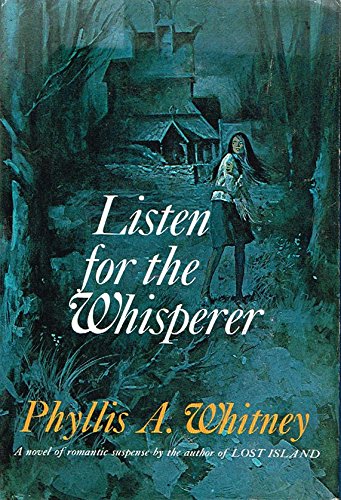
When I was eleven or twelve–not sure which–my parents let me join the Mystery Guild, and after I got the initial shipment of books, the first catalogue with a selection was a novel called Listen for the Whisperer, by Phyllis A. Whitney–whose juvenile mysteries I was still reading. I read the description, and its story–about a film star and a murder twenty years in the past–intrigued me; I was just starting my Hollywood fascination, and this seemed right up my alley. My mother gave me permission; I ordered it, and I never looked back with Phyllis A. Whitney.

listen for the whisperer

I sat in the darkened theater with my hands clasped tensely in my lap and my eyes fixed unblinking upon the screen. The man beside me touched my arm and I pulled away from him, not wanting anything to break the spell of the scene that was moving, inexorably to its climax.

“Let up, Leigh,” Dick whispered. “This is pure corn, even if Laura Worth did win an Oscar nomination for it years ago.”

Twenty years ago. I knew. But I would not listen to him. I shut him out and watched the screen. I knew the scene by heart, but the impact was always the same. My ambivalence was always the same. I was fascinated by every move the woman on the screen made, yet at the same time I detested her utterly. No one had a better right to detest her.

In the role of Helen Bradley in the movie adaptation of my father’s novel, The Whisperer, Laura Worth was coming down that famous Victorian staircase that had been almost a character in the book. Not only I, but the entire audience sensed her fear. Terror seemed to emanate from her as she descended the stairs, one hand clinging to the banister, the other held to her throat in dread. She was a woman going to meet death–and knowing it. The audience knew it, too. Sure of the outcome, sure she would finally escape, they still felt the fright she meant to convey. Even Dick was silent, watching as she reached the foot of the stairs.

The black and white screen managed to reproduce the eeriness of gaslight; even the furnishings seemed to suggest the gray flicker that was the very color of terror. Helen Bradley knew that she lived in this house with a husband who intended to kill her. She knew that no one would believe her accusation if she made it, and that there was no escape from what was going to happen–very soon. Yet she must go down those stairs, cross the hall and enter the parlor where he waited for her. The background music was hushed, suitably tense and anticipatory. You forgot this was Laura Worth, the actress. You became Helen Bradley.

Pretty great opening there, isn’t it? Mrs. Whitney established who the center of the novel is: an actress named Laura Worth, and as the opening scene progresses, Dick asks Leigh, “Wasn’t there some scandal that hurt the picture and cost her the Oscar?”

And that is the central mystery at the heart of the novel: the murder of director Cass Alroy during the filming of The Whisperer, some twenty years or so earlier. Ms. Worth had a habit of sleeping in her dressing room during filming; in order to feel closer to the part and to the process of filming. She’d been feuding with her director since filming started; there were rumors of a love affair gone bad between them. One night while she was staying in her dressing room, she had a crash and went out to see what made the noise; a younger co-star who also happened to be a huge fan of hers, Rita Bond, was also there, and they discovered the dead body of Cass Alroy, hit over the head and killed by someone unknown. The feud stories cast suspicion on Laura; after the filming was complete she gave up her career, left Hollywood, and returned to her home country, Norway–she was half-Norwegian–and became a recluse.

Leigh Hollins, the main character, is Laura’s daughter. Laura had an affair with Leigh’s father during the filming of another of his books, but she wasn’t interested in either marriage or being a mother; so she gave up the child to Leigh’s father, who later married someone else who raised Leigh as her own. Leigh has never known her birth mother, and that has always been a bone of contention and discontent in her life. Now, watching the film again, as a young journalist who often writes profiles of film stars and with her father dead, Leigh decides to go to Norway and make contact with her birth-mother after all these years. But what she finds when she gets to Norway is that the secrets from the past–and the mystery of who killed Cass Alroy–is still very current and swirling around her mother’s household. Leigh also finds herself not only in danger, but some romance as she tries to build a relationship with her mother and get to the truth about what happened so many years ago on the set of The Whisperer–and almost everyone in the household is a suspect, then and now.

It’s a terrific book, if a little dated; one of my primary problems with Whitney’s heroines is they weren’t nearly as strong as I would have liked, and another trope she repeatedly used (although not in this particular novel) was good girl (her heroine) vs. “bad girl” (the villainess); the bad girl in the story inevitably was sexually promiscuous, mean-spirited, and often married to the man the heroine was in live with, and made him miserable (Lost Island, Columbella, The Turquoise Mask, among many others). Another recurrent theme in Whitney’s work was family drama/tension; her heroines also often had to return to somewhere they’d fled and avoided to try to repair a family relationship: in this book, the heroine and her birth mother; in Silverhill, she is returning her mother’s body to the family she was estranged from; in The Turquoise Mask she is going to meet her mother’s family and try to get to the truth of her mother’s death when she was a little girl; in Lost Island she is returning to get to know the son she gave up to her cousin and the son’s father, whom her cousin married (Lost Island was always one of my favorites; I may have to revisit it as well).

Whitney’s books are mostly available as ebooks now; some are still in paperback print–but I think the majority of her children’s books are unavailable. She won two Edgars for Best Juvenile Mystery, and was named a Grand Master by Mystery Writers of America in the 1980’s. As I said, some of her books probably seem a little dated now, but she was an incredibly prolific writer, the books are still engaging, and I think she isn’t remembered as much as perhaps she should be.

Go Rest High on that Mountain

Saturday morning in New Orleans, and all is well. I slept really well last night–the deep dead sleep I love so much, because it’s so revitalizing–and can’t help but notice that I’ve been enjoying that kind of sleep a lot more since I started back to the gym. Coincidence? I think not.

Yesterday, I’m not going to lie, started out pretty fucking shitty. I got up feeling terrific. Well rested, ready to get out and kick some ass this weekend; as evidenced by yesterday morning’s blog entry. I went to the gym, had a tough workout–the motivation was there, but missing Wednesday had put my body out of sync with the weight-lifting, which made it more of a struggle than it should have been–then I came home. I started doing the laundry (I do the bed linens every Friday), made myself a protein shake, started getting the dishes taken care of, and then sat down at my desk to check my emails and social media. My twitter feed was filled with homophobic micro-aggressions from people who should, actually know better; as I read through I felt my anger and gorge rise. I was just about to send a PM to a friend (who definitely should know better) when Scooter jumped up onto my desk and knocked over my protein shake….all over my desk, my keyboard, my checkbook, my wallet, the research books I’ve been using for a writing project, my lap, and various file folders.

I was not pleased.

That took about half an hour to get cleaned up (thanks again, Scooter) and by the time I was finished I was already behind schedule for getting to work and running errands. I have a tire with low air, so I stopped at a convenient gas station (there is literally only one that’s convenient, and even it is out of the way) and of course, it was filled with morons. WHY WOULD YOU TAKE THE BACK PUMP INSTEAD OF PULLING TO THE FORWARD ONE?

I suspect her name was Karen.

The gas station turned out to be an exercise in aggravation and frustration, so I decided to say fuck it and do it over the weekend sometime. Then I got stuck behind a garbage truck, and when finally–after driving all the way uptown behind this idiot going 14 miles per hour–I got stuck behind a street cleaner on Jefferson on my way to Claiborne. We’ll just pretend there were no idiots on their cell phones on I-10 because I just can’t with people who think a phone call is more important than their life and the lives of everyone else on the highway.

Seriously, days like yesterday make me long for the next meteor and extinction event.

By the time I finally got home from work,  I was essentially done-in and exhausted. I later attributed it to the lack of a protein shake–I mean, the protein shakes I generally have after working out are enormous and have a lot of protein in them; because it spilled I had to have one of those prepackaged ones, which only had about half the protein in it that I usually rebuild with after a good workout–so note to self: should there ever be a repeat of the Protein Shake Incident, drink two of the pre-packaged ones, or you will suffer later.

So, it’s a gorgeous and sunny day outside; it’s a bit chilly here in the Lost Apartment, but that probably means it’s warmer outside. I have to walk over to the Home Depot (I need to get file folders and a new little notebook to replace my check register; yes, I still balance my checkbook, and yes, I still write everything I spend down), and the Lost Apartment  needs cleaning. I am way behind on my emails again (what else is new) and I have some things I need to get taken care of today; I want to finish reading my Ali Brandon novel this weekend, and I also want to pick out my next Reread Project read. I decided that since it’s Leap Day I shall also spend the day working on the numerous in-progress short stories I have; I am also going to try to get the Secret Project planned out and back on track again today, so I can launch myself full force into it again tomorrow. I also want to try to use today (and my new file folders) to get better organized. One of the worst things about Carnival is you literally just try to tread water with everything and you inevitably get scattered, disorganized and behind…and then it’s so hard to get everything back under control yet again once it’s over. I may not get much writing done today–certainly I know I won’t get as much done as I would like to get done–but the most important thing is to ensure that I am organized, know what I need to get done, and that way I can start organizing tasks and start getting them done.

I also got a shit ton of books in the mail this week; some definite treasures, some from authors I’m not familiar with, and once again, I weep at the idea of all the books I will never have the time to read. I am perhaps most excited about Alabama Noir, from the Akashic noir series; edited by Don Noble, it has stories from some of my favorite writers (Ace Atkins, Carolyn Haines, and Suzanne Hudson, among others) and of course, it’s ALABAMA, which I still feel such a strong pull towards, despite having never lived there and knowing deep in my bones and my soul that New Orleans is my home. Do other people feel that way about the states where they were born, where their parents and family are from? Or is it just a Southern thing? One of the reasons I started writing Bury Me in Shadows was because I wanted to write about Alabama, and the complexity of my feelings for the state. I’ve done some Alabama short stories, and I’ve set one book in Alabama–Dark Tide, which was mostly set down in the Gulf beach area–but I’ve always wanted to write more about Alabama. I think the reason Bury Me in Shadows has been so difficult to write for me is because I’m really not sure what the state is like now; and yes, of course it’s fiction, but I also don’t want to indulge in stereotyping and I want to be able to write honestly. I don’t have the time or the money to drive up there, look around, and get a better sense of place than my memories–plus, the part of the state I’m from isn’t the most friendly for people like me–but you never know. All it would really take is a long weekend and a cheap motel somewhere.

And on that note I just heard the dryer click off, so perhaps it’s time for me to get going on everything.

Have a lovely Saturday/Leap Day, Constant Reader!

1621981_10152213121411473_280855996_n

Walking the Floor Over You

I have always loved to read, and have always encouraged other people to read. It’s one of the great pleasures of my life, for as long as I can remember. Once I learned how to read, I never stopped reading. I will probably never stop reading. There are fewer non-sexual pleasures in life as satisfying as reading a good book.

As I’ve mentioned before, my grandmother got me really started into watching old movies–both horror and crime–and also encouraged me to read. She was the one who got me started reading Mary Stewart, by giving me her copy of The Ivy Tree; my friend Felicia in high school reminded me of Stewart and so I started reading more of her work. (I still have not read all of Mary Stewart’s work–that “I don’t ever want to run out of something new to read by Mary Stewart” thing I do) And while I enjoyed all of them, I enjoyed some more than others. For example, i remember reading The Moon-spinners, but not really enjoying it very much, frankly. I never revisited the book…but now that I am doing the Reread Project, I decided to give it another read.

0449027953

It was the egret, flying out of the lemon grove, that started it. I won’t pretend I saw it straight away as the conventional herald of adventure, the white stag of the fairytale, which, bounding from the enchanted thicket, entices the prince away from his followers and loses him in the forest where danger threatens with the dusk. But, when the big white bird flew suddenly up among the glossy leaves and the lemon flowers, and wheeled into the mountain, I followed it. What else is there to do, when such a thing happens on a brilliant April noonday at the foot of the White Mountains of Crete; when the road is hot and dusty, but the gorge is green, and full of the sound of water, and the white wings, flying ahead, flicker in and out of the deep shadow, and the air is full of the scent of lemon blossom?

The car from Heraklion had set me down where the track for Agios Georgios leaves the road. I got out, adjusted on my shoulder the big bag of embroidered canvas that did duty as a haversack, then turned to thank the American couple for the lift.

“It was a pleasure, honey.” Mrs. Studebaker peered, rather anxiously, out of the car window. “But are you sure you’re all right? I don’t like putting you down on the hill like this, in the middle of nowhere. You’re sure you’re in the right place? What does that sign post say?”

The above pictured cover was the one I originally read; the reread was of a more recent edition. When I was younger, I was fascinated by ancient history: Egypt, Greece, and Rome, to be exact; Greek or Roman or Egyptian ruins on the cover of a book, especially if it was a suspense novel, drew me to the book like moth to flame. (That was what originally drew me to read Phyllis A. Whitney’s Mystery of the Hidden Hand, which I now believe–my memory lies, remember–was the first Whitney I read, because it was set in Greece) I had also remembered seeing a film version of The Moon-spinners, broken up over two weeks’ episodes of The Wonderful World of Disney, which starred Hayley Mills. I don’t remember much of the film now, but I do remember thinking it was vastly different from the book when I read it the first time. It’s not on Disney Plus (neither is Johnny Tremain or Now You See Him Now You Don’t, which has annoyed me regularly since I signed up for the service), and I’m not about to spend even three dollars on renting it on Amazon Prime–although I was tempted enough to look it up to see if it can actually be viewed anywhere.

Anyway.

I enjoyed the book much more greatly this time. I’m not certain why, precisely, I didn’t like it as much as Stewart’s other books at the time, but sometimes that’s just the way it is. The Moon-spinners focuses on Nicola Ferris, an adventurous young Englishwoman in her early twenties. She works at the British Embassy in Athens; her parents died when she was a teenager and she went to live with her aunt Frances, who is a leading botanist. Frances is also single and terribly independent, like most women in Stewart novels; Nicola admires and loves her aunt greatly and emulates her. Her aunt is taking a yacht voyage with friends around Greece and the islands; Nicola decides to take a vacation, meet up with Frances on Crete–a friend, a travel writer, has recommended a very remote village with a small hotel to them–and Nicola has the great good fortune, while on Crete, to meet an American couple (the above mentioned Studebakers) who are driving around Crete and offer her a lift to Agios Georgios, putting her there a day earlier than expected. (This sentence, describing the Studebakers,  They were both lavish with that warm, extroverted, and slightly overwhelming kindliness which seems a specifically American virtue–is a terrific example of Stewart’s exceptional skill as a writer; in that one sentence she tells you exactly who the Studebakers are.) The Studebakers aren’t terribly keen on letting her off in the middle of nowhere, to lug her suitcases and such over a dusty mountain trail to a village where she isn’t expected until tomorrow and where she will know no one; fortunately her work at the embassy has given her a passable knowledge of speaking Greek.  Nicola insists she’s fine and thanks them for their kindness, and starts trudging along the dusty path.

All of Stewart’s heroines are strong, capable, intelligent young woman who can take care of themselves; and courageous. It is while walking on the path that Nicola’s Greek adventure takes off–she stops at a pond to get a drink of water, and in the reflection of the water she sees a man’s face, watching her. Your average run-of-the-mill heroine would scream and run off or be terrified; Nicola is merely startled and curious. This is how she comes across Lambis, the Greek boatman, and young Mark Langley, who has been shot and needs medical attention. Nicola immediately makes Mark’s problems her own. Lambis, as it turns out, had put in his boat in a nearby bay so that Mark and his younger brother Colin could go exploring and look at the ruins of an old church, originally a shrine to a Greek god but converted during the days of the old Eastern Empire into a Byzantine church. As they are walking back to the boat they come across of small group of people arguing over a recently dead body. Mark is shot and left for dead; Colin is taken. And so, now of course, Nicola wants to help rescue Colin and help Mark–she isn’t, after all, expected for another day, and of course, the killers/kidnappers must be from the small town of Agios Georgios.

Stewart is, as always, an exceptionally talented writer. Her descriptions are simple yet poetic; she vividly brings the town, the mountains, the sea, everything to life so well you can easily imagine yourself there. And courageous Nicola, now possessed of dangerous knowledge that could get her killed, has to navigate the village while trying to help Mark find Colin, with no idea of who she can trust and where she can turn to help.

Nicola is a terrific heroine, and I can see why Stewart was so popular with women and teenaged girls; she wrote smart, no-nonsense, capable young women who were courageous and fearless and could pretty much handle anything. The suspense is, at times, unbearable.

There is an element of romance to the story as well; Nicola begins to have feelings for Mark, but it’s practically an afterthought, and it feels almost like it was inserted into the story. There’s absolutely no need for the two of them to develop feelings for each other; other than the psychological closeness that comes from a shared danger (one of the things I loved the most about the sequel to Romancing the Stone, The Jewel of the Nile, is that it showed that happy couples who bond over adventures don’t necessarily wind up living happily ever after; I’ve often wondered about the couples from these types of novels), and this is one of the reasons I no longer really consider Stewart a romantic suspense writer; the romances in her books often feel that way–something inserted into the story later to appease either her agent or editor–and they are completely unnecessary to the story; if anything, the romance develop organically because of what else is going on in the story; the suspense/mystery aspect is the most important part.

And Stewart consistently wrote some of the best openings in crime fiction.

Highly recommended; I will probably reread it again someday.

Mama He’s Crazy

Believe it or not, back before the Internet and social media, it was possible for a book to go viral; to become so popular and so talked about it would sell a gazillion copies and establish the author–usually–as a long-time bestseller. To this day, I don’t know how I became aware of the viral books of the 1970’s (titles like Coma by Robin Cook; Jonathon Livingston Seagull by Richard Back; Jaws by Peter Benchley; The Other by Thomas Tryon; The Exorcist by William Peter Blatty; and The Godfather by Mario Puzo, among others), yet I did become very aware of them, and read most of them (true confession: I never read Jonathon Livingston Seagull, despite being a number one fiction bestseller for two consecutive years).

Mary Higgins Clark’s Where Are The Children? was a viral sensation when it was first published in 1975; I read it in paperback, and distinctly remember plucking it off the wire rack in the Emporia Safeway. I started reading it in the car as my mom drove us back home to Americus–the little town seven miles or so northwest of Emporia, where we lived; population less than a thousand, and the only time I’ve ever lived in such a small town–and couldn’t stop reading. I helped her bring the groceries in, went to my bedroom, and piled the pillows up and went back to reading.

where are the children

He could feel the chill coming through the cracks around the windowpanes. Clumsily he got up and lumbered over to the window. Reaching for one of the thick towels he kept handy, he stuffed it around the rotting frame.

The incoming draft made a soft, hissing sound in the towel, a sound that vaguely pleased him. He looked out at the mist-filled sky and studied the whitecaps churning in the water. From this side of the house it was often possible to see Provincetown, on the opposite side of Cape Cod Bay.

He hated the Cape. He hated the bleakness of it on a November day like this; the stark grayness of the water; the stolid people who didn’t say much but studied you with their eyes. He had hated it the one summer he’d been here–waves of tourists sprawling on the beaches; climbing up the steep embankment to this house; gawking in the downstairs windows, cupping their hands over their eyes to peer inside.

He hated the large FOR SALE sign that Ray Eldredge has posted on the front and back of the big house and the fact that now Ray and the woman who worked for him had begun bringing people in to see the house. Last month it has been only a matter of luck that he’d come along as they’d started through; only lyck that hed gotten to the top floor before they had and been able to put away the telescope.

Time was running out. Somebody would buy this house and he wouldn’t be able to rent it again. That was why he’d sent the article to the paper. He wanted to still be here to enjoy seeing her exposed for what she was in front of these people…now, when she must have started to feel safe.

I bought another copy of Where Are The Children? in 2014; my original copy lost years ago to one of many moves, intending to go back and rereading it at some point. The importance of Mary Higgins Clark, not just to women crime writers but to the genre in general, cannot ever be overstated. Clark was the bridge between the domestic suspense masters of the past–Margaret Millar, Charlotte Armstrong, Dorothy B. Hughes, among many others–and the next generation of women crime writers that dawned in the 1980’s, as well as to the modern domestic suspense writers–women like Alison Gaylin, Lori Rader-Day,  Catriona McPherson, and Wendy Corsi Staub, among many others–and her example–of grace, generosity, kindness, and assistance–is one other writers should emulate.

We could all use more Mary Higgins Clarks in the world.

Anyway, because of this importance, I thought I should reread her first as an homage to her importance; I’d recently met her, in passing, and was shocked when I ran into her again a year later that she remembered my name and the short conversation we’d had as I’d helped her onto the escalator at the Grand Hyatt in New York; I, of course, remembered every word and that glowing smile she’d given me. There was little doubt in my mind she wouldn’t remember me; how many thousands of people had passed briefly through her life? But she was sharp as a tack, and remembered me. “Greg! I was hoping you’d be here if I needed help with the escalator again,” she said, holding our her hand to me with that thousand-watt smile of hers. Then she winked, “I’ll be looking for you later. How did that book you were writing turn out?” When I told her I’d worked out the problem (yes, as I helped her onto the escalator and chatted briefly, I somehow managed to tell her that one of the many reasons I admired her was her dedication to working hard, and asked if she ever got stuck–because I was stuck on my WIP. She laughed and said, “Work through it. That’s the only way.” She was right.) and the book was coming out that very month, she replied, “I look forward to reading it.”

I seriously doubt that she did, frankly–but it was an incredibly kind and generous thing to say to someone many many rungs on the ladder beneath her, if we can even be said to be on the same ladder.

Her recent death obviously saddened many, me amongst them. So I decided to memorialize her by rereading her first and most famous bestseller, Where Are The Children? 

And really, it was past time, wasn’t it?

Upon finishing my reread, I would say that Clark was most like Charlotte Armstrong, of the women who came before her; she wrote about, like Armstrong, normal every day women who were simply minding their own business when something evil came across their path, and they had to dig deep inside and discover their own strength to overcome it.

In Where Are The Children?, Clark came up with a devilishly clever plot about one of the worst things that could ever happen to a woman: the loss of her children. Nancy Harmon, now Nancy Eldredge, married one of her college professors and had two children by him, only to have them snatched away and murdered. Their bodies were found washed ashore, their heads taped inside plastic bags; dead before they went into the water. Nancy was tried for their murders, convicted–and then released on appeal due to a technicality. The disappearance of the prime witness against her made retrying her impractical; so she changed her hair and disappeared from San Francisco to Cape Cod, where she found and married a realtor and had two more children–where no one knows who she is. (This would, of course, be impossible–or incredibly difficult–today; with the Internet and 24 hour news, everyone in the country would recognize her, different hair color or no.) Nancy is still haunted by her past, most of which she has buried in her subconscious–but little does she realize her idyllic new life is about to upended: on the same day the local paper runs an article exposing her past, her two children, Michael and Missy, disappear yet again; and of course, it looks like she has killed yet another set of her children.

But what Clark does is let the reader know immediately that Nancy is not only innocent of killing this set of children, but the first set as well. The book opens, as seen above, with a chapter in the point of view of the villain of the story; she does this consistently throughout the book–we see the events from other points of views, other than just Nancy’s and the villain’s, which also helps the suspense build and keeps the reader turning the page.

Also, it should be noted that the entire timeline of the book is less than one day, and probably not even ten hours; the children disappear around ten in the morning and the climax of the book happens after nightfall. Also, the book takes place during a particularly nasty thunderstorm, which includes hail.

Another excellent way she builds suspense is bringing in minor characters on the periphery of the story, puts a scene in their point of view, and of course it turns out that each one of these minor characters holds another, crucial piece of the puzzle.

Where Are The Children? is a subversive novel in many ways, and it’s easy to see how it became a phenomenon, and why Clark won the hearts of millions of readers. She plays with the tropes of what it means to be a mother; how quickly we blame mothers for anything that happens to their children or how they behave; and how quickly the admiration for motherhood can turn to contempt and scorn–and how easy that turn is made.

It can also be seen as a sequel, of sorts, to those Gothic novels where a child is endangered and the heroine has to act to save the child; this was a well Phyllis A. Whitney and Victoria Holt drew from, many many times. Instead of trying to save the child, in this case this is the aftermath of what happened should the mother (or young governess, whomever the heroine was) not have succeeded the first time in saving the children–but has a chance at redemption by finding and saving the second set of children.

It reminded me somewhat of Charlotte Armstrong’s Mischief, which is also long overdue for a revisit.

And now, back to the spice mines.

He’ll Have to Go

Saturday morning, and I slept in until nearly eight thirty! Living large here, I have to say.

Yesterday was one of those days; the temperature dropped, as you may recall, and once again when turning on the heat Thursday night, it didn’t really come on–it did, but it never truly got warm in the Lost Apartment, either upstairs or down. So, I wound up having to stay home from work to wait for the HVAC guys, who actually arrived dutifully when they said they would (this is so rare as to merit mention), and worked on it for a while. They did eventually leave, and I went to the gym and ran my errands.  I don’t know if the heat is actually fixed or not; we didn’t need it last night anywhere other than the kitchen, and I have a space heater for in there (it never warms up in the kitchen, ever) but I did manage to get a lot of cleaning and organizing done. I also managed to start watching the film of The Talented Mr. Ripley on the iPad yesterday at the gym (the Anthony Minghella version) and it veers away from the book’s narrative much more than I ever had supposed; the character of Meredith (played by Cate Blanchett) doesn’t exist in the book, nor does the entire subplot about Dickie’s affair with the village girl in Mongibello. But the one thing I will say about this film–and the thirty or so minutes of it I watched–Matt Damon is exceptionally great in the role of Tom; far more so than Jude Law as Dickie (he was nominated for an Oscar; the film made him a star), and this just might be one of Damon’s best performances.

Paul, I believe, is off to the office later today, and has plans with friends to go watch Krewe de Vieux tonight; I intend to stay home and work on the Secret Project, get my taxes together and sent off to the accountant, and emails to answer. There’s also organizing and filing to do, and I need to do the floors; I always leave the floors for Saturday vacuuming. Paul’s absence also gives me no excuse for not reading and writing for most of the day; around the cleaning, at any rate–and I am actually looking forward to getting a lot of both done today.

I’m still reading Tracy Clark’s Broken Places, which is really good, and in fact, once I finish writing this I am most likely going to  head over to the easy chair and spend a few hours with it this morning before moving on to the Secret Project. I am also really enjoying Jason Berry’s City of a Million Dreams, which I am not very far into, but I feel confident in recommending just based on the introduction and part of the first chapter. I’ve not read Berry before–he’s local, and has written quite a few books, including taking the Archdiocese to task for covering up the sexual abuse of children–but I am impressed enough to start adding his canon to my TBR list. We started watching Avenue 5, which was much funnier than I thought it would be–and Hugh Laurie is terrific as the captain; the entire cast is actually quite good. We’re probably going to also start watching The Outsider on HBO, which presents a conundrum for me; I generally like to read the book while I am watching the TV series based on it (I did this with Big Little Lies, and found it to be incredibly enjoyable; I’ve not read the King yet, but once I am done with the Clark, I am definitely going to pull The Outsider down from the shelf and give it a go)., but I guess pulling down The Outsider and moving it up to the top of the TBR list won’t hurt anyone or anything.

Parades also start this coming Friday on the St. Charles Avenue route; the challenge is going to be continuing to write and go to the gym around my job and the parades; parade watching is always a blast–it will probably never get old for me–but it’s also exhausting and keeps me up later at night than I probably need to be awake, given how early I will have to get up the following mornings.

It’s also lovely to wake up and sit at my desk and glance around and see clean, clear counters and a sink that is primarily empty of dirty dishes. There’s a load in the dishwasher that needs to be put away, and a load of laundry in the dryer that also neede to be fluffed and folded, but like I said, other than that and the floors (and these stacks of file folders and scribbled notes scattered around my desk), there’s no cleaning to be done this morning. My muscles are tired this morning from the gym yesterday, but I’m not sore, and I feel more stretched than I usually do, which also actually feels good–I may just stretch out a bit a little later; I’d forgotten how good it feels to have stretched muscles as opposed to tight ones.

So, that’s the plan for today, at any rate. I’m going to go pour yet another cup of coffee, take my book and repair to the easy chair; after that, it’s back to the desk to do some writing and answer some emails (I never actually send them until Monday morning; emails beget emails, and I’d rather not wake up Monday morning at the crack of dawn with an insane amount of emails to answer; it’s too, too daunting to deal with on a twelve hour day).

I was also thinking the other day–thanks to a post by someone on Facebook–about books that should be paired together, like a good wine and some good cheese; how reading the two back-to-back can enhance the reading pleasure of both. Michael Koryta’s The Prophet (which is one of my favorite books), for example, pairs beautifully with Megan Abbott’s Dare Me (and you need to be watching the television adaptation of Dare Me); Alafair Burke recommends pairing Scott Turow’s Presumed Innocent with Gillian Flynn’s Gone Girl, and there was one more I can’t quite remember, but it was also quite brilliant. (I also think pairing Stephen King’s Carrie and Christine together enhances the pleasure of reading each even more.)

I was also thinking about “event” books; Gone Girl was probably the most recent “event” book–a book that sold a gazillion copies and everyone was talking about. There have always been “event books”, which in the pre-Internet, pre-social media days was harder to have happen, and yet it did, all the time. Two such books from the 70’s include Thomas Tryon’s The Other and Peter Benchley’s Jaws; the fame of Jaws was spread even further by an event film based on it that has almost entirely eclipsed the book. Robin Cook’s Coma was another one of these; I intend to include The Other in my Reread Project this year, but rather than Jaws I am going to reread Benchley’s second novel, The Deep, and Cook’s second novel, Sphinx–which was Cook’s only non-medical thriller thriller.

And on that note, I am going to repair to the easy chair with my coffee and Tracy Clark. Have a lovely Saturday, Constant Reader; I certainly intend to.

1209113_10151802572687778_2028718899_n

I’d Better Off (In a Pine Box)

I love Patricia Highsmith, and one of the great joys of the last twenty years or so in my reading life has been slowly working my way through her canon.

Is there anything more fun and exciting than discovering a new writer whose work you enjoy? I think not! And it’s always fun to start working your way through their canon. I’m not even remotely close to being finished reading Highsmith; I’ve been enjoying my occasional forays into her work, and if you’ve not read her short stories….well, you’re really missing out. Her short stories are just as quirky and dark and pessimistic as her novels; although I’m really not so certain that I should use the pessimistic label with Highsmith. From everything I’ve read about her, she was a terribly unpleasant person with a cynical world view and a not particularly high opinion of her fellow human beings; although I think I can honestly say right there with you, Patricia! most of the time. Highsmith’s dark, cynical view of the world and her fellow human beings is partly what makes her books so terrific, so amazing, so suspenseful and so entertaining. I think the first of hers that I read was Strangers on a Train, which was a Hitchcock film I’d always loved; imagine my surprise to discover that it was based on a novel (as so many old films were; not many people knew, for example, that Whatever Happened to Baby Jane? was also a novel first, and it’s actually quite a good novel, at that). The book was amazing (and I should probably reread it as well), and I became aware of The Talented Mr. Ripley when the Anthony Minghella film version, starring Matt Damon, Jude Law, and Gwyneth Paltrow, was released. The same author as Strangers on a Train?

I was so in. I actually read the book before I saw the film–which I think we rented, or watched when it made its way to HBO–which I also really enjoyed; Matt Damon did a great job as Ripley. But as more time went by my memories of the novel became supplanted by memories of the film–and as I knew there were differences between the two, I always meant to get back to the book but never did. I also never read the other books in the so-called Ripleyad; I never saw any point. I thought the first novel stood perfectly well on its own with its self-contained story and I worried that reading the others might spoil the first. There are five novels about Tom Ripley in total; written over the course of twenty six years, from 1955 to 1991. (There’s a lovely but expensive boxed set of them available; I may treat myself to that for my birthday, but whether I do or not remains to be seen.)

Over the past few years (probably a decade, I literally have no concept of time anymore) I’ve read some other Highsmith novels; The Blunderer and The Cry of the Owl, neither of which are as well known as the Ripley books or Strangers on a Train, which is a pity; both are truly fantastic–I particularly love the way she flips the narrative in The Cry of the Owl and turns it into something completely different from what the reader is expecting at the beginning; it’s absolutely genius, and mandatory reading for anyone who wants to write suspense novels, frankly.

But I wanted to reread Ripley, and possibly even go on to the other four books in the Ripley series, primarily because I am now rereading some of these older works with an eye to how male sexuality is presented; Ripley  was published during the highly repressive 1950’s, which was a horrible decade in which to have an alternate sexuality as well as to write about them; often they were coded. (I also want to reread Strangers on a Train for that same reason) When the Minghella film was released, there was a lot of talk about Ripley’s sexuality and its possible repression; there’s probably a similarity there between it and A Separate Peace; books in which I recognized something when I read them about male relationships, friendship, and intimacy that resonated with me. And I also realized, as I said earlier, that my memories of the book had become blurred by my memories of the film–which I also want to watch again; I can never forget that image of Matt Damon’s so-pale-it-almost-glowed skin on the beach in his yellow bikini when he awkwardly meets the Jude Law/Gwyneth Paltrow portrayed characters, and I wanted to reread that scene again in particular, to see how Highsmith handled it.

the talented mr. ripley

Tom glanced behind him and saw the man coming out of the Green Cage, heading his way. Tom walked faster. There was no doubt the man was after him. Tom had noticed him five minutes ago, eying him carefully from a table, as if he weren’t quite sure, but almost. He had looked sure enough for Tom to down his drink in a hurry, pay and get out.

At the corner Tom leaned forward and trotted across Fifth Avenue. There was Raoul’s. Should he take a chance and go in for another drink? Tempt fate and all that? Or should he beat it over to Park Avenue and try losing him a few dark doorways? He went into Raoul’s.

Automatically, as he strolled to an empty space at the bar,  he looked around to see if there was anyone he knew. There was the big man with the red hair, whose name he always forgot, sitting at a table with a blonde girl. The red-haired man waved a hand, and Tom’s hand went up limply in response. He slid one leg over a stool and faced the door challengingly, yet with a flagrant casualness.

“Gin and tonic, please,” he said to the barman.

The book opens differently than the Minghella film; which immediately changes the dynamic of who Tom Ripley is. In the film, Dickie Greenleaf’s spots Tom performing at a high society party with a music combo; he’s wearing a jacket that identifies him as an Ivy League alum–so Mr. Greenleaf, seeing that he’s about the same age as his son, thinks Tom might know Dickie and be amenable to an expenses-paid trip to Italy to retrieve him; only later do we learn he’d borrowed the jacket and probably doesn’t know Dickie at all.

As you can see from the above, Highsmith opens with suspense. Someone is following Tom, and it’s making him nervous–why? And why would someone be following him? We soon find out that he’s nervous because he’s been pulling a tax scam; he’s been calling random people, pretending he’s from the IRS and telling them they need to send more money because they didn’t pay enough taxes; it’s just for fun, as the checks aren’t made it out to him and he can do nothing with them. This is our first anticipation, as readers, that Our Hero may not exactly be your traditional-style suspense hero. But it’s only Mr. Greenleaf, not a treasury agent, and Mr. Greenleaf explains his situation to Tom–wanting Dickie to come home, as his mother is dying of leukemia and Dickie needs to get it together, give up his Bohemian life as a painter in Italy and come back to the US to take up his rightful place in the family business.

Soon Tom is on his way to Italy, funded by the Greenleafs, and tasked with bringing the recalcitrant heir home. He does find Dickie on the beach in Mongibello, and has to somehow make his acquaintance–and he doesn’t have a swimsuit:

He hadn’t brought a bathing suit with him, and he’d certainly have to have one here. Tom went into one of the little shops near the post office that had shirts and bathing shorts in its tiny front window, and after trying on several pairs of shorts that did not fit him, or at least not adequately enough to serve as a bathing suit, he bought a black-and-yellow thing hardly bigger than a G-string.

ripley

In the film, the awkwardness of the scene–and Tom in the bathing suit (which, in this case, is a lot more than a G-string; but then again, Tom has buried a lot of shame deep inside himself, and not just about his sexuality) he is clearly uncomfortable wearing, as well as the pasty whiteness of his skin amongst all the tan bodies on the beach, instantly induces sympathy for him–and in the book, it’s much the same. Highsmith takes us into Tom’s mind, in a tight third person point of view, so that we know what he is thinking and what he is feeling–but Highsmith is such a master writer, so good at making we the reader identify with Tom…that we soon forget that she is also dropping little hints along the way about just who he is. He is often refreshingly honest–he is very quick to tell people that he is good at forgery (he is) and mimicking other people (again, he is) and freely admits to many not quite moral talents; the great irony is that Tom has learned that you can quite often tell the absolute truth to people and they won’t believe you. He’s charming in his way, because he has learned that to get what he wants out of life, he has to be. Soon he is quite obsessive about Dickie–and disliking Marge, to the point of hating her for never letting him be alone with Dickie.

And this exchange:

“Marge and I are fine,” Dickie snapped in a way that shut Tom out from them. “Another thing I want to say, but clearly,” he said, looking at Tom, “I’m not queer. I don’t know if you have the idea that I am or not.”

“Queer?” Tom smiled faintly. “I never thought you were queer.”

Dickie started to say something else, and didn’t. He straightened up, the rubs showing in his dark chest. “Well, Marge thinks you are.”

Ah, some self-loathing a teenaged Greg can certainly identify with. Deny, deny, deny.

I loved the book even more than I did on the first read, and perhaps there’s a much longer, more in-depth piece I could write about this book (I certainly tagged a lot of pages as I read), but I am now interested in reading the rest of the Ripleyad; to see how Tom comes out–he certainly wound up ahead of the game at the end of The Talented Mr. Ripley, having lied, forged, stolen, and killed his way to get there.

And I do want to watch the film again–it’s on Netflix. Maybe something to watch while on the treadmill at the gym? Perhaps.