To All the Girls I’ve Loved Before

Friday night I also managed to read another book, a young adult novel by Jennifer Mathieu, and it was a most auspicious debut, The Truth About Alice.

It was actually much better than I thought it would be.
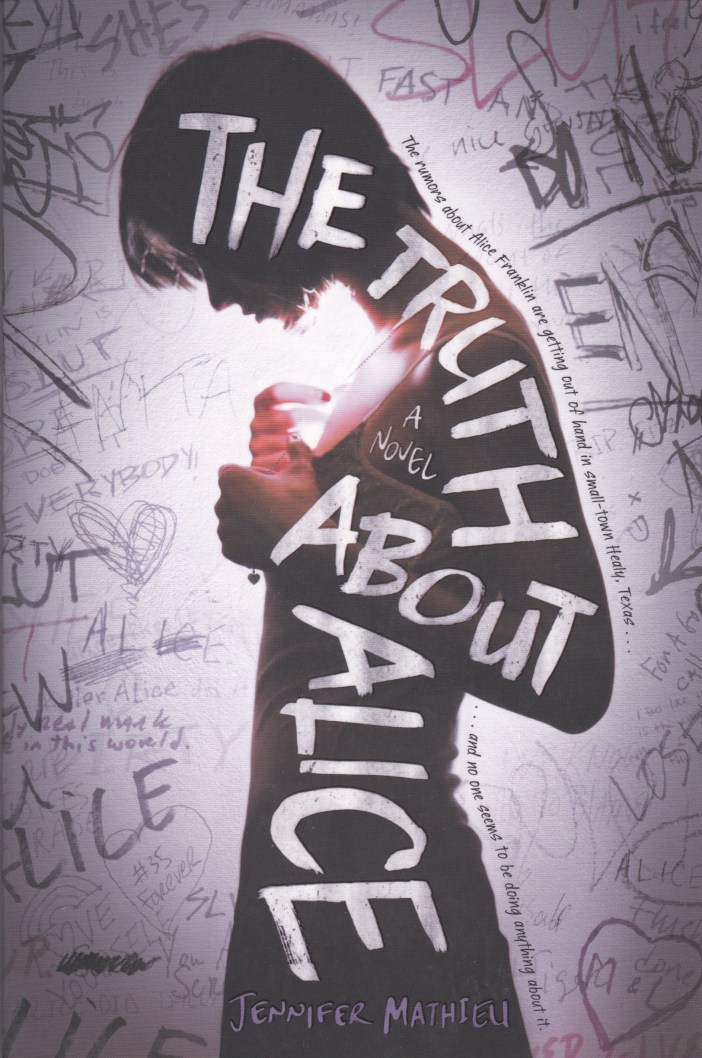
the truth about alice

I, Elaine O’Dea, am going to tell you two definite, absolute, indisputable truths.

1. Alice Franklin slept with two guys in the very same night in a bed IN MY HOUSE this past summer, just before the start of junior year. She slept with one and then, like five minutes later, she slept with the other one. Seriously. And everybody knows about it.

2. Two weeks ago–just after Homecoming–one of those guys, Brandon Fitzsimmons (who was crazy super popular and gorgeous and who yours truly messed around with more than once) died in a car accident. And it was all Alice’s fault.

The focus of the book is the story of Alice Franklin, and what she may or may not have done. It’s also the story of how rumors can take on lives of their own, and how they can destroy a person’s reputation and, untimately, their life.

The book is also written in a very clever way; it’s told from multiple first person points of view, so we see the story of Alice as told by some of the kids who know her. This is a difficult feat for an author to pull off, since the voices have to be unique and distinct, but Mathieu managed this very well. She also managed to capture what it’s like to be a teenager.

Before the rumor gets started about Alice’s behavior at Elaine’s party gets started, Alice is relatively popular. She’s pretty, she’s smart, and everyone likes her. Once the rumor starts going around, though, obviously her popularity begins to drop…and then once the story gets out about Alice sexting Brandon while he was driving–drunk, by the way–she is finished in Healey, Texas, the small town where they all live, and she is finished at Healey High. She is ostracized, no one will speak to her, and she loses all of her friends.

In addition to Elaine, the other viewpoint characters are Kelsie, who was Alice’s best friend before all of this got started; Josh, Brandon’s best friend and a fellow football player, who was in the car when the accident happened; and Kurt, the nerdy genius boy who has no friends but doesn’t seem to care because he is really smart, an orphan living with his grandmother, and is kind of socially awkward. He helped Alice once with a math problem, and she was very kind to him…and he remembers how kind she was. He also is kind of in love with her, because she’s perfect and beautiful and kind…and he has observed her “totally in a not-stalker way” for several years. Alice was Kelsie’s first friend when she moved to Healey, and back where she was from, Kelsie was considered a weirdo and had no friends; so she loves being sort of popular. Once the rumors start, Kelsie is invited to become a part of Elaine’s crowd, the most popular kids in Healey–but to do so, she has to jettison Alice. Not wanting to become the friendless kid again, she turns on her former best friend and moves forward with her friends; even starting an even worse rumor about Alice. Josh also regrets blaming Alice for the accident, and it’s never clear why he does in the first place–until later, and then his own guilt and shame also make a lot more sense. Mathieu didn’t quite take the story as far as I thought she was going to–and I think it would have been stronger if she had, frankly, instead of just hinting at it–but it’s still powerful.

Kurt also offers to help Alice with math again, and the two of them start an unlikely friendship as well.

It’s told very well, as I said, and the truths and come-uppances, when they come, might not be as strong as I would have liked them to be, but they were a lot more realistic in their smallness, and satisfying enough. I really enjoyed the book, and will add Mathieu’s other two novels to my TBR pile.

It also made me think about one of my own works-in-progress…and how to make it better. Well done!
Let the Music Play

I had already decided to make January a theme month on the blog, and to once again make it Short Story Month, with the goal to read a short story every day. As such, I was looking around the shelves of the Lost Apartment for anthologies and single-author collections, and it occurred to me that I have a book at the office that would be absolutely pitch-perfect for this: The Best American Noir of the 20th Century, edited by James Ellroy and Otto Penzler. It’s a gorgeous volume; absolutely beautiful, and it’s also signed by Otto. I must have picked it up one year at the MWA Board event at the Mysterious Bookshop. But it literally is a time capsule of great noir stories, going back to 1923, and what better education in not only short stories, but noir, than to read this marvelous collection, one story at a time, day by day?

I’ve also ordered Lawrence Block’s latest anthology of crime stories inspired by pictures, Alive in Shape and Color.  I may have to extend Short Story Month to Short Story Quarter, and read a story a day until April. Which really isn’t a bad idea, frankly. This is also the period where I’ll be putting together Sunny Places Shady People, the St. Petersburg Bouchercon anthology, so reading short stories should be a priority, don’t you think?

I certainly do.

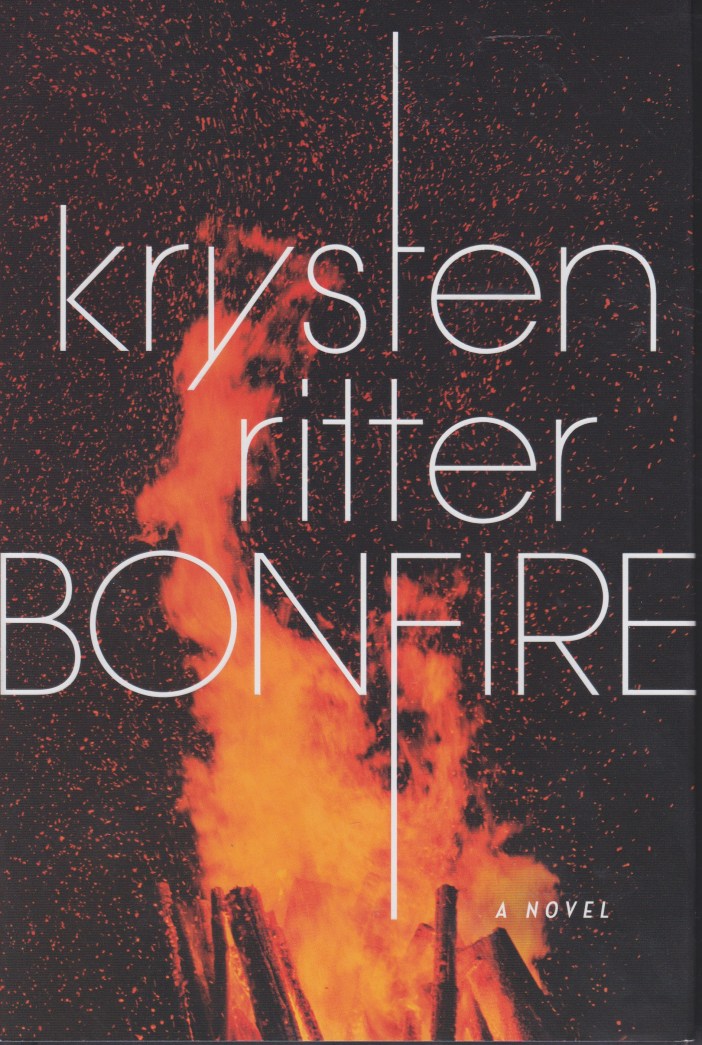
I also finished reading Krysten Ritter’s Bonfire last night–Paul was at a play.

bonfire'.jpeg

 State Highway 59 becomes Plantation Road two miles after the exit for Barrens. The old wooden sign is easy to miss, even among the colorless surroundings. For years now, on road trips from Chicago to New York, I’ve been able to pass on by without any anxiety. Hold my breath, count to five. Exhale. Leave Barrens safely behind, no old shadows running out of the dark woods to strangle me.

That’s a game I used to play as a kid. Whenever I would get scared or have to go down to the old backyard shed in the dark, as long as I held my breath, no monsters or ax murderers or deformed figures from horror movies would be able to get me. I would hold my breath and run full speed until my lungs were bursting and I was safe in the house with the door closed behind me. I even taught Kaycee this game back when we were kids, before we started hating each other.

It’s embarrassing, but I still do it. And the thing is, it works.

Most of the time.

Alone, locked in a gas station bathroom, I scrub my hands until the skin cracks and a tiny trickle of blood runs down the drain. It’s the third time I’ve washed my hands since I crossed the border into Indiana. In the dinged mirror over the sink, my face looks pale and warped, and the memories of Barrens bloom again like toxic flowers.

This was a bad idea.

The trauma that is high school is something that many of us apparently never get over, and it’s certainly becoming a crime fiction trope. But this isn’t a bad thing. As I said, almost all of us have traumatic memories of high school, and therefore can relate to the characters and the stories in these types of books. Hell, I’ve drawn from my own high school traumas enough times in my own work to recognize it as a trope of my own (Sara, Lake Thirteen, and both Chanse and Scotty have moments of reflection on their own past that are directly drawn from mine).

Bonfire is a compelling read, and very well written. Abby Williams, our main character who is telling the story in a first-person point of view, fled her hometown of Barrens after a traumatic childhood that included the painful death of her mother from cancer, her father’s religious mania and the resultant brutal parenting that came from it, being not popular, and having her best, childhood friend, Kaycee Mitchell, turn on her and terrorize her with a group of mean girl new friends. But towards the end of their senior year, Kaycee and her friends all became ill–with very odd and strange symptoms. It turned out they were faking it, and Kaycee disappeared. Now, there are some complaints about the factory near town, Optimal Plastics, that has revitalized the dying town but may possibly be poisoning it. Abby, now an environmental lawyer for a non-profit firm that handles such cases, is leading the investigative team and thus has to come back to Barrens to not only run this investigation but deal with her own demons. But are her theories and investigation tainted by her past, and her relationships with people from when she as a child? And why is she so obsessed with the missing Kaycee–whatever happened to her? Was she really faking it, or were the girls really sick? And what the hell is going on in Barrens?

Obviously, the sickness of the girls reminded me a lot of Megan Abbott’s brilliant The Fever from a few years ago; which was based on an actual case. And Ritter’s debut novel is crisply written, with a powerful sense of scene, character and plot that continues to build until it comes to its conclusion. I really enjoyed the book tremendously, and resented not having the time to actually sit down and read it through; I did manage to do so last night while Paul was at a play. It’s probably one of my favorite reads from the year, and I highly recommend it. Well done, Ms. Ritter.

And now back to the spice mines.

Automatic

Friday morning, and the temperature has dropped yet again. I have to work tomorrow and am going to a Christmas party; Sunday we have tickets for The Last Jedi (woo-hoo!) so my weekend card is pretty full. But next weekend is a four day weekend due to the holiday, which is lovely.

I managed to get a second draft of one story done yesterday, as well as getting about halfway through a rewrite of another. I am very pleased with both; once finished with the other second draft I am going to let them sit until next weekend. I am most pleased with myself. I am also about half-way finished with Krysten Ritter’s Bonfire, am still enjoying it, and will most likely finish it this evening–Paul is going to see a play. Today is also my short work day, so I’ll have time to get some cleaning and so forth done this afternoon, and then will undoubtedly curl up in my easy chair to finish reading the book. I am torn as to what to read next; I’ve got four Louise Penny novels in my TBR pile, but am leaning towards either a Daniel Palmer or perhaps something more y/a-ish; No Saints in Kansas or The Truth About Alice or Reality Boy. I’ll undoubtedly decide once I am done with the Ritter. I also have a lot of filing to do, as always.

I also am toying with a y/a idea; I’ve already started writing out ideas and plans for it; it’s working title is Bury Me in Satin, which I really like, but I don’t know why I am wasting time on it when I have to overhaul the Scotty as well as the WIP.

Heavy sigh.

All right, I need to get ready for work. Sorry this is so short, but hey, it’s Friday.

ef990a3327c8c611b21c1f204a9be3e2-1510778174-1510778175


If Ever You’re In My Arms Again

Thursday! It’s hard to believe Christmas is just next weekend. But I mailed my Christmas cards last night on the way home from work (I am very proud of myself; I generally don’t do cards. But this year I not only bought them, but addressed and stamped them and put them in the mail. Not sure how this all came about, but there you have it.), before stopping at the grocery store, and there it is. I’m a bit worn out this morning, tired despite sleeping well (one lovely thing about colder weather is that I sleep better), but I don’t have a lengthy day today and tomorrow is a short one. I hope to start revising stories today while also working on the book some. We shall see how that goes.

I”m still processing the election results in Alabama the other night. I pretty much saw the whole thing as a foregone conclusion; I am from Alabama and my family is from there, and outside of my immediate family, almost everyone on both sides still lives there. I am very well aware of what the Roy Moore supporters are like, how they think, etc. I didn’t need to red Hillbilly Elegy–I did try, but it’s Appalachian apologia was so smug and frankly, wrong I not only put it in the donation pile but I also donated the cover price I’d spent to the Southern Poverty Law Center. (For the record, I think that book is a falsehood designed not only to fool liberals but to lure them into a false state of understanding; one that will hoodwink them into being fooled again and again. There was nothing true or profound in that book.)

I love Alabama in spite of not only itself but myself. The Alabama values the entire country saw on display during the Roy Moore campaign (a pedophile is better than a Democrat; the entire country is out to get us in a liberal conspiracy; we had no race problems here until Obama; Roy Moore waving his pistol at a rally; everything about Kayla Moore–from her teen pregnancy to  her adulterous affair to her divorce to her gold, diamond encrusted earrings she wore on every occasion to prove to everyone just how much more Christian she is than everyone else) are something I am well-acquainted with; I’ve dealt with that mentality my entire life and have tried, unsuccessfully, to wrap my mind around it for fifty-six years: a Christianity that has nothing to do with the actual teachings of Jesus; an almost fanatical belief that their belief and values are the only right ones and anyone who disagrees is in the service of evil; that Satan is very real and working his evil on the country and the world through the Democratic party; and an absolute, unwavering faith that they are going to Heaven and anyone who disagrees in the slightest way with the way they think is going to straight to Hell unless they repent and change their ways and believe what they do and get on board with their version of not just religion but politics. Religion and politics are very much mixed in the South, and don’t ever believe otherwise; they are used interchangeably to validate the other.

It has always been thus; thus is may always be. And don’t mistake it–this election was far closer than it should have been.

Maybe my outlook is a bit bleak, but the county where my family is from in Alabama went 76% for Moore. So I know whereof I speak.

A while ago, I talked about rereading To Kill a Mockingbird and having a lot more issues with it than I did when I originally read the book, back when I was ten or eleven. Don’t get me wrong, the central message of the book–racism is terrible and wrong–still comes through just as strongly as it did when I originally read it, and it’s still incredibly beautifully written. The problems I saw with it, though, went way beyond the notion or concept of the white savior; which Atticus Finch certainly was. Probably the most false scene in the book to me, and the most problematic, was the scene where Tom is in jail and the sheriff comes to get Atticus because those trashy Ewells have gotten some of the other trashy rural people in the county riled up about Tom’s alleged rape of Mayella Ewell; and they want to lynch him. When I originally read the book the horror of those terrible racists coming to exact an unjust punishment on Tom terrified me, and I was thrilled that the upright citizens of the town came to stand off against them and save Tom. Rereading that as an adult–well, every bit of it read to me as not only false but a-historical. Anyone who knows anything about the Jim Crow south knows that the sheriff wouldn’t have gotten some “good men” together to protect a black man accused of raping a white girl; the sheriff would have been one of them. All one has to do is read accounts of what happened to Emmett Till…and so many others, to call bullshit on this part of the book.

Not every white person in Alabama is, or was, a racist; an active member of the KKK. But those who didn’t stand up to those who were? The word we’re looking for is complicit.

I still haven’t read Go Set a Watchman, but I will at some point. I’m still amused at all the people, mostly white, who were so upset and horrified that their beloved Atticus Finch turned out to be a racist and a segregationist after all. I never once got the sense when I was reading To Kill a Mockingbird, even when I was a child, that Atticus wasn’t a racist; he was appointed by the court to represent a black man accused of raping a white girl–and he did, as he was an ethical lawyer, bound to to defend him to the best of his ability. He did so. Did that make him a better man than a lawyer who might have refused to take the case? Yes, it did. It also made him a better man than a lawyer who would have taken the case and botched it. But what also strikes me as false about this book was the judge who appointed Atticus, knowing he would do the best job possible. Really? Again, all you have to do is read accounts of Jim Crow justice in Alabama to know this is also false. If Tom Robinson wasn’t lynched  he most certainly would have been railroaded. He was found guilty despite the great job Atticus did in his defense, despite proving that Mayella Ewing’s testimony couldn’t have been the truth. That, indeed, seemed real and true to me. But the system in 1930’s Alabama trying to be fair to Tom? Bullshit.

Don’t get me wrong: To Kill a Mockingbird is still a beautiful book, and its message is a good one. But it’s also a fairy tale; a fiction that would have never happened in the time period in which it was set. I also can see why Harper Lee’s editor persuaded her not to publish Go Set a Watchman, in which Scout deals with her father being a segregationist, and write To Kill a Mockingbird, in which her father is a hero fighting prejudice and racism, instead. That was the book that needed to be published at the time; and it was a very savvy move. The book was a huge bestseller, has never been out of print, won the Pulitzer Prize, and was made into an Academy Award winning film classic.

This election, in which a small majority of Alabama voters, led by people of color, chose not to elect the racist homophobic evangelic Christian child molester, was a wonderful outcome on every level. akin to the Louisiana electorate choosing the Democrat over adulterous whoremonger David Vitter for governor. But is this is a sea change for the two deep red Southern states, both of which have a proportionally large evangelical Christian population who seriously believe there were no racial issues in their state until Barack Obama was elected president? Only time will tell–and progressives and Democrats have a lot of work to do in the meantime. A lot. But the South can be won back. It won’t be easy, but it can happen.

And now back to the spice mines.

8ae2faf03b2cfd39ca16762fa3d16751

The Warrior

Wednesday, and I finished the first draft of my short story yesterday. It’s quite dark, and I quite love it, but it needs some serious polishing and editing. I changed my mind about the ending while i was writing it, you see, and that changes some things back at the beginning. I want to have that finished by the end of the weekend, as well as another story I’ve worked on recently. Huzzah!

I am also thoroughly enjoying Krysten Ritter’s Bonfire. I do highly recommend it, even though I am not even halfway finished with it, it’s that engaging. Sure, the plot could go off the rails, but I rather like the main character and the story she is telling–both the crime itself as well as the main character’s story in confronting her past–is quite enjoyable.

This weekend, I have to work Saturday and we are going to a Christmas party that evening; Sunday we have tickets for The Last Jedi and I am very excited. I’m a huge Star Wars fan, of course, and I wisely chose to buy tickets in IMAX during the Saints game, so I am assuming the theater won’t be full. Hoping, at any rate, and since we live close to the Superdome the traffic will be going the other way in both instances as we head out to Harahan to see the movie. It’s a much more busy weekend for me than I would ordinarily prefer, but the next weekend is a four day weekend for Christmas and of course, the next is the three day weekend for New Year’s. So…not really having a full day at home this weekend isn’t going to be nearly as traumatizing as it could be.

Anyway, I am really happy with my story. I was asked to write a story for an anthology of crime stories inspired by the work of Joni Mitchell, and when I chose my song, read the lyrics and listened to it again, I really went down a rabbit hole and man, did it ever get dark. Really dark. But what was also fun about it was having to research malls in the early 1990’s; research can be a bit of a drag sometimes, but for me, most of the time it’s so much fun because it triggers a lot of memories, or inspires me even more if it’s from before my time. (note to self: do some research on Washington DC in the early 1950’s; I’ve written a story set during that time but I’ve never done the back-up research, which could be incredibly fun.) Usually, when I write a story that’s set during a time I lived through, I depend on my memory–which ain’t what it used to be, but priming the pump by looking up things on-line triggered memories; memories of stores and displays, the way malls smelled, the parking lots and so forth.

And on that note, ’tis back to the spice mines.

Calvin-Klein-1980

The Warrior

Yesterday I wrote approximately 3300 words of a short story that is due by the end of the month, and I am rather pleased with how it’s going, if I might be so bold. It flowed rather easily from my keyboard also; I’m hoping that mojo will still be there as I try to finish the draft today. It’s dark–when are my stories anything but dark, really–but I am very happy it’s getting close to completion in this draft. I would love to have it finished so I can spend my weekend revising and editing this and another short story I finished in a first draft recently.

I also mapped out a young adult novel over the weekend I’ve been wanting to write for years. I originally wrote it as a short story back in the 1980’s, calling it “Ruins”; I’ve always thought it would make a really good y/a novel if I could figure out how to deal with some societal and cultural issues with it which really couldn’t be ignored. And then I realized, this weekend, that the best way to deal with them is to face them head on. It will get criticized, of course, and I may even get called out, but you can’t not write something because you’re afraid of repercussions, can you? And hope that good discussion comes from it.

Then again, it could just come and go without notice. That happens, too.

This year has mostly been, for me at least, a struggle to write. I’m not sure what has caused this for me; the year had some remarkable highs–the Macavity Award nomination; the Anthony Award win–but for the most part it’s been a struggle with self-doubt and it’s horrible twin sister, depression. I don’t know why this happens to me; I always find that writing–even if I have to force myself to do it–always makes me feel better, even if the work isn’t going particularly well. Sinking my teeth into a story, feeling the characters come to life in my mind and through my keyboard, always seems to make me feel better. I also can use the writing as a way to channel things that upset or bother me; writing is an excellent way to channel anger and rage and heartbreak and every other emotion under the sun. But as this bedeviled year draws to a close, I am feeling creative and productive again; and most importantly, driven.

Then again, tomorrow I could feel like crap and be all ‘why bother’ again.

This is why writers drink.

I’m also really enjoying Krysten Ritter’s Bonfire, even as it is reminding me of Megan Abbott’s The Fever. There are some similarities; although in Abbott’s novel the mysterious illness in the girls is current and in Ritter’s it’s in the past. But it’s very wwell written, and there is some diversity of representation in her characters. It also reminds me a little of Lori Rader-Day’s Little Pretty Things, with it’s small town Indiana setting and it’s strange story from the past. (If you’ve not read Abbott or Rader-Day, buy their books NOW. You’re in for a magnificent treat!) The book also makes me think of my own Kansas past…and book ideas I have that mine that past. Reading good books always inspires me…and that really is the ultimate compliment I can give Ritter’s book. It’s inspiring me.

And that’s terrific.

And now, back to the spice mines.

Patrick-McGrath-90s-Inspired-Shoot-005

The Heart of Rock & Roll

I have to admit, giving up resisting that my Scotty novel needs to go back to the drawing board–and even get a new title–has been an enormous relief. Enormous. I was never sold on the original title anyway, and as we all know, Gregalicious can’t write anything unless he has, at the very least, a really good working title. So, Crescent City Charade is out, and Royal Street Reveillon is in, at least for the moment. I am also considering St. Charles Second Line, for the record. But I kind of want to do a Christmas-related story. I am still planning, so we shall see how that goes.

It’s hard to believe Christmas is two weeks from today. Paul and I are probably not going to buy each other gifts this year; we are still hoping to go to England in the spring (and maybe Paris), so we’d rather save our money for that rather than buy each other gifts. I’m a little distrustful, though; Paul often does this and buys me gifts anyway so I look like a wretched person. That’s not, of course, his intent but rather how I feel. Although there are a couple of things for the apartment I could ostensibly get and say are gifts for him….hmmm, that’s a thought, now isn’t it?

I started reading Krysten Ritter’s Bonfire last night, and am really enjoying it. I didn’t get very far into it, but I really like the character’s voice. I can see why this got such rave reviews; I certainly hope the story is going to develop nicely; I’m not sure what the story is quite yet, but it’s getting there.

Okay, sorry to be so brief, but I’ve got lots of spice to mine today!

1682366-poster-1280-calvin-klein-vine-posts


Union of the Snake

So, I braved Costco AND the grocery store on a frigid Saturday two weeks before Christmas; but I did manage to get a lovely space heater at Costco which has already changed everything in the frigid kitchen.  I also forgot to turn the heat off when I went to bed last night, but it wasn’t obnoxiously hot upstairs–which makes me tend to think that it must have been really cold outside last night. But whatever. I am up this morning, my kitchen is getting warmer thanks to the space heater, and I have some things I need to get done today so I am going to buckle down and try to get it all done as much as possible. Next weekend I have to work on Saturday, so it’s a very short weekend for me, but I can hang with it.

Pual went to a gallery opening last night for the guy who donated his art for the cover of the Saints and Sinners Anthology, and so while Scooter dealt with his abandonment issues by sleeping in my lap I got caught up on this season of Riverdale; I hadn’t realized they hadn’t gone on midseason break and had missed two episodes, with the midseason finale coming up this week. I am pleased to report that KJ Apa was shirtless a lot in last week’s episode (finally), and this season’s mystery is deepening nicely. It really is a good show, probably the best young actors on a teen soap-style show I’ve ever watched, and visually it’s just stunning. I also got our tickets to see Star Wars: The Last Jedi for next Sunday at one, which is also incredibly exciting. I only have to avoid spoilers for a week.

I also watched two episodes of Soundtracks last night, the CNN series about how cultural and societal events influenced the popular music of the time. I watched the episodes about gay rights and Hurricane Katrina; each one made me unexpectedly tear up at moments as I remembered things. I recommend the series; I’m going to keep watching it. CNN series are really quite good; I’ve enjoyed their Decades series and their History of Comedy; and when I am not in the mood to write (or finished for the day) and not in the mood to read, they’re an excellent way to pass some time.

I think I’m going to read Krysten Ritter’s Bonfire next. It’s gotten some excellent reviews, and I’m a fan of hers; Jessica Jones was terrific, and Paul and I both enjoyed Don’t Trust the B, her one season sitcom. I actually think I may spend the rest of the year focusing on reading y/a fiction, to be honest. I have a lot of amazing books in my TBR pile, but…I want to get the WIP whipped into shape to start the agent hunt again in earnest next year; and I have two more y/a manuscripts to whip into shape as well as the Scotty to completely redo. I hate having to throw out eight chapters worth of work–and maybe some editing can get them into decent shape and usable again. As I said, in talking to my friend Susan last week I realized the plot I was developing for the book simply doesn’t work; primarily because New Orleans is such a small town, and New Orleans society is an even smaller one. There’s no way Scotty wouldn’t have known something before he was surprised with it; just given both sides of his family he would have met the person any number of times and would have heard about him; that kind of throws that plot right out the window. Maybe the entire thing should just be scrapped and I should start over completely. I don’t know.

But so yes, there’s a lot I need to get done. I also have a short story due by the end of the month I need to work on, another project is also calling my name, and I have a grant application I need to get ready. I’ve decided to start applying for grants, long shots that they are; but you cannot get one without applying, and while I may not have an MFA or a Ph.D. behind my name I do have an awful lot of publications; my c.v. is at least fifteen pages long–and it hasn’t been updated in years. But I think I have proven that I can write. And I think perhaps a collection of personal essays, of experiences and observations I’ve made throughout my life, studying our culture and the deep flaws in our society and culture, could actually be rather interesting. I have years of diaries and blog entries to cull from; and I often find writing personal essays, on those rare occasions when I’ve had the opportunity to write them, quite rewarding. My favorite essay is “I Haven’t Stopped Dancing Yet”, which was in Love Bourbon Street, and was edited down to be included in another collection, and I could possibly make that the lynchpin of the collection. I also want to pull together my horror and crime short stories into a collection, which will undoubtedly have to be self-published. So many projects, so little time.

And yes, reading Joan Didion has inspired me a bit on that front.

And on that note, I am going to dive back into the spice mines this cold morning in New Orleans. Here’s a lovely hunk to get your week off to a lovely start:

19401848_1875667829363747_5474299384876780524_o

Twist of Fate

It snowed yesterday in New Orleans, and it is still cold today–albeit sunny. I am sitting at my desk this morning wearing fingerless gloves so I can type, a  knit LSU cap on my head, and a blanket wrapped around my legs. I also have to go to Costco at some point today, and I also have to get some things done. Needless to say, a temperature around fifty at my computer doesn’t make that more likely. I may check into space heaters at Costco today–although I may check the attic. There should be another one around here somewhere.

When I got home last night I turned on the heat and cleaned the upstairs, then grabbed a blanket and headed for my easy chair.I stopped reading The Last Picture Show when I got to the bestiality part (which I’d completely forgotten about) and even though there’s an even more important part of the story after the cow-rape (seriously), I just couldn’t pick the book up again. I know I can skip over that part, but honestly. I didn’t remember it, or the relatively nonchalant way McMurtry talked about it in the book–like it’s very common place amongst farm boys (literally, “every farm boy has done it”)–and I don’t know…I still have fond memories of the book, but despite the fact that it’s still really well written, I don’t know if I’m going to keep reading it; although I suppose if I continue reading it as an example of toxic masculinity…and the homophobia in it–what would toxic masculinity be without some good old homophobia?–is also not easy to read; because it’s so casual. 

Then again, that was the thing about the culture back then (it’s set in the 1950’s); the hate was so casual and matter-of-fact. It’s a short book, I may go back to it later today. (And interestingly enough, Larry McMurtry also co-wrote the screenplay for Brokeback Mountain, so there’s that.)

Speaking of homophobia, I was scrolling through HBO Now last night looking for something to watch, and noticed they had American Gigolo available. I had watched that movie only once, years ago on videotape, when a female friend had rented it. I didn’t remember much about it, other than Richard Gere was so incredibly beautiful and at the end Lauren Hutton came through for him at the end, and Blondie’s “Call Me” played over the opening credits and it was criminal that the didn’t at least get an Oscar nomination for Best Song. It should have WON, damn it. It’s a great song and it still holds up today.

91uUHSjYBpL._SY445_

I also remembered that it wasn’t very good.

That memory was correct, but watching it again…so much wasted potential in this movie. It could have been a noir classic.

Gere plays Julian, or Jules, who basically is a gigolo, and not cheap. He works for several different pimps–one a blonde woman with a great beach house, the other a black gay man–but Jules is so in demand and so good at what he does-and let’s face it, Gere smolders. You can see why he catches everyone’s eye when he walks into a room, and no one wears an expensive suit like he does–but he’s also become incredibly arrogant because he is so good. Both of his pimps argue with him about the split on jobs they get for him–but he’s so good he always gets his way, but both warn him that his attitude and ingratitude to them is going to bite him in the ass one day. The gay pimp sets him up with a kinky job in Palm Springs–he has to be abusive to the woman while the husband watches–which makes him incredibly uncomfortable but he does the job well because the pimp tells him they want him back. Jules throws the word ‘fag’ around a lot–“I don’t do fags” etc., which, as someone who is paid for sex, I can certainly see why he would want to be clear on what he does and what he doesn’t, but again–casual homophobia. He meets and falls for Lauren Hutton in a restaurant at a posh hotel, who turns out to be an unhappy politician’s wife. They embark on a secret affair, but she turns out to be his alibi for the night the Palm Springs wife is murdered…and he can’t tell the police about her. This is also kind of where the movie goes off the rails. The crime itself is treated as an afterthought, and Jules being suspected and investigated–and he is being framed–are all secondary to his development as a character; all of this is just a moral lesson for him about being humble and how you shouldn’t treat people badly because they won’t stand by you when you need him, all the while he’s making this incredible noble sacrifice for the woman he loves.

A woman is brutally murdered as a plot point and pivot so Jules can learn humility.

Whoa. And wow.

And even the resolution doesn’t make sense. Turns out the gay pimp pulled off this elaborate ruse and frame just to teach Jules a lesson in humility? I wasn’t really clear on this at the end; it didn’t make sense to  me the first time I watched and it still didn’t make sense this time. The confrontation with the pimp ends with him accidentally knocking him off the balcony, but Jules tries to save him, but he can’t hold him. He falls to his death with Jules literally left holding his boots. He is taken in by the police and arrested, refuses to speak to his lawyer, but then Lauren Hutton comes forward and alibis him for the original murder, because she loves him…and they speak to each other through glass in the prison’s visiting room when she tells him she’s cleared him because she loves him. The end. And my first thought was, well, your alibi isn’t going to do him any good NOW that he’s killed the pimp, even if it was an accident. So you just blew up your own life for no reason because he’s still going to jail.

None of that was resolved. It’s really a shame, because it could have been a great noir classic. And it many ways it is actually a good film, and highly original: it was one of the first movies to ever focus so heavily on male beauty, and Gere is often in underwear or naked (full frontal, at that) or shirtless; the camera lingers over him lovingly the way it previously only did for women; the soundtrack by Giorgio Moroder was excellent and also the first time electronica music was used for a film score; and the entire film is beautifully shot. But the writer/director didn’t see it as a film noir or a crime film; he saw it as a character study with a redemptive arc, and that was where the film fell flat.

Pity.

And now back to the spice mines.

Drive

It is cold, gray and wet again this morning in New Orleans; the high is predicted to be 42. 42! Honestly. I turned the heat on yesterday and honestly, forgot to turn it off before i left for the day–and usually this makes the upstairs an inferno. Nope, it was merely comfortable up there when I got home from work last night. So, I turned it off when I went to bed, and turned it back on again this morning as I shiver at my computer. Heavy sigh.

But Paul comes home tonight, hurray! And it’s also Friday, so I have a short day today to usher in the weekend. I got an unexpected royalty check yesterday–it’s so lovely that the Frat Boy books from Kensington are still selling, all these years later–and that altered my weekend errand plans somewhat. There’s also no Saints game on Sunday, nor any college football, so I have absolutely no excuse to not clean and edit and write this weekend. I do hate that college football season is over almost entirely, but hey–what can you do? LSU did far better than I could have hoped after a rocky start, and the Saints did a lot better than I thought they would have, especially after that 0-2 start.

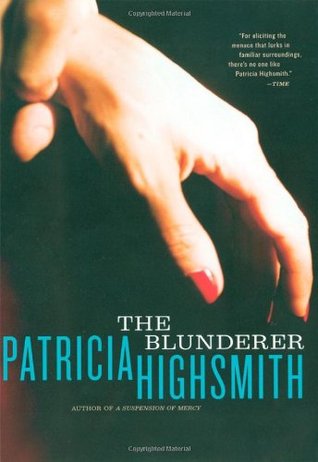
Last night, I finished reading Patricia Highsmith’s The Blunderer, and started rereading Larry McMurtry’s The Last Picture Show, which is my favorite novel of his. I read it the first time when I was about twelve, I think; and have reread it several times since; but I haven’t read it again in over twenty years, and I found a copy when I was cleaning out the storage unit and dragged it out. It’s not the first book people think of when they think of McMurtry–that would most likely be his Pulitzer Prize winning Lonesome Dove–and I’ve read a lot of McMurtry–not all of it, certainly–but I’ve always had a special regard for this novel. But I’ll talk more about that when I’ve finished the reread.

Meanwhile, The Blunderer by Highsmith was quite an interesting read.

276203

The man in dark-blue slacks and a forest-green sport-shirt waited impatiently in the line.

The girl in the ticket booth was stupid, he thought, never had been able to make change fast. He tilted his fat bald head up at the inside of the lighted marquee, read NOW PLAYING! Marked Woman,  looked without interest at the poster of a half-naked woman displaying a thigh, and looked behind him in the line to see if there was anyone in it he knew. There wasn’t. But he couldn’t have timed it better, he thought. Just in time for the eight o’clock show. He shoved his dollar bill through the scallop in the glass.

“Hello,” he said to the blonde girl, smiling.

“Hello.” Her empty blue eyes brightened. “How’re you tonight?”

It wasn’t a question she expected to be answered. It wasn’t.

And so begins Patricia Highsmith’s third novel. The thing that is so terrific about Highsmith is you really never know what you’re going to get with her; her plots are fiendishly original and clever, and so deliciously dark and relatable in some way. The Blunderer opens with Melchior Kimmel establishing an alibi for himself by going to see a film and being seen…and once seen and recognized, he keeps going and exits, heads for his car and then follows a bus north. At a designated rest stop he parks out of sight, finds his wife, who has gotten off the bus, convinces her to follow him to go and chat, and once they are out of sight he brutally murders her.

He gets away with it, too–he was seen at the movie theater, remember, and no one saw him at the rest stop. His wife’s murder remains unsolved.

Until lawyer Walter Stackhouse sees a notice in the paper about the murder. It intrigues him. He writes essays, or wants to write essays, about what he calls ‘unequal friendships,’ where one friend is lesser than the other and yet the better friend seems to get dragged along by the other. This murder fascinates him, and he starts trying to think how the husband could have done it and gotten away with it…and actually figures it out. Walter is also unhappily married; his wife, Clara, is frankly awful and is trying to ruin his friendships with other people and isolate him; yet she also makes him terribly unhappy. He tried to leave her once before and she threatened to kill herself, so they patched things up. But he is now introduced to another young woman whom he’s attracted to…and somehow Clara has figured this out and continues to make him miserable.

His idle fascination with the Kimmel murder eventually leads him to visit the bookstore Kimmel owns and operates, orders a book, and decides, after having seen Kimmel, that he must be innocent. His own life, meantime, gets worse. He tells Clara he wants a divorce and she attempts suicide. She gets out of the hospital and is just as awful as ever…and then her mother dies and she has to go back to her hometown in Pennsylvania to attend to things. She takes the bus. Obsessed with the Kimmel case, and wondering if he could, in fact, kill his own awful wife…he follows her bus in his car. When they reach a rest stop, he gets out of his car and looks for Clara…and cannot find her. But he’s seen…and later, Clara’s body is found at the bottom of a cliff. Suicide or murder? The police think it’s suicide at first…but the similarity to the Kimmel case is there….and his own fascination with that case now comes back to bite him in the ass.

I greatly enjoyed this book, as I have all of Highsmith’s that I’ve read thus far, and I love how she deftly changes directions in ways the reader cannot see coming. You can’t help but feel for Walter in his horrible dilemma, and the way his life starts to slowly spiral out of control all because he happened to read about an interesting murder in the newspaper. As the weird connections between the two cases slowly come to light, no one believes Walter is innocent–not the police, his friends, his co-workers, his maid, nor even his new love. It’s an extraordinary story, and the way Highsmith heightens the tension until it’s almost unbearable, the two parallel stories crossing and recrossing, is quite exceptional.

Highly recommended.