This is probably one of the most famous songs about New Orleans of all times, and of course, doing a deep dive into the history of the song–which began as an English folk song, of all things–was a pleasant way to spend a few hours. I heard the recording by the Animals when I was a kid, and honestly never cared very much about it. I always thought it was about a house of prostitution in New Orleans–Storyville, probably–but never gave it much more thought than that. But when I was looking for titles of songs about New Orleans to use for blatant self promotion for Mississippi River Mischief, it was kind of an obvious one. And when it came up on my list for this next post, I realized I didn’t really know very much about the song other than I didn’t care for it very much. It originated in the 16th century as an English folk song, and gradually evolved into an Appalachian folk song called “Rising Sun Blues” (great title, I may abscond with it, frankly) before finally becoming a folk-rock hit for The Animals in 1964 with its current name. (Musicologists suggests it’s thematically related to the old English folk song “The Unfortunate Rake,” per Wikipedia.)
I do find that kind of thing interesting, even if I don’t have any use for that information. (Although Barbara Michaels did a great job of using classic traditional folk songs and their history as the foundation for her underrated but marvelous novel Prince of Darkness–which I would love to revisit.)
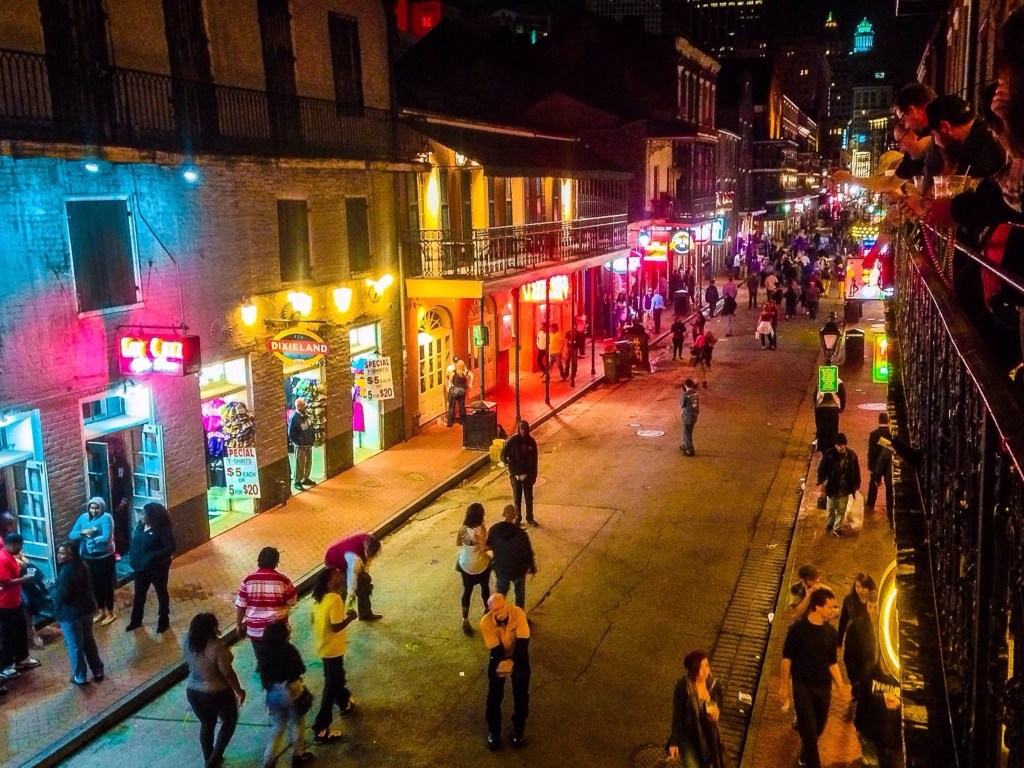
If you were playing Family Feud and the question “what is New Orleans known for”, the top two answers would probably be Bourbon Street and Mardi Gras. This annoys the locals and the natives to no end; and it’s understandable. Boiling New Orleans down to those two things is incredibly reductive. But they are major facets of the city, and both are responsible for a lot of tourist revenue, which the parish, city and state desperately need because our state and local governments (all of Louisiana’s cities and parishes) are complete and utter failures. When we moved here in the mid-90s, New Orleans had a strong base of tourism, but it was nothing like now. Since Katrina the city’s primary focus has been building the city into a tourist destination, putting all of the proverbial eggs into that particular basket. The pandemic wound up killing businesses that Katrina couldn’t; the St. Charles Tavern at the corner at Martin Luther King didn’t survive COVID, as one example. (They had amazing fried mushrooms; we used to get them every once in a while as a delicious greasy breaded and deep-fried treat.)
When I first decided to start writing about New Orleans (much as I hate to say this, but New Orleans really IS my muse, and I love that I live in the neighborhood of the Muses here), one of the things I was determined not to do was use clichés about the city in my work. It wasn’t until my fifth novel that I wrote about Carnival/Mardi Gras, which is where most writers about the city inevitably start (cliché as it may be, you also cannot write about New Orleans without eventually having to write about it); I wanted to get more established as a writer before I went there. Part of the reasons the first two Scotty books were set around Southern Decadence and (to a far lesser extent) Halloween was because those were also important holidays for the gays here. I did address Bourbon Street with the first Scotty; I knew that title (Bourbon Street Blues) would tell anyone that it was a New Orleans story, so yes, I took advantage of a cliché there. But I also realize now that most of my New Orleans writings were very provincial in a way; I mostly write about the “sliver along the river”–the Marigny, the Quarter, the CBD, the lower Garden District, the Garden District, the Irish Channel, and Uptown. There’s way more to New Orleans than these neighborhoods–sometimes I send them over the bridge to the West Bank or out to Metairie; there was a very vivid post-Katrina scene where I sent Chanse out to Lakeview, but for the most part I’ve not done much about other neighborhoods here. The West Bank, City Park, the East, Gentilly; all of these rich and vibrant neighborhoods–as well as the diverse ethnic make-up of the city–are very fertile ground for someone writing about New Orleans. Generally, the neighborhoods I write about are the neighborhoods writers who don’t live here focus on because they are the better known ones.
And of course, I’ve rarely, if ever, touched the history of the city–and it is rich, compelling, and fascinating…and super dark.
That’s kind of why I wanted to move this recent Scotty out of the city and into one of the rural parishes not far from the city limits. I have fictionalized these parishes before–I try not to fictionalize New Orleans, but have no problem inventing parishes and towns in the rest of Louisiana. St. Jeanne d’Arc parish is loosely based on St. John the Baptist and St. Charles parishes, known as “river parishes” because they run along the river north of the city. Redemption, also an invention I’ve used in other books, is based on the “bayou parishes”–not along the river, but between the river and the wetlands/Gulf of Mexico; those are Terrebonne and Lafourche parishes. Louisiana is just as interesting as New Orleans, and also has an amazing and interesting history of its own. Of course, the next Scotty will be back in the city–his next few, if they go as planned, will all be within the city–but that doesn’t mean I don’t want to keep writing about Louisiana and my fictional parishes, either.
There really is so much material here I could never run out of ideas.


Greg, I love reading about the background of your novels and stories. Yours is my favorite author blog, bar none, and I’m always happy to see a post from you in my inbox. I wish I could pull off that kind of conversational yet highly personal and informational voice.
Alas, we must agree to disagree on “House of the Rising Sun.” It’s one of my favorite songs and was the second one I learned when I was in college and learning to play guitar. (The first was “The Wreck of the Edmund Fitzgerald,” and the third was “Puff the Magic Dragon,” all of which makes me feel very, very old, lol.)
LikeLike