Mean

When I was a child and lived on the south side of Chicago, elementary school was dismissed every day at 3:15 pm. It took about ten minutes for my sister and I to walk the block home, meaning we usually could just catch the last minutes and closing credits of Dark Shadows every day. This was disappointing, of course, because we loved the show and tried to keep up with it; the older woman down the street with whom our mother left us every morning on her way to catch the bus for her shift spooling wire at an electronics factory in Cicero and fed us both breakfast and lunch also watched, and would tell us the following morning what was going on in Collinwood (she also got us to watch One Life to Live and General Hospital with her; but we weren’t as veste in Llanview and Port Charles as we were with the haunted Collins family).

But at three thirty every day one of the affiliate networks in Chicago showed reruns of old movies, and we generally watched the movie–we weren’t allowed outside unless our mother was home–and she usually got home around four. My grandmother had already given me a taste for old movies and mysteries, so watching the afternoon movie wasn’t a hardship for me, and it kept my sister and I quiet while Mom made dinner and did whatever housewifely and motherly chores she had to take care of before Dad came home.

It was watching those afternoon movies where I first encountered The Bad Seed.
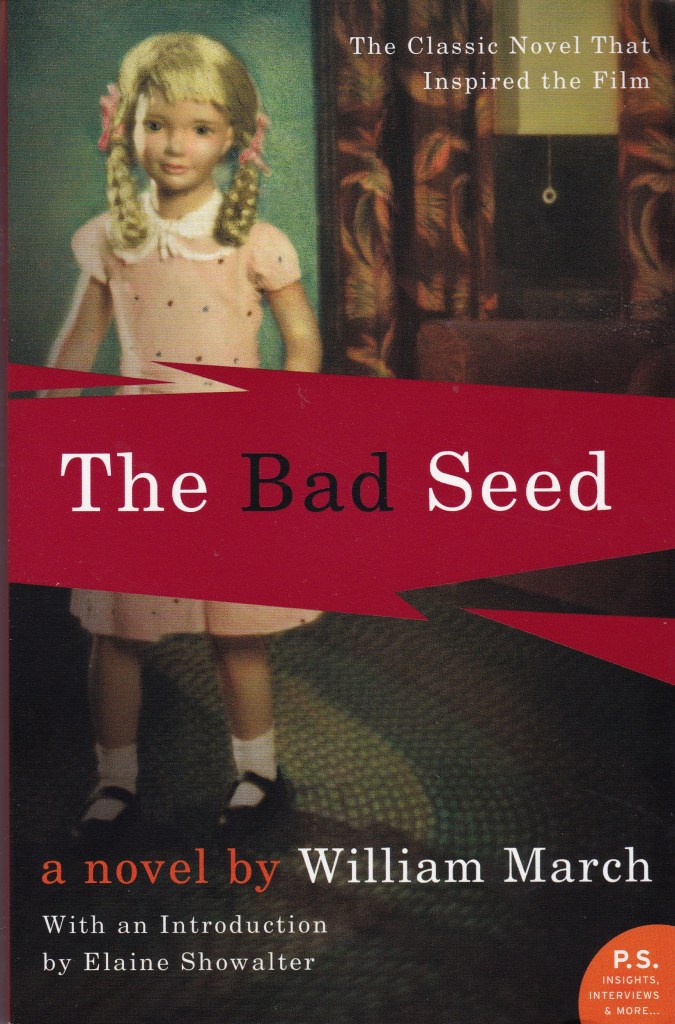
Later that summer, when Mrs Penmark looked back and remembered, when she was caught up in despair so deep that she knew there was no way out, no solution whatever for the circumstances that encompassed her, it seemed to her that June seventh, the day of the Fern Grammar School picnic, was the day of her last happiness, for never since then had she known contentment or felt peace.

The picnic was an annual, traditional affair held on the beach, an among the oaks, of Benedict, the old Fern summer place at Pelican Bay. It was here that the impeccable Fern sisters had been born and had lived through their languid, eventless summers. They had refused to sell the old place, and had kept it up faithfully as a gesture of love even when necessity made them turn their town house into a school for the children of their friends. The picnic was always held on the first Saturday of June since the eldest of the three sisters, Miss Octavia, was convinced, despite the occasions on which it had rained that particular day, and the picnic had to be held inside, after all, that the first Saturday of June was invariably a fine one.

If The Bad Seed has lost its ability to shock and horrify, it’s because in the decades since it was published (and adapted into both a play and film) the notion of a child being a killer has gone from being shocking to the general public to one that is kind of accepted; children do kill, and despite all the societal push towards sentimentality toward children. Rhoda is a sociopath, if not a psychopath; her inability to feel remorse or empathy or any other kind of human emotion is chilling to read about–she’s a stone cold killer, and clearly, she thinks nothing of killing to get something she wants: whether it’s the penmanship medal from her school, or a nice trinket promised to her, and then to shut up the janitor who sees through her and threatens to expose her; there’s a progression there. First she kills on impulse to get something she wants, then she coldly and calculatedly kills to protect herself. Rhoda is maturing as a killer, which is very chilling for the reader. The book is told entirely from the point of view of Rhoda’s mother, Christine–who is very slowly coming to realize, time after time, that her child is a monster, despite the innocence of childhood and everything we are taught to think, sentimentally, about children.

Psychology was starting to come into its own in the United States during the 1950’s, and you can see how crime writers took to psychology in that decade: The Bad Seed asks the question of nature v. nurture (although its answer is that it’s nature, genetic, and cannot be helped–and there’s some truth to that. I’m not entirely sure that sociopathy or psychopathy is learned behavior; are these cold-blooded killers born that way or are they creations of their environment? The solution Mrs. Penmark comes up with and executes in the novel is dramatically different from the film–the film had to abide by the Production Code, whereas novels had no such restrictions on them–and I believe the book’s ending actually works better than the film’s.

One thing that the book does brilliantly is depict the emotional turmoil and distress of the mother, slowly beginning to suspect and find proof that her child, that she loves so dearly, is actually a monster.

I first read this book when I was a teenager; I’d already seen the movie when I discovered the book on the shelves at the library, and so I checked it out and read it. I enjoyed it tremendously at the time–and it also had me watching other teens and young children for signs of sociopathy for a few years–and so thought it might be worth a revisit. It was, most definitely; it’s a bit dated, and of course the notion of a killer child isn’t quite so shocking as it was back during the Eisenhower administration–we’ve seen too many real life examples of this, and of course the trope of the killer child has been used, over and over again, in crime fiction and in films, so it’s not the brace of cold water in the face that it once was (kind of like how Beast in View by Margaret Millar was groundbreaking in its time–its still a great read–but what Millar did in that novel has been copied and imitated so much that it’s almost a cliche; one has to read these books with those sort of things in mind). Agatha Christie also used the trope of the sociopathic child (although in a quick google search it turns out Christie’s sociopathic child killer predated The Bad Seed; honestly, Christie did everything first).

It was a very pleasant reread, and as always, it’s interesting to visit (or revisit) books that were considered shocking in their time, only to have them turn out to be fairly tame–I’m looking at you, both Peyton Place and Valley of the Dolls–as well as to see how far the crime fiction genre has progressed. (I still consider Peyton Place to have a place in crime fiction, even though most people don’t. And while the crimes in the book may not be the driving point of the story, those crimes do impact everyone in the town in some way….there’s another essay to be written, probably after I reread the book at some point. It’s been awhile since I’ve revisited both Peyton Place and Valley of the Dolls….perhaps that can be my Christmas present to myself.

Love Story

Thursday morning, and I am working from home today. I have some errands that simply must be run this morning–fortunately I only have to work a half-day today–so once I get this posted and get my own act together, it’s off to the errands so I can come home and do data entry/make condom packs. I think I am going to rewatch the Christopher Reeve Superman–it’s a 1970’s movie, after all, and I don’t know yet if it will deserve a place in the Cynical 70’s Film Festival; I don’t think so, but I think it could be a fun reread while working with my hands.

I was very tired when I got home from work yesterday–so tired that I skipped the gym (!) and didn’t work on the book. Tonight when I finish my condom packing I am going to have to get back to the book, and figure if I can get two chapters done in one day I’ll be back on schedule. LSU’s lamb-to-the-slaughter game against Alabama isn’t until Saturday evening, so I should be able to get several chapters finished during the day that day, and maybe even more. Who knows? There’s a plethora of possibilities.

I slept late this morning–I did wake up at six, again at seven, and finally at eight. I feel much better: very rested, relaxed, my muscles feel good, and my back also doesn’t hurt at all. This is, needless to say, quite lovely, and while it is cold this morning, the cold is nowhere near as bitter as it was the last few mornings, so I can handle it. I haven’t even put on a cap to keep my head warm, which is a lovely thing. It’s very gray outside–the sky is covered with clouds, so it’s kind of grayish-gloomy; like winter mornings I remember from my childhood in the Midwest. I ordered electric blankets the other day–a friend on Facebook suggested it when I was complaining about the cold, and had one of those wow it never ever occurred to me to get electric blankets moments when I truly wonder about my intelligence and intellectual capacity. But in fairness to me, I don’t think I’ve ever owned an electric blanket, and we certainly didn’t have any when I was growing up….but thinking about it this morning, what a difference that could have made that bitterly cold winter I spent in Minneapolis twenty five years ago….

I am still reading both The Bad Seed by William March and Lincoln by Gore Vidal; obviously I was too tired last night to make any headway on either. Paul and I did watch an episode of something that might turn into a guilty pleasure for us….Cajun Justice, about the sheriff of Plaquemines Parish. Louisiana was an enormously popular location for reality television shows back in the day–remember Duck Dynasty?–and since one of my co-workers is moving to Plaquemines Parish (Houma, specifically) she was the one who found this single season reality show…when she mentioned it to me the other day–when we first talked about her move down there, and it’s been a couple of weeks; it was around the time I was looking up Cajun/Louisiana folklore for a potential Christmas horror story, which is when I was finding all those wonderful bayou supernatural legends, like le feu follet and the lutin…which I was able to look up in Gumbo Ya-Ya. The show is kind of, I don’t know, offensive in some ways, as it depicts Cajuns and their culture as an exotic thing; lots of talk about voodoo and black magic and so forth. (This is part of the problem I had with writing about Cajuns and the supernatural; I’m afraid I’ll give in to the stereotypes rather than depict the culture and the people authentically.) I mean, I do want to write short stories illustrating Cajun culture and their interesting folklore and legends (Monsters of Louisiana), but I also want to do it correctly. Gumbo Ya-Ya is an excellent source material, a great starting place, but I am also very aware that its authors were also steeped in the white supremacy and racism of the time in which they wrote and compiled the book, which also makes it harder to decipher what is real and what isn’t.

All right, I’ve got dishes to put away and laundry to fold before I hit the errand trail, so have a happy Thursday, Constant Reader, and I’ll check in with you later.

The Outside

And the vacation is over and it’s back to work this morning. Huzzah?

As I mentioned, I didn’t get nearly as much done as I had hoped over the vacation, but that always happens. I got back into the writing of the book, and that’s really the most important thing to me; I was beginning to think I was just going to keep blowing it off and then wake one morning and realize fuck it’s due next week and I haven’t done a fucking thing.

You know, like I always do.

But I made some good progress on the book; I started a couple of new short stories (whether they will amount to anything is a completely different subject, of course); I got a lot of rest, and I also managed to get some cabinets cleaned out and organized. Looking back, of course, it feels like I didn’t get an awful lot done and I am not entirely certain where all the time actually went–but I am counting the week as a win and will not give it to my tendency to be negative about myself, which is far too often my default.

I did finish reading Night of Camp David yesterday, and it’s timeliness was a bit astonishing, really; the concept of a president having a mental breakdown and being extremely paranoid is something I’ve seen at least twice in my lifetime, and hope to never see again. I started rereading William March’s classic The Bad Seed yesterday as well–I read it originally a very long time ago–when I was a teenager, I think; I checked it out of the library, as I recall–and I don’t really remember as much of it as I would like. I suspect most of my memories of the story are from the film, frankly.

We finished watching The Undoing last night, and I wasn’t terribly pleased with how it ended; it was an interesting episode, but it didn’t feel earned…no spoilers, of course, but I felt the ending was a bit of a cheat for those who’d watched the entire time, and too much was left unanswered, I felt. Your mileage might vary, of course. Overall we enjoyed it–the performances were great–but we were disappointed with the final episode, is all. We also watched another episode of Murder on Middle Beach, which was interesting–some new added twists and suspects mixed into it last night, and there’s only one more episode. I suspect the mystery of who actual committed the murder isn’t going to be solved in the final episode, but I do hope the young man making the documentary (about his mother’s murder) gets some kind of closure here, otherwise I am not sure what the point of the documentary was, other than the true-crime craze we seem to be experiencing right now in popular culture.

It’s very cold in New Orleans this morning–right now it’s forty-nine degrees, and not getting warmer today. The forecast for the week is abysmal–forties at night, sixties during the day–which is going to make getting up early and going to work a pain in the butt, as I am not a big fan of the cold under any circumstances.

And on that note, I need to start getting ready to head into the office. Have a lovely Monday, Constant Reader.