I Wanna Dance with Somebody

Only when I’m dancing do I feel this free…

I love to dance.

Really, how was there ever any doubt about my sexuality?

Well, there probably wasn’t, but I still live with the illusion that people didn’t know. It makes me happy, okay? Allow me my delusions, thank you.

I think the first time I ever danced was at a school dance when I was a sophomore. I don’t remember what the dance was for, but that was it. A friend of mine asked me to dance, and I replied, “I don’t know how” (which was true), and she laughed at me, saying, “all you have to do is move” and showed me a basic back and forth step with swinging arms that was pretty simple. “Just stay on the beat,” she advised, and I found myself losing myself on the dance floor, getting into the music, and improvising…and for the first time in my life got compliments for something. This happened again when we moved to Kansas and at my first dance there–girls couldn’t believe what a good dancer I was, and they all wanted to dance with me.

Granted, most guys were not fun to dance with, usually doing some kind of weird shuffling kind of movement that was always off-beat and looked almost painful to do. But I basically figured out the trick–moving your hips and shoulders on different beats of the music instead of together. And the more I did it, the more I loved it. Guys were also not supposed to enjoy dancing, as it wasn’t ‘manly’ or something; I don’t know, there was a lot of idiotic bullshit like that for boys when I was one. My love of dancing continued on through my twenties–there weren’t any really good clubs for dancing, gay or straight, back then–and it really wasn’t until I moved to Tampa and started going to a gay bar in Ybor City called Tracks that I really found my place in the community.

Oh, not right away. I would dance when I’d go out, but not much; I was very self-conscious, and dancing made me sweat–a lot. My hair (what was left anyway) would plaster to my scalp with sweat, my socks and shirt would be soaked through, and I really really believed I was unattractive. But when I was out on the dance floor, I didn’t really care about how I looked or if anyone was looking at me or anything other than the driving beat and cutting loose on the dance floor. I never felt tired or sore the next morning either–I always felt good after dancing all night…

….and then I lost weight and discovered the gay bars in New Orleans.

I also discovered Ecstasy, but that’s probably best handled at a different time.
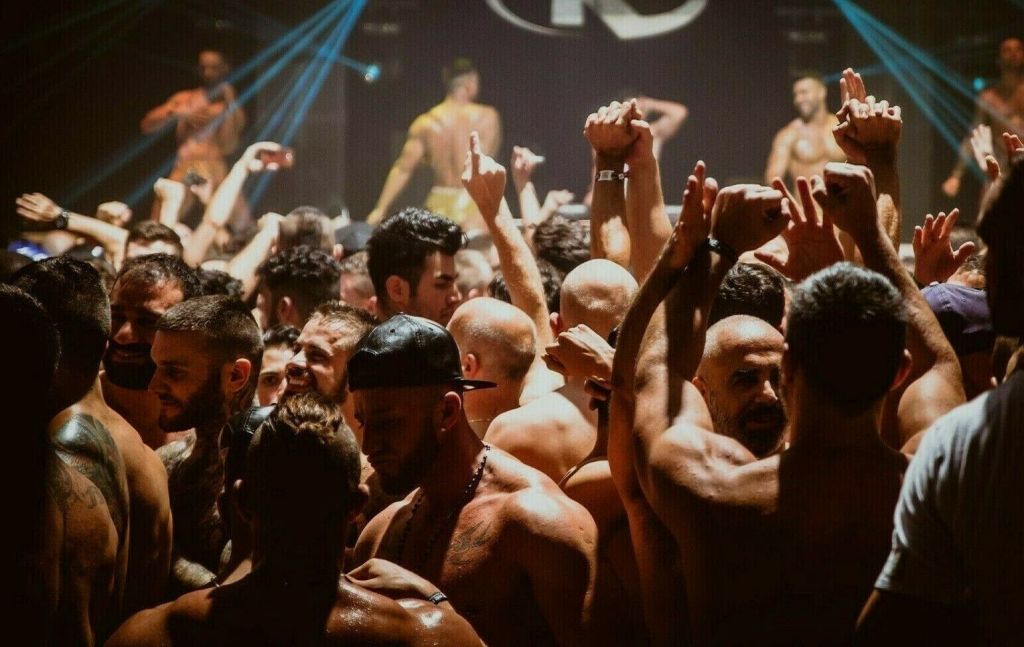
Oh, how I loved coming to New Orleans to dance the night away! That was the one thing I always hated, everywhere else that I lived or visited; the night always ended with last call, sometime after midnight and always no later than three. In New Orleans, the evening ended when you were too tired and sweaty and exhausted to dance any more. I used to go dancing at least three nights per week when I lived in Tampa (Friday, Saturday, Sunday), which also continued in New Orleans. I also spent a lot of evenings in gay neighborhood bars while in Tampa–didn’t really do much of that after moving here.

There’s something about being in an altered state (of whatever kind) out on the dance floor in a sea of shirtless gay men, all dancing and having a great time, while killer music plays through the speakers, the constant thumping of the bass getting into your nervous system. There would also be a light show during the dancing, and mist sprayed down into the crowd (in the older days before I lived here, I used to think they put poppers in the mist because you could smell it…although now I’m not sure that wasn’t just from how many people were using them on the dance floor), whistles and bells and there was always some older gay hippie, shirtless with long gray hair, shaking a tambourine out there. Everyone was friendly on the dance floor, smiling and grinning and flirting and grind-dancing, and the loud music just got into your soul, making it an almost out of body experience.

I always hated that the mixes you heard in clubs were so hard to find in record shops.

And the divas we sang along to–Deborah Cox and Madonna and Celine Dion and Martha Wash and Whitney Houston and Mariah Cary, among many nameless others–I was always lip syncing when I danced, really doing drag without the make-up and costumes and wigs–music I could just get lost in for hours. On the dance floor, everything was okay and everything was going to be better and this insular all-gay world was a place where I was at peace, where I was happy, and where nothing could ever bother me.

I miss dancing, but I also am older and can’t stay up late enough to go out dancing, let alone dance for even a few hours. But dancing has always been an integral part of my gay identity, even if I don’t do it anymore. I still listen to the music I can find on Spotify or Youtube, and believe me, there’s nothing like blasting gay dance music for cleaning the house. I used to have deejays make me tapes for my aerobics classes–and the attendees always loved the music.

Are gay bars still community hubs? I honestly don’t know–but all the young gay men I work with go out to clubs, so I guess so. Maybe not as integral as when going to one actually put you at risk of being arrested, but still important.

Cover Girl

Drag is a part of queer culture I’ve always known about but has also been something primarily on the periphery of my gay life and world; I’ve only occasionally ever thought about perhaps doing it–as a gag or as a costume at some point; a very dear friend has always wanted to dress me up as Joan Crawford (narrow waist, big shoulders, enormous eyebrows), which is something I would consider doing if it wasn’t so much work–I am way too lazy to ever do drag properly and respectfully. I did a very poor attempt at drag many years ago, for a Showgirls themed birthday party for a friend; the result was far from pretty. I did sometimes used to use mascara and eye liner when I would go out; it emphasized my enormous and expressive eyes which most people have always considered my best feature (although aging has deprived me of my eyelashes). Drag was just another part of the community and culture, like leathermen, bears, and gym queens–another patch on the quilt that makes up our queer world.

My primary interest in drag has always been historical and cultural; drag culture has always been a part of the gay bar scene, since time immemorial, it seems. I have always been interested in every aspect of gay culture since coming to terms with my own sexuality and recognizing that not coming to terms with it meant a lifetime of guaranteed misery, and shouldn’t I really take a chance on being happy? There was always a lot, for me, of misunderstanding about drag culture and its place in the gay community; but that also primarily came from people outside of the community and therefore didn’t have the slightest grasp of it–i.e. ignorant slurs that all gay men dressed like women whenever they had the chance, you know–not “real men.”

But seriously, who wants to buy into the cult of toxic masculinity? No fucking thanks.

I don’t know the history of drag, but I did know–from the very beginning–that there was a significant difference between drag and the trans experience; there’s definitely crossover, but the Venn diagram of drag and trans is not a complete circle. I understood this always, even when I knew very little of either. This was always the issue I had with To Wong Foo Thanks for Everything Julie Newmar–the queens in the movie didn’t just do drag for performance or pageants, but dressed as women in their everyday life…which made them transwomen who also did drag. The failure of that film to define the difference between the two, I think and believe, has a lot to do with the current-day conflation by the Right of drag queens with transwomen. Likewise, was the Nathan Lane character from The Birdcage (and the French original) a transwoman or a drag queen?

And the fact that I, knowing as little about gay life and culture as I did in 1994, knew that the Wong Foo movie was conflating two completely different things as the same certainly means that other, better-educated people should have, as well.

But it’s also important to remember that the movie wasn’t made for the queer community–no Hollywood studio film with queer characters is intended for a queer audience, and thus there’s a falseness to them that rings hollow to me (don’t even get me started on Philadelphia); what Sarah Schulman once (paraphrasing) described as “the creation of a fake public homosexuality that will play in Peoria.”

There’s an essay in that, methinks.

The first time I went to a gay bar in Houston is my first true memory of seeing someone in drag performing on the bar in person. She was doing Liza as Sally Bowles from Cabaret, and as I walked in the door with some co-workers from That Airline, the first thing I saw was her up on the bar, with a musclebound dancer on either side of her in bikinis or thongs, and I can remember thinking wow this is decadent like Isherwood’s Berlin–but I liked it. I felt at home there, in a way I never did in gay bars in Fresno (or anywhere else I was able to sneak away and visit one), and felt like that night was when my gay life actually began: I was with co-workers, I was going to a gay bar openly, and the co-workers knew I was gay but had never really experienced being gay as anything but misery and depression and a curse. I don’t remember the name of the queen, but ever since then, “Mein Herr” always brings a nostalgic smile to my face.

But again, I didn’t go out much or do much during those two years in Houston as I still wasn’t completely comfortable being totally out. I moved to Tampa in 1991 and started living as an out gay man…and started spending more time in gay bars. A popular night for airline employees as Tuesday Nights at Tracks, where cocktails were only fifty cents and no cover before ten. There was also a drag show at midnight, with an actual stage in a show room, and that was my first real experience watching drag queens perform. There was a gay paper there–I cannot remember what it was called to save my life; I know the one in Texas was This Week in Texas, called TWIT by everyone–but it often had information about performances and other night life ads and so forth. I began to get a better understanding of drag, its place in the community, and its importance to gay culture, period.

And of course, once I moved to New Orleans, there was Bianca del Rio.

The mainstreaming of drag actually began in the early 1990’s, with RuPaul having a surprise hit record out of nowhere, “Supermodel (You Better Work)”, which started exposing more people to drag who ordinarily would have never seen one. RuPaul was everywhere in the early 1990’s, and even had her own talk show on MTV for a while. The Adventures of Priscilla Queen of the Desert and its homogenized American version To Wong Foo, Thanks for Everything, Julie Newmar were both incredibly popular. (I enjoyed Priscilla, and I’ve already touched on my issues with Julie Newmar–which will probably become an essay at another time.)

There were, of course, other successful queens out there before RuPaul’s big breakthrough and later, comeback with Drag Race, but few had as large a profile in the culture as RuPaul. Lady Bunny, Miss Coco Peru, Miss Richfield 1998, and Varla Jean Merman were all making a pretty decent living as performers before the drag explosion that followed the launch of Drag Race.

I’ve met numerous drag queens on the local scene both in and out of drag–I’ve always been fond of Princess Stephaney and Blanche Debris (who is retired now), and the drag community of New Orleans was always incredibly supportive of the NO/AIDS Task Force. I met Bianca out of drag a couple of times, but I doubt he remembers me…but Drag Bingo at Oz on Sundays with Bianca and Blanche (I just realized their first names both translate into English as white) was always a blast–and I made a point of never trying to get Bianca’s attention because she was always quick and that tongue was sharp as a scalpel always.

I also work with several co-workers who either did drag or have started doing it while I’ve known them, which indirectly helped me with the writing of Death Drop and my original story for a drag queen. Jem is sort of patterned in some ways on one of my former co-workers who actually went to a drag school here in New Orleans–and eventually quit his full-time job to do drag full-time. He’s been in Queer as Folk and numerous other shows filmed here, and has been booking gigs all over the country–check out his Instagram, isn’t he fucking gorgeous? So that gave me the idea to make the first book with Jem his drag origin story.

Learning about drag to write this book–and its sequel–has been an enjoyable learning experience for me. At some point I know I am going to have to do a transformation; I need to know how it feels to have the make-up and the padding and the wig and the dress and shoes on. I can imagine it all from doing theater in high school, but it’s not the same.

And yes, I will share the pictures when and if it does happen.

It’s Raining Men

The first song I ever danced to in a gay bar was, quite naturally, “It’s Raining Men.”

I never said I wasn’t a stereotype, did I?

I was twenty-one the first time I ever set foot in a gay bar. (If there were gay bars anywhere near me in Kansas, I had no idea) It was in Fresno, California, of all places; where I spent the 80’s and which I often lovingly refer to as “Topeka in the Valley.” It wasn’t much of anything, really; a small building on Blackstone Avenue, I think just past Olive, and near the off-ramp for the new cross-town highway in an attempt to alleviate traffic on the main streets of the city (it may have been further north). The bar was called the Express, and someone I worked with–the first obviously gay man I ever knew, and certainly the first one who was out and proud and not ashamed of it–took me one night after work. I was nervous as hell. I had no idea what I was getting myself into, and I remember it was dark and crowded. There was a bigger front room with the bar, and there was a smaller dance floor further in the back. We arrived–I didn’t recognize the song that was playing–got a beer (he got a vodka and cranberry), and then the next song started up. I didn’t know it, had never heard it before, but he dragged me out onto the dance floor and yes, the song was quite a jam. I loved it, and rather self0-consciously danced my ass off (I always loved to dance). My friend later told me the song was by the Weather Girls, who used to sing back-up for Sylvester, and it was called “It’s Raining Men.” The song was utterly ridiculous–it still is–but those powerhouse vocals, the driving beat, and the absolute joy in the idea that all you had to do was “rip off the roof and stay in bed” so a hot man will drop in from the sky for you? How could gay men not embrace the song? I bought the single at Tower Records a few days later, and every time that song played, I’d be out on the dance floor. Even now, when I hear it, I always think back to that first night I went to a gay bar.

HIV/AIDS was already a thing, but we didn’t know much about it in Fresno; it seemed like something new and scary but maybe no worse than some other new diseases that had been discovered in the 1970’s/early 1980’s. The rare yet terrifying information and reporting on it referred to it as GRID. It eventually claimed that co-worker who took me to my first gay bar, and his roommate, who was the one who told me years later that the co-worker (whose name I cannot recall, I just know it started with a K) was in the hospital, dying. “It’s Raining Men” always reminds me of him; always takes me back to that first time when I so nervously paid my cover charge and flashed my ID and walked into my first ever gay bar. There was another gay bar in Fresno, the Red Lantern, that was in a much shoddier (“dangerous”) part of town. (Gay bars, back in the day, were never in the best neighborhoods. Tracks in Ybor City in the early 90’s–when I lived in Tampa–was also not in the best neighborhood. Ybor City did begin gentrifying before I moved away, but originally? Yeah, not the best neighborhood.) I went there a few times as well–made friends there, made friends in the other bar, too. I lost all those friends, of course, and their names and faces are also gone, more lives lost to the mists of time in my memory. It seems a bit shameful to not be able to remember the names and faces of the first people who knew a part of me I’d never let anyone see before, but they also didn’t know me in that I kept the other part of my life secret from them.

It’s very strange, because I decided to google the gays bars of Fresno while I was writing this and apparently the Express closed in 2013? I don’t think it stayed in the same location–according to the site I found it had also been called “708” before becoming the Express again; who knows what that was all about. But the Red Lantern is still there on Belmont Avenue, in the same location; how wild is that? That’s a pretty long-lived gay bar for a place like Fresno, really. I remember in Houston there was JR’s, and Heaven, and maybe another one there in the Montrose district. But I didn’t start spending a lot of my weekend evenings in gay bars until I moved to Tampa. Tracks in Ybor City and Howard Avenue Station were the two primary gay bars when I lived there; and there was Bedrox on Clearwater Beach–which was the gay section.

And of course, there are gay bars everywhere in New Orleans. I haven’t set foot in one in a number of years, and may never do so again. I’m old; spending the night dancing would end with me in the hospital, or needing days to recover.

I don’t know what gay bars are like now because I’ve not been a part of that culture for a very long time–we haven’t even done condom outreach during special weekends in the bars in years anymore–which is why it’s hard for me to write about Scotty being still a party-boy. His age in the book I just finished and turned in is roughly forty-three or forty-four; after Katrina when I had to actually pick a time for the books to have been set (Katrina couldn’t be ignored), I decided that the Southern Decadence where Scotty met both Frank and Colin was in 2004, Jackson Square Jazz was that Halloween, and Mardi Gras Mambo was Carnival 2005. Scotty had just turned twenty-nine in Bourbon Street Blues, which meant he was roughly born in 1976, which works with the other timelines, making him twelve or thirteen when the Cabildo caught fire the last time. While the other books can be more amorphous, obviously Who Dat Whodunnit was set in January of 2010, right before the Saints won the Super Bowl. With the pandemic starting in 2020–which I will deal with at some point–this one had to take place before the world shut down, so I am thinking it’s May of 2019. I don’t want to skip ahead a year to the pandemic, so Quarter Quarantine Quadrille will be further in the future. I kind of want to do Decadence again in another book–with Scotty older but not much wiser–but am not entirely sure. I also would like to really do a Scotty Halloween book, and maybe even a hurricane evacuation one, I don’t know.

I am, however, very glad that I did write those first three Scotty books, when I was enmeshed in gay bar culture, because I’m glad it’s preserved in fiction. That world is gone now–washed away when the levees failed and the city rebuilt. Someone once told me I was the only person to document that pre-Katrina gay male existence, of going out to bars and being promiscuous and dancing all night long and drinking too much and occasionally dipping into party drugs.

I’m also kind of glad modern gays don’t have to use the weekends and gay bars as a place to let loose and be as free and gay as possible, which they couldn’t do during the week. Friday nights were always a relief, a respite from a cold and unloving world that judged us harshly and wished us harm.

I don’t miss the bright lights, the cigarette smoke (that’s how long it’s been), the stench of male sweat and the smell of poppers in the air as the deejay spins another banger. I mean, I do, but not in a sad kind of way; those memories are lovely and they make me a little wistful for the days when gay bars weren’t clogged with bachelorette parties and obnoxious drunk straight girls. But those weren’t the good old days, really; we had no rights and our sex lives were against the law; the few legal protections we have now were goals back then, something we could strive to achieve sometime in the distant future. I certainly never thought Lawrence would decriminalize my sex life and Obergefell would make it legal for Paul and I to marry; I never thought those things would happen during my lifetime. I didn’t expect to see an openly gay member of the Presidential cabinet; out queer characters as leads in television shows and movies–none of these things seemed possible to that closeted twenty-one year old who walked wide-eyed into the Express and went out to dance to “It’s Raining Men.”

I had no idea what the future held for me or for my community that night. In some ways I wish I could let that kid know everything would be okay and his life would turn out so much better than he ever dared dream…but knowing might change things, and I wouldn’t want to change anything that would take away the life I live now, because I love it.