Boogie Fever

In March of 2020, something I had only been vaguely aware of became something I was acutely aware of, seemingly overnight: the world, in fact, shut down in the face of a virulent and potentially deadly disease that was communicable. I went to work one morning and all of our appointments had been cancelled; they’d put up shields everywhere in the testing rooms and at the front desk; and after we were there for about a couple of hours the word came down from the chief medical officer: we were shutting down. It happened so fast my head spun. Within days the Tennessee Williams Festival was cancelled, the Edgar banquet was in jeopardy, and false information was spreading even more quickly than the virus. I also remember thinking that the measures we were taking as a country were so drastic that “surely it would be over in a few weeks.”

Ah, naivete.

Stressed out and concerned about everything and everyone, I did what I always do in stressful times: I turned to books. And, as is my wont, I decided to read about plagues. I got down my copy of Barbara Tuchman’s A Distant Mirror to read the bubonic plague chapter again; I have a copy of a book called The Black Death (whose author I cannot recall) that I also read; I revisited The Stand by Stephen King (an all-time favorite of mine); Thomas Mann’s Death in Venice; Camus’ The Plague; and even got down Katherine Anne Porter’s short story collection to reread “Pale Horse Pale Rider.” I was, as you can obviously tell, interested in seeing how previous plagues had been dealt with, survived, and the changes they wrought on civilization and society. I also wondered how to write about the pandemic (it not being my first pandemic, either; I always felts queers of a certain age were a little better prepared for the coronavirus outbreak than the rest of the world because we’d already been through HIV/AIDS), and if I would eventually; I wrote a short story called “The Flagellants” which I hope to publish someday somewhere, probably in a short story collection of my own, and even came up with an idea for a Scotty: Quarter Quarantine Quadrille.

But I was also seeing people saying they wouldn’t read fiction set during pandemic times; and other authors shying away from it. I kind of shook my head but understood; I remember how New Orleans writers didn’t want to deal with Hurricane Katrina afterwards–I certainly didn’t when I was living through the aftermath–but we all eventually came around to writing about it. Even if it’s fiction, I feel like we need to have documentation of what it’s like to go through things like hurricanes and pandemics and other paradigm shifts that change the world as we used to know it before the shift.

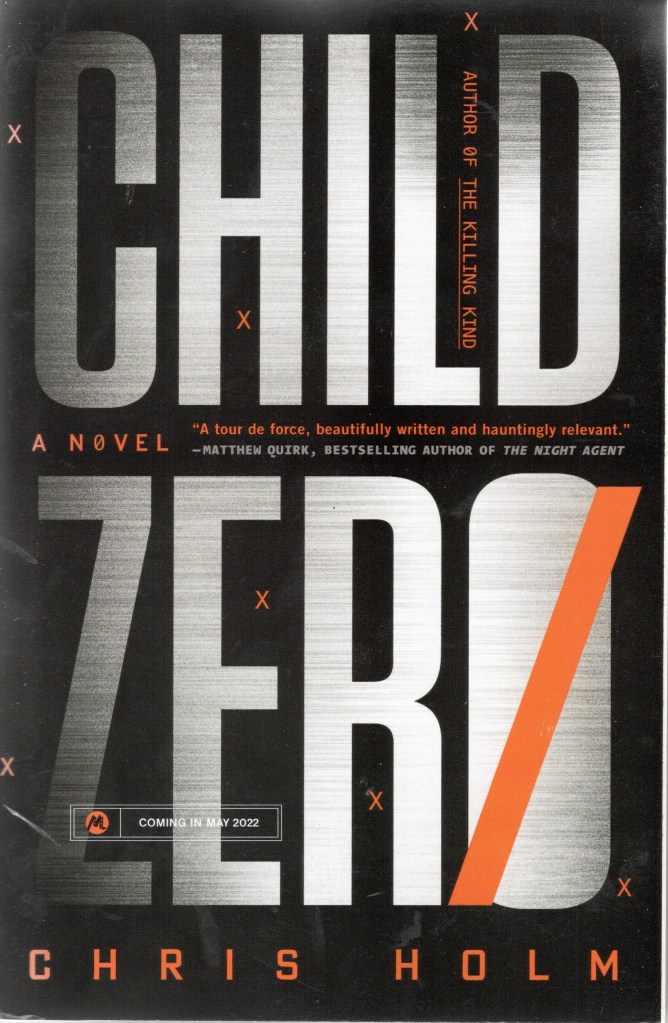
This past week I started reading an advance copy of the new Chris Helm book, Child Zero, and finished it yesterday–and yes, it’s a pandemic story, and no, it’s not about COVID-19…but what it is, is one hell of a read.
Pike and his men reached the encampment’s southwest gate at precisely 3:15 a.m.

Twelve minutes earlier, their sleek black SUV’s–three in total, armored, tinted, and stripped of emblems, license plates, and VINs–entered the Lincoln Tunnel in Weehawken, New Jersey, having passed the darkened tollbooths without slowing. Two minutes after that, they emerged beneath the murky waters of the Hudson River in Midtown Manhattan and zigzagged until they reached Eighth Avenue.

The stoplights blinked yellow in all directions. They encountered neither traffic nor pedestrians. Three years ago, Pike thought, these streets would’ve been bustling–even at this time of night. Now, thanks to the citywide curfew, they were empty save for police cruisers and sanitation crews.

The forer rolled lazily through intersections, or idled nose-to-tail beside one another so their drivers could converse. The latter clung to the side of tanker trucks in hazmat suits, or wandered two-by-two with smaller canisters strapped to their backs spraying bus stops, subway stations, and other public spaces with disinfectant foam. Fresh from the nozzle, it was enough to make your eyes water, but within minutes it dissipated to a lacy film that turned to fine white dust when touched, and smelled like some fragrance chemist’s idea of clean.

My assumption is that smell was either lemon or pine, or a combination of both?

Child Zero is, more than anything else, a rapid-paced thriller about a future world in which antibiotics have become useless; a virus has spread throughout the world rendering them (I won’t go into the technical details here; it’s explained much better within the pages of the novel and I am no scientist) ineffective in stopping infections or bacteriological diseases of any kind. A cut or a scratch can literally lead to death, and the world has clamped down into an authoritarian society that is even more frightening to contemplate than the pandemic itself. Would this be considered a science thriller? I’m not sure how you would classify this book within the world of crime fiction; it’s definitely a page turning thriller (once I got going yesterday there was no way I was putting it down until I reached the end), and kind of reminded me of Michael Crichton’s The Andromeda Strain, only better (The Andromeda Strain scared the shit out of me when I read it as a teenager a gazillion years ago); Chris Helm is a better writer than Michael Crichton at his best, and it’s amazing what a difference sentence structure, word choices, and intense character development can make in a thriller. Focusing on a pair of cops, one white male and one Muslim woman, who get drawn into an investigation into a mass shooting event at a quarantine camp in Central Park (“Park City”), their investigation soon runs afoul of powerful people, within the government and without; Jacob Gibson is soon put on leave but soon they are witness to another mass death event; and find themselves helping a young illegal immigrant, twelve-year-old Mateo–who is the target everyone is looking for.

You see, all the murder victims in Park City were, surprisingly enough in a time of pandemic, completely healthy–which makes no sense. Somehow, Mateo is the key to everything…and time is running out because Jacob’s four year old daughter is sick.

This is a non-stop thrill ride from start to finish, but what makes it better than your average thriller is not just the timeliness of the story but the fact that the characters aren’t two-dimensional Hero, Sidekick, and Target, the way they so often are in thrillers. They have interior lives, are sharply drawn, and you care about what happens to them–which, to me, is perhaps the most important part of a thriller (and why so many thrillers, in my opinion, miss the mark).

Get it pre-ordered if you haven’t already. It’s truly terrific.

You Can’t Always Get What You Want

Ah, Venice.

I’ve always loved Venice: the idea of a city that exists in a place where no city really should but does anyway (like New Orleans); a city with a long and remarkable history that at one time was one of the major powers of the world, despite not really having much population yet somehow carving out an empire; and always dreamed of visiting there. When Paul and I lucked into our marvelous trip to Italy back in 2014 (I think it was 2014? I could be wrong, it may have been 2015 but it really doesn’t matter) I definitely wanted to include Venice in our itinerary. We wound up only being there for twenty-four hours, but I was enchanted (I was enchanted by all of Italy, really), and have always wanted to go back and spend more time there. We were incredibly lucky when we were there; it was the week before Labor Day weekend, and there were no real crowds there (I have since seen horrible pictures of crowds so thick you can barely move), and we just wandered around looking at beautiful buildings and crossing canals and going into churches and eating gelato–lots and lots of gelato (which was every day, everywhere, while we were in Italy–we even got some at the airport when we flew back out).

Venice is also the setting for my all-time favorite novella and movie based on it (Daphne du Maurier’s “Don’t Look Now”). I love the Katharine Hepburn film Summertime, in which a lonely unmarried teacher comes to Venice and is also enchanted by how gorgeous the city is, and also finds a bittersweet romance with a handsome Italian man. One of my favorite parts of Indiana Jones and the Last Crusade is set there. I finally read Thomas Mann’s “Death in Venice” as part of my “plague days” reading last year when COVID-19 shut down the country; as well as Daphne du Maurier’s take on the tale, “Ganymede.” John Berendt’s City of Falling Angels, about the La Fenice fire and the insanity in rebuilding the fabled opera house, was a remarkably insightful look at how things work in Venice, as well as the restoration works on the city and its gnarled bureaucracy, as well as the blasé attitudes of the locals about how corrupt and insane everything is there.

It goes without saying that the similarities between Venice and New Orleans are striking, and run much deeper than the constant threat of water and Carnival.

I started writing a novella this year set in Venice–which I’ve wanted to write about ever since I visited–and at some point I will revise it to get it ready for publication; it’s on my to-do list–and so naturally, Christopher Bollen’s A Beautiful Crime was added to my TBR pile as soon as I knew of it.

And what a delight it turned out to be.

Down below the cry of gulls, below floors of tourists undressing and dressing for dinner, below even the shrinking figure of his killer. a man lies crumpled and bleeding. He’s been dead for only a few seconds. He’s sprawled on his stomach, his body twisted at the hips, his left arm hooked in a U above his head. From a distance, from high above, he looks almost as if he were sleeping. It’s the blood leaking through his pink shirt that gives the crime away.

Outside, the sun is setting on what is unarguably the most beautiful city on the planet. There are a lot of dead bodies in this town. Upstairs in the man’s room, an English guidebook recommends taking a boat out to San Michele to visit an entire island of them. Among the legions buried there are the composer Igor Stravinsky, the ballet director Sergei Diaghilev, and the poet Ezra Pound.

The city is sinking and has been for centuries. Enjoy it while you can. The blood is pooling around the body. Screams are blaring from all directions. The killer is making a run for the exit.

But none of this has happened yet.

I don’t think I’d heard of Christopher Bollen before I heard about this book; I may have read some of his work (he writes for both Vanity Fair and Interview magazines), but I was not prepared for how good this book would be.

And the really good news is its his fourth; he has three more books for me to read and cherish and enjoy. Huzzah! (It’s always delightful to discover a new-to-you writer you love, isn’t it?)

The premise behind this book is pretty genius: a young gay couple who have fallen quickly and madly in love with each other, come up with a “foolproof” plan to con a wealthy douchebag out of enough money for the two to ride off into the sunset together after paying off their unsurmountable debt…and Venice is where the action happens. Bollen spent time in Venice interning at the Peggy Guggenheim museum, which pays off in this complex and riveting noirish thriller. Bollen brings Venice to life in a way that few other writers have; you can smell the canals, taste the food, enjoy the bite of the liquor and savor the wine and the spellbinding beauty of the city through the eyes of his characters.

Our young, intrepid gay couple are Nick Brink and Clay Guillory. Nick came to New York to escape his sterile and stale childhood home in the Midwest, and soon has a very well-to-do older man in love with him; Ari, who is an expert in antique silver and runs one of the few silver businesses left in the country. Nick loves Ari, but it’s not a deep passionate love; it seems more like gratitude and appreciation more than anything else. Ari does love Nick, but his plans for their future (he also employs Nick at the silver shop, which is pivotal to the plot of the book) are making Nick claustrophobic and feeling trapped. Nick looks at the years ahead with Ari (and possibly a child) and is terrified of what his life will become; while this is stable and nice and everything he could have possibly wanted…now that he has it, he’s not sure it is what he wanted after all.

Clay is the surviving companion of an older gay man, Freddy van der Haar, last scion of one of the first families of New York (going back to the days of New Amsterdam and the Dutch settlement); Freddy was one of the last surviving colorful characters of the wild and crazy Bohemian artist scene in New York, and had the wealth to really pursue the kind of life and lifestyle that no longer seems possible or to exist anymore. Everyone, of course, believes Clay is a gold digging conniver who may have even murdered Freddy for the inheritance. But the truth is not how it appears on the surface; there was no money left, and Clay has even gone deeply into debt taking care of Freddy as he declines slowly into death. Clay owes hundreds of thousands of dollars to student loans and medical bills, and doesn’t see any way out of his situation.

The two meet by chance at Freddy’s memorial service; Ari knew Freddy, of course, and Nick doesn’t want to be there. He slips out for air and meets Clay on the steps–Clay isn’t attending (he knows very well what Freddy’s friends think of him) but just wants to make sure that the flowers he ordered arrived. They encounter each other again shortly thereafter, when Clay brings in the last of the van der Haar silver collection for appraisal and possible sale; unfortunately it’s all worthless junk. But the mutual attraction is there, and soon Nick is slipping away from work and his shared apartment with Ari for afternoon trysts at Clay’s inherited brownstone in Brooklyn, which he is selling to help pay down the debts of Freddy’s estate as well as his own.

And the two lovers come up with a plan: part of Clay’s inheritance is a small piece of a palazzo in Venice which the van der Haars once owned completely. The rest of the palazzo is now owned by a wealthy investor named Richard West (whom Freddy despised), who has an obsession with the van der Haar family and wants to possess some of their silver. Why not have Clay try to sell the junk to West, and have Nick–who works for an antique silver firm, after all–falsely authenticate it so they can pay off all that debt and live happily ever after? West is a major scumbag, after all, who fucked Clay over once already; and is it really a crime to fuck over someone who is so awful? Not only will their debts be paid but Clay will finally have vengeance against the man who cheated him out of his dream job…and so begins the game of cat-and-mouse.

And what a delight it is. Bollen is a terrific writer–his gift for sentences and paragraph construction is amazing–and his characters all seem quite real. He peoples the book with a terrific supporting cast, all of whom are actualized; from Daniela the transwoman (who is old school; refuses the term “trans”) with whom Nick stays in Venice, to Freddy himself to West and his entourage. As the deception goes deeper, the pacing also begins to pick up, as well as the sense of dread as they change and adapt their plan and decide to go for even more money…and like the best Hitchcock films and all great noirs, the deeper they get into the deception, the more dangerous the game becomes.

Venice itself is a character; Bollen writes about the city with such love and affection that it becomes impossible to imagine the book being set anywhere else–and he also addresses the primary issue in Venice: the crowds of tourists and the outsiders buying apartments to rent out as Air BnB’s, thus driving up the cost of real estate and living in the city that is forcing the locals out (just like New Orleans! Something else the two have in common!)–and this also plays an integral part in the story.

I loved this book, and even though for a while it was making me think I need to scrap my Venice novella…I soon realized I don’t have to. My novella is in the perspective of a tourist falling in love with the city, whereas Bollen’s is written from the POV of someone with intimate, personal knowledge of the city that comes from living there and truly experiencing what it is to be a Venetian.

Highly recommended; it’s a great read.

Delusions of Grandeur

So, we survived yet another manic quarantine Monday, did we not? And here we are, ready to get on with our week with another Tuesday. Huzzah! Or so I think. The jury may still be out on this week.

I am working an early shift today, which is why I am awake while there is still dark pressing against my windows. But I’m on my first cappuccino (of the two I allow myself,  only on days when I have to get up this early) and so soon my mind will be dusted free of cobwebs and I can face looking at my email inbox…ha ha ha, just kidding! The only thing that would prepare me for my inbox is a good belt of bourbon, methinks–and one might not even be enough.

Focus.

I need to focus, for I have too much to do for me not to.  What else is new, though, right?

We started watching a dreadful new Netflix show, Outer Banks, last night. We’d finished the concluding chapter of Tales of the City on Sunday night, and thus needed something new to watch. It’s not good, but it was entertaining enough for us to watch the first three episodes (it’s really hard to decide based on a first episode alone–we made that mistake with Schitt’s Creek initially, and yes, it was a complete mistake)–it’s essentially set up as a locals vs. rich people struggle, Pogues against Kooks, and of course, as always, the poor scrappy law-breaking Pogues are who we’re supposed to root for; and there’s also a treasure hunt and murders involved–a ship carrying four hundred million dollars in gold sank off the Outer Banks back in the 1800’s, our hero’s missing father was looking for the ship, and so on. I doubt we’ll continue–when it was time for bed and turning off the television, we both decided, meh, it’s good as a back-up when we’ve exhausted every other possibility. 

And given how much I love me a treasure hunt story…yeah.

I also started reading Katherine Anne Porter’s story of the Spanish influenza, “Pale Horse Pale Rider,” and am reminded again how much I really dislike Katherine Anne Porter’s writing style. Several pages into the story, I don’t really give a shit about her characters, Miranda and Adam, because I don’t really know anything about them. Porter writes in a strange style, that follows Miranda’s thought processes, yet at the same time gives us nothing to make us care about Miranda. She comes across as relatively cold; living in her boarding house, worrying about money, dating Adam, with the war as a background in the distance that kind of always is in the back of everyone’s mind. The Spanish influenze pandemic is occurring at the same time yet it doesn’t seem real to Miranda; one thing I will give Porter is she does manage to capture precisely how self-absorbed we all are, and how that self-absorption blinds us to what is really going on all around us, but we ignore it until it directly affects us (writing this note in my journal last night I realized this is something du Maurier also does in her stories–distracting her characters with their own little personal dramas so that they don’t pay attention to what is going on right under their noses, especially in “Don’t Look Now”–and that also was a theme in Thomas Mann’s “Death in Venice”). I don’t know that I’ll go back and finish reading the Porter story; as I said, I am not a fan, and yes, am aware that she won awards and was highly acclaimed as a writer. But…just not feeling it, frankly, not on this read nor on previous ones.

It’s funny that I am reading famous fiction about plagues and epidemics during a global pandemic, and it only just now occurred to me that I’ve not read any writing about HIV or AIDS in years. My novella “Never Kiss a Stranger” is, actually, my first attempt at writing this kind of fiction myself–and I am no longer so familiar with current gay literature that I don’t know if that’s something that has passed out of fashion with gay writers. I don’t think the m/m writers ever address it much; I’ve certainly never written about it before–for a number of reasons. When I first came to discover queer lit, there was a lot of it; almost every book or story about gay men being published, or that had been published since the mid-1980’s, involved it on some level or another. When I first started writing, it was still a question being debated in queer lit circles: was it irresponsible not to mention it, even in passing, in queer lit? Was it irresponsible to write erotica without the use of condoms? And while at the time I started publishing the drug cocktail had been discovered and the breakthroughs to extend life and lessen the impact of the diagnosis, when it came. I’ve very deliberately set “Never Kiss a Stranger” in the New Orleans of 1994, when HIV/AIDS was essentially wiping out the gay community in New Orleans, and I’m trying to capture that feeling of impending doom that hung over all of us back then, the sense of inevitability when it came to getting infected and dying, and how that felt to live through and experience.

The panel we did the other night for the Bold Strokes Book-a-thon was about writing during a pandemic; the interesting thing about that panel was two of us–J. M. Redmann and I–had both written during the previous HIV/AIDS epidemic; COVID-19 is our second time around. I think back to those days before I was a writer, when I was reading gay lit left and right, trying to familiarize myself with topics and themes; I think about the questions that we debated about our own work as we did panels and readings and so forth when my first book came out, and the other new writers doing the same. I remember that the big question then was whether or not we considered ourselves gay writers, or whether our books are gay (I distinctly remember Poppy Z. Brite replying to that question on a panel with “I don’t know, I’ve never asked my books if they were gay”); that all seems kind of silly now. (Frankly, it seemed silly then; it didn’t matter whether we considered ourselves gay authors or our books to be gay; that’s how they were going to be classified whether we liked it or not, and it was cute we thought we had come control over that–we had absolutely none.)

One of the things I am trying to do this week is determine how many things I have in some sort of progress–and I am not including the short stories that have lain unfinished in my files for years; I just want to get a handle on everything that’s in progress for now so I can get a better sense of where I stand on my next short story collection(s), and to see how many novellas there are that need completing–off the top of my under-caffeinated brain this morning, I can only think of three, but I think there are four in total–at least “Never Kiss a Stranger,” “Fireflies,” and “Festival of the Redeemer” are the ones I can remember–perhaps later on I can remember more of them; there should be at least one more, because I remember thinking I could publish them all together in one book so there has to be one more–maybe it was “A Holler Full of Kudzu”? I don’t remember.

And on that note–my lack of memory–I’m going to dive back into the spice mines. Have a lovely Tuesday, Constant Reader.

IMG_0529

I Will Always Love You

Constant Reader should know by now that one of my favorite writers is Daphne du Maurier. I was a teenager when I first got my hands on a copy of Rebecca, and I have reread the book every few years ever since. Around this same time–I think I was thirteen?–I also got a copy of her short story collection, Echoes from the Macabre, and become forever also enchanted by her story “Don’t Look Now.” These short stories were kind of a revelation to me; I hadn’t read many short stories at this point outside of the ones I had to read for English classes (and quite frankly, forcing teenagers to read “The Minister’s Black Veil”, with all due respect, should be considered a violation of the Geneva Convention, as is making them read “Sinners in the Hands of an Angry God”), and her mastery of subtlety, and weaving small details that turn out to be hugely important later was one of the things I admired the most about du Maurier. Over the course of the next few years I would return to du Maurier, to read The Flight of the Falcon, Frenchmen’s Creek, The Winding Stair, Jamaica Inn, The King’s General, and Rule Britannia. I didn’t love these other novels as much as I loved (love) Rebecca, but I became an enormous fan of du Maurier and her writing style; I also loved how she subverted tropes and genre expectations with her novels. I also loved that she wrote across a broad range of genres and styles with her work; you never really know what you’re going to get when you pick up one of her novels.

I had gotten a copy of her short story collection The Breaking Point several years ago; it contains some of the same stories as Echoes from the Macabre (“The Pool,” “The Blue Lenses”–bloody fantastic story, and “The Chamois”), and opens with “The Alibi,” which I read as part of the Short Story Project a few years back (was it last year? The year before? Does time have any meaning anymore?) but the other day (was it last week? Two weeks ago? Time has no meaning anymore) when I was talking about “Death in Venice” in reference to du Maurier’s “Don’t Look Now” and someone asked had I read du Maurier’s “Ganymede”? I had not, so I looked it up and was most delighted to see it was included in The Breaking Point; I just hadn’t gotten into the book far enough, and it is sandwiched between “The Blue Lenses” (which you really must read) and “The Pool”; which explains when I never progressed further in the book, having already read those two stories.

So, having now read both “Don’t Look Now” and “Death in Venice”, I thought it was perhaps time for me to read “Ganymede,” which is the du Maurier tale most often academically associated with “Death in Venice”–but it is very different.

They call it Little Venice. That was what drew me here in the first place. And you have to admit that there is a curious resemblance–at least for people like myself, with imagination. There is a corner, for instance, where the canal takes a bend, fronted by a row of terraced houses, and the water has a particular stillness, especially at night, and hte glaring discordancies that are noticeable during the day, like the noise of the shunting from Paddington Station, the rattle of the trains, the ugliness, all that seems to vanish. Instead…the yellow light from the street lamps might be the mysterious glow you get from those old lanterns set in brackets on the corner of some crumbling palazzo, whose shuttered windows look blindly down upon the stagnant sweetness of a side-canal.

It is, and I must repeat this, essential to have imagination, and the house-agents are clever–they frame their advertisement to catch the eye of waverers like myself. “Two-roomed flat, with balcony, overlooking canal, in the quiet backwater known as Little Venice,” and instantly, to the famished mind, to the aching heart, comes a vision of another two-roomed flat, another balcony, where at the hour of waking the sun makes patterns on a flaking ceiling, water patterns, and the sour Venetian smell comes through the window with the murmur of Venetian voices, the poignant “Ohé!” as the gondola rounds the bend and disappears.

In Little Venice we have traffic too. Not sharp-nosed gondolas, of course, gently rocking from side to side, but barges pass my window carrying bricks, and sometimes coal–the coal-dust dirties the balcony; and if I shut my eyes, surprised by the sudden hooting, and listen to the rapid chug-chug of the barge’s engine, I can fancy myself, with my same shut eyes, waiting for a vaporetto at one of the landing-stages. I stand on the wooden planking, hemmed in by a chattering crowd, and there is a great surge and throbbing as the vessel goes hard astern. Then the vaporetto is alongside, and I, with my chattering crows, have gone aboard and we are off again, churning the water into wavelets with our wash, and I am trying to make up my mind whether to go direct to San Marco, and so to the piazza and my usual table, or to leave the vaporetto higher up the Grand Canal and thus prolong exquisite anticipation.

As Constant Reader knows, I spent a mere twenty-four hours in Venice on our trip to Italy back whenever that was (2014? 2015? Time has certainly ceased to have any meaning), and it was certainly not enough. Our trip was timed beautifully to avoid crowds of tourists I expected to see in Venice, Florence, and Pisa; it wasn’t planned that way but simply worked out for us. We arrived in the city on a bright sunny early afternoon; lugged our bags through the narrow streets to find our hotel, which was a charming family business on a back canal, not far from the Rialto Bridge and a very short walk to the Piazza San Marco. It did turn gray and start drizzling a bit as we walked around exploring the beautiful city, and I was completely enchanted by it; twenty four hours was certainly not enough. I did stand in the Piazza San Marco and say, quoting Indiana Jones and the Last Crusade, “ah, Venice.”

I’ve also been writing a story set in Venice, which I’ve been wanting to do since I was there–and probably should have done before now. It’s called “Festival of the Redeemer,” and in some ways it’s yet another homage to “Don’t Look Now”, but it is also it’s own story–it was kind of inspired by “Don’t Look Now”, but as I write it it’s become something else entirely. So, I wanted to reread “Don’t Look Now”–and then of course moved on to “Death In Venice,” before coming around to “Ganymede.”

I can see why the latter two stories (“Death in Venice” and “Ganymede”) are academically linked; there are similarities between the stories: two older men coming to Venice on a holiday; the city wasn’t either’s first choice of vacation spot; and soon after their arrival they find themselves obsessed with a beautiful teenaged boy. In the Mann story, his main character is a rather stuffy and pompous author whose successes and literary brilliances have earned him an honorary nobility in Germany; in the du Maurier, he is a classics scholar, an utterly unbearable pretentious snob, and basically a pedophile with a taste for post-pubescent boys. In the Mann story, Aschenbach’s obsession with teenager Tadzio is portrayed as both something noble and pure and beautiful; no lust, nothing impure, nothing to see here; it’s an aesthetic and pure admiration for the young man’s classical and breathtaking beauty, which inevitably leads to Aschenbach’s death because he has become aware of the cholera outbreak but he cannot bear to leave his beautiful young man behind. The story has thus been embraced by academia as a classic–even though the entire story rings with a hollow inauthenticity that renders the entire thing a pointless masturbatory exercise on Mann’s part: by trying to make a bold sentence about aging and death and the pursuit of beauty and love in a pure form, it overlooks the simple, basic thesis that Aschenbach is drooling over the good looks of a fourteen year old. Aschenbach is nothing more than another Humbert Humbert, convinced that his “love” for a child is something noble and pure rather than its tawdry reality.

Du Maurier doesn’t have that same sentimentality and nobility of purpose than Mann apparently had when undertaking his tome; she saw right through it and saw the story for it was, and her pastiche–if it was indeed influenced by the Mann story, and not something she thought up herself–lacks sentimentality and doesn’t pretend to be anything other than what it actually is: the self-justification of a pedophile for what happened to him in Venice–and the damage his peculiarity of taste causes. But du Maurier’s unnamed narrator (another trick of which du Maurier was fond; not naming her main characters) reads much like Humbert Humbert; he is trying to justify his tastes, predilections, and desires for young boys as something noble–but du Maurier exposes the tawdriness underlying his unsavory tastes. The object of his obsession also goes without name other than Ganymede; which our pedophile starts calling him once he sees him waiting tables in the Piazza San Marco, and is reminded, not only by what he does for a living but by his youthful beauty, of the myth of Ganymede–the only time in Greek mythology in which the beauty of a young man so moved Zeus that he brought him to Olympus, made him divine, and replaced his female cupbearer, Hebe, with him. And so the young man becomes Ganymede in the myth being spun by our narrator.

Nor is our narrator the only villain in this tale; Ganymede’s uncle notes the narrator’s interest in Ganymede and thus prepares to exploit the attraction; one is never certain whether Ganymede himself is in on the scam, or is an unwitting prop in his uncle’s procuring. The story, of course, concludes with a tragedy–most du Maurier tales do–but unlike Aschenbach, our narrator does not die in Venice; but causes the death of his obsession. The story concludes with our narrator back in London, living in his two-room flat in Little Venice, remembering his experience and remembering his Ganymede and the tragedy that ensued…but the story closes with him talking about another young waiter at another restaurant, in this “little Venice”, one who reminds him of Ganymede and the delusions he built up around him; he is doing the same thing with this new shiny object that has crossed his path…it is clearly, as du Maurier makes plain, his pattern.

I greatly enjoyed this story, and while I can see the parallels, as I said, with “Death in Venice”, I feel du Maurier took a more honest and realistic approach to telling her story than Mann did with his. I will reread this story again–its a great story–and will probably dive into some more du Maurier this summer.

cin2-play hard4

Hey Good Lookin’

Hey there, Sunday morning, how’s about you doin’?

Well, we’re still here, aren’t we? That’s something to be grateful for, I suppose; I don’t know what horrors today might still have in store for me, or what fresh new ones await on the morrow, but for now–I am okay, we’re all okay, and it’s always okay to take a step back away when you need to because it can be so overwhelming.

Yesterday was lovely. I slept in, I read some emails, I did laundry and cleaned the kitchen. I organized the stuff on the cabinets on the stove-side (downtown in New Orleans) of the kitchen; I had a protein shake for lunch and peanut butter toast for breakfast. I worked on the laundry room shelves, and reorganized the bathroom vanity. I read Daphne du Maurier’s “Ganymede,” which was both creepy and charming at the same time–which only makes it creepier, doesn’t it? I made a shopping list for the next time I go to Costco. I made progress on getting organized, despite the on-going irritations with my computer which finally resulted in it doing a deep crash, but now it seems to be working just beautifully. I didn’t lose anything but time, and well–the one thing to come out of the dramatic shift and change in my work schedule is eight hour days, five days a week–and despite getting up early and having to go to bed early as a result–I find myself with more free time than I had before. There’s no sports to watch on television; this weekend I would have been running around getting exhausted (but having a great time doing it) at TWFest/S&S. That’s correct; that is what would have been the normal madness of life I associate with this time of year–part of the reason, I suspect, I feel so unmoored most of the time; this is anything but a normal time–and I also know, from past experience,  that normal is going to be different from now on. There’s no going back to December 2019, when we were all looking forward to the end of an annus horribilis; we had no idea what horrors our eldritch reality had waiting in store for us in 2020.

An innocent, more carefree and hopeful time. Hard to believe it’s only been three months since Christmas.

But yesterday I stayed away from the news and scrolled past it on the rare occasions I ventured into the Internet yesterday; it made for a much more relaxed day, and I even refused to worry about how many bad things might be happening while I wasn’t paying attention–and then realized with luck, some of the stuff that probably shot by in our daily dystopian news reality, the stuff I’ll never go back and get caught up on, hopefully won’t be necessary. The only news I want to hear at this point is that this whole situation has miraculously resolved itself and everything is back to normal, and if that were the news, I’ll find out soon enough, right?

Right.

But it was lovely to feel like it was my life again, and a normal Saturday. I could feel the tension slowly easing itself out of my shoulder blades as the day passed and I grew more and more relaxed, as the ease of repetition and mindless work put me into a more zen-like state, where my mind could release itself from its bonds and be creative; think creatively and solve problems and get organized; and of course the memories from AFTER Katrina, of going to the gym to develop a routine for every day and sticking to that; setting a routine of things to do to keep me occupied, my mind focused elsewhere than what the reality was outside my front door. None of this is possible now, of course; but I am going to start stretching every morning so at least I am doing something to take care of my body. But I am trying to adapt and change to a new system, a new normal, a new reality; and finding time to write–which I am going to do today–goes a very long way to reestablishing a new reality for me.

We finished watching The Chilling Adventures of Sabrina, and I already miss it. It’s quite an excellent show; and as I mentioned already, Kiernan Shipka is perfectly cast as Sabrina (I also kept thinking, as I watched, what a good Nancy Drew she would make); in fact, everyone is pretty much perfectly cast, and the high production quality of the show is something to see indeed. After we finished Sabrina, we started with the third season of Ozark, and if you haven’t been watching that show, you need to start from the beginning and go to binge-heaven. Cleverly written, beautifully directed and filmed, and remarkably cast–Julia Garner as Ruth is a particular stand-out–Ozark is one of the best shows of the last few years. And then we moved on to Tiger King, the docu-series everyone is talking about, and wow–what an interesting show. The funny thing is I had always wanted to write a book built around the Big Cat Rescue organization run by Carole Baskin; I had a base idea formed around it, and when Paul and I stayed at the Saddlebrook Tennis Resort north of Tampa a few years ago (probably more than a few years ago; I think it was 2012? 2013? Time holds little to no meaning to me anymore) I had considered contacting them to do some research while we were there. The name of the book was going to be The Stripes of the Tiger and I actually came across my file with notes a few days ago when I was organizing and filing in the kitchen. (I often have ideas that hold my interest for a little while and then I see another new, shiny object and move on)

“Ganymede” was a chilling and charming story, as I mentioned earlier–and I can see why it’s compared to “Death in Venice’; there are definitely similarities under the surface of the stories; an older tourist comes to Venice on holiday, becomes obsessed with a much younger, extremely beautiful teenager, and the end result of both stories is death. The Mann story, of course, ends with the death of the tourist from a cholera outbreak; the du Maurier ends very differently. Naturally, I prefer the du Maurier story, which is dark and twisted, and I’ll say it if no one else wants to make the comparison: “Ganymede” also has a lot in common with Lolita. I’ll have more to say about “Ganymede,” but I think I’ll save that for a dedicated post.

And on that note, I am heading back into the spice mines. Have a lovely Sunday, Constant Reader.

ChristopherDaniels_Shirtless_3

Wide Open Spaces

Well, here we are in the midst of the new normal–a term I’ve always hated, absolutely hated–and the adjustment has been…problematic, but not anything I can neither handle nor deal with. I am up at the break of dawn today because today, tomorrow and Friday I get to start my work-day at 7:30 am at the screening stations. As we all know, Gregalicious absolutely is not a morning person, so this is going to be…interesting, to say the least.

I cannot be held responsible, quite frankly.

I started reading Daphne du Maurier’s story “Ganymede” last night, and no, I still haven’t finished reading “Death in Venice”; I opened the Kindle app on my iPad to see if the ebook was there–it was–and then I opened it and clicked on the table of contents for “Ganymede” so it would be ready when I was and I started reading and…three pages later I tore my eyes away and stopped. I can see, yet again, this is du Maurier in top form; I can’t wait to finish reading it so I can discuss it, along with “Death in Venice” and “Don’t Look Now”, altogether; particularly as there are some thematic similarities between the three tales. As I am working on my own Venetian story (“Festival of the Redeemer”), I think it’s interesting and fun to read other classic stories set in Venice. (Don’t come for me, I know “Ganymede” is more influenced directly by “Death in Venice’:, but I can see, and would argue, that “Don’t Look Now” also shows some of the Mann influence–perhaps not as much as “Ganymede,” but it’s definitely there.)

I was also thinking last night about Anne Rice’s Cry to Heaven, which is also set in Venice. It’s one of my favorite Rice novels (along with The Witching Hour and The Tale of the Body Thief) but it’s also been quite a while since I read it, and I think I only read the book the once, to be perfectly and completely honest. It’s set in the Venetian world of opera and power politics within the Venetian government; and of course John Berendt’s The City of Falling Angels is also about the burning of the primary opera house in Venice and the political fallout that followed within the city. Venice and New Orleans, at least in my mind, are very similar; both cities are dominated by their proximity to water, after all, and their relationship to that water affected the way the cities developed and also the kind of cities they are. I hope to one day be in Venice for Carnival–but that would also require me to be filthy rich, but like all Americans I still cling to that dream that someday I’ll become a one-percenter, even though it becomes more and more unlikely every passing year.

We are still watching the highly addictive and thoroughly entertaining Chilling Adventures of Sabrina, and as it gets progressively darker and darker and more and more appealing, as I did the other day, I can’t help but think how much better Riverdale would have turned out under the more loose standards of Netflix, as opposed to the CW.

This version of Sabrina is ever so much more entertaining than the old Melissa Joan Hart version, that’s for fucking sure. But I also tend to prefer the dark side.

The light is coming up outside. It feels like it’s been about a million years since I got up this early; but then again–the old pre-pandemic quarantine world seems like a different time and place, as though it belonged to someone else; which is kind of how the pre-Katrina world has seemed to me since the evacuation. Some of my co-workers brought up the imminence of the upcoming hurricane season–which begs the question: how and when and where would New Orleanians evacuate to during a quarantine, when the vast majority of hotels and motels everywhere have been closed and shuttered?

Then again, in these days and times, it’s probably best not to think about that until it becomes absolutely necessary. That’s the key to surviving these times, or at least how I survived the Katrina aftermath: don’t look ahead, don’t think about tomorrow; just think about today and what you can do to get through it because every passing day is a victory, one to go into the win column, and yet another step forward to that unknowable future.

I didn’t write anything last night when I got home from the office;  I was very tired–both physically and emotionally–and so I just kind of wanted to relax and rest. I did the dishes and retired to my easy chair for the rest of the evening, knowing I’d have to go to bed fairly early, and so I did. Tomorrow and Friday both I have to get up at this ungodly hour; although I am hopeful it is only for this one particular week. And who knows what tomorrow, or next week, will hold at the day job?

Hang in there, Constant Reader–these are tough and strange times.

Chris-Campanioni-18

Blue Eyes Crying in the Rain

Well, we made it to Monday again, Constant Reader, and I suppose that’s reason enough to be happy in these uncertain times, right?

Paul’s building officially goes on lock-down at three. He’s been going into the office, wearing gloves and maintaining social distancing, primarily to get things done that could only be done from there while preparing for the move to working from home. I’m quite relieved, frankly, that he won’t be going back into the office anymore; that’s one less thing I have to worry about. I am going to be working at the office on a hit-or-miss basis mostly; our clinic is still open for patients, but our STI clinic is closed for the duration (although there’s apparently a conference call this week between upper level department personnel and the Office of Public Health about that. Social distancing or no social distancing, in times of distress…people tend to hook up more, and the fatalism that comes with times of distress generally means condoms aren’t be used…I hope a protocol to keep both us and our clients safe can be found so we can commence with testing again); most of us from our department have been helping with screening the patients who arrive for appointments, to use the food pantry, or pick up prescriptions at the Aveeda pharmacy on the second floor.

Yesterday I reread Daphne du Maurier’s “Don’t Look Now” and was once again, as I have been every time I’ve read it, by the mastery on display in that story. I will undoubtedly post a blog entry about it again–I started writing one yesterday–and when I was finished, I started reading Thomas Mann’s “Death in Venice”, which is a new-to-me story and one I’ve been meaning to get to for quite some time. Others have mentioned I need to read du Maurier’s “Ganymede” as well; it’s included in her collection The Breaking Point, which I have a copy of somewhere, but couldn’t put my hands on it yesterday, so this morning I downloaded the ebook. (And bravo to the du Maurier estate; it wasn’t that long ago that a lot of her work was unavailable as ebooks; they are all up now and ready to go, which is very cool and exciting for a du Maurier aficionado like myself. It means no more scouring eBay or aLibris for used copies of uncertain provenance and condition.) I hope to finish reading “Death in Venice” tonight; and get started on “Ganymede” either tonight or tomorrow.

I did manage to get some writing done; I revised a story for one of those blind-read submissions I was talking about earlier, and was very pleased to have the intellectual challenge of writing something again–even if it was simply a matter of revising. I am going to spend some time at some point today revising the other story for the other blind read; the Sherlock story’s deadline was pushed back a month so I can go ahead and focus on these other two stories–which, as I said, are merely revisions, which makes them a bit easier. I am hopeful doing these revisions will help me out in the long run and get me back into writing again, just as reading those short stories will get me back into reading.

We also started watching The Chilling Adventures of Sabrina on Netflix this weekend. I had tried the first episode when the series originally dropped its first season whenever that was, and frankly, wasn’t too terribly impressed with it so stopped watching. Paul at some point over the last few months was over at a friend’s, who had it on in the background, and he suggested to me that we give it another whirl. Very glad we did; it’s extremely dark and incredibly well done; far superior to its sister show Riverdale (I can’t help but think how much better Riverdale would be if it aired on Netflix rather than the CW), and we are pretty much caught up in it now. I love that there’s a gay main character who is actually being allowed a love life (Ambrose) and a non-binary character who may or may not be a lesbian and is depicted carefully, honestly, and authentically; this is actually rather huge, and I am curious to see where the character of Susie goes.

Louisiana’s cases–in particularly, the confirmed in New Orleans–continue to rise every day, and as more testing is done I suspect will go through the stratosphere. There have been twenty deaths in Louisiana this far–fifteen of them in New Orleans–and I have yet to check the latest death/infection toll. Our rates are climbing must faster than Italy’s did; which is not a good sign, and our health care infrastructure here is going to be overwhelmed very quickly, if it’s not already happened. I suspect (and hope) that Crescent Care might become a designated COVID-testing drive thru site at some point this week; it only makes sense that we do–we have the perfect set up for it, really; the way our building was constructed, with the garage on the first floor with a different entrance and exit and the clinics on the two floors above–but I of course don’t make those calls. Ironically as this first started, I did think and hope that upper management would make that offer to OPH and CDC; I hope that we are going to be a part of the solution to this pandemic, rather than on the sidelines.

And let’s face it–for some of us who work there, this isn’t our first deadly pandemic.

And on that note, it’s back to the spice mines. Shelter in place if you can, Constant Reader, and have a lovely, quiet, safe and healthy day.

charlie

D-I-V-O-R-C-E

Well, the number of positive cases for COVID-19 in Louisiana has now jumped to 867, with 20 deaths; by my brain calculator that is somewhere between 2 and 3 percent, which isn’t great, but isn’t terrible. As we start amping up our testing here–and I suspect my day job is going to eventually become a testing center–the numbers will only continue to rise, which means an even longer period of self-isolation and this “shelter-at-home” order.

As I said to a friend earlier this morning, I’ve seen New Orleans this empty and quiet before; it’s just weird that a hurricane isn’t involved. I realized yesterday I was sort of expecting there to be an evacuation order eventually in my subconscious, which is where this sense of anxious waiting was coming from. And of course, once I realized my mind had lapsed into “hurricane prep mode”, the anxiousness went away.

I didn’t do much writing yesterday, but I’m fine with it, really. I’m going to try to focus today, and at least finish the revision of one story while hopefully getting to work on another. All of these writing projects, the ones that began before the virus outbreak, seem like they are from a different place and time; almost as though they are someone else’s stories. But that’s okay, really; I am hoping that I’ll be able to start focusing better now that I’ve achieved what passes for mental stability around here. I’ve decided to start reading short stories, picking up the Short Story Project again because my attention span doesn’t seem particularly well-suited to reading longer works of fiction at the current moment. I tried getting back into the book I was reading before all of this started, but unfortunately it had been so long I couldn’t really remember what was going on and who the characters were, so I sadly put it aside. I also am not sure where this came from, but I am going to look for my copy of Thomas Mann’s Death in Venice; although now that I think about it more, I think someone was making a joke about watching the movie. I’ve not read the story but am vaguely familiar with it; I think it takes place during a cholera outbreak in Venice which is why someone mentioned it on Twitter yesterday. I refreshed my vague memory of what Death in Venice is about, and I began to wonder–how much of Daphne du Maurier’s is an homage/pastiche to Death in Venice? I had also been thinking about rereading “Don’t Look Now,” perhaps I should read them back to back to get a grasp on whether there is anything to the thesis. As one of my many projects-in-progress is set in Venice, it cannot hurt to read other works about Venice, and my own story was sort of an homage to “Don’t Look Now” in some ways, so yeah, it can’t hurt.

I also want to get some straightening/organizing done in the living room, which has been let go for far too long. Books are piled up everywhere, I haven’t vacuumed in God knows how long, and every time I sit in my easy chair to watch something on the television, I get a little perturbed looking around at the settled dust and so forth. It’s also time to do another cull of the books; I have books I haven’t read that I’ve forgotten that I own, and if reading short stories again will get me reading muscles flexed and warmed up and ready to go again, it’s not a bad idea to start looking through the stacks to see what I want to read next. Maybe something by Michael Koryta? He’s one of my favorite writers, and I’ve yet to read a book of his that I haven’t thoroughly enjoyed, and then there also my Alafair Burke backlist; some Daphne du Mauriers I’ve not read yet; and so it goes.

Having so many unread books by so many talented authors around the house makes it  hard to decide what to read next–especially when you’re also trying to reread things.

SO, for now, I am going to make myself another cup of coffee, curl up in my easy chair with du Maurier’s “Don’t Look Now,” and once I am finished reading that, I’ll find my copy of Death in Venice and read it before heading back to the computer to finish revising this short story, and then I’m going to try to get everything organized that I need to get organized so I can sail into the week prepared and ready for whatever challenges the pandemic will be sending my way.

Have a lovely Sunday.

antmadam