It really boggles my mind that it took me so long to get into listening to audiobooks. I think it was more of a sense that it didn’t count as reading if I wasn’t holding a book (or my iPad) in my hands and scanning the words with my eyes. I’ve never really liked being read to, either; and while I do enjoy live readings by authors of their work, those generally don’t last more than ten hours. I also worried that, as I do have ADHD and good writing always inspires me and floods my brain with ideas for new work for me or stuff that I am already working on (driving through Alabama, for whatever reason, always is inspiring to me), and it’s very easy to go back to where I was reading when inspiration hit. It’s not quite as easy to do this when you’re listening–I haven’t exactly mastered the rewind thing while driving at eighty miles per hour–so I am always afraid I’ve missed something. But…audiobooks in the car on long trips has literally changed my life and made the drives less irritating, boring and painful.
I have always had a taste for fiction that could be classified as Gothic; two of my favorite writers (Daphne du Maurier and Mary Stewart) were masters of the genre. I thought with the deaths or retirements of the major Gothic authors of the mid to late twentieth century that the style (or sub-genre, if you will) had fallen out of fashion (after it’s peak in the 1970’s and early 1980’s) and I missed them, terribly. What I hadn’t known was authors were still writing them, updating and reinvigorating the field…because the cover styles that always marked a Gothic novel (big spooky house, light in a window, creepy looking tree, woman in a flowing nightgown with long hair running from it and looking back over her shoulder in fear) were actually which became obsolete.
I am so glad I found Carol Goodman.
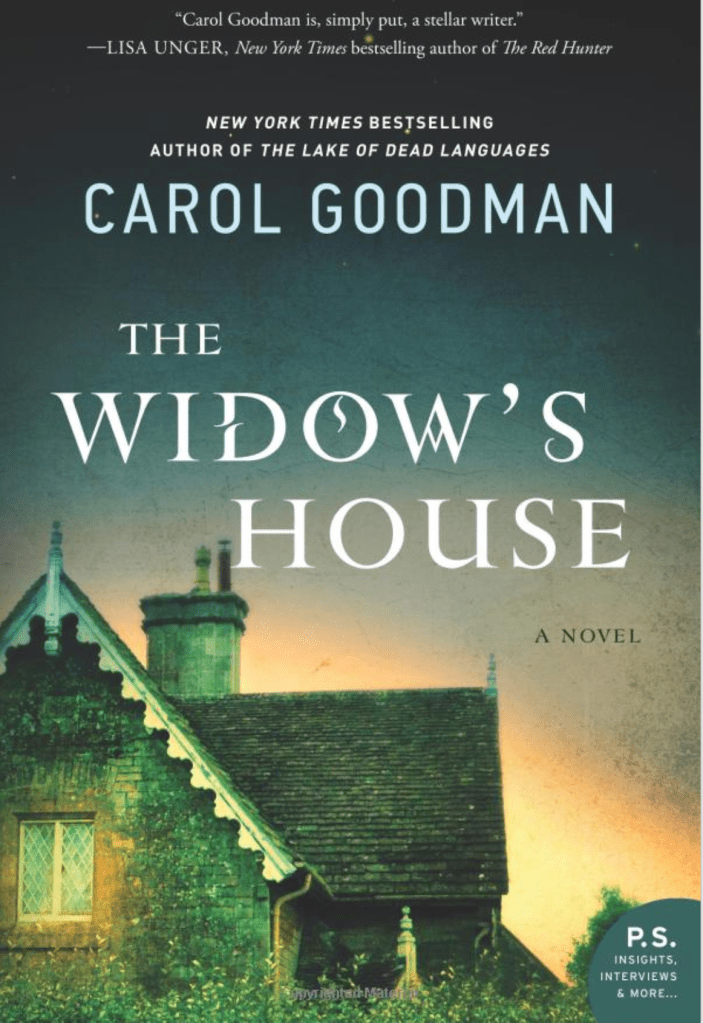
When I picture the house I see it in the late afternoon, the golden river light filling the windows and gilding the two-hundred-year old brick. That’s how we came upon it, Jess and I, at the end of a long day looking at houses we can’t afford.
“It’s the color of old money,” Jess said, his voice full of longing. He was standing in the weed-choked driveway, his fingers twined through the ornate loops of the rusted iron gate. “But I think it’s a little over our ‘price bracket.'”
I could hear the invisible quotes around the phrase, one the Realtor had used half a dozen times that day. Jess was always a wicked mimic and Katrine Vanderburgh, with her faux country quilted jacket and English rubber boots and bright yellow Suburban, was an easy target. All she needs is a hunting rifle to look like she strode out of Downton Abbey, he’d whispered in my ear when she came out of the realty office to greet us. You’d have to know Jess as well as I did to know it was himself he was mocking for dreaming of a mansion when it was clear we could barely afford a hovel.
It had seemed like a good idea. Go someplace new. Start over. Sell the (already second mortgaged) Brooklyn loft, pay back the (maxed-out) credit cards, and buy something cheap in the country. By country, Jess meant the Hudson Valley, where we’d both gone to college. and where Jess had begun his first novel. He’d developed the superstition over the last winter that if he returned to the site where the muses had first spoken to him he would finally be able to write his long-awaited second novel. ANd how much could houses up there cost? We both remembered the area as rustic: Jess because he’d seen it through the eyes of a Long Island kid and me because I’d grown up in the nearby village of Concord and couldn’t wait to get out and live in the city.
Isn’t that a great opening?
All of Goodman’s novels are unique, but tied together by that strong, literate authorial voice that makes starting to read (or listen) to a new one as comfortable as slipping into your house shoes; the word choices are marvelous, and the sentence/paragraph constructions are so intricate yet not impenetrable to the reader. Goodman’s novels usually have a central core that has to do with education and/or literature of some kind, and are inevitably set in either upstate New York and/or the Hudson Valley or the city itself; but there’s always a brooding, old building involved. The books are also smart and well-paced, and there is often a dual timeline involved, whether it alternates between past and present or does an entire time-jump to reveal the secrets and the truths bedeviling our heroine. Goodman’s heroines are likable, relatable, and understandable.
The Widow’s House focuses primarily on our main character, Clare Martin. Clare met her husband, Jess, in a creative writing seminar at a impressive university near Concord, where she grew up and she and Jess are currently looking for a house they cannot afford. Both were aspiring writers when they met; Jess wrote a debut novel that made a splash but is now ten years overdue on his second (aside: this always amazes me. I don’t think I’ve ever known a writer given an advance who then never delivered a manuscript for ten years or more without consequence, but this always pops up in novels about literary writers–Michael Chabon’s Wonder Boys comes to mind. Then again, most writers I know are genre writers and no crime writer could ever not deliver for ten years–I always feel horribly guilty when I miss a deadline and then it’s usually only an extra month that I need, not ten years. Maybe it’s different for those who write lit-ra-CHOOR) while Clare has buried her own authorial ambitions while working as an editor (and then a freelance one) to support Jess while he writes his book (I also would never let Paul go ten years without working while I couldn’t write so I could support him financially; I feel relatively confident the obverse is also true). The house their realtor is showing them at the opening of this book is called River House, but it’s also a site of many tragedies and deaths and madness, so much so that someone has taken a chisel and changed RIVER HOUSE on the gate column to RIVEN HOUSE. But the master of the crumbling old house is looking for caretakers to live on the property rent-free in exchange for upkeep work on the estate… but the master is the same writing professor in whose class they met–a professor Jess resents for trashing his debut novel in the New York Times, a review Jess is certain has kept him from breaking out as a major (best-selling) literary star. But the deal is too good to pass up, and Clare herself thinks moving there might help her restart her own writing…
Several of Goodman’s other novels tackle the world of the writer–The Stranger Behind You was a particular standout–and boy, could I relate to Clare’s fears and insecurities and anxieties about writing. To make matters worse, there also seems to be a ghost (or two, or maybe even three) at Riven House–but only Clare sees or experiences the haunting, to the point that she begins to question her own sanity. But why? Why would someone gaslight Clare, the wife of an underperforming novelist? There were some times in the book where Jess would be a bit of a emotionally abusive ass to her, and I would get a bit frustrated with her–a point I often had with the heroines of Victoria Holt and Phyllis A. Whitney–for subsuming herself and her needs and desires and dreams in service to his, and he doesn’t seem to appreciate it in the least. The ghost mystery has to do with tragedies in the path; the murder of an illegitimate child, the suicide of its mother, and madness and murder. Clare starts unraveling the mysteries from the past to get to the bottom of what is going on at Riven House–and there’s a marvelous, heart racing conclusion during a massive winter storm and power loss at Riven House, when Clare finally finds the truth and has to fight for her own life.
What a satisfying, thoroughly enjoyable read–which is what you always get from Carol Goodman. If you haven’t read her yet, START. Immediately.
You can thank me later.


 Queer and Loathing in America