Do They Know It’s Christmas

Christmas Eve, and all through the house–not a kitty is stirring, and we don’t have a mouse.

It’s a bright sunshiny morning here in New Orleans, and I slept very late because we stayed up watching a show on Acorn TV (a streaming subscription I’d forgotten I had) called Loch Ness, which was highly entertaining, fairly well written, beautifully shot, and well acted. I do recommend it–there were some definitely unanswered questions in the resolution, but it pretty much wrapped itself up for the most part, and as I said, we really enjoyed it. Loch Ness also looked incredibly beautiful; I always pictured it as cold and gray and foggy–assuming, of course, that it was shot on location.

I also woke up this morning–late–to see that Romance Writers of America is burning to the ground this morning, having had their board make a decision that being called a racist is much much worse than actually being a racist, or doing and saying racist things. I have my own issues with RWA, of course–a long-standing policy of passively encouraging homophobia and queer exclusion, which I thought they were getting better about, but active institutional support of racists and racism against authors of color has completely and irrevocably erased those thoughts once and for all; because quite naturally pointing out homophobia would mean being punished for doing so–because the only thing worse than homophobia is being accurately accused of it. Shame on you, RWA, shame on you.

Yeah, not going anywhere near that dumpster-fire of an organization.

So, what am I going to do today, with this gorgeous day? Am I going to try to get writing done? Am I going to try to do much of anything on this fine Christmas Eve here in the Lost Apartment? Or am I simply going to curl up in my easy chair with a book? Probably going to just curl up in my chair with my book. I am getting further into Laura Benedict’s The Stranger Inside, and greatly enjoying it the deeper I get into this interestingly twisted tale. I do have some cleaning and straightening up to do around here, but I can save that for later this evening. We are venturing out to see Rise of Skywalker tomorrow–thank you, everyone on my social media feeds for not posting spoilers–and of course, this weekend is the college football play-offs, with LSU facing Oklahoma in one semi-final.

But there’s plenty of time between now and Saturday for me to get stressed about that.

I’ve also been looking through Victoria Holt’s Kirkland Revels, which is one of my favorite romantic suspense novels of the mid-twentieth century (originally published in 1962!) primarily because it has a unique spin on the genre of the preyed-upon heroine: she’s pregnant with the heir to the family fortune and estate. A pregnant romantic suspense heroine? I think Kirkland Revels might even be the only romantic suspense novel with a pregnant heroine–I can’t think of many novels of any kind where the heroine was pregnant almost the entire course of the story, other than Rosemary’s Baby–which is actually an interesting observation. (I also believe that Rosemary’s Baby is perhaps one of the most brilliant studies in paranoia ever written; Levin did much the same with The Stepford Wives; no one wrote paranoia better than Levin, and he is also one of my favorite writers. His canon is well overdue for a revisit.)

I also may rewatch the premiere of Megan Abbott’s television series adaptation of Dare Me. It was really quite good, and a second viewing will possibly enable me to write a post about it that doesn’t simply say “OMG it’s so good you have to watch it.”

GAH. SO little time to do all the things I want to do!

And on that note, I should probably finish this and go do something, anything, else.

Have a merry Christmas eve, everyone.

IMG_0977

R.O.C.K in the USA

Happy Sunday and a good morning to all y’all.

I didn’t get as much done yesterday as I would have liked; running my errands in the pre-rain humidity literally wore me out, and then when I got going again I started cleaning and doing laundry and well, once I start doing that–as well as going through and trying to organize the books–I am pretty much done for the day….especially after I discovered Burnt Offerings was available for streaming on Prime. Oliver Reed! Karen Black! Bette Davis (who was totally wasted in her role)! I’d seen the movie years ago, I think when it first aired on television after it’s theatrical run, and while it’s still has some moments, it overall doesn’t hold up as well as I would have hoped. I read the book for the first recently in the last few years, and it was wonderful. But watching Burnt Offerings put me in mind of an essay about horror in the 1970’s; the 1970’s was a time when the suburbs really developed because of ‘white flight’ from the cities and desegregation; this was this whole movement of back to the country from the urban centers, and at the same time, there was horror that specifically focused on this phenomenon (without the racism and white flight issues); namely this book, Harvest Home by Thomas Tryon, The Stepford Wives by Ira Levin, and even Stephen King lightly touched on this in ‘salem’s Lot; the dangers of the country to people from the city.

One could even argue that James Dickey’s Deliverance also belongs in this category, and it put me in mind of an essay that I may never write. I also thought up another yesterday while running my errands, after car after car after car violated traffic rules and almost caused me to be in in accident (three times, to be exact; which might be a new record): “Right of Way,” in which I would extrapolate the American contempt for traffic rules and laws for everyone’s safety can be directly correlated to contempt for law and order, the system, taxes, everything. I made some notes, and this is one I may actually write. Essays are fun and I do enjoy writing them but I don’t very often, unless one is requested of me for something, and perhaps that’s the wrong approach.

Today I am going to go to the gym and I am going to start rereading Royal Street Reveillon and make notes for the big revision that is coming. I’m also going to start reading Jackson Square Jazz out loud for copy editing purposes, and I’d also like to work on “A Whisper from the Graveyard” today. I should at some point also work on finished “Never Kiss a Stranger,” which means I should also make a to-do list for everything I want to get done in July.

Hmmm. Perhaps not a bad idea, at that.

I also remembered I have notes on a short story I need to read and decide what revisions I need to be make.

It never truly ends, does it? But I am looking forward to Sharp Objects tonight on HBO; I actually liked this book by Gillian Flynn better than Gone Girl, which of course made her hugely famous and hopefully hugely rich. I still haven’t read her Dark Places, but that’s because I still subscribe to the “if I don’t read all the canon then I still have something by her to read” mentality, which is partly why I still have not read the entire canon of either Daphne du Maurier or Shirley Jackson or Patricia Highsmith.

So, I have a lot to do today–only one more day after today before I return to the office, but at least it’s only a four day work week–and so I should probably get back to the spice mines.

The next story up in Promises in Every Star and Other Stories is “Bloodletting”:

The damp air was thick with the scent of blood.

It had been days since I had last fed, and the desire was gnawing at my insides. I stood up, and my eyes focused on a young man walking a bicycle in front of the cathedral. He was talking on a cell phone, his face animated and agitated. He was wearing a T-shirt that read Who Dat Say They Gonna Beat Dem Saints? and a pair of ratty old paint-spattered jeans cut off at the knees. There was a tattoo of Tweetybird on his right calf, and another indistinguishable one on his left forearm. His hair was dark, combed to a peak in the center of his head, and his face was flushed. He stopped walking, his voice getting louder and louder as his face got darker.

I could smell his blood. I could almost hear his beating heart.

I could see the pulsing vein in his neck, beckoning me forward.

The sun was setting, and the lights around Jackson Square were starting to come on. The tarot card readers were folding up their tables, ready to disappear into the night. The band playing in front of the cathedral was putting their instruments away. The artists who hung their work on the iron fence around the park were long gone, as were the living statues. The square, so teeming with life just a short hour earlier, was emptying of people, and the setting sun was taking the warmth with it as it slowly disappeared in the west. The cold breeze coming from the river ruffled my hair a bit as I watched the young man with the bicycle. He started wheeling the bicycle forward again, still talking on the phone. He reached the concrete ramp leading up to Chartres Street. He stopped just as he reached the street, and I focused my hearing as he became more agitated. What do you want me to say? You’re just being a bitch, and anything I say you’re just going to turn around on me.

I felt the burning inside.

Desire was turning into need.

I knew it was best to satisfy the desire before it became need. I could feel the knots of pain from deprivation forming behind each of my temples and knew it was almost too late. I shouldn’t have let it go this long, but I wanted to test my limits, see how long I could put off the hunger. I’d been taught to feed daily, which would keep the hunger under control and keep me out of danger.

Need was dangerous. Need led a vampire to take risks he wouldn’t take ordinarily. And risks could lead to exposure, to a painful death.

The first lesson I’d learned was to always satiate the hunger while it was still desire, to never ever let it become need.

I had waited too long.

“Bloodletting” is an unusual story for me in that it’s actually a short story that bridges the gap between my novella “Blood on the Moon” and the novel Need; I eventually used it as the book’s first chapter. I have always wanted to give vampire fiction a try; I created an entire world that I first wrote about in the novella “The Nightwatchers,” which I always intended to develop into a series. I still would like to develop that series, and when the opportunity came to write “Blood on the Moon” I realized I could simply still use the world I’d created for “The Nightwatchers” and move on to different characters. The second book in the series, the one that was to follow Need, Desire, was going to tie the two story-lines together but Need didn’t sell as well as the publisher would have liked and so Desire died in the water. I may still go back and write it, of course, but I have no publisher for it and I am not particularly interested in self-publishing that much. But…I never say never. I wrote “Bloodletting” for Blood Sacraments, and only had to change the original concept a little bit; in the original idea Cord, my vampire, was actually sitting on the roof of St. Louis Cathedral watching the crowd for his next victim. I still love that image, and may use it sometime, but I did eventually change it to how it reads now.

57921a3ee18a224b7db94cbb1638e3d2

Half Breed

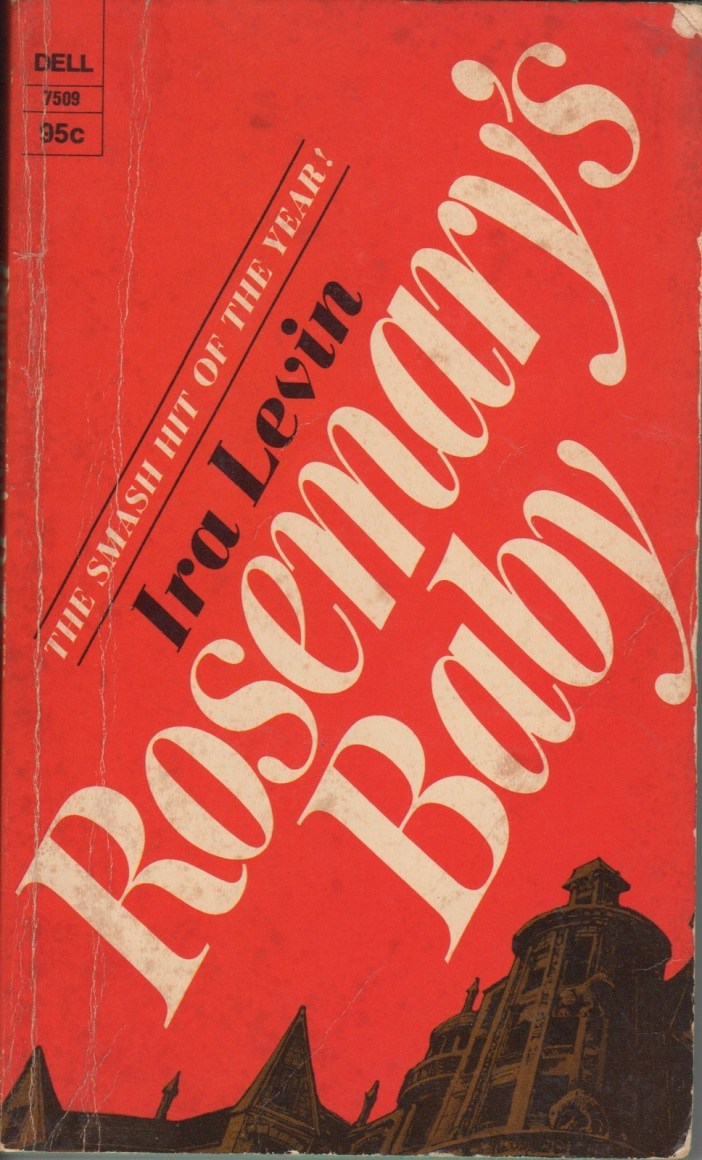
Ira Levin was one of my favorite writers. He only wrote seven novels during his lifetime (he died in 2007), and I’ve read all of them but one; they were each extraordinary. Like James M. Cain, his most famous novels were very short; but each one that I read was exceptional. His books were so ubiquitous that they’ve entered the vernacular; the references may be lost on younger people, but most people will know what you mean when you reference a Stepford wife or a boy from Brazil.

And everyone knows Rosemary’s Baby.

rosmarys-baby-apr-1968-ira-levin-publ-dell-7509-0-95-218pp-pb

Levin was an amazing writer, truly amazing. Take the opening to Rosemary’s Baby:

Rosemary and Guy Woodhouse had signed a lease on a five-room apartment in a geometric white house on First Avenue when they received word, from a woman named Mrs. Cortez, that a four-room apartment in the Bramford had become available. The Bramford, old, black, and elephantine, is a warren of high-ceilinged apartments prized for their fireplaces and Victorian detail. Rosemary and Guy had been on its waiting list since their marriage but had finally given up.

The opening paragraph of The Stepford Wives:

The Welcome Wagon lady, sixty if she was a day but working at youth and vivacity (ginger hair, red lips, a sunshine-yellow dress), twinkled her eyes and teeth at Joanna and said, “You’re really going to like it here! it’s a nice town with nice people! You couldn’t have made a better choice!” Her brown leather shoulderbag was enormous, old and scuffed; from it she dealt Joanna packets of powdered breakfast drink and soup mix, a toy-size box of non-polluting detergent, a booklet of discount slips good at twenty-two local shops, two cakes of soap, a folder of deoderant pads–

Both start so innocently; a young couple getting the apartment of their dreams, a wife newly moved to the suburbs being greeted by the Welcome-Wagon Lady (do people still do that, I wonder?). Sunshine, light, and innocence, right? Both books begin with new beginnings; a fresh start in a new home. And yet–both wives, Rosemary and Joanna, wind up in terrifying situations, and even worse, no one believes them, least of all their husbands–particularly since it was their husbands who sold them out in the first place; Guy Woodhouse selling Rosemary out to a cult of Satanists in exchange for career success, Joanna’s husband selling his feminist wife out for a realistic, animatronic robot version with a sexier figure who is programmed to be an obedient wife/slave to her husband. The Stepford Wives was the first Levin novel I read, and I read it shortly after it came out in paperback, plucking it off the wire paperback racks at the Zayre’s in Bolingbrook shortly after we’d moved to that suburb. And it’s really a frightening book to read when you’ve just moved to the suburbs.

But I can’t help but wonder why Levin’s work in these two instances isn’t considered domestic suspense? Both books are from the point of view of women; about their issues and their place in their marriages; and borrow the most important theme from romantic suspense novelists like Phyllis Whitney and Victoria Holt: his heroines cannot fully trust their husbands. Of course, both books veer into the supernatural…are they horror novels?

My favorite work of Levin’s is his first novel, which also won the Edgar for Best First, A Kiss Before Dying. It’s been filmed twice–neither film is worth watching, frankly–and it literally is genius. If you haven’t read it, you really need to–it’s one of the best suspense novels I’ve ever read. The problem, of course, with A Kiss Before Dying is you can’t really discuss it without spoiling it–and while you can still enjoy the book knowing the big twist, not having it spoiled really makes you appreciate how genius Levin really was.

And now, back to the spice mines.