Mighty Love

I love nothing more than a great ghost story (which is why, although I loved the book, I was enormously disappointed with Peter Straub’s Ghost Story; it’s an amazing novel and a horror classic and one of my favorite horror novels of all time, but it is emphatically not a ghost story). I’m not sure why I love them so much, but even as a kid, reading the mysteries for kids I always gravitated towards the ones with some kind of ghostly title: The Ghost of Blackwood Hall, The Haunted Fort, The Phantom of Pine Hill, The Ghost at Skeleton Rock, The Haunted Showboat, The Ghost in the Gallery, etc. The ghosts and hauntings in these books were never real–just like the ghosts and monsters on Scooby Doo Where Are You? weren’t–but I still was drawn to them.

There was an ABC Movie of the Week when I was really young that I absolutely loved: The House That Would Not Die. It starred Barbara Stanwyck as a woman who moved into a house she’d inherited from a relative, along with her niece, and of course, the house turned out to be haunted. The story was terrific and it scared me a lot–and you can never go wrong with Barbara Stanwyck; I may even have watched it with my grandmother, who was a big Stanwyck fan. A few years later, we were somewhere–some people my parents knew had invited us over for dinner, and before and after, as the adults, my sister and I were deposited in the den to watch television and entertain ourselves while behaving. They had books, which I gravitated towards, I pulled down a volume of Reader’s Digest Condensed Books and found a ghost story inside. As I started reading, I was drawn into it and I realized it was the same plot, the same story, of the TV movie I’d liked, and kept reading. I read the entire thing that evening–it was condensed, after all–and thought, oh, I’d like to see that movie again.

Flash forward and I am in college, browsing in a second-hand bookstore when I find a worn paperback copy of the book. Pleased and delighted at the opportunity to not only read it again but read the entire version? For fifty cents? Absolutely.

It was Ammie, Come Home, which is one of my favorite ghost stories, and favorite novels, of all time. It was written by Barbara Michaels–for another dollar I picked up two more of her novels, Witch and House of Many Shadows. I loved all three books, but I’ve always preferred Ammie, considered it my favorite. Over the years Michaels–and her alter-ego, Elizabeth Peters-became one of my favorite writers of all time. I love her books, no matter what the name or brand or whatever you want to call it; they are all witty, with strong, likable female characters, there’s some little dash of romantic interest involved in all of them, and a very strong suspense component. The Peters novels were more mysteries; the Michaels sometimes involved the supernatural, and sometimes they didn’t.

But, oh, how I love Ammie, Come Home, and I recently, during my isolation, took it down and made it a part of this year Reread Project.

Ammie Come Home Barbara Michaels Fawcett Crest 1968 harry bennet cover art

By five o’clock it was almost dark, which was not surprising, since the month was November; but Ruth kept glancing uneasily toward the windows at the far end of the room. It was a warm, handsome room, furnished in the style of a past century, with furniture whose present value would have astonished the original owners.. Only the big overstuffed sodas, which face one another before the fireplace, were relatively modern. Their ivory brocade upholstery fitted the blue-and-white color scheme, which has been based upon the delicate Wedgwood plaques set in the mantel. A cheerful fire burned on the hearth, sending sparks dancing from the crystal glasses on the coffee table and turning the sherry in the cut-glass decanter the color of melted copper. Since her niece had come to stay with her, Ruth had set out glasses and wine every evening. It was a pleasant ritual, which they both enjoyed even when it was followed by nothing more elegant than hamburgers. But tonight Sara was late.

The darkening windows blossomed yellow as the streetlights went on; and Ruth rose to draw the curtains. She lingered at the window, one hand absently stroking the pale blue satin. Sara’s class had been over at three-thirty…

And, Ruth reminded herself sternly, Sara was twenty years old. When she agreed to board her niece while the girl attended the Foreign Service Institute at a local university, she had not guaranteed full-time baby-sitting. Sara, of course, considered herself an adult. However, to Ruth her niece still had the touching, terrifying illusion of personal invulnerability which is an unmistakable attribute of youth. And the streets of Washington–ven of this ultrafashionable section–were not completely safe after dark,

Even at the dying time of year, with a bleak dusk lowering, the view from Ruth’s window retained some of the famous charm of Georgetown, a charm based on formal architecture and the awareness of age. Nowadays that antique grace was rather self-conscious; after decades of neglect, the eighteenth century houses of the old town had become fashionable again, and now they had the sleek, smug look born of painstaking restoration and a lot of money.

Ammie, Come Home is possibly one of the best constructed, if not the very best, ghost stories I’ve ever read. As you can see from the opening paragraphs, Michaels does an exceptional job of setting everything up, giving us insights into her main character, Ruth Bennett, and her relationship with her niece. We go on to find out that Ruth is probably in her mid to late forties, was widowed in World War II, never remarried, and for the most part, it’s implied that her husband’s death pretty much was the end of any romance in her life; something she isn’t terribly interested in. This is, of course, foreshadowing–but not the way the reader might think. Yes, in the opening scene of the book, which features her niece Sara getting a ride home from one of her professors, that ah, yes, Ruth and Dr. Pat MacDougal are going to fall in love-but there’s more to Ruth’s history than that, which of course is the mark of the truly terrific writer. We also glean that childless Ruth has grown deeply fond of her niece Sara–and disapproves of Sara’s boyfriend Bruce (mainly because of his youth, the way he dresses, and what she thinks of as his smug superiority).

(This last, by the way, is the only part of the book that feels dated. Written and originally published in the 1960’s, Sara and Bruce are both college students and Pat works at a college–he’s a cultural anthropologist with a specialty in superstitions and rituals–so, as anyone who knows anything about the 1960’s knows, it was a decade of youthful rebellion and anti-establishmentarianism. There are occasional asides from both Ruth and Pat about the generation gap–this was also the first time this phrase was used, during this period–where the kids want to make change. There are a few mild arguments over that, but it’s always very good natured and never gets very deep. But the very generation gap is part of the structure of the novel; when strange things start happening in Ruth’s home, particularly involving Sara–Ruth and Pat immediately think of mental illness; Bruce is the only one open-minded enough to see the truth; that the house is haunted by a malevolent spirit–and there may even be more than one.)

It’s also very clever of Michaels to use that generational divide to explore the notions of the supernatural and a spirit world–because Bruce is given a forty-eight hour deadline to convince the older two in their quartet that Sara isn’t mentally ill but is being haunted. So, as Bruce convinces them–helped by more apparitions and events in the house–the reader is also being convinced that what’s going on in the house is supernatural in origin. How she does it is a master class in suspense/horror writing; and there are some lines that just the reader to the bone: And what looked back at her through Sara’s eyes was not Sara.

The ghost hunters eventually get to the bottom of the haunting of the old house in Georgetown by finding out the deeply hidden truth about what happened there centuries earlier, and finally freeing the spirits trapped to the house.

And maybe the creepiest, yet saddest, thing is the disembodied voice they hear, over and over, in the back yard, calling Ammie….come home…..come home…..Ammie…. —which is described as “it sounded like what the wind would sound like if it had a voice.”

And despite the dated 1960’s references, the book still holds up, over forty years later.

I rediscovered Michaels in the mid to late 1980’s, which was when I also discovered that she also wrote the Elizabeth Peters novels, and that the absolutely delightful Crocodile on the Sandbank, which I’d loved, wasn’t merely a stand alone, but the first book in a long-running, and completely fantastic, series featuring heiress Amelia Peabody and her Egyptologist husband Emerson. There isn’t a single dud in the Amelia Peabody series–and there are smart, funny, clever, and intricately plotted–and over the years the Peabody-Emerson clan had children, raised them, and those children grew up to be involved in the adventures of their parents–and every book, save one, actually took place in Egypt at the turn of the twentieth century. I need to reread Crocodile on the Sandbank, and in fact, would love to revisit the entire series. She wrote two other series as Elizabeth Peters as well–the Vicky Bliss series and the Jacqueline Kirby–as well as stand alones; every Peters novel is a gem, as is every novel she wrote as Barbara Michaels.

And now back to the spice mines.

Galveston

So here we are, on yet another Tuesday morning. Yesterday wasn’t a complete loss for me; I was very tired after going out and getting myself tested in the morning, so I came home and decided to take a “Greg Day”; no emails, no work,  and as little social media as possible. Easier said than done, of course, but you know–that’s how the ball bounces sometimes. I did get further into my reread of Ammie, Come Home (I always forget the damned comma in the title) by Barbara Michaels–one of the best Gothic ghost stories ever published, even if a little dated today–and I read a few chapters of Barbara Tuchman’s A Distant Mirror–the 14th century is my second favorite century, behind the 16th–and when my brain couldn’t focus to read, I watched some videos on Youtube that sent me into yet another wormhole, this one of videos about American Horror Story.

In my defense, it started with a video about Jessica Lange’s roles on the show, which led to Sarah Paulson, and Lily Rabe, and…you get the picture.

And then, of course, ESPN replayed that particular Monday night football game from back in September, 2006. That warm night when the Saints played their first home game since the 2004 season. A year after Katrina, when the roof came off the Superdome and people died and still others were trapped there for days. When the city was almost completely destroyed, its economy gone, her people scattered. Our futures were uncertain that bleak fall of 2005, and even throughout 2006, with our abbreviated Mardi Gras and frustratingly slow, it seemed, recovery. We’d almost lost the Saints to San Antonio when the city drowned, but they’d stayed–and the true hero of that was Tagliabue at the NFL, not Tom Benson–and now the Superdome, long a symbol of the city and now a monument to its worst moments, was ready to reopen and create a new identity for itself, just as the city was seeking to be reborn, just as those who lived here were waiting for hope. I remember that day in the city–I knew the Saints were winning but I was busy; the Lost Apartment was still lost and still wouldn’t be finished for another two months. All we had was a tiny old black and white portable television in the carriage house, whose carpet had been ripped up to be replaced but hadn’t yet so there were carpet tacks sticking up out of the bare, scarred exposed wood. We were sleeping on a mattress on top of a box spring on the floor. Paul’s desk and computer were set up in one corner of the room, the staircase and railing took up another side and the little television, which was rarely watched, sat on top of a dresser. I ran errands that day and sensed something in the air–I knew the Saints were winning games but wasn’t paying attention because I was busy trying to make a living and keep myself to the very strict schedule I had to follow in order to have the slightest chance of getting anything done. But i could feel it when I went out to the car, in the air. People were wearing Saints jerseys, or at least black and gold, everywhere I looked. Saints flags were flying on the front of houses (we take flags seriously in New Orleans). Everyone was in Saints gear–the post office, the grocery store, Walgreens, everywhere–and when I got home I looked it up on-line: yup, the Superdome was reopening for Monday Night Football, and we were playing the hated Falcons. Paul and I watched on that little black and white television, screaming and cheering and getting a little teary eyed.  It gave us something we hadn’t had in a long time–hope. They called the game both “ReBirth” and “Domecoming”; both fit.

And while the Saints had always been our team before, that night they became OUR TEAM. Even New Orleanians who weren’t football fans became Saints fans that night. And the sheer joy with which the team played that night was so apparent, and so obvious, and they made it so clear they were doing it for the city…I’ve rarely felt so connected with a football team the way I did with that 2006 Saints team.

As glorious as winning the Super Bowl was, I have to say I think the Domecoming game was probably the greatest moment in Saints history.

Watching the game last night during another social and societal upheaval–one that is affecting the entire world and not just us this time–reminded me of that feeling. Tears spilled out of my eyes once again as Steve Gleason blocked that punt and the Dome erupted; listening to that crowd, seeing their faces and the tears of joy on their faces…having something like the Saints to cheer for, to help us through the hard times, and to give us hope again for the first time since Katrina crossed southern Florida…it’s hard to explain that, I guess.

Try to imagine what it’s going to be like when we have sports again–or the first time you can go out to a restaurant again, or what it’s like to be free of this worry and burden and fear…heady stuff, frankly.

And now…now I am feeling tired again, so I am going to go lie down for a bit. Stay safe, everyone.

Evans1

Amarillo by Morning

So, this morning when I woke up, as my first cup of coffee brewed, I dialed the COVID-19 testing hot-line for staff at the day job and made an appointment to get tested. They scheduled me for 9:20 am; I was called at around eight thirty, which left me with about fifty minutes to wake up, drink some coffee, and pull myself together. Our clinic’s COVID testing set-up is in the parking garage which is the ground floor of our building; staff simply drives into the garage and pulls up to the area where the tents and check-in desk are set up, and the doctor comes out and swabs your nose. Needless to say, as I swilled down coffee and brewed another quick cup to take with me in the car, my nerves were definitely feeling a bit frayed. Saturday was a better day than Friday; yesterday was better than Saturday. So far this morning I seem to feel okay other than fatigue–going up stairs to put on a T-shirt and shorts to drive over to the office made my legs and hips ache a bit; it also triggered a small coughing fit (note: the only time my lungs feel tight is when I cough; other than that I breathe fine and they don’t phase me at all. But when I cough, I feel a tightness in the center of my chest that is pretty severe–but as I said, once the coughing spasm passed, I feel fine) but I got dressed and drove over to the office. It didn’t take long as the streets are pretty empty–there’s some traffic, to be sure, and a pandemic and over-burdened hospitals doesn’t seem to be stopping people from driving like thoughtless assholes–and then I pulled into the garage, got checked in, signed my consent to be tested form, and Dr. Halperin came out and swabbed both nostrils.

And while I can see why the vice-president thought it was invasive–I imagine anything put it any of his orifices would be invasive to him–it really wasn’t that bad. It’s certainly not the worst thing I’ve ever had done to me; I’d certainly rather get my nostrils swabbed like that on a regular basis than have an abscessed tooth ever again, and the worst part of it wasn’t the invasiveness at all. The worst part is the chemical on the swab–it doesn’t quite burn per se, but the closest experience I can think of to it is when you accidentally and deeply inhale mothballs; my eyes watered and it burned a little bit, but not painfully.

In a best case scenario, the test results will be back within 2-4 days–it may be longer, who knows? But I have to go into a strict quarantine until the results do come back, which means not leaving the house or running any errands or doing much of anything. Of course I have gloves and masks, so I can theoretically do some things and leave the house if necessary, but I shouldn’t really take the risk of infecting someone else by going out in public until I know for a certain whether I currently have it, or did have it, or don’t have it at all. I was also a little confused because I’d assumed there would be a blood draw to go with the swab test, but I am also conditioned to thinking about testing for different viruses (HIV, syphilis, and Hep C) so I assumed the testing would also have to involve blood. But then I realized, afterwards as I was driving home, that mucous doesn’t carry the HIV, syphilis or Hep C viruses (virii?); but the COVID-19 virus can be airborne transmitted–which means it must be in the mucous membranes along with the antibodies.

At least that makes testing for it that much easier, so that’s kind of a plus?

I also noticed, this morning, a little bit of PTSD kicking in from the good old HIV/AIDS pandemic days–“oh, look, I need to get tested for a potentially fatal virus and have to wait days to get the results back”–but I quickly tamped that down, shoved the lid closed and firmly padlocked it. I suppose it’s a bit of a surprise that particular version of all the PTSD’s I have locked behind various doors in my brain took so long to try to worm it’s way out, but it did finally show up and I was able to beat it down rather easily.

Thank you, coping mechanisms, developed over several decades of seemingly endless trauma.

I didn’t have to take a nap yesterday, but after we finished watching Miss Fisher and the Crypt of Tears, a lovely stand-alone film follow-up to the wonderful Miss Fisher series from Australia (it was kind of an Indiana Jones-lite adventure, set in Palestine in 1928 and quite fun), I got down my copy of Barbara Tuchman’s A Distant Mirror and opened it up to the chapter about the Black Death. Yes, I recognize that my recent fascination with plagues and epidemics and pandemics is probably morbid, given the current state of affairs in the world, yet my curiosity had always had a bit of morbidity to it and it’s really not surprising that it would take this kind of turn. (And I’m actually kind of glad; I was glad to finally read “Death in Venice” even if it left me a little cold; and it also led me down the path to rereading “The Masque of the Red Death”, and back into my Daphne du Maurier short stories) Realistically, while everyone talks about the Spanish influenza pandemic of a hundred years ago, primarily because it was the most recent pandemic (note to self: reread Katherine Anne Porter’s “Pale Horse Pale Rider”), the worst pandemic in history was clearly the bubonic plague, the Black Death, or, as it was known more simply during the fourteenth century, “the pestilence.”

Here’s how the chapter opens:

In October 1347, two months after the fall of Calais, Genoese trading ships put into the harbor of Messina in Sicily with dead and dying men at the oars. The ships had come from the Black Sea port of Caffa (now Feodosiya) in the Crimea, where the Genoese maintained a trading post. The diseased sailors showed strange black swellings about the size of an egg or an apple in the armpits and groin. The swellings oozed blood and pus and were followed by spreading boils and black blotches on the skin from internal bleeding. The sick suffered severe pain and died quickly within five days of the first symptoms. As the disease spread, other symptoms of continuous fever and spitting of blood appeared instead of the swelling or buboes. The victims coughed and sweated heavily and died even more quickly, within three days or less, sometimes in 24 hours. In both types everything that issued from the body–breath, sweat, blood from the buboes and lungs, bloody urine, and blackened excrement–smelled foul. Depression and despair accompanied the physical symptoms, and before the end “death is seen seared on the face.”

The disease was bubonic plague, present in two forms: one that infected the bloodstream, causing the buboes and internal bleeding, and was spread by contact; and a second, more virulent pneumonic type that infected the lungs and was spread by respiratory infection. The presence of both at once caused the high mortality and speed of contagion. So lethal was the disease that cases were known of persons going to bed well and dying before they woke, of doctors catching the illness at a bedside and dying before the patient. So rapidly did it spread from one to another that to a French physician, Simon de Covino, it seemed as if one sick person “could infect the whole world.” The malignity of the pestilence appeared more terrible because its victims knew no prevention and no remedy.

The chapter is pretty horrific, and it’s hard to imagine what it must have been like to live through in the fourteenth century. It’s impossible to know how many people died because they died so quickly that graveyards overflowed and burial pits had to be dug; people simply dragged the bodies of their dead loved ones to the pits and dumped them there. Estimates were obviously guesses and sometimes exaggerated; one monk’s reported death toll for one particular city, in fact, was more than what its recorded population showed. But it’s not inaccurate to guess that one third of the European population died during the pestilence; towns disappeared, families completely died out. Farms went untended because the farmers and their families died; there were also undoubtedly consequential deaths, not from the plague but because of it; young children whose parents had died starved to death, etc. Naturally they thought it was the end of the world, a punishment from God for sin; and the fourteenth century, which Ms. Tuchman describes as “calamitous”, was certainly ripe for that kind of belief.

One of the interesting things to me about this current pandemic is–and this may entirely be because I am not paying attention and my social media is sort of a bubble; but I cannot believe someone would be saying this about the pandemic and no one i know would notice it and be outraged enough to post about it–where are the evangelicals? Where are all those “end times” preachers and ministers and con artists to prey on the fears of their congregation? Why isn’t anyone pointing out that this could actually be the “rapture” where God is calling his own to him? I have seen that some trashbag minister called this God’s punishment for the gays–but it didn’t gain any traction.

Maybe one of the outcomes of this pandemic will be the ending of that nonsense. I rather doubt it, but you know, hope springs eternal.

I did read for a while yesterday–I got further into Ammie Come Home and I read a short story by Harlan Ellison, “On the Downhill Side”, from his collection Deathbird Stories, which I’d originally read years ago, before I moved to New Orleans, and this story is set in New Orleans. Oddly enough, when I opened the ebook in my Kindle app on the iPad (I was actually looking to see if the collection included his Edgar winning “The Whimper of Whipped Dogs”–it does) it was already opened to that story, so I read it, and as always with Ellison, loved it–and while it certainly is brilliantly written, it was written by someone who didn’t live here. I did love the story; like all of Ellison’s stories, the humanity in it was overwhelming and identifiable and relatable. I’ll probably give it, at some point, its own entry here.

And now I am feeling a bit tired, so I am going to go rest for a bit.

Sexy-Shirtless-Guys-8

Forever and Ever Amen

Yesterday afternoon I got sucker-punched; there I was, having a good day and getting things done and then–WHAM! Right between the eyes–Southwest sent me a reminder email about my scheduled and ticketed trip to New York for the Edgars at the end of April. The 30th, to be exact, but because of the symposium and other duties, I was going to be flying up there on the 28th, hence the reminder email. It didn’t help that the email reminded me that today would have been the closing for TWFest/S&S, and I got teary-eyed and sad and overwhelmed and had to get off the computer and away from the world for a little while.

It was out of the blue–I’ve said this before and it’s my own advice to other people (“remember something unexpected will happen–a tweet, a Facebook post, an email–that will catch you off guard and trigger something internal”) but it’s still rough when it happens, and it did, in fact, derail the rest of my day; there was no writing accomplished yesterday, and I didn’t really do much of anything afterwards, other than binge a few more episodes of Ozark (greatly enjoying this third season; the performances are stellar, particularly Laura Linney and Julia Garner) and then went to bed early. I slept fairly well, and this morning I feel even, but man–was that ever rough yesterday or what?

This week I have to go to work at 8:15 at our other building (campus?) every morning before leaving around noon to head to our other building (campus?) on Elysian Fields for the afternoon shift. Adapting to what is essential a 9-to-5 life isn’t going to be easy for me; it’s something I’ve managed to avoid my entire life until age fifty-eight, although I have to confess (as I said the other day) there really is something to eight hours five days a week. I like getting home earlier than I usually do (around eight), and I just have to  adjust to having those early evenings free. Hurricane season is coming, and so is termite swarm season and the time when stinging caterpillars rain down from the live oak trees like something out of C-level horror film from the 1950’s–usually the second bill on a drive-in double feature; you know the kind of film I mean–and then comes the heat and humidity of the summer. It’s already hotter this year than it usually is at this time of the year; I can only imagine how truly unbearable July and August are going to be this summer. There are but two days left in this hellish March, and then it’s April. (And I do hope nobody is foolish enough to play pranks on April Fool’s Day…)

I’ve decided since my attention span is so limited that it’s time to go back to both the Short Story Project (which I’ve been doing these last few weeks, really) as well as the Reread Project. I had considered rereading Mary Stewart’s This Rough Magic next, since I don’t really remember much of it at all, but have decided to reread one of my all time favorites, and definitely my favorite ghost story of all time, Ammie Come Home by Barbara Michaels. It’s been awhile since I read it, and it was, of course, the first novel by Michaels I read. I had originally watched the Made for TV movie that was based on it (The House That Wouldn’t Die, starring none other than the magnificent Miss Barbara Stanwyck), and then later found it in a volume of Reader’s Digest Condensed Books (remember those?) about a year or so later at my grandmother’s. I eventually bought a used paperback copy when I was either fifteen or sixteen and read the full novel, and it’s been a favorite of mine ever since. (In those days, I preferred her work as Barbara Michaels–it wasn’t until years later that I really got into her novels under the name Elizabeth Peters, and there was no turning back from that moment.)

I have a lot of emails in my inbox to answer–remember, I was in a flurry of responding to emails when I got the reminder from Southwest that derailed my entire day yesterday–as well as to sort and file. I’ve absolutely got to get back on that horse and dive into my emails headfirst today, and I’ve got to generate some others and consolidate all my notes and create an overall to-do list. My primary concern with so many seemingly endless tasks is that I am going to forget something important; I need to get my equilibrium back–hopefully getting used to my next work schedule will be helpful in that regard–and I need to get better organized.

I always seem to be saying that, don’t I?

Hmmmmm.

But the sun is rising and the world is gray outside my windows, and it’s about time for me to head into the spice mines. Stay safe, everyone, and have a lovely day.

Diego_Instore

You Are My Sunshine

Ah, Phyllis A. Whitney.

I first discovered Mrs. Whitney’s work at the Tomen Branch of the Chicago Public Library, where it stood on the corner of Pulaski and 27th Street. My mother used to leave my sister and I at the library while she grocery shopped (not always; we could only go to the library and check out books when we were returning the ones we’d checked out the last time, so about every other Saturday; I can only imagine the relief she felt when she saw us go through the library doors on those Saturdays to be free of her kids for a while) at the Jewel/Osco kitty corner across the street. The book–The Secret of the Tiger’s Eye–was a lot of fun; I was just discovering the joys of mysteries through the Scholastic Book Club at school, and was also discovering the Hardy Boys, Nancy Drew, and the other series for kids, and it was educational. Set in Cape Town,  I learned a lot about apartheid and the structural and systemic racism in South Africa. Bonita (I think that was her name) had to come spend the summer there with her aunt, and soon became involved in a mystery involving her dead cousin. It was great fun, and soon I was either buying her books from the book club or checking them out from the public library or the school library: The Mystery of the Hidden Hand (Greece), The Mystery of the Golden Horn (Istanbul), and so forth. Her books was also kind of travelogues, where she managed to also educate her young readers about the places where there were set, and the history there, as well. Mrs. Whitney had been a librarian, and so she knew her research, she took her writing–and her audience–seriously, and she won two Edgar Awards for best mystery for juveniles.

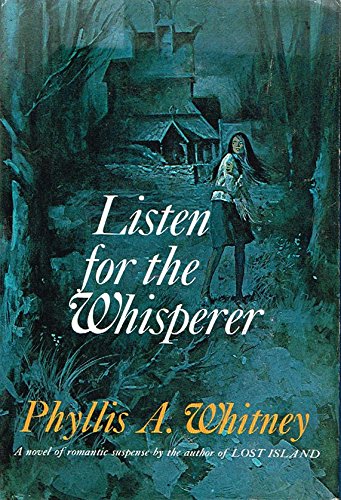
When I was eleven or twelve–not sure which–my parents let me join the Mystery Guild, and after I got the initial shipment of books, the first catalogue with a selection was a novel called Listen for the Whisperer, by Phyllis A. Whitney–whose juvenile mysteries I was still reading. I read the description, and its story–about a film star and a murder twenty years in the past–intrigued me; I was just starting my Hollywood fascination, and this seemed right up my alley. My mother gave me permission; I ordered it, and I never looked back with Phyllis A. Whitney.

listen for the whisperer

I sat in the darkened theater with my hands clasped tensely in my lap and my eyes fixed unblinking upon the screen. The man beside me touched my arm and I pulled away from him, not wanting anything to break the spell of the scene that was moving, inexorably to its climax.

“Let up, Leigh,” Dick whispered. “This is pure corn, even if Laura Worth did win an Oscar nomination for it years ago.”

Twenty years ago. I knew. But I would not listen to him. I shut him out and watched the screen. I knew the scene by heart, but the impact was always the same. My ambivalence was always the same. I was fascinated by every move the woman on the screen made, yet at the same time I detested her utterly. No one had a better right to detest her.

In the role of Helen Bradley in the movie adaptation of my father’s novel, The Whisperer, Laura Worth was coming down that famous Victorian staircase that had been almost a character in the book. Not only I, but the entire audience sensed her fear. Terror seemed to emanate from her as she descended the stairs, one hand clinging to the banister, the other held to her throat in dread. She was a woman going to meet death–and knowing it. The audience knew it, too. Sure of the outcome, sure she would finally escape, they still felt the fright she meant to convey. Even Dick was silent, watching as she reached the foot of the stairs.

The black and white screen managed to reproduce the eeriness of gaslight; even the furnishings seemed to suggest the gray flicker that was the very color of terror. Helen Bradley knew that she lived in this house with a husband who intended to kill her. She knew that no one would believe her accusation if she made it, and that there was no escape from what was going to happen–very soon. Yet she must go down those stairs, cross the hall and enter the parlor where he waited for her. The background music was hushed, suitably tense and anticipatory. You forgot this was Laura Worth, the actress. You became Helen Bradley.

Pretty great opening there, isn’t it? Mrs. Whitney established who the center of the novel is: an actress named Laura Worth, and as the opening scene progresses, Dick asks Leigh, “Wasn’t there some scandal that hurt the picture and cost her the Oscar?”

And that is the central mystery at the heart of the novel: the murder of director Cass Alroy during the filming of The Whisperer, some twenty years or so earlier. Ms. Worth had a habit of sleeping in her dressing room during filming; in order to feel closer to the part and to the process of filming. She’d been feuding with her director since filming started; there were rumors of a love affair gone bad between them. One night while she was staying in her dressing room, she had a crash and went out to see what made the noise; a younger co-star who also happened to be a huge fan of hers, Rita Bond, was also there, and they discovered the dead body of Cass Alroy, hit over the head and killed by someone unknown. The feud stories cast suspicion on Laura; after the filming was complete she gave up her career, left Hollywood, and returned to her home country, Norway–she was half-Norwegian–and became a recluse.

Leigh Hollins, the main character, is Laura’s daughter. Laura had an affair with Leigh’s father during the filming of another of his books, but she wasn’t interested in either marriage or being a mother; so she gave up the child to Leigh’s father, who later married someone else who raised Leigh as her own. Leigh has never known her birth mother, and that has always been a bone of contention and discontent in her life. Now, watching the film again, as a young journalist who often writes profiles of film stars and with her father dead, Leigh decides to go to Norway and make contact with her birth-mother after all these years. But what she finds when she gets to Norway is that the secrets from the past–and the mystery of who killed Cass Alroy–is still very current and swirling around her mother’s household. Leigh also finds herself not only in danger, but some romance as she tries to build a relationship with her mother and get to the truth about what happened so many years ago on the set of The Whisperer–and almost everyone in the household is a suspect, then and now.

It’s a terrific book, if a little dated; one of my primary problems with Whitney’s heroines is they weren’t nearly as strong as I would have liked, and another trope she repeatedly used (although not in this particular novel) was good girl (her heroine) vs. “bad girl” (the villainess); the bad girl in the story inevitably was sexually promiscuous, mean-spirited, and often married to the man the heroine was in live with, and made him miserable (Lost Island, Columbella, The Turquoise Mask, among many others). Another recurrent theme in Whitney’s work was family drama/tension; her heroines also often had to return to somewhere they’d fled and avoided to try to repair a family relationship: in this book, the heroine and her birth mother; in Silverhill, she is returning her mother’s body to the family she was estranged from; in The Turquoise Mask she is going to meet her mother’s family and try to get to the truth of her mother’s death when she was a little girl; in Lost Island she is returning to get to know the son she gave up to her cousin and the son’s father, whom her cousin married (Lost Island was always one of my favorites; I may have to revisit it as well).

Whitney’s books are mostly available as ebooks now; some are still in paperback print–but I think the majority of her children’s books are unavailable. She won two Edgars for Best Juvenile Mystery, and was named a Grand Master by Mystery Writers of America in the 1980’s. As I said, some of her books probably seem a little dated now, but she was an incredibly prolific writer, the books are still engaging, and I think she isn’t remembered as much as perhaps she should be.

Go Rest High on that Mountain

Saturday morning in New Orleans, and all is well. I slept really well last night–the deep dead sleep I love so much, because it’s so revitalizing–and can’t help but notice that I’ve been enjoying that kind of sleep a lot more since I started back to the gym. Coincidence? I think not.

Yesterday, I’m not going to lie, started out pretty fucking shitty. I got up feeling terrific. Well rested, ready to get out and kick some ass this weekend; as evidenced by yesterday morning’s blog entry. I went to the gym, had a tough workout–the motivation was there, but missing Wednesday had put my body out of sync with the weight-lifting, which made it more of a struggle than it should have been–then I came home. I started doing the laundry (I do the bed linens every Friday), made myself a protein shake, started getting the dishes taken care of, and then sat down at my desk to check my emails and social media. My twitter feed was filled with homophobic micro-aggressions from people who should, actually know better; as I read through I felt my anger and gorge rise. I was just about to send a PM to a friend (who definitely should know better) when Scooter jumped up onto my desk and knocked over my protein shake….all over my desk, my keyboard, my checkbook, my wallet, the research books I’ve been using for a writing project, my lap, and various file folders.

I was not pleased.

That took about half an hour to get cleaned up (thanks again, Scooter) and by the time I was finished I was already behind schedule for getting to work and running errands. I have a tire with low air, so I stopped at a convenient gas station (there is literally only one that’s convenient, and even it is out of the way) and of course, it was filled with morons. WHY WOULD YOU TAKE THE BACK PUMP INSTEAD OF PULLING TO THE FORWARD ONE?

I suspect her name was Karen.

The gas station turned out to be an exercise in aggravation and frustration, so I decided to say fuck it and do it over the weekend sometime. Then I got stuck behind a garbage truck, and when finally–after driving all the way uptown behind this idiot going 14 miles per hour–I got stuck behind a street cleaner on Jefferson on my way to Claiborne. We’ll just pretend there were no idiots on their cell phones on I-10 because I just can’t with people who think a phone call is more important than their life and the lives of everyone else on the highway.

Seriously, days like yesterday make me long for the next meteor and extinction event.

By the time I finally got home from work,  I was essentially done-in and exhausted. I later attributed it to the lack of a protein shake–I mean, the protein shakes I generally have after working out are enormous and have a lot of protein in them; because it spilled I had to have one of those prepackaged ones, which only had about half the protein in it that I usually rebuild with after a good workout–so note to self: should there ever be a repeat of the Protein Shake Incident, drink two of the pre-packaged ones, or you will suffer later.

So, it’s a gorgeous and sunny day outside; it’s a bit chilly here in the Lost Apartment, but that probably means it’s warmer outside. I have to walk over to the Home Depot (I need to get file folders and a new little notebook to replace my check register; yes, I still balance my checkbook, and yes, I still write everything I spend down), and the Lost Apartment  needs cleaning. I am way behind on my emails again (what else is new) and I have some things I need to get taken care of today; I want to finish reading my Ali Brandon novel this weekend, and I also want to pick out my next Reread Project read. I decided that since it’s Leap Day I shall also spend the day working on the numerous in-progress short stories I have; I am also going to try to get the Secret Project planned out and back on track again today, so I can launch myself full force into it again tomorrow. I also want to try to use today (and my new file folders) to get better organized. One of the worst things about Carnival is you literally just try to tread water with everything and you inevitably get scattered, disorganized and behind…and then it’s so hard to get everything back under control yet again once it’s over. I may not get much writing done today–certainly I know I won’t get as much done as I would like to get done–but the most important thing is to ensure that I am organized, know what I need to get done, and that way I can start organizing tasks and start getting them done.

I also got a shit ton of books in the mail this week; some definite treasures, some from authors I’m not familiar with, and once again, I weep at the idea of all the books I will never have the time to read. I am perhaps most excited about Alabama Noir, from the Akashic noir series; edited by Don Noble, it has stories from some of my favorite writers (Ace Atkins, Carolyn Haines, and Suzanne Hudson, among others) and of course, it’s ALABAMA, which I still feel such a strong pull towards, despite having never lived there and knowing deep in my bones and my soul that New Orleans is my home. Do other people feel that way about the states where they were born, where their parents and family are from? Or is it just a Southern thing? One of the reasons I started writing Bury Me in Shadows was because I wanted to write about Alabama, and the complexity of my feelings for the state. I’ve done some Alabama short stories, and I’ve set one book in Alabama–Dark Tide, which was mostly set down in the Gulf beach area–but I’ve always wanted to write more about Alabama. I think the reason Bury Me in Shadows has been so difficult to write for me is because I’m really not sure what the state is like now; and yes, of course it’s fiction, but I also don’t want to indulge in stereotyping and I want to be able to write honestly. I don’t have the time or the money to drive up there, look around, and get a better sense of place than my memories–plus, the part of the state I’m from isn’t the most friendly for people like me–but you never know. All it would really take is a long weekend and a cheap motel somewhere.

And on that note I just heard the dryer click off, so perhaps it’s time for me to get going on everything.

Have a lovely Saturday/Leap Day, Constant Reader!

1621981_10152213121411473_280855996_n

Walking the Floor Over You

I have always loved to read, and have always encouraged other people to read. It’s one of the great pleasures of my life, for as long as I can remember. Once I learned how to read, I never stopped reading. I will probably never stop reading. There are fewer non-sexual pleasures in life as satisfying as reading a good book.

As I’ve mentioned before, my grandmother got me really started into watching old movies–both horror and crime–and also encouraged me to read. She was the one who got me started reading Mary Stewart, by giving me her copy of The Ivy Tree; my friend Felicia in high school reminded me of Stewart and so I started reading more of her work. (I still have not read all of Mary Stewart’s work–that “I don’t ever want to run out of something new to read by Mary Stewart” thing I do) And while I enjoyed all of them, I enjoyed some more than others. For example, i remember reading The Moon-spinners, but not really enjoying it very much, frankly. I never revisited the book…but now that I am doing the Reread Project, I decided to give it another read.

0449027953

It was the egret, flying out of the lemon grove, that started it. I won’t pretend I saw it straight away as the conventional herald of adventure, the white stag of the fairytale, which, bounding from the enchanted thicket, entices the prince away from his followers and loses him in the forest where danger threatens with the dusk. But, when the big white bird flew suddenly up among the glossy leaves and the lemon flowers, and wheeled into the mountain, I followed it. What else is there to do, when such a thing happens on a brilliant April noonday at the foot of the White Mountains of Crete; when the road is hot and dusty, but the gorge is green, and full of the sound of water, and the white wings, flying ahead, flicker in and out of the deep shadow, and the air is full of the scent of lemon blossom?

The car from Heraklion had set me down where the track for Agios Georgios leaves the road. I got out, adjusted on my shoulder the big bag of embroidered canvas that did duty as a haversack, then turned to thank the American couple for the lift.

“It was a pleasure, honey.” Mrs. Studebaker peered, rather anxiously, out of the car window. “But are you sure you’re all right? I don’t like putting you down on the hill like this, in the middle of nowhere. You’re sure you’re in the right place? What does that sign post say?”

The above pictured cover was the one I originally read; the reread was of a more recent edition. When I was younger, I was fascinated by ancient history: Egypt, Greece, and Rome, to be exact; Greek or Roman or Egyptian ruins on the cover of a book, especially if it was a suspense novel, drew me to the book like moth to flame. (That was what originally drew me to read Phyllis A. Whitney’s Mystery of the Hidden Hand, which I now believe–my memory lies, remember–was the first Whitney I read, because it was set in Greece) I had also remembered seeing a film version of The Moon-spinners, broken up over two weeks’ episodes of The Wonderful World of Disney, which starred Hayley Mills. I don’t remember much of the film now, but I do remember thinking it was vastly different from the book when I read it the first time. It’s not on Disney Plus (neither is Johnny Tremain or Now You See Him Now You Don’t, which has annoyed me regularly since I signed up for the service), and I’m not about to spend even three dollars on renting it on Amazon Prime–although I was tempted enough to look it up to see if it can actually be viewed anywhere.

Anyway.

I enjoyed the book much more greatly this time. I’m not certain why, precisely, I didn’t like it as much as Stewart’s other books at the time, but sometimes that’s just the way it is. The Moon-spinners focuses on Nicola Ferris, an adventurous young Englishwoman in her early twenties. She works at the British Embassy in Athens; her parents died when she was a teenager and she went to live with her aunt Frances, who is a leading botanist. Frances is also single and terribly independent, like most women in Stewart novels; Nicola admires and loves her aunt greatly and emulates her. Her aunt is taking a yacht voyage with friends around Greece and the islands; Nicola decides to take a vacation, meet up with Frances on Crete–a friend, a travel writer, has recommended a very remote village with a small hotel to them–and Nicola has the great good fortune, while on Crete, to meet an American couple (the above mentioned Studebakers) who are driving around Crete and offer her a lift to Agios Georgios, putting her there a day earlier than expected. (This sentence, describing the Studebakers,  They were both lavish with that warm, extroverted, and slightly overwhelming kindliness which seems a specifically American virtue–is a terrific example of Stewart’s exceptional skill as a writer; in that one sentence she tells you exactly who the Studebakers are.) The Studebakers aren’t terribly keen on letting her off in the middle of nowhere, to lug her suitcases and such over a dusty mountain trail to a village where she isn’t expected until tomorrow and where she will know no one; fortunately her work at the embassy has given her a passable knowledge of speaking Greek.  Nicola insists she’s fine and thanks them for their kindness, and starts trudging along the dusty path.

All of Stewart’s heroines are strong, capable, intelligent young woman who can take care of themselves; and courageous. It is while walking on the path that Nicola’s Greek adventure takes off–she stops at a pond to get a drink of water, and in the reflection of the water she sees a man’s face, watching her. Your average run-of-the-mill heroine would scream and run off or be terrified; Nicola is merely startled and curious. This is how she comes across Lambis, the Greek boatman, and young Mark Langley, who has been shot and needs medical attention. Nicola immediately makes Mark’s problems her own. Lambis, as it turns out, had put in his boat in a nearby bay so that Mark and his younger brother Colin could go exploring and look at the ruins of an old church, originally a shrine to a Greek god but converted during the days of the old Eastern Empire into a Byzantine church. As they are walking back to the boat they come across of small group of people arguing over a recently dead body. Mark is shot and left for dead; Colin is taken. And so, now of course, Nicola wants to help rescue Colin and help Mark–she isn’t, after all, expected for another day, and of course, the killers/kidnappers must be from the small town of Agios Georgios.

Stewart is, as always, an exceptionally talented writer. Her descriptions are simple yet poetic; she vividly brings the town, the mountains, the sea, everything to life so well you can easily imagine yourself there. And courageous Nicola, now possessed of dangerous knowledge that could get her killed, has to navigate the village while trying to help Mark find Colin, with no idea of who she can trust and where she can turn to help.

Nicola is a terrific heroine, and I can see why Stewart was so popular with women and teenaged girls; she wrote smart, no-nonsense, capable young women who were courageous and fearless and could pretty much handle anything. The suspense is, at times, unbearable.

There is an element of romance to the story as well; Nicola begins to have feelings for Mark, but it’s practically an afterthought, and it feels almost like it was inserted into the story. There’s absolutely no need for the two of them to develop feelings for each other; other than the psychological closeness that comes from a shared danger (one of the things I loved the most about the sequel to Romancing the Stone, The Jewel of the Nile, is that it showed that happy couples who bond over adventures don’t necessarily wind up living happily ever after; I’ve often wondered about the couples from these types of novels), and this is one of the reasons I no longer really consider Stewart a romantic suspense writer; the romances in her books often feel that way–something inserted into the story later to appease either her agent or editor–and they are completely unnecessary to the story; if anything, the romance develop organically because of what else is going on in the story; the suspense/mystery aspect is the most important part.

And Stewart consistently wrote some of the best openings in crime fiction.

Highly recommended; I will probably reread it again someday.

Mama He’s Crazy

Believe it or not, back before the Internet and social media, it was possible for a book to go viral; to become so popular and so talked about it would sell a gazillion copies and establish the author–usually–as a long-time bestseller. To this day, I don’t know how I became aware of the viral books of the 1970’s (titles like Coma by Robin Cook; Jonathon Livingston Seagull by Richard Back; Jaws by Peter Benchley; The Other by Thomas Tryon; The Exorcist by William Peter Blatty; and The Godfather by Mario Puzo, among others), yet I did become very aware of them, and read most of them (true confession: I never read Jonathon Livingston Seagull, despite being a number one fiction bestseller for two consecutive years).

Mary Higgins Clark’s Where Are The Children? was a viral sensation when it was first published in 1975; I read it in paperback, and distinctly remember plucking it off the wire rack in the Emporia Safeway. I started reading it in the car as my mom drove us back home to Americus–the little town seven miles or so northwest of Emporia, where we lived; population less than a thousand, and the only time I’ve ever lived in such a small town–and couldn’t stop reading. I helped her bring the groceries in, went to my bedroom, and piled the pillows up and went back to reading.

where are the children

He could feel the chill coming through the cracks around the windowpanes. Clumsily he got up and lumbered over to the window. Reaching for one of the thick towels he kept handy, he stuffed it around the rotting frame.

The incoming draft made a soft, hissing sound in the towel, a sound that vaguely pleased him. He looked out at the mist-filled sky and studied the whitecaps churning in the water. From this side of the house it was often possible to see Provincetown, on the opposite side of Cape Cod Bay.

He hated the Cape. He hated the bleakness of it on a November day like this; the stark grayness of the water; the stolid people who didn’t say much but studied you with their eyes. He had hated it the one summer he’d been here–waves of tourists sprawling on the beaches; climbing up the steep embankment to this house; gawking in the downstairs windows, cupping their hands over their eyes to peer inside.

He hated the large FOR SALE sign that Ray Eldredge has posted on the front and back of the big house and the fact that now Ray and the woman who worked for him had begun bringing people in to see the house. Last month it has been only a matter of luck that he’d come along as they’d started through; only lyck that hed gotten to the top floor before they had and been able to put away the telescope.

Time was running out. Somebody would buy this house and he wouldn’t be able to rent it again. That was why he’d sent the article to the paper. He wanted to still be here to enjoy seeing her exposed for what she was in front of these people…now, when she must have started to feel safe.

I bought another copy of Where Are The Children? in 2014; my original copy lost years ago to one of many moves, intending to go back and rereading it at some point. The importance of Mary Higgins Clark, not just to women crime writers but to the genre in general, cannot ever be overstated. Clark was the bridge between the domestic suspense masters of the past–Margaret Millar, Charlotte Armstrong, Dorothy B. Hughes, among many others–and the next generation of women crime writers that dawned in the 1980’s, as well as to the modern domestic suspense writers–women like Alison Gaylin, Lori Rader-Day,  Catriona McPherson, and Wendy Corsi Staub, among many others–and her example–of grace, generosity, kindness, and assistance–is one other writers should emulate.

We could all use more Mary Higgins Clarks in the world.

Anyway, because of this importance, I thought I should reread her first as an homage to her importance; I’d recently met her, in passing, and was shocked when I ran into her again a year later that she remembered my name and the short conversation we’d had as I’d helped her onto the escalator at the Grand Hyatt in New York; I, of course, remembered every word and that glowing smile she’d given me. There was little doubt in my mind she wouldn’t remember me; how many thousands of people had passed briefly through her life? But she was sharp as a tack, and remembered me. “Greg! I was hoping you’d be here if I needed help with the escalator again,” she said, holding our her hand to me with that thousand-watt smile of hers. Then she winked, “I’ll be looking for you later. How did that book you were writing turn out?” When I told her I’d worked out the problem (yes, as I helped her onto the escalator and chatted briefly, I somehow managed to tell her that one of the many reasons I admired her was her dedication to working hard, and asked if she ever got stuck–because I was stuck on my WIP. She laughed and said, “Work through it. That’s the only way.” She was right.) and the book was coming out that very month, she replied, “I look forward to reading it.”

I seriously doubt that she did, frankly–but it was an incredibly kind and generous thing to say to someone many many rungs on the ladder beneath her, if we can even be said to be on the same ladder.

Her recent death obviously saddened many, me amongst them. So I decided to memorialize her by rereading her first and most famous bestseller, Where Are The Children? 

And really, it was past time, wasn’t it?

Upon finishing my reread, I would say that Clark was most like Charlotte Armstrong, of the women who came before her; she wrote about, like Armstrong, normal every day women who were simply minding their own business when something evil came across their path, and they had to dig deep inside and discover their own strength to overcome it.

In Where Are The Children?, Clark came up with a devilishly clever plot about one of the worst things that could ever happen to a woman: the loss of her children. Nancy Harmon, now Nancy Eldredge, married one of her college professors and had two children by him, only to have them snatched away and murdered. Their bodies were found washed ashore, their heads taped inside plastic bags; dead before they went into the water. Nancy was tried for their murders, convicted–and then released on appeal due to a technicality. The disappearance of the prime witness against her made retrying her impractical; so she changed her hair and disappeared from San Francisco to Cape Cod, where she found and married a realtor and had two more children–where no one knows who she is. (This would, of course, be impossible–or incredibly difficult–today; with the Internet and 24 hour news, everyone in the country would recognize her, different hair color or no.) Nancy is still haunted by her past, most of which she has buried in her subconscious–but little does she realize her idyllic new life is about to upended: on the same day the local paper runs an article exposing her past, her two children, Michael and Missy, disappear yet again; and of course, it looks like she has killed yet another set of her children.

But what Clark does is let the reader know immediately that Nancy is not only innocent of killing this set of children, but the first set as well. The book opens, as seen above, with a chapter in the point of view of the villain of the story; she does this consistently throughout the book–we see the events from other points of views, other than just Nancy’s and the villain’s, which also helps the suspense build and keeps the reader turning the page.

Also, it should be noted that the entire timeline of the book is less than one day, and probably not even ten hours; the children disappear around ten in the morning and the climax of the book happens after nightfall. Also, the book takes place during a particularly nasty thunderstorm, which includes hail.

Another excellent way she builds suspense is bringing in minor characters on the periphery of the story, puts a scene in their point of view, and of course it turns out that each one of these minor characters holds another, crucial piece of the puzzle.

Where Are The Children? is a subversive novel in many ways, and it’s easy to see how it became a phenomenon, and why Clark won the hearts of millions of readers. She plays with the tropes of what it means to be a mother; how quickly we blame mothers for anything that happens to their children or how they behave; and how quickly the admiration for motherhood can turn to contempt and scorn–and how easy that turn is made.

It can also be seen as a sequel, of sorts, to those Gothic novels where a child is endangered and the heroine has to act to save the child; this was a well Phyllis A. Whitney and Victoria Holt drew from, many many times. Instead of trying to save the child, in this case this is the aftermath of what happened should the mother (or young governess, whomever the heroine was) not have succeeded the first time in saving the children–but has a chance at redemption by finding and saving the second set of children.

It reminded me somewhat of Charlotte Armstrong’s Mischief, which is also long overdue for a revisit.

And now, back to the spice mines.

Chiseled in Stone

Sunday! It’s raining and gray outside this morning; I’m not sure (because I haven’t looked) what that means for today’s parades (Femme Fatale, Carrollton, and King Arthur–which is over fifty floats and loaded down with gay men, most of whom I know so I always get buried with beads), but I will take a look later. This morning i need to get some work done, and I need to make it to the gym for the start of week three of my workouts–which means today is three sets rather than two of everything. However, I decided it only made sense to cut the treadmill/cardio part of my workouts during parade season; it only makes sense, you know–as I am doing a lot of standing and jumping and walking during the parades. We only went to the night parades yesterday–Sparta and Pygmalion–because Paul was sleeping during the day (it’s festival crunch time, and he stays up really late working) and yes, I could have gone by myself–but it’s not as much fun without him. If the parades are–heaven forbid–rained out, then I will have a lot of free time to get things done, rather than trying to get them done before and after the parades.

Instead of parades yesterday afternoon, I spent most of the day writing some and finishing rereading Mary Higgins Clark’s Where Are the Children? It really is a hard book to put down, which was, of course, Mrs. Clark’s biggest strength as a writer–that, and her ability to tap into women’s biggest fears. I’m writing a rather lengthy post about the book already–so I won’t discuss it too much here. And if the parades are cancelled, I’ll probably get that finished today.

So, I intend to spend this morning prepping for the gym and answering emails, then when I get home from the gym I’ll get cleaned up and write some before the parades get here–if they are, indeed, coming; they might just be delayed. There aren’t any evening parades today, so of course they can all have their scheduled departures pushed back; they may also abandon the marching bands and walking crews to roll in the rain. I don’t know if we have the physical stamina to stand in the rain for four hours–neither one of us can risk getting sick at this point–but then again, there are overhanging balconies at the corner, so who knows? I guess I’ll judge how bad the weather is when I am walking to the gym this morning.

I also now have to make the all-important decision on what to read next. I think I’m going to take a break from books that I have to read and read something just for the fun of it, and I think I’m going to choose a cozy by a writer I’ve not read before. When I said I wanted to diversify my reading–and started, last year, doing so by reading more authors of color–I didn’t just mean reading books by authors marginalized by race or sexuality; I also meant books outside of what I generally read. I don’t read a lot of cozies, and I’m not exactly sure why that is; I’ve read Donna Andrews, Elaine Viets, Leslie Budewitz and others, but I am now questioning whether or not those actually qualified as cozies? I generally get cozies in the gift bags given out at conferences, and I do buy them from time to time–I support women writers, and I do feel like cozies are treated as somewhat less than by the crime  genre in general–and I also feel like it’s time to change that perception, and give cozies their due. I have an interesting looking one on hand from Ali Brandon, Double Booked for Murder, and I think that’s what I am going to read next. My cozy reading is woefully less than what it should be, and I want to start making up for that lost time. After that, I’ll probably move on back to the books I need to read and one of my reading projects, whether it’s the Reread Project or the Diversity Project (I am thinking Mary Stewart’s The Moonspinners is way overdue for a reread), or even, perhaps, some Cornell Woolrich.

Woolrich is one of those pulpy writers from the mid-twentieth century who wrote a lot of books and short stories, but was also a miserable alcoholic and a gay man who lived with his mother most of his life. He wrote the story Hitchcock adapted as Rear Window, and wrote several other important noir-esque pulpy novels. I had started reading The Night Has a Thousand Eyes a few years ago, but got sidetracked by something else–probably reading for an award–and never got back to it, which is a shame; I greatly enjoyed it, and I find Woolrich to be an interesting character. I wish I had the time and the energy and the wherewithal to devote more to writing nonfiction; I think a biography of Woolrich would make for interesting reading (I also have always wanted to do one of John D. MacDonald, but again–would I ever have the time to read his–or Woolrich’s, for that matter–entire canon? Not entirely likely; maybe once I’ve retired from the day job and have days to fill with writing and reading and research); I am also curious because it seems most writers from that time period–including Faulkner, Hemingway, and Fitzgerald–all had drinking problems; as did Woolrich. I’m not surprised a gay man living in those times lapsed into alcoholism–it’s a wonder more gay men of my generation don’t have lingering addiction problems.

I’m still dealing with my creative ADD problem, alas; being aware that it’s going on and happening doesn’t make it easier to control. I just realized yesterday–as I was writing notes in my journal about another short story idea (“Die a Little Death”) that I’d also completely forgotten about “Never Kiss a Stranger”; which is still yet another long story (novella?) I am in process with, along with “Festival of the Redeemer,” and still another I’ve not pulled out and worked on in over a year. It’s absolutely insane how many works I currently have in some kind of progress, which means ninety-five percent of them will most likely never be finished or see print. (Well over a hundred short stories or novellas; I have at least four novel manuscripts in some sort of progress; and fragments of at least five other novels–and none of this is counting essays in progress, either…yeah, it’s unlikely that I will ever finish all of this. And still I persist. Just like I will never read all the novels I want to read, I will never finish writing everything I want to write. Sigh.)

All right, I’m going to go read for a little while before I brave the rain to go to the gym. Have a lovely Sunday, everyone.

1525612_10152176992191473_1390838301_n

Rose Garden

My paternal grandmother–the one who went undiagnosed for bipolar disorder until she was in her eighties; better late than never, I suppose–was also the first person in my life to encourage me to not only read but to become a writer. She also introduced me to old movies–including horror, suspense, mystery, and noir–and also was the person who introduced me to some of my favorite writers, including Ellery Queen, Victoria Holt, Erle Stanley Gardner, and the magnificent Mary Stewart. My grandmother gave me a copy of Mary Stewart’s The Ivy Tree in hardcover, saying, “This one has a huge surprise in it.”

She wasn’t wrong, either.

Flash forward a few years, and a friend in high school convinced me to read a novel called The Crystal Cave. I started reading it and couldn’t stop reading it, and then immediately went out and bought my own copy of the sequel, The Hollow Hills. The friend–Felisha–told me I should also check out some of Mary Stewart’s other, non-Arthurian novels, so the next time I went to the library, I went to the S’s in fiction and there it was on the shelf: The Ivy Tree, even the same edition I read when I nine or ten. Of course I checked it out, and also checked out Airs Above the Ground, The Moonspinners, and This Rough Magic. Spoiler: I loved them all. I would eventually read the rest of the Arthur books, buying them in hardcover when they were released (The Last Enchantment and the Mordred story, This Wicked Day), and gradually went back and read the majority of her suspense novels…but there are some, to this day, that I have not read–primarily because I don’t ever want to run out of Mary Stewart novels to read.

And now that I think about it…truth be told, it’s been so long since I read so many of these novels that I could probably reread them now and they would seem new to me. But I have reread both The Ivy Tree and Airs Above the Ground many times; I always considered The Ivy Tree my favorite of her novels because it was the first I read–but in truth, Airs Above the Ground is definitely my favorite of them all. I am including Mary Stewart in the Reread Project, naturally; but I definitely need to make time to reread some of the ones I don’t remember.

Mary Stewart is often frequently mis-categorized as a Gothic writer, when in fact nothing could be further from the truth; perhaps some of her novels (Touch Not the Cat, The Gabriel Hounds) might skirt the edge of Gothic suspense, but that isn’t what she wrote. She is also often called romantic suspense, and again, while some of the book danced close to that (Madam Will You Talk? and Nine Coaches Waiting–which, come to think of it, might also fall into that Gothic category again), she basically wrote suspense novels about headstrong young women who took charge of their situations and rarely, if ever, needed rescuing.

.airs above the ground

Carmel Lacy was the silliest woman I know, which is saying a good deal. The only reason I was having tea with her in Harrods on that wet Thursday afternoon was that when she rang me up she had been so insistent that it had been impossible to get out of; and besides, I was so depressed anyway that even tea with Carmel Lacy was preferable to sitting alone at home in a room that still seemed to be echoing with that last quarrel with Lewis. That I had been entirely in the right, and that Lewis had been insufferably, immovably, furiously in the wrong was no particular satisfaction, since he was now in Stockholm, and I was still here in London, when by rights we should have been lying on a beach together in the Italian sunshine, enjoying the first summer holiday we had been able to plan together since our honeymoon two years ago. The fact that it had rained almost without ceasing ever since he had gone hadn’t done anything to mitigate his offence; and when, on looking up ‘Other People’s Weather’ in the Guardian each morning, I found Stockholm enjoying a permanent state of sunshine, and temperatures somewhere in the seventies, I was easily able to ignore the reports of a wet, thundery August in Southern Italy. and concentrate steadily on Lewis’s sins and my own grievances.

“What are you scowling about?” asked Carmel Lacy.

“Was I? I’m sorry. I suppose I’m just depressed with the weather and everything. I certainly didn’t mean to glower at you! Do go on. Did you decide to buy it in the end?”

God, how I love this character. Vanessa March was not your ordinary run-of-the-mill heroine; look at how much we learn, not only about her, but who she is and where she is at emotionally, in that opening paragraph! We learn she is married; has had a horrible fight with her husband about having to change their vacation plans; is completely and utterly convinced she was in the right; and would rather spend time with someone she clearly doesn’t like rather than stay in her lonely apartment with her memories of the argument–which she is still angry about. But this tea at Harrod’s with silly Carmel Lacy is what sets the story in motion: you see, Carmel is divorced; left by her husband who now lives in Vienna, and she needs someone to travel with her teenaged son who wants to go see his father. Why would Vanessa be interested in making such a trip? And that’s when we get an insight into Carmel’s personality; she slyly mentions having seen Lewis in a newsreel at the cinema; something about a fire involving a traveling carnival in Austria, and surely Vanessa is going there to meet him? Vanessa never lets Carmel see she doesn’t have the slightest idea why or how Lewis could be in Austria rather than Sweden. Instead, she goes to the same cinema, watches the newsreel, sees that it is, indeed, her husband in the newsreel–he’s obviously lied to her, and then she calls Carmel and tells her she’d be delighted to escort her son to Austria.

Vanessa has no idea what’s in store for her in Austria, and yet she has no qualms about taking off for there, with a teenaged boy who’s practically a stranger to her, in tow; this is one of the reasons I love Stewart’s heroines; they were definitely not shrinking Violets, and impetuously always set off for adventure to parts unknown. The second chapter, which details the flight from London to Vienna, is another gem of a chapter. Timothy Lacy, a young teenager, cannot hide his disdain, dislike, and disapproval of his traveling companion; like all teenagers, he doesn’t think he needs an escort or a glorified babysitter. After a while, he buys a carton of cigarettes from the flight attendant, much to Vanessa’s inward amusement, and finally she says:

“You know, I couldn’t really care less is you want to smoke all day and all night till you die of six sorts of cancer all at once. Go right ahead. And as a matter of fact, the sooner the better. You have the worst manners of any young man I ever met.”

The paperback dropped to his knees, and he looked at me full for the first time, eyes and mouth startled open. I said: “I know quite well that you’re perfectly capable of traveling alone, and that you’d prefer it. Well, so would I. I’ve got troubles enough of my own, without bothering about yours, but if I hadn’t said I’d go with you, you’d have never got away. I know you’re sitting there fulminating because you’ve had a kind of nursemaid tagged onto you, but for goodness’ sake aren’t you adult enough to know that there are two sides to everything? You know you’d get on fine on your own, but your mother doesn’t, and there’s no sense in making gestures to reassure oneself, if they’re only distressing other people. Surely all that matters now is that you have got your own way, so why not make the best of it? We’re stuck with each other till I get you–or you get me–safely into Vienna and you meet your father. Then we’re both free to go about our own affairs.”

I don’t think I’ve ever loved a character more than I loved Vanessa March at that moment. It’s an excellent icebreaker, and she and Timothy Lacy–Tim–become friends after that exchange. But Tim, like Vanessa, has secrets of his own–for one thing, his father has no idea he’s showing up; has a new, younger fiancee; and no place or welcome for Tim–so without any other option, Vanessa brings Tim along on her search for the carnival from the newsreel. Tim is absolutely fascinated with horses–and Vanessa, as it turns out, is, like her father, a certified veterinarian.

I cannot say more without giving away spoilers–and spoilers in a Stewart novel are quite distressing; as part of the joy of reading her novels for the first time are the surprises she pulls on her unsuspecting readers; surprises that, even on a reread when you know what’s to come, you still can’t spot the stitching in her seamless plots. One of my all time favorite reveals in crime fiction takes place in this book–the brilliantly composed scene in which the old horse begins to dance in the moonlight, and what all that scene means–every time I reread the book I still get chills…and that’s not the only surprise Stewart pulls on the reader in Airs Above the Ground. It’s quite an exceptional thriller, with Vanessa and Tim making an exceptionally fun and interesting and witty team of sleuths trying to get to the bottom of what is going on around the carnival–and one of the best climaxes to a suspense novel I’ve ever read; then again, it’s hard to go wrong with a speeding train.

Genius, absolute genius.

And of course, being a devotee of Airs Above the Ground (which was, in fact, an Edgar nominee for Best Novel) also enabled me to surprise people with a Jeopardy! answer–“The horses known for the airs above the ground”–to which I quickly replied, “What are the Royal Lipizzan stallions of the Spanish Riding School, Alex?”

If you’ve not read this–despite it being slightly dated, you really need to.