Royal Street Reveillon

Ah, reality television.

I am, and can be, remarkably naïve when it comes to some things. I literally will believe almost everything I am told because my default is never to assume someone is lying (unless they’ve proven themselves to be a liar before), so I actually believed, all those years I was watching The Real World, that the show was “unscripted” and the cast had cameras and microphones on them 24/7.

Then The Real World came to New Orleans–to my neighborhood, in fact–and the “gay one” got a job bar-backing at Oz (one of my favorite gay bars; and autocorrect tried to turn that into “barebacking”, which is an entirely different thing), and it wasn’t long before I realized that The Real World wasn’t, actually, “real.” I saw them any number of times walking from one destination to another to film, the camera crews not filming and just walking behind the cast; I actually watched them set up a scene in Oz and go through several takes, and so yeah, the luster and magic was gone for me. I think I may have watched another season or two after New Orleans, but reality television had also changed dramatically from when the first season of that show aired (and yes, I am aware that PBS’ An American Family was the first real reality-type show) and by the time I stopped watching that it wasn’t about kids learning to get along and learning from each other’s differences as it was about getting wasted, hooking up, and fighting.

You know, the formula Bravo quickly adapted to in Season Two of The Real Housewives of Orange County.

Viewers want conflict.

I never watched the Real Housewives shows, but usually on Sundays when it wasn’t football season Paul would come downstairs and fall asleep on the couch while I would either read or edit in my easy chair. I’d turn on the television for background noise, and it was just easiest to always park the channel on Bravo because they’d marathon something–originally Law & Order, then The West Wing or Inside the Actor’s Studio, which were fun for an occasional distraction but not enough of one to take my interest away from what I was doing. But Bravo changed, and those marathons eventually became one of the Real Housewives shows. I winced a bit, but again, background noise I didn’t need to pay attention to–it all seemed so exploitative and, well, awful–that I couldn’t see myself ever watching regularly. So I began to slowly recognize who they were–all the gossip site pop-ups and so forth on social media also covered them extensively–and even know something about them. I didn’t want to ever become a regular viewer, didn’t think I ever would.

And yet…

I originally tuned into The Real Housewives of Beverly Hills to see Kim Richards, whom I remembered as a child star when I was a kid–from Nanny and the Professor to Escape to Witch Mountain to Tuff Turf–and was interested to see how she turned out, what happened to her…and just like a soap opera back in the day, I was soon tuning in every week. Some other friends turned out to be big fans of both Orange County and New York, so I started watching New York so we could talk about it (my antipathy to Orange County would be a subject for another essay at some other point), and there was no turning back after that.

I still primarily only watch New York and Beverly Hills with any regularity (although Atlanta is always a favorite), and there have been times when I’ve thrown up my hands in disgust with what was actually going on with the season and stopped watching (I stopped watching Beverly Hills during the “let’s out Denise Richards as bi!” bullshit, for example, and never did finish the season); but I am still absolutely fascinated by the concept behind these shows. Is any of it for real? How much is set up and scripted? It becomes very easy to get sucked into the shows–they are highly addictive; they remind me a lot of soaps as they are very high on petty drama and melodrama, feuds and fights and arguments–and how much of what we see is actually not audience manipulation on the part of production, the network, and the editors. (Women often claim to have “gotten a bad edit”–which always makes me think about The Real World–that show really started everything) I find myself getting emotionally sucked into the petty dramas too–which often spill out into the social media world and the endless blogs that dedicate themselves to reporting on these shows–and there are times when I think, well done, production! I would have never guessed you could ever show me a side of this horrible woman that would make me sympathetic to her.

Because while the women may manipulate and scheme and plan and script things, the primary people being manipulated by production are the audience and the line between reality and “reality” often gets so blurred that it’s hard to tell what is real and what isn’t.

Take, for example, this current rollercoaster of a season of The Real Housewives of Beverly Hills. Before the season started airing there was gossip flying around the Internet about their Aspen trip and a meltdown by a supporting cast member in her second year officially on the show–Kathy Hilton, older sister of OG cast member Kyle Richards–that supposedly went “really dark”…only for the season to start airing and the behavior of other members of the cast (Lisa Rinna, Diana Jenkins, Erica Girardi) being far worse than any of the rumors floated about Kathy’s “meltdown.”

Again, a subject for another time, perhaps once the reunion episodes have aired.

Anyway, I had always thought that a Real Housewives type show, set and filmed in New Orleans, would make the excellent backdrop for a crime story, particularly because of those blurred lines between reality and “reality”…so I used it for one of those e-novellas back in the day. After they were taken off the market, I kept thinking about how I wasted the background of a reality show on a story no one can access anymore and so that original story eventually morphed into Scotty VIII, Royal Street Reveillon.
I fished the last olive out of my almost empty glass and popped it into my mouth. I glanced at my watch as I chewed it, and moaned after swallowing. “There’s nothing like a good martini,” I said, glancing around the bar and getting our server’s attention.

“Do we have time for another?” My nephew Taylor finished the rest of his sazerac and looked at me hopefully.

“I take it you liked it.” I replied, not even trying to hide my smile. “But no time for another unless we want to be late.”

This was Taylor’s first time at the Sazerac Bar. He’d turned twenty-one just a few weeks before Thanksgiving, and since we were going to a party at the Joy Theater, I thought I’d treat him to a sazerac in the bar where they were invented. I personally don’t care for the drink—give me gin or vodka any day of the week—but everyone in New Orleans is required to try a sazerac at least once.

And now I could rest easy, having done not only my civic duty but treated Taylor to a New Orleans rite of passage.

I’d also wanted him to see the Roosevelt Hotel’s Christmas decorations. The Roosevelt was one of the grand old hotels of the city, and their lobby decorations are truly spectacular. Since we were going to a party at the Joy Theater—a mere block or so from the hotel, I thought, why not kill two birds with one stone? This was Taylor’s second Christmas with us, and I wanted to do it right. We’d already done Celebration in the Oaks at City Park, and I’d loved seeing the beautifully decorated ancient live oak trees through a newbie’s eyes.

I know it’s corny, but I love Christmas.

I love everything about it. I love decorating my apartment. I love picking out presents that are one hundred percent perfect for the person and carefully wrapping it up in beautiful paper, topped with a bow and twining ribbons around the box. I love picking out a tree, and the wonderful smell of pine that permeates everything inside once it’s delivered. I love getting the boxes of ornaments down from the storage closet and adorning the branches with them. I love tinsel and opening a new box of icicles for the branches. I love Christmas cookies and cakes and pies and turkey and celebrating and spending time with people I love.

I even love carols—although I do think that September is a bit early to start playing them unless the intent is to drive people to homicide by December.

While I kept the original backstories of the Grande Dames of New Orleans cast as I had in the original, I changed a lot because I didn’t want those few who had read the original to know the ending. I also wanted to do some fun things with the story, adding in another murder that was completely unconnected to the primary story as well as yet another deep personal dilemma for Scotty that doesn’t get resolved in this story, and trying to keep track of all the crazy things I had going on–as well as the complicated and complex backstories and threads of different subplots; I added another murder for the main story and I wanted to make it a bit more topical, so I added an element of “me too” to the story (in all honesty as I write the current one I wish I hadn’t done this because I can’t just drop it, either, like it never happened), and I found myself having fun with it. This was by far the most complicated and layered Scotty book since probably Mardi Gras Mambo, and this was one I felt very contented about when I turned it into the publisher. Even revisiting it now, as part of the prep for the current one, I kind of am proud of myself for it.

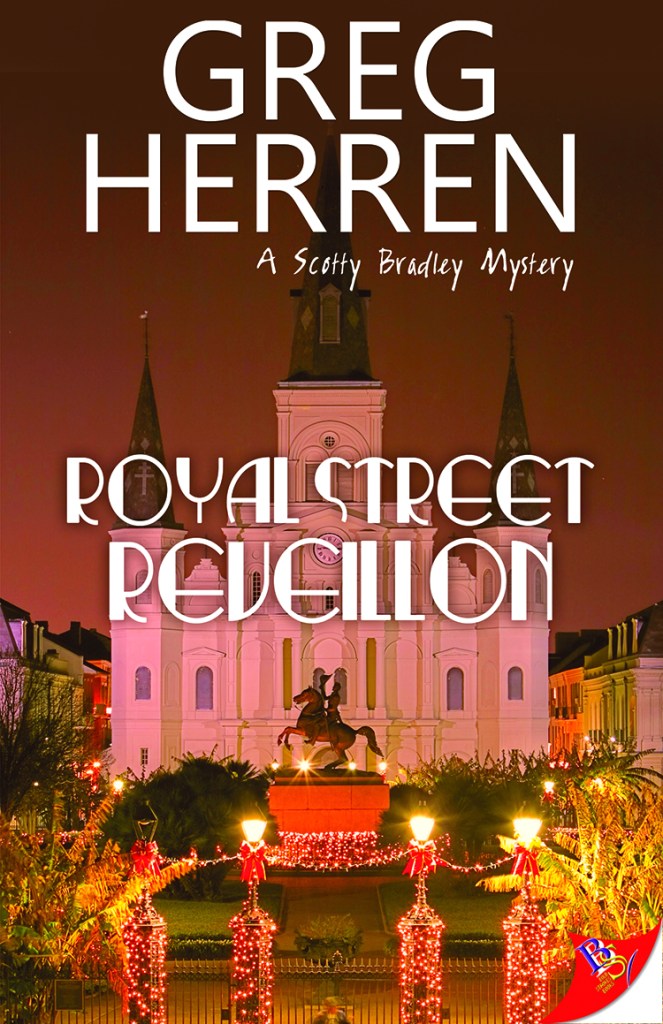
I also set it during Christmas season in New Orleans because I love New Orleans at Christmas-time. It’s one of the few times of the year where I don’t mind that it gets dark so fucking early–because New Orleans has put on her Christmas face and it’s absolutely delightful. One of the things I love most about this crazy city is how everyone here takes decorating so seriously–so seriously they decorate their houses and windows for everything. Jackson Square is stunning with the big red bows tied on the lampposts guarding the gates, as you can see in the gorgeous cover my publisher gave my book (and perhaps the thing about it that make me happiest the most is that one of the lamp’s light is out–just like it would be in real life) and the lights and…sighs happily.

I did think, for a time, about ending the series with this one, but I left the personal story hanging yet again which meant there would be another one–and I honestly don’t know what happened that it took me so long to get around to writing another one, but here we are.

Sweet Mary

Preparing for a workshop on writing sex scenes is not as easy as one might think. And of course, I have to do it today since the workshop is tomorrow morning, but I am going to have to do it around appointments and driving all over the metropolitan area of the city and it looks like we’re going to be having a shitty weather day on top of it all. Huzzah. I did sleep in this morning–I suspect my Fitbit, which I am not so sure I trust anymore is going to tell me that I didn’t sleep well (oh, there was some thunder!) and in just now checking the weather I see we are going to be having thunderstorms during the entire time I will be out dashing around the city. Huzzah.

Heavy heaving sigh.

Last night after Paul and I got home, I finished (I’d started the night before while I was waiting for Paul to come home) watching the first episode of The Real World New Orleans: Homecoming, or whatever it’s called. We used to watch The Real World religiously; I think we stopped watching during the Austin season, and never went back. But we were very excited back in the day when the New Orleans show was announced, and of course, even in those pre-Internet days stories about the cast and the filming used to break in the newspaper. They also were living in the Belfort mansion, which isn’t far from where we lived then (and now), but in the years since it’s turned into a boutique hotel. (The owner–mentioned but not by name–used to work out at my gym.) I am not sure where the house they are living in for this taping is, but I think it’s on Esplanade Avenue; I don’t recognize it from the exteriors. I never really had put a lot of thought into the shows before it filmed here–but once it started, I started to understand that “reality television” wasn’t really reality. They weren’t on camera 24/7, like the show claimed, and they also set up shots and maybe there wasn’t a script, per se, but it wasn’t “real”–we used to see the cast walking around the neighborhood, followed by a film crew that wasn’t filming them. They also filmed in places we knew; Danny the gay one worked as a bartender in one of the gay bars (I want to say Oz? I could be wrong, it’s been over twenty-odd years), and of course we used to see them and the signs on the doors of businesses announcing that the show would be filming there, the time they would be filming, and being present inside during those times meant consent to being filmed unless you advised the crew otherwise (those people who are pixilated out in background scenes didn’t give consent). The “job” the cast did while here was to produce a talk-type television show on local public access which began airing while they were still filming; Paul and I actually caught it by mistake flipping through the channels, and as we watched it, we both said, “Oh, this isn’t going to go over well here”–they were being hypercritical of the city, and yes, as you can imagine, it didn’t go over well. Places began denying them the right to film there, they were criticized everywhere–from all the local newspapers to all the local media–and they eventually had to apologize in order to get places to let them film. (I actually kind of felt sorry for them–they were kids, for Christ’s sake.) The reunion show is weird to watch–again, they were going to places I recognized (the drag show was at the Bourbon Parade, the dance club above the Pub), but it’s also weird to see how they look now, who they’ve become, and hear their stories about the impact being on the show had on their lives.

Then Paul came back downstairs and we watched the first two episodes of the new Queer as Folk, which was filmed here and is also set here. New Orleans is a beautiful city, and that’s one thing the producers and editors decided to play off; the show is beautifully filmed, and they made sure they showed off the city’s beauty at every opportunity they had. It was kind of choppy at the start–uneven, but first episodes when you’re launching a new series often are; it is the rare show that pulls off the first episode perfectly, especially when there’s a large ensemble cast. I love the cast, by the way; it’s mixed and diverse and displays a broad spectrum of the community, as opposed to the original (with its focus on white cisgender men, with the token lesbian couple thrown in just for fun). Paul and I watched the original primarily to be supportive; we knew it was a groundbreaking show and we needed to support it so networks would see there was value in queer programming, but neither of us were really fans of the show itself. It was very earnest, very ABC Afterschool Special and preachy when it came to important topics; and then would veer off into the ridiculous. For me, it was this weird mix of a Very Special Episode and silliness, and it is virtually impossible to do both. Daytime soaps make it look easy, but it’s not that easy to do–we always kept saying, “they need to either decide if they want to be a serious drama or gay Melrose Place” (obviously, we were hoping they’d go the Melrose Place route), but it seems like this reboot–despite the shaky opening–is off to a good start. We will continue watching, and hoping for the best (my supervisor at my day job filmed with the show; he does drag as Debbie with a “D”–his outfits and lewks are fucking amazing, so I am also hoping to see Debbie on the show)–and as Paul said, (and is why I’ll keep watching that awful Homecoming show) “at the very least, the city looks beautiful.” Babylon, the queer bar in the show, was actually in the neighborhood of my old office; it sits on the corner of Frenchmen Street and Chartres, and that neighborhood you see in the show isn’t the Quarter but the Marigny (I miss my old office on Frenchmen Street). We will probably continue watching it tonight, and I am kind of oddly looking forward to it. I am definitely here for all the queer rep on television lately, even as the trash continues to come for us and our rights.

Yes, I said trash, even though the word hardly expresses my deep, abiding, and utter contempt for those who hate me and my community and wish us dead.

And there’s the rain.

AND the obligatory flash flood warning came right after it started, of course.

Heavy sigh.

I did work on “Never Kiss a Stranger” yesterday some; it’s now about twenty-four thousand words, for those who are keeping track. I am really liking the story and I am really enjoying working on it, for those who were wondering. It’s nice to be writing again and enjoying it–it’s been weird this past year how that has gone; but I’ve also come to recognize that I have had periods of my life where I was going through depression and didn’t realize its extent until it had passed. I feel like I’ve been experiencing at the very least low-key depression since March 2020–the kind where I am tired all the time, not sleeping well, and even when I look back at that period, I’ve either forgotten everything and what I actually can remember…it’s through a bit of fog, with darkness around the edges…and I’ve not really been enjoying writing since March 2020, if I’m going to be honest. I am enjoying it again–good thing, since it’s compulsive for me and I always will do it, regardless of how I feel about it–but my writing has always been a source of joy for me, and having that not be the case has been very unpleasant. I’ve really not been finding much joy in anything since March 2020, but I also feel like I’ve kind of turned a corner, somehow–my brain snapped or something and it snapped back into the place where it should have been all along.

And on that note, best get ready to head out to Metairie in a thunderstorm in flash flood conditions. Woo-hoo!

Talk to you tomorrow, Constant Reader.

I’m Real

Reality television goes above-and-beyond to convince the viewers that it’s “real” and “authentic”; but it’s kind of weird to me to think that people can actually go about their day-to-day lives with a camera crew following them, constantly having to set up and break down, without that having some sort of impact on their behavior and relationships with each other. In the case of the Real Housewives shows, obviously they aren’t being followed 24/7 the way The Real World always claimed they did with their casts…which was exposed for bullshit to me when MTV was filming The Real World: New Orleans and they lived in the Bellefort mansion on St. Charles Avenue–essentially in my neighborhood. Periodically I would see a group of them–young people I assumed were the cast–walking around in the neighborhood with a camera crew following them on their way to someplace they were going to film…which meant that obviously they weren’t being filmed 24/7 as the camera men were not filming them as they walked. That breaking of the fourth wall for me was kind of a spoiler in some ways (I never really spent a great deal of thought on the show or how it was made; if I had spent a minute or two thinking about it rather than just blindly accepting what I was told I would have realized how ludicrous the 24/7 filming thing they claimed actually was–but I never cared enough to question anything). After that fourth wall was broken for me, I wasn’t as into The Real World as I had been previously; plus, the longer the show went on, the more it became focused on blackout drinking, sex, and violence–none of which I particularly wanted to watch, really.

When Bravo–which used to be a more higher-minded channel showing Inside the Actor’s Studio as well as syndicated repeats of Law and Order and The West Wing–chose to capitalize on the success of their first forays into reality television with Queer Eye for the Straight Guy and the great reality competition shows Project Runway (we were obsessed with it) and Top Chef by going for something a little more Real World-ish with The Real Housewives of Orange County, I wasn’t particularly interested. As Sonja Morgan was told by Bethenny Frankel in one memorable encounter on the New York franchise, “it’s a cheater brand”–something branded similarly to something vastly more successful as an attempt to piggy-back on that success; in this case, they were copying ABC’s breakout hit Desperate Housewives AND The OC. The ubiquitous previews–run constantly during the syndicated repeats we watched as well as the competition programs–did nothing to inspire me to want to watch even a little bit. The show was successful enough to spawn another franchise in New York, and then another in Atlanta. These shows became part of the public consciousness, really; you couldn’t get away from them, particularly if you watched anything else on Bravo–you began to learn what some of the women’s names were; began to know who was friends with whom and who couldn’t stand who; who was fighting with who and why and so on. Sometimes on weekends while Paul slept on the couch and I sat in my chair reading a book or revising something I was working on, I would just put the channel on Bravo because they always ran marathons on the weekends–whether it was The West Wing, Law and Order, Project Runway or a Housewives franchise–primarily because I always need some sort of noise in the background whenever I do anything. Occasionally Paul would wake up and watch for a few minutes, or I would look up and watch for a while, slowly figuring out what was actually going on with the show, but not interested enough to watch as they aired or become heavily involved. Paul and I actually started watching Atlanta when it started airing–we were drawn in by previews featuring NeNe Leakes, who was hilarious–but I wasn’t very comfortable with it, to be honest; my liberal white guilt made me wonder whether this was a kind of “look at the how funny and weird Black women are!” kind of show. I also didn’t like that the first show to feature Black women had a token white woman on it–none of the other shows with all white casts ever added a minority to the mix; why couldn’t Black women have a show that was all about Black women without needing a white woman to round out the cast? And I was definitely not a fan of Kim Zolciak, so we gradually stopped watching regularly; after all, there was always a marathon going to be aired at some point on a weekend.

I also gave Beverly Hills a whirl when it first aired, primarily because I remembered Kim Richards from her days as a child actress and wanted to see her as an adult. Seeing what she’d become was a bit of a shock, but I watched that entire first season as it aired in amazement, falling in love with Lisa Vanderpump (as so many did) and kind of liking Camille Grammer. She was a bit unfiltered and came across as a very spoiled, privileged white woman…but she was fun to watch and I couldn’t stand Kyle Richards, who was her primary antagonist. But I stopped watching when the show became too dark in the second season, dealing with spousal abuse of one of the cast-members and her husband’s eventual suicide.

A little too real, frankly.

But some friends got me to start watching New York again as it aired in a later season, and this time, I embraced the lunacy and the madness, seeing it for what it was: entertainment. Sure, there was an element of people being rewarded for behaving badly, and whether the madness I was watching was authentic and real, filmed as it occurred, or was “produced” really didn’t matter. I didn’t need to see how the cheese was made, nor did I care; but as I started watching the others so I could talk about them with my friends, dissecting characters and behaviors, I began to realize that these shows were the nighttime soaps of this new age; addictive shows about people with money behaving badly that we talked about (I used to watch Dynasty with a huge group of friends, every Wednesday night: Bong Hits with the Carringtons and the Colbys). Each new edition/franchise of the show was uniquely different from the others; some I never got into (DC, Miami) and others I watched religiously (New York, Atlanta, Beverly Hills), and others I’d keep up with generally (Orange County, Potomac)–my viewing habits for the ones I didn’t watch religiously eventually evolved into simply watching the reunions–which essentially summed up the highs and lows of the season without all the filler.

But I also became interested in watching from a sociological point of view as well; it wasn’t just entertainment, the shows actually provided all kinds of looks into things like group dynamics, how some minor understanding could become blown completely out of proportion, how betrayals of trust are difficult to come back from with a friend, and watching how these women’s evolution was potentially altered, even contaminated, by exposure on camera to a wide audience. Success on the shows might lead to success away from the cameras, but primarily in business more than anything else; these shows were not a jumping off-point into any kind of scripted acting, other than stunt casting on Broadway in shows very late in their run (see: NeNe Leakes, Cinderella; Erika Jayne, Chicago). Bethenny Frankel, seen as the primary success story to arise from the shows (I’ve never cared for her, to be honest), has never managed to translate her popularity as a Housewife into anything successful that wasn’t linked, in some ways, to her original show (her talk show failed, her ripoff of The Apprentice for HBO also failed); and like Trump, her business is really now just licensing the “Skinnygirl” label to other companies marketing products since she sold the alcohol company for a lot of money to Jim Beam years ago.

This interest eventually, as always, evolved into fiction for me. I had always been interested in writing a Scotty book rooted in a season of a Real World-type show filming here; that gradually evolved into my own version of the Housewives shows, The Grande Dames. That eventually worked its way into Royal Street Reveillon, which might be one of my personal favorite Scotty books. I still do watch New York, although I’ve had to back away from Beverly Hills because I cannot stand to see alleged criminal conspirator and ruthless narcissist Erika Girardi on my television; I feel that giving them that extra streaming view somehow condones the fact they didn’t fire her and continue to give her a platform to spin her lies and evade prosecution and restitution.

So, I was very interested when I saw this book talked about on one of the Facebook fan pages I belong to:

As a reward for the procedure the other day, I decided to download this, and in my exhausted state Thursday evening, I started reading it on my Kindle.

If you’re a fan of the shows, you will definitely enjoy this. Essentially, it’s an oral history, with Quinn interviewing not only actual Housewives but also members of production and people from the network about the casts, things that happened on the show, and the controversies. It’s fascinating; production and the network people are always very quick to justify their own questionable behavior in the actions they did or did not take when something bad was happening in front of the cameras (which was to be expected). What was truly interesting to me was the women themselves, and their commentary on their castmates, and the absolute zero fucks they give about lifting the curtain and letting us all see how the sausage was made. What’s particularly weird, though, is you do find yourself wondering–just as you do when you watch the shows–how much of it is real and how much of it is the women either covering their own asses or staying in “character” from the shows; Sherée Whitfield makes absolutely no bones about how much she loathes NeNe Leakes…and actually, nobody spoken to from the Atlanta cast, past or present, says anything nice about her other than she makes good TV. (Likewise, New Jersey castmates are very quick to point out that cast-mates Teresa and Melissa, sisters-in-law, still very much hate each other despite the “reconciliation” for the cameras.)

But again, are they just playing a part still, or are their answers authentic? It’s hard to say. I do think some of the former cast members who are bitter about their experiences (looking at you, Carole Radziwell and Heather Thomsen) are being honest, since they have nothing to lose; the ones who are still on their shows perhaps not so much. (Props to Teresa Guidice, too; she literally is who she appears to be, both on television and in this book–so either she’s very good at playing “Teresa” to the point of staying in character all the time, or she basically is that person. I’m not sure she’s a good enough actress to pull off a performance, though.)

Reading the book was a lot of fun, though, and I think if you are a fan of these shows, you’ll also enjoy it. I greatly enjoyed reading it, and it also reads, as oral histories tend to do, very quickly. Does it actually give the reader an accurate view behind the scenes, or any insight into who these women really are off-camera and in their own lives? I don’t know, and that, I guess, is part of the fun; it’s a very good extension of the shows for fans.

I have recently begun to wonder about whether I should continue to watch these shows. I go back and forth between embracing the enjoyment I get from watching (there’s no such thing as a guilty pleasure; we should never feel guilty about finding joy in anything in life; one of the producers even says towards the beginning, that guilty pleasure thing pisses me off because it’s always directed at things women enjoy–a man can sit in front of the television all day watching football yet no one calls the NFL a “guilty pleasure”–which is a very good fucking point) and wondering if I am part of a system that glorifies and rewards bad behavior. do the shows demean women, make them look bad and infantile and childish?

Reading this book gave me no answers other than I should continue to enjoy what I enjoy without spending a lot of time questioning or over-analyzing both myself and my motivations. I also don’t care if people judge me for anything I get enjoyment from; after all, I get judged by people for my sexuality and I really don’t give two shits about the people who do that, either.

But if you don’t watch the shows, I wouldn’t suggest or recommend you read this book; none of it will make any sense to you once they start talking about what happened during the seasons and the conflicts/relationships between the women.

It Never Rains in Southern California

Less than a week until Royal Street Reveillon is officially out in the world!

And so far, no current labor pains!

But, in fairness, it took me a good long while to write this book. My memory is so bad, and I’m so constantly and regularly busy, that I don’t even remember when I actually wrote it and turned it in to my publisher. I think it was earlier this year? I don’t remember–and that’s kind of sad. This is but one of the many reasons I don’t think I’ll ever write a memoir; my memory lies to me all the time and I never know what I remember correctly, let alone times and timelines and so forth. For example, when I was writing my essay “I Haven’t Stopped Dancing Yet” for Love, Bourbon Street, I went into it thinking I spent weeks in Kentucky at my parents’ after the evacuation, when it was actually less than three before I returned to Louisiana. That was a shock, believe me…but it’s true: we evacuated on August 28th, and I returned to New Orleans for good in early October after several weeks on the North Shore at my friend Michael’s. Stress and age and everything else combines to make things seem different in memory; and I’ve also noted, many times, how often people look back through a rosy glow of nostalgia. (I’ve always thought people view the past nostalgically because they aren’t happy, for one reason or another, in the present; they think oh, everything was so much simpler and easier back then. It’s usually not that true.)

So, Gregalicious, why did you decide to write a murder mystery built around a reality television show filming in New Orleans?

I didn’t watch An American Family, the first true reality show, back in the 1970’s on PBS, as the Loud family allowed their lives to be filmed for the entertainment of the masses. The show, which was the baseline for everything that came later, was quite controversial–I remember reading in the newspaper that one of the sons came out as gay on camera, which was kind of a big deal in the 1970’s–but in the 1990’s, I was a big fan of MTV’s sociological experiment, The Real World, and it’s sister-show that came later, Road Rules. But as the shows went on, they went from being a sociological experiment (hey, let’s take a group of seven kids from completely different backgrounds, make them live together and work on a project, and see what, if anything, they learn from each other) to being exploitative (hey, if all of them are young and beautiful and damaged, and we encourage them to drink and hook up, drama will ensue!), which was when I lost interest in watching them anymore. I also watched the game show version–The Challenges–primarily because the young men were always hot, often shirtless, and sometimes even less clad than that, plus watching the competitions was interesting. But it, too, eventually paled in interest to me–they were so repetitive, and the producers never intervened when violence broke out, and that was more often than not–and so I stopped watching.

The Real Housewives was different for me. Back in the day, we used to watch Bravo a lot–Inside the Actor’s Studio, Project Runway, reruns of Law and Order and The West Wing–and when they started promoting a new show they were doing called The Real Housewives of Orange County, I sniffed disdainfully at it. At that time, one of the hottest shows on network television was Desperate Housewives, and this seemed to be a rip-off, an attempt to cash in on the success of another network’s show by copying the title and so forth: “oh, if you like that show, here’s the real women of the area who are housewives, and what there lives are like.” The previews I’d see didn’t really encourage me to watch–the women seemed, for the most part, like horrible people, particularly Vicki Gunvalson–but as the show spawned spin-off shows in other cities and regions, I became more than passingly acquainted with them. They usually ran marathons on Sundays, and when it’s not football season Sunday television was pretty much a wasteland. I’d flip on the marathon for background noise while I read a book and Paul napped on the couch–but I also began to absorb the shows through a kind of osmosis. I knew who the women were and what their lives were like–but still didn’t watch regularly until around 2010, or 2011 or so.

And once I started giving Real Housewives of New York and Beverly Hills my full attention–yeah, I was hooked.

Paul would even watch with me from time to time…and we played a game: if they did a New Orleans version, who would they cast? It was fun, because we also were relatively certain none of the women we thought would kill it on such a show would ever remotely consider doing such a show (Southern Charm New Orleans proved us right), and then I began to think…but such a show here would be absolutely the perfect background for a murder mystery, because of the way everyone here is so connected to everyone else and there would be backstory and history galore.

I always saw it as a Scotty book, but when I turned it into the Paige novella, that changed things. I still wanted to do a Scotty book about a reality show, and I started making notes for one called Reality Show Rhumba. And, if you’re wondering, that’s where the character of Frank’s nephew Taylor Wheeler came from; when I added him to the regular cast of characters for the Scotty series, my intent was to have him eventually be case in a Real World-type show here in New Orleans, and anchor a murder mystery. But then…the Paige novella series went nowhere, and I hated losing such a great idea..so as I went into Garden District Gothic I introduced Serena Castlemaine to the boys, thus planting the seeds for Royal Street Reveillon, knowing I could keep some parts of the story but would have to change others–which was cool, because I always felt that the original novella was kind of rushed, and I didn’t have either the time–or the space (since novellas are by nature shorter)–to make the story what I wanted it to be.

And now, back to the spice mines.

285654_10151224009396509_1642606770_n

We’re An American Band

Wednesday, Hump Day, and the slow slide into another weekend. It’s also pay day, which is really Pay the Bills Day–never a pleasant task, no matter how much I try to make it into one (“Oh, isn’t it satisfying to get this done?” Um, no, not really.)

I woke up after a lovely night’s sleep to a horrendous thunderstorm; we are now in a tornado warning, which I think means one has been spotted; I’m not really sure where precisely–I can never remember the difference between watch and warning. 

Okay, I looked it up and I was right: warning means one has been spotted. Looking at the radar map, it’s not in our area, but it’s rather close to where the office is.

Which should make for an exciting day at work, no?

I had planned on running some errands this morning before heading in, and now I am not so sure I want to do that, understandably, unless this all lightens up before it’s time to go in. We’re also in a flash flood warning (through Sunday on one, JULY 23RD on another, because the river is already high and this tropical thing out in the gulf could send a storm surge up the river. (Aside: it is raining so hard I keep thinking the sink is running and start to get up to go turn off the spigot before catching myself.)

I haven’t written much this week so far; I’ve primarily focused on rereading things I’ve already read and editing them and making notes for revisions as I go. I know I should reread everything I’ve written for the WIP–in order to possibly trigger where to go with the next chapter, which I’ve been stuck on for quite some time–but I am feeling particularly writing-lazy, and I also know I am going to regret that should we have to evacuate in the face of the coming storm this weekend. But an evacuation would sort of change everything anyway–all bets are off!–so there’s also that.

I watched the season finale of The Real Housewives of Beverly Hills last night when I got home from work–I wasn’t so tired Monday night after work, but for some reason last night I was exhausted–and it entertained. It’s very strange, and more than a little unsettling, to see it without Lisa Vanderpump; if any of the original cast still left was going to go, my money and preferences would have been Kyle Richards, whom I have never been able to stand or bear for very long. This season was really not very good, and there were more than a few times when I considered, seriously, stopping watching. The only thing I liked about this season was the addition of Denise Richards.  I didn’t have high hopes for her as an addition–Paul and I actually tried to watch her reality show years ago, Denise Richards: It’s Complicated, and didn’t last beyond the premiere episode. (We usually will give any new show we try a couple of episodes, unless it is so beyond redemption in the premiere we assume it isn’t going to get better; alas, Denise’s original foray into reality television fell into that category–and we wanted to like it. We loved her in Drop Dead Gorgeous, which is a vastly under-appreciated comic classic.) Paul came home in the middle of the episode–he doesn’t really watch my reality shows with me, he has more discerning tastes–and as I explained things to him, I stopped at one point and said, “And it is truly frightening that I know this much, not only about the show, but about their lives outside of the show.

But as Laura Lippman says, one should never apologize for anything in this world that one enjoys, as there are so many things and experiences we don’t enjoy–we should definitely allow ourselves to enjoy things that might earn us scorn from others. She’s right, of course; I don’t give a shit if someone looks down on me for enjoying reality television; hell, I’ve written a book around reality television (Royal Street Reveillon, coming this September, from Bold Strokes Books! Preorder now!). I’ve watched reality television going back to the very first season of The Real World on MTV, which, while not the first reality show, was certainly the precursor to the reality show boom of this century.

It’s also payday, and I have to pay the bills this morning. My favorite chore, but it must be done.

Have a lovely Wednesday, Constant Reader. I look forward to giving you another Gregalicious update tomorrow.

IMG_1644

Tonight She Comes

Reality television.

I started watching in back in the original days of The Real World on MTV; the social experiment of picking vastly different young people from vastly different places with vastly different backgrounds, to see whether or not they can learn from each other and grow; or simply clash and create drama for the cameras. I enjoyed watching, I’m not going to lie–I didn’t lose interest until later seasons, when it became all about the kids getting drunk and hooking up and so forth. But the influence of The Real World–and its sister show, Road Rules–on reality television is unmistakable.

I’ve stuck my toe in the water with several reality shows–I used to be completely addicted to Project Runway, until it left Bravo for Lifetime and I lost interest–and the same with RuPaul’s Drag Race–after the Adore/Bianca/Courtney season I didn’t see how it could be anything other than a disappointment going forward so I stopped (although I did tune in for the glory that was RPD All-Stars Season Two), but I never got into Survivor or The Bachelor or any of the others. But I do watch the Real Housewives–New York is, without question, the gold standard, with Atlanta a close second with Beverly Hills trailing them both substantially; I can’t with Potomac, Orange County, and Dallas. 

I also really enjoyed the first season of Lifetime’ UnReal, but got behind on Season 2, heard bad things, and so never picked it back up again.

My love of (some of) the Housewives shows has resulted in my winding up on two Housewives related panels over the years at Bouchercon (Albany and New Orleans, to be precise), which were enormously fun; and I have also managed to observe what a cultural phenomenon these shows have become. There are recaps everywhere all over the Internet; there’s the Bravo website itself; and these women are often sprawled all over the tabloids I see while in line at the grocery store. (And no, I have only ever watched about twenty minutes of a Kardashian show and it was so horrible I never went back. More power to you if you’re a fan, but they are just not for me.

I even wrote a very short book–which is no longer available anywhere–based on the filming of such a show in New Orleans; it was pulled from availability primarily because I was never truly satisfied or happy with it. I wrote it very quickly in a window between deadlines and never felt I was able to explore all the things, the issues, with reality television that I wanted to with it. And yes, I decided to use that same backstory–a Real Housewives type show filmed in New Orleans–to write the new Scotty book because 1) it’s a great idea and 2) since I am writing off dead-line I can do it the way I want to and hopefully say the things I wanted to say in the first. Some of the original elements of the story I used before still exist in this Scotty book, but there’s a lot of changes I’ve made so it’s not the same story. The draft is very very rough, and since I’ve finished it and put it aside I’ve had a lot of great ideas for it; fixes and changes and so forth.

I think it might be the best Scotty yet, and it’s certainly the most complicated.

I started reading Jessica Knoll’s The Favorite Sister yesterday, and before I knew what happened most of the afternoon was gone and I was about half-way through. Her book is also built around a reality television show, and boy, is this book biting. I loved her debut, Luckiest Girl Alive, and this one is just as good. You’ll get a full report, Constant Reader, when I finish it.

Next up for the Short Story Project: “Don’t Walk in Front of Me” by Sarah Weinman, from Baltimore Noir, edited by Laura Lippman:

I wanted honest work and got it at Pern’s. A Jewish bookstore is a strange place to work for a guy like me, but I didn’t have much choice; a month of job hunting left me frustrated and ready to break things, and the ad stuck on the store’s main window was as close to salvation as I could get.

Thus Sam–we were on a first-name basis from the beginning–was very particular about which items I could handle and which I couldn’t (“Anything with God’s name on it, leave it to me”), he left me to my own devices when it came to  handling teh cash register, stocking the books, and helping out customers. I hadn’t know much at all about Judaism, but I sure learned fast.

When I told my mother where I was working, she was understandably confused, but got over it quickly enough. I had a job, and a pretty decent one, and that was what mattered to her most.

“I worried about you, Danny, the whole time you were incarcerated. She articulated each syllable, just as she did every time she used the word. Which was a lot, because my mother adored big words. It was her way of showing how much more educated she was than the rest of the mamas in Little Italy.

Sarah Weinman is a fine short story writer; her stories in Lawrence Block’s stories-inspired-by-art are two of my favorites. Her upcoming study of the kidnapping case that inspired Lolita, The Real Lolita, will be out this fall and I can’t wait to dig into it. This story is another one of her little gems: a guy with a criminal past takes the only job he can get, and slowly but inexorably gets drawn into trying to help his boss solve a personal problem, and how things get out of hand from there. Brava, Sarah! WRITE MORE SHORT STORIES.

And now, back to the spice mines.

34276625_213697892755340_5149474438521028608_n