I’m Gonna Make You Love Me

I’ve always considered myself to be a child of the seventies.

Sure, I was a child for during the sixties, but I turned nine in 1970. While I am sure that turbulent decade provided some (a lot of) influences on me, my personality, my likes/dislikes, and my future, I am equally confident that my values and thoughts and beliefs probably weren’t as shaped from that turbulent decade as they were by the 1970’s. The seventies are really the first decade for which I have a lot of recall (recently, a friend was amazed that I remembered those horrible Rag City Blues jeans for women that were, for some reason beyond my thought processes, popular in the latter part of the decade; what can I say–I do remember the decade fairly well for the most part–or at least as far as my memory can be trusted). I’ve always wanted to write books either set in the seventies completely or even partly; Where the Boys Die, my 70’s suburban Chicago novel, keeps pushing its way to the forefront of my increasingly crowded (and clouded) mind. (NO I AM WRITING CHLORINE NEXT WAIT YOUR TURN)

I remember Watergate and how the scandal grew. I remember the 1972 landslide reelection of Nixon, and the country’s negative reaction to the Ford pardon of the man who brought him to power; I also remember Jimmy Carter running for president out of seemingly nowhere and getting elected. There was The Brady Bunch and The Partridge Family and Archie Bunker and Mary Richards; Sonny and Cher and Carol Burnett and Donny and Marie and the Jackson 5 and Grand Funk Railroad. Top Forty radio ruled the AM airwaves; not every car came equipped with FM capabilities, and the only way you could play your own music in your car was with an eight-track player. I started the decade reading the Hardy Boys and Nancy Drew and The Three Investigators; by the end of the decade I was reading John D. MacDonald and Sidney Sheldon and Harold Robbins. It was a very weird decade…of odd color and fashion choices; avocado greens and browns and American cheese orange were ridiculously popular, as was shag carpeting, velour, clingy polyester shirts, corduroys, bell bottoms and slogan T-shirts. Baseball shirts and rugby sweaters also became popular later in the decade. People had feathered hair parted in the center, and there was this weird sense of, I don’t know, missing out? Movies were grittier, harsher, more realistic; actors went from the polished shine of the old Hollywood system glamour to warts-and-all realism. Television was also beginning to change but was still heavily censored. Boogie and truckin’ and shake your booty became part of the vernacular; the decade began with the break-up of the Beatles and ended with disco’s last gasps while new wave and punk and rap started their rise.

It was the decade I went through puberty and realized that I was attracted to other boys instead of girls; I wasn’t quite sure what that meant but definitely found out in the seventh grade it meant I was a faggot, fairy, queer, cocksucker, and all those other lovely words that were burned into my brain that year. It was the decade where I read Harold Robbins’ Dreams Die First (a truly execrable novel) over and over again because the main character had sex with both men and women, and if I am not mistaken, contained the first male-on-male sex scene I’d ever read (oral); it was also the decade where we moved from Chicago to the suburbs to the cornfields of Kansas and I graduated from high school. (Ironically, it was in Kansas that I discovered gay books with explicit gay sex scenes in them–the News Depot on Commercial Street not only carried The Front Runner by Patricia Nell Warren and her other novels, but also Gordon Merrick; and their magazine racks also had gay porn magazines–which, now that I think about it, meant there were others there in Lyon County and environs; I didn’t realize it at the time, of course.) It was when Norah Lofts’ The Lute Player made me aware that Richard the Lion-Hearted was like me, too; and Susan Howatch’s Cashelmara and Penmarric also had gay characters and plots involving them…

I’ve always thought the seventies was a much more important decade than ever given credit for; usually it is merely considered a connecting time from the 60’s to the 80’s…but almost everything that came after–socially, politically, culturally–got started in the seventies. So I was glad to see this book about that frequently dismissed time.
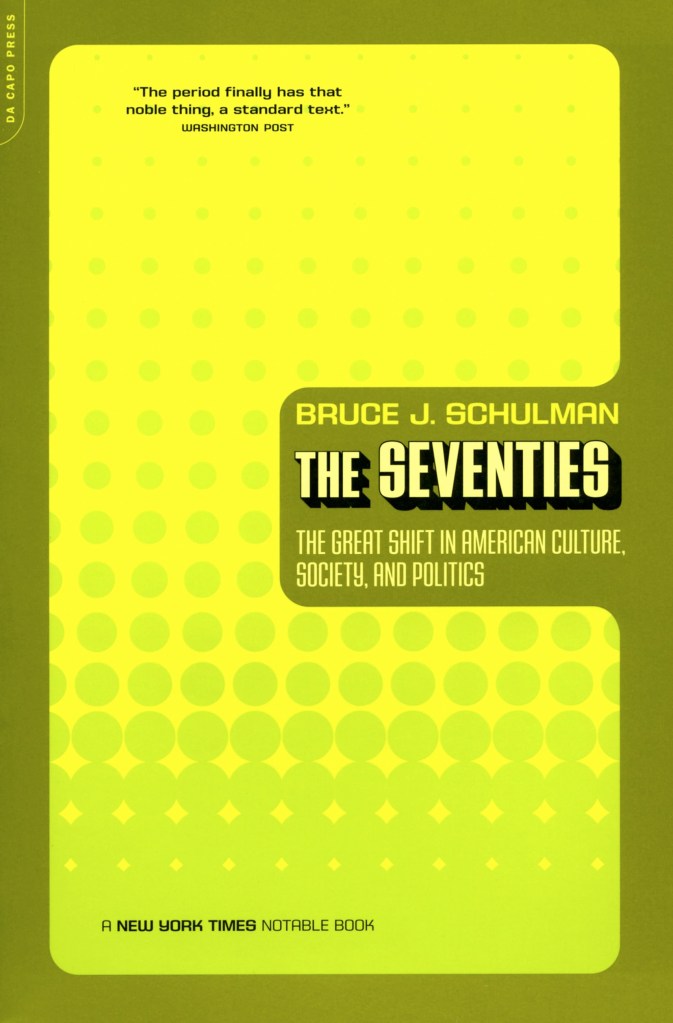
As I mentioned previously, the Seventies were turbulent; they were the decade that also saw the beginning of the end of the post-war economic/prosperity bubble. Gas shortages, skyrocketing inflation, and the insidious use of racism to break the Democratic coalition began–everything we find ourselves dealing with today had its roots in the Seventies–and it did seem, to those of us growing up in the shadow of the mushroom cloud, that the world had lost its mind and our country (or rather, its mythology) had lost its way. Schulman’s study of the decade, breaking down how the shifts in culture, politics, and our society began, were exploited for divisive purposes, and permanently changed attitudes moving forward was a fascinating, if chilling, read. I remember the terrorist attacks. I remember watching the Munich Olympics that ended in bloodshed on an airport runway and murdered Israeli athletes. The book brought back a lot of memories; I am not so sure I agree with all of Schulman’s assertions about the decade–there certainly wasn’t very much about the burgeoning gay rights movement, other than how it chased lesbians off into the Women’s Movement–but it was interesting to read the book and relive the decade a bit, as well as the memories it triggered.

I do highly recommend this book for people who weren’t around for the Seventies and might be wondering how the fuck did we end up in this current mess?


Face Up

Wednesday has rolled around again, as it always does, and last night was another restful sleep of the same sort I had on Monday; restful but awake or half-awake the majority of the time. I am beginning to wonder, quite frankly, if this is just another affect of getting older; the inability to sleep deeply every night. Yesterday I wasn’t as tired as I feared I would be, which actually was kind of nice, and I do think this will be the case this morning too. I intend to go to the gym this evening for a workout with weights after work–so being tired will not be helpful in the least. Maybe that will put me into a deep sleep tonight.

Maybe it won’t–which is more likely.

We watched two more episodes of The Capture last night on Peacock, which is incredibly good. I still have absolutely no clue what’s going on, but the suspense is so ratcheted up that I cannot wait to get home tonight so we can finish watching it. I want to start reading Laurie R. King’s A Monstrous Regiment of Women, the second in her Mary Russell series, but focus is so important when reading and what little focus I have these days really needs to be spend on the revision of Bury Me in Shadows, which needs to be finished by the end of the month–so time is running out on me, as always. I was thinking about how I reacted to rereading the manuscript with an eye to edits last weekend, and how I always am enormously dissatisfied with the final product when it is released. Don’t get me wrong, I am proud of every book I’ve written, as each represents surmounting a struggle of some sort in some way, and finishing and publishing a novel is always an accomplishment, regardless of how it turned out in the end. I was dissecting this in my head last night while I was making tacos for dinner (nachos for Paul); my strengths are premises, titles, and character–but inevitably whenever I start writing a book most of the time I don’t know how it’s going to end. I try to figure out how to end a book before I start writing it–but on the rare occasions when I have figured out the end beforehand, I question that as I write and inevitably change my mind at least once, if not twice, and as a result, I never am completely confident in my endings. Adding to the neuroses in my brain, the last few chapters of a book generally don’t get as much attention as earlier chapters, either, which makes my insecurity even worse.

I really do wish I could slap my first creative writing teacher across the face for doing such a number on me that it has lasted all these years. FUCKER.

Then again, he typed smugly, I’m about thirty-six novels, five novellas, and fifty short stories into my career; he’s still unpublished, forty years later. So, there’s that…and the fact I never forget a grudge.

I’ve also been toying with some 1970’s research in my spare moments–looking up things and trying to remember things from my tween years–like “sissy bars” (and no, it’s not a bar for effeminate gay men, though it is a great name for a gay bar). I remembered “sissy bars” as being the high bar on boys’ bicycles that girls’ bikes didn’t have back then; turns out it’s actually the back bar at the end of a bike that the passenger behind the driver/rider can lean back on for balance. (I still remember it the other way; and that other bar doesn’t seem to have a name, which is weird.) I’ve been wanting to write about the early 1970’s in the Chicago suburbs for quite some time–I have an idea based on a murder that happened in our suburb when I was a freshman in high school, You’re No Good, which could be a lot of fun to work on and write–and my main character from Lake Thirteen (Scotty?) was from that same fictional suburb…which leads me back into that weird Greg Universe where all of my books are somehow connected, between New Orleans, Alabama, Chicago and it’s suburbs, California, and Kansas–which I completely forgot that I was doing. (Aside: Bury Me in Shadows is set in Corinth County; which is where the main character in Dark Tide was also from; where I set the story “Smalltown Boy”; and where Frank and Scotty’s nephew Taylor is from, making his first appearance in Baton Rouge Bingo.) But the early 1970’s was an interesting and somewhat volatile time, between Vietnam, the economic crisis, and Watergate; where television gave us stuff like The Partridge Family and Love, American Style and horrible variety shows; when the post World War II economic boom in the United States was beginning to crumble and fade away; when Top 40 radio ruled the AM channels and everything was still on vinyl or eight-track tapes, before cable television and 24 hour news and no Internet or cell phones. But… as I mentioned earlier, while I have a great premise and a terrific title, I don’t know the story or how it ends…but that won’t stop me from obsessively researching the period.

And on that note, tis time to head back into the spice mines. Have a great day Constant Reader!

Singularity

Ah, Monday morning and the sun has yet to rise in the east. It’s chilly in the Lost Apartment this morning, and as I steel myself for yet another day in the spice mines at the office, I am also pleased with how much I accomplished this weekend.–which wouldn’t have happened had there been parades. This week, of course, would be the big weekend of Carnival–with Muses and Orpheus and Bacchus and Endymion and Iris and so many, many others passing by down at the corner (well, not Endymion) and I would be trying to figure out how to get to and from work…so glad I don’t have to deal with any of that this year, quite frankly. But I do miss Carnival and the parades. I also have a long weekend coming up; Fat Tuesday is a holiday, so I went ahead and took a vacation day for Monday. Since there’s no distractions going on at the corner this weekend, I instead have four glorious days off in a row, which should help me get much further along with the revisions of the book and getting me that much closer to turning the bitch in.

I did wind up not working yesterday after all. I made groceries and then went to the gym; I was tired after that and repaired to my easy chair. I tried to read, but alas, was too tired and unfocused to get very far in what I was reading, so decided to rest for a while and take notes. This resulted into my falling into–of all things–a wormhole about The Partridge Family on Youtube; I don’t even remember how this came about, to be honest. I think a video was suggested to me, and after I got started down that garden path, there was no returning from it. This wormhole of course led me into music videos–clips from the show–and so forth; and who knew there was still so much Partridge/David Cassidy love out there in the world? (Shouldn’t really have been so surprising, really–look at how seriously the Nancy Drew/Hardy Boys fans still take their devotion to those series books they read decades ago–there’s probably still some serious Leif Erickson and Shaun Cassidy fan channels on Youtube, with some significant crossover between Shaun fans and The Hardy Boys/Nancy Drew fandom as well.) What was really surprising to me was–despite not having heard the music in a while–how good it sounded. David Cassidy was a good singer–it really is astonishing what a superstar he was during that time period–and I could still remember the lyrics to a lot of the songs. I’ve always liked harmonies when it comes to songs, so I always enjoyed the harmonies, and some of the songs still hold up today. (I will not go far as to say the songs would be hit records again today) I had no idea their debut album peaked at Number Four on the charts, that they had so many hits–the first three albums went platinum; any number of gold singles–and listening to the music and watching videos took me back to those years. The Partridge Family spanned the time from when we lived in the city and moved into the suburbs; it finally went off the air when I was in junior high. My sister and I watched every Friday night, groaning our way through The Brady Bunch (even as a kid I thought it was juvenile and lame) as a sort of punishment for getting there. The humor/comedy/situations on The Partridge Family often wasn’t much better–sometimes the two shows used the same basic plot premises–but the concept behind it was so much more clever and original than The Brady Bunch, and it worked better.

And of course, as I watched the videos–there was a Biography, an E! True Hollywood Story, and so forth–I kept thinking about how weirdly Danny Bonaduce’s life has turned out, and then began thinking in terms of a novel about a similar type show in the past whose cast in the present day is trying to figure out why the one whose life took a Bonaduce-like turn did precisely that. He would be dead, of course, and some of the cast members would still be in show business and some would not; it would be one of the younger kids telling the story because their own memories of their time on the show would be vague since they’d been so young, and having left show business far far behind in their rear view mirror….looking into the dead one’s life would, of course, bring back memories of their own and remind them how glad they are to be out of the business now.

And yes, after watching I did make a Partridge Family playlist on Spotify. Sue me.

WE also started watching a show called Resident Alien last night, which was actually kind of clever. I think it airs on Syfy; we’re watching it on Hulu, of course–we only watch the Super Bowl when the Saints are in it, so I think we’ve watched perhaps two Super Bowls this century–and the other one I watched was when I was out of town visiting friends and we went to a Super Bowl party, and I don’t even remember who played that year–and so I suppose this morning congratulations are in order for Tom Brady and the Buccaneers, good for you. Anyway, I digress. I think Resident Alien may have been a film? The title certainly seems familiar, but the premise of the show–which really boils down to ‘fish out of water’–features an alien creature who had a mission to earth, only to have his ship hit by lightning and crash in Colorado. The creature then kills a human and takes over his life while trying to find his ship–now buried in snow–and trying to avoid human contact. Of course he gets unwillingly dragged into human contact, and there’s a big surprise twist at the end of the first episode. Some of the humor is predictable–an alien with no idea of what humans are actually like learning to adapt and become more human-like in order to pull off the deception; this was first done really well with Starman in the 1980’s, starring Jeff Bridges–but it’s still funny. And the little remote town in Colorado is an interesting setting. We liked that first episode and intend to watch more; it’s quite engaging, and while it’s eminently predictable–he’s going to start liking humans and getting personally vested in them–it’s still very well done.

And on that note, tis time to get ready for work. Talk to you tomorrow!

Okie from Muskogee

Thursday morning, and I am working from home today; or taking a mental health day–I’m not sure which it will be as of yet. This week has been fraught, to say the least, and by the time I got home yesterday I was exhausted and literally just collapsed into my easy chair for cat cuddles and mindless Youtube viewing. I don’t precisely remember what led me down that particular rabbit hole, but I at one point found myself listening/watching music videos of the Archies, Josie and the Pussycats, the Monkees, and the Partridge Family. (Hanna-Barbara animation, by the way, wasn’t very good–and the voices! My God, the speaking voices of the characters was like fingernails on a blackboard.) We also continue to watch The Chilling Adventures of Sabrina, and seriously–if you’re home, have Netflix, and are looking for something really fun to binge, you can’t go wrong with Sabrina.

I think what is making this week particularly hard is knowing that this weekend was when the Tennessee Williams Literary Festival/Saints & Sinners was supposed to be taking place; I was looking forward to seeing friends and making new ones, hanging out in the Quarter, staying in our posh suite at the Monteleone while coming home from time to time to keep Scooter company, and then launching into the next week energized and ready to get back to writing. Instead, I am physically and emotionally drained; the weather is spectacular (although I would imagine those from up north would consider this too hot–it is much warmer than it usually is in late March), and who knows what fresh hell tomorrow will bring? This morning I woke up at seven, but stayed in bed almost another two hours simply because I didn’t want to face my emails or whatever the new reality for today was going to be. But I can’t, in fact, stay in bed all day–no matter how much I want to–so I finally rolled out of bed and am now on my first cup of coffee and thinking already about how best to make use of the day.

I did read “The Masque of the Red Death” again finally last evening; I found a pdf on-line free for download (thank you, public domain!) so I downloaded and printed it out and read it while a cat purred in my lap. As I was reading it–it’s really more of a fable or fairy tale than an actual story; there’s no real characters, and the only one who has a name–Prince Prospero–is never developed into anything remotely human or three dimensional; as I said, it’s more of a fable illustrating the futility of trying to escape from death than an actual short story. And yet–yet it still resonated with me more than “Death in Venice”, which, though, I am still thinking about a few days later, which means it affected me probably more than I originally thought.

Either that, or all these stories–linked by plagues and Venice, in some ways; it was easy to imagine Prospero’s palace being on the Grand Canal–are linking and fusing together in my mind somehow; so perhaps the essay I am thinking about isn’t so far-fetched and out of touch with reality as perhaps I may have originally thought. I am going to spend some time today reading du Maurier’s “Death in Venice” pastiche, “Ganymede”, and I will let you know how that goes. I still don’t seem to be able to commit to a full-length novel, but I also do remember that I did read an awful lot in the aftermath of Katrina–in fact, I remember rereading All the President’s Men as well as a book about the criminal conduct of Nixon’s vice president, Spiro Agnew–and so am thinking I might be best off turning to my non-fiction reading. I am still reading Jason Berry’s City of a Million Dreams, and I am thinking about getting down my copy of Barbara Tuchman’s A Distant Mirror and rereading her chapters about the bubonic plague’s first, and most deadly, visits to Europe.

I made a post on Facebook yesterday, a little annoyed, about how the condos being built on my street two lots over is continuing despite the shelter-in-place order, essentially saying so glad the condo construction going on two lots over from my house is considered essential. Don’t get me wrong, I’m glad the guys are working and getting paid; these are scary times, particularly for those living paycheck to paycheck, and I certainly don’t begrudge anyone getting paid-, but I can’t help but think about their safety, and I also can’t help but wonder who in the hell is going to buy a condo in this economic climate? As of yesterday Louisiana had 1,795 confirmed cases and 65 deaths, most of them in Orleans Parish, but it’s spreading gradually to the outer parishes, who are even less equipped to deal with a pandemic than Orleans. Anyway, this led to an idea for a noir short story called “Condos For Sale or Rent”, and I actually scribbled down the opening to the story last night…and it also kind of made me think about, as is my wont, quarantine/pandemic fiction. I wonder what post-flood New Orleans fiction would be like; now I wonder about how this whole pandemic/quarantine event will impact not just crime fiction, but fiction in general.

And here I am, already thinking about a pandemic short story, and even last night, before switching on Sabrina (that’s how the Youtube wormhole started; I was thinking about Sabrina, and how she was originally a character on Archie–so I looked for the old show on Youtube, found the video for “Sugar Sugar”, which featured Sabrina working a kissing booth, and then I got sucked in), I was thinking about a Scotty book during the pandemic/quarantine. Obviously such a book cannot be written now–without knowing what’s going to happen with COVID-19, you cannot tell the entire story–but it’s not a bad idea to take notes and come up with thoughts about it.

I also just remembered Katherine Anne Porter’s Pale Horse Pale Rider is set during the Spanish flu pandemic of 1918; perhaps I should read it again. Not a huge fan of Porter, either, to be honest; I read The Collected Stories of Katherine Anne Porter (I was looking for “Miss Brill,” not realizing at the time that was written by Katherine Mansfield rather than Porter) and was underwhelmed by them. Maybe I should give it another whirl? Maybe my tastes have matured and deepened enough by now for me to develop an appreciation for Porter. I should probably take another run at Hemingway–I only read The Old Man and the Sea and A Farewell to Arms, both of which were required for a lit class in high school and I hated them both–although Hemingway is precisely the kind of writer I’d hate if I knew in real life.

And on that note I am heading back into the spice mines. Have a lovely day, Constant Reader, and do whatever you need to in order to keep yourself safe and uninfected.

Chris-Mears

Should’ve Never Let You Go

And my first morning of vacation looms bright, with a stunningly blue sky and the sun blinding me through my windows. The clouds will roll in later this afternoon, per the weather forecast, and the thunderstorms aren’t supposed to arrive until around eleven; well after the second parade has passed. Tonight’s parades are Druids and (Stevie) Nyx; so only two, to prep us for the madness of Thursday, which includes Muses.

So much to get done today, should I choose to do any of it; I need to get caught back up on Scotty revising, and there’s always cleaning to do around the Lost Apartment. I also have to make groceries and collect the mail, and I’d like to go to the gym at some point this afternoon as well to begin my reconnection with taking better care of my body. There’s also reading to do; I need to read the next story in the Murder-a-Go-Go’s anthology, and I need to finish the ghost story I’m reading in Norah Lofts’ Hauntings, and of course, the delicious pleasure that is Lori Roy’s Gone Too Long also awaits on the end table next to my reclining chair. I need to set aside some time to finish that because I need to read my homework for the panel I’m moderating at the Tennessee Williams Festival–Alafair Burke’s The Better Sister, Samantha Downing’s My Lovely Wife, and Kristien Hemmerechts’ The Woman Who Fed the Dogs. I am also falling very far behind on the Diversity Project, which is enormously disappointing to me.

I’m sort of in a malaise in which I keep putting things off because I don’t want to do them, which isn’t really like me–or at least, the me I’ve been for the last half of my life. The first half of my life was when I just avoided things I didn’t want to deal with, which never ended well. I’m not entirely sure what’s causing it, and the Great Data Disaster of 2018 was so long ago now (three months, almost four!) that I can’t keep blaming things on it; but I can really trace this back to losing that weekend’s worth of work and getting derailed…because I was also on a roll at that point, and I’ve never quite gotten that momentum back.

Something innocuous I posted on social media blew up in a way I certainly never intended, and no, I don’t mean the post that someone needs to do a noir reboot of The Partridge Family, which I still think is a brilliant idea–after all, we never really know what happened to Shirley’s husband, who is rarely, if ever mentioned; and let’s face it, none of those kids looked even remotely related to each other. I envision Shirley as a not only a black widow going through numerous husbands and baby-daddies, but also being a horrific stage mother, forcing her children into musical careers, while having an affair with their sleazy manager, Reuben.

No, I idly posted that someone needs to do one of those music-inspired crime anthologies based on the music of Pat Benatar…and then came up with the title, Crimes of Passion: Crimes Stories Inspired by the Music of Pat Benatar.

Well, it kind of took off, with people replying to my tweet that they’d write to it, or responding on Facebook that they wanted to, even going so far as to pick the songs they wanted. At first–I was at work–I wanted to say, yo, everyone, it was just a thought, I’m not actually doing this but as the day went on I began to think, more and more, that hey, maybe you should think about doing this. More than enough people have offered to write for it, so many so that if anyone drops out there would still be more than enough stories to fill out a volume and for it to be really good.

So…I’m considering it, and considering publishers to approach. So maybe, just maybe, that will be my next anthology.

MAYBE.

And now, back to the spice mines.

22366703_10159458317505290_8781974010612680120_n

Paparazzi

Memories lie.

There are things and moments from my childhood I remember completely differently from my parents and my sister, for example, or moments from early on in Paul’s and my relationship. My memories differ from those of kids I went to high school with, and those of my fraternity brothers. Memory and experience are always, of course, colored by our own internal beliefs, values, fears, and opinions; which is what makes being a crime writer interesting.

I remembered, for example, that we moved from the city out to the suburbs in the winter of 1969. I’ve always thought that was the truth; we moved to our house in Bolingbrook that winter and would have sworn on a stack of Bibles that was the truth. Imagine my surprise, during my recent visit to my parents, to hear both of them insist that wasn’t true and we moved out there in either the winter of 1971 or 1972; and I sat there, confused, and then a key piece of my history snapped into place in the jigsaw puzzle that is my memory: you were ten when you moved; your eleventh birthday was your first birthday in the new house so it had to be 1971. I’d always remembered that we’d lived out there for much longer than we had. We only lived in Bolingbrook for four and a half years; I was in the sixth grade when we moved and we moved to Kansas after my sophomore year ended.

Interesting, isn’t it?

I was rather startled the other day to hear that David Cassidy is in early stage dementia; David Cassidy was a part of my childhood, and it’s hard to remember the years when The Partridge Family aired without hearing their music in the echo chambers of my brain. The Partridge Family Album was, in fact, the first album my sister owned. She had one of those little portable record players that either ran on six enormous batteries or could be plugged into the wall, and she played the album over and over and over again. I didn’t mind because I kind of liked the music myself; and we watched the show religiously every week. My sister, of course, was madly in love with David Cassidy, who did nothing for me. (Even as a nascent gay child, my crush was Kurt Russell.)

Before buying that album my sister primarily bought 45’s; it amazes me that there are any number of people who don’t know what those are, or how you used to stack them on the record player, so the next one would drop when the previous one finished playing and the needle cleared out of the way, or the scratchy sounds from collected dust and/or scratches on the record that you could always hear in the background. David Cassidy replaced Bobby Sherman in my sister and her friends’ affections; Bobby Sherman replaced Davey Jones of the Monkees.

The show itself was pretty dreadful, really. The idea was derived from the Cowsills, an actual family musical group, and it was designed to appeal to young girls and hopefully sell some records; another prefabricated music group along the lines of the Monkees and the Archies. They’d never intended for “Keith” to sing lead vocals on the music, but David Cassidy auditioned and got the part and to their surprise, he could sing and had musical ambitions. (Alas for him, he became a huge teen idol but never got the rock stardom he always dreamed of.) His stepmother in real life, Shirley Jones, was cast as his mother, widowed Shirley who worked in a bank to support her five kids. (Jones was actually an accomplished singer herself, and had an Oscar for playing a prostitute in Elmer Gantry.) Even at the time, I didn’t think the show was funny, but it wasn’t as bad and corny and hokey as The Brady Bunch, which was admittedly a low bar. But I was delighted several years ago to discover that the Partridge Family’s music was on iTunes, and I downloaded some, out of a sense of nostalgia.

And it wasn’t bad. I downloaded more, and still listen to it from time to time. It’s glossy, well produced, and slick pop music, but it’s not terrible. It certainly holds up better than Shaun Cassidy’s hits or New Kids on the Block.

And am I ever glad I didn’t have to go into the office today. I am worn out, frankly, not sure how I am going to survive tonight’s parades.

Heavy sigh