We made it to Wednesday! Huzzah! Huzzah! Here I sit with my coffee on my middle of the week morning, and I feel pretty good, to be honest. I was very tired yesterday, but not in the “I can’t even think” way, but rather the “hmm, I feel fatigued” way, which is fine. Yesterday was Sparky’s birthday, and so I gave him extra treats and pretty much played with him for most of the evening until he went to sleep in my lap. He really is a dear, even when he has Big Kitten Energy.
It’s been a bit of a week thus far, hasn’t it? Who knew that Ginni Thomas wasn’t the most awful SCOTUS wife? AND THAT IS SAYING SOMETHING. I saw someone on social media suggesting we change it, as a society, from “Karens” to “Martha-Anns,” since that name isn’t as common and she is clearly the GALACTIC EMPRESS of “I need to speak to a manager.” Madame Torquemada wouldn’t think Isabella the Catholic wasn’t religious enough for her, and clearly she’d love to implement the Inquisition, too. Thanks again to the third party votes who gave us the president who would appoint him for your service–and again for your service in 2016. I mean, what a vicious, venomous little spider she is, sitting in her house brooding over people being mean to her, waiting for the day she can be spiteful–the irony is it doesn’t make her look like the wife of a Supreme Court justice, but the Alitos clearly have delusions of grandeur and think they’re superior to everyone else. Whatever, trash. Don’t call yourselves patriots when you’re preference is to wipe your ass on the Constitution, and I also love that Alito thinks he’s a superior legal mind to, I don’t know, say every previous justice, which is rather telling. He certainly should not be a judge. But again, me and everyone else not white-cishet were screaming from the rafters that 2016 was about the Supreme Court, and as usual, no one listened–and that was also the case with the 2000 election, too. Sigh. It’s the pits, sometimes feeling like Cassandra on the walls of Troy.
I do feel much more lively this morning than I have any morning this week, but that’s got to be the better night of sleep last night–best of the week, in fact. I have to go pick up the mail today, my copies of the new Paul Tremblay should be there as well as another book from my childhood, Stranger than Science, which I am justifying getting because I plan to use it in The Summer of Lost Boys, which makes it research. I started thinking more about the next book yesterday, too, and how to expand this novella out into a novel. I am of course still going back and forth on it; it could be a novel, or it could just be the novella I stick at the end of my short story collection, but I think it would be too long for that. I need to write the introduction for that and finish the final stories and get it turned in. I know that Never Kiss a Stranger is already about 23k words in length, and there are at least two other subplots I need to weave into it, which should make it all the more interesting. I’ve not done nearly as much writing this week as I would have preferred, but there’s still a few days left in the week, so I can hopefully make up for lost time. What I need to do is summarize what’s already done, figure out where to slot in the subplots, and then buckle up and do the work. Next week is also going to be a little odd; we have Wednesday off for Juneteenth, so I have to work two days, be off one, work two more, and then drive over to Florida to meet Dad for the weekend. Their anniversary is next week–the 20th, to be exact, so Dad wants to go visit Mom and then he’s going on down. It’ll be a nice, relaxing weekend, methinks.
I’m not even going to take my computer with me. I’ll be ignoring everything until I get back.
Today is also the anniversary of the massacre at Pulse nightclub in Orlando, God rest their souls. That resonated because of course it was a dance club, and I had images of it happening here at either Oz or the Parade, which is chilling–and I really hated that the reboot of Queer as Folk was set here and a club shooting was central to the story. Has there been a true crime book about that yet? I feel like someone should, but not me. I am not the right person to do true crime, because I write fiction, I’d probably be unable to resist the urge to twist facts and evidence to fit any theories I might have, and that’s a disservice to the victims. I have thought, numerous times, about the possibility about writing a true crime book based on this case I am following in Oklahoma–without actually talking to any of the people or visiting the area–because one of the more interesting aspects of it all is the reaction, and how it’s all playing out on just this one Facebook page I joined. It still doesn’t make sense that the investigation was so fouled up from day one. How did anyone ever accept the theory that he was hit and killed by the side mirror on an eighteen-wheeler, and besides, I don’t care how drunk you are–there are conflicting reports on how drunk he was, but the autopsy did say .14 blood alcohol content–you’re not going to be unaware of an eighteen-wheeler coming up behind you on a country highway. And there was no wreckage or debris of any kind where the body was found. Sounds intriguing, doesn’t it? At some point I’ll probably write a blog entry about this case, but I don’t think, as much as I believe I could base a compelling novel in it, that I’ll eventually do so unless I can come up with a artistic thesis (that sounds pretentious, doesn’t it?) for it.
It’s funny how writing is like just about everything else in my life, isn’t it? The more I do it the better I write, the more I enjoy the other parts of my life, and if I take a break from it, it takes a while to shake off the dust and scrape off the rust and reactivate my creativity and my writing muscles. I also forget how to write a book sometimes, and that becomes a bit scary until I start remembering things, like oh yes you always have a point to the book you’re writing and you know what theme you want to explore, or I’ll remember something about the process and wonder if I’ve always done it that way because I don’t really remember. I am also finding I am forgetting a lot of the scenes and characters and plots of some of the books I’ve written, which is even scarier–what if I repeat myself, like with Scotty’s predilection for getting into car accidents? Heavy heaving sigh. This is why being a writer is an exercise in madness, really.
And on that note, I am heading into the spice mines. Have a delightful Wednesday; there may be a pride post later on; one never knows.
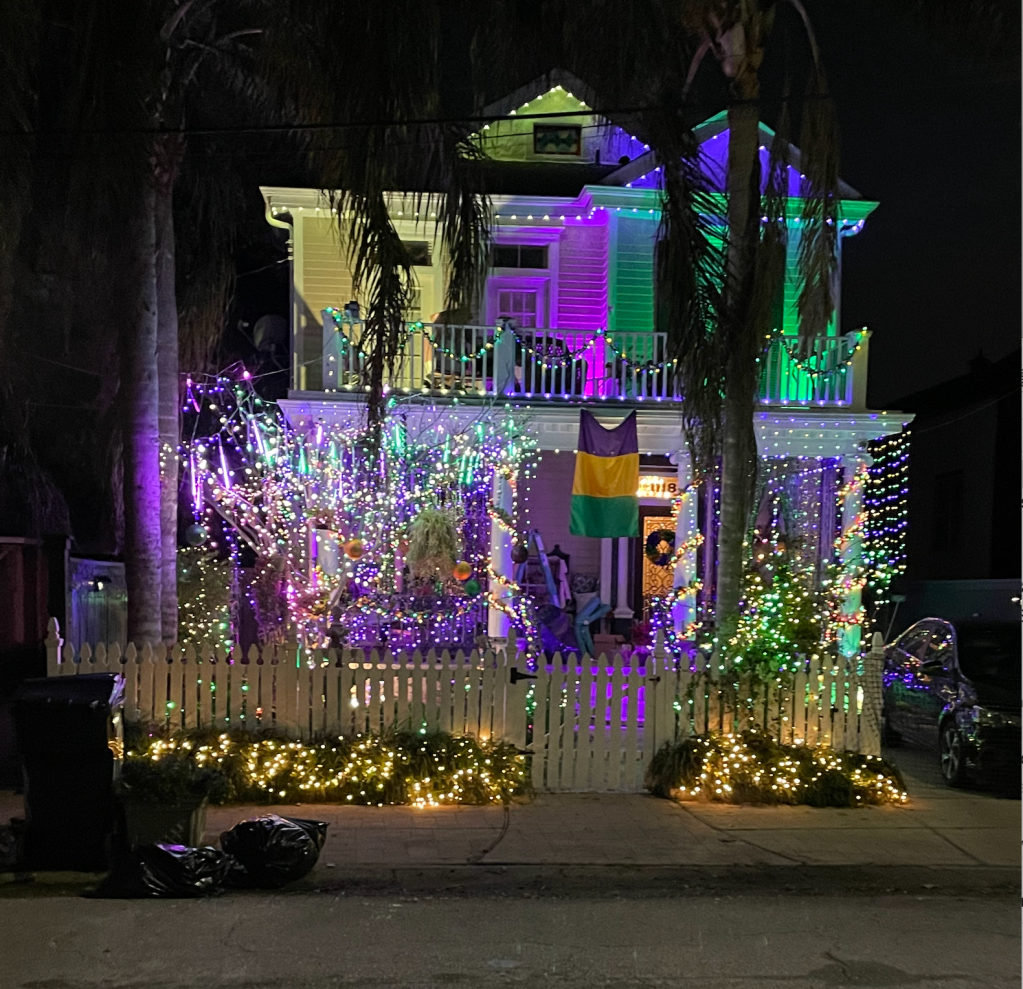
The other night, as I walked to Lilette to meet my friend Laura for dinner, I walked past this house:
It made me smile, as the New Orleans dedication for decorating for the holidays (any holiday, really) always does.
I posted this picture after taking it, along with a caption along the lines of it’s almost Twelfth Night and the start of Carnival! Someone commented, a bit surprised, “already?” which once again made me realize how different living in New Orleans is from living anywhere else, really, in the country. Nobody outside of Louisiana (unless they’re Catholic) understands how Carnival actually works, which makes sense. If it doesn’t affect you, how would you know? So, I decided explaining Carnival would be an excellent blatant self-promotion post, particularly since A Streetcar Named Murder is built around (sort of) a Carnival krewe and their membership recruitment ball. So, buckle up, Constant Reader, I’m going to give you a sort of primer for New Orleans Carnival.
Carnival begins on Twelfth Night, January 6th, and the season continues until it ends at midnight on Fat Tuesday (Mardi Gras is actually the last day of Carnival, not the entire season; but over the years Mardi Gras has become synonymous with Carnival, but the locals will always correct you when you call it Mardi Gras instead of Carnival; and ‘mardi gras” literally translates from the French to Fat Tuesday), when the bells of St. Louis toll the beginning of Lent and the police clear everyone off the streets of the city (no one is supposed to be out on the streets after midnight; I used to love to stand on the balcony at the Parade watching the mounted police officers slowly making their way down Bourbon Street as the crowds disperse before them–and behind them the street is empty). I’m not going to get into the history of Carnival and how it all began as a “farewell to the flesh” before the religious solemnity and penance of Lent; but that’s the part most people don’t get if you’re not from here or Catholic. Christmas, Carnival, Lent, and Easter are all tied together. Twelfth Night is always a fixed date because Christmas is fixed for December 25th; but since Easter’s date is never the same, neither is the date for Mardi Gras/Fat Tuesday, which is always forty days before Easter.
So, first things first. If you want to know all there is to know about each year’s Carnival, you start by getting a copy of Arthur Hardy’s Mardi Gras Guide, seen below. (You can order it on-line if you’re curious about it.)
(Don’t @ me, I know it should be Carnival Guide, but Mr. Hardy is Mr. Expert on all things Carnival, so we let him get away with it every year.)
The guide is invaluable, even though now there’s a parade tracker app so you always know where the parades are. The parades are what most people associate with New Orleans and Carnival/Mardi Gras; the big ones that shut down St. Charles Avenue and Canal Street aren’t until the last two weekends before Fat Tuesday. I don’t even know how many parades pass by our corner during parade season, but it’s a lot. (I’m hearing that the parade routes are being truncated a bit because of not having enough police officers to pull parade duty, but I don’t pay a lot of attention and just look at the Guide–which I have yet to get a copy of this year.) So, parade season is the two weekends prior to Fat Tuesday. The first weekend is easy, really; there’s parades on Friday night, Saturday afternoon and evening, and Sunday afternoon. Then we get a two day respite before they start in earnest, and there’s always at least two a night beginning the Wednesday before Fat Tuesday. Muses is Thursday night, following two others; there are also three on that Friday. Saturday afternoon is my favorite, Iris, which is followed by Tucks. Endymion is the big parade on Saturday night but it has a different route; it doesn’t come down St. Charles unless rain has caused it to be postponed for a night (when Endymion rolls down St. Charles on a Sunday night it’s a nightmare out there at the corner because Endymion is HUGE). There are parades all day Sunday, culminating with Bacchus Sunday night; Orpheus is the grand finale on Monday night, and of course on Fat Tuesday Rex follows Iris and then come the truck parades. There are also other, smaller, walking parades earlier; Krewe de Vieux, for example, is enormous and is a Saturday night later this month. After Twelfth Night and before Parade Season, there are balls and parties and walking parades and all kinds of celebrations leading up to the parades. The bleachers are already going up at Liberty Circle and all along St. Charles.
So, what does A Streetcar Named Murder, which is set in October, have to do with Carnival, and how is this a blatant self-promotion post?
Because the plot of Streetcar is set around an October costume ball for one of the newer Carnival krewes, the completely fictitious Krewe of Boudicca (it was Athena in earlier drafts, until I realized that I should check to make sure such a krewe doesn’t exist anywhere and sure enough, there is one; either in Metairie or on the north shore), which is also kind of new-member rush for the krewe. Our main character, Valerie, has no interest in belonging to a krewe; as she says, she’s fine “just going to parades and catching throws.” But her neighbor/best friend Lorna wants to join Boudicca, and she is dragging an unwilling Valerie along for the ball. It’s at the ball that the murder takes place; turns out the membership chair for Boudicca is Valerie’s nemesis, and of courea Valerie is the one who finds the victim after she’s stabbed.
And of course, it’s Carnival season again in New Orleans! So more info and blatant self-promotion to come!
It’s probably hard to imagine what Southern Decadence is like unless you’ve actually been to it; even the hundreds of pictures I’ve taken and shared on social media over the years can’t even remotely begin to get the concept of what it’s like across–the same as Carnival, really; it has to be seen and experienced to be truly understood. My first Southern Decadence was in 1995, which was around the twenty-second or third time it was held; my knowledge of Decadence, primarily from urban legend and tales told from one gay to another and passed down over the years, is sketchy and probably untrustworthy (if you’d like the unvarnished truth and read about the history, I highly recommendSouthern Decadence in New Orleans from LSU Press, co-written by Frank Perez and Howard Philips Smith; I have a copy and thoroughly enjoyed reading it. Alas, my memory isn’t what it used to be, but the story is it began as a bar crawl for a friend who was moving away, and grew from those humble beginnings into a massive event that draws queers from all over the world).
That first Decadence I came to was also one of the hottest, temperature wise, or perhaps it was simply because I wasn’t used to the summers in New Orleans yet since I didn’t live here. I just remember being in Oz one afternoon and just soaked in my own sweat, and going down the back staircase from the second floor–the staircase that opens out onto the dance floor–and having to hold onto the railing because the steps were slick and wet. The railing was also wet, and when I touched the walls so were they–all the humidity and body heat and sweat–but at the same time it was so much fun. Gorgeous, flirty and friendly men everywhere, everyone scantily dressed and getting wasted and just having a good time. This was during the height of the circuit parties, most of which have died off over the years–there’s no longer a Hotlanta weekend in Atlanta in mid-August anymore, for example–but back then, it seemed like every month if you had the time and the money there was a circuit party somewhere you could fly off to and be yourself and have fun being in an entirely gay environment for a few days. That was, for me, one of the primary appeals of circuit parties and gay bars–they were safe havens for everyone to be out and proud and loud…and after a few weeks navigating the straight world for work and play and life in general…it was lovely to let loose in, for want of a better word, a safe space.
Circuit parties also had their downsides, don’t get me wrong–Michelangelo Signorile detailed some of those in his book Life Outside, which got taken out of context an awful lot–drug use and rampant sex and bad choices also led to other problems, not to mention the spread of HIV and other STI’s; the very first time I ever went to a circuit party–Halloween in New Orleans, 1995–there was a very Masque of the Red Death feel to it; here were all these gay men crowded into a riverfront warehouse, doing drugs and dancing and having a great time while the plague raged outside the doors. I even wrote about that in my diary on the flight back to Tampa a few days later.
But Decadence was always my favorite, out of all of them, and it was something I looked forward to every year. My workouts were always planned so I would hit peak physical condition for Decadence and maintain through Halloween, before starting to work on the Carnival body. It feels weird to talk about it that way, but that was my mentality and my schedule for years. Bulk up for a couple of months, then lean down leading into the event.
I had always wanted to write about Southern Decadence, and I know I’ve written about how I came up with the idea for the book numerous times; standing on the balcony at the Pub watching one of the strippers fight his way through the mob of gay men to get to the Pub so he could work, Paul saying you really should write a book about Southern Decadence and seeing a scene vividly in my head as I looked down at the sea of sweating gay men. I’ve also written about where the idea for the character and his family came from. So what is there left for me to say about Bourbon Street Blues?
The new cover for the ebook edition.
The name’s Dansoir. Dick Dansoir.
Okay, so that really isn’t my name. It’s my stage name from the days when I was on the go-go boy circuit. I started when I was in college, at Vanderbilt up in Nashville. As with almost everything that goes on in my life, I became a go-go boy on a fluke. The Goddess brings interesting experiences into my life all the time. Sometimes I don’t think it’s all that great, to tell the truth, but she always seems to be watching out for me.
I was working out at my gym one day when this guy came up to me and asked me if I wanted to make some easy money.
Like I hadn’t heard that one before.
I was twenty-one at the time, just turned, but I wasn’t some wide-eyed dopey innocent. I was raised in the French Quarter, after all, and by the time I went off to college at age eighteen I had pretty much seen everything. French Quarter kids have a lot more life experience than other kids their age. You can’t really help it. The French Quarter is like Disneyland for adults, and growing up there, you get used to seeing things that other people can only imagine.
Anyway, this guy said he was a booking agent and scout for this agency that booked dancers in gay bars throughout the deep South. The troupe was called Southern Knights.
“You can make a lot of money this way,” he said to me above the sounds of people grunting and weights clanging. “You’ve got the look we like.”
I looked at myself in one of the mirrors that are everywhere in gyms. I was wearing a white tank top and a pair of black nylon jogging shorts. I was pumped up from lifting, and if I did say so myself, I looked pretty good. I’m only about five-eight—nine if I have thick-soled shoes on. I have curly blond hair that’s darker underneath. The sun does lighten it, but that darkness underneath always makes people think I dye it. I don’t. I have big, round brown eyes. I am also one of those blonds lucky enough to be able to tan. I’d gotten a good tan that summer and it hadn’t faded yet. The white tank top showed the tan off nicely. I also have a high metabolism and can stay lean rather easily.
But scam artists are everywhere. I wasn’t about to fall for a line from some stranger in the gym. For all I knew, it was a trick to get my phone number, or an escort service, or something else I didn’t want to be involved in.
Not that I have anything against escorting. People go to escorts for all kinds of reasons—loneliness, fear of commitment, whatever—but they do fulfill a need in the gay community, and more power to them. I just never saw myself taking money from someone for having sex. I like sex. I enjoy it. So, it just never seemed right for me to tale money for doing something I like.
Besides, taking money for it would make it work. I prefer to keep my status amateur.
I got a copy of the book out yesterday and skimmed/read it again, to get another look and remind myself of Scotty’s roots and beginning. I realized yesterday, as I turned the pages of an ARC (yes, I still have ARC copies of Bourbon Street Blues available), several things: one, that the reason I always hate reading my own work is because my brain is trained to read my work editorially, to fix and edit and correct and look for things needing to be fixed (and I can always find something) and that second, it’s really been so long since the last time I looked at this book–or any of the earlier Scottys–was four years ago, when I was writing Royal Street Reveillon. So, by making the obvious effort to flip the editorial switch off, and having so much distance from the book that it almost seemed like something new to me, I was able to skim/read the entire thing without wincing in horror or pain or embarrassment.
The original cover, which always makes me smile.
Bourbon Street Blues was also the last novel I wrote that didn’t have an epigram of any kind, let alone Tennessee Williams: I started that practice with Jackson Square Jazz with a line from Orpheus Descending: “A good-looking boy like you is always wanted.”
Reading the book took me back to the days when I was writing it. The Greg who wrote Bourbon Street Blues is still here, I’ve just been through quite a bit since then and have changed because of my experiences. There were some sentences in the book I would change now to make better, but there are still some jewels in there, and well, I can kind of understand now why the character is so well-liked. He’s charming and humble and kind; sure he talks about “being irresistible” a lot, but that’s part of the charm. Guys find him attractive. He doesn’t necessarily see it, but is more than willing to accept it and not question it. He enjoys his sexuality and he enjoys having sex. I wanted Scotty to be unabashedly sexual and to have no hang-ups, carrying no stress or issues about being a very sexual gay man.
As I read the book again, I also started seeing something that had been pointed out to me over the years a lot–and began to understand why this was pointed out to me so much; an old dog can learn new tricks, apparently–but I still think other people are wrong. The book isn’t “all about sex,’ as some have said. Rather, Scotty sexualizes men; he sees them as potential partners and appreciates beauty in men. His friend David also loves to get laid, so they cruise a lot–whether they are at the gym (either the weight room or the locker room), a bar, wherever they are–and so people get the idea that the book itself is incredibly sexual, even though there is literally only one sex scene in the entire book and it’s not graphic; Scotty’s weird mish-mash of spirituality and beliefs and values make the act itself a sacred ritual, and that was how I wrote the scene; from a spiritual, commune-with-the-Goddess perspective. It’s also funny in that people are so not used to seeing world through the Gay Male Gaze that it’s jarring, and puts sex and sexuality into the minds of the reader.
The question is, would people think the same if this was done through the Straight Male Gaze, in which women are sexualized? Since this is the default of our society–literature, film, television–is flipping the script to show the Gay Male Gaze so uncommon and so unheard of that it triggers such a reaction from some of the readers?
There’s also so much innocence in the book, and it’s also interesting to see it as a kind of time-capsule: Scotty doesn’t have a computer; his rent (on Decatur Street in the Quarter, with a balcony) is $450 a month (ha ha ha ha, that’s what the condo fee would be now monthly); and he also doesn’t have a cell phone. The whole point of the book was to do a Hitchcockian wrong place/wrong time now you’re in danger kind of story; and that is precisely what Bourbon Street Blues is. I’d forgotten that one of the running gags in the book is that he never gets a chance to sleep much throughout the story so he’s tired all the time and just wants it all to be over so he can go to bed.
Another thing that’s dated: even in 2002, in my naïveté and innocence, the evil politician running for governor–when described by Scotty’s brother Storm as problematic–even he doesn’t support an outright ban on abortion–he wants to ban it but with the rape, incest and health exceptions.
Even in 2002 I couldn’t conceive of anyone running for statewide office calling for an outright ban on abortion.
How things change.
It was also interesting that I got two things very wrong in the book, too: for one, I was thinking for some reason the swamp on the edges of Lake Pontchartrain on the way to Baton Rouge on I-10 was the Atchafalaya (it’s the Manchac/Maurepas), and while I had always remembered I’d given Scotty’s mom a name in this book but forgotten it later when I needed a name for her in a different book–I had the name wrong. I thought I’d called her Marguerite in Bourbon Street Blues then named her Cecile in a later book; I had actually called her Isabelle. (I’ve even told that story–about the names–before on panels and been WRONG ALL THIS TIME!)
It was also interesting and fun to remember–as I read–that Scotty was also not looking for a boyfriend. He was perfectly happy and content being single (which was also something important I wanted to write about–a gay man who didn’t care about finding a life-partner, figuring if it was meant to be it would happen). I also presented him with two potential love interests–Colin the cat burglar and Frank the hot daddy–with that actually being resolved without him having to make a choice between them. I also had the book end with Scotty being slowly persuaded into becoming a private eye.
Originally I had conceived it as a stand alone novel, but the publisher offered me a two-book contract, so when I was writing Bourbon Street Blues I knew there was going to be a sequel. This freed me to leave some personal things open for him; I knew I was going to bring Colin back in the next book so he was going to have to choose between them, and I also knew the personal story needed to be wrapped up by the end of the third book, which was going to be the end of the series with everything resolved. That changed when I wrote Mardi Gras Mambo, but that’s a story for another time.
Bottom line: it’s a good book and I am proud of it. It’s only available now as an ebook from Amazon, but I hope to eventually make it available through every service as well as get a print-on-demand version for those who might want one.
Twenty-eight years ago I came to New Orleans for my birthday weekend, and my life changed completely. Earlier that month I had already taken a cold, hard, long look at my life and I didn’t like what I saw. I had been wrapped in misery for years, wallowing in it, and diving so deep into the misery that I allowed it to erase my dreams and any hopes I had for the future. It was, after all, very easy to blame outside forces for my miserable life, and when you dig deep down into the misery, well, it’s a lot easier to just wrap yourself up in self-pity than take any responsibility for your own happiness; making excuses not to try rather than reasons to better myself. I worked for Continental Airlines at the Tampa airport–most times not a bad job for the most part, but the bad days were horrible–and didn’t make much money. I was broke all the time and yes, I wasted a lot of money treating myself to things–like buying lots and lots of books every payday–in an effort to make me feel better about myself and my miserable life. I was horribly lonely.
A bad experience with someone I was romantically interested in was the impetus for the changes I made to my life, because for whatever reason that night everything just bubbled up to the surface; I hated everything about my life, I hated where I was at, I felt trapped and like nothing good was ever going to happen to me. I stayed up the entire night, feeling sorry for myself and unable to sleep, tossing and turning and occasionally crying. At seven o’clock the next morning (it was a day off) I went into my bathroom and took a long, hard look at myself in the mirror. I never want to feel this way ever again, I thought as I looked at red swollen eyes, the unshaved face. the dark purplish circles under my eyes. I then repeated it out loud. I went back to my desk, sat down and opened my latest journal and wrote the words: I hate my life. I stared at the words for a few moments, and then added, I have no one to blame for this but myself. I am the only person who can change things for me. I want to be a writer. I want to be published, and I don’t want to work for Continental for the rest of my life in this job that makes me miserable. I am lonely and it’s probably too late for me to find a life partner. But I have to stop being afraid of everything, and I can’t go the rest of my life NOT living because I am afraid of dying. Other men are not attracted to me because I am overweight–no one ever looks at me twice when I go to bars. I cannot change my face but I can change my body. I will eat healthy. I will drop some of this extra weight. I will do crunches and push-ups every day from now on, and if by January I have been consistent with the workouts and the diet, I will join a gym. I need to start figuring out who I am and how to get what I want because no one is going to knock on my door and just give it to me. The only person who can change the things in my life is me, and I am going to work on being the best possible me that I can.And that means taking the steps necessary to change who I am and what my life is so I can become a writer.
Three weeks later, my birthday weekend rolled around and I flew to New Orleans with a friend for the weekend. We were staying with his on-again off-again boyfriend–who turned out to be one of the nicest gay men I’ve ever known. I really liked him. thought he was a good person–but once they broke up for good that was the end of that; I guess he associated me with his ex and so couldn’t be bothered anymore (or he did a great job of acting the part of the generous host; I am not sure how the invitation to stay with him came about; all I knew was we were going to New Orleans for my birthday and staying with this guy), which was always a shame. I was always grateful to him–have been for twenty-eight years–because coming to New Orleans that weekend was yet another key piece to the puzzle of Greg’s future, a piece I didn’t even now I needed.
I think at that point I may have lost five pounds or so. My friend was gorgeous; one of those perfect gay men with golden skin and very little–if any–body fat; his boyfriend was his counterpart, only with much bigger muscles, bluish-black hair, and that gorgeous gorgeous olive toned skin darker Italians have. They looked beautiful together, too, and I was in some sense a third wheel that weekend, but it was okay with me. They were totally into each other which left me with time on my own to think and reflect. He picked us up at the airport and took us to his apartment (which was in a complex on Sophie Wright Place that Paul and I eventually moved into when we returned from DC in August 2001), we showered and cleaned up, and headed to the Quarter.
I had been to New Orleans before that particular trip, and while I had always felt drawn in some ways to this city since I was a child, I’d never before felt the sense of belonging I felt that weekend. When we stepped out of the cab that night at the corner of Bourbon and St. Ann, I felt this enormous emotional release, as though tension I didn’t know I. had in my shoulders and brain were suddenly gone and a big burden had been lifted from my shoulders. It was as though my soul was saying at last you’ve come home, and I knew then, before we paid the cover charge to go into the bars there at the corner–Oz and the Pub/Parade–that I was going to someday live in New Orleans…and all of my dreams would come true once I did.
I have never been sure what was different about that trip than previous ones. On my brief, previouos visits to the city before, I’d never gotten a real sense of the city before–we stayed in motels by the airport or on the West Bank–and so it wasn’t really possible to get a sense of New Orleans. Waking up in the spare bedroom in the morning, walking out onto the balcony and looking around at the roofs and unique architecture of the lower Garden District, I felt like I was at home. It was also the first time I’d ever come to New Orleans to hang out with other gay people and in the gay section of the Quarter, and maybe that was the difference? I don’t know for certain, but I do know that was the magical trip when everything coalesced in my head on that trip here. I knew New Orleans was my home, and I needed to live there, and my dreams would finally all come true once I’d moved there.
My friend’s boyfriend was a great host. He made sure to take me to see Anne Rice’s home at First and Chestnut (which was also the home of the Mayfair witches in The Witching Hour, a book I’d loved that had only heightened my sense of need to come to New Orleans), and showed me (us) around the entire weekend; we went to Lafayette Cemetery in the Garden District, ate amazing food, and then at night we’d head down to the Quarter to the bars and danced the night away.
That was also the weekend I did Ecstasy for the first time, but that’s a story for a different time.
The entire weekend was a whirl; I have pictures somewhere (or lost many years ago during the course of a move or something) of all the places we went and things we did; the amazing food, dancing all night and going to the Clover Grill in the morning (or La Peniche, over in the Marigny) and then sleeping before going roaming again throughout the city. I fell for New Orleans hard that weekend, and have never really fallen out of love for the city, really, since. We broke up once (that dreadful year Paul and I spent in DC), but we came back and New Orleans forgave us for our desertion and welcomed us back home.
I don’t remember how old I was when I first heard about New Orleans, but I do remember Nancy Drew came to Carnival (called “the Mardi Gras” in the book, eye roll to infinity) in The Haunted Showboat (she also visited briefly during The Ghost of Blackwood Hall), but I don’t really remember much else. I think everyone in the country has a sense of Carnival/Mardi Gras, and always associates that with New Orleans–but New Orleans, obviously, is so much more than that. I was a kid when I watched the James Bond movie Live and Let Die–which whetted my interest in New Orleans and Louisiana–later movies like The Big Easy and Angel Heart and Tightrope expanded that interest, as did Anne Rice’s novels and the Skip Langdon series by Julie Smith. Whenever I had been to New Orleans previously I hadn’t felt anything but a sense that the city was different than everywhere else, and that difference felt alien to me.
But that entire weekend was different. That weekend in the city changed me and changed my life. I’d never felt like I’d belonged anywhere before–I always had felt out of place wherever I lived; part of it was being gay, part of it was being a creative, and the rest had everything to do with being raised by Southern parents with a Southern mentality but not living in the South (not a complaint, I am very grateful to have not been raised down here)–so New Orleans felt special to me; I’d finally found my place or, to quote Pippin, I’d finally found my corner of the sky.
Within a year I’d met the love of my life–who also was in love with New Orleans and wanted to live there–and on August 1, 1996, I drove the U-haul truck with all of our stuff and towing my old car into the city to start the rest of my life. I had already started dipping into the waters of writing–I got a gig with a gay paper in Minneapolis that actually paid me, and had started writing the book that would eventually become Murder in the Rue Dauphine. Within three years of moving to New Orleans I had a book contract and had sold my first ever short stories. Twenty-eight years to the day of that most important visit to New Orleans, and look at me now.
I live in the city I love with the man I love doing the work I love. I’m glad that I didn’t know at the time how important that weekend was going to prove to be; that it was, indeed, really the first day of the rest of my real life, when I finally stopped just enduring my life and actively started living it. It’s not always been easy to live here and love the city; New Orleans can be a hard place a lot of the time. We’ve endured hurricanes and floods, disease and injury, poverty and horror. But even the bad things are made bearable because we live in New Orleans.
I’ve written millions of words about New Orleans. One of the best compliments I can receive is being told that I’ve depicted the city so vividly and lovingly that it’s a character. I do laugh when people call me a “New Orleans expert”–I am anything but an expert; you could fill the Great Library of Alexandria with what I don’t know about New Orleans; every day I discover something new about this wondrous and bizarre place, the only place on earth I’ve ever felt at home. I will never run out of material to write about this magical city, and every day, more ideas and thoughts for stories and characters and essays about New Orleans comes to me.
So, my favorite part of my birthday is the fact that it is also the anniversary of me finding, at long last, where I belong.
And thank you, New Orleans, for always, no matter what, being New Orleans.
I’ve always rather blasphemously called this statue “Drag Queen Jesus”, for reasons that should be fairly apparent.
I did the windows yesterday, and it is literally amazing how I can forget between window cleanings what a difference it makes. It had been so long since I’d done it I need to do them again–it’s never easy getting all that caked on dirt and dust and debris off the glass, even when you do it weekly, as I used to do–but it’s a start.
I woke up early and feeling rested yesterday, which was absolutely lovely–and it was an absolutely lovely day in New Orleans, if a bit warm for mid-November. Did I get as much done as I needed and/or wanted to? Of course not. I did some other cleaning and straightening around the Lost Apartment; made some notes on some projects I am working on, and reread “The Snow Globe” to get a better idea of what I am dealing with on the revision, which I am going to get done today before I go to the gym. I’m also making the week’s to-do list, doing some other chores around the house, and feeling a lot better about things. Yes, I am behind on everything, but a little bit of focus and a little bit of desperation never hurt me, or anything I’ve worked on.
Rereading the story was, actually, something i’d been dreading doing; I always hate to reread something I’ve written, as I always tend to be highly critical and negative, and this story was no exception. I do love the story a lot–it was written to be submitted to a war on Christmas anthology and wasn’t accepted (the anthology never happened, either; long ugly story)–but it definitely needs some work. I originally came up with the story for a Halloween anthology, to be completely honest; there was a call for submissions, I think maybe from the Horror Writers’ Association, for stories with a Halloween theme. I distinctly remember reading the call and then an image popped into my head–me standing on the balcony at the Pub, looking down on Bourbon Street and the front doors of Oz, as a man in a devil costume came out; and he was hot as fuck; perfect body, body paint to make his skin red, and a skimpy red bikini, and thought Satan has a great six-pack, which I then made the opening line of the story. I believe at the time the story was called “All Hallow’s Eve” or something along those lines; but the story never made it past the opening paragraph. When the chance to write a story for the Christmas anthology came along, I remembered that opening and I remembered the joke I made on the Facebook post and thread about Christmas horror stories–I wanted to write about a Satanic snow globe–and immediately saw how to turn my unfinished Halloween story into a Christmas horror story called “The Snow Globe” merely by changing a single letter in the opening line: Santa had a great six-pack.
Voila! And the story began to flow. As I said, it was rejected from the anthology I wrote it for–and in the notes I got from the editors, which was lovely (one rarely gets notes on a rejected story) they basically told me I should have made it more than it was–which I had also thought about doing, but was afraid to–and so naturally, with that confirmation that the initial instincts I’d ignored from lack of confidence were, in fact, correct, I went back to the drawing board and revised it. And clearly, it needed one more revision. I have editorial notes on this story already, which I completely agree with, and I don’t know why–other than utter and sheer laziness–that I have not gone ahead and worked on this story to get it finished and out of the way. That is my goal for this morning–get the damne thing finished and be done with it–and then I can move back on to the book that has been stalled for weeks now.
Last night we watched a few more episodes of Mr. Mercedes, which finally introduced the character of Holly Gibney, who quickly became one of my favorite King characters–which was why I was so delighted she showed up in The Outsider–and so far the character is being played as she was written in the book, which is quite lovely. I think the show has padded/built up some things that I don’t remember from the book–but since I don’t remember them from the book, I am not entirely sure there were changes made. I just know I am deeply enjoying the show–it’s really a shame it hasn’t gotten as much success as it should have. (Maybe it did, I don’t know; but I rarely, if ever, heard anything about the show and there are three seasons…so there wasn’t a lot of social media buzz about it.)
The Saints play this afternoon–I think the game starts around three-ish, if I am not mistaken–and then of course there will be a new episode of The Undoing tonight. That should give me more than enough time to get this story finished, some chores done, and a trip to the gym for a workout. This is my fourth week since we rejoined the gym, and I am eminently proud that I have gone three days a week ever since. I can’t get over how much better I feel physically–the stretching really helps, too–and that correlates with how much better I’ve been sleeping. Who knew that exhaustion would help one sleep? (Sarcasm, don’t @ me)
I also read a few more chapters of The Hot Rock yesterday, which I am enjoying. Westlake’s style in this book is very reminiscent of Rob Byrnes’ brilliant caper novels (Straight Lies, Holy Rollers, Strange Bedfellows)–although since Westlake is the influence here, I should probably say I can see his influence on that unappreciated trilogy; it still kind of amazing to me that I’ve not read more Westlake (or Lawrence Block, for that matter), which is something I am going to need to rectify. (I’ve also never read Ed McBain, but I read some of his Evan Hunter novels.)
As I have often said, my education in crime fiction is a little lacking when it comes to the classics; I’ve not read all of Ross MacDonald or Raymond Chandler, for example, and I’ve also never read a Dick Francis novel either, for that matter. I think I’ve read a Nero Wolfe or two, but not many–although I have thought about using the trope of that series for a book of my own–the brilliant investigative mind who never leaves his/her house so needs a legman, from whose point of view the story is told–and there are any number of other classic crime fiction writers I’ve not cracked a spine on. But with new books I want to read being released all the time and being unable to even keep up with the canon of current writers whose work I love–not to mention all the new-to-me writers I keep discovering–there’s just simply no way I can ever read everything I want to read.
I’ve been doing some more research on Chlorine, recently reading Confidential Confidential, about the scandal rag of the 1950’s, and Montgomery Clift Queer Star, an academic treatise of multiple essays about reading Clift performances and films as queer, which was very interesting. Reading these two books also reminded me of something else that was going on in the time period which I wish to cover–red-baiting and the House Un-American Committee hearings; another period of America not living up to her ideals. It’s probably hard to explain to people who didn’t grow up, or were old enough, to remember the existential threat of the Soviet Union that had Americans seeing Communist spies and Communist infiltration everywhere; without an understanding of the highly paranoid state created by politicians and news outlets, neither the Korean nor Vietnam Wars would have most likely happened. That fear of Communism was also used by conservatives to gin up racial hatred as well as systemic discrimination against people of color and queer people–the queers were considered a national security threat because if you were queer and worked for the government in any capacity, you were thus opened up to blackmail by Communist agents. This was an actual thing, and I all too often see that key element left out of writings about the time, both fiction and non-fiction.
It would thus be wrong to leave Red-baiting out of Chlorine, which will mean more research. Heavy heaving sigh.
And on that note, the dryer just clicked off, so I should fold the clothes and get ready to get back to to work on the story. Have a lovely Sunday, Constant Reader.
Good morning, Thursday; just today and tomorrow before we slide into another delightful three day weekend. Memorial Day! Huzzah! I am always about another day off from the day job–which I completely understand that it sounds like I don’t like my day job, which couldn’t be further from the truth. I just enjoy not having to go to work more than I enjoy going to work; I’m not sure how everyone else comes down on that category, but I’d be more than willing to bet that most people prefer their days off to their days on.
I could be wrong, but I rather doubt it.
Anyway, here I am at the crack of dawn swilling down coffee and trying to get more awake and alert. I am looking at a long day of screening at both buildings (Marine in the morning, Elysian Fields in the afternoon) and right now it seems like its about a million years staring into my face. But I will persevere, and deal with the heavy traffic on the way home just after five. Tomorrow is the Friday of a long weekend, which is absolutely lovely, and my ink cartridge was delivered yesterday so I can pick it up on my way into the office tomorrow and actually start printing shit I need to print again this weekend. Yesterday was a relatively good day, despite being tired–that tired lasted again, like the day before, pretty much all day–but I managed to get my errands accomplished after work and got some organizing and straightening done in the kitchen/office area; always a plus. Paul was a little late getting home last night, but we watched an episode of The Great and then I started streaming The Story of Soaps, an ABC show about the history of the soaps–just to see if it was any good–and it was quite enjoyable; I’ll look forward to watching the rest of it this evening. I watched soaps from the time I was a kid–our babysitter in the summer watched General Hospital, One Life to Live, and Dark Shadows, which is how I got started watching them, and over the years I remained pretty (fairly) loyal to General Hospital and One Life to Live. The summer we moved to Kansas, until we got cable we only got the CBS affiliate from Kansas City, so my mom and I ended up watching the CBS shows–from The Young and the Restless through Search for Tomorrow, As the World Turns, Guiding Light, and The Edge of Night. After cable, we watched General Hospital–it was the late 1970’s by then, and everyone was watching General Hospital by that point.
It’s interesting, in some ways, that our moves–my moves–gradually went west. The suburb we moved to when we left the south side of Chicago was west; from there to Kansas, and from there to California. I started heading more and more east from California, to Houston and then to Tampa, before going north to Minneapolis and coming back south to New Orleans. I never thought about it too much, really; but it’s interesting how I’ve moved around the country and the strange pattern to it. Of course, we’ve been in New Orleans since 1996 (barring that year in Washington), and since I’ve lived here longer than I have anywhere else, I tend to think of New Orleans as home more than I’ve ever thought of the places I’ve lived previously. Granted, had we never left Chicago, I probably would think of Chicago as home, but I’ve literally only been back to Chicago maybe twice, possibly three times, since departing the area in 1975. I’ve never been back to Kansas, and I’ve been to Houston many times since I moved to Tampa–but only twice to Tampa since leaving there (I’ve actually been to Orlando quite a bit; I’d say I’ve visited Orlando more than anywhere other than Houston over the last twenty-odd years).
I tend to not write about Florida, for the most part; while I’ve written about a fictional city in California based on Fresno in the Frat Boy books (the third was set in a different fictional California city, San Felice, based on Santa Barbara), and I’ve written about the panhandle of Florida, I’ve never really based anything on, or written about, the real Tampa or a city based on it (I do have ideas for some stories set in “Bay City”); I’ve not really written about Houston, either. My fiction has always primarily been set in New Orleans, with a few books scattered about other places (Alabama, Kansas, a mountain town in California called Woodbridge) but it’s almost inevitably New Orleans I write about; which makes sense. I live here, I love it here, and I will probably die in New Orleans.
And I’m fine with that, frankly.
“Go West” is also a song I associate with New Orleans, actually. I know it was originally a Village People recording–which I actually never heard before the Pet Shop Boys covered it–but I always associate it with 1994 and when I first started coming to New Orleans; it, along with Erasure’s “Always” were the big hits of the moment that were always being played in gay bars, and I heard them both for the first time on the dance floor at the Parade on my thirty-third birthday; which was also the first time I ever did Ecstasy. So, whenever I hear “Go West” by the Pet Shop Boys, I always think back to that birthday and that trip to New Orleans (“Always” has the same affect, but not as intensely; I’ve never been able to find the proper dance remix the Parade used to play–and in fact, a lyric of the song, “Hold On To The Night”, became a short story I’ve never published anywhere–and haven’t even tried to revise in almost thirty years. It wasn’t a crime story; I was writing gay short stories then, about gay life in New Orleans–and no, I never published the vast majority of them (with the sole exception of “Stigmata”, which was published in an anthology that came and went very quickly), although I did adapt some of them into erotica stories and some could easily be adapted into crime stories…I know a fragment of one, I think, morphed into “Someone to Lay Down Beside Me,” which was published in Jerry Wheeler’s The Dirty Diner anthology, and was probably reprinted in Promises in Every Star.
I should probably pull those stories out again and see if there’s anything I can do with them,
And on that note, I am heading back into the spice mines.




 Queer and Loathing in America