I’ve loved, and been fascinated, by ancient Egypt ever since I was a kid. I don’t remember when, precisely, Egypt became so lodged into my brain; but for as long as I can remember, the ancient history of one of our oldest civilization has intrigued me, and held my interest. I’m hardly an expert–not even close–but I remember pestering my parents to subscribe to the Time-Life Great Ages of Man series; the very first volume of which was, naturally, Ancient Egypt (for the record, I still have my entire set of those books). Cleopatra, of course, also interested me; I’m not sure if my Egyptian interest came before or after watching the Elizabeth Taylor version of Cleopatra on television. (I still am terribly interested in Cleopatra; the court intrigues and politics of the Ptolemy dynasty makes the Borgias and the Medici look like pikers. I always wanted to write a book about–of all things–Cleopatra’s older sister Berenice, who briefly overthrew their father and took the Egyptian crown. The Romans sent legions to support her father, so her reign was very brief. Her younger sister, Arsinoe, who fought Cleopatra for the throne–only to be defeated by Caesar, also interests me.) I’ve always been interested in Akhenaten (loved Allen Drury’s two books about the Amarna revolution, A God Against the Gods and Return to Thebes), Tutankhamun (of course), and Hatshepsut (I read a great Scholastic mystery set during her reign called The Mystery of the Pharaoh’s Treasure, and I think I bought a copy from eBay a while back; I may have the name wrong.)
But as much as I love Egypt, I didn’t love it enough to read Norman Mailer’s Ancient Evenings. I borrowed it from the library, and couldn’t get through the first chapter.
Sorry not sorry.
As a teenager who loved mysteries, I gravitated towards women authors once I’d fairly exhausted the canons of Ellery Queen, Agatha Christie, and Erle Stanley Gardner primarily because I couldn’t relate or identify with the crime novels being written by men at the time. Grim and hard-boiled and toxic masculinity wasn’t a combination I was terribly interested in at the time; I did appreciate noir (discovering James M. Cain when I was about nineteen was wonderful), though–but that was because I associated it with all those great movies I used to watch with my grandmother. I eventually came around, and started enjoying John D. MacDonald and Hammett and Chandler as I got older.
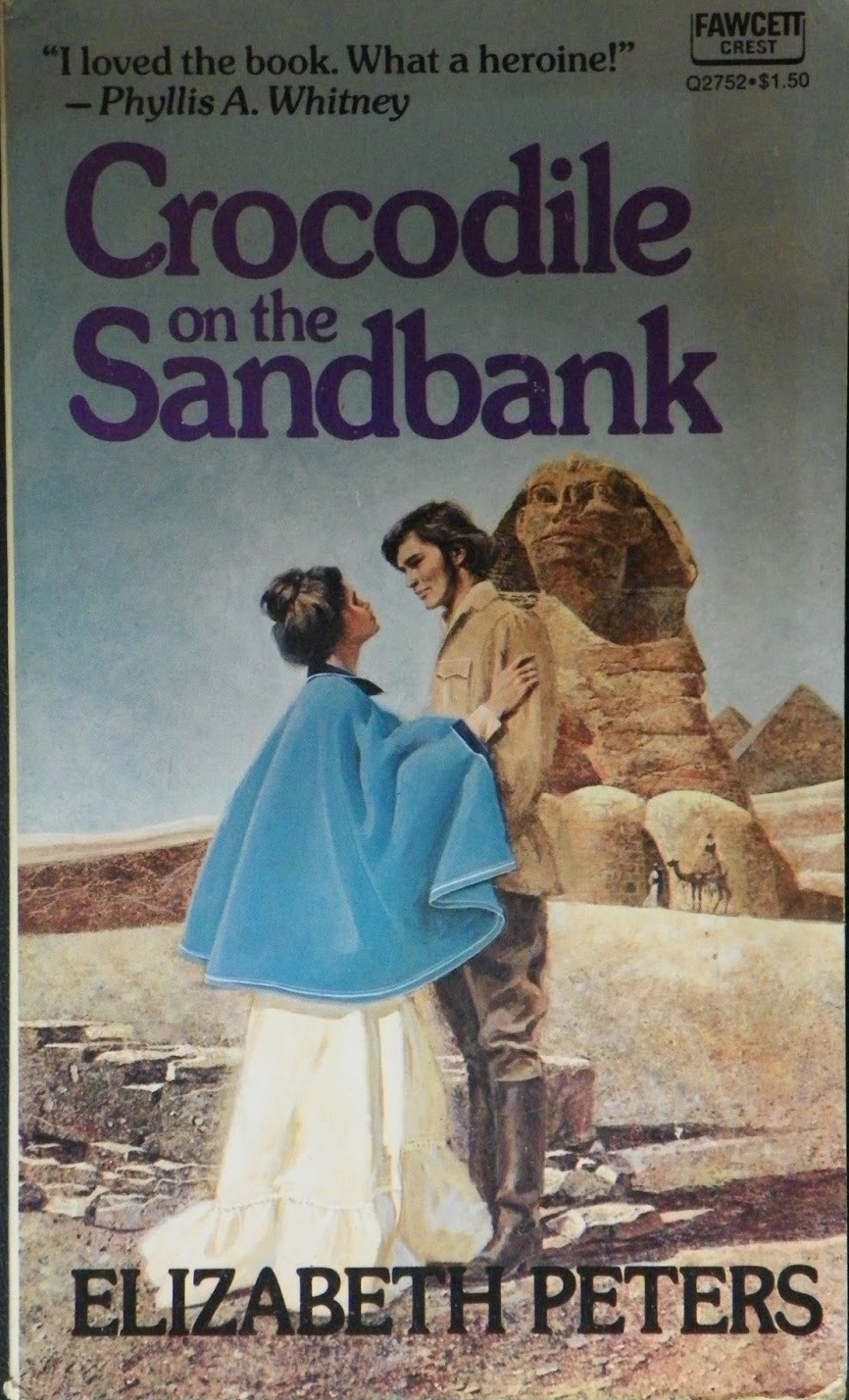
But when I saw this book on the paperback rack at the grocery store in Emporia, I had to get it. It was a mystery; blurbed by one of my favorite writers, Phyllis A. Whitney, and of course, that was the Sphinx on the cover. I bought it, read it, loved it–and forgot about Elizabeth Peters for about a decade or so (I came back to Barbara Michaels in my mid-twenties, and when I discovered she was also Elizabeth Peters, it didn’t register with me.) Then one day I was in the Waldenbooks and More on Dale Mabry Highway in Tampa when I saw a book on the end cap that called to me: The Last Camel Died at Noon, plus an unmistakably Egyptian scene on the cover. The title and the cover alone sold me–and I also knew by then that Elizabeth Peters was the same writer as Barbara Michaels. I bought it and when I got home, I opened to the first page and started reading….about a page in I stopped. Wait, Emerson and Peabody? I turned back to the beginning of the book and there it was, on the BY THE SAME AUTHOR page: THE AMELIA PEABODY SERIES, and the first title was Crocodile on the Sandbank!
You can only imagine my delight. I loved those characters, loved that first book, and to find out now there was a series? I read The Last Camel Died at Noon cover to cover in about twenty-four hours, and the next day I went back to Waldenbooks and More and bought the entire series, and settled in to get reacquainted with two of my favorite fictional characters of all time.
When I first set eyes on Evelyn Barton-Forbes she was walking the streets of Rome–(I am informed, by the self-appointed critic who reads over my shoulder as I write, that I have already committed an error. If those seemingly simple English words do indeed imply that which I am told they imply to the vulgar, I must in justice to Evelyn find other phrasing.)
In justice to myself, however, I must insist that Evelyn was doing precisely what I have said she was doing, but with no ulterior purpose in mind. Indeed, the poor girl had no purpose and no means of carrying it out if she had. Our meeting was fortuitous, but fortunate. I had, as I always have, purpose enough for two.
I had left my hotel that morning in considerable irritation of spirits. My plans had gone awry. I am not accustomed to having my plans go awry. Sensing my mood, my small Italian guide trailed behind me in silence. Piero was not silent when I first encountered him, in the lobby of the hotel, where, in common with others of his kind, he awaited the arrival of helpless foreign visitors in need of a translator and guide. I selected him from amid the throng because his appearance was a trifle less villainous than that of the others.
I was well aware of the propensity of these fellows to bully, cheat, and otherwise take advantage of the victims who employ them, but I had no intention of being victimized. It did not take me long to make this clear to Piero. My first act was to bargain ruthlessly with the shopkeeper to whom Piero took me to buy silk. The final price was so low that Piero’s commission was reduced to a negligible sum. He expressed his chagrin to his compatriot in his native tongue, and included in his tirade several personal comments on my appearance and manner. I let him go on for some time and then interrupted him with a comment on his manners. I speak Italian, and understand it, quite well. After that, Piero and I got on admirably. I had not employed him because I required an interpreter, but because I wanted someone to carry parcels and run errands.
My God, that incredible, incredible voice.
By the end of the second page, I was madly in love with Amelia Peabody; by the end of the third, I wanted to be Amelia Peabody. How could you not love her? She’s fiercely intelligent, even more fiercely independent, spoke her mind, got straight to the point, and had no desire whatsoever to deal with frivolities, sentimentality, and so forth. The youngest child and only daughter of a classics scholar, her six older brothers got married and left her home to take care of their father. She speaks four languages fluently, and frequently curses the accident of birth that left her a female. Her father died and left her everything–which her brothers thought was fair, until it turned out he was a lot richer than anyone thought and had left her half a million pounds, which was an insane amount of money in the late nineteenth century. Unmarried at thirty-two, she considers herself to be too plain, too old, and too sharp-tongued to ever marry, and has decided she is going to die a spinster. (I could never respect a man who would allow his wife to dominate him, but at the same time I could never allow any man to dominate me.) She decides to use her fortune to travel to visit the places she’s always dreamed of and read about in books–which is what brings her to Rome, along with her paid companion–whom she doesn’t care for, and just chance puts her in the forum at the same time as Evelyn, who faints and Peabody, of course, takes charge. She decides to help Evelyn–who was seduced away from her wealthy family and “ruined”, as well as cut off, and she’d come to Rome with the man she thought she loved only to be abandoned by him, with no clothes but what she is wearing and not a penny to her name. Peabody and Evelyn hit it off, she sends the paid companion back to England and engages Evelyn as her new companion, and they depart for Egypt.
So, now two of our players are now in place; it’s time to meet the other two. Once they are all checked in at Shepheard’s in Cairo, Peabody is quickly besotted with Egypt, and pyramids, in particular–and reading Peabody’s descriptions of the country, you cannot help but fall in love with it, too (not a problem for me; I was already there before I read the book). They go to the Antiquities Museum one afternoon–the director was a friend of Peabody’s father–and Peabody is put off by how disheveled and disorganized–and dusty–everything is. She picks up a dusty pot and begins to wipe the dust from it, only to have an enormous man explode with rage at her. They give each other what-for–they are suitably matched in that regard–and this is Emerson, archaeologist with a passion for discovery and knowledge and preserving the past. Emerson’s brother makes apologies, and a spark is lit between Walter and Evelyn. Soon, the Emersons are off to their dig at Amarna, and Peabody and Evelyn rent a sailboat–a dahabeeyah, to be exact–and begin their trip down the Nile.
Naturally, they stop at Amarna, and stumble into quite a bizarre mystery, which includes an animated mummy and several attempts on our troop’s lives. But the four are definitely up to the task–there are times when I laughed out loud–and hilariously, while both Peabody and Emerson become quite irritated with Walter and Evelyn, who can’t see that the other is madly in love with them; Peabody and Emerson are also falling in love, and refuse to see it, bickering and fighting and–oh, it’s just wonderful and charming, and I know I am failing to do the magnificent Ms. Peters’ work any kind of justice. Amanda is just so, so wonderfully fearless and courageous and pure, and doesn’t even worry about her own safety when those she loves are in danger. The book has a most satisfying resolution, and I remember putting it down that first (much as I do every time I reread it) with a happy smile on my face. The Peabody and Emerson books bring me a lot of joy.
I devoured the entire series, loving them all–the way Peters deftly ages her characters and deepens their relationships, and of course the children…one thing that will always make The Last Camel Died at Noon special for me was that was also the adventure that introduced our merry band of archaeologists to Nofret–and therein lies another tale, for yet another time.
I am so, so delighted I reread Crocodile on the Sandbank. If you’ve not read this series, you really should treat yourself to it, because it is just that: the most amazing gift you can give yourself.

 Queer and Loathing in America