Season of the Witch

I read a lot of Norah Lofts when I lived in the suburbs of Chicago.

I originally found her through her historical fictional biographies of royal women, or royal-adjacent. I was in a Henry VIII phase–the whole six wives thing–and I saw a copy of her book about Anne Boleyn–The Concubine–on the wire racks at Zayre’s, so I bought it. It was very well done, and Lofts tried to get into the head of Anne and who she was, the reasons she basically changed Western civilization, and gave me an entirely new perspective on the infamous Anne. From there I went on to A Rose for Virtue (Napoleon’s stepdaughter/sister-in-law Hortense de Beauharnais, Queen of Holland), The King’s Pleasure (Katherine of Aragon), Crown of Aloes (Isabella of Castile), The Lost Queen (Caroline Matilda of Denmark), and Eleanor the Queen (Eleanor of Aquitaine)1. I also read, from there, some of her historical fiction, which I greatly enjoyed (Nethergate comes to mind). What I liked most about Lofts was she was not, in any way, a sentimental writer; her stories didn’t end happily all the time (especially her books about royal women; they all died miserable). I always wanted to read her Nativity novel, How Far to Bethlehem?, or her book Esther (obviously, the Bible’s Queen Esther). I remembered Lofts sometime within the last four or five years, and got a copy of her ghost story collection, which I enjoyed.

And then I remembered one whose plot I really couldn’t recollect–The Little Wax Doll, and got a second hand copy on-line.

It was like reading an entirely new novel, and I am glad I revisited it, believe you me.

The interview had been arranged to take place in London at half past three on a Saturday afternoon. This was a time so extremely convenient to Miss Mayfield that she was disposed to regard it as providential. It had saved her from the embarrassment of having to ask for time off to attend an interview in which she might not be successful, and from which she might be obliged to return to face her present Head’s resentment. In her diffident attempt to maintain secrecy she had left Alchester without the precaution of obtaining a testimonial. This she recognised as the action of a fool, but she had taught in the ugly Midland town for a bare two years, and she carried in her shabby handbag a coolly eulogistic report of her twenty years’ work in Africa, If that did not suffice, and if the interview showed any sign of leading to a new appointment, then would be time enough to approach Miss Stevens and break the news she was contemplating a move,

Canon Thorby had written, “Claridge’s Hotel would be convenient for me, since I have another appointment there earlier in the day. I shall be waiting for you and if you ask at the desk someone will will point me out to you.”

He wrote on thick smooth paper which justified the term “cream-laid.” His writing was small, elegant, meticulously legible. It called up an imaginry vision of the writer, plump, rubicund, with a fringe of silvery hair and tranquil blue eyes. Kindly, perhaps a trifle pompous.

As I said earlier, I didn’t really remember much of this story, other than the main character was an older schoolteacher moving to an idyllic village in East Anglia to teach at the village school, and the little rural village has some pretty dark secrets that she’s going to stumble into. Another thing I’d forgotten–although I should have remembered from reading her ghost story collection–was how compelling a writer she was. There are beautiful turns of phrase everywhere, as well as observations about life–particularly in a small village–that are really spot on, clever and insightful.

I also love that her heroine is a woman many people would overlook–particularly in the time in which this book was written (originally published in 1960)–a dowdy, plain spinster in either her late thirties or early forties. I wouldn’t have thought much about it when I first read the book, but the deep devotion of her attachment to a woman named Ruth, with whom she built a school and hospital in Kenya and worked there with her for forty years, and her determination to save enough money so she and Ruth can retire together and share a cottage blissfully for the rest of their lives?

In this read, this friendship just screamed lesbian to me.

Deborah Mayfield could easily have turned into a stereotype–the old maid schoolteacher–but Lofts isn’t interested in stereotypes; she created a character who is interesting by virtue of the journey she takes over the course of the story. She is a bit unsure of herself at the beginning of the book, always afraid of calling attention to herself and just keeps her opinions to herself. But as she falls in love with this interesting little village and blossoms with not only her students but the other villagers–she still sees herself as a nonentity, not really seeing herself as the others see her–she also, slowly but surely, finds herself being pulled into a strange situation which makes her, always questioning herself, question herself further. Surely, what she suspects cannot be? There can’t be people who believe in the dark arts and witchcraft in this town? But it’s really the only explanation, and as she gets pulled further and further into the odd circumstances regarding her student Ethel and her grandmother Granny Rigby–to the point where she is willing to give up her comfy little home and job to try to call out what’s going on in Walwyk–she begins to get a sense of her own power; the inability to stand by and do nothing while something untoward is going on strengthen her resolve and makes her stronger.

Then about halfway through the book there is a huge plot twist, which throws everything into a different, just as suspenseful and thrilling, direction–and one in which Deborah finally comes into her own, managing to get her way back to Walwyk in order to stop a horrible outcome that isn’t predestined.

One of the other things I like about the book is Lofts’ lack of sentimentality. The ending of the book makes it seem as though the day has been saved…but has it, after all? I also love that we never really know if there is actually witchcraft going on in the town–or maybe it just looks like it? Lofts leaves this up in the air as well–which she probably wouldn’t get away with today.

A terrific reread, and a terrific author I am very happy to rediscover.

  1. She also wrote The Lute Player, about Richard the Lionhearted, his wife Berengaria, and the minstrel Blondel–which was my first exposure to the idea that Richard, the great English hero, was queer. That revelation was a bit life changing, as I began looking for hints of homosexuality being covered up in history books. ↩︎

How Can You Mend a Broken Heart?

We’re supposed to get hurricane strength wind tomorrow and potential tornadoes. Southeastern Louisiana won’t be getting the worst of this storm–that will be further north, but New Orleans and Baton Rouge will still get some shit flung at us. Hurray. The high today is going to be eighty-one; it’s currently sixty-six degrees. I guess it’s sweatshirt under a T-shirt weather for the office again? Most likely.

Paul returned home yesterday morning, and again, it never ceases to amaze me how different it is when he’s home as opposed to when he’s not; it’s not like he’s this enormous person or anything, but the apartment always feels empty and quiet when he’s not home. Scooter, of course, was absolutely delighted to have both daddies home last night, going back and forth between my lap and Paul on the couch–and he was also a lot more quiet than he’s been in quite some time. Of course, Paul’s been missing a lot over the last few months anyway; me only seeing him when he got home and I woke up, groggily, for a moment before going back to sleep and then seeing him sleeping while I dressed for work the next morning. I regret not being able to spend more time down in the Quarter at Saints and Sinners; maybe next year I can plan my life events better so it won’t be a problem for me to spend time seeing people and going to panels. It is a pain in the ass to get down there and come back home every day, of course, but for fuck’s sake–these are my people: queer writers. And the opportunities to see them are rare and we are all getting older and yes, I definitely need to plan better for next year.

I did finish reading Alex Segura’s Secret Identity last evening, and it’s quite wonderful. I enjoyed and savored every page. There will be more to come on that score later. I think now I am going to move on next to Chris Holm’s Child Zero. I also got some older books yesterday in the mail that I ordered on eBay; The Lute Player and The Claw by Norah Lofts (an unjustly forgotten writer of the mid-twentieth century) and one of those Literature Classics leather bound editions of Daphne du Maurier’s Echoes from the Macabre, which is probably my all-time favorite short story collection. It’s a lovely edition in pristine condition, and I am very happy to have a very good copy of it on my bookshelves. The Lute Player is Lofts’ novel about Richard the Lion-hearted, his sad queen Berengaria, and Blondel the minstrel–and was also the first time I realized (when I read it as a freshman in high school) that the great Richard, hero of legend and fiction, was actually….for wont of a better term, not into the ladies so much. I’ve always wanted, since then, to write my own story of Blondel–but then Gore Vidal beat me to it with his A Search for the King, which I read and enjoyed twenty or so years ago. I don’t remember anything about it other than that I enjoyed it; I do like Vidal, and the older I get the more I appreciate his work. I just got a wild hair and thought it would be fun to revisit The Lute Player, and The Claw is her attempt at writing a novel about a serial rapist; heady stuff for 1981. (I’d never read it, but it sounded interesting. I also enjoyed her collection of ghost stories that I read a few years ago; Lofts is terribly underrated and underappreciated as a novelist.)

I do feel a bit disoriented this morning; like I’ve not been into the office in weeks. Literary event over the weekend, sandwiched around work at home hours, undoubtedly has something to do with that. I don’t feel like I know what I am doing or what I need to get done. I do need to make a new to-do list; when I checked the list yesterday morning I had done a terrific job of getting things crossed off (the things I hadn’t crossed off had to do with writing, natch).

I was also thinking last night, after finishing Alex’ superb novel, that I need to figure out my writing schedule for the rest of the year. I had originally planned to try to get a working first draft of Chlorine finished in April, and then get a working first draft of Mississippi River Mischief done in May, then alternate revisions for the rest of the summer while also writing short stories and finishing novellas. I don’t know if that is going to work; I do have a story to write already for April (and haven’t really gotten far into the physical writing of it; I already know how the story is going to work–it’s mapped out in my head) so that’s why I was thinking April–since it also includes trips to Albuquerque and New York–might be better to do short stories and novellas while pushing everything back a month.

Decisions, decisions.

And on that note, I am heading into the spice mines. Have a lovely day, Constant Reader, and I will check in again tomorrow.

I’m Gonna Make You Love Me

I’ve always considered myself to be a child of the seventies.

Sure, I was a child for during the sixties, but I turned nine in 1970. While I am sure that turbulent decade provided some (a lot of) influences on me, my personality, my likes/dislikes, and my future, I am equally confident that my values and thoughts and beliefs probably weren’t as shaped from that turbulent decade as they were by the 1970’s. The seventies are really the first decade for which I have a lot of recall (recently, a friend was amazed that I remembered those horrible Rag City Blues jeans for women that were, for some reason beyond my thought processes, popular in the latter part of the decade; what can I say–I do remember the decade fairly well for the most part–or at least as far as my memory can be trusted). I’ve always wanted to write books either set in the seventies completely or even partly; Where the Boys Die, my 70’s suburban Chicago novel, keeps pushing its way to the forefront of my increasingly crowded (and clouded) mind. (NO I AM WRITING CHLORINE NEXT WAIT YOUR TURN)

I remember Watergate and how the scandal grew. I remember the 1972 landslide reelection of Nixon, and the country’s negative reaction to the Ford pardon of the man who brought him to power; I also remember Jimmy Carter running for president out of seemingly nowhere and getting elected. There was The Brady Bunch and The Partridge Family and Archie Bunker and Mary Richards; Sonny and Cher and Carol Burnett and Donny and Marie and the Jackson 5 and Grand Funk Railroad. Top Forty radio ruled the AM airwaves; not every car came equipped with FM capabilities, and the only way you could play your own music in your car was with an eight-track player. I started the decade reading the Hardy Boys and Nancy Drew and The Three Investigators; by the end of the decade I was reading John D. MacDonald and Sidney Sheldon and Harold Robbins. It was a very weird decade…of odd color and fashion choices; avocado greens and browns and American cheese orange were ridiculously popular, as was shag carpeting, velour, clingy polyester shirts, corduroys, bell bottoms and slogan T-shirts. Baseball shirts and rugby sweaters also became popular later in the decade. People had feathered hair parted in the center, and there was this weird sense of, I don’t know, missing out? Movies were grittier, harsher, more realistic; actors went from the polished shine of the old Hollywood system glamour to warts-and-all realism. Television was also beginning to change but was still heavily censored. Boogie and truckin’ and shake your booty became part of the vernacular; the decade began with the break-up of the Beatles and ended with disco’s last gasps while new wave and punk and rap started their rise.

It was the decade I went through puberty and realized that I was attracted to other boys instead of girls; I wasn’t quite sure what that meant but definitely found out in the seventh grade it meant I was a faggot, fairy, queer, cocksucker, and all those other lovely words that were burned into my brain that year. It was the decade where I read Harold Robbins’ Dreams Die First (a truly execrable novel) over and over again because the main character had sex with both men and women, and if I am not mistaken, contained the first male-on-male sex scene I’d ever read (oral); it was also the decade where we moved from Chicago to the suburbs to the cornfields of Kansas and I graduated from high school. (Ironically, it was in Kansas that I discovered gay books with explicit gay sex scenes in them–the News Depot on Commercial Street not only carried The Front Runner by Patricia Nell Warren and her other novels, but also Gordon Merrick; and their magazine racks also had gay porn magazines–which, now that I think about it, meant there were others there in Lyon County and environs; I didn’t realize it at the time, of course.) It was when Norah Lofts’ The Lute Player made me aware that Richard the Lion-Hearted was like me, too; and Susan Howatch’s Cashelmara and Penmarric also had gay characters and plots involving them…

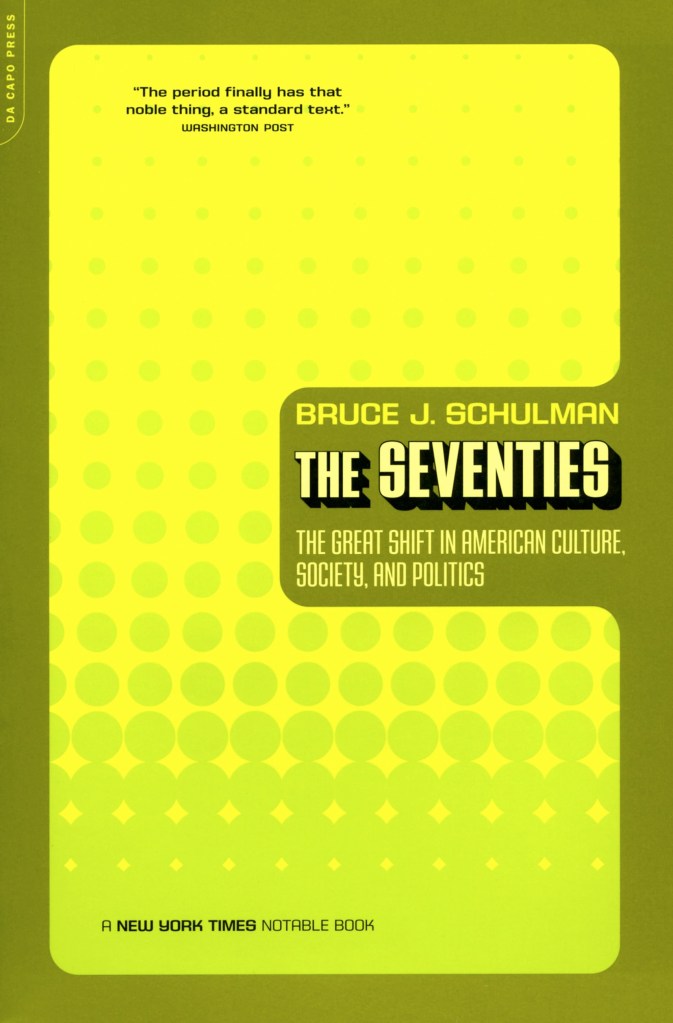
I’ve always thought the seventies was a much more important decade than ever given credit for; usually it is merely considered a connecting time from the 60’s to the 80’s…but almost everything that came after–socially, politically, culturally–got started in the seventies. So I was glad to see this book about that frequently dismissed time.

As I mentioned previously, the Seventies were turbulent; they were the decade that also saw the beginning of the end of the post-war economic/prosperity bubble. Gas shortages, skyrocketing inflation, and the insidious use of racism to break the Democratic coalition began–everything we find ourselves dealing with today had its roots in the Seventies–and it did seem, to those of us growing up in the shadow of the mushroom cloud, that the world had lost its mind and our country (or rather, its mythology) had lost its way. Schulman’s study of the decade, breaking down how the shifts in culture, politics, and our society began, were exploited for divisive purposes, and permanently changed attitudes moving forward was a fascinating, if chilling, read. I remember the terrorist attacks. I remember watching the Munich Olympics that ended in bloodshed on an airport runway and murdered Israeli athletes. The book brought back a lot of memories; I am not so sure I agree with all of Schulman’s assertions about the decade–there certainly wasn’t very much about the burgeoning gay rights movement, other than how it chased lesbians off into the Women’s Movement–but it was interesting to read the book and relive the decade a bit, as well as the memories it triggered.

I do highly recommend this book for people who weren’t around for the Seventies and might be wondering how the fuck did we end up in this current mess?

Walking on Broken Glass

Sometimes I try to remember the first time I saw or heard or watched or read something, anything, that made me feel less weird, less like an outsider…often to no avail. I can never remember if it was That Certain Summer (a very SPECIAL ABC Movie of the Week), or reading Larry McMurtry’s The Last Picture Show, or discovering The Front Runner on the paperback racks at the News Depot on Commercial Street in Emporia; and then I will remember something else, some vague memory of something–hints about Richard the Lion-Hearted in Norah Lofts’ The Lute Player, or subtle hints here and there throughout history (Edward II and Piers Gaveston; Louis XIV’s brother Phillippe Duc D’Orleans; James I and Robert Carr; Achilles and Patroclus)…Mary Renault’s Alexander the Great series…I can never remember precisely the first time I was exposed to who and what I am in popular culture, nor can I remember if it was positive or negative. I do know that in my own life, it was made very clear to me when I was very young that what I am was not normal, was unacceptable, wasn’t what I was supposed to be. My earliest memories are of me not being like other boys, and it took me a while to realize that the others were just playing at being boys (something I was never very good at) and were actually like that; that they weren’t, underneath, just like me, just better at pretending than I was.

This is why we have emphasized, as a community, the importance of representation in popular culture; kids needs to see themselves reflected in the culture they consume so they don’t feel like they don’t belong. Queer kids aren’t raised queer; we don’t learn how to be queer by interacting with our peers (who are mostly straight when we are kids), nor do we learn anything about being queer while we are inside the educational system in this country. I’ve always firmly believed that queers take longer–at least in the olden days–to form lasting romantic relationships because we don’t have “trial runs” when we are kids; we don’t get to date, we don’t get to “go steady”, etc. We don’t get to play House with other kids of the same gender, we don’t learn societal and cultural expectations about relationships and how they work when we are actually kids. Our queer adolescence doesn’t actually start until we come out–admit it to ourselves without shame, and then start telling our family and our friends and our co-workers that we aren’t wired the same way they are. It’s very tricky, and very complicated and sometimes very messy.

Representation absolutely matters.

And we cling to that representation when it shows up. When a prime time show like SOAP introduces the first long-running gay character to the world in Jody Dallas (does anyone even remember this was Billy Crystal’s big break, playing gay on a sitcom in the 1970’s/early 80’s?), we watch–even if the depiction is problematic to the extreme (you also learn very early that your hunger for representation will also force you to turn a blind eye to some things). Steven Carrington on Dynasty, the terrible film Making Love from the early 1980’s, as well as some other problematic depictions and films along the way–we took what we got, and always had to remember that these characters and stories also had to be palatable to straight people…that, in fact, these characters and stories were created with straight people in mind.

As they used to say, “but will it play in Peoria?”

As i stare down sixty this month, I am very happy to see that representation becoming common-place. It’s lovely to see gay books–THRILLERS, even–being published by major presses with queer characters in them. It’s lovely seeing straight writers including sensitive depictions of queer characters and their stories in their books.

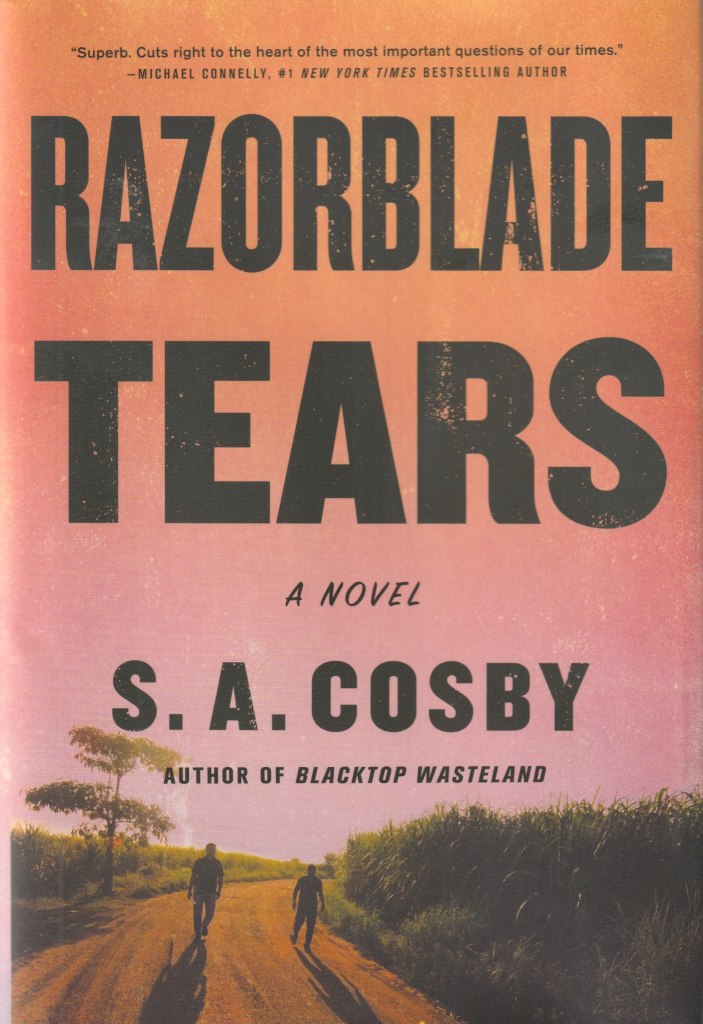
And over the year, yes, problematic tropes that can make you very, very tired have also developed–which makes me wary every time I approach a book by a non-queer person that takes on a trope without hesitation, as S. A. Cosby’s Razorblade Tears does, and that trope is one of the biggest and most hated by the queer community: bury your gays.

Ike tried to remember a time when men with badges coming to his door early in the morning brought anything other than heartache and misery, but try as he might, nothing came to mind.

The two men stood side by side on the small concrete landing of his front step with their hands on their belts near their badges and guns. The morning sun made the badges glimmer like gold nuggets. The two cops were a study in contrast. One was a tall but wiry Asian man. He was all sharp angles and hard edges. The other, a florid-faces white man, was built like a powerlifter with a massive head sitting atop a wide neck. They both wore white dress shirts with clip-on ties. The powerlifter had sweat stains spreading down from his armpits that vaguely resembled maps of England and Ireland respectively.

Ike’s queasy stomach began to do somersaults. He was fifteen years removed from Coldwater State Penitentiary. He has bucked the recidivism statistics ever since he’d walked out of that festering wound. Not so much as a speeding ticket in all those years. Yet here he was with his tongue dry and the back of his throat burning as the two cops stared down at him. It was bad enough being a Black man in the goo ol US of A and talking to the cops. You always felt like you were on the edge of some imaginary precipice during any interaction with an officer of the law. If you were an ex-con, it felt like the precipice was covered in bacon grease.

“Yes?” Ike said.

My faulty memory doesn’t remember how and when I first became aware of S. A. Cosby. What I do remember is that I bought and read one of his earlier works (perhaps his debut?) My Darkest Prayer, and enjoyed it thoroughly. Hard-boiled with a healthy dose of noir, I had a great time reading it–and was thrilled when his Blacktop Wasteland debuted to raves and attention and lots of recognition. Cosby can write like a house afire; and while he keeps up a rat-a-tat pace of story, he also manages to construct sentences and paragraphs beautifully, with a poet’s gift for language–spare and tight, yet poetic and beautiful at the same time (Megan Abbott is the Galactic Empress of this).

So, when I heard the “elevator pitch” for Razorblade Tears, I inwardly winced a bit, even as I had to admit Shawn’s guts; taking on bury your gays is a ballsy move–and also a bit of a dangerous one. If you don’t stick the landing…you’re fucked.

For those of you who don’t know what bury your gays means, it’s very simple: a show, or a book, or a movie, will introduce gay characters (lesbians, queers, whatever initial in the all encompassing umbrella those characters might choose for their identity), get the audience (and especially the queer viewers) deeply vested in them–and then kill them off suddenly and unexpectedly, all so the other queer characters (but usually the straight ones) will experience some kind of personal growth…in other words, you introduce a gay man into your narrative simply to later use him as a plot device, so the other characters can mourn and experience personal growth.

That’s probably explained badly, but you get the gist: gays will inevitably die. A good example of this is the so-called groundbreaking AIDS movie, Philadelphia–but the Tom Hanks character in that movie existed so that Denzel Washington’s character could grow and develop and move on from his own homophobic beliefs and fears about HIV/AIDS; as Sarah Schulman, one of our community’s finest minds, once said, “the entire point of Philadelphia is to make straight people feel better about HIV/AIDS and the gay men dying from it.” (Sections of her book Stagestruck: Theatre, AIDS, and the Marketing of Gay America are absolutely brilliant; it should be required reading for any Queer Studies course.)

The plot of Razorblade Tears is so deeply steeped in “bury your gays” that the gays are already dead when the book opens. The gays in question–Derek and Isiah–were brutally murdered, and the police don’t seem to care too much about looking into who killed them. Their homophobic fathers–both ex-cons–decide to look for their son’s killers. Both Ike and Bobby Lee feel a lot of guilt about their sons and how they rejected them both–their relationship, their eventual marriage, their child–while they were alive; finding their killers isn’t just about revenge but also a matter of atonement. In some ways, it’s like this book is borne from the anger every queer child rejected by their parents feels–you’ll be sorry when I’m dead.*

Ike and Bobby Lee are, indeed, sorry now that their sons are dead.

This also falls into another long-existent fictional trope: don’t fuck with a father. How many films (I’m looking at you, Liam Neeson), books or television shows are about a father’s rage, a father’s revenge, what a father will do to save or avenge their children?

Ike and Buddy Lee aren’t supermen, though. Cosby’s strength (besides his ability with words and images) is how well he creates characters and makes them human through their faults and frailties. Ike and Buddy Lee don’t much like each other as the story begins to move along–I kept thinking of the old Sidney Poitier/Tony Curtis movie, The Defiant Ones–but their ability to look past their own internal prejudices to see the commonalities between them as they unite in this foolhardy crusade to avenge their murdered sons is the real strength of the book here. (As well as the language.) You eventually start to understand them, care about them, want them to get their vengeance…even as you know it will bring them no peace.

I have to admit, I was hesitant to start reading this. I really was concerned I wasn’t going to be able to read it with the empathy necessary for Ike and Buddy Lee and their suffering–that I would think, yeah, well, maybe you should have thought about that when he was alive–but the book ultimately isn’t about their redemption, either; which is a genius move by Cosby. He makes their pain all too real–I cannot imagine the pain any parent should feel when their child dies–but he makes it clear there’s no easy answers here for Ike and Buddy Lee, and that pain will go on even if they get justice for their sons.

Shawn is also a master of writing about the Southern working class–about the poverty, the lack of opportunity, the societal neglect and how those factors all combine to keep those already mired in it trapped with little chance of escape; he clearly loves the rural South but not so much that he can’t expose the tragedy and ugliness that exists there.

It’s a powerful book, and I do recommend it….although the people who probably should read it inevitably won’t. I can recommend it, and do, enthusiastically; it’s a very powerful book, and it made me think–and what more can you want from art?

*sadly, I have seen all too often that a lot of those parents aren’t sorry when their rejected child dies; far too regularly they will say something along the lines of “So-and-so died for me years ago.”