After we moved to the suburbs and had not only a house but a second car, my mother decided that maybe religion was missing from the lives of my sister and I, and began taking us to church–not the Southern Baptist faith she herself was raised in, but the Church of Christ, which was my father’s family’s faith. It wasn’t like my sister and I hadn’t been to church before; whenever we visited relatives in Alabama we were inevitably dragged to church with them, whether we wanted to go or not. It wasn’t even up for debate, so yes, in some ways, my father’s family kind of forced religion on us when we didn’t really go to church at home with our parents. I never knew why Mom decided we needed to start going–she wound up having an off-and-on relationship with the church for the rest of her life–but we did. Dad played golf every Sunday morning and often hit buckets of balls after or maybe went out for lunch with the other players; I don’t know. But not only did we start going to church, she rewarded us by taking us to Ponderosa for lunch (where I first discovered Catalina French salad dressing, a favorite to this day) and then we’d go see a movie. Most of the movies are forgotten now, collecting dust and cobwebs until I think about that movie again and remember it was one Mom took us to.
The Last of Sheila was one of those movies, and I fell in love with it as I watched. It had everything I could possibly want: an incredibly clever murder mystery, a cast of movie stars I recognized, and it was about Hollywood, even though set and shot along the Riviera. It was an inside look at the rich and glamorous–something I felt was like another planet to me in my subdivision house, in my lower middle class existence which was a place where I felt like I didn’t belong.
Shortly after seeing the movie, I was at Zayre’s with a couple of bucks to buy books with, and there were three I wanted–The Last of Sheila and two others, but I could only afford two of them, and I regretfully put The Last of Sheila back because I’d already seen the movie and I could get it the next time.
Constant Reader, it wasn’t there when I went back. I never forget there was a book, either–but I didn’t know whether it was a novelization or an actual book the film had been based on; and I didn’t mind reading novelizations, either. When I rewatched the film again during the pandemic, I remembered there was a book and started looking for it on-line. It was clearly rare and beloved, because whenever a copy would come up for sale on second-hand sites it was always priced anywhere from $150-$300, and I didn’t care about the nostalgic aspects of it that much. Then last summer two popped up on ebay; both more expensive than I would have liked but still–reasonable enough to consider. I put in a bid on one and then realized the other was a “buy it now”, so I went ahead and bought it. A few days later I won the bid–and a little confused, decided to go ahead and honor the bid since I had put one in but simply forgot about it, and I gave the other away to a friend who also loved the movie for Christmas.
And finally, I settled in to read it–after another, recent rewatch.
The Sheila rode at anchor, stern to the quay, stern lines fastened securely over the bollards. The Mediterranean sun glanced off the brightwork and made of the white hull a dazzling blur. Her eighty-seven feet dwarfed the sleek ketch on her port side, a racing vessel owned by the pretender to the Spanish throne, but the Sheila was in her turn outclassed by the ninety-five-footer on her starboard, a powerful yacht owned by a South African diamond billionaire. The Palma marina was, as usual in the summer, crowded with the pleasure craft of the wealthy, berthed as tightly together as possible, their anchor chains frequently fouling.
Lee Parkman swung her long slender legs out of the taxicab and stood somewhat shakily on the quay, shielding her eyes from the too-bright noonday sun that pierced even through the lenses of. her oversized sunglasses. Her legs still felt rubbery from the long, bumpy tide over the dursty roads that led from the Palma Airport to the marina. Mallorca was like that, she thought. The paradox of moderan airport and luxurious anchorage linked by an ancient and ill-kept road.
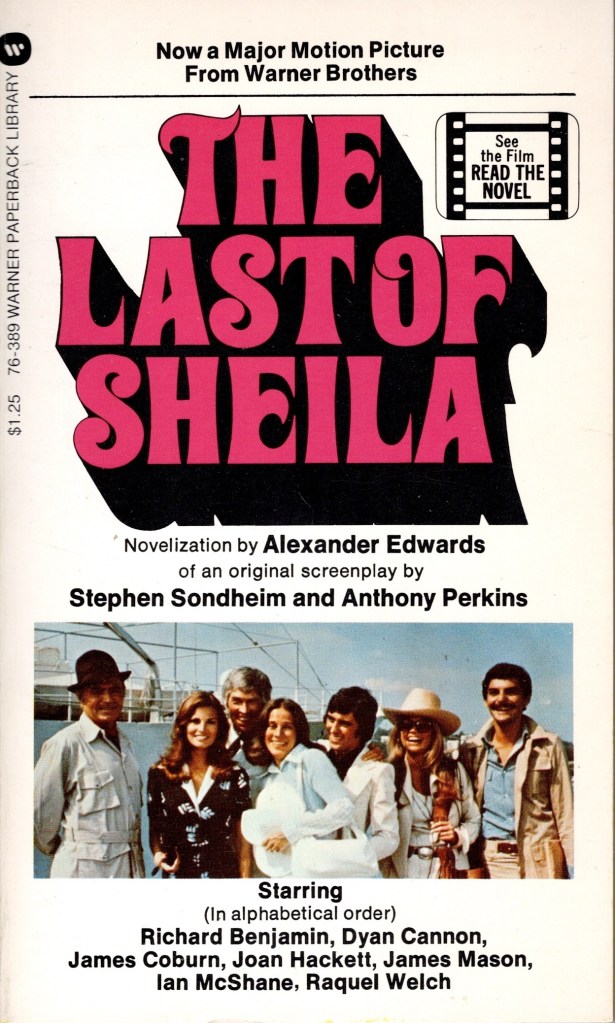
I don’t know if they still do novelizations of popular films as a merchandising gimmick–the cover of this one has a little admonition to see the film READ THE NOVEL and of course, the ever-popular Now a Major Motion Picture From Warner Brothers. There’s also a lovely cast photo prominently featured on the book cover–with the cast posed together in the same way they are in the photograph in the book, which holds the key to the very clever puzzle at the heart of the book, and what a cast of early 1970’s luminaries it contained! James Mason, Joan Hackett, Dyan Cannon, James Coburn, a gorgeous young Ian McShane, Richard Benjamin, and the fabulous Raquel Welch. All play, in a way, traditional Hollywood archetypes: Mason is the director fallen on hard times; Benjamin the writer who can’t get a script film so works on rewrites of other people’s work; Cannon the blowsy loud shark-like Hollywood agent (based on Sue Mengers, anyone remember her?), Coburn as the asshole abusive producer; Welch playing the stunningly beautiful actress with little talent; McShane as her loser husband/manager; and Hackett as the Hollywood heiress, whose father was a monstrous tyrannical producer like the Coburn character, married to the Benjamin character and the only thing keeping him out of hock.
Coburn’s character, Clinton, invites all the others for a week-long trip along the Riviera on his boat, the Sheila, named after his late wife, killed by a hit and run driver about a year earlier. Sheila was a gossip columnist that Clinton truly loved, but she was also a typical Hollywood rags-to-riches story. She started out as a call girl and worked her way up to gossip columnist and married a rich producer before her tragic death. The driver of the car that killed her was never found. He claims to want to produce a picture, a way to honor his dead wife, called The Last of Sheila, which he wants Benjamin/Tom to write, Mason/Philip to direct, and Welch/Alice to star in. They will also spend the week playing a game–each person is assigned a card, and every night they will get clues they will have to solve to figure out who has the card. Once the person who has the card solves it, the game is over for the night so you have to find out who has the card before the cardholder does to get a point. None of them really want to play–but once the first night gets underway, some of them get into it and some of them don’t. There are also all kinds of clues and hints that something a lot more sinister is going on below the surface, as the guests become uncomfortably aware that the game is really about them and their secrets…and then there’s an attempted murder, and then Clinton himself is murdered on the second night.
It’s a fantastic set-up, and it’s an incredibly clever plot. The film’s screenplay, from which the novelization was adapted, was written by closeted gay actor Anthony Perkins and Stephen Sondheim (yes, that same Stephen Sondheim), which also lends depth and insight into this world of cutthroat behavior, backstabbing, and vengeance. The novelization itself is one of the better ones I’ve ever read; they were usually cranked out quickly by a pseudonymous writer trying to make a quick buck (no harm there; I’d certainly write them if the price was right and they were still a thing) who basically simply turned the screenplay into a book, without getting much into the story or layers or character development. But this one of The Last of Sheila is the rare one that you put down when finished and think, Oh, there was so much more that could have been told there–and it even fleshes the characters and the backstory–and the motives–out even further. It actually helps with your appreciation of the film by giving necessary back story to the relationships between them and their individual motives, and I am very glad that I read it.
The Last of Sheila will always be one of my favorite films, because it remains fresh and interesting and its cleverness never stops amazing me every time I watch it.
And of course, Bette Midler’s “Friends” plays over the closing credits–after the perfect ending–which was also my first real exposure to the Divine Miss M, whose debut album I bought shortly after seeing the film and I’ve been a fan ever since.
How did anyone not know?


 Queer and Loathing in America