And somehow, almost twenty-one years have passed since Scotty Bradley burst forth into the world with Bourbon Street Blues, one of what I hoped was the most unconventional and original amateur sleuths in the history of crime fiction. This is neither the time nor the place to again tell the story of how I created him, or how what was supposed to be a one-off stand alone book became a series spread out over twenty years (!!!); I’ve told those stories endlessly over the last twenty years both here and on panels. But Scotty remains very precious to me all these years later, and I still care about getting him and his life right on the page. I don’t torture him or make his life as miserable as I do Chanse’s (poor, poor Chanse), but he has his own problems and issues that he has to face–but his endless optimism and willingness to face things head on and deal with them, rolling with the punches and always getting back up, has never once wavered in all the years I’ve been writing him. I love him, his family–even the stuffy Bradley side; I love that the unconventional family their son married into pushes every single one of their buttons–and I love his New Orleans.
The other night I was scrolling through Youtube and, just for the hell of it, searched for a song that I’ve been trying to find a digital copy of for my Spotify or Apple Music accounts; Erin Hamilton (Carol Burnett’s daughter) remade Cheap Trick’s “The Flame” as a dance song (she also did the same with that old 1970s classic, “Dream Weaver” and I prefer her versions to the originals), and I love the extended remix. I found the video on Youtube and as I listened to it, it brought back a lot of memories of going out to the gay bars, hitting the dance floor and staying out there all night, getting caught up in the music and just having a great time. I think this song predated the turn of the century, so it’s a late 90’s recording…anyway, it really made me think, put me back into a Scotty place in my mind, and as I listened, sang along, and bopped my head, the next Scotty book started forming in my head….and I realized that’s been part of the disconnection I felt writing the last few Scotty books; sure, I could and can still write him, and sure, I could get back into his head space, but it was much harder for me to do than it used to be. I thought it might be because I don’t go to the Quarter at all anymore, or that I don’t spend any time in gay bars anymore; that I don’t know what it’s like to be a gay man in his forties (almost fifties) today–my own memories are of a completely different world than the one we live in now. But now I know what I was doing wrong–I was listening to the wrong kind of music while writing him. If I want to ease back into Scotty’s mind and world, I need to listen to dance music I used to hear in the gay bars.
And can I say that it’s a real shame that it’s so hard to track down old gay bar dance remixes?
Knowing this means I’ll probably keep going with Scotty for a while longer, at any rate. I love him, I love the character, and I know I’ve been avoiding dealing with some things in that series that will eventually have to be addressed…but it’s absolutely lovely to know that I can slip back easily into his mind-space just by listening to great old gay dance remixes.
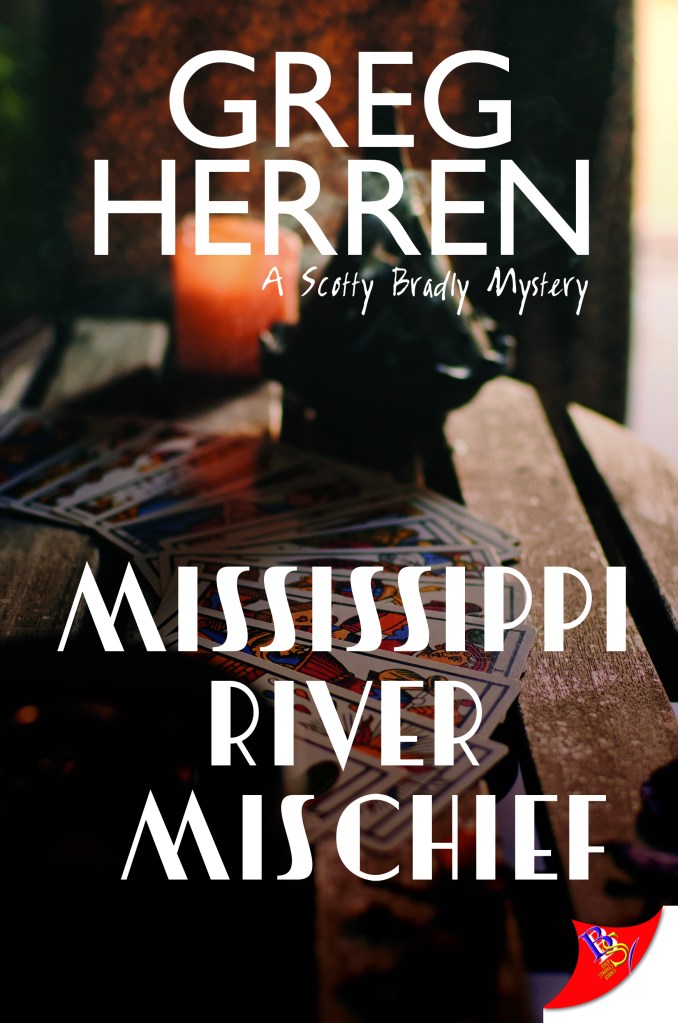
“I think we should turn it into a home gym,” I said into the gloom. “I mean, wouldn’t it be great to just have to go downstairs to work out? And we can put in a sauna and a steam room. What do you think, guys?”
It was the Monday night after Mother’s Day, and the termites were swarming.
That was why we were sitting around the living room in the dark. The only illumination in the entire building came from two blasphemy candles, flickering in the center of the coffee table. Modeled after Catholic prayer candles, one had a picture of Drew Brees in his Saints jersey with a halo and heavenly light shining on his head with the words Pray to Breesus around the base. The other was St. Chris Owens of Bourbon Street.
So, yeah—blasphemy candles. They’re very popular here.
Yet even the scant pale light from the teardrop shaped flames was enough to draw an occasional scout termite from the gloom. We wouldn’t see it until it landed on the glass lip of one of the candles, before dive-bombing into the flame. There would be a brief sizzling sound, and then the yellow flame flickered and turning briefly reddish as the termite immolated. Once it was consumed, the flame would be steady and yellow again.
The swarming rarely lasted more than an hour, but that hour seemed to last an eternity.
Termites have always been the bane of New Orleans’s existence. The domestic kind were bad enough. Houses and buildings were tented to get rid of infestations, the bright yellow and red stripes announcing to the world that a termite Armageddon was happening inside. The city’s original termite problem had grown exponentially worse since the particularly vicious Formosan variety had hitched a ride on a freighter to the fertile feeding grounds of our old, mostly wooden city shortly after World War II. The dampness of our climate must have made them feel like they’d arrived at termite Disney World. The little fuckers love wet wood, so the entire city was an all-you-can-eat buffet. They’d killed live oaks that had survived hurricanes, destroyed historic homes, and I’d heard that they could even chew through brick and mortar.
Maybe that was an urban legend, but it wasn’t one I was interested in proving.
Formosan termites swarmed.
The first rule of surviving Formosan termite season was speed. Every source of light had to be turned off the moment you spotted the first scout. They’re drawn to the light, like moths, but unlike moths, they’re drawn to the light in the hundreds of thousands, turning your home into a scene from Cecil B. DeMille’s ultimate cheesefest The Ten Commandments. The big streetlamps along Decatur Street outside drew the swarms, horrifying clouds of little monsters flying around, frantically trying to mate while shedding wings like revoltingly nasty snowflakes.
It is incredibly hard for me to believe that I have written seventeen or so books and countless short stories set in New Orleans and never have once addressed the swarms of Formosan termites we live through every spring. They return after Mother’s Day and haunt us in the evenings, usually between eight and nine pm, until Memorial Day, give or take. They aren’t a nightly occurrence, thank the heavens, but they are usually at their worst on Mondays and Tuesdays. No one had warned Paul and I about them, so the first time we were swarmed we didn’t know what to do. Remembering that horror from the old apartment on Camp Street (we had a massive security light attached to the house right outside our living room, so any light at all inside would draw clouds and clouds of them inside), how was it possible I had never written about the Formosan termite swarms? And with Scotty having bought the building on Decatur Street from Millie and Velma–who I sent into retirement along the Gulf Coast of Florida–and learning about the responsibilities and drawbacks to being a New Orleans home-owner, as well as trying to figure out how to redesign the interior for more functionality as a single-family dwelling? Of course, the question of what to do with the empty retail space on the first floor would be an issue; I wouldn’t want a living space right on the sidewalk of Decatur Street at any time of day or night or month or year. I also wouldn’t want to deal with renters, either, and thus neither would Scotty. But the space can’t just be left vacant, either. So, I thought it would be a great way to open the book with them sitting out the swarms in the dark, with a couple of candles lit, talking about the renovation plans?
After I finished writing Royal Street Reveillon, I was pretty damned pleased with myself. I thought it was perhaps the best Scotty book of the entire series, and reflected my growth as a writer along with Scotty’s growth and development as a character. When I finished it, I had the thought I always have whenever I finish writing a series book: maybe that should be the last one. But I immediately dismissed that thought from my head; I had left something in the personal story of Scotty and the boys hanging with a bit of a cliffhanger, so I knew there had to be one more book at least to tie off that loose end. I was also thinking about a local-ish political scandal of the last decade–the usual, a conservative Christian pro-family politician outed for having an inappropriate relationship with a teenager (who was over seventeen, the age of consent for boys in Louisiana), and a political powerhouse dynasty that had ruled a near-ish parish for generations was dead in the water. I had been thinking a lot also about taking Scotty and the boys outside of New Orleans and the safety of Orleans Parish for an adventure; as my knowledge of Louisiana grew exponentially along with my study of the state’s history, I really wanted to set a book in a part of Louisiana I could fictionalize and have some fun with. I had already created a couple of fictional parishes and towns in previous work; The Orion Mask particularly was set in fictional Redemption Parish–but Redemption wouldn’t work for this one, so I needed another one.
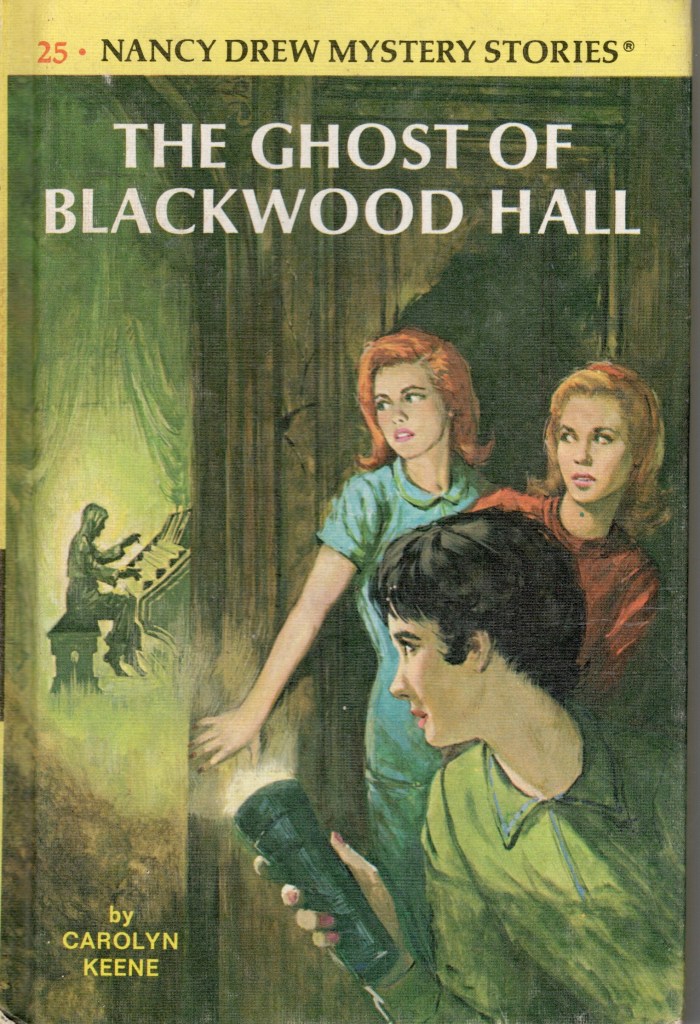
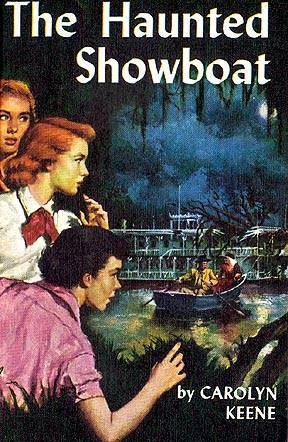
While I was thinking this through, I remembered that two Nancy Drew mysteries were connected to New Orleans–she was only here for a couple of chapters of The Ghost of Blackwood Hall, but most of The Haunted Showboat was set here, or just outside of the metropolitan area (a quick reread showed that “Carolyn Keene’s” Louisiana and New Orleans bore no resemblance whatsoever to the reality…but I knew I had a Nancy Drew Easter egg in Bury Me in Shadows (Blackwood Hall), and I wanted to put one in a Scotty book–so why not a showboat? The ruling dynasty of the invented parish–St. Jeanne d’Arc, for the record–was given the same name as the relatives of Bess and George’s that they and Nancy were visiting in The Haunted Showboat, Haver. I even named the house in Mississippi River Mischief the same name as the Havers’ home in The Haunted Showboat, Sunnymeade.
And yes, the Havers’ showboat/gambling casino was also named the River Princess.
I originally planned on the case coming to Scotty through his sort-of-nephew, Frank’s blood nephew Taylor; someone he met in group therapy (which he is doing to help get through what happened to him in the previous book), or possibly even a boyfriend, someone he’s seeing. I could never get it to work right…and finally, I realized it couldn’t come from Taylor. Taylor is going to continue growing as a person and as a character, but this was too soon after his own trauma for him to be trying to help other people. And then I remembered David, Scotty’s best friend, the music teacher. David’s not been in a book since Mardi Gras Mambo, but I’ve never forgotten about him. And it made sense–David has moved on from his old school and now teaches at NOCCA (our local Fame high school), and the kid is one of his students–and David finds out by confiscating the kid’s phone in class. I wanted to create a character based on this absolute sweetheart of a young man I met; I don’t remember how we met, but friends of a mutual friend were in New Orleans, and wanted me to meet them for drinks…and they had a daughter who went to school here. The kid was a friend of hers, absolutely adorable and sweet, and a ballet major at Tulane. After the daughter and her friend left, the parents immediately turned to me and asked me, “is he gay? <The daughter> think so, and so do we.” What I should have said was, “Well, he’ll let people know if and when he’s ready”; what I actually said was “absolutely.” (I did later find out the kid did eventually come out; wherever he is, I hope he is happy and living his best life. He was so sweet and charming and likable…) When I started writing the character, I made him unlikable, arrogant and sure of himself and his own beauty, and the effect it had on other people. That was wrong, and I went back and made him more of a naïve kid, with a strong sense of right and wrong; and the story worked a lot better. It wasn’t like Scotty to be so judgmental about this kid; if anything, especially after what happened to Taylor, he’s be super-protective.
And this tale–the corrupt old politician and the beautiful teenager working at the food court at Lakeside Mall–gave me a chance to dig into something from Scotty’s past that’s never been truly explored: that his first lover was his high school wrestling coach when he was about fifteen/sixteen. This came up in Jackson Square Jazz–which of course has been unavailable for thirteen years–and I always meant to circle back around to it, just never did…but over the years there have been throwaway lines in books about how Scotty has always preferred older men (Frank is fifteen years older; we’re not really sure how old Colin is), and so to bring it up again in this instance? Yes, perfect.
I loved my story about the corrupt politician, the wrecked showboat in St. Jeanne d’Arc Parish, and the teenager, but something was missing.
I realized two things: something very important was missing, and the crimes of the Haver family were just too big and too many to fit into this book, so I chose to focus on only one…and then the Murdaugh case broke. The Murdaughs were a real life Haver family, and their crimes were almost exactly the same! So, I ripped one of their crimes from the headlines and made that the primary focus of the story, and it was the right choice: the book started falling into place and the story began flowing. I was very nervous about the book–slicing out all the other crimes while building up only one was tricky, since they were all woven through the entire manuscript and the new one had to be as well. I also wasn’t sure if the subject matter was handled appropriately; the old/young daddy/boy thing is the gay community is often mistaken for something much worse than it is, and talking about gay teenagers’ sexuality is also kind of a third rail. But I trust my editor, and she loved it.
I hope you will, too.
You can preorder it here, if you like, or from your favorite e-retailer or local independent!




 Queer and Loathing in America