Thursday morning and I am driving to Alabama this afternoon. I slept well yesterday, but still got tired yesterday afternoon. I am almost finished with an editorial job, which hopefully I will get done tonight before I go to bed at the hotel. I didn’t do much of anything when I got home because I was tired; I just ran the dishwasher (I’d meant to turn it on before I left yesterday morning but didn’t) and repaired to the chair with my purring cuddle kitty and finished The Traitors Australia’s first season. There’s only one of those left and one season of New Zealand on Peacock, and then I am going to have to track down how to stream Canada’s. I am going to listen to Eli Cranor’s latest novel on the drive over and the drive back, and should finish the entire novel by the end of the weekend.
Sigh. I also didn’t pack last night, figuring I could do it after work. My original plan was to drive over this afternoon then drive home after the service tomorrow–old-timey thinking on my part; get it over and get home. Then I realized I have to take Friday off regardless, so why not drive back on Saturday morning? I also thought I’d only leave two hours early, and go from the office. (Dad pointed out that it was kind of nuts to drive back on Friday; which is when I realized how stupid I was being about this entire trip.) Instead I am going to leave work at noon, come home to do some chores and pack, and still get on the road around the time I planned originally to leave work. I don’t have to rush anymore, and rushing always amped up the stress in the pre-medicated days. Now I can just take my time and relax, you know? I can make a packing list this morning at the office and be organized better. I have things to do at the office today before I leave as well, but as long as I stay motivated, I can get everything finished before I head out.
Sigh. Here’s hoping, at any rate.
And it’s yet another messed up week for me; I think this is three or four in a row? There was the water main breaks affecting two separate Mondays and I was sick the Monday in between those two. This week is disrupted by an unexpected trip. But getting home Saturday afternoon will give me the chance to get things caught up, make groceries, and maybe do some cleaning and get the apartment back under control. I do feel like I am actually getting a grip or a handle on my life again…and I just remembered the Festivals are next weekend, too, so that’s not going to be a normal pair of weeks, either. Ah, well, maybe some sense of order will return to my life in April.
One most excellent thing that happened yesterday was a conversation in a group text with some friends led my mind to spiral into what the plot for the next Scotty and its title (French Quarter Follies), so I madly scribbled down some notes and now I know what Scotty XI (eleven???) will be; I was a bit worried because I hadn’t been able to come up with anything, other than I wanted it to be another swing at Carnival. That was kind of exciting; my creativity has been mostly limited to non-fiction (blog and newsletters) since I finished writing the last book and now I am starting to get some of the old creative ADHD back. I’ve not been able to harness and focus it yet, so I am letting it have free reign to bounce all over the place and see what happens. I think listening to Eli’s book on the drive will also kickstart me back into reading fiction again–and I think my next reread with be a Phyllis A. Whitney classic–my very first of her novels for adults, Listen for the Whisperer. (I love that title, too.) I need to complete my reread of The Egyptian Cat Mystery, too.
I also picked up a copy of Bob the Drag Queen’s novel Harriet Tubman: Live in Concert, based on recommendations by Kristopher Zgorski and Catriona McPherson, which I’d really like to dig into.
And on that note, I am heading into the spice mines. Have yourself a merry little Thursday, and most likely won’t be back until Saturday when I get home, or may even wait until Sunday. Until then, au revoir.
There was another water main break in Uptown Thursday–this time nearer to the Tulane campus–but it did not come with yet another boil water advisory this time. It really is awful the way the city’s infrastructure is crumbling below our feet. New Orleans is an impossible city in almost every way, but it’s also necessary, which is why we keep rebuilding and living here. It’s also one of the most unique and charming and lovely cities in this country. But despite being called “the Big Easy” (a name the locals hate and never use), it ain’t all that easy to live here, you know?
But it’s now Saturday morning and the day stretches out in front of me, full of possibilities. There are all kinds of drunken St. Patrick’s Day events going on everywhere today (including the Irisy working at home; driving to the Apple Store in Metairie to get a new iPad before stopping by Costco on my way back into the city. Much as I enjoy Costco–and it wasn’t crowded late yesterday when I was there. I lost my membership cards ages ago (Paul usually goes with me and we use his, but the Festivals are in a few more weeks so…), so had to get a new one, which was remarkably easy, and then I shopped my merry way to a ridiculous amount of money changing hands at the cash register. I came home, had to unload the car, and then put everything away and was exhausted by the time all of that was done, so I sank into my easy chair and watched a couple of episodes of you should know by now and then watched LSU Gymnastics against Arkansas, which was an incredible meet; LSU’s Kailin Chio got a 10 on the three apparatus (apparatii?) she competed on! So exciting! And the new iPad is lovely, if a bit frustrating (the number of passwords I had to reset…), and I am pleased with it. I can use it for writing, and its actually less cumbersome than the laptop (which will be seven years old this year). I was also doing the laundry (and there was a lot of it) all day, and I finished all stages of the dishes by unloading the dishwasher and putting everything away. I did wind up staying up later last night than I’d originally intended, but c’est la vie. I also slept later this morning, which was lovely and I feel rested this morning. My Achilles tendons are still tender, so I am going to ice them off and on all day.
I think today is going to be a mostly chill out, relax, and clean day. The apartment is a mess (Costco and iPad packaging debris–Apple’s packaging is very nice, but unnecessary) so I need to make several pilgrimages to the garbage cans this morning. I want to spend some time reading, and I am going to get up early tomorrow to get some work done–writing, emails, editing–as well as pack up the books I need to get in the mail. I am hoping to have a very good week next week; hopefully we won’t have a boil water advisory Monday, and I won’t be sick. Not sure what the deal has been lately with my Mondays, but it needs to stop!
I also did some reading–not much–last night; my reread of the juvenile Rick Brant Science Adventures’ The Egyptian Cat Mystery, and this time the racism and stereotypes–not to mention white condescension–just jumps off the page at me. The book was originally published in the 1961, the year I was born, and so it also very dated; there is no longer a United Arab Republic, for one example. But I should have expected a 1961 mystery for kids to have been chock full of the horrible societal ills of American exceptionalism–which will be an interesting take for the essay I plan to write when I finish this book. I am also looking forward to diving back into Eli Cranor’s latest, as well as Sarah Weinman’s new one.
I also know I am going to write about my friend who passed away this week, but I am still sorting my complicated feelings about that right now. I am trying to only remember the good memories, but some of the negative ones inevitably surface, and I am also trying to let go of that negativity. There’s no sense in holding onto any of that now that she’s gone, you know? But I know I’ll get there; maybe I should start writing it because it will sort my feelings–maybe not but it’s worth the old college try.
And on that note, I am heading into the spice mines. Have a lovely Saturday, Constant Reader, and I’ll be back tomorrow morning.
Gorgeous Taylor Zakhar-Perez, of Red White and Royal Blue fame.
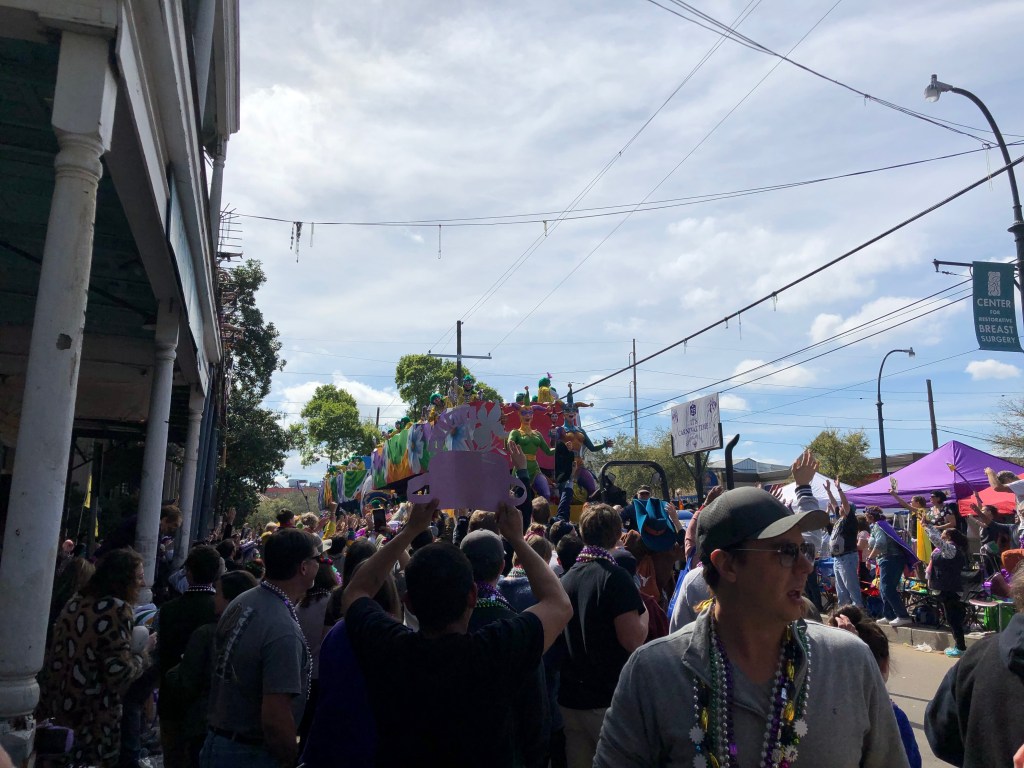
It’s Lundi Gras morning, with my favorite parade–Orpheus1–rolling tonight, and I have two more days before returning to work. I am enjoying this little mini-vacation very much. My Achilles tendons are still a bit sore, so after I get home from the errands I have to run this morning, I am in for the day until Orpheus arrives tonight–unless it rains. It looks a bit gloomy outside the windows, if I am being totally honest. It does happen–and it’s been a hot minute since it’s rained, you know? I slept really well the last two nights, and I feel pretty good. I think another easy day of reading and hanging out around the house while doing some chores sounds lovely. I also spent most of yesterday off-line, and that was marvelous. I like that I am spending less and less time on social media. The world is burning, and doomscrolling isn’t much help with that, you know?
We made art during HIV/AIDS, didn’t we?
I did wake up early yesterday after a lovely night’s sleep, and had a pretty good day around the house. I emptied the dishwasher and ran it again, did some straightening up and organizing around here, and had the pairs figure skating short program on the television while I finished reading The Secret of Hangman’s Inn, and started reading another old series book, The Egyptian Cat Mystery, a Rick Brant science adventure. (Rick Brant is another one of my favorites.) I am going to try to read some of the Eli Cranor today, with some more of the Brant, too. I think I may also start Sarah Weinman’s Without Consent as well. I think going forward I will stick with the three–a new fiction read, a reread, and a nonfiction–going forward is my reading plan. I do need to start reading voraciously again; I miss it. I also need to write about Hangman’s Inn. I also managed to send out another promotional newsletter about Hurricane Season Hustle, which you can read by clicking here.
If the weather does hold and my ankles feel okay, I may take a walk later today to get some pictures of the bead trees blooming and all the debris along the sidewalk and in the trees. I feel rested, and Sparky was very cuddly this morning under my warm pile of blankets in the bed. I want to do some writing today, but I may not; it depends on how I feel when I get home from the errands.
We binged more of season four of The Traitors, and I love everything about this show. I cannot believe none of y’all told me I needed to watch this show. I mean, it checks ALL my boxes–murders, pettiness, camp, a castle, robes with cowls, lanterns and torches and executioners! Alan Cumming is having the best time camping it up as the host–and there are some iconic lines on this show; currently my favorite is “snatched tighter than a housewife’s jawline.” And there are three previous seasons to catch up on! It’s all so deliciously Gothic, which I love. We have one more episode from this season before we are caught up, and we’ll probably watch that either tonight or tomorrow; I’m sure Paul has to work, and I know he has his trainer today, too. I should be able to get some reading and writing done today, and today I can finish the floors–which I’ve put off all weekend.
The emails can wait until Wednesday, seriously.
And on that note, I am going to go get cleaned up so I can run my errands. Have a lovely Lundi Gras Monday wherever you may be, Constant Reader, and I will be back tomorrow for Fat Tuesday.
I loved kids’ series when I was, well, a kid. I still have fond memories of reading and collecting as many of the books as I could–I still have all my copies–and while of course times have changed, I feel bad for kids today who don’t have the plethora of series to choose from that I did when I was a kid.
Of course, I chose all of them, pretty much.
And while the most popular kids’ series were Nancy Drew and the Hardy Boys, my favorites were the ones that weren’t as well known, didn’t last as long, and vanished from print during the late 1960’s and through the 1970’s. I always preferred Judy Bolton, Trixie Belden, and Vicki Barr to Nancy Drew; I enjoyed The Three Investigators, Ken Holt, and Rick Brant far more than I liked the Hardy Boys, but you could get Nancy Drew or Hardy Boys books almost anywhere, whereas the others were incredibly hard to find. Our babysitter used to take us to the Goldblatt’s Department Store on 26th Street in Chicago when she went, pulling her buggy behind her (Dad says Mom used to pull me and my sister in hers to the grocery store, but I don’t remember that). Mom would always give my sister and I two dollars each to spend, and I loved going there because in the basement was the kids’ section, and while my sister was looking at dolls or single records (remember 45’s?) I discovered the remainder table, where Goldblatt’s marked down some of the lesser known Grosset & Dunlap/Stratemeyer Syndicate books on a big table, for like thirty-nine cents, which was a big deal because I could get a lot of books at that price. They were all series books I’d never heard of, but they sounded interesting. It was off that table that I got my first Ken Holt. Rick Brant, and Biff Brewster mysteries. The Biff Brewster books weren’t as good as the other two series, but today I want to talk about Rick Brant, and why I loved the series so much.
Rick Brant, being tall for his age, had no trouble making the final connections on his latest invention. He screwed the bell on solidly, then stepped back to view his handiwork.
The doorbell was now in an unusual position. Instead of being at waist level, it had been moved to the inside of the doorframe and placed up high.
It looked fine. A stranger might have to hunt a little before he saw the push button, but he’d find it all right. Rick went inside and threw the switch that would send electricity into the gadget and went to collect the family.
Mrs. Brant was in the kitchen, supervising the supper preparations for the family and the scientists who made their home on Spindrift Island.
Rick sampled the cake frosting in a nearby bowl and invited, “Can you come out on the porch for a minute, Mom? There’s something I want to show you.”
Mrs. Brant looked up from the roast she was seasoning, a twinkle in her eyes.“What is it now, Rick? Another invention?“
“Wait and see,” he said mysteriously. “I’ll go get Dad and Barby.”
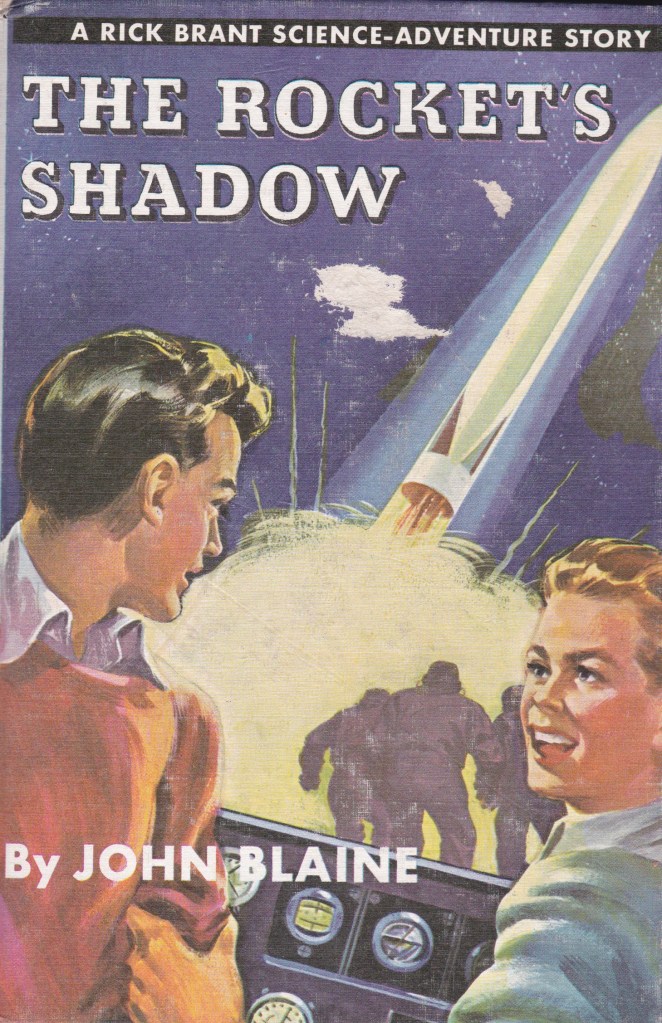
And so opens the first Rick Brant Science Adventure. I bought four Rick Brant books that day (The Rocket’s Shadow, The Egyptian Cat Mystery, The Flying Stingaree, and The Flaming Mountain), all of which had some appeal to me. I wasn’t really that much into science or rocket ships, but I did buy the first because it was, well, the first in the series, and OCD Child Greg had to read the first book. I didn’t have to read the series in order–I did try that with the Hardy Boys, but gave up when it was time for Book 4 and the title, The Missing Chums, didn’t excite me so I got one of the later volumes, The Mystery of the Aztec Warrior instead. There was a pyramid on the cover. I’ve always been a sucker for pyramids–but I always felt obligated to eventually get to the first volume of every series. It wasn’t always necessary, but in some cases–The Three Investigators, Trixie Belden, Judy Bolton–they really did set the stage for the rest of the series and it helped to have read the first one.
I’ll be completely honest here, too: I was never good at science. I don’t know why that was, but I just was never good at any of it–biology, chemistry, physics; math and science were my two Achilles heels. I only read a couple of the Tom Swift books, and even those were because one was reissued in paperback and renamed In the Jungle of the Mayas (the Mayans built pyramids!) but I got the impression the Swift books were more about science than a case or a mystery or anything. The Rick Brant series, on the other hand, while having some insane titles (The Electronic Mind Reader, The Wailing Octopus) like all series did, there were also some that were called “mysteries.” So, yes, science, but also mystery.
I also had no idea it was going to become one of my favorite series.
When I first read The Rocket’s Shadow in the late 1960s/early 1970s, it was already significantly dated. Originally published in either 1946 or 1947, the background to the story was that the scientists on Spindrift Island, off the coast of New Jersey, were trying to build a rocket to send to the moon. Several different groups were trying to accomplish this, and whoever succeeds first was going to get a very lucrative government contract…and their efforts are being sabotaged. Rick’s father, Dr. Hartson Brant, is world-renowned, and of course Rick is very interested in science and is always inventing things to either save time or effort, and they aren’t usually very practical, even though they do work. Rick and his younger sister Barby go to school on the mainland–Spindrift is separated from the coast by tidal flats that are underwater during high tide–but everyone on the island is determined that their rocket will succeed and they’ll catch the saboteurs.
Rick soon figures out a clue and gives chase to some of the saboteurs, who turn on him and attack him–only he is rescued by a blond hitchhiker carrying a military duffle. He and Rick run the attackers off, and then Rick brings his new friend, Don Scott–“Scotty”–home with him because he has no place to go. He’s out of the military and has no family, was just wandering the roads to see where he wound up. The close bond between Rick and Scotty1 resonated with me, especially their sense of camaraderie and affection for each other. They had no girlfriends or even any girls who might be potential dates at first (some were introduced in the series later, Barby growing up for Scotty and a new scientist comes to the island and has a teenaged daughter Jan who is sort of an interest for Rick–but the girls are never more important to them than they are to each other.2
Obviously, by the time I got and read the book we were already into the Apollo space programs from NASA, and we landed on the moon in 1969–so all the science in The Rocket’s Shadow was off and wrong–also the rocket got there in like twenty minutes, not possible even now–and as such, the series could never really be updated and revised like the Hardys and Nancy Drew. The Rocket’s Shadow would have had to have been completely rewritten, and I’m not sure how you could introduce Scotty as a hitchhiker/war vet (he lied about his age) today.
I enjoyed all the books in the series. I did eventually get them all over the years and read them, and many of them are dated. High tech walkie-talkies don’t seem so impressive in a cell phone world, and of course, there are some trips to foreign lands (Asia and Pacific Islands) that are probably more than a little racist and dated now. But I loved The Lost City, where they are off to Tibet to set up a radio receiver on the opposite side of the world from Spindrift to triangulate with the rocket on the moon, and they discover a lost city of Mongols and the tomb of Genghis Khan. They also meet, in that book, an Indian youth named Chahda who helps them out and becomes basically a member of the family, and they take him off the streets of Delhi and pay for him to go to school. Chahda was incredible smart and adventurous too–but not sure how he’d hold up under modern scrutiny in these more evolved times.
And maybe when I’m retired I’ll reread the series critically. The books can be found on ebay and second-hand sites; some are available as ebooks, either on Amazon or Project Gutenberg.
I am even now wondering if this character is why I’ve always liked the name Scotty, and have used it repeatedly for characters of my own creation. ↩︎
I do find in also amusing that my parents–so worried about me reading books about girls instead of boys; did they not understand just how homoerotic the relationships between boys in these books were. This amuses me greatly now. ↩︎
While the official first day of the summer season isn’t here quite yet, it’s already summertime in New Orleans–with everything that means. The thick heavy wet air that clings to you like a warm wet wool blanket; the beautifully bright and yellow sunlight that burns your skin red as it pierces through the windows of your car; and the climbing electric bills as your air conditioning unit desperately tries–and only occasionally succeeds–to keep the temperature livable and breathable inside your home. Tourists who come to New Orleans often complain about the extreme difference in temperature from going inside to out and back inside again; how cold it is everywhere in doors; that the shorts and tank tops, soggy and wet from sweat, aren’t enough covering as the they dry in the cold frigid inside air. It is really impossible to know how to dress in New Orleans when it’s hot; but those of us who live here are used to it, but you never get used to how just existing and moving around outside sucks the energy right out of you, and sometimes–like when you’re lugging all the shit you bought at Costco in from the car–you have to just sit for a spell, chug some cold water or Gatorade (or a daiquiri if you planned ahead), and collect yourself.
That was my yesterday. As you may have noticed had you paid close attention, I had been unwell for a while; primarily from forgetting that I have to be more cautious dealing with heat and more careful and mindful of the maintenance required for my older body. This whole thing started with me being unable to sleep for several nights in a row, and the moved on to severe dehydration and exhaustion and stomach issues. This led to another COVID-19 test, being sent home from work, and a slow recovery. But after days of drinking lots of water, avoiding caffeine (much to my own detriment when it comes to productivity), and good sleep–as well as staying inside as much as possible–I am finally, this morning, feeling like myself once again; energetic and creative and ready to go. I took two more vacation days this week–Wednesday and Thursday–to continue my rest and recovery, and it seems to have done the trick (I was really worried about the Costco trip being a setback; but I am stubborn and I wanted to get it out of the way; but I downed lots of water before I went, took a Gatorade with me, and had another after I got home).
And this morning, yes, I feel like me again for the first time in what seems like an incredibly long time.
I’m working from home today, which means data entry and making condom packs while streaming things on the television; I should finish the first season of Jonny Quest today, since the episodes are only about twenty-four minutes long; which makes me wonder if that’s why it had such a short run on Saturday mornings when I was a child–not enough time left for commercials. Scooby Doo Where Are You? episodes are 21-22 minutes. Money is key, and despite some problematic issues with the show (it was produced in the 1960’s, after all) it still holds up pretty well. It did put me in mind of another kids’ book series I read when I was younger–the Rick Brant Science Adventures by John Blaine, which was yet another one of the many Grosset & Dunlap series. Like the Ken Holt series I talked about recently, the Rick Brant series was never as popular as the Hardy Boys (nothing ever achieved the popularity of Nancy Drew), but were much more interesting, more action-packed, involved actual detective work, and were far better written. The similarities between Jonny Quest and Rick Brant are staggering; the Quests live on an island; Rick and his family also lived on Spindrift Island, separated by tidal flats from the coast on New Jersey. The Quests sort of adopted Hadji, who became Jonny’s best friend; Rick’s best friend is Don Scott (Scotty), and the Brants unofficially adopt him into their family. Jonny and his family go all over the world having adventures and solving mysteries having to do with science, for the most part; Rick and Scotty do the same. Jonny’s father is world-famous scientific genius Benton Quest; Rick’s father is world-famous scientific genius Hartson Brant.
The first few Rick Brants I read, like Ken Holt, I obtained off the sales table in the bargain basement at Goldblatt’s in Chicago: The Rocket’s Shadow, The Egyptian Cat Mystery, The Flying Stingaree, and The Flaming Mountain. Over the years, I found more of them at swap meets and flea markets and used bookstores; I think I met have an almost complete set of them now (I did acquire some via eBay after Katrina). Some of the books are now available for download on Project Gutenberg; several volumes from a variety of those old kids’ series–including Ken Holt, Judy Bolton, and Biff Brewster–are there (and yes, I downloaded all of them). I want to start revisiting some of these series, since they influenced me into becoming a mystery writer, and while scientific knowledge has proceeded incredibly rapidly since the Brant series were published and went out of print, it’s kind of fun to go back and revisit the world of cutting-edge science (or what was seen as futuristic science) at the time; The Rocket’s Shadow was basically about how the Spindrift Island scientists (other scientists and their families also lived on the island) were racing to build and launch a moon rocket–the case involved Rick trying to solve the mystery of who on the island was a traitor and leaking secret information about the rocket project to a competitor; Scotty rescues him from the bad guys in the first chapter. Scotty was a military veteran who lied about his age to enlist and fight in the war (World War II; the book was originally published in 1947)–which was glossed over and ignored as time passed and the series continued, which would have aged him. This was twenty-two years before the actual moon landing, so to kids reading this in 1947 and the years after, it was kind of science fiction.
We will finish the final two episodes of Elite that are available tonight, and then will have to wait for season four. They had started filming before the world shut down, alas, so there’s no telling how long it will be before we get another season to binge and love. I also am not sure how the show is going to continue; this season has them all graduating and the crime this season is focusing on occurs at the graduation party. I can’t praise this show enough; it’s completely addicting, and there are never any slow parts. The way they have developed the characters and their relationships with each other make total sense and are completely believable, despite the sometimes completely over-the-top situations they find themselves in. Once we finish watching, I will devote an entire entry to discussing the show. But seriously–you won’t be sorry if you watch.
And now back to the spice mines. Have a lovely day, everyone.
Thursday–the last full day of work for me this week; Fridays I only work half-days. The weekend looms on the horizon, and in theory, my life should be settling down into a normal routine next week at the day job after weeks of never being completely certain what I would be working the next day. For someone who is an utter control freak about time and scheduling, this has been torturous for me. For some reason I crave structure; I have to be at the office at this time, I can go to the grocery store here and then I can come home and spend this time writing and this time cleaning and this time watching television, relaxing.
And yet I also don’t like being caught in a routine, a rut, if you will.
I am nothing if not a writhing mass of contradictions.
But, like with audiobooks, an old dog can learn a new trick every now and then.
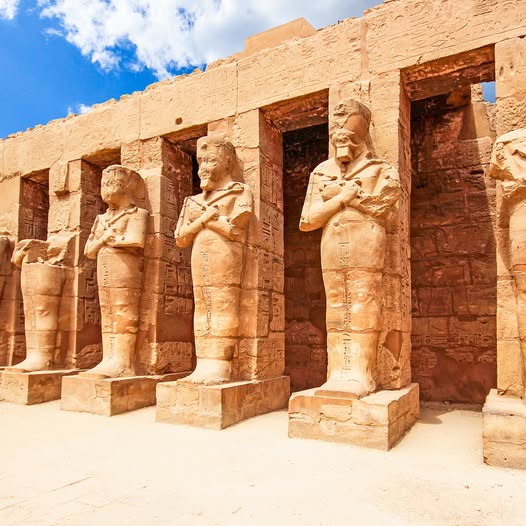
I am currently rereading Erich von Däniken’s Chariots of the Gods?, which I originally read in the 1970’s. The 1970’s was, for some reason–probably all the upheaval of that decade and attempts to recover from the social unrest of the previous decade–a decade of weird conspiracy theory and even more peculiar science; the Bermuda Triangle, UFO’s, Area 54, ancient aliens, etc. I used to read a lot of these books, mainly because they were interesting, even though there were frequently enormous gaps and huge leaps of logic required to follow the authorial reasoning to the points they were trying to make in those days; and even as a teenager I often spotted these logistical flaws. But the concept behind Chariots of the Gods? was one that I was interested in, and while von Däniken’s writing style (in fairness, the book was written in German and translated) left something to be desired, one thing I took away from the book in the first place was the realization that exclamation points used in non-fiction usually means most of the reasoning is bullshit.
(I also loved the movie Stargate, which can probably be directly traced back to reading Chariots of the Gods?)
I kind of love these theories, though, even as I recognized they are problematic. A lot of human history isn’t recorded, and so we are left, for the most part, to wonder about the origins and rise of Egyptian civilization, or what life was like in Ur, or how the idea for written communication began or where it came from, and so forth. I also remember one of the reasons I was partly drawn into the whole Chariots of the Gods? things in the first place was because one of the “sites” he tried to explain away as being designed for ancient astronauts were the strange lines on the plan of Nazca, in Peru–which I had read about in the forty-fourth Nancy Drew mystery, The Clue in the Crossword Cipher. (In retrospect, I am also horribly disappointed neither Nancy or the Hardy Boys–in the original series–never went to Egypt; both Rick Brant and Biff Brewster did, in The Egyptian Cat Mystery and Egyptian Scarab Mystery, respectively.)
But, as I said, even I, a relatively uneducated and unformed preteen, could spot fallacies in logic and reasoning in the book. It was made into a TV special, In Search of Ancient Astronauts, and then a feature film with the same name as the book. Von Däniken wrote several more books–turning it into a virtual cottage industry–but I never read beyond the first.
I was reminded of this recently when I came across an article on Von Däniken’s racism, and that his theories were based in racism (you can read it here), and as I read through the piece, nodding, I was also amazed at how it never occurred to me that essentially, Von Däniken’s theories were predicated on racism and asserting white supremacy by erasing the historical accomplishments of ancient, non-white civilizations. So, I checked the book out of the library to reread it and look for the racial coding–plus, to see if there are as many irrational and illogical leaps made as I remember.
And I also can’t stop thinking about the Bermuda Triangle and other conspiracy theories that were huge in the 1970’s…and wondering why the 1970’s was such a fertile ground for pseudoscience.



 Queer and Loathing in America