To Turn You On

And today, Paul and I celebrate our thirtieth (gulp) anniversary. YIKES. On August 1, we celebrate moving to New Orleans twenty-nine years ago–and then nineteen days later, I turn sixty-four (cue the Beatles). We are going to a matinee of Superman today–the plans are absolutely definite now–and then we’ll come home and relax. Sparky let me sleep in late this morning, which was much appreciated, and now I am awake and drinking coffee and being a bit reflective.

I had a nice day yesterday. I ran my errands and got home again in less than an hour; and I got a lot of the chores done. There’s still some things that need to be done today, but that’s okay. My kitchen sink and dishwasher are empty and the counters are clear. The laundry is all finished and put away, too. There’s still some things I need to get done today, but that’s okay. I didn’t really read anything yesterday other than things I’ve written–short stories and the Chlorine manuscript–in preparation to get to work on all of these things this week. I feel good this morning, good and rested, so I feel like I am going to be able to get some stuff done today before getting cleaned up and heading out for the movie. It’s gorgeous outside today–the sky is blue and the sun is shining, which probably means it’s in the nineties and feels like over a hundred; we’re going into heat advisories this week, too.

We are in what they used to call the dog days of summer–although I have no idea where that phrase actually came from.

We also finished America’s Sweethearts yesterday–and was very glad to see that the cheerleaders got their raise, and a significant one at that. I’ve always thought, based on the success of their branding over the last fifty years, that they were underpaid and very taken advantage of by the Cowboys organization. It’s a full time job, and they give up a lot of control over their own lives by dreaming to put on that barely-more-than-a-bikini uniform. I’d love to know how the cheerleaders were manifested into what they are today–a brand recognized worldwide, and how the decision was made to to pick those costumes and how they are handled and the rules they live by were developed. I know it happened in the 1970s; I wasn’t really much of a fan because I thought they were being overly sexualized to appeal to the male audience. The one takeaway from watching the show when it was originally on TNN was how the cheerleaders were depicted in that classic Madonna/whore thing: they wear revealing costumes that emphasize their bodies, yet they are all young women who seem to be very chaste and virginal, even the ones that are married or have boyfriends…which always struck me as a bit exploitative.

The two women who run the team, Kelli Finglass and Judy Trammell, are blunt to the point of being rude bitches at time, and the depth of their devotion (each have spent over forty years with the team) to the high standards they want for their performers is kind of impressive, if sometimes over the top (I do find myself thinking from time to time while viewing, “that was just rude” or “Kelli, you could have been a bit more diplomatic there”) and there are some interesting gender politics at play with the show, too–the women are all dressed and made-up to draw the male gaze, yet behind the scenes they are very sweet and supportive of each other to the point that someone cynical (like me) has to wonder how much of it is an act for the cameras. I mean, there’s no conflict between the girls, no personality clashes? But it’s also refreshing–after years of watching reality television and drama manufactured for the cameras for ratings so women can scream at each other–to see women’s relationships depicted as a sisterhood, like a sorority; and sometimes how the group reacts to things looks very sorority-minded. It’s kind of nice to see, actually; women supporting women.

And while I wonder about disordered eating and body dysmorphia for them, based on the pressures placed on them to remain slim yet voluptuous, my favorite quote from Kelli is her saying bluntly to one hopeful at training camp, “The uniform is very unforgiving.”

She wasn’t lying.

And on that note, I am heading into the spice mines. Have a lovely Sunday, Constant Reader, and I’ll be back tomorrow morning.
I’m Gonna Make You Love Me

I’ve always considered myself to be a child of the seventies.

Sure, I was a child for during the sixties, but I turned nine in 1970. While I am sure that turbulent decade provided some (a lot of) influences on me, my personality, my likes/dislikes, and my future, I am equally confident that my values and thoughts and beliefs probably weren’t as shaped from that turbulent decade as they were by the 1970’s. The seventies are really the first decade for which I have a lot of recall (recently, a friend was amazed that I remembered those horrible Rag City Blues jeans for women that were, for some reason beyond my thought processes, popular in the latter part of the decade; what can I say–I do remember the decade fairly well for the most part–or at least as far as my memory can be trusted). I’ve always wanted to write books either set in the seventies completely or even partly; Where the Boys Die, my 70’s suburban Chicago novel, keeps pushing its way to the forefront of my increasingly crowded (and clouded) mind. (NO I AM WRITING CHLORINE NEXT WAIT YOUR TURN)

I remember Watergate and how the scandal grew. I remember the 1972 landslide reelection of Nixon, and the country’s negative reaction to the Ford pardon of the man who brought him to power; I also remember Jimmy Carter running for president out of seemingly nowhere and getting elected. There was The Brady Bunch and The Partridge Family and Archie Bunker and Mary Richards; Sonny and Cher and Carol Burnett and Donny and Marie and the Jackson 5 and Grand Funk Railroad. Top Forty radio ruled the AM airwaves; not every car came equipped with FM capabilities, and the only way you could play your own music in your car was with an eight-track player. I started the decade reading the Hardy Boys and Nancy Drew and The Three Investigators; by the end of the decade I was reading John D. MacDonald and Sidney Sheldon and Harold Robbins. It was a very weird decade…of odd color and fashion choices; avocado greens and browns and American cheese orange were ridiculously popular, as was shag carpeting, velour, clingy polyester shirts, corduroys, bell bottoms and slogan T-shirts. Baseball shirts and rugby sweaters also became popular later in the decade. People had feathered hair parted in the center, and there was this weird sense of, I don’t know, missing out? Movies were grittier, harsher, more realistic; actors went from the polished shine of the old Hollywood system glamour to warts-and-all realism. Television was also beginning to change but was still heavily censored. Boogie and truckin’ and shake your booty became part of the vernacular; the decade began with the break-up of the Beatles and ended with disco’s last gasps while new wave and punk and rap started their rise.

It was the decade I went through puberty and realized that I was attracted to other boys instead of girls; I wasn’t quite sure what that meant but definitely found out in the seventh grade it meant I was a faggot, fairy, queer, cocksucker, and all those other lovely words that were burned into my brain that year. It was the decade where I read Harold Robbins’ Dreams Die First (a truly execrable novel) over and over again because the main character had sex with both men and women, and if I am not mistaken, contained the first male-on-male sex scene I’d ever read (oral); it was also the decade where we moved from Chicago to the suburbs to the cornfields of Kansas and I graduated from high school. (Ironically, it was in Kansas that I discovered gay books with explicit gay sex scenes in them–the News Depot on Commercial Street not only carried The Front Runner by Patricia Nell Warren and her other novels, but also Gordon Merrick; and their magazine racks also had gay porn magazines–which, now that I think about it, meant there were others there in Lyon County and environs; I didn’t realize it at the time, of course.) It was when Norah Lofts’ The Lute Player made me aware that Richard the Lion-Hearted was like me, too; and Susan Howatch’s Cashelmara and Penmarric also had gay characters and plots involving them…

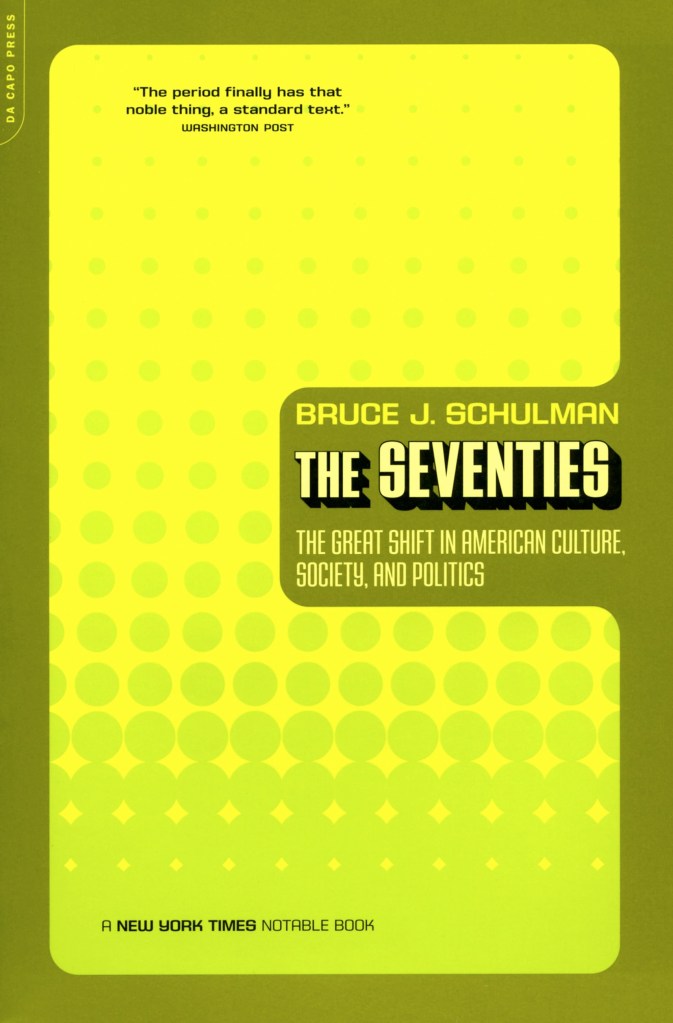
I’ve always thought the seventies was a much more important decade than ever given credit for; usually it is merely considered a connecting time from the 60’s to the 80’s…but almost everything that came after–socially, politically, culturally–got started in the seventies. So I was glad to see this book about that frequently dismissed time.

As I mentioned previously, the Seventies were turbulent; they were the decade that also saw the beginning of the end of the post-war economic/prosperity bubble. Gas shortages, skyrocketing inflation, and the insidious use of racism to break the Democratic coalition began–everything we find ourselves dealing with today had its roots in the Seventies–and it did seem, to those of us growing up in the shadow of the mushroom cloud, that the world had lost its mind and our country (or rather, its mythology) had lost its way. Schulman’s study of the decade, breaking down how the shifts in culture, politics, and our society began, were exploited for divisive purposes, and permanently changed attitudes moving forward was a fascinating, if chilling, read. I remember the terrorist attacks. I remember watching the Munich Olympics that ended in bloodshed on an airport runway and murdered Israeli athletes. The book brought back a lot of memories; I am not so sure I agree with all of Schulman’s assertions about the decade–there certainly wasn’t very much about the burgeoning gay rights movement, other than how it chased lesbians off into the Women’s Movement–but it was interesting to read the book and relive the decade a bit, as well as the memories it triggered.

I do highly recommend this book for people who weren’t around for the Seventies and might be wondering how the fuck did we end up in this current mess?