Snakedriver

Ah, Alabama.

Despite everything that is wrong with Alabama culturally, societally, spiritually, and politically, I’m not ashamed of being from there (and never will be). I do shake my head with every new law passage or court ruling there that flies in the face of decency and the Constitution, because it is sad that the majority of people there are not only so lost spiritually and intellectually, but also defiantly cling to their backwardness. My part of the state, where my people are from, used to be very remote and rural; many native Alabamians, when I tell them where I’m from, are often confused, having never heard of it before. It isn’t on any interstate, rooming options are limited, and you really have to drive for about an hour from the nearest interstate to get there. It’s not quite as remote as it used to be; many of the roads that were dirt and/or gravel when I was a kid are paved now…but there are still plenty of unpaved roads up there in the hills and along the countryside. It’s very different there now, too–the country stores are all gone, and there’s definitely a lot more McMansions than there ever was when I was a kid. (Dad and I often marvel at the palatial homes we come across driving around the county, as Dad shows me places from his childhood and when he and Mom were first married.)

And it’s not cheap to buy property there, either, which was also a bit of a surprise.

Dark Tide was my first attempt to deal with my history and where I am from, but was cowardly in the end and wound up editing most of the backstory of my main character out. It didn’t really fit and made the book something different from what I was trying to do with the book, but as I edited it all out I also felt that I was being a bit cowardly. I knew I was going to have to deal with the troubled history (and present) of the county and state, so I wrote Bury Me in Shadows to not only try to get a better understanding of the area, but to deal with that troubled past. It wasn’t easy–I often found myself cutting things to a bare minimum in a stupid attempt to not give offense, and there were many times while writing it when I’d wince or skip a scene because I wasn’t sure how to word it properly without being preachy. I wanted to show through the story how refusing to face the past with a realistic and jaundiced eye can cause generational trauma and how that, in turn, perpetuates societal racism and homophobia in an endless cycle that strangles growth.

But writing that book also took me down a research wormhole that I’ve never really climbed back out of, and being there last weekend also reawakened some memories as well as creativity and potential future stories. (Dad and I found a really sad set of graves in the same cemetery as my maternal grandparents and uncle; parents and two small children –one was only four months–who’d died on the same day. We speculated as to how that happened, tornado or car accident or house fire, but a distant relative my father also knew explained that the father killed them all and then himself…which naturally started churning things in my brain again.)

I also discovered, during the pandemic, a horrifying documentary called Alabama Snake, which focused on the snake handling churches of northeast Alabama and a minister who tried to kill his wife with snakes…and then discovered there was also a book about the culture from a reporter who’d covered the trial, and continued investigating and looking into the snake handling churches.

I finally read it last week.
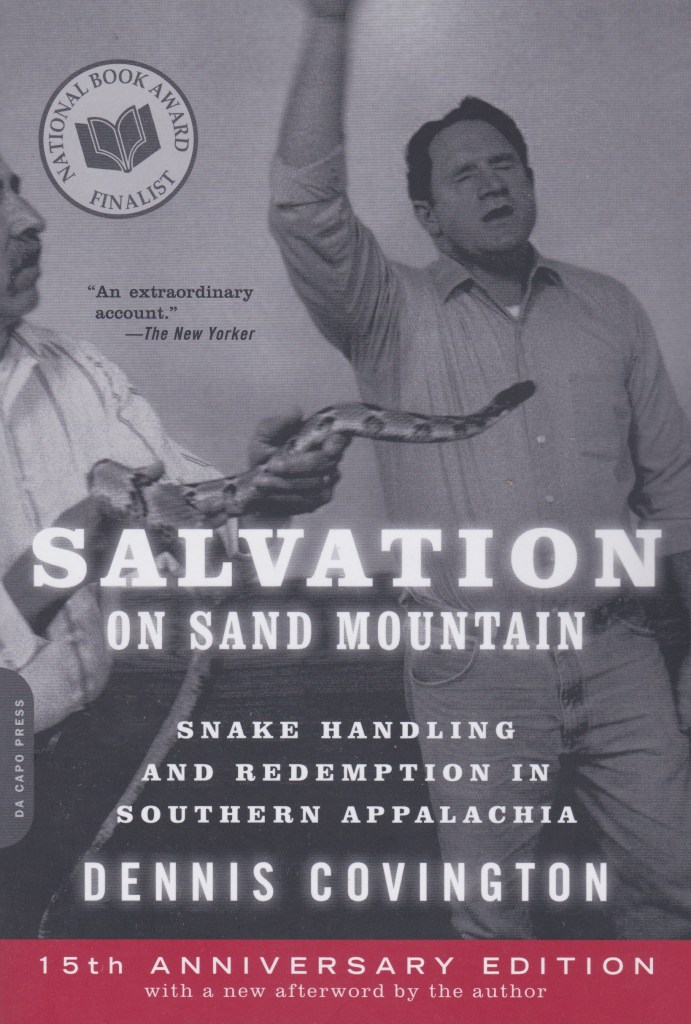
The first time I went to a snake-handling service, nobody even took a snake out. This was in Scottsboro, Alabama, in March of 1992, at The Church of Jesus with Signs Following. I’d come to the church at the invitation of one of the members I’d met while covering the trial of their preacher, Rev. Glenn Summerford, who had been convicted and sentenced to ninety-nine years in prison for attempting to murder his wife with rattlesnakes.

The church was on a narrow blacktop called Woods Cove Road, not far from the Jackson County Hospital. I remember it was a cool evening. The sky was the color of apricots, and the moon had just risen, a thin, silver crescent. There weren’t any stars out yet.

After I crossed a set of railroad tracks past the hospital, I could see the lights of the church in the distance, but as I drew nearer I started to wonder if this was really a church at all. It was, in fact, a converted gas station and country store, with a fiberboard facade and a miniature steeple. The hand-painted sign spelled the preacher’s first name in three different ways: Glenn, Glen, and Glyn. A half dozen cars were parked out front, and even with the windows of my own car rolled up, I could feel the beat of the music.

It’s very difficult to think about Alabama without religion being involved in some way. Alabama is a very religious state, with churches everywhere–one of the things I always comment on whenever I am up there driving around with Dad is “there sure are a LOT of Churches of Christ up here”–you really can’t go anywhere without driving past at least two. Both of my grandmothers were devout (paternal family was Church of Christ; maternal Southern Baptist, although both my mom and uncle married into CoC and joined), but only the CoC was a fanatic with a Bible verse for everything and the uniquely American/Christian methodology of interpreting everything to justify her own behavior and conduct–which wasn’t actually very Christian (memorization doesn’t mean comprehension). I can remember driving around down there once with my grandmother–either in Alabama or the panhandle of Florida, where she wound up after retiring–and driving past a church (I won’t name it because she was wrong) and I said something and she sniffed in disgust. “They speak in tongues and take up serpents,” she replied. “Which is apostasy.”

Apostasy. What a marvelous word, and one that has always snaked its way through my brain, and comes up often whenever I talk about religion. But I digress; I will someday finish the essay in which I talk about my relationship with Jesus and my rejection of dogma.

I also liked the phrase “taking up serpents,” and always wondered why she said that instead of snake-handling.

I had originally thought, when I bought this book, that it was about the attempted murder by rattlesnake and subsequent trial, like the documentary I mentioned; rather it’s an exploration of this sect of Christianity by a curious reporter, and how being exposed to this style of worship made him rethink his own past, his relationship with his own faith, and about Alabama people in general. One of the reasons I enjoyed the book so damned much–even as I was repelled by its subject matter (snakes are the source of some of my worst nightmares; even harmless little garden snakes turn my stomach and engage my flight mechanism)–was because Covington has a very easy, natural and authentic authorial voice, and he really can put you into his mind as he witnesses and experiences this uniquely American brand of Christianity. It was also interesting as he got caught up in the entire experience, as he talked to the members of the various sects (there’s no national structure to the snake-handling churches, as there is with say the Southern Baptists or the Methodists), and watched them actually take up their serpents in the name of the Lord.

There’s also interesting information in the book about how these sects were created–or how they were descended from, surprisingly enough, the Methodists and how that evolved into these Appalachian sects, as well as where the people of the Appalachian regions came from, and that entire Southern mentality of fighting for their traditions and their “way of life” (it was also interesting that it’s a white phenomenon, at least as best I could tell in the book); of how they secluded themselves up in their mountains and hollows and were self-sufficient…but modern technology has forced them into a world that has left them behind.

I’ve always wanted to write about snake handlers…but as I mentioned before, snakes are the stuff of my worst nightmares, so yeah going to witness in person their rites is a big “no” from me, but I feel like I can maybe do that now, or at least make an attempt. I don’t know how much more research I’d need to do to fictionalize snake handlers, but some day it will happen.
Friends

After we moved to the suburbs and had not only a house but a second car, my mother decided that maybe religion was missing from the lives of my sister and I, and began taking us to church–not the Southern Baptist faith she herself was raised in, but the Church of Christ, which was my father’s family’s faith. It wasn’t like my sister and I hadn’t been to church before; whenever we visited relatives in Alabama we were inevitably dragged to church with them, whether we wanted to go or not. It wasn’t even up for debate, so yes, in some ways, my father’s family kind of forced religion on us when we didn’t really go to church at home with our parents. I never knew why Mom decided we needed to start going–she wound up having an off-and-on relationship with the church for the rest of her life–but we did. Dad played golf every Sunday morning and often hit buckets of balls after or maybe went out for lunch with the other players; I don’t know. But not only did we start going to church, she rewarded us by taking us to Ponderosa for lunch (where I first discovered Catalina French salad dressing, a favorite to this day) and then we’d go see a movie. Most of the movies are forgotten now, collecting dust and cobwebs until I think about that movie again and remember it was one Mom took us to.

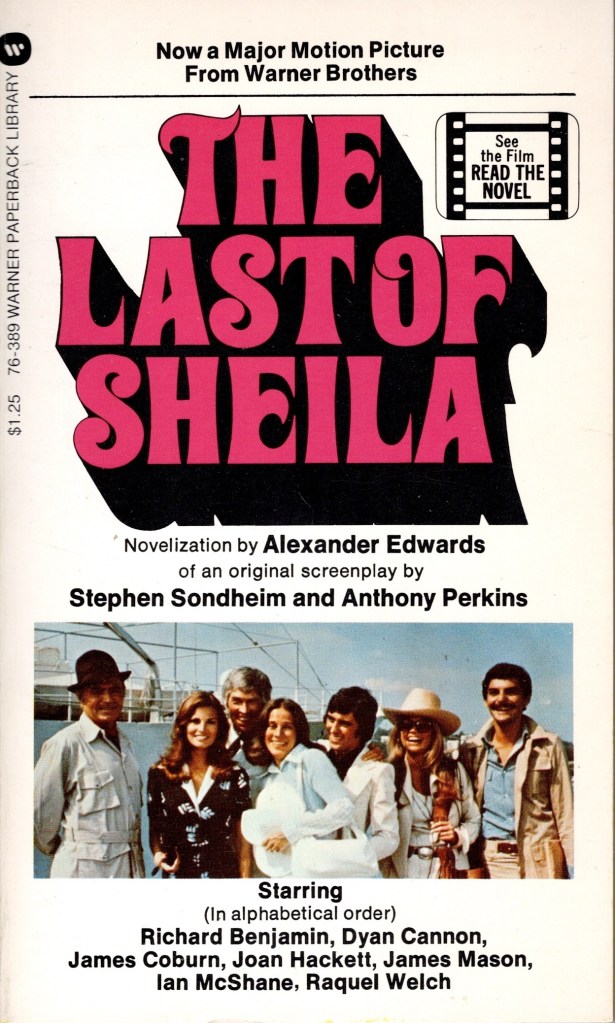
The Last of Sheila was one of those movies, and I fell in love with it as I watched. It had everything I could possibly want: an incredibly clever murder mystery, a cast of movie stars I recognized, and it was about Hollywood, even though set and shot along the Riviera. It was an inside look at the rich and glamorous–something I felt was like another planet to me in my subdivision house, in my lower middle class existence which was a place where I felt like I didn’t belong.

Shortly after seeing the movie, I was at Zayre’s with a couple of bucks to buy books with, and there were three I wanted–The Last of Sheila and two others, but I could only afford two of them, and I regretfully put The Last of Sheila back because I’d already seen the movie and I could get it the next time.

Constant Reader, it wasn’t there when I went back. I never forget there was a book, either–but I didn’t know whether it was a novelization or an actual book the film had been based on; and I didn’t mind reading novelizations, either. When I rewatched the film again during the pandemic, I remembered there was a book and started looking for it on-line. It was clearly rare and beloved, because whenever a copy would come up for sale on second-hand sites it was always priced anywhere from $150-$300, and I didn’t care about the nostalgic aspects of it that much. Then last summer two popped up on ebay; both more expensive than I would have liked but still–reasonable enough to consider. I put in a bid on one and then realized the other was a “buy it now”, so I went ahead and bought it. A few days later I won the bid–and a little confused, decided to go ahead and honor the bid since I had put one in but simply forgot about it, and I gave the other away to a friend who also loved the movie for Christmas.

And finally, I settled in to read it–after another, recent rewatch.

The Sheila rode at anchor, stern to the quay, stern lines fastened securely over the bollards. The Mediterranean sun glanced off the brightwork and made of the white hull a dazzling blur. Her eighty-seven feet dwarfed the sleek ketch on her port side, a racing vessel owned by the pretender to the Spanish throne, but the Sheila was in her turn outclassed by the ninety-five-footer on her starboard, a powerful yacht owned by a South African diamond billionaire. The Palma marina was, as usual in the summer, crowded with the pleasure craft of the wealthy, berthed as tightly together as possible, their anchor chains frequently fouling.

Lee Parkman swung her long slender legs out of the taxicab and stood somewhat shakily on the quay, shielding her eyes from the too-bright noonday sun that pierced even through the lenses of. her oversized sunglasses. Her legs still felt rubbery from the long, bumpy tide over the dursty roads that led from the Palma Airport to the marina. Mallorca was like that, she thought. The paradox of moderan airport and luxurious anchorage linked by an ancient and ill-kept road.

I don’t know if they still do novelizations of popular films as a merchandising gimmick–the cover of this one has a little admonition to see the film READ THE NOVEL and of course, the ever-popular Now a Major Motion Picture From Warner Brothers. There’s also a lovely cast photo prominently featured on the book cover–with the cast posed together in the same way they are in the photograph in the book, which holds the key to the very clever puzzle at the heart of the book, and what a cast of early 1970’s luminaries it contained! James Mason, Joan Hackett, Dyan Cannon, James Coburn, a gorgeous young Ian McShane, Richard Benjamin, and the fabulous Raquel Welch. All play, in a way, traditional Hollywood archetypes: Mason is the director fallen on hard times; Benjamin the writer who can’t get a script film so works on rewrites of other people’s work; Cannon the blowsy loud shark-like Hollywood agent (based on Sue Mengers, anyone remember her?), Coburn as the asshole abusive producer; Welch playing the stunningly beautiful actress with little talent; McShane as her loser husband/manager; and Hackett as the Hollywood heiress, whose father was a monstrous tyrannical producer like the Coburn character, married to the Benjamin character and the only thing keeping him out of hock.

Coburn’s character, Clinton, invites all the others for a week-long trip along the Riviera on his boat, the Sheila, named after his late wife, killed by a hit and run driver about a year earlier. Sheila was a gossip columnist that Clinton truly loved, but she was also a typical Hollywood rags-to-riches story. She started out as a call girl and worked her way up to gossip columnist and married a rich producer before her tragic death. The driver of the car that killed her was never found. He claims to want to produce a picture, a way to honor his dead wife, called The Last of Sheila, which he wants Benjamin/Tom to write, Mason/Philip to direct, and Welch/Alice to star in. They will also spend the week playing a game–each person is assigned a card, and every night they will get clues they will have to solve to figure out who has the card. Once the person who has the card solves it, the game is over for the night so you have to find out who has the card before the cardholder does to get a point. None of them really want to play–but once the first night gets underway, some of them get into it and some of them don’t. There are also all kinds of clues and hints that something a lot more sinister is going on below the surface, as the guests become uncomfortably aware that the game is really about them and their secrets…and then there’s an attempted murder, and then Clinton himself is murdered on the second night.

It’s a fantastic set-up, and it’s an incredibly clever plot. The film’s screenplay, from which the novelization was adapted, was written by closeted gay actor Anthony Perkins and Stephen Sondheim (yes, that same Stephen Sondheim), which also lends depth and insight into this world of cutthroat behavior, backstabbing, and vengeance. The novelization itself is one of the better ones I’ve ever read; they were usually cranked out quickly by a pseudonymous writer trying to make a quick buck (no harm there; I’d certainly write them if the price was right and they were still a thing) who basically simply turned the screenplay into a book, without getting much into the story or layers or character development. But this one of The Last of Sheila is the rare one that you put down when finished and think, Oh, there was so much more that could have been told there–and it even fleshes the characters and the backstory–and the motives–out even further. It actually helps with your appreciation of the film by giving necessary back story to the relationships between them and their individual motives, and I am very glad that I read it.

The Last of Sheila will always be one of my favorite films, because it remains fresh and interesting and its cleverness never stops amazing me every time I watch it.

And of course, Bette Midler’s “Friends” plays over the closing credits–after the perfect ending–which was also my first real exposure to the Divine Miss M, whose debut album I bought shortly after seeing the film and I’ve been a fan ever since.

How did anyone not know?