Science Fiction Double Feature

Lips! Lips! We want lips!
The first time I went to a midnight movie1 was when I was either eighteen or nineteen. I still lived in Kansas then, and the midnight movie was playing at the old movie theater on Sixth Street that was rarely open other than for some special occasion. They’d been doing midnight movies for a while before I went that first time, and I was going with a co-worker who promised me I was going to have an amazing time. I wasn’t so sure. The line outside the Granada Theater was a bizarre sight–many of them dressed up freakishly, and a lot of them were carrying paper bags full of stuff, which I also thought was odd.

I was about to watch, and experience, The Rocky Horror Picture Show for the first time.

I had no idea what was to come.

At the late night, double feature, picture show…
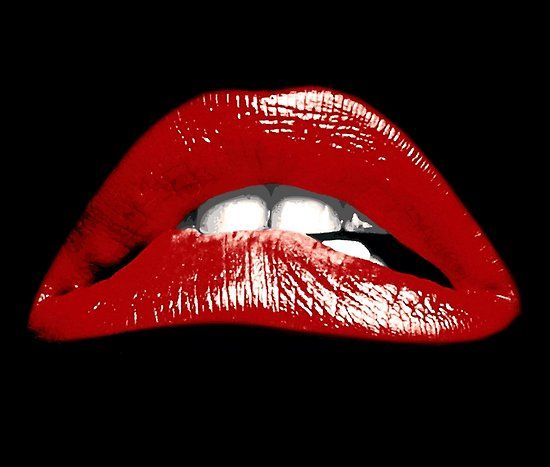
The crowd started chanting for “lips” as the lights in the theater went down, and then I saw what they were chanting for, as two bright red lips appeared on the black screen and started singing as everyone cheered….and started shouting responses to the opening credits.

And I liked the song.

What followed was ninety-eight minutes of insanity. I had never heard of an “interactive” movie before, and it really caught me off guard. How did people know what to yell, and when to yell it? They sang along with the movies, and I soon was caught up in it; getting sprayed with water, ducking out of the way of flying pieces of toast and toilet paper and tampons, and it was all so delightfully subversive in terms of questioning gender and sexuality. You still couldn’t swear on prime time television shows, and you definitely couldn’t say “sex” (I always hated the coy and cheesy ways television writers came up with as a workaround).

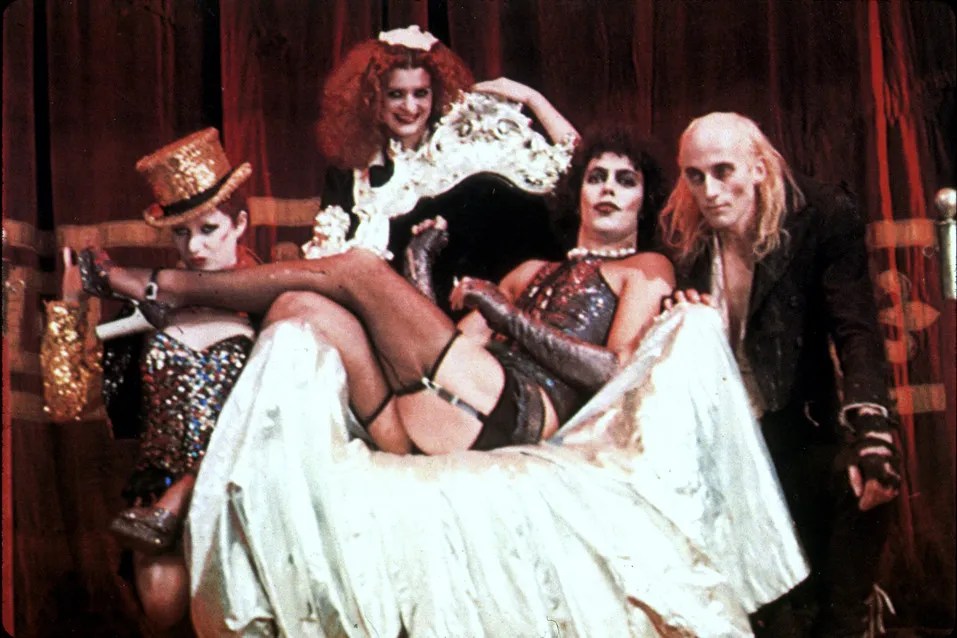
And then of course, there was Tim Curry’s Dr. Frank-n-furter.

I’d never seen anything like that before in my life…and I howled with laughter as he removed his robe to reveal what he was wearing beneath, and several people shouted in unison, “Ladies and gentlemen, Mr. Liza Minnelli!”
And after ninety-eight minutes of madness and mayhem, I was a convert. I walked out of the theater with my head still reeling from all the subversion a still moralistic 1970’s American culture had taught me was wrong on every level, disgusting sin and decadent morality, and I wanted more.

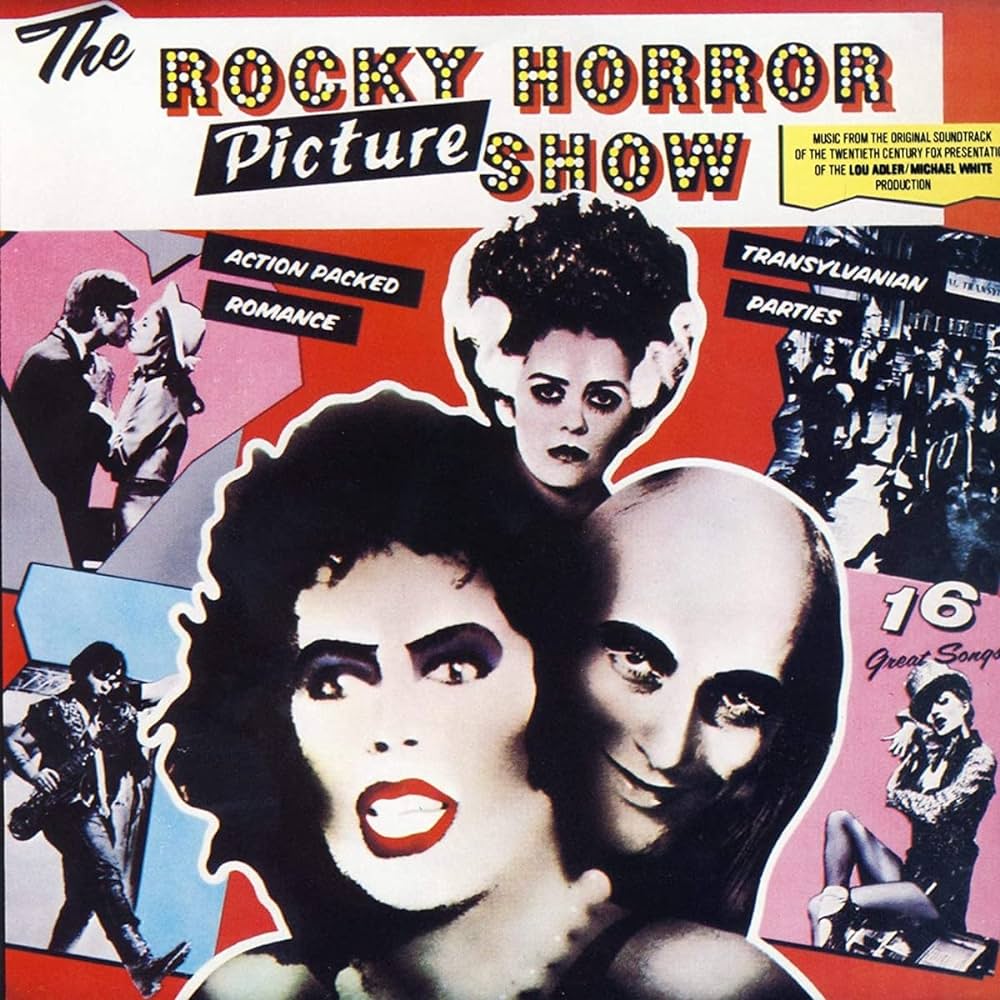
I bought the soundtrack shortly thereafter, both vinyl and eight-track, and it didn’t take long for me to have the entire thing memorized. I don’t remember seeing it again while I lived in Kansas–we moved to California shortly thereafter–but I did discover the theater in Fresno that showed it, and I started going weekly. It was more of a production in Fresno–people dressed up and acted out the parts in front of the screen (they tried to recruit me once to play Brad, but I said no; it would be over another decade before I was comfortable enough to wear only underwear in public; I was really uptight). Eventually, after memorizing the film and soundtrack, learning everything there was to know about the movie and play, I finally stopped going to the midnight movies. HIV/AIDS ripped a lot of the joy out of life in the 1980s for me, and once I was out of the habit of the movie, I was out of the habit and looked back on it as a past experience with nostalgia and joy.

The Rocky Horror Picture Show was the perfect amount of subversion at precisely the right time for me. It opened a world of possibilities to me, but at the same time, it made me very aware that I needed, more than anything else, to get out of Kansas. Much as I loved the movie, those memories of seeing it that first time–and the self-actualization and realization that came in its wake–are also tied up with my growing misery and dissatisfaction with living in Kansas. It’s also tied to discovering actual queer people in Fresno, and recognizing that even this little bit of subversion, something I could go see with the straight friends without any questions or fears, kept me going through the early 1980s as everything started turning even darker than they had ever been in Kansas.

Watching it on television just isn’t the same, either.

But the movie always holds a special place in my heart–and I imagine it does with many other queers for whom it proved an awakening of their true freak selves–and I became a lifelong fan of all the stars, whose careers and successes I followed…but one is now dead to me forever, and Her Name Must Not Be Uttered….and her being in the film has also kind of tainted its legacy with me.

But seriously, what a great movie. I may write an essay about the movie someday, you never know!

  1. I’m not counting the night of the senior prom, when the school districts got together and got the Twin Theaters (I think that was the name) to show a midnight movie to keep us all out of trouble. It was Smokey and the Bandit, by the way. ↩︎

Jambalaya

Louisiana is beautiful.

The state’s nickname is “sportsmen’s paradise,” because all of the macho male outdoor sports–hunting, boating, fishing–are available here in abundance. We’re also called the Pelican State (most prevalent) and several other nicknames, not all of which are complimentary.

Louisiana has always been a conservative state, despite the existence of New Orleans. Originally French then Spanish before becoming American, Louisiana also was a part of the Confederacy and had an economy based on enslavement. We weren’t that far removed from David Duke’s gubernatorial bid (which came all too close to succeeding), and I remember Paul had gone on site visits with his boss at the Arts Council south of the city, and came home saying, completely in disbelief, that “people had yard signs saying ‘this is Duke country’–and me replying, sadly, “in the South they don’t bother to hide the racism–they see it as a positive.” But you cannot really go anywhere in Louisiana without being awed by the natural beauty on display here. I love Madisonville, and the Tchefuncte River area. It’s always a lovely drive to take 90 east when you head north (yes, I am aware I am saying you take an east-west highway to go north; welcome to New Orleans), and head out through the Venetian Isles area and drive along that narrow strip of land separating the lakes, crossing the Rigolets bridge and heading into Slidell.

A while ago, I was following a Twitter conversation about Burt Reynolds movies from the 1970s. Mind you, when I was living in Kansas our movie options were limited. There was a drive-in movie theater on the way from our little town Americus to the county seat of Emporia, and there was a small twin cinema on Commercial Street. The summer before my senior year Smokey and the Bandit opened on a Friday, and the following Friday Star Wars opened in the other theater. Both movies ran for about three months….so I saw them both repeatedly as there was very little else to do. The 1970’s were an interesting time for depictions of rural Southern sheriffs; Jackie Gleason hamming it up and going completely over the top. This was also the same time period that gave us corrupt politician Boss Hogg and the inept sheriff and deputies he controlled. These were always played for laughs, but the thing is–there really wasn’t anything funny about these types of characters in real life. Political and police corruption have always gone hand-in-hand in the Southern states; the police merely existing to enforce and enable the existing power structure. That Twitter conversation, along with reading Ethan Brown’s Murder on the Bayou and the various true crime documentaries about the Jeff Davis 8, put me in mind of writing about that kind of corruption. But I also kept wondering, but is this still true in the South? Do these kind of corrupt power structures still exist in the South? Would this read like a period piece?

And then the Murtaugh scandal broke.

Guess what? It IS still like this in the rural South. Thanks, Murtaughs!

I already had an idea for the next Scotty, and was pulling it all together, using a relatively minor political scandal here locally as the starting point for the story–which involved a conservative politician getting involved with a teenaged boy who worked at the food court at a mall, mostly buying him presents–clothes, underwear, swimsuits–and having the kid send him pictures wearing it. The age of consent in Louisiana is seventeen, and the kid was over seventeen, but while still being an icky thing, it wasn’t illegal–and they never did anything beyond that. It was mostly a harmless flirtation, until the kid, who was gay, realized that the nice man buying him gifts was actually a hardcore far right family values politician, so he went public. I still needed a murder, but I thought it would be simple to come up with one–the politician would have every reason in the world to kill to protect his secret, and he had his parish sheriff’s department to help commit and/or cover up the crime.

I did borrow two of the Murtaugh crimes for the book, but as starting points more than anything else, and came up with my own theories of said crimes for my own story–I wasn’t writing true crime, after all, and I wasn’t interested in proving the guilt of the Murtaughs. What I was interested in was exploring the decline and fall of a politically powerful family that had controlled a parish in Louisiana for well over a hundred years, almost like an absolute monarchy with primogeniture. I had also originally started the story with the kid coming to Scotty and Frank (through Scotty’s old buddy and former workout partner, David, who now teaches at NOCCA) because he gets a text from an unknown number which contains one of the pictures he has sent his older male friend (that he doesn’t know is a family values politician), and is worried about his own future if the information comes out. I wrote an entire draft of this story, but it didn’t work and I didn’t care for it…which was when it clicked into place: use two of the Murtaugh crimes to start with, and built it out from there. I decided that the kid at the mall wasn’t the original target of the politician, and that the original target was killed in a hit-and-run accident the year before; I also used the boat crash, turning it from a boat hitting a bridge to a pick-up truck hitting a bridge and pitching the passengers in the back into the bayou.

I also liked the teenager/older man dynamic, because it had played out with Taylor in the previous book–and Scotty had his own past with an older man when he was a teenager, which I was finally able to circle back around to.

I also invented the parish–surprisingly enough, there is no St. Jeanne d’Arc Parish in Louisiana–but it’s based loosely on what are known as the bayou and river parishes (Terrebone, Lafourche, St. Charles, St. John the Baptist). I already had a fictional parish on that side of the river (Redemption), but I decided Redemption wouldn’t work for this book, so I made it a neighboring parish.

Come In With The Rain

And just like that, we somehow made it to Friday yet again. Good for us all! Seriously, at this point survival is about all we can hope for these days–what with the world aflame, all the hatred and divisiveness in our society and culture, a pandemic, and all this economic uncertainty. I’ve noticed on social media a tendency for people to be hesitant about terrific things that are happening for them, whether personal or professional or both, and to them I say shout it out from the rooftops! We all need to find some joy in this life and world these days, and for heaven’s sakes, don’t feel guilty because good things are happening for you during tough times!

And anyone who looks at your good news and finds it inappropriate or whatever–really should take a long, hard look at themselves and their values, because if you have reached a point in your life where you cannot be happy for other people’s good news….maybe you shouldn’t be on social media at all and need to withdraw to heal yourself for a while.

I’ll take any joy or happiness I can find anywhere in this year 2020.

We all should, frankly.

Wednesday I saw a notice on social media–link, post, whatever–about a television reboot of the old Burt Reynolds/Sally Field film Smokey and the Bandit, which was the second biggest money-making film of 1977 (behind Star Wars). I can’t imagine this happening, to be honest; Burt Reynolds and Jackie Gleason were fairly definitive, and if we’ve learned anything from the Adam Sandler remake of The Longest Yard, Burt Reynolds is kind of hard to replace. Smokey and the Bandit was a surprising hit–I don’t think anyone involved thought it was going to be as huge as it was–and it was fairly definitive of my senior year. We only had two movie theaters in Emporia, Kansas–one was the Twin Cinema, with two screens, which showed new releases (albeit months behind their arrival in major cities and markets; Star Wars opened in June but didn’t get there until August) and another, old classic theater style place, the Granada; one of those wonderful old movie theaters with the marquee that came out over the sidewalk. It was primarily used for art films and special occasion films and things like that; midnight showings of The Rocky Horror Picture Show, that sort of thing. Anyway, Smokey and the Bandit opened at the Twin the weekend before Star Wars, and both stayed for months, rather limiting teenage high school weekend dating options for kids in town and from the rural surrounding counties. I think I saw each of them about eight times each, at a minimum; there was literally nothing else to do. (There was also a late, after prom showing of Smokey the following spring, which, of course, my date and I attended because I clearly hadn’t seen the movie enough times.) I never saw any of the sequels, primarily because I was so burned out on the movie after my senior year; I rewatched it recently–several months ago, I think–and it was kind of a weird time capsule. Burt Reynolds was the sex symbol of the 1970’s for women–he never really did much for me, but I always conceded he was incredibly charismatic and probably a lot more talented than anyone gave him credit for–the open shirts, revealing a thick mane of chest hair; the mustache; the tight jeans; the big warm inviting smile that, whether he actually meant it or not, indicated a sly amusement at life and the world in general. It also reminded me that back in the day sales of Coors beer was illegal east of the Mississippi; that illegality was the driving force of the film’s plot. (Whenever we drove from Kansas to Alabama for our annual visit to the relatives and home, we always ‘smuggled’ cases of Coors for relatives–who primarily only wanted it because they didn’t have access to it.) Everyone drank Coors in Kansas; it was usually the beer on tap in bars, and there was never any question about, when making a beer run, what beer you’d get. I used to drink Coors all the time, and thinking about Coors reminded me that Coors was the first business I ever boycotted because of an anti-gay stance. I don’t exactly remember what it was–I think Colorado passed a horrific anti-gay law; Coors helped bankroll it; and the company itself was deeply homophobic. I stopped drinking Coors and have never had it since–even though Colorado has long since stopped being the ‘hate state’ and Coors may have even apologized and become more gay-friendly; I don’t know, I don’t remember, and I don’t drink beer at all anymore so it really no longer matters anyway. But boycotting Coors was my first-ever personal activism against homophobia, and thus kind of a step in my own growth and acceptance of who I am.

Wow, I really digressed there, didn’t I? Anyway, Smokey and the Bandit actually fits into the Cynical 70’s Film Festival because it is, after all, essentially a “fuck the law” comedy; if ever a spirit inhabited films of the 1970’s if was definitely fuck the law. The movie is about bootlegging, essentially; smuggling beer illegally across country, while breaking all speeding laws along the way–including being chased, and evading, the police. There’s actually an essay in there somewhere…it was also a time when CB radios were enormously popular, or at least they were in Kansas. Practically everyone had one in their car or truck (we didn’t) and I was always amazed that anyone could understand anything being said; whenever I was in a car with a CB and the driver would talk on it, I could never understand what was being said in answer over the radio.

Maybe that was the first sign of my hearing issues. It’s certainly the first time in my life I remember not being able to comprehend what I was hearing.

My lovely Apple adapter arrived yesterday and yes, it works and yes, I can now access my back-up hard drive again…which makes me so incredibly happy, Constant Reader, you have no idea. I feel settled again, if that makes sense, and now everything at my home work station is back the way it was, even if the screen is tiny and I keep getting annoying messages about my memory being depleted. But I can now make an appointment to take it in and have them look at it, and tell me what I need to do–or do it with an on-line Apple rep–and now all feels right in Gregalicious-world again. I also picked up my library books–Montgomery Clift: Queer Star and Confidential Confidential: The Inside Story of Hollywood’s Most Notorious Scandal Magazine–both of which are research for Chlorine.

Quite marvelous, really.

While making condom packs yesterday, I watched the original Fright Night for the first time. It may have been good when it was released, but it really hasn’t aged well–despite a clever concept. Chris Sarandon is great as the vampire next door, and Roddy McDowell as the horror actor/vampire hunter is terrific (despite some bad aging make-up; but in fairness, Roddy McDowell was good in everything), but everyone else is….meh. I was interested to see Amanda Bearse playing the female lead/love interest/reincarnation of the vampire’s old love (shades of Dark Shadows!); she was fresh off her role as Amanda, Liza Colby’s sidekick on All My Children, and years away from coming out as a lesbian. But yeah, it doesn’t hold up. I am wondering if that was why it was remade in 2011? But I’m not going to bother with watching the remake. Also–weirdly enough, in looking up information on the film, one of the supporting actors, playing the character of Evil, apparently went on to be in gay porn…an interesting career choice.

I also discovered full episodes of the syndicated Friday the 13th–the series on Youtube; the first season used to be on Amazon Prime but was unceremoniously yanked before I could finish rewatching. Back when the show was airing in the 1980’s it was great fun–Ryan and Mickey inherit an antique shop from their long lost uncle Lewis Vendredi; only then his old friend Jack Marshak shows up, tells them Lewis made a deal with the devil and everything in the shop was cursed–and they need to get every object back. It’s a great idea for a horror anthology series. It ran for three seasons and yes, it’s clearly made on a low-budget in the 1980’s, but it’s entertaining enough and I watched the first two episodes while finishing the condom packs yesterday.

Today I have to focus and get things done. When I was finished with work yesterday, Paul also finished with work and came downstairs, and we started watching another series on Apple Plus, Servant, directed by M. Night Shyamalan, and it’s creepy and weird and dark and interesting and we definitely were sucked in. It’s plot is kind of complicated and weird–but essentially a nanny with a lot of secrets comes to work for a couple who also have a lot of secrets…and each secret as it is revealed is an eye-opener and changes the story almost completely; Lauren Ambrose is extraordinary as the mom/newscaster/wife. It apparently aired the first season last year; the second season is coming in December. It’s weird and off-putting and perfect for October viewing, really.

And on that note, best to get to work. May your Friday be marvelous and wonderful.