The One You Love

Tuesday and back into the office. My energy spurt after getting home from the pre-operation appointments didn’t last for very long, I’m afraid, and by the middle of yesterday afternoon I was groggy and tired; adrenaline crash from the anxiety rollercoaster, no doubt. We started watching Happy Valley, which is certainly a grim show (I said to Paul, “it’s like a British version of Mare of Easttown“–although obviously Happy Valley came first, but they are very similar in tone and mood: bleak). But the acting and the writing is first rate, and we both are really enjoying it. They called in some prescriptions for me that I’ll need post-surgery, but apparently in checking the CVS website, I have to call them about the pain pills. Terrific. It’s always such a joy trying to reach a pharmacy on the phone. But I have to swing by uptown to get the mail after work today, and so I might as well call so I can pick everything up on my way home from the office.

I am way behind on everything, but I feel a lot better about the post-surgery period. I don’t know how long it’s going to take before the pain goes away, but I imagine I am going to be in a painkiller stupor for at least a couple of days, at the very least. I’ve never really had the kind of surgery where you’re put under and cut on since I had my tonsils out when I was three or four. That’s not bad–going sixty years between surgeries–so I really have nought to complain about, but I kind of wish I had more experience with it so I knew what to expect more; it’s the not-knowing that really triggers my anxiety. Now I am wondering about putting on shirts with the arm-brace on; am I allowed to take it off to put on a shirt if I put it right back on again? Doesn’t the arm need to stay in the same position, even when I am showering? Heavy sigh. They did send me home with a packet of information to read over, so I’ll be doing that today as well. I also have to get the paperwork for my leave finished and turned into Admin today. Heavy sigh. I do have the letter from the surgeon that is required, and I think I have everything I need. (More anxiety, hurray.)

I also need to practice putting the brace on, too. The demonstration wasn’t enough to make me think oh sure I can do this easily on my own with a bent arm.

For the record, I tore my biceps muscle in my left arm back in January. For a number of reasons I am not in the mood to go into right now, I am now finally getting the surgery to have the muscle repaired. It’s a long and slow and painful recovery process; I need to wear the brace for at least three to four weeks, and then it’s physical therapy for months until I get the clearance that it’s all healed and working properly again. I got the distinct impression yesterday that it’ll take about a week for me to be weaned off the pain medications–again, that’s fine, what choice do I have? I don’t know how much, if any, typing I’ll be able to do that first week, and besides, if my brain is scrambled on oxycodone, I wouldn’t be able to write and/or create much anyway. But it didn’t sound like things were going to be as terrible or as worst-case as my mind always seems to want to come up with.

It was also a cold and wet rainy day yesterday; we’ve not had rain in quite some time–not nearly as much as usual in our tropical clime–so the whole day had that undercurrent and wet and cold that I’ve not experienced in quite some time (last winter, to be precise) and so that was also off-putting. I felt cold all day, was wrapped up in a blanket in my easy chair as I doom scrolled social media, watched some documentaries on Youtube (the wives of Charlemagne; the separation of power between the Church and the Holy Roman Empire; and the Black Death), and also caught an episode of Moonlighting, in which Maddie’s mother thinks her husband is cheating so David and Maddie investigate. I also saw some social media posts about Moonlighting not aging as well as I had originally thought, which was worrying. I have such fond memories of the show, and I’ve been enjoying rewatching it, and I thought I was paying attention to the “well it was a different time” things–but I didn’t really see the show as misogynist as I feared it would be, and there were other things that I was certain wouldn’t hold up on–casual homophobia? Casual racism? Casual misogyny? It was written and filmed in the same decade that gave us such great misogynist comedies as Porky’s, Sixteen Candles, and Weird Science (don’t @ me; I don’t make the rules), so how could it not be problematic on some levels today? I’m also a little disappointed that my rewatching didn’t somehow note the red flags (I actually posted at one point that I was surprised it wasn’t more offensive); but it’s also the classic set-up arrangement for old-style screwball romantic comedies–one prim and proper character, another who is spontaneous and always up for a good time and both learn from each other as they grow together into coupledom. I know there are some issues in the old movies too–but I still love them.

Perhaps that might make a good essay?

And today is the official release day for Mississippi River Mischief!

And on that note, it’s off to the spice mines with me. Have a great Tuesday, everyone!

The Night They Drove Old Dixie Down

And what a fucking glorious night THAT must have been, seriously. I’ve always found it interesting that Joan Baez of all people recorded that song and made it a hit. Maybe I should take a look at the lyrics to see how they look from a modern perspective? That’s a thought. There’s so many things we didn’t even notice were problematic back in the day in our comfortable privilege. (I don’t think I can ever watch Sixteen Candles again, honestly, and it was one of my favorite movies. I’m not so sure what that says about me, either.)

Today is another day in the office; I am not sure but I think I have to help out with testing during the needle exchange program today–like I said, I don’t know, but I will be there if they need me. I have other things to do at the office–most of which feels a bit like ‘make-work,’ if I am going to be completely honest, but it’s also tedious little chores that need to be done, and so I might as well do it to fill my day otherwise it may not get done after all. This has been a very weird week for me; I’ve been tired most of the week when I get off work so I’ve not really been getting as much done as I need to be getting done, which means I really need to get motivated for this weekend. I can do that, of course…it’s not always easy, but I can do it. I just have to work on not getting distracted.

Which isn’t as easy as it may sound on paper. (SQUIRREL!!!)

We watched The Batman last night on HBO MAX and I have to say, I really thought it was outstanding. It was nice seeing Gotham City looking like, you know, an actual city as opposed to the dystopic nightmare it has been in almost every Batman film since Tim Burton first brought the Dark Knight to the silver screen back in the 80’s. I also am very impressed with Robert Pattinson, who might be the most interesting iteration of the character yet–and seriously, how did the sparkly vampire from Twilight turn into one of the most interesting and talented young actors of our time? Zoe Kravitz can also be added to the list of well-cast Catwomen from over the years, and there was actually a plot to follow that involved Batman using his investigative skills to solve the mystery and find the Riddler–another excellent take I’d given up on seeing on the big screen–and overall, I didn’t really notice that the movie was nearly three hours long because I could follow the plot, it made sense, and the character arcs were well developed. I think we’re going to rent the most recent Spider-Man (No Way Home) this weekend–I do love Tom Holland–and then we need to figure out something else to watch. A lot of good stuff dropped during the Festival and its aftermath–so we can have our choices of things to watch for quite some time, methinks, which will be really nice. BUT I HAVE TO GET WORK DONE THIS WEEKEND BEFORE I LEAVE FOR NEW YORK OTHERWISE IT WON’T GET DONE UNTIL I GET BACK AND THAT IS SIMPLY UNACCEPTABLE.

Most of all, I need to get that fucking short story written.

I really need to get motivated to get writing again–and I need to start going back to the gym as well. My weight hasn’t fluctuated very much since I went down to 200 and ballooned back up to 212 again; I’ve been a pretty steady 210-212 since then, and while I always thought that 200 would probably be the best weight for me, maybe my body is telling me 210 is where it prefers to be? I know I could, with discipline and hard work and proper eating, maybe get back to below 200 but my word, what a lot of work that would be and since I really no longer obsess about how my body looks (one way in which getting older has been beneficial; I really do not miss those days of body dysmorphia and constantly berating myself for not looking like a Calvin Klein underwear model), I don’t think I have the dedication anymore to do that again. It’s hard enough finding the time to go to the gym in the first place, let alone start eating in a different way and counting carbs and all of that nonsense. No thanks, not for me this time around, thank you very much. I suspect that the mild depression I’ve been dealing with over this last month or so has a lot to do with the not-writing and not-working out aspects of my life. That loss of serotonin probably has everything to do with it. I really need to focus.

I also still haven’t picked out my next read. I am thinking about rereading something–or maybe I am going to give Hemingway another try (Don’t Know Tough had a whole thing about the main character reading The Old Man and the Sea–which, along with A Farewell to Arms, I was forced to read in high school which gave me a deep and abiding distaste for Hemingway). I have a copy of To Have and Have Not, which is, in theory, Hemingway’s only crime novel–it was certainly made into a classic Bogart/Bacall movie–but every time I think about Hemingway I groan inside. But maybe now I am old enough to appreciate Hemingway–I also read Fitzgerald when I was too young, but I’ve always enjoyed Faulkner, which is weird. Maybe because he writes about the rural South? I’ve wanted to give Sanctuary another go for quite some time now as well.

And on that note, I am heading back into the spice mines. Have a happy Friday, Constant Reader, and I will talk to you again tomorrow.

Gorgeous

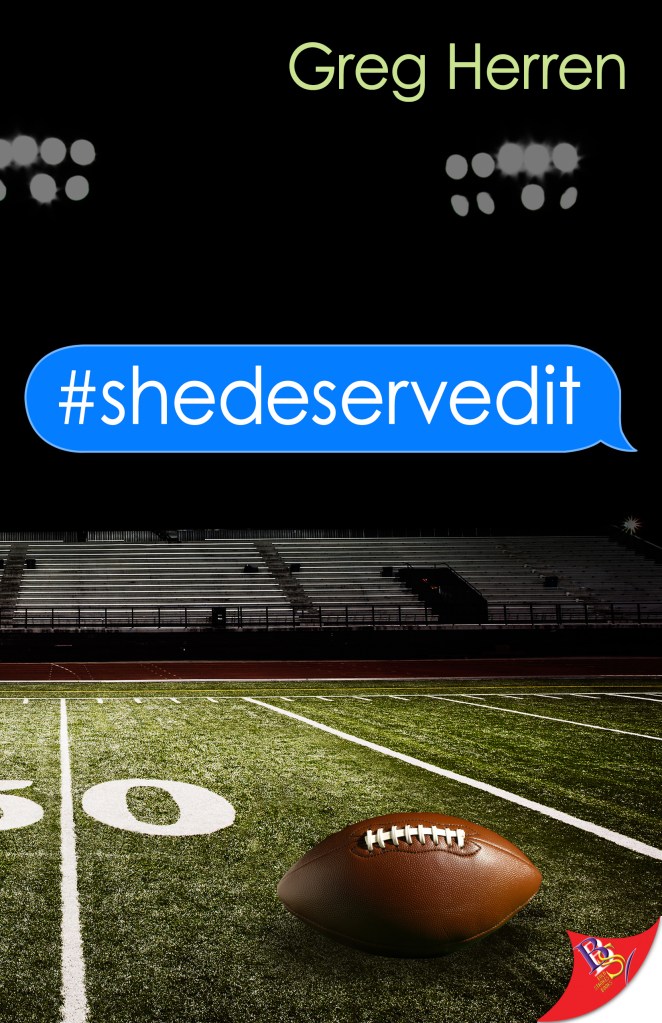
So, as Constant Reader is aware, I’ve been working, off and on, since 2015 on something that I referred to for years as “the Kansas book”, whose actual title is #shedeservedit.

It will be released on 1/11/22 officially; if you pre-order it from the Bold Strokes website, it will ship actually on January 1 (well, probably the 2nd since the 1st is a holiday).

Here’s the cover copy:

Liberty Center High School’s football team has a long history of success, and the dying small town has nothing else to cling to. But when Lance, the star quarterback, is found dead, Alex Wheeler becomes the prime suspect in his best friend’s murder. Alex thought he knew Lance’s secrets–but Lance was keeping his sexuality private and someone else found out. How well did Alex really know Lance, and what else did he keep hidden? 

To prove his innocence and figure out what really happened to Lance that last night, Alex starts connecting the dots and finds that everything leads back to the recent suicide of a cheerleader who may have been sexually assaulted at a team party. Did online bullying and photos of her from the party drive her to suicide? Or was she murdered? Alex and his girlfriend India soon find their own lives are in danger as they get closer and closer to the horrifying truth about how far Liberty Center will go to protect their own.

I’ve been writing what I had taken to calling “the Kansas book” since I was in high school, really. While I was in high school I wrote several stories about a group of kids at a fictional high school, completely based on my own, and while it was certainly melodrama…we also didn’t have shows for teens like Beverly Hills 90210 and movies for teens like Sixteen Candles, Fast Times at Ridgement High, or Risky Business yet; all “teen fare” at the time was mostly from Disney, G-rated, and farcical; likewise, television programs targeted toward younger viewers were mostly for really young kids or what we now call “tweens.” And while I had crushes on both Kurt Russell and Jan-Michael Vincent (who didn’t?), those Disney films were little better than The Brady Bunch. I think it was in 1980 when I decided to take those stories and extrapolate them into a longer story, thinking it would be my first novel–and it expanded from the kids to include their older siblings and parents and teachers as well. I moved the story from the rural county to the county seat, and over the course of three years I painstakingly wrote about three thousand notebook pages. It was a sloppy mess, to be honest; I was thinking in terms of writing something along the lines of Peyton Place–the story of a town over the course of five years–but as I wrote I dropped characters and storylines; changed character names when a better name occurred to me; as I said, it was a total mess…and when I completed it, in the days before computers, I realized that I needed to type the entire thing up, and alas, I didn’t know how to touch type and whenever I typed anything I consistently made errors. So, I simply set it aside and went back to writing short stories before starting, in 1991, to try my hand at novels again.

In the years since, I cheerfully pulled elements from that ancient manuscript out to use for other books and other stories–there was a murder mystery at the heart of the book, and I actually used that as the basis for the plot of Murder in the Garden District; apparently I have always had crime in mind when it came to my writing–and I also pulled character names and other stories from it to use elsewhere. I reverted back to the rural county aspect of the original short stories to write Sara; one of the things I had to do recently was go through Sara and anything else I’ve written and published already having to do with Kansas to record the character names to make sure I wasn’t using them again in this book. I also originally began the basics of this book sometime before Katrina–the star quarterback’s dead body being found on the fifty yard line of the football field, and originally the primary POV character was the only detective on the small town’s police force. What I wrote was really good–I believe I got up to about five chapters–and it was also a flashback story with parallel time-lines; one in 1977, when the quarterback was murdered, and the present day, with someone who was in high school at the time becoming convinced that the person convicted of the crime was actually innocent and railroaded as a cover-up. I could never get the whole plot worked out, and it went through several changes and stages as I worked on it, still being called “the Kansas book.”

Two real life crimes–the rapes in Steubenville, Ohio and the other in Marysville, Missouri, in which girls were either drugged or pressured into over drinking and then when too wasted to even speak were sexually assaulted by athletes–inspired me to drag the framework of this story out and use it to tell a similar style story. I was, like anyone with a conscience or a soul, horrified by these rapes, and even more horrified by the aftermath; the way the girls were humiliated and shamed publicly and on social media, and I couldn’t get a hashtag that the kids in one of the towns used while shaming the victim: #shedeservedit.

That, I felt, was my title, and I could build the story from there. I could still have the dead quarterback; I could still have the town reeling from the one-two punch of the rape and the murder, only now I could layer in the victim-blaming and shaming. (I will never forget female newscasters talking about how sad it was that the boys convicted for the Steubenville case’s lives were ruined; I saved my sympathy for the poor girl they victimized; how on earth would she get past this?) I wrote the entire first draft in one month in the summer of 2015, and have tinkered with it, off and on, ever since. It was early last year, I think, pre-pandemic, when. I finally decided that two books I’d been working on between others over the last few years needed to be done and out of my hair; and the best way to force myself to finish them both once and for all was to offer them to my publisher. I did that, was given deadlines, and now, as I am finishing the final version of #shedeservedit, I also have a release date (1/11/22) and a cover to share with you all, so here it is (obviously, see above).

Writing this has been a journey, as writing any book can be; the Imposter Syndrome reared its ugly head numerous times during the writing of this book–should a man be writing a book about this subject? Is telling such a story from the point of view of a young man, friend to both the rape victim and the rapists, the right way to tell it? Am I centering a young man in a story about sexual assault and the toxic rape culture that has grown up around a small town’s athletic success?

I guess time will tell.

Treacherous

And it’s Saturday, and my vacation is slowly but surely drawing to a close. Heavy heaving sigh,

It’s been lovely, actually, even if I haven’t been particularly inspired to do a whole lot this entire time. It’s always easy–and kind of a cop-out–to say, well, you needed the physical, intellectual, and emotional rest, but I really need to cut myself a break every now and again. The endless struggle between “feeling lazy” and “everyone needs a break” is an endless war inside my head; inevitably, the things I need to get done will get done and at some point, I’ll forgive myself for the rest.

I had a very strange inspiration for a short story the other day, which I scribbled down and have some vague idea of where the story will go; it’s called “The Sound of Snow Falling” and the first line is: It was the ice storm that finally broke him. I love that first line; whether it will wind up being a good story remains to be seen. But one thing I’ve never mined in my fiction is my utter hatred for cold weather; perhaps it’s time.

I actually worked on the book yesterday afternoon! It was lovely, and while it still needs polishing up some, I am confident that now that I’ve gotten past whatever the fuck it was that kept me holding back from working on it, I am certain I am going to get this done sooner rather than later–which is a very good thing, as time is running out very quickly. Today I have to run some errands, so I am planning on working on the book before I do that. The Iron Bowl (Auburn-Alabama) is today, and LSU plays Texas A&M tonight, so I need to try to get as much done as I can before the 2:30 kick off.

I did go to the gym yesterday and today my back muscles are sore and tight, so I am going to need to use the heating pad at some point today–probably while I drink more coffee and read some more of Night of Camp David, which is kind of scarily prophetic, given it was published originally in 1965. We also watched this week’s episode of The Mandalorian, which did a marvelous job of tying the show into the the original trilogy, the prequels, and the final trilogy–apparently, it also tied the show into The Clone Wars, which I’ve never watched (and perhaps should). We also found out the Child’s name–Gorgu–and as always, the show was enormously entertaining (also: a guest spot by Michael Biehn, of The Terminator and Aliens fame!) and visually stunning and splendid. It did occur to me last night that the show–in which the Mandalorian’s quest is to find Gorgu’s people–can’t ever really separate them, as their relationship is at the beating heart of the show.

The show is really one of the highlights of my every weekend, frankly.

We weren’t ready for bed yet, and were trying to find some stand-up comedian special to watch before hand–to no avail–when Amazon Prime suggested Porky’s to us. I had actually run across the movie when looking for things to add to my watchlist, and the film–from 1981–was a watershed moment in “teen movies”–when they turned from the unrealistic fluff from Disney or message movies to sex comedies. I assumed the movie wouldn’t hold up–I remember thinking it was really funny when I was twenty and saw it in the theater–and I was correct; the humor falls very flat in almost every case; the way women are treated–and the way they are expected to simply put up with it (and do) is horrifying, It’s a comedy predicated on the idea that high school boys are always horny and always trying to get laid–none of the boys have a relationship of any kind with any women–and the only female cast members exist only as potential sex partners–Wendy is the female equivalent of the boys, and despite her easy way with her own favors, (basically the boys see her as a willing sex partner who can be persuaded to have sex with just about anyone) she is actually popular and has a lot of friends. (This struck me as wrong when I originally saw it–she would have had a bad reputation-and none of the girls would have been friends with her) The other women in the cast are Miss Honeywell (a very young Kim Cattrall)–again, everyone calls her Lassie because she gets very aroused by the smell of the equipment room and howls loudly as she gets laid–and an uptight, overweight, gym teacher known as Beulah Ballbricker, that they all call Ball-breaker and I suppose her sexual repression and determination to keep the girl students safe from the lusts and perversions of the boys is played for laughs. She represents the sexual frustration and repression of the time, I suppose, that all the kids are rebelling against; but you also can’t help feel sorry for her in some ways.

The movie clearly doesn’t hold up–there are still some moments that are funny–but it depends entirely too much on very low sex humor for laughs, and its very vulgarity was what made it funny; it was shocking, and you would laugh back then because you couldn’t believe they were doing these things in a movie for laughs. Some forty years later, it’s no longer shocking, so it’s not funny anymore and it’s just plain vulgar. They also tacked on a subplot about prejudice and anti-semitism to, I suppose, give the movie a “serious” message about how stupid bigotry actually is in reality. And yet it–along with Fast Times at Ridgemont High and Animal House of a few years earlier–changed the teen movie forever, and paved the way for other movies of the 1980’s like Risky Business, Sixteen Candles, and The Last American Virgin. With the enormous success of this low-budget indie film, along with Ridgemont High and Animal House, Hollywood finally got the message that you can’t go wrong with sex comedies for teens–and teen movies, while still kind of extreme in some ways, began to more accurately reflect what life was like for teenagers, as opposed to the Frankie-Annette movies of the 1960’s and the Kurt Russell films for Disney in the 1970’s; or began developing films in which the teens were actually fully realized characters–I’m not sure how realistic the notion of running a brothel from your parents’ home in a wealthy suburb is. (Although now that I’ve said that, Risky Business was probably based on something that actually happened.)

There’s a really interesting essay or dissertation or even book there, methinks, but I’m not enough of a film expert to do such a thing–although it would make for interesting reading.

And on that note, I am heading into the spice mines. The caffeine is beginning to kick in, which is most lovely, and I am most anxious to get functional and to work on the book as quickly as I can. Have a lovely Saturday, Constant Reader.

You’re Not Sorry

There are few things I despise more than the non-apology.

These tumultuous times in which we find ourselves inhabiting now has, amongst its innumerable other crimes, introduced the world to the apology that really isn’t an apology; in which someone refuses to admit fault and isn’t sorry for what they said; they’re merely sorry you misinterpreted what they said. It generally runs along the lines of something like I’m sorry if my words offended anyone–which, to me, kind of places the blame on the people who were offended by the shitty thing said in the first place–and usually, for the record? What was originally said was pretty fucking offensive; insensitive to the point where I have to seriously question the empathy and humanity of the speaker, and generally leaves me feeling sorry for anyone related to said speaker, or who is forced to have to interact with them in any way, shape or form, because of work.

This happens constantly these days; it’s become sadly predictable: someone says something incredibly shitty, people are justifiably shocked, horrified and outraged, which inevitably leads to the person apologizing for their words, but at the same, they are also very careful not to take on any blame themselves. I don’t understand this mentality, but it’s a linguistic knot people are always very careful to tie with precision: I’m sorry what I said offended you, not I’m sorry I offended you by saying that. The difference is pretty clear; the first relieves the original speaker of any fault and places all blame on the people taking offense (really, it’s just gaslighting); while the second accepts blame and begs pardon and is actually a sincere attempt by a decent person to take responsibility and implies a promise to do better in the future.

And personally,  I don’t accept these non-apologies. I find them, frankly, to be worse than the original offense. My response? “Seriously, go fuck yourself. And yes, I fully intended to offend you and I am not sorry at all; in fact, you might to fuck off now before I really focus on hurting your feelings–because I can, and am quite good at it.”

I’m not sure when we as a people, society and culture ceased being able to admit we were wrong, admit fault, and promise to do better. What is so terrible about being wrong? We are all human, and we all make mistakes, don’t we? It’s inevitable; it’s embarrassing somewhat, but seriously–the world will not end if you ever admit you’re wrong. I’ve admitted I’m wrong and apologized even when I didn’t think I was wrong in the first place–because it isn’t about MY feelings.

I guess thinking about other people’s feelings isn’t something we do anymore? When, precisely, did that change? Or was the whole “care about others” thing just another part  of the massive gaslighting of me about everything else this life has turned out to be, from politics to history to religion?

I will admit it here, I will admit it there, I will admit it everywhere. I’ve been wrong many times in my life, and will probably be wrong quite a few more times before my ashes are sprinkled into the Mississippi (although I am beginning to think I may have some of them sprinkled there and some sprinkled into the Rigolets; I must remember to make provision for that in my will–and yes, now that I am in my sixtieth year, I need to start thinking about those things and taking them a lot more seriously than I have in the past). I see this bizarre “refusal to ever admit error” every day on social media–not as much as I used to, as I tend to unfriend and/or hide narcissistic sociopaths who have nothing better to do with their lives and their time than to troll people on the web as a way of making themselves feel superior to other people. To paraphrase  Sixteen Candles, “why do you want to be King of the Dipshits? Well, you can hold court without me, O Wise and All-Knowing One.”

I know I should be more tolerant, but I have neither the time nor the patience to deal with this kind of trash any longer, nor do I want to see it on my feeds. And as I grow more and more conscious of how little time I may have left in this world–I certainly don’t want to spend what there actually is left listening to this kind of nonsense anymore.

Enough! Life exposes me to enough toxicity that I cannot control; but I can control what I chose to see on my social media. And if you want to smugly assert that I am fooling and deluding myself by putting myself into an echo chamber–feel free to assume your moral and intellectual superiority. I, for one, am tired of being exposed to homophobia and racism and misogyny and bigotry and prejudice and ignorance; I’ve been around it my entire life and I’d really prefer not to be around it anymore.

Ugh.

I am also, in an effort to control this narrative that my life has become, trying to be more positive about things. Yes, I recognize the irony in that this entry began as a rant about awful people and their gaslighting ways; but cutting as much negativity as I can out of my life like the cancer it is will be the first step in looking at the world in a more positive light. It would be very easy to look at yesterday and think, ah, yes, started out the day terribly behind and after an enormously frustrating day where everything that could go wrong did, I am choosing to look at what I managed to get done, despite the endless frustrations, as a triumph. I did manage to get some organizing done. I got some research notes recorded for a future project. I got some chores around the Lost Apartment done, and tried to organize my computer files around a computer update that came out of nowhere and really annoyed the hell out of me at the time. It took a while–it always does after these things–for my computer to go back to functioning properly, but this morning it’s running better than it has in a while. So, I guess there’s that. I’m trying not to feel like I lost the day yesterday, and being frustrated and annoyed with the circumstances beyond my control isn’t going to help me get anything done today.

I started reading Celeste Ng’s Little Fires Everywhere, and as I got through the first two chapters I began remembering the show more. The book is so well-written, and I love how Ng puts these little touches of truth in to deftly set the narrative up very quickly; after a mere two chapters I know what Shaker Heights is like to live in, the kind of relationship Mia and Pearl have, and the entire family dynamic of the other family–parents with their children, the children with each other. I can’t stop wishing Id read the book along with the show, but that cannot be helped now, and I’m really enjoying the book.

I slept later than I wanted to this morning, but then again I stayed up later than I’d intended to last night as well. We watched another HBO MAX documentary show, in two parts, Who Killed Garrett Phillips? Coming hard on the heels of The Case Against Adnan Syed, Paul and I have been having good conversations about just how broken our criminal justice system is. I’ve also been seeing some great conversations on social media between crime writers about this very thing as well, and about how we, as crime writers, are also sort of complicit in the perpetuation of the mythology of the infallible police department. The enormously popular Law and Order franchises have done an excellent job of depicting criminals as scumbags and our Constitutional rights as essentially “get out of jail free” cards that keep the good, hardworking cops from putting away the dangerous criminals that prey on every day citizens. Obviously, it isn’t that black and white, and there are many more shades of gray involved; people also tend to forget the entire point of our Constitutional rights are to protect everyone against abusive conduct from the state. Is it incredibly frustrating when someone isn’t convicted of a crime? Sure, but how do we–how does anyone–ever know that someone actually is guilty if theres little to no evidence one way or the other? I am stunned, frankly, that Adnan Syed was convicted based on how little evidence there actually was against him, other than someone who was pretty much an unreliable witness who testified against him. The multiple years of the Potsdam police and district attorney’s office trying to hang the murder of Garrett Phillips on a black man when the only evidence of anything they had against him was that they were in the school parking lot at the same time was completely racist and insane; they didn’t even look at anyone else or at any other option. Within 24 hours, based on NOTHING, they became convinced that one of the few black men in the area, an ex of the child’s mother, was guilty and only looked for evidence that would put him behind bars. It was infuriating to watch, frankly.

And it does make you wonder how many people who didn’t do anything wrong are sitting in jail right now.

I’ve briefly touched on this from time to time in my books; I know for a fact that I said once–probably in a Chanse book, but I don’t remember which one–that the cops decide early on who’s guilty and stop looking for facts and information that don’t bolster the case they are building. The question I’ve seen a lot on social media lately is whether we, as crime writers, are complicit in building up a mythology of police work as opposed to the reality. It’s a difficult question, one that is very nuanced, and brings up many philosophical questions as well. J. M. Redmann always says that we as writers write about the search for justice in a world where justice is rarely found; I think about that a lot when I write. I know that I also prefer to end my books with a criminal caught and behind bars; even if the justice is Pyrrhic, at least for a time, at the end of my books, the bad guys are in jail and order of a sort has been restored to the worlds of my characters. I never talk about the trials; I’ve thought about using Chanse testifying at a trial as a framing device for one of his investigations, but it was something I never got around to doing; Chanse novels inevitably always follow the A leads to B leads to C structure Ive used since the beginning; Scotty books inevitably do that as well, even if the story skitters about a lot more in a more confused pattern than the Chanse one do.

As citizens, we don’t like to think that our justice system has become corrupted or broken, or that it operates in a way that isn’t fair to everyone; in order to maintain our semblance on sanity (or what passes for it) far too many of us are willing to look the other way or just believe what we are told. In Who Killed Garrett Phillips? so many of the people of that small town simply found it so easy to believe that the black guy must be a killer (and did so very quickly) and when the cops told the family he was the guy, they simply believed it and never questioned it–likewise, the Korean family of the victim in The Case Against Adnan Syed never questioned the police and district attorney’s viewpoint that Hae Min Lee’s ex-boyfriend was so jealous of her new relationship that he would, with no previous indication before or since that he was that kind of person, plan to kill her and then execute the plan; a grieving family will always believe what they are told by the police, and nobody ever wants to question why they are so quick and easy to believe what the police say mainly because we want to believe they are right, because if we ever stop believing that the police aren’t impartial, that their investigations aren’t carried out in a professional, unbiased, and impartial way, then what happens when we need them?

The abuses in the Garrett Phillips case carried out by the now-sanctioned former district attorney, Mary Rain, and her obvious racism and bias was appalling to see, and disheartening. We may never know who killed that boy now, and it’s partially her fault; her determination to convict an accused black man and absolute refusal to even consider for a moment that he might not have done it, to follow any of the myriad of other leads that were possible, is a horrifying abuse of justice and power. And never fool yourself that prosecutors don’t have a lot of power, or that they can abuse that power for any number of reasons, not the least of which is political power and furthering their own political careers.

I had an idea recently–time has no meaning any more, so it may have been any time during the past three years–about writing a book about Venus Casanova’s last case as a New Orleans police detective. Having put in for retirement already, in her last month she’s been assigned desk duty to ease her out of the workforce–obviously you don’t want to assign an active case to someone who might not be able to see it through–and she’s essentially catching up on all of her paperwork and interviewing suspects for other detectives’ cases in her remaining time. Her ritual has always been to go out to the neighborhood coffee shop before going to work and reading the paper over her coffee. With less than a month to go she reads about a shooting of a young Black man in a sketchy neighborhood–but soon realizes that the young man’s grandmother, who was raising him, was someone she went to high school with many years ago and lost touch with when she went away to college. She decides to check with the investigating officer, and he tells her “it’s just another random shooting.” (The book would be called that, Just Another Random Shooting.) He’s not going to look into it anymore, dismissing it as another drug related crime with no witnesses and no evidence, and so she asks if he minds if she talks to the grandmother–and it turns out to be something else entirely; and that lackadaisical response from the police–‘just another random shooting’– was something the killers planned on. It’s an interesting idea, and it worries at my brain from time to time, particularly when I see another local news report about another young Black man being killed for no apparent reason in a sketchy neighborhood. And then I wonder, am I the right person to tell this story? Who am I, as a gay white man, to write from the perspective of a straight Black woman in a city with a violent history of oppressing people of color?

I can think of any number of reasons to justify writing from Venus’ perspective; I’ve always loved the character, I’ve always wanted to write from her perspective; I’ve thought many times over the years of centering her in a book about her; I feel like I know her inside and out already.  But…on the other hand, sure, writers write and have a right to write about whatever they choose, but….

It is a good idea, though, and I also don’t see the story working from any other point of view. Sigh.

And now back to the spice mines.

IMG_4211

Stay

We did finish watching Castle Rock last week. I’m not really sure what to think of it, but I probably should watch the finale one more time just to be sure. I was playing with my phone–getting text messages–and I may have missed something key.

Either that, or the finale simply made no sense.

Which is, I suppose, a possibility.

I did write yesterday, not nearly as much as I wanted to or would have liked to, but despite all of my best efforts the words simply weren’t coming as quickly or as easily as I would like. I can remember, years ago, putting Madonna or Stevie Nicks or Fleetwood Mac CD’s in the stereo and hitting shuffle, sitting down at the computer and then several hours and thousands of words later realizing there was no music playing anymore and the afternoon was gone. Now, I feel like I am always scrabbling to get some work done between interruptions and distractions. It’s okay–the work is getting done, if at a slower pace than I would prefer–but I do miss those blissful afternoons writing away like a madman.

I’ve been mulling over my y/a about rape culture. As I said yesterday, I had thought (oh, innocence) that in the years that had passed since Steubenville that it wasn’t timely anymore. Yeah, that. It is amazing that at age fifty-seven I can still be so fucking naive about the world in which I live. I read a terrific essay the other day on Vox about how one of the greatest teen rom-coms of the 1980’s, Sixteen Candles, is actually deeply problematic (I’d already recognized its racism years ago), which also sent me into a deep think about other movies aimed at the youth market in the 1980’s and how problematic they are: Revenge of the Nerds, Risky Business, Weird Science, The Breakfast Club, Fast Times at Ridgemont High (less so than the others), Valley Girl, and The Last American Virgin, among many others–and we can’t forget (no matter how hard we try) Porky’s and it slew of even worse sequels. I also started reading Dead Girls by Alice Bolan; which is well written and very interesting. (Every so often I think I would like to write creative non-fiction; I would love to write a critique of the bury your gays trope which would also deal with how gay men are depicted in crime fiction, as well as piece on Gothic romantic suspense novels from the 1950’s through the 1980’s, posited on the premise that these books were noir for women; but then I read something like this book and think, not educated or well read or smart enough.)  I also think there’s a book in a critical reexamination of teen films/books/television programs and how they handled gender roles and sexual assault in the 1980’s.

I am also seriously considering learning how to speak Italian…although French would probably be better for research purposes.

And the Saints won!

And now back to the spice mines.

40406659_292290734896055_5601432137682124800_n

Crazy for You

Wednesday morning, and I am awake ridiculously early. I actually woke up just before four, but stayed in bed until six–at which point I got out of bed and figured might as well be productive instead of just laying here staring at the alarm clock. It’s also my long day at the office, but c’est la vie. It is what it is. If anything, I should sleep really well tonight, at the very least.

I didn’t read any short stories yesterday, alas, as I spent most of my weekend reading Karen McManus’ One of Us Is Lying, a huge phenomenal bestselling young adult novel that’s being adapted as a TV mini-series, a la Thirteen Reasons Why.

Scan

Bronwyn

Monday, September 24, 2:55 pm.

A sex tape. A pregnancy scare. Two cheating scandals. And that’s just this week’s update. If all you knew of Bayview High was Simon Kelleher’s gossip app, you’d wonder how anyone found time to go to class.

“Old news, Bronwyn,” says a voice over my shoulder. “Wait till you see tomorrow’s post.”

Damn. I hate getting caught reading About That, especially by its creator. I lower my phone and slam my locker shut. “Whose lives are you ruining next, Simon?”

Simon falls into step beside me as I move against the flow of students heading for the exit. “It’s a public service,” he says with a dismissive wave. “You tutor Reggie Crawley, don’t you? Wouldn’t you rather know he has a camera in his bedroom?”

Well, that’s a start, isn’t it?

The book is sort of a Breakfast Club turned on its ear;  if one of the student archetypes from that film had died during detention and all the other kids in there had a reason to want him dead. It’s a clever idea (one I am kicking myself for not thinking of myself), and the story is, above all else, compulsively readable. The book is told in shifting first person point of view; we get inside the heads and see the viewpoint of all four of the kids who are now suspects, which isn’t an easy thing to do McManus not only takes us there, but by seeing their lives through their eyes–their families, their relationships with friends, their ambitions and goals and so forth–we as readers begin to care about them, which makes knowing that one (or more) of them might be a killer even more problematic for the reader because you become emotionally vested.

Like The Breakfast Club, McManus takes the typical student stereotypes–the brain, the jock, the criminal, the beauty, and the outcast–and turns them on their ears.

In the 1980’s, the teen movie was reinvented and made much more real, more relatable, and more fun than what those that had come before. Serious films about teens were usually told from the point of view of the adults (The Blackboard Jungle, Up the Down Staircase) with an occasional exception, like Rebel Without a Cause. The 60’s saw the teen movie evolve into beach and surfing movies, and of course the Disney films like The Computer Wore Tennis Shoes and Now You See Him Now You Don’t–silly comedies that viewed teen life as though it were something frozen in time from the 1950’s (and even that wasn’t particularly realistic–malt shops, sock hops, etc) But beginning with Fast Times at Ridgemont High, the teen films of the 1980’s evolved into something different, something else, and John Hughes was one of the driving factors of that with his films, like Sixteen Candles, The Breakfast Club, and Pretty in Pink, among others (those are the Molly Ringwald trilogy, probably the most famous and best-remembered). In all honesty–and don’t come for me–I never thought The Breakfast Club was that great of a movie; sure, the actors were appealing, there were some great scenes, some funny moments–but the most, to me, honest part of the movie was when they were sitting around talking and Claire said they wouldn’t be friends at school on Monday because that’s what I had  been thinking all along. 

But One of Us Is Lying completely subverts that and turns it  on its head; as it does with a lot of other y/a book tropes, and again, the story moves very well. As someone who has read a lot of crime (and all of Agatha Christie) I was able to figure out who the killer was early on; but most teenagers I suspect would be completely caught unawares.

I really enjoyed this and couldn’t put it down because I wanted to find out what happened to the characters, and I cared about them; and it even ends with a John Hughes moment, which was nice.