The Girl Is Mine

I have always loved to read. I always escaped from the world into the pages of books, and quite often thought and/or believed that the world as it appeared in books was a much better place than the world I lived in. Being different from other kids, on top of all the other chemical imbalances and so forth going on in my head (hello anxiety!) left me constantly on edge; never knowing when the next unkindness or disruption to my life was going to happen. My parents worried often that I read too much instead of playing and doing little boy things–which never held much interest for me–but never knew that it was my life, and those societal little boy expectations, that I was trying so hard to withdraw from. I don’t know how old I was when I began realizing that the world was nothing like the books I read; and that interpreting and viewing the world from a perspective primarily gained from the reading of books for children–which were very much about establishing norms and behavioral expectations of kids–was a mistake. Even books for adults–which I started reading when I was about ten years old–didn’t really help me in dealing with the world.

But books were my solace and my job as a child, as a teenager, as a young adult, and even all the way through my thirties. I also drew comfort from rereading favorites over and over again; if I didn’t have the time to start something new I’d just take down an old favorite and reread it again. I recently realized I don’t do that anymore and haven’t in a while; on the rare occasions when I do reread something it’s a choice–“it’s been a while since I reread Rebecca, I should give it another whirl”–and just assumed it was because I have little time to read so I don’t reread anymore. That’s not the actual case; I could reread things instead of going down Youtube wormholes, but I don’t…because my life isn’t so horrible that I need that escape from it anymore and I don’t need the comfort from revisiting the familiar. This is progress, after all, and I am very happy about that realization.

But I digress. I read a middle grade ghost story recently, and it was exactly the kind of book I used to look for at Scholastic Book Fairs and at the library.
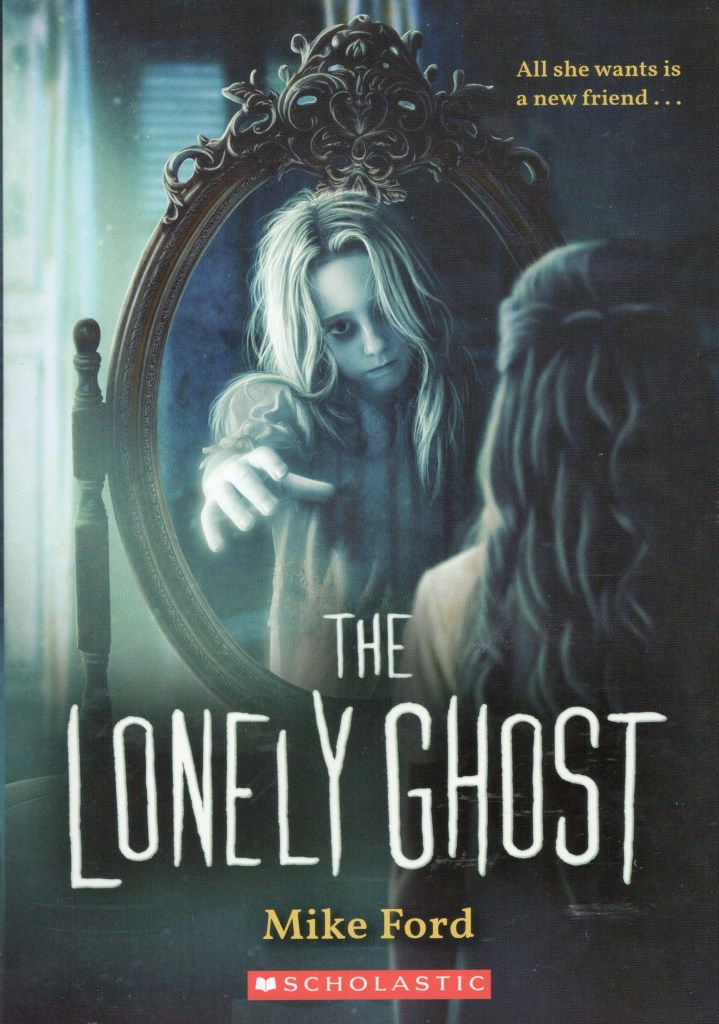
“Ouch!”

Ava peered at her fingertip, where a bead of blood was forming. She stuck her finger in her mouth and glared at the rosebush she had been hacking away at with a pair of clippers. Her blood tasted coppery on her tongue and made her feel sick. She took her finger out and pressed her thumb against the spot where the thorn had pricked her. There was a little sliver of black visible beneath the pale pink skin.

“You need to get that out,” Cassie said. “You could get sporotrichosis.”

“Sporowhat?” Ava asked.

Her sister swept her long, dark hair out of her face and tucked it behind her ear. She, of course, was wearing gloves. “An infection caused by the Sporothrix schenskii,” she said. “It’s a fungus that grows on rose thorns. among other places,” she added when Ava stared at her with one eyebrow cocked. “Named after Benjamin Schenck, the medical student who first discovered it, in 1896.”

“Oh, right,” Ava said. “Benjamin Schenck.” She pointed at Cassie with the clippers. “Why do you know these things?”

“I was reading up about roses,” Cassie said. “Because of the garden and the Blackthorn roses. It just came up.”

“Most girls our age read about pop stars,” Ava teased.

I’ve debated about trying to write for middle-grade readers most of my life. While there were books I enjoyed when I was a kid, as I mentioned before, the stuff classified as “juvenile” in those days rarely depicted kids who were anything like kids I knew in real life; often-times the books always featured kids who never broke rules, never got annoyed or frustrated or angry; paragon children that the authors wished real world children would be more like. (The Hardy Boys and Nancy Drew are perfect examples in their revised versions) I enjoyed the mysteries (and the historicals), but never could really relate much to the characters.

The Lonely Ghost isn’t one of those books, and as I mentioned earlier, had Mike Ford been writing these types of books when I was the right age for them, he would have been one of my favorite writers. Look how great that opening scene is–we meet the two sisters, get a sense of who they are and what their relationship is like predicated on how they speak to each other (sisters who love each other and are fond of each other but also are very different). This book follows the classic horror trope of an unsuspecting family moving into a spooky old house–either inherited, or purchased very cheaply–where they hope to make a new life for themselves, only to find the house isn’t what they expected. What we don’t learn about Ava and Cassie in that opening scene is they are fraternal twins–which is also incredibly important to the story. Ava’s more worldly and outgoing, a soccer star; while her sister is quieter, more studious, and into Drama Club, where Ava also ends up because they didn’t get her application for soccer in on time. But there’s something going on in the house that has to do with the previous owner–who also had a fraternal twin–and strange things start happening; and Cassie also starts acting strangely. Ava and her new friends have to get to the bottom of the haunting of Blackthorn House before it actually harms Cassie.

The book flows really well, and the girls–and their friendships–seem absolutely real. It’s been a minute since I’ve read something middle-grade, and aside from language and situations, the primary difference between it and young adult seems to be lower stakes in every way–no murders or sexual assaults or anything that might be too much for younger readers. It’s easy to get lost in the story because of a strong and compelling authorial voice, and the girls are all distinct enough within who they are and what they look like–which isn’t always the case–and it reads very quickly.

Mike Ford is the middle-grade authorial name for my friend Michael Thomas Ford, by the way, and yes, we’ve been friends for a long time but I also believe he is one of the best gay writers of our time and doesn’t nearly get the recognition or rewards that he deserves. I’m looking forward to reading more of these stories!

And The Walls Came Down

When I was a kid, I lived for the Scholastic Book Fairs. There were always more books I wanted than I can afford (still a problem for me with books to this very day), and it was through them that I discovered my love for mysteries as well as deepened my love of history. I bought anything that was history or mystery; very rarely did a book combine both.

This is part of the reason I was so appalled and disgusted by Scholastic’s cowardly abandonment of its commitment to education and diversity by giving book fairs the options to opt out of carrying books–you know, the ones that teach kids empathy for people who are different from them or show kids that they aren’t alone or books they can see themselves in–because they might upset some bigoted parents in Brotherfuck, Arkansas or Sisterfuck, Tennessee.

When I think about what a difference a book like Annie on My Mind by Nancy Garden or Trying Hard to Hear You by Sandra Scoppetone or Rainbow Boys by Alex Sanchez would have made for young Gregalicious, this Scholastic decision makes me shake with rage. (I have pointed out any number of times that Scholastic also publishes the Bitch-Queen of TERFs, so their cowardice is really no surprise. Can’t piss off their massive cash cow, now can they?)

I was thinking about this as I read Angel Luis Colón’s book, Infested, because it would probably be one of the books shoved into that Diverse Books To Not Be Included box Scholastic uses to warn schools about “subversive” and “dangerous” books. The book, by the way, is not only is superb but something any kid who enjoys horror would love.

However, it centers a main character who is a teenager of Puerto Rican descent, and while it never disparages white people…it doesn’t center them, so I can easily some Daughter of the Confederacy getting her panties into a nasty twist over her precious child reading something that doesn’t uphold White Supremacy. How dare young Hispanic readers have an option to read about a Hispanic teenager’s hero’s journey?

The NERVE of MTV Fear to publish such a book!

I can’t remember a time I hated my mother and my stepfather more than the summer before my senior year.

And it wasn’t the normal kind of Oh man, these people don’t understand me bad Disney movie kind of throwback hate. This was mortal-enemy-level hate. It was deep and pitch-black and enough to make me nearly consider getting into death metal.

While I knew I’d change my mind as the emotions scarred over, the laundry list of offenses was too much to bear.

Let me start by saying how much I really enjoyed this book. The main character, Manny, is very realistic and both relatable and likable. The pacing is excellent, and it builds beautifully to its thrilling climax and resolution. The stakes are high but grounded in reality, and the authorial voice is so strong and memorable that I was sorry to finish and bid Manny and his friends and family farewell.

I was also a little amused because the original opening line of Bury Me in Shadows–back when it was called Ruins still–was My mother ruined my life the summer before my senior year.

Obviously, that changed–a lot changed as Ruins morphed into Bury Me in Shadows–but great minds, right? I’ve admired Angel’s work for a very long time–I really need to go back and finish his backlist–and so was excited to see what he could do with a young adult horror thriller.

Great things, it turns out.

The story focuses on the first person perspective of Manny, a seventeen-year-old with a baby half-sister whose stepfather has taken a job in the Bronx managing an apartment building that’s about to open. Manny doesn’t want to leave San Antonio, but it’s more resentment that he wasn’t consulted (no one wants to change schools before their senior year; I can relate because I changed high schools after my sophomore year) rather than anything else. He doesn’t really have a lot of friends back there, but it was home and familiar to him. He also struggles with identity issues; he’s Puerto Rican, but a blanquito–someone who is Hispanic but white (which could lead into all kinds of sidebar conversation which would be inappropriate for now)–and he doesn’t really speak much Spanish anymore; he did when younger but is losing it as he gets older, which is also concerning to him. He’s angry about the move–they didn’t discuss anything with him, just told him it was happening, and he really didn’t want to leave San Antonio–but once he’s in the Bronx, he begins to see that it’s really not a bad thing to have moved there. There’s a variety of Hispanic/Latinx cultures there he can learn about, and he likes that. There’s also other issues touched on here–gentrification being a major one, and as there are no easy answers to that question in real life, one isn’t provided here but both sides of the issue are addressed and Manny sees the good and bad in both.

But the building has a roach problem–and it’s not just your usual roach problem, either. Something very strange is going on in that building, and Manny isn’t entirely sure if these things are really happening, or if he is losing his mind. If you’re like me and hate insects of all shapes, sizes and varieties, your skin will crawl repeatedly throughout this book. It’s up to Manny and his new friend Sasha to figure out the truth about what is really going on in the building, and as I said, it’s terrific and fast-paced and very hard to stop reading once the story starts going great guns.

Highly recommended–unless you’re truly squeamish and triggered by insects. Colón made my skin crawl–no small feat!

Play with Fire

Well, I met quota again last night which was marvelous. It’s still a bit chilly this morning. By the weekend it should be back into the seventies (it was yesterday as I ran my errands after work; it’s sixty-one this morning but it does feel colder outside of my bed and blankets), as the Alabama and Kansas State fans start arriving for the Sugar Bowl. LSU is also playing on New Years’ Day in the Citrus Bowl against Purdue, which will probably be the only game I actually watch that day.

There’s been a conversation going on over at Book Twitter lately that doesn’t really impact me in any way, but it’s been kind of interesting to follow. The conversation has to do with concerns about what is and isn’t considered y/a fiction as well as what is, or should be, considered age-appropriate reading material for teenagers and pre-teens. It doesn’t impact me because no one considers me a young adult writer, for one thing; despite having written numerous books with younger and/or teenaged characters (Sorceress, Sleeping Angel, Sara, Lake Thirteen, Dark Tide, Bury Me in Shadows, #shedeservedit), most people think of me as a gay mystery writer. Everything published under my own name is a mystery novel of some sort, whether it’s one of the series books or one of the stand-alones. I’ve never really marketed myself as a writer of young adult fiction, really; I shy away from that, I think, because of The Virginia Incident and the subconscious fear that one day that controversy might resurrect itself (which is ludicrous, and I know that; it certainly would have by now and it hasn’t, which further proves my belief that The Incident had nothing to do with me or my writing or my career and everything to do with systemic homophobia and othering used for political gain). It just seems weird to me that in less than five years after that happened–when I was deemed a menace to America’s youth–I could publish books for teenagers without a single whiff of complaint or scandal or even the raise of a single eyebrow.

Interesting, isn’t it? Almost like the whole thing was just more smoke and mirrors whose sole intent was to rile the homophobic base.

I just love that my existence is considered by some as a constant and continued threat to children.

One of the things that has always mystified me over the years is what is and isn’t considered age-appropriate. Intellectually I was far more advanced that most of my classmates (my emotional and personal maturity being an entire other subject–I’d say I am still behind on that score) and I started reading early. The library and the Scholastic Book Fairs were my best friends as a child, and I read everything I could get my hands on. I loved history, from which grew an appreciation and love for historical fiction (which I really don’t read much of anymore, which is odd. I really want to read Hilary Mantel’s Cromwell books…) and of course, my grandmother got me interested in “scary” movies and mysteries.

You’d think I’d be a huge fan of historical mysteries, but I actually don’t read many of them. I did love Elizabeth Peters’ Amelia Peabody series, and I’ve become a huge fan of Laurie R. King’s Mary Russell series…I think exploring historical mysteries might be a project for 2023.

But the point was I was reading books far too advanced for most people my age when I was young. I freely will admit that in my first read of Gone with the Wind at age ten I didn’t know Rhett raped Scarlett the night of Ashley’s surprise birthday party–it wasn’t until a reread in my late teens where I thought oh, this isn’t right–let alone that she enjoyed being overpowered and forced. I also read The Godfather when I was ten, and there was no mistaking anything about Sonny Corleone and Lucy Mancini. He had a cock the size of a horse’s and her vagina was apparently the Lincoln Tunnel. (Although the she felt something burning pass between her thighs still mystifies me to this day.) I also read The Exorcist when I was ten and I was also very well aware of what was going on in the crucifix masturbation scene. As a kid, I was fascinated by these sex scenes (aka “the dirty parts”), and it wasn’t until I was older than I began to question the entire Sonny-Lucy thing (and why it was even in the book in the first place); and while the crucifix scene was gross, shocking and basically icky to me at ten–when I reread the book sometime in the past decade it seemed prurient, to be honest–used primarily for shock value and to get people to talk about it.

So, yes, I started reading books for adults when I was around ten. I also read Antonia Fraser’s Mary Queen of Scots and Robert K. Massie’s Nicholas and Alexandra that same year–I remember doing a book report on Mary Queen of Scots and my teacher not believing that I had read the thick volume; he started opening the book at random and asking me questions–which I was able to answer, so he grudgingly accepted the book report and gave me an A. (Teachers have doubted me all of my life; can’t imagine why I am insecure about my intelligence…)

Over the course of my teens I also read books by Harold Robbins, Sidney Sheldon, Jackie Collins, Jacqueline Susann and Gordon Merrick-every last one of them crammed to the gills with racy sex scenes. I was also reading Stephen King, Irving Wallace, Herman Wouk, Agatha Christie, Ellery Queen, Jean Plaidy, Victoria Holt, Phyllis A. Whitney and any number of authors who wrote for adult audiences not teens. Were there things in the books I didn’t understand? Sure there were. Were there things in those books that were probably inappropriate for teenagers? Undoubtedly. (I’ve also never forgotten the scene in Joyce Haber’s The Users where a Liza Minnelli-based character fucked herself with her own Oscar; some images are simply too vivid to forget methinks.)

This is one reason I shy away from calling some of my books with teenagers “young adult” novels. Megan Abbott’s Dare Me centered teenagers, but I would never consider Dare Me a young adult novel. I was thinking about this the other night while watching Sex Lives of College Girls (it’s hilarious, you really should be watching); can I authentically write about teenagers anymore? Have I ever been able to? I don’t speak their language anymore, and I haven’t been one in over forty years (!!!!); I don’t know the technology they use or their slang or what they watch or listen to. I don’t know what today’s teens think about virginity and sexuality these days; do the tired old tropes still exist? Does that whole “good girl/bad girl” dynamic still exist, or are today’s teenaged girls a bit more sophisticated than they were when I was in high school when it comes to sex and sexuality? (Contrasting two high school shows with queer content makes you wonder–there’s the jaded cynicism of the rich kids in Elite vs the wholesome purity and innocence and sweetness of Heartstopper, which also had me wondering–although I feel certain Heartstopper might be closer to reality than Elite…or that’s just my hope?) Of course I have other ideas for more books about young people–I have another in-progress one that’s been sitting around for a very long time that I need to repurpose–and I’d kind of like to write more at some point, but I don’t know. My suburban 70’s serial killer preying on teenaged boys book would be told from the perspective of a twelve year old, but it would definitely not be a young adult novel–but will probably be marketed and sold as one.

And on that note I am heading into the spice mines on my last day in the office for 2022. Check back in with you later, Constant Reader.

Where Do I Go From Here

The earliest years of my childhood–with a few minor exceptions–are lost in the foggy distant parts of my memories, unable to be summoned at will but sometimes resurfacing at the oddest moments. I don’t, for example, really remember much of how I started reading. I remember being fascinated by dinosaurs and getting dinosaur books from the library; I remember Scholastic Books Fairs and going to the library, both the Chicago Public Library’s nearest branch as well as the one inside my elementary school. I remember, vaguely, comic books: Richie Rich, Caspar, Wendy, Dot, Little Lotta and anything Disney before moving on to the world of Archie and Millie the Model before discovering, and loving, the world of DC super hero comics accidentally. Comic books were only a dime or twelve cents when I was a kid with an allowance of a dollar per week, so I could get quite a few comics with my allowance every week rather than trying to save it for another week so I could spend $1.50 on a Hardy Boys or Nancy Drew (by the time I discovered them, of course). I would not, nor would I ever, consider myself to be an expert on comics; I was a fan, and not a rabid one, either. I never learned the names of writers or artists (I do, however, remember Denny O’Neil from the 1970’s) until one of my returns to comics (I often went years without feeding my super-hero addiction); the 1980’s return got me learning names like John Byrne and Tim McFarlane. It’s always been a dream–one I don’t return to very often–to actually write for a comic title (I really really really want to write for Nightwing) someday but the older I get the less likely that item will be scratched off my lengthy bucket list (someday I might blog about the bucket-list things I am slowly becoming aware that I will never ever be able to accomplish).

Naturally, I’ve been looking forward to reading Alex Segura’s Secret Identity ever since the title was announced: comic books? The 1970’s? A crime story? COUNT ME IN.

And I am pleased to report it did not disappoint in the slightest.

Her eyes fluttered open at the sound.

Carmen Valdez rolled out of her small twin bed with ease, the muscle memory kicking in–even now, in the middle of the night. The shrill scream was familiar, too.

She tiptoed across her small bedroom, avoiding the toys strewn on the floor, as she made her way to the door.

Another scream.

Mami.

The screaming and arguing were routine. Carmen found that she’d become numb to it. She could almost predict it, in the hours before bed. If Mami and Papi were drinking–drinking that stuff–it was a bad sign. It meant they were changing. Becoming meaner. Darker. Something else. She would rush through her routine, rush to get to the relative safety of her room, her closed door, her darkness.

But she also knew the darkness could only shield her from so much. It hid her, but it didn’t silence then. She knew the screams would come. Carmen would just pray she could sleep through them.

I turned fourteen in 1975, and the entire world seemed to be, I don’t know, in some kind of transition that most people in my sheltered world believed would wind up not being good. We were already looking back; American Graffiti had struck gold with a nostalgia craze driven by the memory of “how much simpler (better) things had been back then” (despite the fact American Graffiti is actually a really bleak, dark movie) that was only further amplified by a resurfacing of the Beach Boys and the airing of Happy Days. My high school had “sock hops” (of all things) and my sister played the double album of the Beach Boys’ Endless Summer endlessly. It was easy, of course, to look at the sanitized world of television shows like Happy Days and repeats of Leave it to Beaver and wistfully wish for a simpler time…particularly when impressions we were getting of New York City wasn’t the pristine, clean city of Doris Day movies like Pillow Talk and Lover Come Back but the dirty, gritty noir sensibilities of movies like The French Connection, Shaft, and Serpico. I was already a reader, reading fiction for adults but still occasionally grabbing a comic book or two from the spinner rack at the Jewel Osco, or Mad from the magazine rck at the 7/11 on Briarcliff Road in Bolingbrook, the extremely white suburb my family had escaped to from Chicago and its desegregated schools.

It was also a weird time for comics, to be honest.

So, revisiting that time in Alex Segura’s new novel, Secret Identity, was interesting.

Alex’ book focuses on Carmen Valdez, a young Cuban-American woman living in New York and working as secretary to the publisher at Triumph Comics, a company much lower on the food chain than either Marvel or DC–the ones everyone knows–and hoping to get her own break into the business as a writer. She learned to speak English reading comics (mostly Archie and Betty and Veronica), but eventually moved on to caped crusaders. She gets an opportunity when another writer at Triumph asks for her help in putting together a new hero, the Legendary Lynx–even as a more experienced person in the business tells her not to trust Harvey Stern, the writer. But with all the hope and idealism that a hardscrabble life in New York with a dead-end job in a dying comics company has somehow not stomped out of her yet (ah, to be in my twenties again…), she takes the plunge and collaborates with Harvey–who winds up dead, shot in the forehead. No one knows the new comic Harvey had delivered six scripts for (under only his name) had any input from Carmen–who did the yeoman’s share of the work. Now she has to figure out how to reclaim her character and her work. To do so, she has to find out more about who Harvey was…and that means getting mixed up in a police investigation and eventually into the crosshairs of the killer.

I also appreciated the fact that “stolen work/characters” was the driving force in this book; comic book history is riddled with these kinds of situations, and it was fun seeing it from an insider’s point of view.

The story’s greatest strength is the character of Carmen. Within a few chapters of the story I felt like she was someone I actually knew, had talked to, maybe even had wine or drinks with; she felt like a friend…definitely someone I’d want to know in the real world. Another strength is Segura’s knowledge of the world behind the scenes of a comic book company and the industry itself. (I couldn’t help but grin periodically whenever someone referred to comics as a dying form; the 70’s slump was followed by a renaissance no one could have seen coming, and they are still going strong today.) Carmen’s relationships with the people in her orbit are also realistic and strongly drawn.

An added bonus inside the book are actual pages of art from The Legendary Lynx–which are strong enough to make a good comic book on their own (something we might be looking for in the future, Alex?).

Quickly paced with strong, believable characters, this was a terrific read. Thanks, Alex!